
 100% FREE ACCESS
10th Standard Syllabus & Materials
10th Standard
TN 10th English Prose - 4 - The Attic Important Questions And Answers Study Material - QB365 Set A
NEW10th Standard
TN 10th English Supplementary - 3 - The Story of Mulan Important Questions And Answers Study Material - QB365 Set A
NEW10th Standard
TN 10th English Poem - 3 - I am Every Woman Important Questions And Answers Study Material - QB365 Set A
NEW10th Standard
TN 10th English Prose - 3 - Empowered Women Navigating The World Important Questions And Answers Study Material - QB365 Set A
NEW10th Standard
TN 10th English Supplementary - 2 - Zigzag Important Questions And Answers Study Material - QB365 Set A
NEW10th Standard
TN 10th English Poem - 2 - The Grumble Family Important Questions And Answers Study Material - QB365 Set A

Published on: 13/05/2022
QB365 provides detailed and simple solution for every
Creative Questions in class 10 Science Subject. It will helps to get more idea about question pattern in everyCreative questions with solution.
Download Tamil Nadu 10th Standard Science question papers, model tests, one-mark questions, important questions, and public exam papers in PDF format. Free study materials and answer keys for TN State Board students.
Questions + Answers key
Take MCQ Science Test1.
Explain the laws of reflection.
2.
Explain Reflection of sound.
3.
Explain Wave Velocity.
4.
Write the categories of sound waves based on their frequencies.
5.
Explain Longitudinal waves.
1.
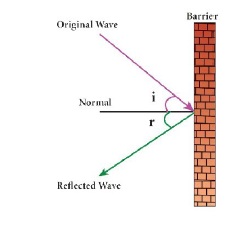
(i) The following two laws of reflection are applicable to sound waves as well. The incident wave a, the normal to the reflecting surface and the reflected wave at the point of incidence lie in the same plane.
(ii) \(\bar{\mathcal{w}}\) The angle of incidence \(\angle \)i is equal to the angle of reflection \(\angle \)r.
(iii) The sound waves that travel towards the reflecting surface are called the incident waves.
(iv) The sound waves bouncing back from the reflecting surface are called reflected waves.
(v) For all practical purposes, the point of incidence and the point of reflection is the same point on the reflecting surface.
(vi) A perpendicular line drawn at the point of incidence is called the normal. The angle which the incident sound wave makes with the normal is called the angle of incidence, ‘i’.
(vii) The angle which the reflected wave makes with the normal is called the angle of reflection, 'r’.
2.
a) When sound waves travel in a given medium and strike the surface of another medium, they can be bounced back into the first medium. This phenomenon is known as reflection.
b) In simple the reflection and refraction of sound is actually similar to the reflection of light.
c) Thus, the bouncing of sound waves from the interface between two media is termed as the reflection of sound.
d) The waves that strike the interface are termed as the incident wave and the waves that bounce back are termed as the reflected waves.
3.
Wave velocity: The velocity with which the wave travels through the medium is called wave velocity. In other words, the distance travelled by a sound wave in unit time is called the velocity of a sound wave.
\(\therefore\) Velocity = Distance / Time taken
If the distance travelled by one wave is taken as one wavelength (\(\lambda\)) and, the time taken for this propagation is one time period (T), then, the expression for velocity can be written as;
V = \(\lambda\) / T.
Therefore, velocity can be defined as the distance travelled per second by a sound wave. Since, Frequency (n) =1/T, equation can be written as;
V = n\(\lambda\).
Velocity of a sound wave is maximum in solids because they are more elastic in nature than liquids and gases. Since, gases are least elastic in nature, the velocity of sound is the least in a gaseous medium.
So, vS > vL > vG.
4.
i) Audible waves : These are sound waves with a frequency ranging between 20 Hz and 20,000 Hz. These are generated by vibrating bodies such as vocal cords, stretched strings etc.
ii) Infrasonic waves : These are sound waves with a frequency below 20 Hz that cannot be heard by the human ear. e.g., waves produced during earth quake, ocean waves, sound produced by whales, etc.
iii)Ultrasonic waves : These are sound waves with a frequency greater than 20 KHz, Human ear cannot detect these waves, but certain creatures like mosquito, dogs, bats, dolphins can detect these waves. e.g., waves produced by bats.
5.
i) Sound waves are longitudinal waves that can travel through any medium (solids, liquids, gases) with a speed that depends on the properties of the medium.
ii) As sound travels through a medium, the particles of the medium vibrate along the direction of propagation of the wave.
iii) This displacement involves the longitudinal displacements of the individual molecules from their mean positions.
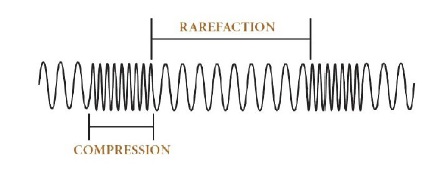
iv) This results in a series of high and low pressure regions called compressions and rarefactions.

10th Standard Syllabus & Materials
10th Standard
TN 10th English Prose - 2 - The Night the Ghost Got in Important Questions And Answers Study Material - QB365 Set A
NEW10th Standard
TN 10th English Supplementary - 1 - The Tempest Important Questions And Answers Study Material - QB365 Set A
NEW10th Standard
TN 10th English Poem - 1 - Life Important Questions And Answers Study Material - QB365 Set A
NEW10th Standard
TN 10th English Prose - 1 - His First Flight Important Questions And Answers Study Material - QB365 Set A



Tamilnadu Stateboard 10th Standard Subjects
Tamilnadu Stateboard Standards





