
 100% FREE ACCESS
10th Standard Syllabus & Materials
10th Standard
TN 10th English Prose - 4 - The Attic Important Questions And Answers Study Material - QB365 Set A
NEW10th Standard
TN 10th English Supplementary - 3 - The Story of Mulan Important Questions And Answers Study Material - QB365 Set A
NEW10th Standard
TN 10th English Poem - 3 - I am Every Woman Important Questions And Answers Study Material - QB365 Set A
NEW10th Standard
TN 10th English Prose - 3 - Empowered Women Navigating The World Important Questions And Answers Study Material - QB365 Set A
NEW10th Standard
TN 10th English Supplementary - 2 - Zigzag Important Questions And Answers Study Material - QB365 Set A
NEW10th Standard
TN 10th English Poem - 2 - The Grumble Family Important Questions And Answers Study Material - QB365 Set A

Published on: 13/05/2022
QB365 provides detailed and simple solution for every Book back Questions in class 10 Science Subject. It will helps to get more idea about question pattern in every book back questions with solution.
latest Book back QuestionsDownload Tamil Nadu 10th Standard Science question papers, model tests, one-mark questions, important questions, and public exam papers in PDF format. Free study materials and answer keys for TN State Board students.
Questions + Answers key
Take MCQ Science Test1.
What is bolting? How can it be induced artificially?
2.
Why is vegetative propagation practiced for growing some type of plants?
3.
Trace the pathway followed by water molecules from the time it enters a plant root to the time it escapes into the atmosphere from the leaf.
4.
List out the parasitic adaptations in leech.
5.
Write a short note on mesophyll.
6.
A cobalt specimen emits induced radiation of 75.6 millicurie per second. Convert this disintegration in to becquerel (one curie = 3.7 × 10¹⁰ Bq).
7.
What is the role of the earth wire in domestic circuits?
8.
Why does an empty vessel produce more sound than a filled one?
9.
Find the final temperature of a copper rod. Whose area of cross section changes from 10 m2 to 11 m2 due to heating. The copper rod is initially kept at 90 K. (Coefficient of superficial expansion is 0.0021 /K)
10.
A ball of mass 1 kg moving with a speed of 10 ms-1 rebounds after a perfect elastic collision with the floor. Calculate the change in linear momentum of the ball.
11.
Write notes on various factors affecting solubility.
12.
Explain the types of double displacement reactions with examples.
13.
a) State the reason for addition of caustic alkali to bauxite ore during purification of bauxite.
b) Along with cryolite and alumina, another substance is added to the electrolyte mixture. Name the substance and give one reason for the addition
14.
Arrive at, systematically, the IUPAC name of the compound: CH3–CH2–CH2–OH
15.
Calculate the number of water molecule present in one drop of water which weighs 0.18 g.
1.
(i) Bolting is production of a flowering stem in plants.
(ii) Treatment of rosette plants with gibberellin induces sudden shoot elongation followed by flowering. This is called bolting.
2.
Vegetative propagation has only mitotic division, no gametic fusion and daughter plants are genetically similar to the parent plant. So some plants grow by propagation practices.
3.
(i) Root pressure → Capillary action → Adhesion→ Cohesion → Transpiration pull → Transpiration.
(ii) Once the water enters the root hairs, the concentration of water molecules in the root hair cells become more than that of the cortex.
(iii) Thus the water from the root hair moves to the cortical cells by osmosis and then reaches the xylem.
(iv) From there the water is transported to the stem and the leaves.
(v) There are two pathways by which the water absorbed by the root hairs enters the deeper layers. Apoplast pathway and Symplast pathway.
(vi) Apoplast pathway does not involve crossing the cell membrane and the movement is dependent on the gradient.
(vii) In Symplast pathway, water enters the cell through the cell membrane.
(viii) Transpiration is the evaporation of water in plants through stomata in the leaves.
(ix) Water evaporates from mesophyll cells of leaves through stomata.
4.
Leech is a parasite and sucks the blood of vertebrates and show adaptations.
(i) Suckers are present in the anterior and posterior ends of the body, by which the animal attaches itself to the body of the host.
(ii) The three jaws inside the mouth causes a triradiate or Y shaped wound in the skin of the host.
(iii) Saliva contains a protein called hirudin which prevents the blood clotting. Thus continuous supply of blood is maintained.
(iv) Blood is stored in the crop. It gives nourishment to the leech for several months. Hence, there is no digestive juices and enzyme.
5.
(i) The tissue present between the upper and the lower epidermis is called mesophyll.
(ii) Mesophyll cells contain chloroplasts.
(iii) In dicot leaf, the mesophyll is differentiated into palisade parenchyma and spongy parenchyma.
(iv) Palisade cells do not have intercellular spaces and take active part in photosynthesis.
(v) Whereas, spongy parenchyma cells have large intercellular spaces and helps in gaseous exchange.
6.
1 curie - 3.7 x 10¹⁰ Bq
1 milli curie = 3.7 x 1010 x 10-3 Bq
75.6 milli curie = 75.6 x 3.7 x 1010-3 Bq
= 279.72 x 10⁷ Bq
75.6 millicurie = 2.80 x 10⁹ Bq
7.
(i) The earth wire provides a low resistance path to the electric current.
(ii) The earth wire sends the current from the body of the appliance to the Earth, whenever a live wire accidentally touches the body of metallic electric appliance.
(iii) Thus, the earth wire serves as a protective conductor, which saves us from electric shock.
8.
(i) When an empty vessel is struck, the air molecules are set in vibration and when filled vessel is struck the liquid molecules are set in vibration.
(ii) Since the amplitude of vibration of air molecules is greater than liquid molecules, empty vessel produces louder sound than the filled vessel.
9.
Area of copper rod, Ao = 10 m2
Changes of Area of cross section,
Initial temperature \(\Delta \mathrm{A} =11 -10 =1 \mathrm{~m}^{2} \)
\(\mathrm{~T}_{1} =90 \mathrm{~K} \)
\(a_{\mathrm{A}} =0.0021 / \mathrm{K} \)
\(\mathrm{T}_{2} =? \)
\(\frac{\Delta A}{A_{0}} =a_{\mathrm{A}} \Delta \mathrm{T} \)
\(\frac{1 }{10 } =0.0021\left[\mathrm{~T}_{2}-90\right] \)
\(0.1 =0.0021\left[\mathrm{~T}_{2}-90\right]=\frac{0.1}{0.0021}+90=\mathrm{T}_{2} \)
\(\mathrm{~T}_{2} =137.61 \mathrm{~K}\)
So the final temperature of a copper rod is 137.61 K
10.
Given \(\mathrm{m}=1 \mathrm{~kg}, \quad \mathrm{v}=10 \mathrm{~m} \mathrm{~s}^{-1}\)
When a ball bounces back with the same speed, the momentum changes from mv to -mv. So, the change in momentum is -2 mv.
Δp = mv - mu
= -mv - mv
\(=-2 \mathrm{mv}=-2 \times 1 \times 10 \) \([Here \ mu = mv \\ mv = -mv]\)
\(\therefore \Delta P=-20 \mathrm{~kg} \mathrm{~m} \mathrm{~s}^{-1}\)
11.
There are three main factors which govern the solubility of a solute. They are:
a) Nature of the solute and solvent
b) Temperature
c) Pressure
a) Nature of the solute and solvent:
(i) The nature of the solute and solvent plays an important role in solubility.
(ii) Although water dissolves an enormous variety of substances, both ionic and covalent, it does not dissolve everything.
(iii) The phrase that scientists often use when predicting solubility is "like dissolves like".
(iv) The expression means that dissolving occurs when similarities exist between the solvent and the solute.
(v) For example: Common salt is a polar compound 4 and dissolves readily in polar solvent like water.
(vi) Non-polar compounds are soluble in non-polar solvents. For example: Fat dissolved in ether.
(vii) But non-polar compounds, do not dissolve in polar solvents; polar compounds do not dissolve in non-polar solvents.
b) Effect of Temperature:
Solubility of Solids in Liquid:
(i) Generally, solubility of a solid solute in a liquid solvent increases with increase in temperature.
(ii) For example, a greater amount of sugar will dissolve in warm water than in cold water.
(iii) In endothermic process, solubility increases with increase in temperature.
(iv) In exothermic process, solubility decreases with increase in temperature.
Solubility of Gases in liquid:
(i) Solubility of gases in liquid decrease with increase in temperature.
(ii) Generally, water contains dissolved oxygen.
(iii) When water is boiled, the solubility of oxygen in water decreases, so oxygen escapes in the form of bubbles.
(iv) Aquatic animals live more in cold regions because, more amount of dissolved oxygen is present in the water of cold regions.
(v) This shows that the solubility of oxygen in water is more at low temperatures.
c) Effect of Pressure:
(i) Effect of pressure is observed only in the case of solubility of a gas in a liquid.
(ii) When the pressure is increased, the solubility of a gas in liquid increases.
(iii) The common examples for solubility of gases in liquids are carbonated beverages, i.e. soft drinks, household cleaners containing aqueous solution of ammonia, formalin aqueous solution of formaldehyde, etc.
12.
When two compounds react, if their ions are interchanged, then the reaction is called double displacement reaction.
There are major classes of double displacement reactions. They are:
(i) Precipitation Reactions
(ii) Neutralization Reactions
(i) Precipitation Reactions:
a) When aqueous solutions of two compounds are mixed, if they react to form an insoluble compound and a soluble compound, then it is called precipitation reaction.

b) When the clear aqueous solutions of potassium iodide and lead (II) nitrate are mixed, a double displacement reaction takes place between them.
Pb(NO3)2(aq)+ 2KI(aq) ⟶ PbI2(S) + 2KNO3(aq)
PbI2 form a yellow precipitate
(ii) Neutralization Reactions:
(i) It is a type of displacement reaction in which the acid reacts with the base to form a salt and water.
(ii) It is called 'neutralization reaction' as both acid and base neutralize each other.
Acid + Base ⟶ Salt + Water
(iii) Reaction of sodium hydroxide with hydrochloric acid is a typical neutralization reaction.
(iv) Here, sodium displaces hydrogen from hydrochloric acid forming sodium chloride, a neutral soluble salt.
\(\mathrm{NaOH}_{(\mathrm{aq})}+\mathrm{HCl}_{(\mathrm{aq})} \rightarrow \mathrm{NaCl}_{(\mathrm{aq})}+\mathrm{H}_{2} \mathrm{O}_{(\mathrm{l})}\)
(v) When ammonium hydroxide reacts with nitric acid it forms ammonium nitrate and water.
\(\mathrm{HNO_3}_{(\mathrm{aq})}+\mathrm{NH_4OH}_{(\mathrm{aq})} \rightarrow \mathrm{NH_4NO_3}_{(\mathrm{aq})}+\mathrm{H}_{2} \mathrm{O}_{(\mathrm{l})}\)
13.
a) Addition of caustic alkali to bauxite ore:
(i) Bauxite ore is finely ground and heated under pressure with a solution of concentrated caustic soda solution at 150oC to obtain sodium meta aluminate.
(ii) Al2O3 + 2 NaOH → 2 NaAlO2 + H2O
(iii) On diluting sodium meta aluminate with water, a precipitate of aluminium hydroxide is formed.
(iv) NaAlO2 + 2 H2O → Al(OH)3 + NaOH
(v) The precipitate is filtered, washed, dried and ignited at 1000oC to get alumina.
(iv) \(2 \mathrm{Al}(\mathrm{OH})_{3} \stackrel{1000^{\circ} \mathrm{C}}{\longrightarrow} \mathrm{Al}_{2} \mathrm{O}_{3}+3 \mathrm{H}_{2} \mathrm{O}\)
b) (i) Electrolyte : Pure alumina + molten cryolite +fluorspar
(ii) Fluorspar is added to lowers the fusion temperature of electrolyte.
14.
Step 1: The parent chain consists of 3 carbon atoms. The root word is 'Prop'.
Step 2: There are single bonds between the carbon atoms of the chain. So, the primary suffix is 'ane'
Step 3: Since, the compound contains - OH group, it is an alcohol. The carbon chain is numbered from the end which is closest to -OH group. (Rule 3)
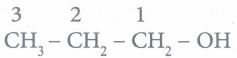
Step 4: The locant number of –OH group is 1 and thus the secondary suffix is ‘1-ol’.
The name of the compound is Prop + ane + (1-ol) = Propan-1-ol
Note: Terminal ‘e’ of ‘ane’ is removed as per Rule 5
15.
Molecular mass of water (H2O) = H2O = H x 2 + O x 1
= 1 x 2 + 16 x 1
= 2 + 16
=18
No of moles = \(\frac{Given \ Mass}{Molecular \ Mass}\)
Number of moles = \(\frac{0.18}{8}= \frac{0.18 \times 100}{18 \times 100}=0.01\)
No of moles = \(\frac{Number\ of \ molecules}{Avogadro's \ number}\)
Number of molecules = No of moles x Avogadro's number
= 0.01 x 6.023 x 1023
= 0.06023 x 10²³
Number of molecules in 0.18 g of water = 6.023 x 10²¹
Alternative method
Gram molecular mass of water = H2O
= 1 x 2 + 16 x 1 = 2 + 16
= 18 g
Number of molecules \(=\frac{\text { Avogadro's number } \times \text { given mass }}{\text { Gram molecular mass }}\)
Number of molecules \(=\frac{6.023 \times 10^{23} \times 0.18}{18}\)
= \(6.023 \times 10^{23} \times 0.01\)
Number of molecules of 0.18 g of water = 6.023 x 10²¹ molecules.

10th Standard Syllabus & Materials
10th Standard
TN 10th English Prose - 2 - The Night the Ghost Got in Important Questions And Answers Study Material - QB365 Set A
NEW10th Standard
TN 10th English Supplementary - 1 - The Tempest Important Questions And Answers Study Material - QB365 Set A
NEW10th Standard
TN 10th English Poem - 1 - Life Important Questions And Answers Study Material - QB365 Set A
NEW10th Standard
TN 10th English Prose - 1 - His First Flight Important Questions And Answers Study Material - QB365 Set A



Tamilnadu Stateboard 10th Standard Subjects
Tamilnadu Stateboard Standards





