
 100% FREE ACCESS
10th Standard Syllabus & Materials
10th Standard
TN 10th English Prose - 4 - The Attic Important Questions And Answers Study Material - QB365 Set A
NEW10th Standard
TN 10th English Supplementary - 3 - The Story of Mulan Important Questions And Answers Study Material - QB365 Set A
NEW10th Standard
TN 10th English Poem - 3 - I am Every Woman Important Questions And Answers Study Material - QB365 Set A
NEW10th Standard
TN 10th English Prose - 3 - Empowered Women Navigating The World Important Questions And Answers Study Material - QB365 Set A
NEW10th Standard
TN 10th English Supplementary - 2 - Zigzag Important Questions And Answers Study Material - QB365 Set A
NEW10th Standard
TN 10th English Poem - 2 - The Grumble Family Important Questions And Answers Study Material - QB365 Set A

Published on: 13/05/2022
QB365 provides detailed and simple solution for every Book back Questions in class 10 Science Subject. It will helps to get more idea about question pattern in every book back questions with solution.
latest Book back QuestionsDownload Tamil Nadu 10th Standard Science question papers, model tests, one-mark questions, important questions, and public exam papers in PDF format. Free study materials and answer keys for TN State Board students.
Questions + Answers key
Take MCQ Science Test1.
Write the physiological effects of gibberellins.
2.
What are the phases of menstrual cycle? Indicate the changes in the ovary and uterus.
3.
Illustrate the structure and functions of brain.
4.
Why are leucocytes classified as granulocytes and agranulocytes? Name each cell and mention its functions.
5.
6.
Describe and name three stages of cellular respiration that aerobic organisms use to obtain energy from glucose.
7.
Compare the properties of alpha, beta and gamma radiations.
8.
What is mean by reflection of sound? Explain:
a) reflection at the boundary of a rarer medium
b) reflection at the boundary of a denser medium
c) Reflection at curved surfaces
9.
10.
State Newton’s laws of motion?
11.
An object of height 3cm is placed at 10cm from a concave lens of focal length 15cm. Find the size of the image.
12.
Explain the experiment of measuring the real and apparent expansion of a liquid with a neat diagram.
13.
'A' is a blue coloured crystalline salt. On heating it loses blue colour and to give 'B'. When water is added, 'B' gives back to 'A'. Identify A and B, write the equation.
14.
Name the acid that renders aluminium passive. Why?
15.
The molecular formula of an alcohol is C4H10O. The locant number of its –OH group is 2.
(i) Draw its structural formula.
(ii) Give its IUPAC name.
(iii) Is it saturated or unsaturated?
1.
(i) Application of gibberellins on plants stimulate extraordinary elongation of internode. E.g: Corn and Pea.
(ii) Treatment of rosette plants with gibberellin induces sudden shoot elongation followed by flowering. This is called bolting.
(iii) Gibberellins promote the production of male flowers in monoecious plants (Cucurbits).
(iv) Gibberellins break dormancy of Potato tubers.
(v) Gibberellins are efficient than auxins in inducing the formation of seedless fruit - Parthenocarpic fruits (Development of fruits without fertilization) E.g: Tomato.
2.
The reproductive period is marked by characteristic events repeated almost every month in physiologically normal woman (28 days with minor variation) in the form of a menstrual flow
The menstrual cycle consists of 4 phases:
(i) Menstrual or Destructive phase
(ii) Follicular or Proliferative Phase
(iii) Ovulatory Phase
(iv) Luteal or Secretory Phase
|
Phase |
Days |
Changes in Ovary |
Changes in Uterus |
Hormonal Changes |
|---|---|---|---|---|
| Menstrual phase | 4-5 days | Development of primary follicles | Breakdown of uterine endometrial lining leads to bleeding | Decrease in progesterone and oestrogen |
| Follicular phase | 6th -13thday | Primary follicles grow to become a fully mature Graafian follicle | Endometrium regenerates through proliferation | FSH and oestrogen increase |
| Ovulatory phase | 14th day | The Graafian follicle ruptures, and releases the ovum( egg) | Increase in endometrial thickness | LH peak |
| Luteal phase | 15th-28th day | Emptied Graafian follicle develops into corpus luteum | Endometrium is prepared for implantation if fertilization of egg takes place. If fertilization does not occur corpus luteum degenerates, uterine wall ruptures, bleeding starts and unfertilized egg is expelled | LH and FSH decrease Corpus luteum produces progesterone and its level increases followed by a decline if menstrual bleeding occurs. |
3.
A human brain is formed of three main parts:
(a) forebrain
(b) midbrain and
(c) hindbrain.
(1) Forebrain:
A. Cerebrum(cortex)
B. Diencephalon
i) Thalamus ii) Hypothalamus
(2) Midbrain
(3) Hindbrain:
A. Cerebellum
B. Pons
C. Medulla Oblongata
| Part of brain | Structure | Description | Functions |
| Forebrain | Cerebrum (cortex) |
(i) It is the largest portion forming nearly two-third of the brain. (ii) It is divided into 2 halves (Right and Left hemispheres) interconnected by Corpus collosum. (iii) The outer portion is called cortex (grey matter) and inner portion is called medulla (white matter) (iv) The cortex is extremely folder forming elevations (gyri) and abd depressions (sulci) in between. (v) Each cerebral hemisphere is divided into frontal lobe, parietal lobe, temporal lobe and occipital lobe. |
(i) Sensory perception (ii) Control of voluntary functions (iii) Language (iv) Thinking (intelligence) (v) Memory (vi) Decision making (vii) Creativity |
| Thalamus | It is present in cerebral medulla is a major conducting centre for sensory and motor signalling. | Acts as a relay centre | |
| Hypothalamus | (i) It lies at the base of the thalamus (ii) It is an important link between nervous system and endocrine glands |
(i) Controls involuntary functions (ii) Temperature control (iii) Thirst, hunger control (iv) Urinationi (v) Controls the secretion of hormones from anterior pituitary gland |
|
| Midbrain | Corpora quadrigemina |
(i) It is located between thalamus and hindbrain (ii) It is made of four rounded bodies |
Controls visual and auditory (hearing) reflexes |
| Hindbrain | Cerebellum | It is seçond largest part of the brain formed of two large sized hemispheres and middle vermis |
(i) Coordinates voluntary movements (ii) Maintains body balance |
| Pons | (i) 'Pons' a latin word, meaning bridge (ii) It is a bridge of nerve fibre that connects the lobes of cerebellum. |
(i) Relays signals between the cerebellum, spinal cord, midbrain and cerebrum (ii) Controls respiration and sleep cycle. |
|
| Medulla Oblongata | It is the posterior most part of the brain that connects spinal cord and various parts of brain. |
(i) Has cardiac centre, respiratory centres, vasomotor centres and digestive centre (ii) Also regulates vomiting and salivation |
4.
WBC's are colourless and nucleated cells. Granulocytes contain granules in their cytoplasm. Agranulocytes do not contain granules in their cytoplasm, So they are classified as Granulocytes and Agranulocytes.
Granulocytes: Granulocytes contain granules in their cytoplasm. They are of three types.
(i) Neutrophils:
i) They are large in size and have a 2-7 lobed nucleus.
ii) These corpuscles form 60% - 65% of the total leucocytes.
iii) Their number are increased during infection and inflammation.
(ii) Eosinophils:
i) Eosinophils has a bilobed nucleus and constitute 2% - 3% of the total leucocytes.
ii) Their number increases during conditions of allergy and parasitic infections.
iii) It brings about detoxification of toxins.
(iii) Basophils:
i) Basophils have lobed nucleus.
ii) They form 0.5% - 1.0 % of the total leucocytes.
iii) They release chemicals during the process of inflammation.
(iv) Agranulocytes:
i) Granules are found in the cytoplasm of these cells.
ii) The Agranulocytes are of two types:
(i) Lymphocytes:
i) These are about 20 - 25% of the total leucocytes.
ii) They produce antibodies during bacterial and viral infections.
(ii) Monocytes:
i) They are the largest of the leucocytes and are amoeboid in shape.
ii) These cells form 5 - 6% of the total leucocytes.
iii) They are phagocytic and can engulf bacteria.
5.
6.
The 3 stages of erobic respiration are Glycolysis, Krebs cycle and Electron Transport Chain.
(a) Glycolysis (Glucose splitting):
(i) Glycolysis takes place in the cytoplasm of the cell.
(ii) It is the breakdown of one molecule of glucose (6 carbon) into two molecules of Pyruvic acid (3 carbon).
(b) Krebs Cycle:
(i) This cycle occurs in mitochondrial matrix.
(ii) At the end of glycolysis, 2 molecules of pyruvic acid enter into mitochondria.
(iii) The oxidation of pyruvic acid into CO2 and water takes place.
(iv) It is also called Tricarboxylic Acid Cycle (TAC).
(c) Electron Transport Chain:
(i) NADH2 and FADH2 molecules formed during glycolysis and Krebs cycle are oxidised to NAD+ and FAD+ to release the energy through electrons.
(ii) These electrons move through the electron transport chain and release energy.
(iii) This energy is used by ADP to synthesize ATP.
(iv) This is called oxidative phosphorylation.
(v) In this process O2 gets reduced to water.
(vi) \(\mathrm{C}_{6} \mathrm{H}_{12} \mathrm{O}_{6}+6 \mathrm{O}_{2} \rightarrow 6 \mathrm{CO}_{2}+6 \mathrm{H}_{2} \mathrm{O}+\mathrm{ATP}\)
7.
|
Properties |
\(\alpha \) - rays |
\(\beta \) - rays |
\(\gamma \) - rays |
|---|---|---|---|
| What are they? | Helium nucleus (2He4) consisting of two protons and two neutrons | They are electrons. (-1e0), basic elementary particles of all atoms. |
They are electromagnetic waves consisting of photons. |
| Charge | Positively charged particles. Charge of each alpha particle = +2e | Negatively charged particles. Charge of each beta particle=-e | Neutral particles Charge of each gamma particle = zero |
| Ionizing power | 100 times greater than \(\beta \) rays and 10,000 times greater than \(\gamma \)rays | Comparatively low | Very less ionization power |
| Penetrating power | Low penetrating power (even stopped by a thick paper) |
Penetrating power is greater than that of α rays. They can penetrate through the thin metal foil. | They have a very high penetrating power greater than that of \(\beta \) rays. They can penetrate through thick metal blocks. |
| Effect of electric and magnetic field | Deflected by both the fields. (in accordance with Fleming's left-hand rule) | Deflected by both the fields but the direction of deflection is opposite to alpha rays. (in accordance with Fleming's left-hand rule) | They are not deflected by both the fields |
| Speed | Their speed ranges from 1/10 to 1/20 times the speed of light. | Their speed can go up to 9/10 times the speed of light. | They travel at the speed of light. |
8.
Reflection of sound waves:
(i) When sound waves travel in a given medium, and strikes the surface of another medium, they can bounce back into the first medium.
(ii) This phenomenon is known as reflection.
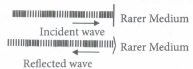
a) Reflection at the boundary of a rarer medium:
(i) Consider a wave travelling in a solid medium striking on the interface between the solid and the air.
(ii) The compression exerts a force F on the surface of the rarer medium.
(iii) As a rarer medium has smaller resistance for any deformation, the surface of separation is pushed backwards (Figure).
(iv) As the particles of the rarer medium are free to move, a rarefaction is produced at the interface.
(v) Thus, a compression is reflected as a rarefaction and a rarefaction travels from right to left.
b) Reflection at the boundary of a denser medium
(i) A longitudinal wave travels in a medium in the form of compressions and rare factions.
(ii) Suppose a compression travelling in air from left to right reaches a rigid wall. The compression exerts a force F on the rigid wall.
(iii) In turn, the wall exerts an equal and opposite reaction R = - F on the air molecules. This results in a compression near the rigid wall.
(iv) Thus, a compression travelling towards the rigid wall is reflected back as a compression. That is, the direction of compression is reversed.
c) Reflection of sound in plane and curved surfaces:
(i) When sound waves are reflected from curved surfaces, the intensity of reflected waves is changed.
(ii) When reflected from a convex surface, the reflected waves are diverged out and the intensity is decreased.
(iii) When sound is reflected from a concave surface, the reflected waves are converged and focused at a point. So the intensity of reflected waves is concentrated at a point.
(iv) Parabolic surfaces are used when it is required to focus the sound at a particular point.
(v) Hence, many halls are designed with parabolic reflecting surfaces.
(vi) In elliptical surfaces, sound from one focus will always be reflected to the other focus no matter where it strikes the wall.
9.
10.
(i) Newton's First law: Newton's first law states that, everybody continues to be in its state of rest or the state of uniform motion along a straight line unless it is acted upon by some external force.
(ii) Newton's second law of motion: Newton's second law states that, the force acting on an object is directly proportional to the rate of change of linear momentum of the object and the change in momentum takes place in the direction of force.
(iii) Newton's third law of motion: Newton's third law states that, for every action there is an equal and opposite reaction. They always act on two different bodies.
11.
Given:
\(\mathrm{f}=-15 \mathrm{~cm}, \mathrm{u}=-10 \mathrm{~cm}, \mathrm{v}=?, \mathrm{~h}=3 \mathrm{~cm} \)
\(\frac{1}{f} =\frac{1}{v}-\frac{1}{u} \Rightarrow \frac{1}{v}-\frac{1}{u} =\frac{1}{f} \)
\(\frac{1}{v} =\frac{1}{f}+\frac{1}{u} \)
.JPG)
\(\frac{1}{v}=\frac{-5}{30}=-\frac{1}{6} \)
\(v=-6 \mathrm{~cm} \)
Size of the image:
Magnification \(=\frac{+v}{u} \quad\left(m=\frac{h^{\prime}}{h}\right) \)
\(\frac{h^{\prime}}{h} =\frac{-v}{u} \)
\(\frac{h^{\prime}}{3} =\frac{-6}{-10}=0.6 \)
\(h^{\prime} =0.6 \times 3=1.8 \mathrm{~cm}\)
Size of the image =1.8 cm
12.
Aim:
To measure real and apparent expansion of liquid.
Apparatus Required:
a) Round bottomed flask, a narrow glass tube with a scale, burner.
Procedure:
b) The liquid whose real and apparent expansion is to be determined is poured in a container up to a level.
c) Mark this level as L1.
d) Now, heat the container and the liquid using a burner.
e) Initially, the container receives the thermal energy and it expands.
f) As a result, the volume of the liquid appears to have reduced.
g) Mark this reduced level of liquid as L2.
h) On further heating, the thermal energy is supplied to the liquid through the container results in the expansion of the liquid.
i) Hence, the level of liquid rises to L3
j) Now, the difference between the levels L1 and L3 is called apparent expansion. Apparent expansion = L3 - L1.
k) The difference between the levels L2 and L3 is called real expansion. Real expansion = L3 - L2.
Result:
The real expansion is always more than the apparent expansion.

13.
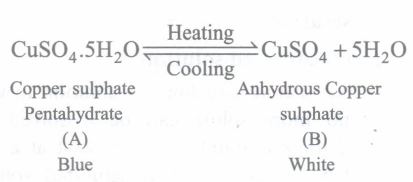
(i) 'A' is copper sulphate pentahydrate (CuSO4.5H2O).
(ii) 'B' is Anhydrous copper sulphate (CuSO4)
14.
(i) Dilute or concentrated nitric acid renders aluminum passive.
(ii) It does not attack aluminium but it forms oxide film on its surface.
15.
(i) 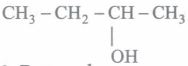
(ii) IUPAC name - Butane-2-ol (or) 2-Butanol.
(iii) The compound is saturated, because these compounds are do not decolourize with bromine water.

10th Standard Syllabus & Materials
10th Standard
TN 10th English Prose - 2 - The Night the Ghost Got in Important Questions And Answers Study Material - QB365 Set A
NEW10th Standard
TN 10th English Supplementary - 1 - The Tempest Important Questions And Answers Study Material - QB365 Set A
NEW10th Standard
TN 10th English Poem - 1 - Life Important Questions And Answers Study Material - QB365 Set A
NEW10th Standard
TN 10th English Prose - 1 - His First Flight Important Questions And Answers Study Material - QB365 Set A



Tamilnadu Stateboard 10th Standard Subjects
Tamilnadu Stateboard Standards





