
 100% FREE ACCESS
10th Standard Syllabus & Materials
10th Standard
TN 10th English Prose - 4 - The Attic Important Questions And Answers Study Material - QB365 Set A
NEW10th Standard
TN 10th English Supplementary - 3 - The Story of Mulan Important Questions And Answers Study Material - QB365 Set A
NEW10th Standard
TN 10th English Poem - 3 - I am Every Woman Important Questions And Answers Study Material - QB365 Set A
NEW10th Standard
TN 10th English Prose - 3 - Empowered Women Navigating The World Important Questions And Answers Study Material - QB365 Set A
NEW10th Standard
TN 10th English Supplementary - 2 - Zigzag Important Questions And Answers Study Material - QB365 Set A
NEW10th Standard
TN 10th English Poem - 2 - The Grumble Family Important Questions And Answers Study Material - QB365 Set A

Published on: 12/06/2021
QB365 provides detailed and simple solution for every Book back Questions in class 10 Science Subject. It will helps to get more idea about question pattern in every book back questions with solution.
Download Tamil Nadu 10th Standard Science question papers, model tests, one-mark questions, important questions, and public exam papers in PDF format. Free study materials and answer keys for TN State Board students.
Questions + Answers key
Take MCQ Science Test1.
If the pH of a solution is 4.5, what is its pOH?
2.
A door is pushed, at a point whose distance from the hinges is 90 cm, with a force of 40 N. Calculate the moment of the force about the hinges.
3.
What is the pH of 1.0 × 10⁻⁵ molar solution of KOH?
4.
What would be the pH of an aqueous solution of sulphuric acid which is 5 × 10⁻⁵ mol litre–1 in concentration.
5.
A radon specimen emits radiation of 3.7 × 10³ GBq per second. Convert this disintegration in terms of curie. (one curie = 3.7 × 10¹⁰ disintegration per second).
6.
Calculate the percentage of sulphur in H2SO4.
7.
Find the amount of urea which is to be dissolved in water to get 500 g of 10 % w / w aqueous solution?
8.
A solution was prepared by dissolving 25 g of sugar in 100 g of water. Calculate the mass percentage of solute.
9.
Find the mass of potassium chloride would be needed to form a saturated solution in 60 g of water at 303 K? Given that solubility of the KCl is 37 / 100 g at this temperature.
10.
In the circuit diagram given below, three resistors R1, R2 and R3 of 5 Ω, 10 Ω and 20 Ω respectively are connected as shown. Calculate:
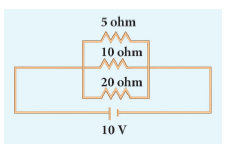
A) Current through each resistor
B) Total current in the circuit
C) Total resistance in the circuit
11.
A source of sound is moving with a velocity of 50 m s–1 towards a stationary listener. The listener measures the frequency of the source as 1000 Hz. what will be the apparent frequency of the source when it is moving away from the listener after crossing him? (velocity of sound in the medium is 330 m s–1)
12.
A beam of light passing through a diverging lens of focal length 0.3m appear to be focused at a distance 0.2m behind the lens. Find the position of the object.
13.
A source producing a sound of frequency 90 Hz is approaching a stationary listener with a speed equal to (1/10) of the speed of sound. What will be the frequency heard by the listener?
14.
Keeping the temperature as constant, a gas is compressed four times of its initial pressure. The volume of gas in the container changing from 20cc (V1 cc) to V2 cc. Find the final volume V2.
15.
Calculation of mass from mole
Calculate the mass of the following
i) 0.3 mole of aluminium (Atomic mass of Al = 27)
ii) 2.24 litre of SO2 gas at S.T.P
iii) 1.51 × 10²³ molecules of water
iv) 5 × 10²³ molecules of glucose?
1.
pH + pOH = 14
pOH = 14 – 4.5 = 9.5
pOH = 9.5
2.
Formula: The moment of a force M = F × d
Given: F = 40 N and d = 90 cm = 0.9 m.
Hence, moment of the force = 40 × 0.9 = 36 N m.
3.
KOH is a strong base and dissolve in water and gives
\(\mathrm{KOH_{(aq)}} \rightarrow \mathrm{K}^{+}_{(s)}+\mathrm{OH}^{-}_{(aq)}\)
Each KOH molecules gives one OH- ion. So 1.0 x 10⁻⁵ molar molar solution of KOH gives 1.0 x 10⁻⁵ OH- ions.
\({\left[\mathrm{OH}^{-}\right] } =1.0 \times 10^{-5} \)
\(\mathrm{pOH} =-\log _{10}\left[\mathrm{OH}^{-}\right] \)
\(=-\log _{10} 1.0 \times 10^{-5} \)
\(=-(-5) \log _{10} 10 \)
\(\mathrm{pOH} =5 \times 1 \)
\(\mathrm{pOH} =5 \)
\(\mathrm{pH}+\mathrm{pOH} =14 \)
\(\mathrm{pH} =14-\mathrm{pOH} \)
=14 - 5
pH = 9
The pH of 1.0 x10⁻⁵ molar solution of KOH is 9.
4.
Sulphuric acid dissociates in water as:
H2SO4(aq) → 2 H+(aq) + SO42-(aq)
Each mole of sulphuric acid gives two mole of H+ ions in the solution. One litre of H2SO4 solution contains 5 × 10⁻⁵ moles of H2SO4 which would give 2 × 5 × 10–5 = 10 × 10–5 or 1.0 × 10⁻⁴ moles of H+ ion in one litre of the solution.
Therefore,
[H+] = 1.0 × 10⁻⁴ mol litre–1
pH = –log10[H+] = –log1010–4 = –(–4 × log1010)
= –(–4 × 1) = 4
5.
1 Bq = one disintegration per second
one curie = 3.7 × 10¹⁰ Bq
1 Bq = \(\frac { 1 }{ 3.7\times { 10 }^{ 10 } } \) curie
∴ 3.7 x 10³ G Bq = 3.7 x 103 x 109 x \(\frac { 1 }{ 3.7\times { 10 }^{ 10 } } \)
= 100 curie
6.
molecular mass of H2SO4
= (1 × 2) + (32 × 1) + (16 × 4)
= 2 + 32 + 64
= 98 g
% of S in H2SO4 = \(\frac { Mass\ of\ sulphur }{ Moleculer\ mass\ of\ H_2\ SO_4 } \times 100\)
% of S in H2SO4 = \(\cfrac { 32 }{ 98 } \times 100\)
= 32.65%
7.
Mass percentage (w / w) = \(\frac{\text { Mass of the solute }}{\text { Mass of the solution }} \times 100\)
\(10=\frac{\text { Mass of the urea }}{500} \times 100\)
Mass of urea = 50 g
8.
Mass of the solute = 25 g
Mass of the solvent = 100 g
\(\begin{aligned}
\text { Mass Percentage }
\end{aligned}=\frac{\text { Mass of the solute }}{\text { Mass of the solution }} \times 100\)
\(\begin{aligned}
\text { Mass Percentage }
\end{aligned}=\frac{\text { Mass of the solute }}{\begin{array}{l}
\text { Mass of the solute }+ \text { Mass of the solvent }
\end{array}} \times 100\)
\(=\frac {25}{25+100}\times\)100
= \(\frac{25}{125}\times\)100
= 20%
9.
Mass of potassium chloride in 100 g of water in saturated solution = 37 g
Mass of potassium chloride in 60 g of water in saturated solution = \(\frac{37}{100}\)× 60
= 22.2 g
10.
A) Since the resistors are connected in parallel, the potential difference across each resistor is same (i.e. V=10V)
Therefore, the current through R1 is,
\({ I }_{ 1 }=\frac { V }{ { R }_{ 1 } } =\frac { 10 }{ 5 } =2A\)
Current through \({ R }_{ 2 }={ I }_{ 2 }=\frac { V }{ { R }_{ 2 } } =\frac { 10 }{ 10 } =1A\)
Current through \({ R }_{ 3 }={ I }_{ 3 }=\frac { V }{ { R }_{ 3 } } =\frac { 10 }{ 20 } =0.5A\)
B) Total current in the circuit, I = I1 + I2 + I3
= 2 + 1 + 0.5 = 3.5 A
C) Total resistance in the circuit \(\frac { 1 }{ { R }_{ P } } =\frac { 1 }{ { R }_{ 1 } } +\frac { 1 }{ { R }_{ 2 } } +\frac { 1 }{ { R }_{ 3 } } \)
\(=\frac { 1 }{ 5 } +\frac { 1 }{ 10 } +\frac { 1 }{ 20 } \)
\(=\frac { 4+2+1 }{ 20 } \)
\(\frac { 1 }{ { R }_{ P } } =\frac { 7 }{ 20 } \)
Hence, \({ R }_{ P }=\frac { 20 }{ 7 } =2.857\Omega \)
11.
When the source is moving towards the stationary listener, the expression for apparent frequency is
\(n'=\left( \frac { v }{ v-{ v }_{ s } } \right) n\)
\(1000=\left( \frac { 330 }{ 330-50 } \right) \times n\)
\(n=\left( \frac { 1000 \times 280 }{ 330 } \right)\)
n = 848.48 Hz
The actual frequency of the sound is 848.48 Hz. When the source is moving away from the stationary listener, the expression for apparent frequency is
\(n'=\left( \frac { v }{ v+{ v }_{ s } } \right) n\)
=\(\left( \frac { 330 }{ 330+50 } \right) \times 848.48\)
= 736.84 Hz
12.
f = -0.3m, v = -0.2m
\(\cfrac { 1 }{ f } =\cfrac { 1 }{ v } -\cfrac { 1 }{ u } \)
\(\cfrac { 1 }{ u } =\cfrac { 1 }{ v } -\cfrac { 1 }{ f } \)
\(\cfrac { 1 }{ u } =\cfrac { 1 }{ -0.2 } -\cfrac { 1 }{ -0.3 } =\cfrac { -10 }{ 6 } \)
\(u=\cfrac { -6 }{ 10 } =-0.6m\)
13.
When the source is moving towards the stationary listener, the expression for apparent frequency is
\(n'=\left( \frac { v }{ v-{ v }_{ s } } \right) n\)
= \(\left( \frac { v }{ v-\left( \frac { 1 }{ 10 } \right) v } \right) n=\left( \frac { 10 }{ 9 } \right) n\)
= \(\left( \frac { 10 }{ 9 } \right) \times 90=100\) Hz
n'=100 Hz
14.
Data:
Initial pressure (P1)= P
Final Pressure (P2) = 4P
Initial volume (V1) = 20cc = 20cm3
Final volume (V2) = ?
Using Boyle's Law, PV = constant
P1V1 = P2V2
\({ V }_{ 2 }=\frac { { P }_{ 1 } }{ { P }_{ 2 } } \times { v }_{ 1 }\)
\(=\frac { P }{ 4P } \times 20{ cm }^{ 3 }\)
V2 = 5 cm3
15.
1) 0.3 mole of aluminium (Atomic mass of Al = 27)
\(\text { Number of moles }=\frac{\text { Mass of } \mathrm{Al}}{\text { Atomic mass of } \mathrm{Al}}\)
Mass = No. of moles × atomic mass
So, mass of Al = 0.3 × 27
= 8.1 g
2) 2.24 litre of SO2 gas at S.T.P
Molecular mass of SO2 = 32 + (16 × 2)
= 32 + 32 = 64
\(\text { Number of moles of } \mathrm{SO}_2=\frac{\begin{array}{c} \text { Given volume of } \mathrm{SO}_2 \text { at S.T.P } \end{array}}{\begin{array}{c} \text { Molar volume } \mathrm{SO}_2 \text { at S.T.P } \end{array}}\)
Number of moles of SO2 = \(\frac{2.24}{22.4}\)
= 0.1 mole
\(\text { Number of moles }=\frac{\text { Mass }}{\text { Molecular mass }}\)
Mass = No. of moles × molecular mass
Mass = 0.1 × 64
Mass of SO2 = 6.4 g
iii) 1.51 × 10²³ molecules of water
Molecular mass of H2O = 18
\(\text { Number of moles }=\frac{\begin{array}{c} \text { Number of molecules of }\text { water } \end{array}}{\text { Avogadro's number }}\)
= 1.51 × 10²³ / 6.023 × 1023
= 1 / 4
= 0.25 mole
\(\text { Number of moles }=\frac{\text { Mass }}{\text { Molecular mass }}\)
0.25 = mass / 18
Mass = 0.25 × 18
Mass = 4.5 g
iv) 5 × 10²³ molecules of glucose
Molecular mass of glucose = 180
\(\text { Mass of glucose }=\frac{\begin{array}{c} \text { Molecular mass } \times \text { number of particles } \end{array}}{\text { Avogadro's number }}\)
= (180 × 5 × 1023) / 6.023 × 1023
= 149.43 g

10th Standard Syllabus & Materials
10th Standard
TN 10th English Prose - 2 - The Night the Ghost Got in Important Questions And Answers Study Material - QB365 Set A
NEW10th Standard
TN 10th English Supplementary - 1 - The Tempest Important Questions And Answers Study Material - QB365 Set A
NEW10th Standard
TN 10th English Poem - 1 - Life Important Questions And Answers Study Material - QB365 Set A
NEW10th Standard
TN 10th English Prose - 1 - His First Flight Important Questions And Answers Study Material - QB365 Set A



Tamilnadu Stateboard 10th Standard Subjects
Tamilnadu Stateboard Standards





