
 100% FREE ACCESS
10th Standard Syllabus & Materials
10th Standard
TN 10th English Prose - 4 - The Attic Important Questions And Answers Study Material - QB365 Set A
NEW10th Standard
TN 10th English Supplementary - 3 - The Story of Mulan Important Questions And Answers Study Material - QB365 Set A
NEW10th Standard
TN 10th English Poem - 3 - I am Every Woman Important Questions And Answers Study Material - QB365 Set A
NEW10th Standard
TN 10th English Prose - 3 - Empowered Women Navigating The World Important Questions And Answers Study Material - QB365 Set A
NEW10th Standard
TN 10th English Supplementary - 2 - Zigzag Important Questions And Answers Study Material - QB365 Set A
NEW10th Standard
TN 10th English Poem - 2 - The Grumble Family Important Questions And Answers Study Material - QB365 Set A

Published on: 13/05/2022
QB365 provides detailed and simple solution for every Book back Questions in class 10 Science Subject. It will helps to get more idea about question pattern in every book back questions with solution.
latest Book back QuestionsDownload Tamil Nadu 10th Standard Science question papers, model tests, one-mark questions, important questions, and public exam papers in PDF format. Free study materials and answer keys for TN State Board students.
Questions + Answers key
Take MCQ Science Test1.
With a neat labelled diagram explain the techniques involved in gene cloning.
2.
Biofortification may help in removing hidden hunger. How?
3.
Describe mutation breeding with an example.
4.
Polyploids are characterised by gigantism. Justify your answer.
5.
A breeder wishes to incorporate desirable characters into the crop plants. Prepare a list of characters he will incorporate.
1.
Gene Cloning:
(i) The carbon copy of an individual is often called a clone. However, more appropriately, a clone means to make a genetically exact copy of an organism.
Techniques involved in gene cloning:
(i) In gene cloning, a gene or a piece of DNA fragment is inserted into a bacterial cell where DNA will be multiplied (copied) as the cell divides.
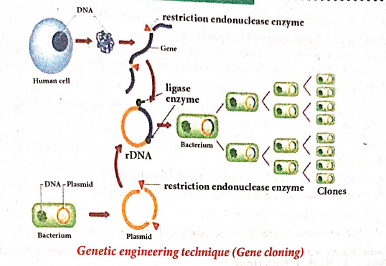
A brief outline of the basic steps involved in gene cloning are:
(i) Isolation of desired DNA fragment by using restriction enzyme
(ii) Insertion of the DNA fragment into a suitable vector (Plasmid) to make rDNA
(iii) Transfer of rDNA into bacterial host cell (Transformation)
(iv) Selection and multiplication of recombinant host cell to get a clone
(v) Expression of cloned gene in host cell.
(vi) Using this strategy several enzymes, hormones and vaccines can be produced.
2.
(i) Biofortification is the scientific process of developing crop plants enriched with high levels of desirable nutrients like vitamins, proteins and minerals.
(ii) Production of Bio fortification crops help in removing hidden hunger.
Examples:
(i) Protina, Shakti and Rathna are lysine rich maize hybrids (developed in India).
(ii) Atlas 66, a protein rich wheat variety.
(iii) Iron rich fortified rice variety.
(iv) Vitamin A enriched carrots, pumpkin and spinach.
(v) So in this way, Biofortification may help in removing hidden hunger.
3.
Mutation:
(i) Mutation is defined as the sudden heritable change in the nucleotide sequence of DNA in an organism.
(ii) It is a Process by which genetic variations are created which in turn brings about changes in the organism.
(iii) The organism which undergoes mutation is called a mutant.
(iv) The factors which induce mutations are known as mutagens or mutagenic agents.
(v) Mutagens are two types namely physical mutagens and chemical mutagens.
(i) Physical mutagens:
Radiations like X-rays, α, β and γ-rays, UV rays, temperature, etc. which induce mutations are called physical mutagens.
(ii) Chemical mutagens:
(i) Chemical substances that induce mutations are called chemical mutagens.
(ii) Eg: Mustard gas and nitrous acid. The utilization of induced mutation in crop improvement is called mutation breeding. Achievements of mutation breeding:
Achievements of mutation breeding:
(i) Sharbati Sonora wheat produced from Sonora-64 by using gamma rays.
(ii) Atomica 2 rice with saline tolerance and pest resistance.
(iii) Groundnuts with thick shells.
4.
Polyploldys are characterised by gigantism
An organism having more than two sets of chromosomes is called polyploid. It causes increase in size. Polys = Many + aploos = One fold + eidos = Form (E.g) Watermelon
5.
A breeder will incorporate the following characters:
(i) Tallness and profuse branching are desirable characters for fodder crops.
(ii) Dwarfness is desirable in cereals, so that less nutrients are consumed by these crops.

10th Standard Syllabus & Materials
10th Standard
TN 10th English Prose - 2 - The Night the Ghost Got in Important Questions And Answers Study Material - QB365 Set A
NEW10th Standard
TN 10th English Supplementary - 1 - The Tempest Important Questions And Answers Study Material - QB365 Set A
NEW10th Standard
TN 10th English Poem - 1 - Life Important Questions And Answers Study Material - QB365 Set A
NEW10th Standard
TN 10th English Prose - 1 - His First Flight Important Questions And Answers Study Material - QB365 Set A



Tamilnadu Stateboard 10th Standard Subjects
Tamilnadu Stateboard Standards





