
 100% FREE ACCESS
10th Standard Syllabus & Materials
10th Standard
TN 10th English Prose - 4 - The Attic Important Questions And Answers Study Material - QB365 Set A
NEW10th Standard
TN 10th English Supplementary - 3 - The Story of Mulan Important Questions And Answers Study Material - QB365 Set A
NEW10th Standard
TN 10th English Poem - 3 - I am Every Woman Important Questions And Answers Study Material - QB365 Set A
NEW10th Standard
TN 10th English Prose - 3 - Empowered Women Navigating The World Important Questions And Answers Study Material - QB365 Set A
NEW10th Standard
TN 10th English Supplementary - 2 - Zigzag Important Questions And Answers Study Material - QB365 Set A
NEW10th Standard
TN 10th English Poem - 2 - The Grumble Family Important Questions And Answers Study Material - QB365 Set A

Published on: 13/05/2022
QB365 provides detailed and simple solution for every Book back Questions in class 10 Science Subject. It will helps to get more idea about question pattern in every book back questions with solution.
latest Book back QuestionsDownload Tamil Nadu 10th Standard Science question papers, model tests, one-mark questions, important questions, and public exam papers in PDF format. Free study materials and answer keys for TN State Board students.
Questions + Answers key
Take MCQ Science Test1.
2.
Give the balanced chemical equation of the following reactions:
(i) Neutralization of NaOH with ethanoic acid.
(ii) Evolution of carbon dioxide by the action of ethanoic acid with NaHCO3.
(iii) Oxidation of ethanol by acidified potassium dichromate.
(iv) Combustion of ethanol.
3.
How is ethanol manufactured from sugarcane?
4.
Arrive at, systematically, the IUPAC name of the compound: CH3–CH2–CH2–OH
5.
What is called homologous series? Give any three of its characteristics?
1.
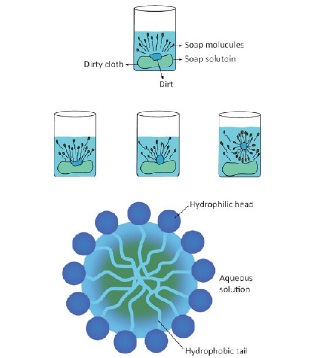
2.
(i) Ethanoic acid reacts with sodium hydroxide to form sodium ethanoate and water
CH3COOH + NaOH ⟶ CH3COONa + H2O
Ethanoic acid Sodium hydroxide
(ii) Ethanoic acid reacts with sodium bicarbonate and liberates CO2, with brisk effervescence.
CH3COOH + NaHCO3 ⟶ CH3COONa + CO2 ↑ + H2O
Ethanoic acid Sodium hydroxide
(iii) Ethanol is oxidized to ethanoic acid with alkaline KMnO4 or acidified K2Cr2O7

(iv) Ethanol is highly inflammable liquid. It burns with oxygen to form carbon dioxide and water.
.JPG)
3.
(i) Molasses is a dark coloured syrupy liquid left after the crystallization of sugar from the concentrated sugarcane juice.
(ii) It contains 30 % of sucrose, which cannot be separated by crystallization
(i) Dilution of molasses: Molasses is first diluted with water to bring down the U concentration of sugar to about 8 to 10%.
(ii) Addition of Nitrogen source:
a) Molasses usually contains enough nitrogenous matter to act as food for yeast during the fermentation process.
b) If the nitrogen content of the molasses is poor, ammonium sulphate or ammonium phosphate is added.
(iii) Addition of Yeast:
a) This solution kept in large fermentation tank and yeast is added to and it kept at about 303 K for a few days.
b) During this period, the enzymes invertase and, zymase present in yeast, converts sucrose into ethanol.
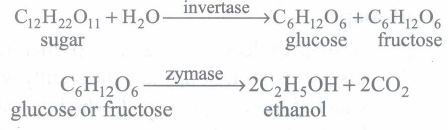
c) The fermented liquid is technically called wash.
(iv) Distillation of wash:
a) This wash containing 15 to 18 % alcohol, is now subjected to fractional distillation.
b) The main fraction drawn in an aqueous solution of ethanol which contains 95.5 % of ethanol and 4.5 % of water.
c) This is called rectified spirit.
d) This mixture is then refluxed over quicklime for about 5 to 6 hour and then allowed to stand for 12 hours.
e) On distillation of mixture, pure alcohol (100%) is obtained.
f) This is called absolute alcohol.
4.
Step 1: The parent chain consists of 3 carbon atoms. The root word is 'Prop'.
Step 2: There are single bonds between the carbon atoms of the chain. So, the primary suffix is 'ane'
Step 3: Since, the compound contains - OH group, it is an alcohol. The carbon chain is numbered from the end which is closest to -OH group. (Rule 3)
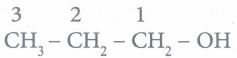
Step 4: The locant number of –OH group is 1 and thus the secondary suffix is ‘1-ol’.
The name of the compound is Prop + ane + (1-ol) = Propan-1-ol
Note: Terminal ‘e’ of ‘ane’ is removed as per Rule 5
5.
Homologous series is a group or a class of organic compounds having same general formula and similar chemical properties in which the successive numbers differ by a -CH2 group.
E.g: Methane - CH4
Ethane - CH3CH3
Propane - CH3CH2CH3
Characteristics:
(i) Each member of the series differs from the preceding or succeeding member by one methylene group (-CH2) and hence by a molecular mass of 14 amu.
(ii) All members of a homologous series contain the same elements and functional group.
(iii) They are represented by a general molecular formula. e.g. Alkanes, CnH2n + 2
(iv) All the members can be prepared by a common method.

10th Standard Syllabus & Materials
10th Standard
TN 10th English Prose - 2 - The Night the Ghost Got in Important Questions And Answers Study Material - QB365 Set A
NEW10th Standard
TN 10th English Supplementary - 1 - The Tempest Important Questions And Answers Study Material - QB365 Set A
NEW10th Standard
TN 10th English Poem - 1 - Life Important Questions And Answers Study Material - QB365 Set A
NEW10th Standard
TN 10th English Prose - 1 - His First Flight Important Questions And Answers Study Material - QB365 Set A



Tamilnadu Stateboard 10th Standard Subjects
Tamilnadu Stateboard Standards





