
 100% FREE ACCESS
10th Standard Syllabus & Materials
10th Standard
TN 10th English Prose - 4 - The Attic Important Questions And Answers Study Material - QB365 Set A
NEW10th Standard
TN 10th English Supplementary - 3 - The Story of Mulan Important Questions And Answers Study Material - QB365 Set A
NEW10th Standard
TN 10th English Poem - 3 - I am Every Woman Important Questions And Answers Study Material - QB365 Set A
NEW10th Standard
TN 10th English Prose - 3 - Empowered Women Navigating The World Important Questions And Answers Study Material - QB365 Set A
NEW10th Standard
TN 10th English Supplementary - 2 - Zigzag Important Questions And Answers Study Material - QB365 Set A
NEW10th Standard
TN 10th English Poem - 2 - The Grumble Family Important Questions And Answers Study Material - QB365 Set A

Published on: 13/05/2022
QB365 provides detailed and simple solution for every
Creative Questions in class 10 Science Subject. It will helps to get more idea about question pattern in everyCreative questions with solution.
Download Tamil Nadu 10th Standard Science question papers, model tests, one-mark questions, important questions, and public exam papers in PDF format. Free study materials and answer keys for TN State Board students.
Questions + Answers key
Take MCQ Science Test1.
Explain the waste water treatment process.
2.
Write a note on Obesity.
3.
Why are Genetically modified organisms produced? Explain the purpose and advantages.
4.
Explain in detail the uses and main parts of the 'SCRATCH' animation software.
5.
Name the pituitary hormones, and on the target tissues? How does it exert its action.
6.
X is the oldest fossil bird. The animal X became extinct a long time ago. But the study of fossils of X tells us that it had features like birds and some like reptiles.
(i) Identify 'X'?
(ii) Name one feature in which 'X' resembled birds.
(iii) Name one feature in which 'X' resembled reptiles.
7.
Differentiate simple reflexes and conditional reflexes.
8.
Write a note on mutation.
9.
Arun and Ram were good friends. But Ram slowly started loosing interest in studies as they grew up. The teacher found out that Ram had three siblings and their parents could not give him good food or personal care. What value does this episode give us.
10.
List the difference between RBC and WBC.
1.
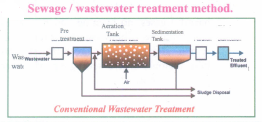
The conventional water treatment:
i) Pre-screening
ii) Aeration
iii) Sludge Management and Water Reuse.
(i) Pre-screening: Screening of waste water to remove soil and solid particulates.
(ii) Aeration: Screened wastewater is pumped to an aeration tank. Microbial contaminants are removed by the biological degradation that occurs in the presence of air.
(iii) Sedimentation process: The solid particles in suspension form are allowed to settle under the effect of gravity. The particles that settle out from the suspension is known as sludge.
(iv) Sludge removal: The sludge generated by the degradation process is transferred periodically from the tank for safe disposal.
(v) Disinfection: Chlorination and Ultra Violet (UV) radiation of treated water to remove any microorganism contamination.
(vi) Water recycling: The water will then be supplied for domestic or industrial purposes.
2.
(i) Obesity is the state in which there is an accumulation of excess body fat with an abnormal increase in body weight.
(ii) Obesity occurs if intake of calories is more than the expenditure of energy.
(iii) Overweight and obesity are conditions where the body weight is greater than the mean standard weight for age and height of an individual.
(iv) Body Mass Index (BMI) is an estimate of body fat and health risk. BMI = Weight (kg) / Height (m)2
Causes and risk factors :
(i) Obesity is due to genetic factors, physical inactivity, eating habits (overeating) and endocrine factors.
(ii) Obesity is a positive risk factor in development of hypertension, diabetes, gall bladder disease, coronary heart disease, and arthritis.
Prevention and Control of Obesity :
(i) Diet Management: Low calorie, normal protein, vitamins and mineral, restricted carbohydrate and fat, high fiber diet can prevent overweight.
(ii) Physical exercise: A low calorie diet accompanied by moderate exercise will be effective in causing weight loss. Meditation, yoga and physical activity can also reduce stress related to overeating.
3.
Genetically Modified Organisms:
(i) Genetic modification refers to the alteration or manipulation of genes in the organisms using rDNA techniques in order to produce the desired characteristics.
(ii) The DNA fragment inserted is called transgene. Plants or animals expressing a modified endogenous gene or a foreign gene are also known as transgenic organisms.
Advantages:
(i) The transgenic plants are much stable, with improved nutritional quality, resistant to diseases and tolerant to various environment conditions.
(ii) Similarly transgenic animals are used to produce proteins of medicinal importance at low cost and improve livestock quality. eg Golden Rice is a genetically modified Rice which can produce Beta carotene.
4.
'Scratch' is a software used to create animations, cartoons and games easily. Scratch, on the other hand, is a Visual Programming Language. It was developed in the Massachusetts Institute of Technology (MIT) Media Lab to make programming easier and more fun to learn.
Scratch Environment Editor:
(i) The Scratch editor has three main parts: They are Stage, Sprite and Script editor.
(ii) Stage: Stage is the background appearing when we open the scratch window. The background will most often be white. You can change the background colour as you like.
(iii) Sprite: The characters on the background of a Scratch window are known as Sprite. Usually a cat appears as a sprite when the Scratch window is opened. The software provides facilities to make alternations in sprite.
(iv) Script editor / Costume editor: Where you edit your programs or your sprite's pictures.
The script editor has three main parts :
(a) Script area: Where you build scripts.
(b) Block menu: Where you choose the category of blocks (programming statements) to use.
(c) Block palette: Where you choose the block to use.
5.
| Pituitary hormones | Tissue | Action |
| Growth hormone | All tissues | Growth of cartilage, bones, muscles and enlargement of all tissues. |
| Thyroid Stimulating Hormone |
Thyroid gland | Controls growth of the thyroid gland, co-ordinates its activities and hormone secretion. |
| Adrenocortico tropic Hormone |
Adrenal gland - cortex layer |
Stimulates adrenal cortex the produce its hormones and influences protein synthesis also |
| Gonadotropins a. Follicular stimulating hormone |
Testis - Germinal epithelium Ovary - Follicles |
In male it stimulates germinal epithelium of testis to produce sperms. In female, it initiates growth of ovarian follicles. |
| b. Luteinizing hormone | Testis (Male) Ovary (Female) |
Promotes the Leydig cells to secrete male sex hormone testosterone. Causes ovulation |
| c. Prolactin | Mammary glands | Initiates development of mammary glands during pregnancy and stimulates milk production after child birth. |
| Posterior lobe - hormones a. Vasopressin |
Kidney tubules | Increases reabsorption of water and reduces water loss through urine. |
| b. Oxytocin | Uterus | Helps in contraction of smooth muscles of uterus at the time of child birth and milk ejection from mammary gland. |
6.
(i) Arachaeopteryx.
(ii) It had wings with feathers like a bird.
(iii) It had conical teeth like a reptile.
7.
| Simple reflexes | Conditional reflexes | |
| i) | These reflexes are inbuilt and unlearned responses. | These reflexes are the result of practice and learning. |
| ii) | Eg: Winking of eyes when any dust particle enters. | Eg: Playing harmonium by striking a particular key on seeing a music note. |
8.
(i) The term mutation was introduced by Hugo De Vries in 1901 when he observed phenotypic changes in the evening Primrose plant, Oenothera lamarckiana.
(ii) Mutation is an inheritable sudden change in the genetic material (DNA) of an organism.
(iii) Mutations are classified into two main types, namely chromosomal mutation and gene mutation. Chromosomal mutation: The sudden change in the structure or number of chromosomes is called chromosomal mutation. This may result in
Changes in the structure of chromosomes:
Structural changes in the chromosomes usually occurs due to errors in cell division. Changes in the number and arrangement of genes takes place as a result of deletion, duplication, inversion and translocation in chromosomes. Changes in the number of chromosomes: They involve addition or deletion in the number of chromosomes present in a cell. This is called ploidy. There are 2 types of ploidy:
Euploidy in plants and animals:
(a) Euploidy: It is the condition in which the individual bears more than the usual number of diploid (2n) chromosomes. If an individual has three haploid sets of chromosomes, the condition is called triploidy (3n). If it has four haploid sets of chromosomes. It is called Tetraploidy. Tetraploid plants are advantageous as they often result in increased fruit and flower size.
(b) Aneuploidy: It is the loss or gain of one or more chromosomes in a set. It is of 3 types:
(i) Monosomy (2n-1),
(ii) Trisomy (2n+1)
(iii) Nullisomy (2n-2). In man, Down's syndrome is one of the commonly known aneuploid condition.
Gene or point mutation:
(i) Gene mutation is the changes occurring in nucleotide sequence of a gene.
(ii) It involves substitution, deletion, insertion or inversion of a single or more than one nitrogenous base.
(iii) Gene alteration results in abnormal protein formation in an organism.
9.
A small family is a happy family. If there are one or two children in a family, the parents can afford to give them good education, food, personal care and other facilities required for them to grow into healthy and happy individuals. Thus it is important for parents to plan a small family which will also build a healthy nation.
10.
| S.No |
RBC |
WBC |
|---|---|---|
| i | They are red in colour due to the presence of respiratory pigment hemoglobin. | They are colourless. |
| ii | They are biconcave/disc-shaped. | They are amoeboid in shape. |
| iii | The RBC is not classified into types, all red blood cells are the same. | They are classified into granulocytes and agranulocytes. |
| iv | The mature RBC's lack a nucleus. | They are nucleated. |
| v | They cannot change their shape. | They can change their shape and are capable of amoeboid movement. |
| vi | They are smaller than leucocytes. | They are larger than erythrocytes. |
| vii | They are responsible for the transport of respiratory gases (CO2 and O2). | They help to defend the body against pathogens. |

10th Standard Syllabus & Materials
10th Standard
TN 10th English Prose - 2 - The Night the Ghost Got in Important Questions And Answers Study Material - QB365 Set A
NEW10th Standard
TN 10th English Supplementary - 1 - The Tempest Important Questions And Answers Study Material - QB365 Set A
NEW10th Standard
TN 10th English Poem - 1 - Life Important Questions And Answers Study Material - QB365 Set A
NEW10th Standard
TN 10th English Prose - 1 - His First Flight Important Questions And Answers Study Material - QB365 Set A



Tamilnadu Stateboard 10th Standard Subjects
Tamilnadu Stateboard Standards





