
 100% FREE ACCESS
10th Standard Syllabus & Materials
10th Standard
TN 10th English Prose - 4 - The Attic Important Questions And Answers Study Material - QB365 Set A
NEW10th Standard
TN 10th English Supplementary - 3 - The Story of Mulan Important Questions And Answers Study Material - QB365 Set A
NEW10th Standard
TN 10th English Poem - 3 - I am Every Woman Important Questions And Answers Study Material - QB365 Set A
NEW10th Standard
TN 10th English Prose - 3 - Empowered Women Navigating The World Important Questions And Answers Study Material - QB365 Set A
NEW10th Standard
TN 10th English Supplementary - 2 - Zigzag Important Questions And Answers Study Material - QB365 Set A
NEW10th Standard
TN 10th English Poem - 2 - The Grumble Family Important Questions And Answers Study Material - QB365 Set A

Published on: 05/07/2021
QB365 provides detailed and simple solution for every
Creative Questions in class 10 Science Subject. It will helps to get more idea about question pattern in everyCreative questions with solution.
Download Tamil Nadu 10th Standard Science question papers, model tests, one-mark questions, important questions, and public exam papers in PDF format. Free study materials and answer keys for TN State Board students.
Questions + Answers key
Take MCQ Science Test1.
Explain the internal structure of Dicot Root (Bean) with a labeled diagram.
2.
Explain Irreversible reaction.
3.
Explain Electron affinity.
4.
Write the Uses of Radio activity.
5.
Explain Avogadro hypothesis.
6.
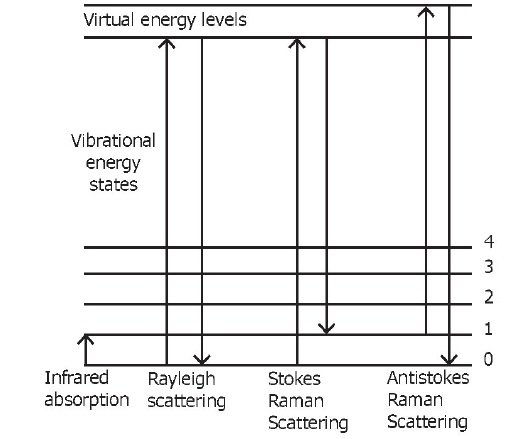
Explain about Raman scattering.
7.
Explain Reflection of sound.
8.
Explain Electrical Resistivity.
9.
Explain the principle of moments:
10.
Explain about Linear expansion with a suitable diagram.
1.
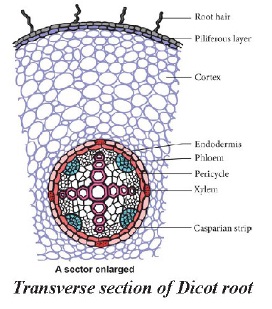
Internal Structure of Dicot Root (Bean):
A thin transverse section of dicot root shows the following structures.
i) Epiblema: It is the outermost layer. Cuticle and stomata are absent. Unicellular root hairs are present. It is also known as Rhizodermis or the Piliferous layer.
ii) Cortex: It is a multilayered large zone made of thin-walled parenchymatous cells with intercellular spaces. It stores food and water.
iii) Endodermis: It is the innermost layer of cortex. The cells are barrel-shaped, closely packed, and show band-like thickenings on their radial and inner tangential walls called Casparian strips. It helps in the movement of water and dissolved salts from the cortex into the xylem.
iv) Stele: All tissues inner to endodermis constitute stele. It includes a pericycle and vascular bundle.
a) Pericycle: Inner to endodermis lies a single layer of pericycle. It is the site of origin of lateral roots.
b) Vascular bundle: It is radial. Xylem is exarch and tetrach. The tissue A sector enlarged present between xylem and phloem is called conjunctive tissue. In dicot root, it is made up of parenchyma.
c) Pith: Young root contains pith whereas in old root pith is absent.
2.
The reaction that cannot be reversed is called irreversible reaction. The irreversible reactions are unidirectional, i.e., they take place only in the forward direction. Consider the combustion of coal into carbon dioxide and water.
C(s) + O2(g) \(\longrightarrow\) CO2(g) + Heat
Coal Oxygen Carbon dioxide
In this reaction, solid coal burns with oxygen and gets converted into carbon dioxide gas and water. As the product is a gas, as soon as it is formed it escapes out of the reaction container. It is extremely hard to decompose a gas into a solid. Thus, the backward reaction is not possible in this case. So, it is an irreversible reaction.
3.
Electron affinity is the amount of energy released when a gaseous atom gains an electron to form its anion. It is also measured in kJ/mol and represented by the following equation:
\({A}_{\left(g\right)}+{e}^{-}\to {{A}^{-}}_{\left(g\right)}+energy\)
\(C{l}_{\left(g\right)}+{e}^{-}\to C{{l}^{-}}_{\left(g\right)}+energy\)
Like ionisation energy, electron affinity also increases from left to right in a period and decreases from top to bottom in a group.
4.
Many radio isotopes can be obtained from radioactivity. These radio isotopes have found wide variety of applications in the fields of medicine, agriculture, industry and archeological research.
Agriculture :
The radio isotope of phosphorous (P-32) helps to increase the productivity of crops. The radiations from the radio isotopes can be used to kill the insects and parasites and prevent the wastage of agricultural products. Certain perishable cereals exposed to radiations remain fresh beyond their normal life, enhancing the storage time. Very small doses of radiation prevent sprouting and spoilage of onions, potatoes and gram. Medicine Medical applications of radio isotopes can be divided into two parts:
i) Diagnosis.
ii) Therapy Radio isotopes are used as tracers to diagnose the nature of circulatory disorders of blood, defects of bone metabolism, to locate tumors, etc.
iii) Some of the radio isotopes which are used as tracers are: hydrogen, carbon, nitrogen, sulphur, etc.
iv) Radio sodium (Na24) is used for the effective functioning of heart.
v) Radio - Iodine (I131) is used to cure goiter.
vi) Radio-iron is (Fe59) is used to diagnose anemia and also to provide treatment for the same.
vii) Radio phosphorous (P32) is used in the treatment of skin diseases.
viii) Radio cobalt (Co60) and radio-gold (Au198) are used in the treatment of skin cancer.
ix) Radiations are used to sterilize the surgical devices as they can kill the germs and microbes.
x) Industries.
xi) In industries, radioactive isotopes are used as tracers to detect any manufacturing defects such as cracks and leaks. Packaging faults can also be identified through radio activity. Gauges, which have radioactive sources are used in many industries to check the level of gases, liquids and solids.
xii) An isotope of californium (Cf 252) is used in the airlines to detect the explosives in the luggage.
xiii) An isotope of Americium (Am241) is used in many industries as a smoke detector.
Archeological research :
Using the technique of radio carbon dating, the age of the Earth, fossils, old paintings and monuments can be determined. In radio carbon dating, the existing amount of radio carbon is determined and this gives an estimate about the age of these things.
5.
The volume of any given gas must be propositional to the number of molecules in it. If “V’ is the volume, ‘n’ is the number of molecules of a gas, then Avogadro's law is represented mathematically as follows.
V \(\alpha\) n
V = Constant x n.
Thus one litre (1 dm3) of hydrogen contains the same number of molecules as in one litre of oxygen. i.e., the volume of the gas is directly propositional to the number of molecules of the gas.
Explanation: Let us consider the reaction between hydrogen and chlorine to form hydrogen chloride gas.
H2 + Cl2 \(\to \) 2HCl(g )
(g) (g) 2 volumes.
According to Avogadro's law, 1 volume of any gas is occupied by 'n' number of molecules
‘n' molecules + 'n' molecules \(\to \) 2n molecules.
1/2th molecule + 1/2th molecule \(\to \) 1 molecule.
1 molecule of hydrogen chloride gas is made up of 1/2 molecule of chlorine. Hence the molecules can be subdivided. This law obeys the Dalton's Atomic Theory.
6.
(i) When a parallel beam of monochromatic light passes through a gas (or) liquid or transparent solid, a part of light rays are scattered.
(ii) The scattered light contains some additional frequencies other than that of incident frequency. This is known as Raman scattering (or) Raman effect.
(iii) Raman scattering is defined as the interaction of light ray with the particles of pure liquids or transparent solids, which leads to a change in wave length or frequency.
(iv) The spectral lines having frequency equal to the incident ray frequency is called Rayleigh line and the spectral lines which are having frequencies other than the incident ray frequency are called Raman lines.
(v) The lines having frequencies lower than the incident frequency is called Stokes lines and the lines having frequencies higher than the incident frequency are called Antistokes lines.
7.
a) When sound waves travel in a given medium and strike the surface of another medium, they can be bounced back into the first medium. This phenomenon is known as reflection.
b) In simple the reflection and refraction of sound is actually similar to the reflection of light.
c) Thus, the bouncing of sound waves from the interface between two media is termed as the reflection of sound.
d) The waves that strike the interface are termed as the incident wave and the waves that bounce back are termed as the reflected waves.
8.
i) The resistance of any conductor ‘R’ is directly proportional to the length of the conductor ‘L’ and is inversely proportional to its area of cross section ‘A’
ii) R\(\alpha\) L, R\(\alpha\) 1/A,
Hence, R\(\alpha\) L/A
Therefore, R = \(\rho \) L/A
Where, \(\rho \) (rho) is a constant, called as electrical resistivity or specific resistance of the material of the conductor.
From equation (1), \(\rho \) =RA/L
If L= 1m, A= 1m2 then, from the above equation), \(\rho \) =R
iii) Hence, the electrical resistivity of a material is defined as the resistance of a conductor of unit length and unit area of cross section. Its unit is ohm metre.
iv) Electrical resistivity of a conductor is a measure of the resisting power of a specified material to the passage of an electric current. It is a constant for a given material.
9.
(i) At equilibrium, the algebraic sum of the moments of all individual forces about any point is equal to zero.
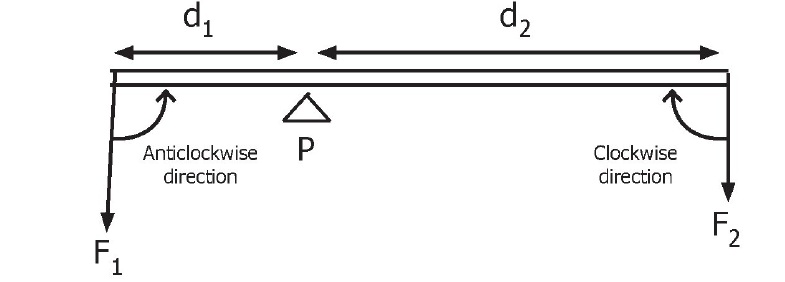
(ii) In the illustration, the force F1, produces an anticlockwise rotation at a distance d, from the point of pivot (P) called fulcrum and force F2 produces a clockwise rotation at a distance d2 from the point of pivot P. The principle of moments can be written as follows;
Moment in Moment in
Clockwise direction = Anticlockwise direction
F1 x d1 = F1 x d2
10.
i) When a body is heated or cooled, the length of the body changes due to change in its temperature.
ii) Then the expansion is said to be linear or longitudinal expansion.
iii) The ratio of increase in length of the body per degree rise in temperature to its unit length is called as the coefficient of linear expansion.
iv) The SI unit of Coefficient of Linear expansion is K-1.. The value of coefficient of linear expansion is different for different materials.
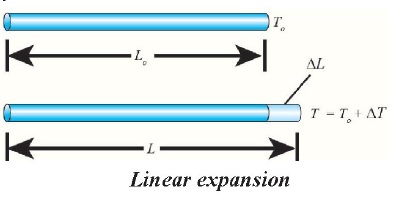
5. The equation relating the change in length and the change in temperature of a body is given below:
\(\Delta \mathrm{L} / \mathrm{L}_{0}=\alpha \mathrm{L} \Delta \mathrm{T}\)
\(\triangle L\) - Change in length (Final Length-Original length)
Lo - Original length
\(\triangle T\) - Change in temperature (Final temperature - Initial temperature)
\(\alpha L\) - Coefficient of linear expansion.

10th Standard Syllabus & Materials
10th Standard
TN 10th English Prose - 2 - The Night the Ghost Got in Important Questions And Answers Study Material - QB365 Set A
NEW10th Standard
TN 10th English Supplementary - 1 - The Tempest Important Questions And Answers Study Material - QB365 Set A
NEW10th Standard
TN 10th English Poem - 1 - Life Important Questions And Answers Study Material - QB365 Set A
NEW10th Standard
TN 10th English Prose - 1 - His First Flight Important Questions And Answers Study Material - QB365 Set A



Tamilnadu Stateboard 10th Standard Subjects
Tamilnadu Stateboard Standards





