
 100% FREE ACCESS
10th Standard Syllabus & Materials
10th Standard
TN 10th English Prose - 4 - The Attic Important Questions And Answers Study Material - QB365 Set A
NEW10th Standard
TN 10th English Supplementary - 3 - The Story of Mulan Important Questions And Answers Study Material - QB365 Set A
NEW10th Standard
TN 10th English Poem - 3 - I am Every Woman Important Questions And Answers Study Material - QB365 Set A
NEW10th Standard
TN 10th English Prose - 3 - Empowered Women Navigating The World Important Questions And Answers Study Material - QB365 Set A
NEW10th Standard
TN 10th English Supplementary - 2 - Zigzag Important Questions And Answers Study Material - QB365 Set A
NEW10th Standard
TN 10th English Poem - 2 - The Grumble Family Important Questions And Answers Study Material - QB365 Set A

Published on: 13/05/2022
QB365 provides detailed and simple solution for every
Creative Questions in class 10 Science Subject. It will helps to get more idea about question pattern in everyCreative questions with solution.
Download Tamil Nadu 10th Standard Science question papers, model tests, one-mark questions, important questions, and public exam papers in PDF format. Free study materials and answer keys for TN State Board students.
Questions + Answers key
Take MCQ Science Test1.
Explain Electrical Conductance and Electrical Conductivity.
2.
Explain Electrical Resistivity.
3.
Explain the Ohm’s Law.
4.
Explain Electrical potential difference.
5.
Tabulate the Symbols of some components of a circuit.
1.
i) Conductance of a material is the property of a material to aid the flow of charges and hence, the passage of current in it. The conductance of a material is mathematically defined as the reciprocal of its resistance (R). Hence, the conductance ‘G’ of a conductor is given by
ii) G = 1/R
iii) Its unit is ohm-1. It is also represented as ‘mho’. The reciprocal of electrical resistivity of a material is called its electrical conductivity.
iv) \(\sigma =1/\rho \)
v) Its unit is onm-1 metre-1 It is also represented as mho metre-1.
vi) The conductivity is a constant for a given material. Electrical conductivity of a conductor is a measure of its ability to pass the current through it.
vii) Some materials are good conductors of electric current. Example: copper, aluminium, etc. While some other materials are nonconductors of electric current (insulators). Example: glass, wood, rubber, etc. Conductivity is more for conductors than for Insulators. But the resistivity is less for conductors than for insulators.
2.
i) The resistance of any conductor ‘R’ is directly proportional to the length of the conductor ‘L’ and is inversely proportional to its area of cross section ‘A’
ii) R\(\alpha\) L, R\(\alpha\) 1/A,
Hence, R\(\alpha\) L/A
Therefore, R = \(\rho \) L/A
Where, \(\rho \) (rho) is a constant, called as electrical resistivity or specific resistance of the material of the conductor.
From equation (1), \(\rho \) =RA/L
If L= 1m, A= 1m2 then, from the above equation), \(\rho \) =R
iii) Hence, the electrical resistivity of a material is defined as the resistance of a conductor of unit length and unit area of cross section. Its unit is ohm metre.
iv) Electrical resistivity of a conductor is a measure of the resisting power of a specified material to the passage of an electric current. It is a constant for a given material.
3.
A German physicist, Georg Simon Ohm established the relation between the potential difference and current, which is known as Ohm’s Law.
According to Ohm’s law, at a constant temperature, the steady current ‘I’ flowing through a conductor is directly proportional to the potential difference ‘V’ between the two ends of the conductor.
I \(\alpha\) V. Hence, I/V = constant.
The value of this proportionality constant is found to be 1/R
Therefore, I = (I /R) V
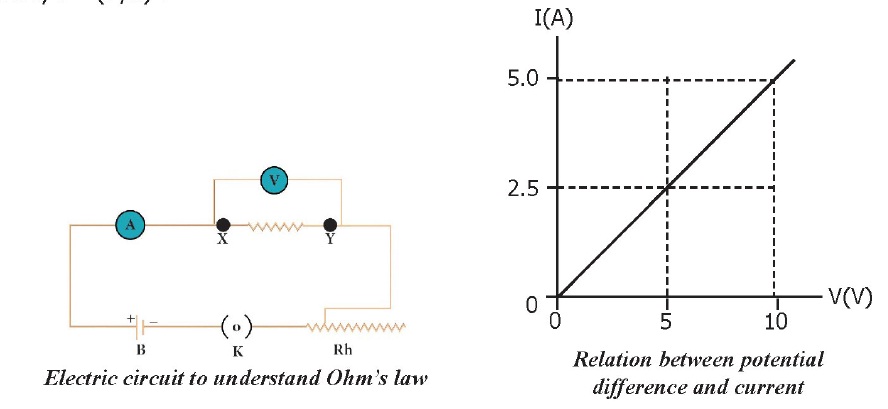
V = IR Here, R is a constant for a given material (say Nichrome) at a given temperature and is known as the resistance of the material. Since, the potential difference V is proportional to the current I, the graph between V and I is a straight line for a conductor.
4.
i) The electric potential difference between two points is defined as the amount of work done in moving a unit positive charge from one point to another point against the electric force.

ii) Electrical potential moved a charge Q from a point A to another point B. Let ‘W’ be the work done to move the charge from A to B. Then, the potential difference between the points A and B is given by the following expression.
iii) Potential Difference (V) = Work done (w)/ Charge (Q).
iv) Potential difference is also equal to the difference in the electric potential of these two points. If VA and VB represent the electric potential at the points A and B respectively, then, the potential difference between the points A and B is given by:
V= VA- VB (If VA is more than VB)
V = VB- VA (If VB is more than VA).
5.
| Component | Use of the component | Symbol used |
| Resistor | Used to fix the magnitude of the current through a circuit | 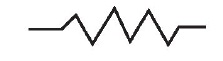 |
| Variable resistor or Rheostat | Used to select the magnitude of the current through a circuit. | 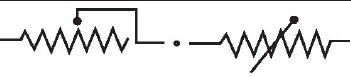 |
| Ammeter | Used to measure the current. | 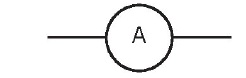 |
| Voltmeter | Used to measure the potential difference. | 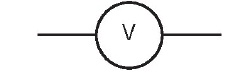 |
| Galvanometer | Used to indicate the direction of current |  |
| A diode | A diode has various uses, 7 which you will study in higher classes | 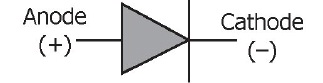 |
| Light Emitting Diode (LED) | LED has various uses which you will study in higher classes. | 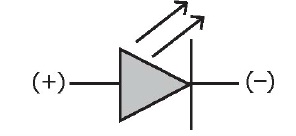 |
| Ground connection | Used to provide protection to the electrical components. It also serves as a reference point to measure the electric potential | 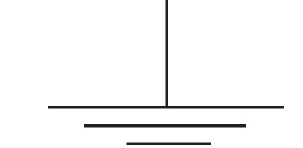 |

10th Standard Syllabus & Materials
10th Standard
TN 10th English Prose - 2 - The Night the Ghost Got in Important Questions And Answers Study Material - QB365 Set A
NEW10th Standard
TN 10th English Supplementary - 1 - The Tempest Important Questions And Answers Study Material - QB365 Set A
NEW10th Standard
TN 10th English Poem - 1 - Life Important Questions And Answers Study Material - QB365 Set A
NEW10th Standard
TN 10th English Prose - 1 - His First Flight Important Questions And Answers Study Material - QB365 Set A



Tamilnadu Stateboard 10th Standard Subjects
Tamilnadu Stateboard Standards





