
 100% FREE ACCESS
10th Standard Syllabus & Materials
10th Standard
TN 10th English Prose - 4 - The Attic Important Questions And Answers Study Material - QB365 Set A
NEW10th Standard
TN 10th English Supplementary - 3 - The Story of Mulan Important Questions And Answers Study Material - QB365 Set A
NEW10th Standard
TN 10th English Poem - 3 - I am Every Woman Important Questions And Answers Study Material - QB365 Set A
NEW10th Standard
TN 10th English Prose - 3 - Empowered Women Navigating The World Important Questions And Answers Study Material - QB365 Set A
NEW10th Standard
TN 10th English Supplementary - 2 - Zigzag Important Questions And Answers Study Material - QB365 Set A
NEW10th Standard
TN 10th English Poem - 2 - The Grumble Family Important Questions And Answers Study Material - QB365 Set A

Published on: 12/06/2021
QB365 provides detailed and simple solution for every Book back Questions in class 10 Science Subject. It will helps to get more idea about question pattern in every book back questions with solution.
Download Tamil Nadu 10th Standard Science question papers, model tests, one-mark questions, important questions, and public exam papers in PDF format. Free study materials and answer keys for TN State Board students.
Questions + Answers key
Take MCQ Science Test1.
The sex of the new born child is a matter of chance and neither of the parents may be considered responsible for it. What would be the possible fusion of gametes to determine the sex of the child?
2.
How is the structure of DNA organised? What is the biological significance of DNA?
3.
Explain with an example the inheritance of dihybrid cross. How is it different from monohybrid cross?
4.
Kavitha gave birth to a female baby. Her family members say that she can give birth to only female babies because of her family history. Is the statement given by her family members true? Justify your answer.
5.
Pure-bred tall pea plants are first crossed with pure-bred dwarf pea plants. The pea plants obtained in F1 generation are then selfed to produce F2 generation of pea plants.
a. What do the plants of F1 generation look like?
b. What is the ratio of tall plants to dwarf plants in F2 generation?
c. Which type of plants were missing in F1 generation but reappeared in F2 generation?
6.
Flowers of the garden pea are bisexual and self-pollinated. Therefore, it is difficult to perform hybridization experiment by crossing a particular pistil with the specific pollen grains. How Mendel made it possible in his monohybrid and dihybrid crosses?
1.
(i) Human beings have 23 pairs of chromosomes out of which 22 pairs are autosomes and one pair (23rd pair) is the sex chromosome.
(ii) The female gametes or the eggs formed are similar in their chromosome type (22+XX).
(ii) Therefore, human females are homogametic.
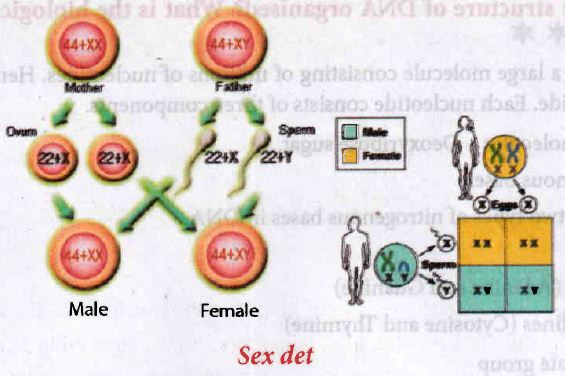
(iv) The male gametes or sperms produced are of two types.
(v) They are produced in equal proportions.
(vi) The sperm bearing (22+X) chromosomes and the sperm bearing (22+Y) chromosomes.
(vii) The human males are called heterogametic.
(v) It is a chance of probability as to which category of sperm fuses with the egg.
(vi) If the egg (X) is fused by the X-bearing sperm an XX individual (female) is produced.
(vii) If the egg (X) is fused by the Y-bearing sperm an XY individual (male) is produced.
(viii) The sperm, produced by the father, determines the sex of the child. The mother is not responsible in determining the sex of the child.
(ix) Now let's see how the chromosomes take part in this formation.
(x) Fertilization of the egg (22+X) with a sperm (22+X) will produce a female child (44+XX) while fertilization of the egg (22+X) with a sperm (22+Y) will give rise to a male child (44+XY).
2.
DNA is a large molecule consisting of millions of nucleotides. Hence, it is also called a polynucleotide. Each nucleotide consists of three components.
(i) A sugar molecules - Deoxyribose sugar.
(ii) A nitrogenous base.
There are two types of nitrogenous bases in DNA.
They are
(a) Purines (Adenine and Guanine)
(b) Pyrimidines (Cytosine and Thymine)
(iii) A phosphate group
Nucleoside and Nucleotide:
Nucleoside = Nitrogen base + Sugar
Nucleotide = Nucleoside + Phosphate
The nucleotides are formed according to the purines and pyrimidines present in them.
Watson and Crick model of DNA:
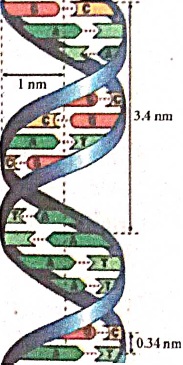
(i) DNA molecule consists of two polynucleotide chains.
(ii) These chains form a double helix structure with two strands which run anti-parallel to one another.
(iii) Nitrogenous bases in the centre are linked to sugar-phosphate units which form the backbone of the DNA.
(iv) Pairing between the nitrogenous bases is very specific and is always between purine and pyrimidine linked by hydrogen bonds.
a) Adenine (A) links Thymine (T) with two hydrogen bonds (A = T)
b) Cytosine (C) links Guanine (G) with three hydrogen bonds( C ≡ G) This is called complementary base pairing.
(v) Hydrogen bonds between the nitrogenous bases make the DNA molecule stable.
(vi) Each turn of the double helix is 34 Ao (3.4 nm). There are ten base pairs in a complete turn.
(vii) The nucleotides in a helix are joined together by phosphodiester bonds.
Significance of DNA:
(i) DNA is responsible for the transmission of hereditary information from one generation to next generation.
(ii) It contains information required for the formation of proteins.
(iii) It controls the developmental process and life activities of an organism.
3.
(i) Dihybrid cross involves the inheritance of two pairs of contrasting characteristics (or contrasting traits) at the same time.
(ii) The two pairs of contrasting characteristics chosen by Mendel were shape and colour of seeds: round-yellow seeds and wrinkled-green seeds.
(iii) Mendel crossed pea plants having round - yellow seeds with pea plants having wrinkled green seeds.
Mendel made the following observations:
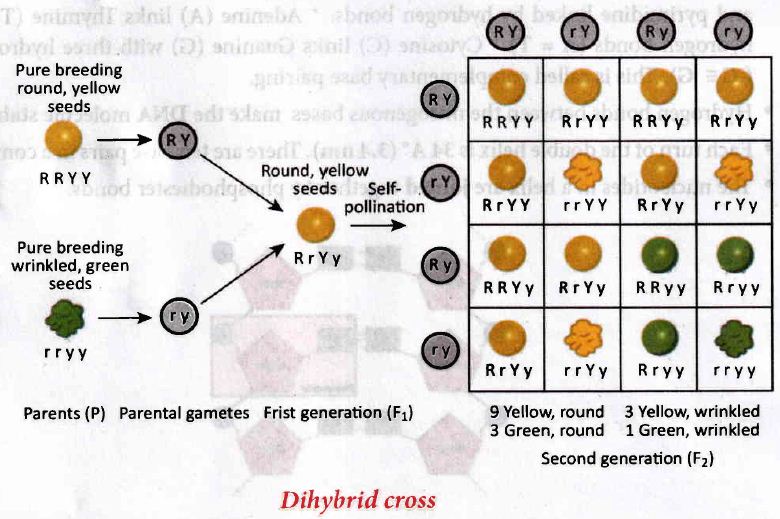
(i) Mendel first crossed pure breeding pea plants having round-yellow seeds with pure breeding pea plants having wrinkled green seeds and found that only round yellow seeds were produced in the first generation (F1).
(ii) No wrinkled-green seeds were obtained in the F1 generation.
(iii) From this it was concluded that round shape and yellow colour of the seeds were dominant traits over the wrinkled shape and green color of the seeds.
(iv) When the hybrids of F1 generation pea plants having round-yellow seeds were cross-breed by self pollination, then four types of seeds having different combinations of shape and colour were obtained in second generation or F2 generation.
(v) They were round-yellow, round-green, wrinkled yellow and wrinkled-green seeds.
(vi) The ratio of each phenotype (or appearance) of seeds in the F2 generation is 9:3:3:1. This is known as the Dihybrid ratio.
(vii) From the above results it can be concluded that the factors for each character or trait remain independent and maintain their identity in the gametes.
(viii) The factors are independent to each other and pass to the offsprings (through gametes).
Results of a Dihybrid Cross:
(i) Mendel got the following results from his dihybrid cross.
Four Types of Plants:
(i) A dihybrid cross produced four types of F2 offsprings in the ratio of 9 with two dominant traits, 3 with one dominant trait and one recessive trait, 3 with another dominant trait and
another recessive trait and 1 with two recessive traits.
New Combination:
(i) Two new combinations of traits with round green and wrinkled yellow had appeared in the dihybrid cross (F2 generation).
| Monohybrid Cross | Dihybrid Cross |
| Cross involving inheritance of only one pair of contrasting character. |
Cross involves the inheritance of two pair of contrasting character. |
| E.g. Stem length | E.g. seed shape and seed colour |
4.
Kavitha's family members' statement is false, because the sex is determined by male.
In human being female gametes form the chromosome type 22+XX. But in male gametes two types of chromosomes are formed. One is (22+X) another one is (22+Y).
(i) If a female gametes are (22+X) fuses with a male gamete (22+X) than its forms a female child.
(ii) If a female gamete (22+X) is fuses with the male gamete (22+Y) than it forms a male child.
(iii) The sex is determined by the male gamete.
5.
a) The F1 generation plants are tall.
b) In the F1 generation there were 3 tall plants and a dwarf plant. The ratio is 3 : 1.
c) The dwarf plants were missing in F1 generation but reappeared in F2 generation.
6.
(i) Flowers of the garden pea are bisexual and self-pollinated.
(ii) During hybridization experiment, Mendal simply cut off anther in bud (Emasculation) and did the cross pollination of selected plant's pollen on the stigma of the flower.
(iii) So self pollination will be avoided.
(iv) And there by he followed the effects of crossing for several generation.

10th Standard Syllabus & Materials
10th Standard
TN 10th English Prose - 2 - The Night the Ghost Got in Important Questions And Answers Study Material - QB365 Set A
NEW10th Standard
TN 10th English Supplementary - 1 - The Tempest Important Questions And Answers Study Material - QB365 Set A
NEW10th Standard
TN 10th English Poem - 1 - Life Important Questions And Answers Study Material - QB365 Set A
NEW10th Standard
TN 10th English Prose - 1 - His First Flight Important Questions And Answers Study Material - QB365 Set A



Tamilnadu Stateboard 10th Standard Subjects
Tamilnadu Stateboard Standards





