
 100% FREE ACCESS
10th Standard Syllabus & Materials
10th Standard
TN 10th English Prose - 4 - The Attic Important Questions And Answers Study Material - QB365 Set A
NEW10th Standard
TN 10th English Supplementary - 3 - The Story of Mulan Important Questions And Answers Study Material - QB365 Set A
NEW10th Standard
TN 10th English Poem - 3 - I am Every Woman Important Questions And Answers Study Material - QB365 Set A
NEW10th Standard
TN 10th English Prose - 3 - Empowered Women Navigating The World Important Questions And Answers Study Material - QB365 Set A
NEW10th Standard
TN 10th English Supplementary - 2 - Zigzag Important Questions And Answers Study Material - QB365 Set A
NEW10th Standard
TN 10th English Poem - 2 - The Grumble Family Important Questions And Answers Study Material - QB365 Set A

Published on: 12/06/2021
QB365 provides detailed and simple solution for every Book back Questions in class 10 Science Subject. It will helps to get more idea about question pattern in every book back questions with solution.
Download Tamil Nadu 10th Standard Science question papers, model tests, one-mark questions, important questions, and public exam papers in PDF format. Free study materials and answer keys for TN State Board students.
Questions + Answers key
Take MCQ Science Test1.
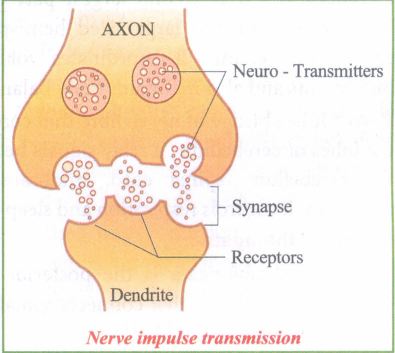
How nerve impulses are transferred from one neuron to next neuron?
2.
Describe the structure of spinal cord.
3.
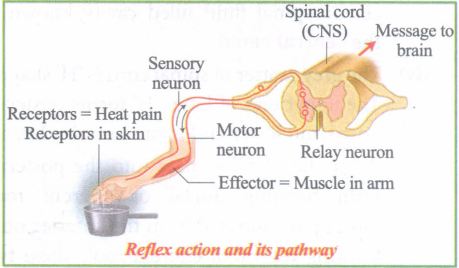
What will you do if someone pricks your hand with a needle? Elucidate the pathway of response with a neat labelled diagram.
4.
With a neat labelled diagram explain the structure of a neuron.
5.
‘A’ is a cylindrical structure that begins from the lower end of medulla and extend downwards. It is enclosed in bony cage ‘B’ and covered by membranes ‘C’. As many as ‘D’ pairs of nerves arise from the structure ‘A’.
(i) What is A?
(ii) Name (a) bony cage ‘B’ and (b) membranes ‘C’
(iii) How much is D?
1.
(i) All the information from the environment ate detected by the receptors located in our sense organs such as the eyes, the nose, the skin etc.
(ii) Information from the receptors is transmitted as electrical impulse and is received by the dendritic tips of the neuron.
(iii) This impulse travels from the dendrite to the cell body and then along the axon to its terminal end
(iv) On reaching the axonal end, it causes the nerve endings to release a chemical (neurotransmitter) which diffuses across a synapse and starts a similar electrical impulse in the dendrites of the next neuron, then to their cell body to be carried along the axon.
(v) In this way, the electrical signal reaches the brain or spinal cord. The response from brain (or spinal cord) is similarly passed on to the effector organs such as the muscle or gland cell, that undergoes the desired response.
(vi) The flow of nerve impulses from axonal end of one neuron to dendrite of another neuron through a synapse is called synaptic transmission.
(vii) Neurotransmitters are the chemicals which allow the transmission of nerve impulse.
(viii) The important neurotransmitter released by neurons is called Acetylcholine.
2.
Spinal Cord :
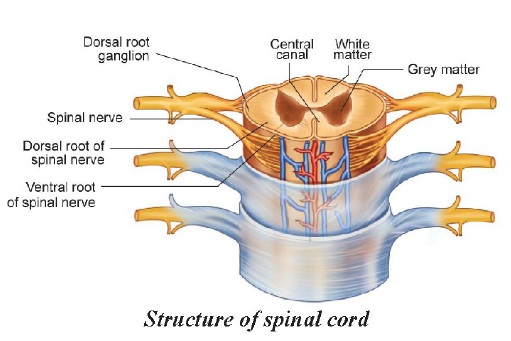
i) Spinal cord is a cylindrical structure lying in the neural canal of the vertebral column.
ii) It is also covered by meninges.
iii) It extends from the lower end of medulla oblongata to the first lumbar vertebra.
iv) The posterior most region of spinal cord tapers into a thin fibrous thread like structure called filum terminale.
v) Internally, the spinal cord contains a cerebrospinal fluid filled cavity known as the central canal.
vi) The grey matter of spinal cord is 'H' shaped.
vii) The upper end of letter 'H' forms posterior horns and lower end forms anterior horns.
viii) A bundle of fibres pass into the posterior horn forming dorsal or afferent root.
ix) Fibres pass outward from the anterior horn forming ventral or efferent root.
x) These two roots joins to form spinal nerves.
xi) The white matter is external and have bundle of nerve tracts.
xii) Spinal cord conducts sensory and motor impulses to and from the brain.
xiii) It controls reflex actions of the body.
3.
(i) If someone pricks our hand with a needle, a reflex action occurs in one body that makes our hand to withdraw immediately without our consciousness
(ii) The stimulus is the pain which is sensed by receptors in our hand. This stimulus in turn triggers an impulse in sensory neuron.
(iii) The sensory neuron. transmits or conveys the message to the spinal cord.
(iv) Spinal cord interprets the stimulus and the impulse is passed on to the relay neuron which in turn transmits it to a motor neuron.
(v) Motor neurons carry command from spinal cord to our arm.
(vi) Muscle in our arm contracts and we withdraw our hand immediately from the pan.
(vii) In this example, muscle is an effector organ which has responded to the pain.
4.
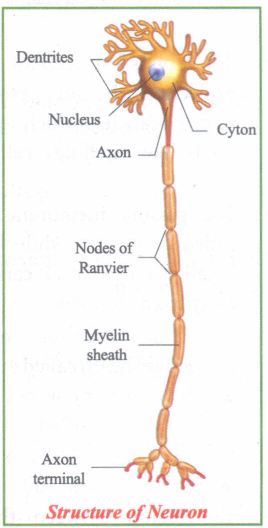
A neuron typically consists of three basic parts:
Cyton, Dendrites and Axon.
(i) Cyton:
(a) Cyton is also called cell body or perikaryon.
(b) It has a central nucleus with abundant cytoplasm called neuroplasm.
(c) The cytoplasm has large granular body called Nissl's granules and the other cell organelles like mitochondria, ribosomes, lysosomes, and endoplasmic recticulum.
(d) Neurons do not have the ability to divide, as there is no centriole
(e) Several neurofibrils are present. in the cytoplasm that help in transmission of nerve impulses to and from the cell body.
(ii) Dendrites:
(a) These are the numerous branched cytoplasmic processes that project from the surface of the cell body.
(b) They conduct nerve impulses towards the cyton.
(c) The branched projections increase the surface area for receiving the signals from other nerve cells.
(iii) Axon:
(a) The axon is a single, elongated, slender projection.
(b) The end of axon terminates as fine branches which terminate into knob like swellings called synaptic knob.
(c) The plasma membrane of axon is called axolemma, while the cytoplasm is called axoplasm.
(d) It carries impulses away from the cyton.
(e) The axons may be covered by a protective sheath called myelin sheath which is further covered by a layer of Schwann cells called neurilemma.
(f) Myelin sheath breaks at intervals by depressions called Nodes of Ranvier.
(g) The region between the nodes is called as internode.
(h) Myelin sheath acts as insulator and ensures rapid transmission of nerve impulses.
(iv) Synapse:
(a) A junction between synaptic knob of axon of one neuron and dendron of next neuron is called synaptic junction.
5.
(i) 'A' is Spinal cord.
(ii) (a) vertebral column (b) meninges
(iii) 31 pairs of nerves

10th Standard Syllabus & Materials
10th Standard
TN 10th English Prose - 2 - The Night the Ghost Got in Important Questions And Answers Study Material - QB365 Set A
NEW10th Standard
TN 10th English Supplementary - 1 - The Tempest Important Questions And Answers Study Material - QB365 Set A
NEW10th Standard
TN 10th English Poem - 1 - Life Important Questions And Answers Study Material - QB365 Set A
NEW10th Standard
TN 10th English Prose - 1 - His First Flight Important Questions And Answers Study Material - QB365 Set A



Tamilnadu Stateboard 10th Standard Subjects
Tamilnadu Stateboard Standards





