
 100% FREE ACCESS
10th Standard Syllabus & Materials
10th Standard
TN 10th English Prose - 4 - The Attic Important Questions And Answers Study Material - QB365 Set A
NEW10th Standard
TN 10th English Supplementary - 3 - The Story of Mulan Important Questions And Answers Study Material - QB365 Set A
NEW10th Standard
TN 10th English Poem - 3 - I am Every Woman Important Questions And Answers Study Material - QB365 Set A
NEW10th Standard
TN 10th English Prose - 3 - Empowered Women Navigating The World Important Questions And Answers Study Material - QB365 Set A
NEW10th Standard
TN 10th English Supplementary - 2 - Zigzag Important Questions And Answers Study Material - QB365 Set A
NEW10th Standard
TN 10th English Poem - 2 - The Grumble Family Important Questions And Answers Study Material - QB365 Set A

Published on: 13/05/2022
QB365 provides detailed and simple solution for every Book back Questions in class 10 Science Subject. It will helps to get more idea about question pattern in every book back questions with solution.
latest Book back QuestionsDownload Tamil Nadu 10th Standard Science question papers, model tests, one-mark questions, important questions, and public exam papers in PDF format. Free study materials and answer keys for TN State Board students.
Questions + Answers key
Take MCQ Science Test1.
Classify neurons based on its structure.
2.
How nerve impulses are transferred from one neuron to next neuron?
3.
Describe the structure of spinal cord.
4.
Illustrate the structure and functions of brain.
5.
Our body contains a large number of cells ‘L’ which are the longest cells in the body. L has long and short branch called as ‘M’ and ‘N’ respectively. There is a gap ‘O’ between two ‘L’ cells, through which nerve impulse transfer by release of chemical substance ‘P’.
(i) Name the cells L.
(ii) What are M and N?
(iii) What is the gap O?
(iv) Name the chemical substance P.
1.
The neurons may be of different types based on their structure and functions.
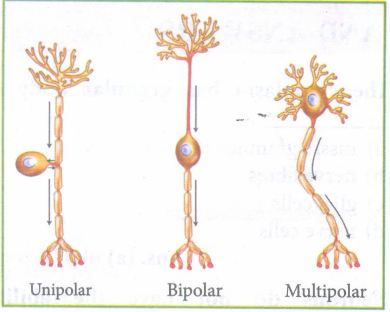
Structurally the neurons may be of the following types:
(i) Unipolar neurons
(ii) Bipolar neurons
(iii) Multipolar neurons
(i) Unipolar neurons:
i) Only one nerve process arises from the cyton which acts as both axon and dendron.
ii) Unipolar neurons found in early embryos but not in adults.
(ii) Bipolar neurons:
i) The cyton gives rise to two nerve processes of which one acts as an axon while another as a dendron.
ii) Bipolar neurons found in retina of eye and olfactory epithelium of nasal chambers.
(iii) Multipolar neurons:
i) The cyton gives rise to many dendrons and an axon.
ii) Multipolar neurons found in cerebral cortex of brain.
2.
(i) All the information from the environment ate detected by the receptors located in our sense organs such as the eyes, the nose, the skin etc.
(ii) Information from the receptors is transmitted as electrical impulse and is received by the dendritic tips of the neuron.
(iii) This impulse travels from the dendrite to the cell body and then along the axon to its terminal end
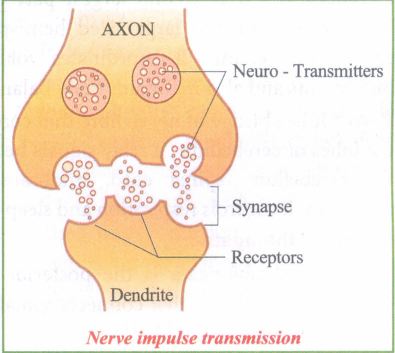
(iv) On reaching the axonal end, it causes the nerve endings to release a chemical (neurotransmitter) which diffuses across a synapse and starts a similar electrical impulse in the dendrites of the next neuron, then to their cell body to be carried along the axon.
(v) In this way, the electrical signal reaches the brain or spinal cord. The response from brain (or spinal cord) is similarly passed on to the effector organs such as the muscle or gland cell, that undergoes the desired response.
(vi) The flow of nerve impulses from axonal end of one neuron to dendrite of another neuron through a synapse is called synaptic transmission.
(vii) Neurotransmitters are the chemicals which allow the transmission of nerve impulse.
(viii) The important neurotransmitter released by neurons is called Acetylcholine.
3.
Spinal Cord :
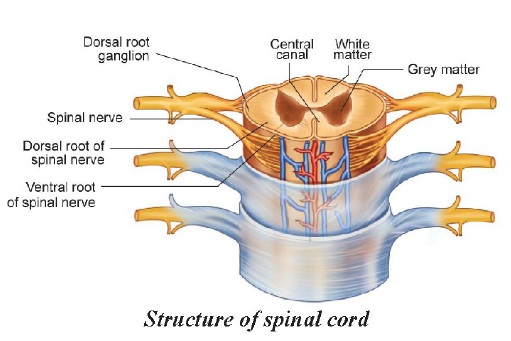
i) Spinal cord is a cylindrical structure lying in the neural canal of the vertebral column.
ii) It is also covered by meninges.
iii) It extends from the lower end of medulla oblongata to the first lumbar vertebra.
iv) The posterior most region of spinal cord tapers into a thin fibrous thread like structure called filum terminale.
v) Internally, the spinal cord contains a cerebrospinal fluid filled cavity known as the central canal.
vi) The grey matter of spinal cord is 'H' shaped.
vii) The upper end of letter 'H' forms posterior horns and lower end forms anterior horns.
viii) A bundle of fibres pass into the posterior horn forming dorsal or afferent root.
ix) Fibres pass outward from the anterior horn forming ventral or efferent root.
x) These two roots joins to form spinal nerves.
xi) The white matter is external and have bundle of nerve tracts.
xii) Spinal cord conducts sensory and motor impulses to and from the brain.
xiii) It controls reflex actions of the body.
4.
A human brain is formed of three main parts:
(a) forebrain
(b) midbrain and
(c) hindbrain.
(1) Forebrain:
A. Cerebrum(cortex)
B. Diencephalon
i) Thalamus ii) Hypothalamus
(2) Midbrain
(3) Hindbrain:
A. Cerebellum
B. Pons
C. Medulla Oblongata
| Part of brain | Structure | Description | Functions |
| Forebrain | Cerebrum (cortex) |
(i) It is the largest portion forming nearly two-third of the brain. (ii) It is divided into 2 halves (Right and Left hemispheres) interconnected by Corpus collosum. (iii) The outer portion is called cortex (grey matter) and inner portion is called medulla (white matter) (iv) The cortex is extremely folder forming elevations (gyri) and abd depressions (sulci) in between. (v) Each cerebral hemisphere is divided into frontal lobe, parietal lobe, temporal lobe and occipital lobe. |
(i) Sensory perception (ii) Control of voluntary functions (iii) Language (iv) Thinking (intelligence) (v) Memory (vi) Decision making (vii) Creativity |
| Thalamus | It is present in cerebral medulla is a major conducting centre for sensory and motor signalling. | Acts as a relay centre | |
| Hypothalamus | (i) It lies at the base of the thalamus (ii) It is an important link between nervous system and endocrine glands |
(i) Controls involuntary functions (ii) Temperature control (iii) Thirst, hunger control (iv) Urinationi (v) Controls the secretion of hormones from anterior pituitary gland |
|
| Midbrain | Corpora quadrigemina |
(i) It is located between thalamus and hindbrain (ii) It is made of four rounded bodies |
Controls visual and auditory (hearing) reflexes |
| Hindbrain | Cerebellum | It is seçond largest part of the brain formed of two large sized hemispheres and middle vermis |
(i) Coordinates voluntary movements (ii) Maintains body balance |
| Pons | (i) 'Pons' a latin word, meaning bridge (ii) It is a bridge of nerve fibre that connects the lobes of cerebellum. |
(i) Relays signals between the cerebellum, spinal cord, midbrain and cerebrum (ii) Controls respiration and sleep cycle. |
|
| Medulla Oblongata | It is the posterior most part of the brain that connects spinal cord and various parts of brain. |
(i) Has cardiac centre, respiratory centres, vasomotor centres and digestive centre (ii) Also regulates vomiting and salivation |
5.
(i) Nerve cells or neurons
(ii) Axon and Dendrites
(iii) Synapse
(iv) The chemical is Acetylcholine

10th Standard Syllabus & Materials
10th Standard
TN 10th English Prose - 2 - The Night the Ghost Got in Important Questions And Answers Study Material - QB365 Set A
NEW10th Standard
TN 10th English Supplementary - 1 - The Tempest Important Questions And Answers Study Material - QB365 Set A
NEW10th Standard
TN 10th English Poem - 1 - Life Important Questions And Answers Study Material - QB365 Set A
NEW10th Standard
TN 10th English Prose - 1 - His First Flight Important Questions And Answers Study Material - QB365 Set A



Tamilnadu Stateboard 10th Standard Subjects
Tamilnadu Stateboard Standards





