
 100% FREE ACCESS
10th Standard Syllabus & Materials
10th Standard
TN 10th English Prose - 4 - The Attic Important Questions And Answers Study Material - QB365 Set A
NEW10th Standard
TN 10th English Supplementary - 3 - The Story of Mulan Important Questions And Answers Study Material - QB365 Set A
NEW10th Standard
TN 10th English Poem - 3 - I am Every Woman Important Questions And Answers Study Material - QB365 Set A
NEW10th Standard
TN 10th English Prose - 3 - Empowered Women Navigating The World Important Questions And Answers Study Material - QB365 Set A
NEW10th Standard
TN 10th English Supplementary - 2 - Zigzag Important Questions And Answers Study Material - QB365 Set A
NEW10th Standard
TN 10th English Poem - 2 - The Grumble Family Important Questions And Answers Study Material - QB365 Set A

Published on: 04/07/2021
QB365 provides detailed and simple solution for every
Creative Questions in class 10 Science Subject. It will helps to get more idea about question pattern in everyCreative questions with solution.
Download Tamil Nadu 10th Standard Science question papers, model tests, one-mark questions, important questions, and public exam papers in PDF format. Free study materials and answer keys for TN State Board students.
Questions + Answers key
Take MCQ Science Test1.
Explain the working of the eye.
2.
Explain the Sign Conventions of lenses.
3.
Write the sign convention for lenses.
4.
Explain Raman Scattering.
5.
State the laws of refraction.
1.
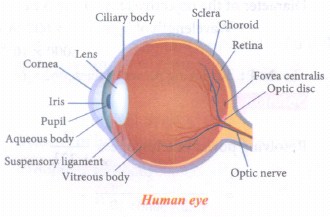
(i) The transparent layer cornea bends the light rays through pupil located at the centre part of the Iris.
(ii) The adjusted light passes through the eye lens. Eye lens is convex in nature. So, the light rays from the objects are converged and a real and inverted image is formed on retina.
(iii) Then, retina passes the received real and inverted image to the brain through optical nerves. Finally, the brain senses it as erect image.
2.
(i) The object is always placed on the left side of the lens.
(ii) All the distances are measured from the optical centre of the lens.
(iii) The distances measured in the same direction as that of incident light are taken as positive.
(iv) The distances measured against the direction of incident light are taken as negative. (v) The distances measured upward and perpendicular to the principal axis is taken as positive.
(v) The distances measured downward and perpendicular to the principal axis is taken· as negative.
3.
| S.No. | Convex Lens | Concave Lens |
| i | Focal length | + for convex lens - for concave lens |
| ii | Distance of object | - if the object is to the left object of the lens + if the object is to the right of the lens |
| iii | Distance of image | + if the image is formed on the right of the lens (real image) - if the image is formed one the left of the lens (virtual image) |
| iv | Magnification | + for erect images - for inverted images |
4.
(i) When a parallel beam of monochromatic (single coloured ) light passes through a gas or liquid or transparent solid, a part of light rays are scattered. This scattering is called Raman scattering (inelastic scattering).
(ii) Raman Scattering is defined as "The interaction of light ray with the particles of pure liquids or transparent solids, which leads to a change in wavelength or frequency".
(iii) The scattered light contains some additional frequencies (or wavelengths) other than that of incident frequency (or wavelength). This is known as Raman scattering or Raman Effect.
(iv) The modified lines are called 'Raman lines' and the unmodified lines are called as 'Rayleigh lines'. The lines having frequencies lower than the incident frequency is called stokes lines and the lines having frequencies higher than the incident frequency are called Anti-stokes lines.
5.
(i) First law of refraction : The incident ray of light, the refracted ray of light and the normal to the refracting surface all lie in the same plane.
(ii) Second law of refraction : The ratio of the sine of the angle of incidence and sine of the angle of refraction is equal to the ratio of refractive indices of the two media. This law is also known as Snell's law.
\(\frac{\operatorname{sin i}}{\sin x}=\frac{\mu_2}{\mu_1} .\).

10th Standard Syllabus & Materials
10th Standard
TN 10th English Prose - 2 - The Night the Ghost Got in Important Questions And Answers Study Material - QB365 Set A
NEW10th Standard
TN 10th English Supplementary - 1 - The Tempest Important Questions And Answers Study Material - QB365 Set A
NEW10th Standard
TN 10th English Poem - 1 - Life Important Questions And Answers Study Material - QB365 Set A
NEW10th Standard
TN 10th English Prose - 1 - His First Flight Important Questions And Answers Study Material - QB365 Set A



Tamilnadu Stateboard 10th Standard Subjects
Tamilnadu Stateboard Standards





