
 100% FREE ACCESS
10th Standard Syllabus & Materials
10th Standard
TN 10th English Prose - 4 - The Attic Important Questions And Answers Study Material - QB365 Set A
NEW10th Standard
TN 10th English Supplementary - 3 - The Story of Mulan Important Questions And Answers Study Material - QB365 Set A
NEW10th Standard
TN 10th English Poem - 3 - I am Every Woman Important Questions And Answers Study Material - QB365 Set A
NEW10th Standard
TN 10th English Prose - 3 - Empowered Women Navigating The World Important Questions And Answers Study Material - QB365 Set A
NEW10th Standard
TN 10th English Supplementary - 2 - Zigzag Important Questions And Answers Study Material - QB365 Set A
NEW10th Standard
TN 10th English Poem - 2 - The Grumble Family Important Questions And Answers Study Material - QB365 Set A

Published on: 04/07/2021
QB365 provides detailed and simple solution for every
Creative Questions in class 10 Science Subject. It will helps to get more idea about question pattern in everyCreative questions with solution.
Download Tamil Nadu 10th Standard Science question papers, model tests, one-mark questions, important questions, and public exam papers in PDF format. Free study materials and answer keys for TN State Board students.
Questions + Answers key
Take MCQ Science Test1.
Explain the types of corrosion.
2.
How is Bauxite ore concentrated?
3.
Explain the process of Smelting of Hematite ore in a Blast Furnace.
4.
Explain Bessemerisation
5.
How is zinc blende concentrated? Explain it with a neat diagram
1.
Types of Corrosion:
(i) Dry Corrosion or Chemical Corrosion :
The corrosive action in the absence of moisture is called dry corrosion. It is the process of a chemical attack on a metal by a corrosive liquids or gases such as O2, N2, SO2, H2S etc. It occurs at high temperature.
(ii) Wet Corrosion or Electrochemical Corrosion: The corrosive action in the presence of moisture is called wet corrosion. It occurs as a result of electrochemical reaction of metal with water or aqueous solution of salt or acids or bases.
2.
Chemical method or Leaching:
(i) This method is employed when the ore is in a very pure form.
(ii) The ore is treated with a suitable reagent such that the ore is soluble in it but the impurities are not. The impurities are removed by filtration.
(iii) The solution of the ore, ie., the filtrate is treated with a suitable reagent which precipitates the ore.
3.
Smelting (in a Blast Furnace) :
The charge consisting of roasted ore, coke and limestone in the ratio 8:4:1 is smelted in a blast furnace by introducing it through the cup and cone arrangement at the top. There are three important regions in the furnace.
.JPG)
(a) The Lower Region (Combustion Zone) The temperature is at 1500°C. In this region, coke burns with oxygen to form CO2 when the charge comes in contact with a hot blast of air.
.JPG)
It is an exothermic reaction since heat is liberated.
(b) The Middle Region (Fusion Zone) - The temperature prevails at 1000°C. In this region, CO2 is reduced to CO.
.JPG)
Limestone decomposes to calcium oxide and CO2
.JPG)
These two reactions are endothermic due to absorption of heat. Calcium oxide combines with silica to form calcium silicate slag.
CaO + SiO2 ⟶ CaSiO3
(c) The Upper Region (Reduction Zone) - The temperature prevails at 400°C . In this region carbon monoxide reduces ferric oxide to form a fairly pure spongy iron.
.JPG)
The molten iron is collected at the bottom of the furnace after removing the slag.
The iron thus formed is called pig iron. It is remelted and cast into different molds. This iron is called cast iron.
4.
Bessemerisation The molten matte is transferred to Bessemer converter in order to obtain blister copper. Ferrous sulphide from matte is oxidized to ferrous oxide, which is removed as slag using silica.
2FeS+3O2 ⟶ 2FeO+2SO2 ↑
.JPG)
2 Cu2S + 3O2 ⟶ 2 Cu2O + 2 SO2
.JPG)
5.
Froth floatation:
(i) Principle: This process depends on the preferential wettability of the ore with oil (pine oil) and the gangue particles by water. Lighter ores, such as sulphide ores, are concentrated by this method. E.g. Zinc blende ZnS
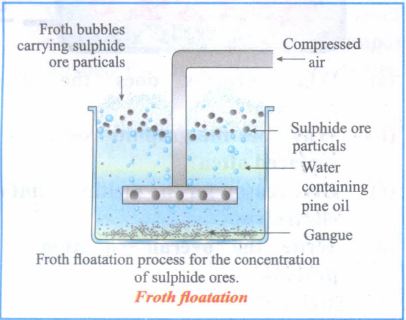
(ii) Method: The crushed ore is taken in a large tank containing oil and water and agitated with a current of compressed air. The ore is wetted by the oil and gets separated from the gangue in the form of froth. Since the 4 ore is lighter, it comes on the surface with the froth and impurities are left behind

10th Standard Syllabus & Materials
10th Standard
TN 10th English Prose - 2 - The Night the Ghost Got in Important Questions And Answers Study Material - QB365 Set A
NEW10th Standard
TN 10th English Supplementary - 1 - The Tempest Important Questions And Answers Study Material - QB365 Set A
NEW10th Standard
TN 10th English Poem - 1 - Life Important Questions And Answers Study Material - QB365 Set A
NEW10th Standard
TN 10th English Prose - 1 - His First Flight Important Questions And Answers Study Material - QB365 Set A



Tamilnadu Stateboard 10th Standard Subjects
Tamilnadu Stateboard Standards





