
 100% FREE ACCESS
10th Standard Syllabus & Materials
10th Standard
TN 10th English Prose - 4 - The Attic Important Questions And Answers Study Material - QB365 Set A
NEW10th Standard
TN 10th English Supplementary - 3 - The Story of Mulan Important Questions And Answers Study Material - QB365 Set A
NEW10th Standard
TN 10th English Poem - 3 - I am Every Woman Important Questions And Answers Study Material - QB365 Set A
NEW10th Standard
TN 10th English Prose - 3 - Empowered Women Navigating The World Important Questions And Answers Study Material - QB365 Set A
NEW10th Standard
TN 10th English Supplementary - 2 - Zigzag Important Questions And Answers Study Material - QB365 Set A
NEW10th Standard
TN 10th English Poem - 2 - The Grumble Family Important Questions And Answers Study Material - QB365 Set A

Published on: 13/05/2022
QB365 provides detailed and simple solution for every
Creative Questions in class 10 Science Subject. It will helps to get more idea about question pattern in everyCreative questions with solution.
Download Tamil Nadu 10th Standard Science question papers, model tests, one-mark questions, important questions, and public exam papers in PDF format. Free study materials and answer keys for TN State Board students.
Questions + Answers key
Take MCQ Science Test1.
Can Human beings survive with anaerobic respiration - Justify.
2.
Why is a dicot leaf described as dorsiventral?
3.
Explain the role of sunlight in photosynthesis.
4.
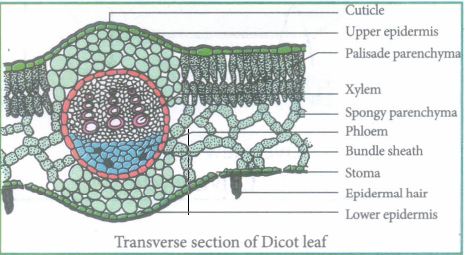
Draw a transverse section of dicot leaf and label the parts
5.
Write a note on vascular tissue system.
1.
(i) In anaerobic respiration the amount of energy produced is very less.
(ii) Aerobic respiration is seen is humans wherein the number of ATP molecules produced from a glucose molecule is more than an aerobic respiration.
2.
(i) The dorsal and ventral surfaces of a dicot leaf can be clearly distinguished
(ii) The dorsal surface is darker is appearance and the ventral surface is lighter.
(iii) This is due to distribution of palisade parenchyma below the upper epidermis which as rich in chloroplasts.
(iv) Hence the dicot left is described as dorsiventral.
3.
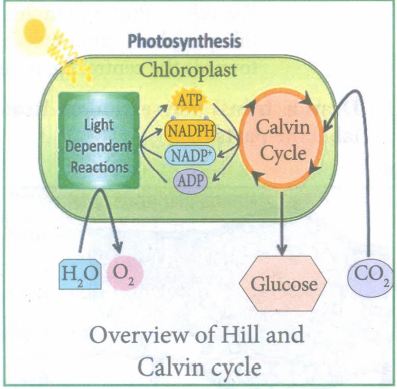
The entire process of photosynthesis takes place inside the chloroplast. The structure of chloroplast is such that the light dependent (Light reaction) and light independent (Dark reaction) take place at different sites in the organelle.
a) Light dependent photosynthesis:
(Hill reaction \ Light reaction)
(i) Discovered by Robin Hill (1939). This reaction takes place in the presence of light energy in thylakoid membranes (grana) of the chloroplasts.
(ii) Photosynthetic pigments absorb the light energy and convert it into chemical energy ATP and NADPH2. These products of light reaction move out from the thylakoid to the stroma of the chloroplast.
b) Light independent reactions:
(Biosynthetic phase):
(i) The second steps (dark reaction or biosynthetic pathway) is carried out in the stroma.
(ii) During this reaction CO2 is reduced into carbohydrates with the help of light generated ATP and NADPH2.
(iii) This is also called as Calvin cycle and is carried out in the absence of light.
(iv) In Calvin cycle the inputs are CO2 from the atmosphere and the ATP and NADPH2 produced from light reaction
4.
5.
(i) It consists of xylem and phloem tissues.
(ii) They are present in the form of bundles called vascular bundles.
(iii) Xylem conducts water and minerals to different parts of the plant.
(iv) Phloem conducts food materials to different parts of the plant.
There are three different types of vascular bundles namely:
(i) Radial
(ii) Conjoint
(iii) Concentric
(i) Radial Bundles:
(i) Xylem and phloem are present in different radii alternating with each other. Eg: roots.
(ii) Conjoint bundles: Xylem and phloem lie on the same radius. There are two types of conjoint bundles
a) Collateral:
(i) Xylem lies towards the centre and phloem lies towards the periphery.
(ii) When cambium is present in collateral bundles, it is called open. Eg: dicot stem and collateral bundle without cambium is called closed. Eg: monocot stem.
b) Bicollateral:
In this type of bundle, the phloem is present on both outer and inner side of xylem. Eg: cucurbita.
(iii) Concentric bundles: Vascular bundle in which xylem completely surrounds the phloem or vice versa is called concentric vascular bundle. It is of two types:
Types:
a) Amphivasal:
Xylem surrounds phloem. Eg: Dracaena
b) Amphicribral:
Phloem surrounds xylem. Eg: Ferns Endarch: Protoxylem lies towards the centre and metaxylem lies towards the periphery. Eg: stem. Exarch: Protoxylem lies towards the periphery and metaxylem lies towards the centre. Eg: roots.

10th Standard Syllabus & Materials
10th Standard
TN 10th English Prose - 2 - The Night the Ghost Got in Important Questions And Answers Study Material - QB365 Set A
NEW10th Standard
TN 10th English Supplementary - 1 - The Tempest Important Questions And Answers Study Material - QB365 Set A
NEW10th Standard
TN 10th English Poem - 1 - Life Important Questions And Answers Study Material - QB365 Set A
NEW10th Standard
TN 10th English Prose - 1 - His First Flight Important Questions And Answers Study Material - QB365 Set A



Tamilnadu Stateboard 10th Standard Subjects
Tamilnadu Stateboard Standards





