
 100% FREE ACCESS
10th Standard Syllabus & Materials
10th Standard
TN 10th English Prose - 4 - The Attic Important Questions And Answers Study Material - QB365 Set A
NEW10th Standard
TN 10th English Supplementary - 3 - The Story of Mulan Important Questions And Answers Study Material - QB365 Set A
NEW10th Standard
TN 10th English Poem - 3 - I am Every Woman Important Questions And Answers Study Material - QB365 Set A
NEW10th Standard
TN 10th English Prose - 3 - Empowered Women Navigating The World Important Questions And Answers Study Material - QB365 Set A
NEW10th Standard
TN 10th English Supplementary - 2 - Zigzag Important Questions And Answers Study Material - QB365 Set A
NEW10th Standard
TN 10th English Poem - 2 - The Grumble Family Important Questions And Answers Study Material - QB365 Set A

Published on: 04/07/2021
QB365 provides detailed and simple solution for every
Creative Questions in class 10 Science Subject. It will helps to get more idea about question pattern in
every Creative questions with solution.
Download Tamil Nadu 10th Standard Science question papers, model tests, one-mark questions, important questions, and public exam papers in PDF format. Free study materials and answer keys for TN State Board students.
Questions + Answers key
Take MCQ Science Test1.
Explain the structure of Chloroplast with labeled diagram.
2.
Explain the process of Photosynthesis.
3.
Explain the structure of Mitochondria with labeled diagram.
4.
Explain aerobic respiration.
5.
Write the differences between Dicot and Monocot Stem.
1.
Chloroplasts are green plastids containing green pigment called chlorophyll. Chloroplasts are oval shaped organelles having a diameter of 2-10 micrometer and a thickness of 1-2 micrometer.
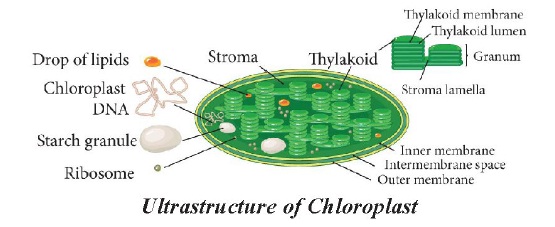
i) Envelope: Chloroplast envelope has outer and inner membranes which is seperated by intermembrane space.
ii) Stroma: Matrix present inside to the membrane is called stroma. It contains DNA, 70 S ribosomes and other molecules required for protein synthesis.
iii) Thylakoids : It consists of thylakoid membrane that encloses thylakoid lumen. Thylakoids forms a stack of disc like structures called a grana (singular-granum).
iv) Grana: Some of the thylakoids are arranged in the form of discs stacked one above the other. These stacks are termed as grana, they are interconnected to each other by membranous lamellae called Fret channels
2.
Photosynthesis is the process in which carbondioxide combines with water in the pressure of sunlight and chlorophyle to form carbohydrates
6CO2 + 12H2O \(\xrightarrow[{Chlorophyle}]{Light}\)C2H12O6 + 6H2O + 6O2 \(\uparrow \)
Carbondioxide + water Glucose + water + oxygen
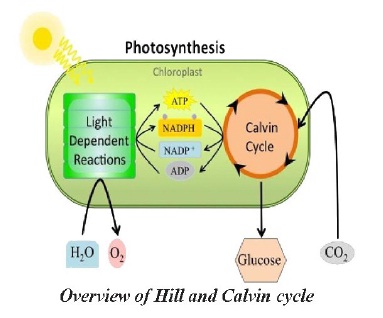
The entire process of photosynthesis takes place inside the chloroplast.
The structure of chloroplast is such that the light dependent (Light reaction) and light independent (Dark reaction) take place at different sites in the organelle
i) Light dependent photosynthesis (Hill reaction \ Light reaction)
a) This was discovered by Robin Hill (1939). This reaction takes place in the presence of light energy in thylakoid membranes (grana) of the chloroplasts.
b) Photosynthetic pigments absorb the light energy and convert it into chemical energy ATP and NADPH2.
c) These products of light reaction move out from the thylakoid to the stroma of the chloroplast.
ii) Light independent reactions (Biosynthetic phase)
(i) The second steps (dark reaction or biosynthetic pathway) is carried out in the stroma. During this reaction CO2 is reduced into carbohydrates with the help of light generated ATP and NADPH2.
(ii) This is also called as Calvin cycle and is carried out in the absence of light.
(iii) In Calvin cycle the inputs are CO2 from the atmosphere and the ATP and NADPH2 produced from light reaction.
3.
i) Mitochondrial Membranes: It consists two membranes called inner and outer membrane. Each membrane is 60-70 A° thick.
a) Outer mitochondrial membrane is smooth and freely permeable to most small molecules. It contains enzymes, proteins and lipids. It has porin molecules (proteins) which form channels for passage of molecules through it.
b) Inner mitochondrial membrane is semi permeable Membrane AND — om becomes attic outer inner regulates the passage of materials into and out of the mitochondria. It is rich in enzymes and carrier proteins. It consists of 80% proteins and lipids.
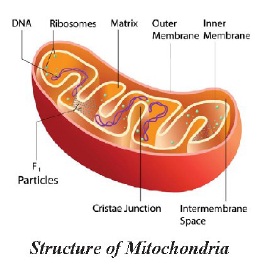
ii) Cristae: The inner mitochondrial membrane gives rise to finger like projections called cristae. These cristae increase the inner surface area (fold in inner membrane) of the mitochondria to hold variety of enzymes.
iii) Oxysomes: The inner mitochondrial membrane bear minute regularly spaced tennis racket shaped particles known as oxysomes (F1 particle). They involve in ATP synthesis
iv) Mitochondrial matrix - It is a complex mixture of proteins and lipids. Matrix contains enzymes for Krebs cycle, mitochondrial ribosomes(70 S), tRNAs and mitochondrial DNA.
4.
Aerobic respiration is the type of cellular respiration in which organic food is completely oxidized with the help of oxygen into carbon dioxide, water and energy. It occurs in most plants and animals.
\({C}_{6} {H}_{12} {O}_{6}+6 {O}_{2} \ \stackrel{\text { Mitochondria }}{\longrightarrow} \ 6 {CO}_{2} \ +6 {H}_{2} {O}+{ATP}\)
Glucose + Oxygen Carbon dioxide + Water + Energy
Stages of Aerobic respiration :
a) Glycolysis (Glucose splitting): It is the breakdown of one molecule of glucose (6 carbon) into two molecules of pyruvic acid (3 carbon). Glycolysis takes place in cytoplasm of the cell. It is the first step of both aerobic and anerobic respiration.
b) Krebs Cycle : This cycle occurs in mitochondria matrix. At the end of glycolysis, 2 molecules of pyruvic acid enter into mitochondria. The oxidation of pyruvic acid into CO2 and water takes place through this cycle. It is also called Tricarboxylic Acid Cycle (TCA).
c) Electron Transport Chain: This is accomplished through a system of electron carrier complex called electron transport chain (ETC) located on the inner membrane of the mitochondria. NADH2 and FADH2 molecules formed during glycolysis and Krebs cycle are oxidised to NAD+ and FAD+ to release the energy via electrons. The electrons, as they move through the system, release energy which is trapped by ADP to synthesize ATP. This is called oxidative phosphorylation. In this process O2, the ultimate acceptor of electrons gets reduced to water.
5.
| S.No. | Tissues | Dicot Stem | Monocot Stem |
| i | Hypodermis | Collenchymatous | Sclerenchymatous |
| ii | Ground tissue | Differentiated into cortex, endodermis, pericycle and pith |
Undifferentiated |
| iii | Vascular bundles | i) Less in number ii) Uniform in size iii) Arranged in a ring iv) Open v) Bundle sheath absent |
i) Numerous ii) Smaller near periphery, bigger in the centre iii) Scattered iv) Closed v) Bundle sheath present |
| iv | Secondary growth | Present | Mostly absent |
| v | Pith | Present | Absent |
| vi | Medullary rays | Present | Absent |

10th Standard Syllabus & Materials
10th Standard
TN 10th English Prose - 2 - The Night the Ghost Got in Important Questions And Answers Study Material - QB365 Set A
NEW10th Standard
TN 10th English Supplementary - 1 - The Tempest Important Questions And Answers Study Material - QB365 Set A
NEW10th Standard
TN 10th English Poem - 1 - Life Important Questions And Answers Study Material - QB365 Set A
NEW10th Standard
TN 10th English Prose - 1 - His First Flight Important Questions And Answers Study Material - QB365 Set A



Tamilnadu Stateboard 10th Standard Subjects
Tamilnadu Stateboard Standards





