
 100% FREE ACCESS
10th Standard Syllabus & Materials
10th Standard
TN 10th English Prose - 4 - The Attic Important Questions And Answers Study Material - QB365 Set A
NEW10th Standard
TN 10th English Supplementary - 3 - The Story of Mulan Important Questions And Answers Study Material - QB365 Set A
NEW10th Standard
TN 10th English Poem - 3 - I am Every Woman Important Questions And Answers Study Material - QB365 Set A
NEW10th Standard
TN 10th English Prose - 3 - Empowered Women Navigating The World Important Questions And Answers Study Material - QB365 Set A
NEW10th Standard
TN 10th English Supplementary - 2 - Zigzag Important Questions And Answers Study Material - QB365 Set A
NEW10th Standard
TN 10th English Poem - 2 - The Grumble Family Important Questions And Answers Study Material - QB365 Set A

Published on: 04/07/2021
QB365 provides detailed and simple solution for every
Creative Questions in class 10 Science Subject. It will helps to get more idea about question pattern in
every Creative questions with solution.
Download Tamil Nadu 10th Standard Science question papers, model tests, one-mark questions, important questions, and public exam papers in PDF format. Free study materials and answer keys for TN State Board students.
Questions + Answers key
Take MCQ Science Test1.
Describe the internal structure of Monocot or Isobilateral Leaf with labeled diagram.
2.
Describe the Internal Structure of Dicot or Dorsiventral Leaf (Mango) with labeled diagram.
3.
Describe the Internal Structure of Monocot Stem (Maize) with labeled diagram.
4.
Explain the internal structure of Dicot Stem (Sunflower) with labeled diagram.
5.
Explain the internal structure of monocot root (Maize) with labeled diagram.
1.
The transverse section of a monocot leaf reveals the following structures.
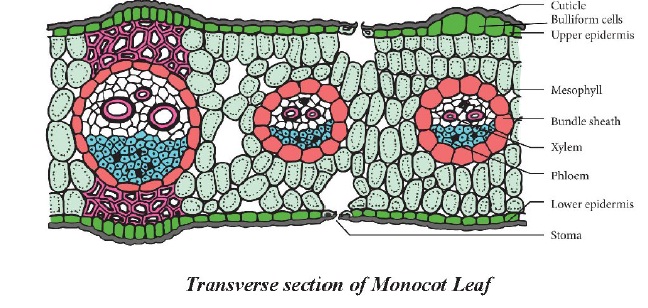
i) Epidermis : Monocot leaf has upper and lower epidermis. Epidermis is made up of parenchyma cells. Cuticle is present on the outer wall stomata are present on both upper and lower epidermis. Some cells of upper epidermis are large and thin walled they are known as bulliform cells.
ii) Mesophyll : It is the ground tissue that is present between both epidermal layers. Mesophyll is not differentiated into palisade and spongy parenchyma. The cells are irregularly arranged with inter-cellular spaces. These cells contain chloroplasts.
iii) Vascular bundles : Large number of vascular bundles are present, some of which are small and some are large. Each vascular bundle is surrounded by parenchymatous bundle sheath. Vascular bundles are conjoint, collateral and closed. Xylem is present towards upper epidermis and phloem towards lower epidermis.
2.
The transverse section of leaf shows the following structures
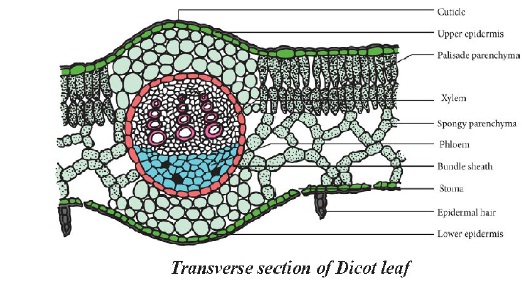
i) Upper epidermis: This is the outermost layer made of single layered parenchymatous cells without intercellular spaces. The outer wall of the cells are cuticularized. Stomata are less in number.
ii) Lower epidermis: It is a single layer of parenchymatous cells with a thin cuticle. It contains numerous stomata. Chloroplasts are present only in guard cells. The lower epidermis helps in the exchange of gases. The loss of water vapour is facilitated through this chamber.
iii) Mesophyll: The tissue present between the upper and lower epidermis is called mesophyll. It is differentiated into Palisade parenchyma and Spongy parenchyma.
a) Palisade parenchyma: It is found just below the upper epidermis. The cells are elongated. These cells have more number of chloroplasts. The cells do not have intercellular spaces and they take part in photosynthesis.
b) Spongy parenchyma: It is found below the palisade parenchyma tissue. Cells are almost spherical or oval and are irregularly arranged. Cells have intercellular spaces. It helps in gaseous exchange.
iv) Vascular bundles: Vascular bundle of mid-rib is larger. Vascular bundles are conjoint, collateral and closed. Each vascular bundle is surrounded by a sheath of parenchymatous cells called bundle sheath. Each vascular bundle consists of xylem lying towards the upper epidermis and phloem towards the lower epidermis.
3.
Internal Structure of Monocot Stem (Maize):
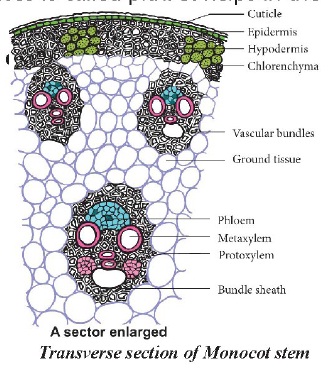
A transverse section of monocot stem reveals the following structures.
i) Epidermis: It is the outermost layer. It is made up of single layer of parenchyma cells. It is covered with thick cuticle. Multicellular hairs are absent and stomata are also less in number.
ii) Hypodermis: It is made up of few layers of sclerenchyma cells interrupted by chlorenchyma. Sclerenchyma provides mechanical support to plant.
iii) Ground tissue: The entire mass of parenchyma cells next to hypodermis and extending to the centre is called ground tissue. It is not differentiated into endodermis, cortex, pericycle and pith.
iv) Vascular Bundle: Vascular bundles are skull shaped and scattered in the ground tissue. Vascular bundles are conjoint, collateral, endarch and closed. Each vascular bundle is surrounded by few layer of sclerenchyma cells called bundle sheath.
a) Xylem: It consists of metaxylem and protoxylem. Xylem vessels are arranged in V or Y shape. In mature vascular bundle, the lower most protoxylem disintegrates and form a cavity. This is called protoxylem lacuna.
b) Phloem: It consists of sieve tube elements and companion cells. Phloem parenchyma, and phloem fibers are absent.
v) Pith: Pith is not differentiated in monocot stems.
4.
Internal Structure of Dicot Stem (Sunflower):
The transverse section of a dicot stem reveals the following structures.
i) Epidermis: It is the outermost layer. It is made up of single layer of parenchyma cells, its outer wall is covered with cuticle. It is protective in function.
ii) Cortex: It is divided into three regions:
a) Hypodermis: It consists of 3 - 6 layers of collenchyma cells. It gives mechanical support.
b) Middle cortex: It is made up of few layers of chlorenchyma cells. It is involed in photosynthesis due to the presence of chloroplast.
c) Inner cortex: It is made up of few layers of parenchyma cells. It helps in gaseous exchange and stores food materials.
Endodermis is the inner most layer of cortex it consists of a single layer of barrel shaped cells, these cells contain starch grains. So it is also called starch sheath.
iii) Stele: The central part of the stem inner to endodermis is known as stele. It consists of pericycle, vascular bundle and pith.
a) Pericycle: It occurs between vascular bundle and endodermis. It is multilayered, parenchymatous with alternating patches of sclerenchyma.
b) Vascular bundle: Vascular bundles are conjoint, collateral, endarch and open. They are arranged in the form of a ring around the pith.
c) Pith: The large central parenchymatous zone with intercellular spaces is called pith. It helps in the storage of food materials.
5.
Internal Structure of Monocot Root (Maize)
A thin transverse section of monocot root, shows the following characteristic features.
i) Epiblema or Rhizodermis: It is the outermost layer of the root, and is made up of single layer of thin walled, parenchymatous cell. Stomata and cuticle are absent. The root hair helps in absorption of water and minerals from the soil. This layer also protects the inner tissues.
ii) Cortex: It is multilayered large zone, composed of parenchymatous cells with intercellular spaces. It stores water and food material.
iii) Endodermis: It is the innermost layer of cortex with characteristic casparian strips and passage cells. Casparian strips are band like thickening made of suberin.
iv) Stele: All the tissues inner to endodermis constitute stele. It includes pericycle, vascular tissues and pith.
a) Pericycle: It is a single layer of thin walled cells. The lateral roots originate from this layer.
b) Vascular tissues: It consists of many patches of xylem and phloem arranged radially. The xylem is exarch and polyarch. The conjunctive tissue is made up of sclerenchyma.
c) Pith: It is present at the center. It is made up of parenchyma cells with intercellular space. Its contains abundant amount of starch grains. It stores food.

10th Standard Syllabus & Materials
10th Standard
TN 10th English Prose - 2 - The Night the Ghost Got in Important Questions And Answers Study Material - QB365 Set A
NEW10th Standard
TN 10th English Supplementary - 1 - The Tempest Important Questions And Answers Study Material - QB365 Set A
NEW10th Standard
TN 10th English Poem - 1 - Life Important Questions And Answers Study Material - QB365 Set A
NEW10th Standard
TN 10th English Prose - 1 - His First Flight Important Questions And Answers Study Material - QB365 Set A



Tamilnadu Stateboard 10th Standard Subjects
Tamilnadu Stateboard Standards





