
 100% FREE ACCESS
10th Standard Syllabus & Materials
10th Standard
TN 10th English Prose - 4 - The Attic Important Questions And Answers Study Material - QB365 Set A
NEW10th Standard
TN 10th English Supplementary - 3 - The Story of Mulan Important Questions And Answers Study Material - QB365 Set A
NEW10th Standard
TN 10th English Poem - 3 - I am Every Woman Important Questions And Answers Study Material - QB365 Set A
NEW10th Standard
TN 10th English Prose - 3 - Empowered Women Navigating The World Important Questions And Answers Study Material - QB365 Set A
NEW10th Standard
TN 10th English Supplementary - 2 - Zigzag Important Questions And Answers Study Material - QB365 Set A
NEW10th Standard
TN 10th English Poem - 2 - The Grumble Family Important Questions And Answers Study Material - QB365 Set A

Published on: 04/07/2021
QB365 provides detailed and simple solution for every
Creative Questions in class 10 Science Subject. It will helps to get more idea about question pattern in everyCreative questions with solution.
Download Tamil Nadu 10th Standard Science question papers, model tests, one-mark questions, important questions, and public exam papers in PDF format. Free study materials and answer keys for TN State Board students.
Questions + Answers key
Take MCQ Science Test1.
Explain the role of growth hormone produced by pituitary gland.
2.
Name the pituitary hormones, and on the target tissues? How does it exert its action.
3.
Describe the role of pancreas in maintenance of blood sugar level.
4.
Write a note on Thyroid Dysfunctions.
5.
Explain the physiological effects of Auxins.
1.
(i) Growth hormone is produced by anterior to be of pituitary gland.
(ii) GH promotes the development and enlargement of all tissues of the body.
(iii) It stimulates the growth of muscles, cartilage and long bones.
(iv) It controls the cell metabolism The improper secretion of this hormone leads to the following conditions.
Dwarfism:
(i) It is caused by less secretion of growth hormone in children.
(ii) The characteristic features are stunted growth, delayed skeletal formation, retarded sexual development and mental disability.
Gigantism:
(i) Over secretion of growth hormone leads to gigantism in children.
(ii) It is characterised by overgrowth of all body tissues and organs. Individuals attain abnormal increase in height.
Acromegaly: Excess secretion of growth hormone in adults may lead to abnormal enlargement of head, "face,hands and feet.
2.
| Pituitary hormones | Tissue | Action |
| Growth hormone | All tissues | Growth of cartilage, bones, muscles and enlargement of all tissues. |
| Thyroid Stimulating Hormone |
Thyroid gland | Controls growth of the thyroid gland, co-ordinates its activities and hormone secretion. |
| Adrenocortico tropic Hormone |
Adrenal gland - cortex layer |
Stimulates adrenal cortex the produce its hormones and influences protein synthesis also |
| Gonadotropins a. Follicular stimulating hormone |
Testis - Germinal epithelium Ovary - Follicles |
In male it stimulates germinal epithelium of testis to produce sperms. In female, it initiates growth of ovarian follicles. |
| b. Luteinizing hormone | Testis (Male) Ovary (Female) |
Promotes the Leydig cells to secrete male sex hormone testosterone. Causes ovulation |
| c. Prolactin | Mammary glands | Initiates development of mammary glands during pregnancy and stimulates milk production after child birth. |
| Posterior lobe - hormones a. Vasopressin |
Kidney tubules | Increases reabsorption of water and reduces water loss through urine. |
| b. Oxytocin | Uterus | Helps in contraction of smooth muscles of uterus at the time of child birth and milk ejection from mammary gland. |
3.
The endocrine portion of pancreas is made up of Islets of Langerhans.
Structure of Pancreas:
The Islets of Langerhans consists of two types of cells namely alpha cells and beta cells. The alpha cells secrete glucagon and beta cells secrete insulin.
Functions of Pancreatic hormones:
A balance between insulin and glucagon production is necessary to maintain blood glucose concentration.
Insulin :
(i) Insulin helps in the conversion of glucose into glycogen which is stored in liver and skeletal muscles.
(ii) It promotes the transport of glucose into the cells.
(iii) It decreases the concentration of glucose in blood.
Glucagon:
(i) Glucagon helps in the breakdown of glycogen to glucose in the liver.
(ii) It increases blood glucose levels.
Diabetes mellitus :
The deficiency of insulin causes Diabetes mellitus. It is characterised by
(i) Increase in blood sugar level (Hyperglycemia)
(ii) Excretion of excess glucose in the urine (Glycosuria).
(iii) Frequent urination (Polyuria).
(iv) Increased thirst (Polydipsia).
(v) Increase in appetite (Polyphagia).
4.
When the thyroid gland fails to secrete the normal level of hormones, the condition is called thyroid dysfunction. It leads to the following conditions.
Hypothyroidism: It is caused due to the decreased secretion of the thyroid hormones. The abnormal conditions are simple goitre, cretinism and myxoedema.
Goitre:
(i) It is caused due to the inadequate supply of iodine in our diet.
(ii) This is commonly prevalent in Himalayan regions due to low level of iodine content in the soil.
(iii) It leads to the enlargement of thyroid gland which protrudes as a marked swelling in the neck and is called as goitre.
Cretinism:
(i) It is caused due to decreased secretion of the thyroid hormones in children.
(ii) The conditions are stunted growth, mental defect, lack of skeletal development and deformed bones. They are called as cretins
Myxoedema:
(i) It is caused by deficiency of thyroid hormones in adults.
(ii) They are mentally sluggish, increase in body weight, puffiness of the face and hand, oedematous appearance.
Hyperthyroidism:
(i) It is caused due to the excess secretion of the thyroid hormones which leads to Grave's disease (Exopthalmic goitre).
(ii) The symptoms are protrusion of the eyeballs (Exopthalmia), increased metabolic rate, high body temperature, profuse sweating, loss of body weight and nervousness.
5.
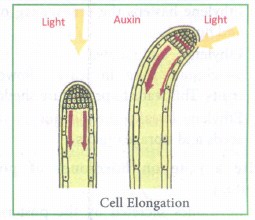
Auxins bring about a variety of physiological effects in different parts of the plant body. Some of them are discussed below:
(i) Auxins promote the elongation of stems and coleoptiles which makes them to grow.
(ii) Auxins induce root formation at low concentration and inhibit it at higher concentration.
(iii) The auxins produced by the apical buds suppress growth of lateral buds. This is called Apical Dominance.
(iv) Seedless fruits without fertilization are induced by the external application of auxins. (Parthenocarpy). Examples: Watermelon, Grapes, Lime etc.
(v) Auxins prevent the formation of abscission layer.

10th Standard Syllabus & Materials
10th Standard
TN 10th English Prose - 2 - The Night the Ghost Got in Important Questions And Answers Study Material - QB365 Set A
NEW10th Standard
TN 10th English Supplementary - 1 - The Tempest Important Questions And Answers Study Material - QB365 Set A
NEW10th Standard
TN 10th English Poem - 1 - Life Important Questions And Answers Study Material - QB365 Set A
NEW10th Standard
TN 10th English Prose - 1 - His First Flight Important Questions And Answers Study Material - QB365 Set A



Tamilnadu Stateboard 10th Standard Subjects
Tamilnadu Stateboard Standards





