
 100% FREE ACCESS
10th Standard Syllabus & Materials
10th Standard
TN 10th English Prose - 4 - The Attic Important Questions And Answers Study Material - QB365 Set A
NEW10th Standard
TN 10th English Supplementary - 3 - The Story of Mulan Important Questions And Answers Study Material - QB365 Set A
NEW10th Standard
TN 10th English Poem - 3 - I am Every Woman Important Questions And Answers Study Material - QB365 Set A
NEW10th Standard
TN 10th English Prose - 3 - Empowered Women Navigating The World Important Questions And Answers Study Material - QB365 Set A
NEW10th Standard
TN 10th English Supplementary - 2 - Zigzag Important Questions And Answers Study Material - QB365 Set A
NEW10th Standard
TN 10th English Poem - 2 - The Grumble Family Important Questions And Answers Study Material - QB365 Set A

Published on: 04/07/2021
QB365 provides detailed and simple solution for every
Creative Questions in class 10 Science Subject. It will helps to get more idea about question pattern in
every Creative questions with solution.
Download Tamil Nadu 10th Standard Science question papers, model tests, one-mark questions, important questions, and public exam papers in PDF format. Free study materials and answer keys for TN State Board students.
Questions + Answers key
Take MCQ Science Test1.
What is UTI? Explain its types.
2.
Describe different events of human reproduction from fertilization to foetal development.
3.
Describe the structure of Ovum with labelled diagram.
4.
Describe the structure of Human Sperm with labelled diagram.
5.
Describe the structure of testes with labelled diagram.
1.
A urinary tract infection (UTI) is an infection in any part of our urinary system our kidneys, ureters, bladder and urethra. Woman are susceptible to UTI from the bacteria that are present on skin, rectum or vagina.
The types of UTI are:
i) Cystitis or Bladder infection: Bacteria lodged in the urinary bladder thrive and multiply leading to inflammation. It is most common in the age group of 20 to 50.
ii) Kidney Infection: The bacteria can travel from the urinary bladder and upward to ureter and affect one or both the kidneys. It also infects the blood stream and leads to serious life-threatening complications.
iii) Asymptomatic Bacteriuria: The bacteria present in the urinary bladder which may not show any symptoms.
2.
a) Fertilization : Fertilization in human is internal and occurs in the oviduct of the female genital tract. The sperm enters into the ovum and fuses with it, resulting in the formation of a ‘zygote’ This process is called fertilization. The zygote is a fertilized ovum.
b) Cleavage and Formation of Blastula : The first cleavage takes place about 30 hours after fertilization. Cleavage is a series of rapid mitotic divisions of the zygote to form many celled blastula (Blastocyst) which comprises an outer layer of smaller cells and inner mass of larger cells.
c) Implantation : The blastocyst (fertilized egg) reaches the uterus and gets implanted in the uterus. The process of attachment of the blastocyst to the uterine wall (endometrium) is called implantation. The fertilized egg becomes implanted in about 6 to 7 days after fertilization.
d) Gastrulation : The transformation of blastula into gastrula and the formation of primary germ layers (ectoderm, mesoderm and endoderm) by rearrangement of the cells is called gastrulation. This takes place after the process of implantation.
e) Organogenesis : The establishment of the germ layers namely ectoderm, mesoderm and endoderm initiates the final phase of embryonic development. During organogenesis the various organs of the foetus are established from the different germ layers attaining a functional state.
f) Formation of Placenta : The placenta is a disc shaped structure attached to the uterine wall and is a temporary association between the developing embryo and maternal tissues. It allows the exchange of food materials, diffusion of oxygen, excretion of nitrogenous wastes and elimination of carbon dioxide. A cord containing blood vessels that connects the placenta with the foetus is called the umbilical cord.
g) Pregnancy (Gestation) : It is the time period during which the embryo attains its development in the uterus. Normally gestation period of human last for about 280 days. During pregnancy the uterus expands upto 500 times of its normal size.
h) Parturition (Child Birth) : Parturition is the expulsion of young one from the mother’s uterus at the end of gestation. Oxytocin from the posterior pituitary stimulates the uterine contractions and provides force to expel the baby from the uterus, causing birth.
3.
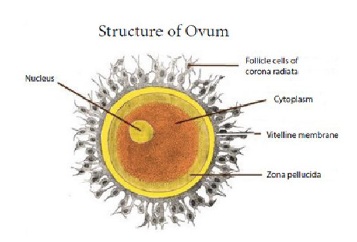
a) The mature ovum or egg is spherical in shape.
b) The ovum is almost free of yolk. It contains abundant cytoplasm and the nucleus.
c) The plasma membrane of ovum is surrounded by three membranes.
(i) Inner thin zona pellucida.
(ii) Vitelline membrane forms the surface layer of the ovum.
(iii) An outer thick corona radiata.
d) The corona radiata is formed of follicle cells.
e) The fluid-filled space between zona pellucida and the surface of the egg is called perivitelline space.
4.
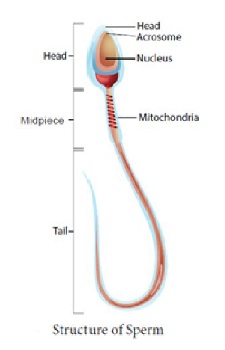
i) The spermatozoan consists of head, a middle piece and tail.
ii) The sperm head is elongated and formed by the condensation of nucleus.
iii) The anterior portion has a cap structure called acrosome.
iv) Acrosome contains hyaluronidase an enzyme that helps the sperm to enter the ovum during fertilization.
v) Ashort neck connects the head and middle piece which comprises the centrioles.
vi) The middle piece contains the mitochondria which provides energy for the movement of tail. It brings about sperm motility which is essential for fertilization.
5.
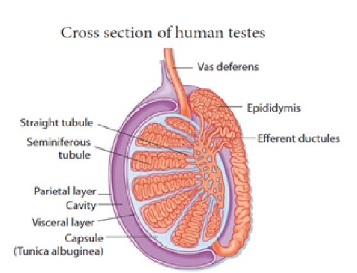
i) Testes are the reproductive glands of the male that are oval shaped organs which lie outside the abdominal cavity of a man in a sac like structure called scrotum.
ii) Each testes is covered with a layer of fibrous tissue called tunica albuginea.
iii) Many septa from this layer divide the testes into pyramidal lobules, in which lie seminiferous tubules, cells of Sertoli, and the Leydig cells (interstitial cells).
iv) The process of spermatogenesis takes place in the seminiferous tubules.
v) The Sertoli cells are the supporting cells and provide nutrients to the developing sperms.
vi) TheLeydig cells are polyhedral in shape and lie between the seminiferous tubules and secrete testosterone. It initiates the process of spermatogenesis.

10th Standard Syllabus & Materials
10th Standard
TN 10th English Prose - 2 - The Night the Ghost Got in Important Questions And Answers Study Material - QB365 Set A
NEW10th Standard
TN 10th English Supplementary - 1 - The Tempest Important Questions And Answers Study Material - QB365 Set A
NEW10th Standard
TN 10th English Poem - 1 - Life Important Questions And Answers Study Material - QB365 Set A
NEW10th Standard
TN 10th English Prose - 1 - His First Flight Important Questions And Answers Study Material - QB365 Set A



Tamilnadu Stateboard 10th Standard Subjects
Tamilnadu Stateboard Standards





