
 100% FREE ACCESS
10th Standard Syllabus & Materials
10th Standard
TN 10th English Prose - 4 - The Attic Important Questions And Answers Study Material - QB365 Set A
NEW10th Standard
TN 10th English Supplementary - 3 - The Story of Mulan Important Questions And Answers Study Material - QB365 Set A
NEW10th Standard
TN 10th English Poem - 3 - I am Every Woman Important Questions And Answers Study Material - QB365 Set A
NEW10th Standard
TN 10th English Prose - 3 - Empowered Women Navigating The World Important Questions And Answers Study Material - QB365 Set A
NEW10th Standard
TN 10th English Supplementary - 2 - Zigzag Important Questions And Answers Study Material - QB365 Set A
NEW10th Standard
TN 10th English Poem - 2 - The Grumble Family Important Questions And Answers Study Material - QB365 Set A

Published on: 13/05/2022
QB365 provides detailed and simple solution for every
Creative Questions in class 10 Science Subject. It will helps to get more idea about question pattern in
every Creative questions with solution.
Download Tamil Nadu 10th Standard Science question papers, model tests, one-mark questions, important questions, and public exam papers in PDF format. Free study materials and answer keys for TN State Board students.
Questions + Answers key
Take MCQ Science Test1.
Explain the process of fertilization of angiospermic plants.
2.
What is Cross pollination or allogamy? What are the advantages and disadvantages of cross pollination?
3.
What is self-pollination or autogamy? What are the advantages and disadvantages of self pollination?
4.
With labelled diagram describe the structure of pollen grain.
5.
Explain the vegetative reproduction takes place in plants.
1.
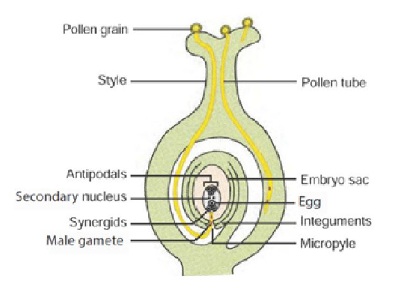
a) Pollen grains reach the right stigma and begin to germinate.
b) Pollen grain forms a small tube-like structure called pollen tube which emerges through the germ pore. The contents of the pollen grain move into the tube.
c) Pollen tube grows through the tissues of the stigma and style and finally reaches the ovule through the micropyle.
d) Vegetative cell degenerates and the generative cell divides to form two sperms (or male gametes).
e) Tip of pollen tube bursts and the two sperms enter the embryo sac.
f) One sperm fuses with the egg (syngamy) and forms a diploid zygote. Sperm (n) + Egg (n) = Zygote (2n)
g) The other sperm fuses with the secondary nucleus (Triple fusion) to form the primary endosperm nucleus which is triploid in nature. Second sperm (n) + Secondary nucleus (2n) = Endosperm nucleus (3n)
h) Since two types of fusion, syngamy and triple fusion take place in an embryo sac the process is termed as double fertilization.
i) After triple fusion, primary endosperm nucleus develops into an endosperm. Endosperm provides food to the developing embryo.
j) Later the synergids and antipodal cells degenerate.
2.
Cross-pollination is the transfer of pollen from the anthers of a flower to the stigma of a flower on another plant of the same species. E.g. apples, grapes, plum, etc.
Advantages of cross pollination
i) The seeds produced as a result of cross pollination, develop and germinate properly and grow into better plants, i.e. cross pollination leads to the production of new varieties.
ii) More viable seeds are produced.
Disadvantages of cross-pollination
i) Pollination may fail due to distance barrier.
ii) More wastage of pollen grains.
iii) It may introduce some unwanted characters.
iv) Flowers depend on the external agencies for pollination.
3.
The transfer of pollen grains from the anther to the stigma of same flower or another flower borne on the same plant is known as self-pollination or autogamy. e.g. Hibiscus.
Advantages of self-pollination
i) Self-pollination is possible in certain bisexual flowers.
ii) Flowers do not depend on agents for pollination.
iii)There is no wastage of pollen grains.
Disadvantages of self-pollination
i) The seeds are less in numbers.
ii) The endosperm is minute. Therefore, the seeds produce weak plants.
iii) New varieties of plants cannot be produced.
4.
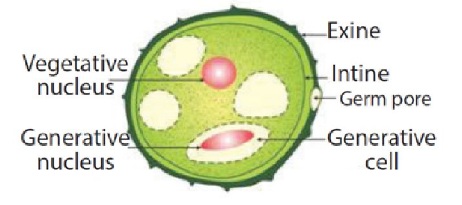
i) Pollen grains are usually spherical in shape.
ii) It has a two-layered wall.
iii) Exine: The hard-outer layer is known as exine. It has prominent apertures called germ pores.
iv) Intine: The inner thin layer is known as intine. It is a thin and continuous layer made up of cellulose and pectin.
v) Mature pollen grains contain two cells, the vegetative and the generative cell.
vi) Vegetative cell contains a large nucleus.
vii) The generative cell divides mitotically to form two male gametes.
5.
In vegetative reproduction, new plantlets are formed from vegetative (somatic) cells, buds or organs (root, stem, leaf or bud) of plant. It has only mitotic division, no gametic fusion and daughter plants are genetically similar to the parent plant.
Vegetative reproduction may take place through;
a) By vegetative parts
(i) Leaves: In Bryophyllum small plants grow at the leaf notches
(ii) Stems: In strawberry aerial weak stems touch the ground and give off adventitious roots and buds. When the connections with the parent plant is broken, the offspring beomes independent.
(iii) Root: Tuberous roots (Asparagus and Sweet potato) can be used for vegetative propagation.
(iv) Bulbils : In some plants the flower bud modifies into globose bulb which are called as bulbils, when these falls on the ground they grow into new plants. e.g. Agave.
b) Fragmentation : In filamentous algae, breaking of the filament into many fragments is called fragmentation. Each fragment having atleast one cell, may give rise to a new filament of the algae by cell division e.g. Spirogyra.
c) Fission : In this type the parent cell divides into two daughter cells and each cell develops into a new adult organism e.g. Amoeba.
iv) Budding: Formation of a daughter individual from a small projection, the bud, arising on the parent body is called budding. e.g. Yeast.
v) Regeneration : The ability of the lost body parts of an individual organism to give rise to an whole new organism is called regeneration. It takes place by specialized mass of cells e.g Hydra and Planaria.

10th Standard Syllabus & Materials
10th Standard
TN 10th English Prose - 2 - The Night the Ghost Got in Important Questions And Answers Study Material - QB365 Set A
NEW10th Standard
TN 10th English Supplementary - 1 - The Tempest Important Questions And Answers Study Material - QB365 Set A
NEW10th Standard
TN 10th English Poem - 1 - Life Important Questions And Answers Study Material - QB365 Set A
NEW10th Standard
TN 10th English Prose - 1 - His First Flight Important Questions And Answers Study Material - QB365 Set A



Tamilnadu Stateboard 10th Standard Subjects
Tamilnadu Stateboard Standards





