
 100% FREE ACCESS
10th Standard Syllabus & Materials
10th Standard
TN 10th English Prose - 4 - The Attic Important Questions And Answers Study Material - QB365 Set A
NEW10th Standard
TN 10th English Supplementary - 3 - The Story of Mulan Important Questions And Answers Study Material - QB365 Set A
NEW10th Standard
TN 10th English Poem - 3 - I am Every Woman Important Questions And Answers Study Material - QB365 Set A
NEW10th Standard
TN 10th English Prose - 3 - Empowered Women Navigating The World Important Questions And Answers Study Material - QB365 Set A
NEW10th Standard
TN 10th English Supplementary - 2 - Zigzag Important Questions And Answers Study Material - QB365 Set A
NEW10th Standard
TN 10th English Poem - 2 - The Grumble Family Important Questions And Answers Study Material - QB365 Set A

Published on: 05/07/2021
QB365 provides detailed and simple solution for every
Creative Questions in class 10 Science Subject. It will helps to get more idea about question pattern in everyCreative questions with solution.
Download Tamil Nadu 10th Standard Science question papers, model tests, one-mark questions, important questions, and public exam papers in PDF format. Free study materials and answer keys for TN State Board students.
Questions + Answers key
Take MCQ Science Test1.
Explain about the Gases.
2.
Explain about Real and apparent expansion.
3.
Explain about Superficial expansion.
4.
Explain about Linear expansion with a suitable diagram.
5.
How to establish the thermal equilibrium?
1.
Gases are classified as real gases and ideal gases.
Real Gases:
i) If the molecules or atoms of a gases interact with each other with a definite amount of intermolecular or inter atomic force of attraction, then the gases are said to be real gases.
ii) At very high temperature or low pressure, a real gas behaves as an ideal gas because in this condition there is no interatomic or intermolecular force of attraction.
Ideal Gases:
iii) If the atoms or molecules of a gas do not interact with each other, then the gas is said to be an ideal gas or a perfect gas.
iv) Actually, in practice, no gas is ideal. The molecules of any gas will have a certain amount of interaction among them.
v) But, these interactions are weaker when the pressure is low or the temperature is high because the interatomic or intermolecular forces of attraction are weak in ideal gas.
vi) Hence, a real gas at low pressure or high temperature can be termed as a perfect gas. Ideal gases obey Boyle’s law, Charles’s law and Avogadro's law.
vii) All these laws state the relationship between various properties of a gas such as pressure (P), volume (V), temperature (T) and number of atoms (n). In a given state of the gas, all these parameters will have a definite set of values.
viii) When there is a change in the state of the gas, any one or more of these parameters change its value.
2.
Real expansion:
i) If a liquid is heated directly without using any container, then the expansion that you observe is termed as real expansion of the liquid.
ii) Coefficient of real expansion is defined as the ratio of the true rise in the volume of the liquid per degree rise in temperature to its unit volume.
iii) The SI unit of coefficient of real expansion is K-1
Apparent expansion:
i) Heating a liquid without using a container is not possible. Thus, in practice, we can heat any liquid by pouring it in a container.
ii) A part of thermal energy is used in expanding the container and a part is used in expanding the liquid.
iii) Thus, we observed is not the actual or real expansion of the liquid.
iv) The expansion of a liquid apparently observed without considering the expansion of the container is called the apparent expansion of the liquid.
v) Coefficient of apparent expansion is defined as the ratio of the apparent rise in the volume of the liquid per degree rise in temperature to its unit volume.
vi) The SI unit of coefficient of apparent expansion is K-1.
3.
a) If there is an increase in the area of a solid object due to heating, then the expansion is called superficial or areal expansion.
b) Superficial expansion is determined in terms of coefficient of superficial expansion.
c) The ratio of increase in area of the body per degree rise in temperature to its unit area is called as coefficient of superficial expansion.
d) Coefficient of superficial expansion is different for different materials.
e) The SI unit of Coefficient of superficial expansion is K-1.
f) The equation relating to the change in area and the change in temperature is given below.
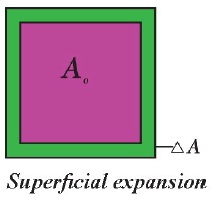
\(\Delta A / A_{o}=\alpha_{A} \Delta T\)
\(\triangle A\) - Change in area (Final area - Initial area)
Ao - Original area
\(\triangle T\) - Change in temperature (Final temperature - Initial temperature)
\(\alpha\)A - Coefficient of superficial expansion.
4.
i) When a body is heated or cooled, the length of the body changes due to change in its temperature.
ii) Then the expansion is said to be linear or longitudinal expansion.
iii) The ratio of increase in length of the body per degree rise in temperature to its unit length is called as the coefficient of linear expansion.
iv) The SI unit of Coefficient of Linear expansion is K-1.. The value of coefficient of linear expansion is different for different materials.
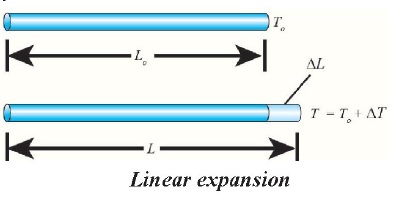
5. The equation relating the change in length and the change in temperature of a body is given below:
\(\Delta \mathrm{L} / \mathrm{L}_{0}=\alpha \mathrm{L} \Delta \mathrm{T}\)
\(\triangle L\) - Change in length (Final Length-Original length)
Lo - Original length
\(\triangle T\) - Change in temperature (Final temperature - Initial temperature)
\(\alpha L\) - Coefficient of linear expansion.
5.
i) Two or more physical systems or bodies are said to be in thermal equilibrium if there is no net flow of thermal energy between the systems.
ii) Heat energy always flows from one body to the other due to a temperature difference between them.
iii) If two bodies are said to be in thermal equilibrium, then, they will be at the same temperature.
iv) There will be a transfer of heat energy from the hot body to the cold body until a thermal equilibrium is established between them.
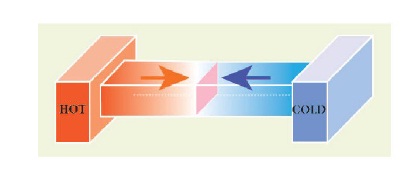
v) When a cold body is placed in contact with a hot body, some thermal energy is transferred from the hot body to the cold body.
vi) As a result, there is some rise in the temperature of the cold body and decrease in the temperature of the hot body.
vii) This process will continue until these two bodies attain the same temperature.

10th Standard Syllabus & Materials
10th Standard
TN 10th English Prose - 2 - The Night the Ghost Got in Important Questions And Answers Study Material - QB365 Set A
NEW10th Standard
TN 10th English Supplementary - 1 - The Tempest Important Questions And Answers Study Material - QB365 Set A
NEW10th Standard
TN 10th English Poem - 1 - Life Important Questions And Answers Study Material - QB365 Set A
NEW10th Standard
TN 10th English Prose - 1 - His First Flight Important Questions And Answers Study Material - QB365 Set A



Tamilnadu Stateboard 10th Standard Subjects
Tamilnadu Stateboard Standards





