
 100% FREE ACCESS
10th Standard Syllabus & Materials
10th Standard
TN 10th English Prose - 4 - The Attic Important Questions And Answers Study Material - QB365 Set A
NEW10th Standard
TN 10th English Supplementary - 3 - The Story of Mulan Important Questions And Answers Study Material - QB365 Set A
NEW10th Standard
TN 10th English Poem - 3 - I am Every Woman Important Questions And Answers Study Material - QB365 Set A
NEW10th Standard
TN 10th English Prose - 3 - Empowered Women Navigating The World Important Questions And Answers Study Material - QB365 Set A
NEW10th Standard
TN 10th English Supplementary - 2 - Zigzag Important Questions And Answers Study Material - QB365 Set A
NEW10th Standard
TN 10th English Poem - 2 - The Grumble Family Important Questions And Answers Study Material - QB365 Set A

Published on: 13/05/2022
QB365 provides detailed and simple solution for every Book back Questions in class 10 Science Subject. It will helps to get more idea about question pattern in every book back questions with solution.
latest Book back QuestionsDownload Tamil Nadu 10th Standard Science question papers, model tests, one-mark questions, important questions, and public exam papers in PDF format. Free study materials and answer keys for TN State Board students.
Questions + Answers key
Take MCQ Science Test1.
Why is the Sinoatrial node called the pacemaker of heart?
2.
Who discovered Rh factor? Why was it named so?
3.
What are heart sounds? How are they produced?
4.
Describe the structure and working of the human heart.
5.
Trace the pathway followed by water molecules from the time it enters a plant root to the time it escapes into the atmosphere from the leaf.
1.
Sino-atrial node is called the 'pacemaker' of heart because it is capable of initiating impulse which can stimulate the heart muscles to contract thereby pushing the blood into the ventricles.
2.
(i) Rh factor was discovered by Landsteiner and Wiener in 1940. It was named so because it was first discovered in Rhesus monkey.
3.
(i) The rhythmic closure and opening of the valves cause the sound of heart.
(ii) The first sound LUBB is of longer duration and is produced by the closure of the tricuspid and bicuspid valves after the beginning of the ventricular systole.
(iii) The second sound DUPP is of a shorter duration and is produced by the closure of semilunar valves at the end of ventricular systole.
4.
Structure of heart:
(i) Heart is a muscular pumping organ that pumps out blood into the blood vessels.
(ii) It is enclosed in a double walled sac called pericardium.
(iii) The two upper thin walled chambers are called auricles and the two thick walled chambers are called ventricles.
(iv) The chambers are separated by septum
(v) Heart contains pericardial fluid.
Working of heart:
(i) Contraction of heart is called systole and relaxation is called diastole.
(ii) When the auricles are filled with blood they are in diastole. The tricuspid and bicuspid valves remain closed. This is called atrial diastole.
(iii) When the auricles are full they contract. This leads to the opening of tricuspid and bicuspid valves. Blood from the auricles are pushed to the ventricles. This is called atrial systole.
(iv) Now the valves are closed. The ventricles contract. The deoxygenated blood from the right ventricle enters the pulmonary artery and the oxygenated blood from the left ventricle enters the aorta. This is called ventricular systole.
(v) These three events constitute the cardiac cycle.
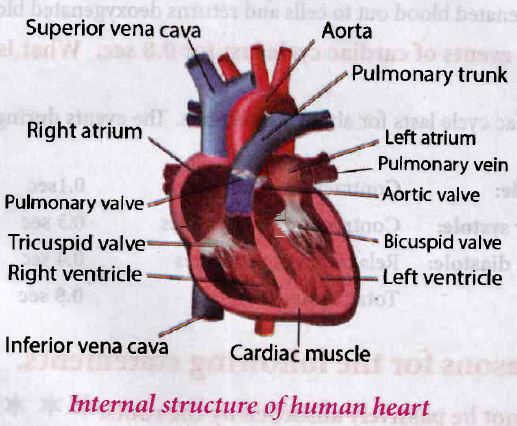
5.
(i) Root pressure → Capillary action → Adhesion→ Cohesion → Transpiration pull → Transpiration.
(ii) Once the water enters the root hairs, the concentration of water molecules in the root hair cells become more than that of the cortex.
(iii) Thus the water from the root hair moves to the cortical cells by osmosis and then reaches the xylem.
(iv) From there the water is transported to the stem and the leaves.
(v) There are two pathways by which the water absorbed by the root hairs enters the deeper layers. Apoplast pathway and Symplast pathway.
(vi) Apoplast pathway does not involve crossing the cell membrane and the movement is dependent on the gradient.
(vii) In Symplast pathway, water enters the cell through the cell membrane.
(viii) Transpiration is the evaporation of water in plants through stomata in the leaves.
(ix) Water evaporates from mesophyll cells of leaves through stomata.

10th Standard Syllabus & Materials
10th Standard
TN 10th English Prose - 2 - The Night the Ghost Got in Important Questions And Answers Study Material - QB365 Set A
NEW10th Standard
TN 10th English Supplementary - 1 - The Tempest Important Questions And Answers Study Material - QB365 Set A
NEW10th Standard
TN 10th English Poem - 1 - Life Important Questions And Answers Study Material - QB365 Set A
NEW10th Standard
TN 10th English Prose - 1 - His First Flight Important Questions And Answers Study Material - QB365 Set A



Tamilnadu Stateboard 10th Standard Subjects
Tamilnadu Stateboard Standards





