
 100% FREE ACCESS
10th Standard Syllabus & Materials
10th Standard
TN 10th English Prose - 4 - The Attic Important Questions And Answers Study Material - QB365 Set A
NEW10th Standard
TN 10th English Supplementary - 3 - The Story of Mulan Important Questions And Answers Study Material - QB365 Set A
NEW10th Standard
TN 10th English Poem - 3 - I am Every Woman Important Questions And Answers Study Material - QB365 Set A
NEW10th Standard
TN 10th English Prose - 3 - Empowered Women Navigating The World Important Questions And Answers Study Material - QB365 Set A
NEW10th Standard
TN 10th English Supplementary - 2 - Zigzag Important Questions And Answers Study Material - QB365 Set A
NEW10th Standard
TN 10th English Poem - 2 - The Grumble Family Important Questions And Answers Study Material - QB365 Set A

Published on: 07/02/2020
10th Standard Mathematics All Chapter Creative Questions-I-2020
Download Tamil Nadu 10th Standard Maths question papers, model tests, one-mark questions, important questions, and public exam papers in PDF format. Free study materials and answer keys for TN State Board students.
Questions + Answers key
Take MCQ Maths Test1.
Find the depth of a cylindrical tank of radius 28 m, if its capacity is equal to that of a rectangular tank of size 28 m x 16 m x 11 m.
2.
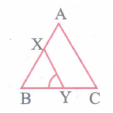
In figure the line segment XY is parallel to side AC of \(\Delta ABC\) and it divides the triangle into two parts of equal areas. Find the ratio \(\cfrac { AX }{ AB } \)
3.
The marks scored by 5 students in a test for 50 marks are 20, 25, 30, 35, 40. Find the S.D for the marks. If the marks are converted for 100 marks, find the S.D. for newly obtained marks.
4.
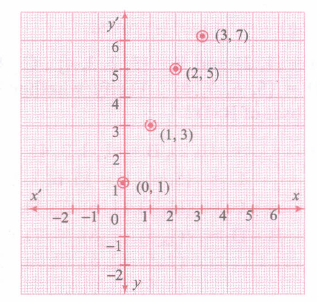
Let A = {0, 1, 2, 3} and B = {1, 3, 5, 7, 9} be two sets. Let f: A \(\rightarrow\)B be a function given by f(x) = 2x + 1. Represent this function as a graph.
5.
Prove that the equation x2(a2+b2)+2x(ac+bd)+(c2+ d2) = 0 has no real root if ad≠bc.
6.
Use Euclid's algorithm to find the HCF of 4052 and 12756.
7.
If A (-5, 7), B (-4, -5), C (-1, -6) and D (4, 5) are the vertices of a quadrilateral, find the area of the quadrilateral ABCD.
8.
The perpendicular from A on side BC at a \(\triangle\)ABC intersects BC at D such that DB = 3 CD. Prove that 2AB2 = 2AC2 + BC2.
9.
From a point on a bridge across a river, the angles of depression of the banks on opposite sides at the river are 30° and 45°, respectively. If the bridge is at a height at 3 m from the banks, find the width at the river.
10.
BL and CM are medians of a triangle ABC right angled at A.
Prove that 4(BL2 + CM2) = 5BC2.
11.
Evaluate \(\frac { tan{ 65 }^{ o } }{ tan{ 25 }^{ o } } \)
12.
A spherical ball of iron has been melted and made into small balls. If the radius of each smaller ball is one-fourth of the radius of the original one, how many such balls can be made?
13.
S.D. of a data is 2102, mean is 36.6, then find its C.V.
14.
Find the number of coins, 1.5 cm is diameter and 0.2 cm thick, to be melted to form a right circular cylinder of height 10 cm and diameter 4.5 cm.
15.
Find the co-efficient of variation for the following data: 16, 13, 17,21, 18.
16.
Find two consecutive natural numbers whose product is 20.
17.
A chess board contains 64 equal squares and the area of each square is 6.25 cm2, A border round the board is 2 cm wide.
18.
Find the sum of first 24 terms of the list of numbers whose nth term is given by an = 3 + 2n.
19.
Which of the following list of numbers form an AP? If they form an AP, write the next two terms:
1,-1,-3, -5, ...
20.
The following table represents a function from A = {5, 6, 8, 10} to B = {19, 15, 9, 11}, where f(x) = 2x - 1. Find the values of a and b.
| x | 5 | 6 | 8 | 10 |
|---|---|---|---|---|
| f(x) | a | 11 | b | 19 |
21.
Find the value of k if the points A(2, 3), B(4, k) and (6, -3) are collinear.
22.
Let f = {(2, 7); (3, 4), (7, 9), (-1, 6), (0, 2), (5,3)} be a function from A = {-1,0, 2, 3, 5, 7} to B = {2, 3, 4, 6, 7, 9}. Is this
(i) an one-one function
(ii) an onto function,
(iii) both one and onto function?
23.
Find the coordinates at the points of trisection (i.e. points dividing in three equal parts) of the line segment joining the points A(2, -2) and B(-7, 4).
24.
When three coins are tossed, the probability of getting the same face on all the three coins is ___________
\(\frac { 1 }{ 8 } \)
\(\frac { 1 }{ 4 } \)
\(\frac { 3 }{ 8 } \)
\(\frac { 1 }{ 3 } \)
25.
The radius of a wire is decreased to one-third of the original. If volume the same, then the length will be increased _______of the original.
3 times
6 times
9 times
27 times
26.
The ratio of the volumes of two spheres is 8 : 27. If r and R are the radii of sphere respectively, Then (R - r) : r is ___________
1:2
1:3
2:3
4:9
27.
Find the value of P, given that the line \(\frac { y }{ 2 } =x-p\) passes through the point (-4, 4) is ____________
-4
-6
0
8
28.
Three circles are drawn with the vertices of a triangle as centres such that each circle touches the other two if the sides of the triangle are 2cm,3cm and 4 cm. find the diameter of the smallest circle.
1 cm
3 cm
5 cm
4 cm
29.
Two concentric circles if radii a and b where a>b are given. The length of the chord of the circle which touches the smaller circle is ____________
\(\sqrt { { a }^{ 2 }-{ b }^{ 2 } } \)
\(\sqrt { { a }^{ 2 }-{ b }^{ 2 } } \)
\(\sqrt { { a }^{ 2 }+{ b }^{ 2 } } \)
\(2\sqrt { { a }^{ 2 }+{ b }^{ 2 } } \)
30.
Choose the correct answer
(i) Every scalar matrix is an identity matrix
(ii) Every identity matrix is a scalar matrix
(iii) Every diagonal matrix is an identity matrix
(iv) Every null matrix is a scalar matrix
(i) and (iii) only
(iii) only
(iv) only
(ii) and (iv) only
31.
Sum of infinite terms of G.P is 12 and the first term is 8. What is the fourth term of the G.P?
\(\frac { 8 }{ 27 } \)
\(\frac { 4 }{ 27 } \)
\(\frac { 8 }{ 20 } \)
\(\frac { 1 }{ 3 } \)
32.
If \(f(x)=\frac { x+1 }{ x-2 } ,g(x)=\frac { 1+2x }{ x-1 } \) then fog(x) is ___________
Constant function
Quadratic function
Cubic function
Identify function
33.
1.
Volume of the cylindrical tank = Volume of the rectangle tank
πr2h = 28 x 16 x 11 m3

\(h=\frac { 16\times 11 }{ 88 } =2m\)
2.
Given XY IIA C
So,
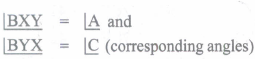
\(\therefore \Delta ABC\sim \Delta XbY\) (AAA similarity criterion)
So, \(\cfrac { ar(ABC) }{ ar(XBY) } =\left( \cfrac { AB }{ XB } \right) ^{ 2 }\) ...(1)
ar(ABC) = 2ar(XBY)
\(\cfrac { ar(ABC) }{ ar(ABC) } =\cfrac { 2 }{ 1 } \) ...(2)
From (1) and (2),
\(\left( \cfrac { AB }{ XB } \right) ^{ 2 }=\cfrac { 2 }{ 1 } i.e.,\cfrac { AB }{ XB } =\cfrac { \sqrt { 2 } }{ 1 } \)
\(\cfrac { XB }{ AB } =\cfrac { 1 }{ \sqrt { 2 } } \)
\(1-\frac{X B}{A B}=1-\frac{1}{\sqrt{2}}\)
\(\cfrac { AB-XB }{ AB } =\cfrac { \sqrt { 2 } -1 }{ \sqrt { 2 } } \)
\(\cfrac { AX }{ AB } =\cfrac { \sqrt { 2 } -1 }{ \sqrt { 2 } } =\cfrac { 2-\sqrt { 2 } }{ 2 } \)
3.
Let assumed mean A = 30
C = 5
| x | d' = \(\frac { x-30 }{ 5 } \) | d'2 |
| 20 | -2 | 4 |
| 25 | -1 | 1 |
| 30 | 0 | 0 |
| 35 | 1 | 1 |
| 40 | 2 | 4 |
| Σd' = 0 | Σd'2 = 10 |
σ =\(\sqrt { \left( \frac { \Sigma d'^{ 2 } }{ n } \right) -\left( \frac { \Sigma d' }{ n } \right) ^{ 2 } } \) x c
=\(\sqrt { \frac { 10 }{ 5 } -0 } \) x 5
=\(\sqrt { 2 } \) x 5
= 5\(\sqrt { 2 } \)
To convert the values for 100, all the values will be multiplied by 2. Therefore the new values are 40, 50, 60, 70, 80.
Let A = 60, C = 10
| x | d' = \(\frac { x-60 }{ 10 } \) | d'2 |
| 40 | -2 | 4 |
| 50 | -1 | 1 |
| 60 | 0 | 0 |
| 70 | 1 | 1 |
| 80 | 2 | 4 |
σ =\(\sqrt { \left( \frac { \Sigma d'^{ 2 } }{ n } \right) -\left( \frac { \Sigma d' }{ n } \right) ^{ 2 } } \) x c
=\(\sqrt { \frac { 10 }{ 5 } -0 } \) x 10
=\(\sqrt { 2 } \) x 10
= 10\(\sqrt { 2 } \)
S.D. also be multiplied by 2. It is also true for the division also.
4.
A Graph f = {(x, f(x) / x \(\epsilon \) A}
{(0, 1), (1, 3), (2, 5), (3, 7)}
5.
D= b2-4ac
⇒ 4(ac + bd)2 - 4(a2 + b2)(c2 + d2)
⇒ 4[(ac + bd)2 - (a2 + b2)(c2 + d2)]
⇒ 4(a2c2 + b2d2 + 2acbd - a2c2b2c2 - a2d2 - b2d2]
⇒ 4[2acbd - a2d2 - b2c2]
⇒ 4[a2d2 + b2c2 - 2adbc]
⇒-4[ ad - bc]2
We have ad≠ bc
∴ ad- be of 0
⇒ (ad - bc)2 > 0
⇒ 4(ad - bc)2 < 0 ⇒ D < 0
Hence the given equation has no real roots.
6.
Since 12576 > 4052 we apply the division lemma to 12576 and 4052, to get
12576 = 4052 x 3 + 420.
Since the remainder 420 ≠ 0, we apply the division lemma to 4052
4052 = 420 x 9 + 272.
We consider the new divisor 420 and the new remainder 272 and apply the division lemma to get
420 = 272 x 1 + 148, 148 ≠ 0
∴ Again by division lemma
272 = 148 x 1 + 124, here 124 ≠ 0
∴ Again by division lemma
148 = 124 x 1 + 24, Here 24 ≠ 0
∴ Again by division lemma
124 = 24 x 5 + 4, Here 4 ≠ 0
∴ Again by division lemma
24 = 4 x 6 + 0.
The remainder has now become zero. So our procedure stops. Since the divisor at this stage is 4.
∴ The HCF of 12576 and 4052 is 4.
7.
By joining B to D, you will get too triangles ABD and BCD.
Now, the area of ΔABD
=\(\frac { 1 }{ 2 } \)[ -5(-5 - 5) + (-4)(5 -7) + 4(7 + 5)]
=\(\frac { 1 }{ 2 } \)(50 + 8 + 48)
=\(\frac { 106 }{ 2 } \) = 53 square units.
Also, the area of ΔBCD
=\(\frac { 1 }{ 2 } \) = [-4(-6 - 5) - 1(5 + 5) + 4(-5 + 6)]
=\(\frac { 1 }{ 2 } \)(44 - 10 + 4)
= 19 square units.
So, the area of quadrilateral ABCD
= 53 + 19 = 72 square units.
8.
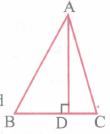
We have DB = 3 CD.
BC = BD + DC
BC = 3CD + CD
BC = 4CD
\(CD=\cfrac { 1 }{ 4 } BC\)
\(CD=\cfrac { 1 }{ 4 } BC\)
\(BD=3cD=\cfrac { 3 }{ 4 } BC\)
Since \(\Delta ABD\) is a right triangle (i) right angled at D.
AB2 = AD2 + BD2
By \(\Delta ACD\) is a right triangle right angled at D
AC2 = AD2 + CD2
Subtracting equation (iii) from equation (ii), we got
AB2 - AC2 = BD2 - CD2
\(\Rightarrow { AB }^{ 2 }-{ AC }^{ 2 }=\left( \cfrac { 3 }{ 4 } BC \right) ^{ 2 }-\left( \cfrac { 1 }{ 4 } BC \right) ^{ 2 }\)
\((from \ CD=\cfrac { 1 }{ 4 } BC,BD=\cfrac { 3 }{ 4 } BC)\)
(i) \(\Rightarrow { AB }^{ 2 }-{ AC }^{ 2 }=\cfrac { 9 }{ 16 } { BC }^{ 2 }-\cfrac { 1 }{ 16 } { BC }\)
\(\Rightarrow { AB }^{ 2 }-{ AC }^{ 2 }=\cfrac { 1 }{ 2 } { BC }^{ 2 }\)
\(\Rightarrow { AB }^{ 2 }-{ AC }^{ 2 }=\cfrac { 1 }{ 2 } BC{ 2 }^{ 2 }\)
\(\Rightarrow 2({ AB }^{ 2 }-{ AC }^{ 2 })={ BC }^{ 2 }\)
\(\Rightarrow { 2AB }^{ 2 }=2{ AC }^{ 2 }+{ BC }^{ 2 }\)
9.
A and B represent points on the bank on opposite sides at the river, so that AB is the width of the river. P is a point on the bridge at a height of 3m i.e., DP = 3 m. We are interested to determine the width at the river which is the length at the side AB of the ΔAPB.
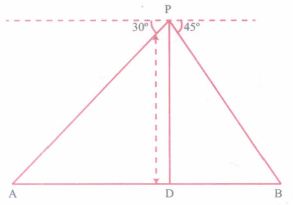
Now, AB = AD + DB
In right ΔAPD,
ㄥA = 30o
So, tan 30° = \(\frac { 1 }{ \sqrt { 3 } } =\frac { 3 }{ AD } \)
i.e., \(\frac { 1 }{ \sqrt { 3 } } =\frac { 3 }{ AD } \) (or) AD = 3\(\sqrt { 3 } \)
Also, in right ΔPBD,
B = 45o
So, BD = PD = 3m
Now, AB = BD + AD
= 3 + 3\(\sqrt { 3 } \) = 3(1+\(\sqrt { 3 } \))m
Therefore, the width at the river is 3(+\(\sqrt { 3 } \))m
10.
BL and CM are medians at the \(\triangle\)ABC in which
\(A=\angle { 90 }^{ 0 }\)
From \(\triangle\)ABC
BC2 = AB2 + AC2
(Pythagoras theorem)
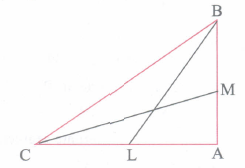
From \(\Delta ABL\)
BL2 = AL2 + AB2
\({ BL }^{ 2 }=\left( \cfrac { { AC }^{ 2 } }{ 2 } \right) +{ AB }^{ 2 }\)
(L is the mid-point at AC)
\({ BL }^{ 2 }=\cfrac { { AC }^{ 2 } }{ 4 } +{ AB }^{ 2 }\)
4BL2 = AC2 + 4AB2
From \(\Delta CMA\)
CM2 = AC2 + AM2
\({ CM }^{ 2 }={ Ac }^{ 2 }+\left( \cfrac { AB }{ 2 } \right) ^{ 2 }\)
(M is the mid-point at AB)
\({ CM }^{ 2 }={ AC }^{ 2 }+\cfrac { { AB }^{ 2 } }{ 4 } \)
4CM2 = 4AC2+ AB2
Adding (2) and (3), we have
4(BL2 + CM2) = 5(AC2 + AB2)
4(BL2 + CM2) = 5BC2
11.
We know:
cot A = tan(90o - A)
So,
cot 25° = tan (90° - 25°) = tan 65°
\(\frac { tan{ 65 }^{ o } }{ tan{ 25 }^{ o } } \) = \(\frac { tan{ 65 }^{ o } }{ tan{ 25 }^{ o } } \) = 1
12.
No. of balls required \(=\frac { \frac { 4 }{ 3 } \pi { r }^{ 3 } }{ \frac { 4 }{ 3 } \pi \times { \left( \frac { r }{ 4 } \right) }^{ 3 } } \)
\(={ r }^{ 3 }\times \frac { 4 }{ r } \times \frac { 4 }{ r } \times \frac { 4 }{ r } =64\)
13.
σ = 21.2, \(\bar { x } \) = 36.6
CV = \(\frac { \sigma }{ \bar { x } } \) x 100 = \(\frac { 21.2 }{ 36.6 } \) x 100 = 57.92%
14.
No. of coins required \(=\frac{Volume\ of\ the\ cylinder}{Volume\ of\ 1\ coin}\)
\(=\frac { \pi { r }_{ 1 }^{ 2 }{ h }_{ 1 } }{ \pi { r }_{ 2 }^{ 2 }{ h }_{ 2 } } =\frac { \pi \times \frac { 42 }{ 20 } \times \frac { 45 }{ 20 } \times 10 }{ \pi \times \frac { 15 }{ 20 } \times \frac { 15 }{ 20 } \times \frac { 2 }{ 10 } } \)
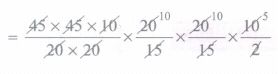
= 450
15.
Mean \(\bar { x } \) = \(\frac { 16+13+17+21+18 }{ 5 } =\frac { 85 }{ 5 } \) = 17
| x | d = x - 17 | d2 |
| 16 | -1 | 1 |
| 13 | -4 | 16 |
| 17 | 0 | 0 |
| 21 | 4 | 16 |
| 18 | 1 | 1 |
| Σd = 0 | Σd2 = 34 |
σ =\(\sqrt { \frac { \Sigma d^{ 2 } }{ n } } =\sqrt { \frac { 34 }{ 5 } } =\sqrt { 638 } \)
σ = 2.61
Co-efficient of variation
CV = \(\frac { \sigma }{ \bar { x } } \) x 100 = \(\frac { 2.61 }{ 17 } \) x 100
= 15.35%
16.
Let a natural number be x.
The next number = x + 1
x (x + 1) = 20
X2+x-20 = 0
(x + 5)(x - 4) = 0
x=-5,4
∴ x=4
(∵ x≠-5, x is a natural number
The next number = 4 + 1= 5
Two consecutive numbers are 4,5.
17.
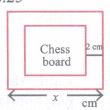
Let the length of the side of the chess board be x cm. Then
Area of 64 squares = (x - 4)2
(x - 4)2 = 64 x 6.25
⇒ x2-8x+ 16=400
⇒X2- 8x - 384 =0
⇒ X2- 24x + 16x - 384 = 0
⇒(x - 24)(x + 16) = 0
⇒ x=24 cm.
18.
an = 3 +2n
a1 = 3 + 2 = 5
a2 = 3 + 2 x 2 = 7
a3 = 3 + 2 x 3 = 9
List of numbers becomes 5, 7, 9, 11,.........
Here, 7 - 5 = 9 - 7 = 11 - 9 = 2 and so on. So, it forms an A.P. with common difference d = 2.
To find S24 we have n = 24, a = 5, d = 2.
S24 = \(\frac{24}{2}\) [2 x 5 + (24 - 1) x ]
= 12 [10 + 46] = 672.
So, sum of first 24 terms of the list of numbers is 672.
19.
1,-1,-3, -5, ...
t2 - t1 = -1 - 1 = -2
t3 - t2 = -3 - (-1)= -2
t4 - t3 = -5 - (-3) = -2
The given list of numbers form an A.P with the common difference -2.
The next two terms are (-5 + (-2)) = -7, -7 + (-2) = -9.
20.
A = {5, 6, 8, to}, B = {19, 15,9, 11}
f(x) = 2x - 1
f(5) = 2(5) - 1 = 9
f(8) = 2(5)-1 = 15
\(\therefore\) a = 9; b = 15
21.
Since the given points are collinear, the area a the triangle formed by them must be 0, i.e.,
= \(\frac { 1 }{ 2 } \) [2(k + 3) + 4(-3 - 3) + 6(3 - k)] = 0
= \(\frac { 1 }{ 2 } \) [-4k] = 0
k = 0
Area of ΔABC
= \(\frac { 1 }{ 2 } \)[2(0 + 3) + 4(-3 - 3) + 6(3 - 0)] = 0
22.
It is both one-one and onto function
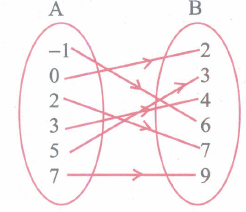
All the elements in A have their separate images in B. All the elements in B have their preimage in A. Therefore it is one-one and onto function.
23.
Let P and Q be the points of trisection at AB.
i.e., AP = PQ = QB
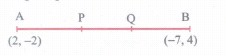
Therefore, P divides AB internally in the ratio 1:2. Therefore, the coordinates at P, by applying the section formula, are
\(\left[ \frac { 1(-7)+2(2) }{ 1+2 } ,\frac { 1(7)+2(-2) }{ 1+2 } \right] \) i.e., (-1,10)
Now, Q also divides AB internally in the ratio 2:1, so, the coordinates at Q are
\(\left[ \frac { 2(-7)+1(2) }{ 2+1 } ,\frac { 2(4)+(-2) }{ 2+1 } \right] \) i.e., (-4,2)
Therefore, the coordinates at the points at trisection of the line segment joining A and B are (-1, 0) and (-4, 2).
24.
(b)
\(\frac { 1 }{ 4 } \)
25.
(c)
9 times
26.
(a)
1:2
27.
(b)
-6
28.
(a)
1 cm
29.
(b)
\(\sqrt { { a }^{ 2 }-{ b }^{ 2 } } \)
30.
(d)
(ii) and (iv) only
31.
(a)
\(\frac { 8 }{ 27 } \)
32.
(d)
Identify function
33.
(b)

10th Standard Syllabus & Materials
10th Standard
TN 10th English Prose - 2 - The Night the Ghost Got in Important Questions And Answers Study Material - QB365 Set A
NEW10th Standard
TN 10th English Supplementary - 1 - The Tempest Important Questions And Answers Study Material - QB365 Set A
NEW10th Standard
TN 10th English Poem - 1 - Life Important Questions And Answers Study Material - QB365 Set A
NEW10th Standard
TN 10th English Prose - 1 - His First Flight Important Questions And Answers Study Material - QB365 Set A



Tamilnadu Stateboard 10th Standard Subjects
Tamilnadu Stateboard Standards





