
 100% FREE ACCESS
10th Standard Syllabus & Materials
10th Standard
TN 10th English Prose - 4 - The Attic Important Questions And Answers Study Material - QB365 Set A
NEW10th Standard
TN 10th English Supplementary - 3 - The Story of Mulan Important Questions And Answers Study Material - QB365 Set A
NEW10th Standard
TN 10th English Poem - 3 - I am Every Woman Important Questions And Answers Study Material - QB365 Set A
NEW10th Standard
TN 10th English Prose - 3 - Empowered Women Navigating The World Important Questions And Answers Study Material - QB365 Set A
NEW10th Standard
TN 10th English Supplementary - 2 - Zigzag Important Questions And Answers Study Material - QB365 Set A
NEW10th Standard
TN 10th English Poem - 2 - The Grumble Family Important Questions And Answers Study Material - QB365 Set A

Published on: 07/02/2020
10th Standard Mathematics All Chapter Creative Questions-II-2019-2020
Download Tamil Nadu 10th Standard Maths question papers, model tests, one-mark questions, important questions, and public exam papers in PDF format. Free study materials and answer keys for TN State Board students.
Questions + Answers key
Take MCQ Maths Test1.
Find the depth of a cylindrical tank of radius 28 m, if its capacity is equal to that of a rectangular tank of size 28 m x 16 m x 11 m.
2.
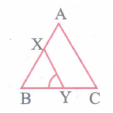
In figure the line segment XY is parallel to side AC of \(\Delta ABC\) and it divides the triangle into two parts of equal areas. Find the ratio \(\cfrac { AX }{ AB } \)
3.
Find the standard deviation for the following data. 5, 10, 15, 20, 25. And also find the new S.D. if three is added to each value.
4.
Using quadratic formula solve the following equations.9x2-9(a+b)x+(2a2+5ab+2b2)=0
5.
Show that any positive odd integer is of the form 4q + 1 or 4q + 3, where q is some integer.
6.
Let A = {1,2, 3, 4} and B = {-1, 2, 3, 4, 5, 6, 7, 8, 9, 10, 11, 12} Let R = {(1, 3), (2, 6), (3, 10), (4, 9)} \(\subseteq \) A x B be a relation. Show that R is a function and find its domain, co-domain and the range of R.
7.
Find a relation between x and y such that the point (x, y) is equidistant from the points (7, 1) and (3, 5).
8.
P.T (1+tan∝tan∝tanβ)2 +(tan∝-tanβ)2 =sec2 ∝sec2β.
9.
In \(\angle ACD={ 90 }^{ 0 }\) and \(CD\bot AB\) Prove that \(\cfrac { { BC }^{ 2 } }{ { AC }^{ 2 } } =\cfrac { BD }{ AD } \)
10.
Express cot 85° + cos 75° in terms of trigonometric ratios of angles between 0° and 45°.
11.
Prove that in a right triangle, the square of 8. the hypotenuse is equal to the sum of the squares of the others two sides.
12.
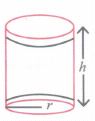
A wooden article was made by scooping out a hemisphere from each end of a cylinder as shown in figure. If the height of the cylinder is 10 cm and its base is of radius 3.5 cm find the total surface area of the article.
13.
Final the probability of choosing a spade or a heart card from a deck of cards.
14.
Find the number of coins, 1.5 cm is diameter and 0.2 cm thick, to be melted to form a right circular cylinder of height 10 cm and diameter 4.5 cm.
15.
C.V. of a data is 69%, S.D. is 15.6, then find its mean.
16.
A two digit number is such that the product of its digits is 18, when 63 is subtracted from the number, the digits interchange their places. Find the number.
17.
A chess board contains 64 equal squares and the area of each square is 6.25 cm2, A border round the board is 2 cm wide.
18.
How many terms of the AP: 24, 21, 18, ... must be taken so that their sum is 78?
19.
Determine the AP whose 3rd term is 5 and the 7th term is 9.
20.
A function f: (1,6) \(\rightarrow\)R is defined as follows:
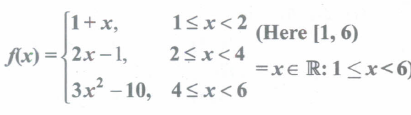
Find the value of f(2) - f( 4).
21.
Find the area of the quadrilateral whose vertices, taken in order, are (-4, -2), (-3, -5), (3, -2) and (2, 3).
22.
A function f: [-7,6) \(\rightarrow\) R is defined as follows.
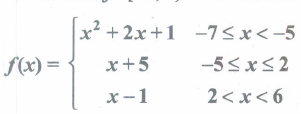
f(-7) - f(-3)
23.
If the points A(6, 1), B(8, 2), C(9, 4) and D(P, 3) are the vertices of a parallelogram, taken in order. Find the value of P.
24.
If cos θ + cos2θ = 3 then tan2θ + cot2θ is equal to ___________
4
7
6
9
25.
Th4e batsman A is more consistent than batsman B if ___________
C.V of A > C.V of B
C.V of A < C.V of B
C.V of a =C.V of B
C.V of A≥C.V of B
26.
The area of triangle formed by the points (a, b+c), (b, c+a) and (c, a+b) is ____________
a+b+c
abc
(a+b+c)2
0
27.
Two concentric circles if radii a and b where a>b are given. The length of the chord of the circle which touches the smaller circle is ____________
\(\sqrt { { a }^{ 2 }-{ b }^{ 2 } } \)
\(\sqrt { { a }^{ 2 }-{ b }^{ 2 } } \)
\(\sqrt { { a }^{ 2 }+{ b }^{ 2 } } \)
\(2\sqrt { { a }^{ 2 }+{ b }^{ 2 } } \)
28.
In the given figure if OC = 9 cm and OB = 15 cm then OB + BD is equal to ____________
23 cm
24 cm
27 cm
30 cm
29.
If \(A=\left[ \begin{matrix} 1 & 2 \\ 3 & 4 \\ 5 & 6 \end{matrix} \right] _{ 3\times 2 }\) \(B=\left[ \begin{matrix} 1 & 2 & 3 \\ 4 & 5 & 6 \end{matrix} \right] _{ 2\times 3 }\) then which of the following products can be made from these matrices
(i) A2
(ii) B2
(iii) AB
(iv) BA
(i) only
(ii) and (iii) only
(iii) and (iv) only
all the above
30.
In the arithmetic series Sn = k + 2k + 3k +...+ 100, k is positive integer and k is a factor 100 then Sn is ____________
\(1000\frac { 10 }{ k } \)
\(5000\frac { 50 }{ k } \)
\(\frac { 1000 }{ k } +10\)
\(\frac { 5000 }{ k } +50\)
31.
If f(x) = ax - 2, g(x) = 2x - 1 and fog = gof, the value of a is ___________
3
-3
\(\frac { 1 }{ 3 } \)
13
32.
If S1 denotes the total surface area at a sphere of radius ૪ and S2 denotes the total surface area of a cylinder of base radius ૪ and height 2r, then ___________
S1 = S2
S1 > S2
S1
S1 = 2S2
33.
The radius of base of a cone 5 cm and height is 12 cm. The slant height of the cone ___________
13 cm
17 cm
7 cm
60 cm
1.
Volume of the cylindrical tank = Volume of the rectangle tank
πr2h = 28 x 16 x 11 m3

\(h=\frac { 16\times 11 }{ 88 } =2m\)
2.
Given XY IIA C
So,
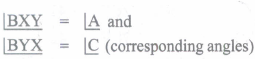
\(\therefore \Delta ABC\sim \Delta XbY\) (AAA similarity criterion)
So, \(\cfrac { ar(ABC) }{ ar(XBY) } =\left( \cfrac { AB }{ XB } \right) ^{ 2 }\) ...(1)
ar(ABC) = 2ar(XBY)
\(\cfrac { ar(ABC) }{ ar(ABC) } =\cfrac { 2 }{ 1 } \) ...(2)
From (1) and (2),
\(\left( \cfrac { AB }{ XB } \right) ^{ 2 }=\cfrac { 2 }{ 1 } i.e.,\cfrac { AB }{ XB } =\cfrac { \sqrt { 2 } }{ 1 } \)
\(\cfrac { XB }{ AB } =\cfrac { 1 }{ \sqrt { 2 } } \)
\(1-\frac{X B}{A B}=1-\frac{1}{\sqrt{2}}\)
\(\cfrac { AB-XB }{ AB } =\cfrac { \sqrt { 2 } -1 }{ \sqrt { 2 } } \)
\(\cfrac { AX }{ AB } =\cfrac { \sqrt { 2 } -1 }{ \sqrt { 2 } } =\cfrac { 2-\sqrt { 2 } }{ 2 } \)
3.
| x | d' = \(\frac { x-15 }{ 5 } \) | d'2 |
| 5 | -2 | 4 |
| 10 | -1 | 1 |
| 15 | 0 | 0 |
| 20 | 1 | 1 |
| 25 | 2 | 4 |
| Σd = 0 | Σd'2 = 10 |
\(\bar { x } =\frac { \Sigma x }{ n } =\frac { 75 }{ 5 } \)=15
d'=\(\frac { x-\bar { x } }{ c } =\frac { x-A }{ c } \)
A is assumed mean c is common factor.
Here A= 15, C = 5
σ =\(\sqrt { \left( \frac { \Sigma d'^{ 2 } }{ n } \right) -\left( \frac { \Sigma d' }{ n } \right) ^{ 2 } } \) x c
=\(\sqrt { \frac { 10 }{ 5 } -0 } \) x c
=\(\sqrt { 2 } \) x 5
= 5\(\sqrt { 2 } \)
If 3 is added to each value, we get 8, 13, 18,23, 28 as new values.
| x | d' = \(\frac { x-18 }{ 5 } \) | d'2 |
| 8 | -2 | 4 |
| 13 | -1 | 1 |
| 18 | 0 | 0 |
| 23 | 1 | 1 |
| 28 | 2 | 4 |
| Σd' = 10 | Σd'2 = 10 |
∴ σ =\(\sqrt { \left( \frac { \Sigma d'^{ 2 } }{ n } \right) -\left( \frac { \Sigma d' }{ n } \right) ^{ 2 } } \) x c
=\(\sqrt { \frac { 10 }{ 5 } -0 } \) x 5
=\(\sqrt { 2 } \) x 5
= 5\(\sqrt { 2 } \)
S.D. doesn't change when a number is added or subtracted to the values.
4.
9x2-9(a+b)x+(2a2+5ab+2b2)=0
Comparing this with ax2 + bx + c = O.
a =9
b = -9(a + b)
c = (2a2 + 5ab + 2b2)
∴ ∆=B2-4AC
⇒ 81(a+b)2-36(2a2+5ab+2b2)
⇒ 9a2 + 9b2 - 18ab
⇒ 9(a - b)2> 0
∴ the roots are real and given by
\(\beta =\frac { -B-\sqrt { D } }{ 2A } =\frac { 9(a+b)+3(a-b) }{ 18 } \)
\(=\frac { 12a+6b }{ 18 } =\frac { 2a+b }{ 3 } \)
\(\beta =\frac { -B-\sqrt { D } }{ 2A } =\frac { 9(a+b)+3(a-b) }{ 18 } \)
\(=\frac { 6a+12b }{ 18 } =\frac { a+2b }{ 3 } \)
5.
Let us start with taking a, where a is a +ve odd integer.
We apply the division algorithm with 'a' and 'b' = 4.
Since 0 ≤ r < 4, the possible remainders are 0,1,2,3.
That is, a can be 4q, or 4q + 1, or 4q + 2 or 4q + 3, where 1 is the quotient. However, since a is odd, a cannot be 4q or 4q + 2 (since they are both divisible by 2).
Any odd integer is of the form 4q + 1 or 4q + 3
6.
Domain of R = {1,2,3,4}
Co-domain of R = B = {-1, 2, 3,4,5,6, 7, 9, 10, 11,12}
Range of R = {3, 6,10, 9}
7.
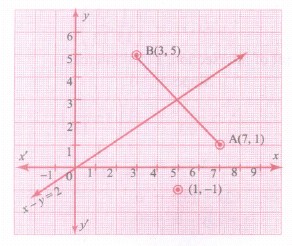
Let P(x, y) be equidistant from the points A (7, 1) and B (3, 5).
We are given that AP = BP. So, AP2 = BP2
(x - 7)2 + (y - 1)2 = (x - 3)2 + (y - 5)2
x2- 14x + 49 + y - 2y + 1 = x2- 6x + 9 + y -10y + 25
x - y = 2
Which is the required relation.
8.
9.
\(\Delta ACD\sim \Delta ABC\)
So,
\(\cfrac { AC }{ AB } =\cfrac { AD }{ AC } \)
AC2 = AB ·AD
Similarly \(\Delta BCD\sim \Delta BAC\)
So,
\(\cfrac { BC }{ BA } =\cfrac { BD }{ BC } \)
BC2 = BA·BD
From (1) and (2)
\(\cfrac { { BC }^{ 2 } }{ AC^{ 2 } } =\cfrac { BA.BD }{ AB.AD } =\cfrac { BD }{ AD } \)
10.
cot 85° + cos 75°
= cot(90° - 5°) + cos(90° - 15°)
= tan 5° + sin 15°
11.
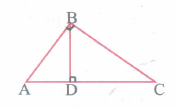
We are given a right triangle ABC right angled at B.
We need to prove that AC2 = AB2 + BC2
Let us draw \(BD\bot AC\)
Now,\(\Delta ADB\sim \Delta ABC\)
\(\cfrac { AD }{ DB } =\cfrac { BC }{ AC } \)
(sides are proportional)
Also,
\(\Delta BDC\sim \Delta ABC\)
\(\cfrac { CD }{ BC } =\cfrac { BC }{ AC } \)
CD·AC = BC2 ..(2)
Adding (1) and (2)
AD .AC + CD . AC = AB2+ BC2
AC(AD + CD) = AB2 + BC2
AC.AC = AB2 + BC2
AC = AB2 + BC2
12.
Radius of the cylinder be r
Height of the cylinder be h
Total surface area of the article
= CSA of cylinder + CSA of 2 hemispheres
= 2ㅠrh + 2πr2 = 2πr(h + 2r)
\(=2\times \frac { 22 }{ 7 } \times 3.5\times (10+2\times 3.5)\)
= 22 x 17 = 374 cm2
13.
Total number of cards = 52
Event of selecting a spade card = A
Event of selecting a heart card = B
n(A) = 13, n(B) = 13
P(A) =\(\frac { 13 }{ 52 } =\frac { 1 }{ 4 } \), P(B) =\(\frac { 13 }{ 52 } =\frac { 1 }{ 4 } \).
A ⋂ B refers to a card is both spade and heart. It is not possible

A, B are exclusive events.
P(A,B) = P(A) + P(B) =\(\frac { 1 }{ 4 } +\frac { 1 }{ 4 } =\frac { 1 }{ 2 } \).
14.
No. of coins required \(=\frac{Volume\ of\ the\ cylinder}{Volume\ of\ 1\ coin}\)
\(=\frac { \pi { r }_{ 1 }^{ 2 }{ h }_{ 1 } }{ \pi { r }_{ 2 }^{ 2 }{ h }_{ 2 } } =\frac { \pi \times \frac { 42 }{ 20 } \times \frac { 45 }{ 20 } \times 10 }{ \pi \times \frac { 15 }{ 20 } \times \frac { 15 }{ 20 } \times \frac { 2 }{ 10 } } \)
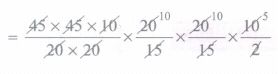
= 450
15.
CV =\(\frac { \sigma }{ \bar { x } } \) x 100 ⇒ \(\bar { x } =\frac { \sigma }{ CV } \) x 100
\(\bar { x } =\frac { 15.6 }{ 6.9 } \) x 100 = 22.6
16.
Let the tens digits be x. Then the uints digits=\(\frac{18}{x}\)
∴ Number =10x+\(\frac{18}{x}\)
and number obtained by interchanging the digits =10x+\(\frac{18}{x}\)
\(\\ \therefore \left( 10x+\frac { 18 }{ x } \right) -\left( 10\times \frac { 18 }{ x } +x \right) =63\)
\(\Rightarrow 10x+\frac { 18 }{ x } -\frac { 180 }{ x } -x=0\)
\(\Rightarrow 9x-\frac { 162 }{ x } -63=0\)
⇒ 9x2-63x-162=0
⇒ x2-7x-18=0
⇒ (x-9)(x+2)=0⇒ x=9,-2
But a digit can never be (-ve), so x = 9.
So, the required number \(=10\times 9+\frac { 18 }{ 9 } =92\)
17.
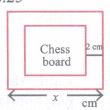
Let the length of the side of the chess board be x cm. Then
Area of 64 squares = (x - 4)2
(x - 4)2 = 64 x 6.25
⇒ x2-8x+ 16=400
⇒X2- 8x - 384 =0
⇒ X2- 24x + 16x - 384 = 0
⇒(x - 24)(x + 16) = 0
⇒ x=24 cm.
18.
Here a = 24, d = 21-24 = -3, Sn = 78. We need to find n.
We know that,
Sn= \(\frac{n}{2}\) (2a + (n - 1)d)
78 = \(\frac{n}{2}\) 48 + (n -1)(-3))
78 = \(\frac{n}{2}\) 2(51-3n)
or 3n2 - 51n + 156 = 0
n2 -17n + 52 = 0
(n - 4)(n - 13) = 0
n = 4 or 13
The number of terms are 4 or 13.
19.
We have
a3 = a + (3 - 1)d = a + 2d = 5 (1)
a7 = a + (7 - 1)d = a + 6d = 9 (2)
(1) - (2) ⇒ -4d -4 ⇒ d = 1.
Sub, d = 1 in (1), we get
a + 2(1) = 5
a = 3
Hence the required A.P. is 3, 4, 5, 6, 7.
20.
f(2) - f(4)
f(2) = 2x - 1
= 2(2) - 1 = 3
f(4) = 3x2 - 10
= 3(42) - 10 = 38
\(\therefore\) f(2) - f(4) = 3 - 38 = 35
21.
We have Area of the quadrilateral
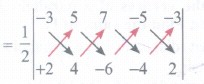
=\(\frac { 1 }{ 2 } \) [(-12 - 30 - 28 -10) - (+ 10 + 28 + 30 + 12)]
\(\frac { 1 }{ 2 } \) [-80 - (80)]
\(\frac { 1 }{ 2 } \)[-160] = -80 = 80 square units.
(∵ Area is always +ve).
22.
f(-7) = x2 + 2x + 1
= (-7)2 + 2(-7) + 1
= 49 - 14 + 1 = 36
f(3) = x + 5 = -3 + 5 = 2
f(-7) - f(-3) = 36 + 2 = 38
23.
We know that diagonals at a parallelogram bisect each other.
So, the coordinates of the mid-point at AC = coordinates of the mid-point at BD.
i.e., \(\left[ \frac { 6+9 }{ 2 } ,\frac { 1+4 }{ 2 } \right] =\left[ \frac { 8+P }{ 2 } ,\frac { 2+3 }{ 2 } \right] \)
\(\left[ \frac { 15 }{ 2 } ,\frac { 5 }{ 2 } \right] =\left[ \frac { 8+P }{ 2 } ,\frac { 5 }{ 2 } \right] \)
\(\frac { 15 }{ 2 } =\frac { 8+P }{ 2 } \)
P = 7
24.
(b)
7
25.
(b)
C.V of A < C.V of B
26.
(d)
0
27.
(b)
\(\sqrt { { a }^{ 2 }-{ b }^{ 2 } } \)
28.
(c)
27 cm
29.
(c)
(iii) and (iv) only
30.
(d)
\(\frac { 5000 }{ k } +50\)
31.
(a)
3
32.
(a)
S1 = S2
33.
(a)
13 cm

10th Standard Syllabus & Materials
10th Standard
TN 10th English Prose - 2 - The Night the Ghost Got in Important Questions And Answers Study Material - QB365 Set A
NEW10th Standard
TN 10th English Supplementary - 1 - The Tempest Important Questions And Answers Study Material - QB365 Set A
NEW10th Standard
TN 10th English Poem - 1 - Life Important Questions And Answers Study Material - QB365 Set A
NEW10th Standard
TN 10th English Prose - 1 - His First Flight Important Questions And Answers Study Material - QB365 Set A



Tamilnadu Stateboard 10th Standard Subjects
Tamilnadu Stateboard Standards





