
 100% FREE ACCESS
10th Standard Syllabus & Materials
10th Standard
TN 10th English Prose - 4 - The Attic Important Questions And Answers Study Material - QB365 Set A
NEW10th Standard
TN 10th English Supplementary - 3 - The Story of Mulan Important Questions And Answers Study Material - QB365 Set A
NEW10th Standard
TN 10th English Poem - 3 - I am Every Woman Important Questions And Answers Study Material - QB365 Set A
NEW10th Standard
TN 10th English Prose - 3 - Empowered Women Navigating The World Important Questions And Answers Study Material - QB365 Set A
NEW10th Standard
TN 10th English Supplementary - 2 - Zigzag Important Questions And Answers Study Material - QB365 Set A
NEW10th Standard
TN 10th English Poem - 2 - The Grumble Family Important Questions And Answers Study Material - QB365 Set A

Published on: 07/02/2020
10th Standard Mathematics All Chapter Important Creative Questions-I- 2019-2020
Download Tamil Nadu 10th Standard Maths question papers, model tests, one-mark questions, important questions, and public exam papers in PDF format. Free study materials and answer keys for TN State Board students.
Questions + Answers key
Take MCQ Maths Test1.
In a right triangle ABC, right-angled at B, if tan A = 1, then verify that 2 sin A cos A = 1.
2.
If the radii of the circular ends of a conical bucket which is 45 cm high are 28 cm and 7 cm, find the capacity of the bucket. (Use π = \(\frac{22}{7}\))
3.
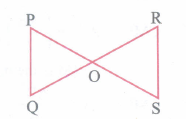
In figure if PQ || RS Prove that \(\Delta POQ\sim \Delta SOQ\)
4.
Find the standard deviation of 30, 80, 60, 70, 20, 40, 50 using the direct method.
5.
Let A = {0, 1, 2, 3} and B = {1, 3, 5, 7, 9} be two sets. Let f: A \(\rightarrow\)B be a function given by f(x) = 2x + 1. Represent this function as a table.
6.
Find the values of k for which the following equation has equal roots.
(k - 12)r + 2(k - 12)x + 2 = 0
7.
Find the LCM and HCF of 6 and 20 by the prime factorisation method.
8.
If A (-5, 7), B (-4, -5), C (-1, -6) and D (4, 5) are the vertices of a quadrilateral, find the area of the quadrilateral ABCD.
9.
The perpendicular from A on side BC at a \(\triangle\)ABC intersects BC at D such that DB = 3 CD. Prove that 2AB2 = 2AC2 + BC2.
10.
From a point on a bridge across a river, the angles of depression of the banks on opposite sides at the river are 30° and 45°, respectively. If the bridge is at a height at 3 m from the banks, find the width at the river.
11.
BL and CM are medians of a triangle ABC right angled at A.
Prove that 4(BL2 + CM2) = 5BC2.
12.
If sin (A - B) = \(\frac12\), cos (A + B) = \(\frac12\), 0o < A + ≤ 90°, A > B, find A and B.
13.
A spherical ball of iron has been melted and made into small balls. If the radius of each smaller ball is one-fourth of the radius of the original one, how many such balls can be made?
14.
Final the probability of choosing a spade or a heart card from a deck of cards.
15.
What is the ratio of the volume of a cylinder, a cone, and a sphere. If each has the same diameter and same height?
16.
C.V. of a data is 69%, S.D. is 15.6, then find its mean.
17.
Find two consecutive natural numbers whose product is 20.
18.
A chess board contains 64 equal squares and the area of each square is 6.25 cm2, A border round the board is 2 cm wide.
19.
Find the sum of first 24 terms of the list of numbers whose nth term is given by an = 3 + 2n.
20.
In a flower bed, there are 23 rose plants in the first row, 21 in the second, 19 is the third, and so on. There are 5 rose plants in the last row. How many rows are there in the flower bed?
21.
The following table represents a function from A = {5, 6, 8, 10} to B = {19, 15, 9, 11}, where f(x) = 2x - 1. Find the values of a and b.
| x | 5 | 6 | 8 | 10 |
|---|---|---|---|---|
| f(x) | a | 11 | b | 19 |
22.
Find the value of k if the points A(2, 3), B(4, k) and (6, -3) are collinear.
23.
A function f: [-7,6) \(\rightarrow\) R is defined as follows.
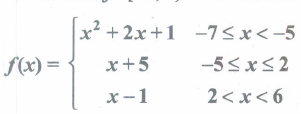
\(\cfrac { 4f(-3)+2f(4) }{ f(-6)-3f(1) } \)
24.
If the points A(6, 1), B(8, 2), C(9, 4) and D(P, 3) are the vertices of a parallelogram, taken in order. Find the value of P.
25.
A number x is chosen at random from -4, -3, -2, -1, 0, 1, 2, 3, 4. The probability that \(\left| x \right| \le 3\) is ___________
\(\frac { 3 }{ 9 } \)
\(\frac { 4 }{ 9 } \)
\(\frac { 1 }{ 9 } \)
\(\frac { 7 }{ 9 } \)
26.
A cone of height 9 cm with diameter of its base 18 cm is carved out from a wooden solid sphere of radius 9 cm. The percentage of wood wasted is
45%
56%
67%
75%
27.
28.
Find the slope and the y-intercept of the line \(3y-\sqrt { 3x } +1=0\) is ____________
\(\frac { 1 }{ \sqrt { 3 } } ,\frac { -1 }{ 3 } \)
\(-\frac { 1 }{ \sqrt { 3 } } ,\frac { -1 }{ 3 } \)
\(\sqrt { 3 } ,1\)
\(-\sqrt { 3 } ,3\)
29.
If ABC is a triangle and AD bisects A, AB = 4cm, BD = 6cm, DC = 8cm then the value of AC is ____________
\(\frac { 16 }{ 3 } cm\)
\(\frac { 32 }{ 3 } cm\)
\(\frac { 3 }{ 16 } cm\)
\(\frac { 1 }{ 2 } cm\)
30.
If triangle PQR is similar to triangle LMN such that 4PQ = LM and QR = 6 cm then MN is equal to ____________
12 cm
24 cm
10 cm
36 cm
31.
32.
The difference between the remainders when 6002 and 601 are divided by 6 is ____________
2
1
0
3
33.
If function f : N⟶N, f(x) = 2x then the function is, then the function is ___________
Not one - one and not onto
one-one and onto
Not one -one but not onto
one - one but not onto
34.
1.
In ABC, tan A = \(\frac{BC}{AB}\) = 1
BC = AB
Let AB = BC = k, where k is a positive number
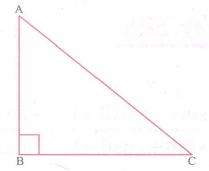
Now, AC = \(\sqrt { { AB }^{ 2 }+{ BC }^{ 2 } } \)
= \(\sqrt { { (k) }^{ 2 }+{ (k) }^{ 2 } } =k\sqrt { 2 } \)
Therefore,
\(sinA=\frac { BC }{ AC } =\frac { 1 }{ \sqrt { 2 } } \) and
\(cosA=\frac { AB }{ Ac } =\frac { 1 }{ \sqrt { 2 } } \)
So, \(2sinAcosA=2\left[ \frac { 1 }{ \sqrt { 2 } } \right] \left[ \frac { 1 }{ \sqrt { 2 } } \right] =1\), which is the required value
2.
Clearly bucket forms frustum of a cone such that the radii of its circular ends are r1 = 28 cm, r2 = 7 cm, h = 45 cm
Capacity of the bucket = volume of the frustum
\(\Rightarrow \frac { 1 }{ 3 } \times \pi h[{ r }_{ 1 }^{ 2 }+{ r }_{ 2 }^{ 2 }+{ r }_{ 1 }{ r }_{ 2 }]\)
\(\Rightarrow \frac { 1 }{ 3 } \times \frac { 22 }{ 7 } \times 45[{ 28 }^{ 2 }+{ 7 }^{ 2 }+28\times 7)]\)
= 22 x 15 x (28 x 4 + 7 + 28)
\(\Rightarrow 330\times 147{ cm }^{ 2 }\Rightarrow 48510{ cm }^{ 2 }\)
3.
PQ II RS
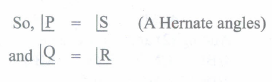
Also

\(\angle \therefore \Delta POQ\sim \Delta SOR\) (AAA similarity criterion)
4.
| x | x2 |
| 30 | 900 |
| 80 | 6400 |
| 60 | 3600 |
| 70 | 4900 |
| 20 | 400 |
| 40 | 1600 |
| 50 | 2500 |
| Σx = 350 | Σx2 = 20300 |
σ =\(\sqrt { \frac { \Sigma x^{ 2 } }{ n } -\left( \frac { \Sigma x }{ n } \right) ^{ 2 } } \)
=\(\\ \sqrt { \frac { 20300 }{ 7 } -\left( \frac { 350 }{ 7 } \right) ^{ 2 } } \)
=\(\sqrt { 400 } \) = 20
5.
A table
| x | 0 | 1 | 2 | 3 |
|---|---|---|---|---|
| f(x) | 1 | 3 | 5 | 7 |
6.
\(\frac { (k-12) }{ a } { x }^{ 2 }+\frac { 2(k-12) }{ b } x+\frac { 2 }{ c } =0\)
D2 = b2- 4ac = (2(k - 12))2 - 4(k - 12)(2)
= 4(k - 12)[(k - 12) - 2]
= 4(k-12)(k- 14)
The given equation will have equal roots, if D = 0
⇒ 4(k-12)(k-14) 0
k - 12 = 0 or k - 14 0
k 12, 14
7.
We have 6 = 21 x 31 and
20 = 2 x 2 x 5 = 22 x 51
You can find HCF (6, 20) = 2 and LCM (6, 20) = 2 x 2 x 3 x 5 = 60.
As done in your earlier classes. Note that HCF (6, 20) = 21 = product of the smallest power of each common prime factor in the numbers.
LCM (6, 20) = 22 x 31 x 51 = 60.
= Product of the greatest power of each prime factor, involved in the numbers.
8.
By joining B to D, you will get too triangles ABD and BCD.
Now, the area of ΔABD
=\(\frac { 1 }{ 2 } \)[ -5(-5 - 5) + (-4)(5 -7) + 4(7 + 5)]
=\(\frac { 1 }{ 2 } \)(50 + 8 + 48)
=\(\frac { 106 }{ 2 } \) = 53 square units.
Also, the area of ΔBCD
=\(\frac { 1 }{ 2 } \) = [-4(-6 - 5) - 1(5 + 5) + 4(-5 + 6)]
=\(\frac { 1 }{ 2 } \)(44 - 10 + 4)
= 19 square units.
So, the area of quadrilateral ABCD
= 53 + 19 = 72 square units.
9.
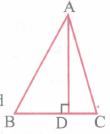
We have DB = 3 CD.
BC = BD + DC
BC = 3CD + CD
BC = 4CD
\(CD=\cfrac { 1 }{ 4 } BC\)
\(CD=\cfrac { 1 }{ 4 } BC\)
\(BD=3cD=\cfrac { 3 }{ 4 } BC\)
Since \(\Delta ABD\) is a right triangle (i) right angled at D.
AB2 = AD2 + BD2
By \(\Delta ACD\) is a right triangle right angled at D
AC2 = AD2 + CD2
Subtracting equation (iii) from equation (ii), we got
AB2 - AC2 = BD2 - CD2
\(\Rightarrow { AB }^{ 2 }-{ AC }^{ 2 }=\left( \cfrac { 3 }{ 4 } BC \right) ^{ 2 }-\left( \cfrac { 1 }{ 4 } BC \right) ^{ 2 }\)
\((from \ CD=\cfrac { 1 }{ 4 } BC,BD=\cfrac { 3 }{ 4 } BC)\)
(i) \(\Rightarrow { AB }^{ 2 }-{ AC }^{ 2 }=\cfrac { 9 }{ 16 } { BC }^{ 2 }-\cfrac { 1 }{ 16 } { BC }\)
\(\Rightarrow { AB }^{ 2 }-{ AC }^{ 2 }=\cfrac { 1 }{ 2 } { BC }^{ 2 }\)
\(\Rightarrow { AB }^{ 2 }-{ AC }^{ 2 }=\cfrac { 1 }{ 2 } BC{ 2 }^{ 2 }\)
\(\Rightarrow 2({ AB }^{ 2 }-{ AC }^{ 2 })={ BC }^{ 2 }\)
\(\Rightarrow { 2AB }^{ 2 }=2{ AC }^{ 2 }+{ BC }^{ 2 }\)
10.
A and B represent points on the bank on opposite sides at the river, so that AB is the width of the river. P is a point on the bridge at a height of 3m i.e., DP = 3 m. We are interested to determine the width at the river which is the length at the side AB of the ΔAPB.
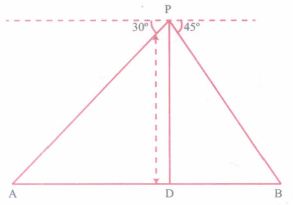
Now, AB = AD + DB
In right ΔAPD,
ㄥA = 30o
So, tan 30° = \(\frac { 1 }{ \sqrt { 3 } } =\frac { 3 }{ AD } \)
i.e., \(\frac { 1 }{ \sqrt { 3 } } =\frac { 3 }{ AD } \) (or) AD = 3\(\sqrt { 3 } \)
Also, in right ΔPBD,
B = 45o
So, BD = PD = 3m
Now, AB = BD + AD
= 3 + 3\(\sqrt { 3 } \) = 3(1+\(\sqrt { 3 } \))m
Therefore, the width at the river is 3(+\(\sqrt { 3 } \))m
11.
BL and CM are medians at the \(\triangle\)ABC in which
\(A=\angle { 90 }^{ 0 }\)
From \(\triangle\)ABC
BC2 = AB2 + AC2
(Pythagoras theorem)
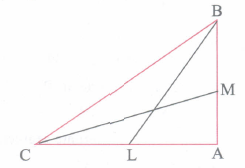
From \(\Delta ABL\)
BL2 = AL2 + AB2
\({ BL }^{ 2 }=\left( \cfrac { { AC }^{ 2 } }{ 2 } \right) +{ AB }^{ 2 }\)
(L is the mid-point at AC)
\({ BL }^{ 2 }=\cfrac { { AC }^{ 2 } }{ 4 } +{ AB }^{ 2 }\)
4BL2 = AC2 + 4AB2
From \(\Delta CMA\)
CM2 = AC2 + AM2
\({ CM }^{ 2 }={ Ac }^{ 2 }+\left( \cfrac { AB }{ 2 } \right) ^{ 2 }\)
(M is the mid-point at AB)
\({ CM }^{ 2 }={ AC }^{ 2 }+\cfrac { { AB }^{ 2 } }{ 4 } \)
4CM2 = 4AC2+ AB2
Adding (2) and (3), we have
4(BL2 + CM2) = 5(AC2 + AB2)
4(BL2 + CM2) = 5BC2
12.
Since, sin(A - B) = \(\frac12\), ∴ A-B = 30° ..... (1)
Also, since cos (A + B) = \(\frac12\)
∴ A + B = 60° ...(2)
Solving (1) and (2)
A - B + A + B = 30o + 60o
2A = 90o
A = 45o
We get,
A = 45° and B = 15°
13.
No. of balls required \(=\frac { \frac { 4 }{ 3 } \pi { r }^{ 3 } }{ \frac { 4 }{ 3 } \pi \times { \left( \frac { r }{ 4 } \right) }^{ 3 } } \)
\(={ r }^{ 3 }\times \frac { 4 }{ r } \times \frac { 4 }{ r } \times \frac { 4 }{ r } =64\)
14.
Total number of cards = 52
Event of selecting a spade card = A
Event of selecting a heart card = B
n(A) = 13, n(B) = 13
P(A) =\(\frac { 13 }{ 52 } =\frac { 1 }{ 4 } \), P(B) =\(\frac { 13 }{ 52 } =\frac { 1 }{ 4 } \).
A ⋂ B refers to a card is both spade and heart. It is not possible

A, B are exclusive events.
P(A,B) = P(A) + P(B) =\(\frac { 1 }{ 4 } +\frac { 1 }{ 4 } =\frac { 1 }{ 2 } \).
15.
Volume of a cylinder \(=\pi { r }^{ 2 }h\)
Volume of a cone \(=\frac { 1 }{ 3 } \pi { r }^{ 2 }h\)
Volume of a sphere \(=\frac { 4 }{ 3 } \pi { r }^{ 3 }\)
Their ratio V1 : V2 : V3
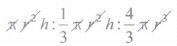
\(h:\frac { h }{ 3 } :\frac { 4r }{ 3 } \)
3h: h: 4r
3h : h : 2(2r) (where 2r = h)
∴ V1 : V2 : V3 = 3: 1 : 2
16.
CV =\(\frac { \sigma }{ \bar { x } } \) x 100 ⇒ \(\bar { x } =\frac { \sigma }{ CV } \) x 100
\(\bar { x } =\frac { 15.6 }{ 6.9 } \) x 100 = 22.6
17.
Let a natural number be x.
The next number = x + 1
x (x + 1) = 20
X2+x-20 = 0
(x + 5)(x - 4) = 0
x=-5,4
∴ x=4
(∵ x≠-5, x is a natural number
The next number = 4 + 1= 5
Two consecutive numbers are 4,5.
18.
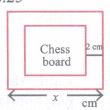
Let the length of the side of the chess board be x cm. Then
Area of 64 squares = (x - 4)2
(x - 4)2 = 64 x 6.25
⇒ x2-8x+ 16=400
⇒X2- 8x - 384 =0
⇒ X2- 24x + 16x - 384 = 0
⇒(x - 24)(x + 16) = 0
⇒ x=24 cm.
19.
an = 3 +2n
a1 = 3 + 2 = 5
a2 = 3 + 2 x 2 = 7
a3 = 3 + 2 x 3 = 9
List of numbers becomes 5, 7, 9, 11,.........
Here, 7 - 5 = 9 - 7 = 11 - 9 = 2 and so on. So, it forms an A.P. with common difference d = 2.
To find S24 we have n = 24, a = 5, d = 2.
S24 = \(\frac{24}{2}\) [2 x 5 + (24 - 1) x ]
= 12 [10 + 46] = 672.
So, sum of first 24 terms of the list of numbers is 672.
20.
The number of rose plants in the 1st, 2nd, 3rd, . . . rows are
23,21, 19, ... 5
It forms an A.P.
Let the number of rows in the flower bed be n.
Then a = 23, d = 21 - 23 = -2/a = 5.
As, an = a + (n - 1)d i.e. tn = a + (n - 1)d
We have 5 = 23 + (n - 1)(-2)
i.e. -18 = (n - 1)(-2)
n = 10
ஃ There are 10 rows in the flower bed.
21.
A = {5, 6, 8, to}, B = {19, 15,9, 11}
f(x) = 2x - 1
f(5) = 2(5) - 1 = 9
f(8) = 2(5)-1 = 15
\(\therefore\) a = 9; b = 15
22.
Since the given points are collinear, the area a the triangle formed by them must be 0, i.e.,
= \(\frac { 1 }{ 2 } \) [2(k + 3) + 4(-3 - 3) + 6(3 - k)] = 0
= \(\frac { 1 }{ 2 } \) [-4k] = 0
k = 0
Area of ΔABC
= \(\frac { 1 }{ 2 } \)[2(0 + 3) + 4(-3 - 3) + 6(3 - 0)] = 0
23.
\(\cfrac { 4f(-3)+2f(4) }{ f(-6)-3f(1) } \)
For f(1) & f(3)
Since 1 & 3 lies between -5 ≤ x ≤2, We take, f(x) = x +5
f(1) = 1 + 5 = 6
f(-3) = -3 +5 = 2
For f(4): Since 4 lies between 2 < x < 6 We take, f(x) = x -1
f(4) = 4 -1 = 3
For f(-6): Since -6 lies between -7≤ x < -5 ,We take, f(x) = x² + 2x +1
f(-6) = (-6)² + 2(-6) + 1 = 36 -12 + 1 = 24 +1 = 25
Now ,\(\cfrac { 4f(-3)+2f(4) }{ f(-6)-3f(1) } \) =\(\frac{ 4(2) +2(3) }{ 25 - 3(6)}\)
= \(\frac{ 8 + 6 }{ 25 -18}\)
= \(\frac{14 }{ 7}\) = 2
Hence, the value of \(\cfrac { 4f(-3)+2f(4) }{ f(-6)-3f(1) } \) = 2
24.
We know that diagonals at a parallelogram bisect each other.
So, the coordinates of the mid-point at AC = coordinates of the mid-point at BD.
i.e., \(\left[ \frac { 6+9 }{ 2 } ,\frac { 1+4 }{ 2 } \right] =\left[ \frac { 8+P }{ 2 } ,\frac { 2+3 }{ 2 } \right] \)
\(\left[ \frac { 15 }{ 2 } ,\frac { 5 }{ 2 } \right] =\left[ \frac { 8+P }{ 2 } ,\frac { 5 }{ 2 } \right] \)
\(\frac { 15 }{ 2 } =\frac { 8+P }{ 2 } \)
P = 7
25.
(d)
\(\frac { 7 }{ 9 } \)
26.
(d)
75%
27.
(a)
28.
(a)
\(\frac { 1 }{ \sqrt { 3 } } ,\frac { -1 }{ 3 } \)
29.
(a)
\(\frac { 16 }{ 3 } cm\)
30.
(b)
24 cm
31.
(b)
32.
(b)
1
33.
(d)
one - one but not onto
34.
(d)

10th Standard Syllabus & Materials
10th Standard
TN 10th English Prose - 2 - The Night the Ghost Got in Important Questions And Answers Study Material - QB365 Set A
NEW10th Standard
TN 10th English Supplementary - 1 - The Tempest Important Questions And Answers Study Material - QB365 Set A
NEW10th Standard
TN 10th English Poem - 1 - Life Important Questions And Answers Study Material - QB365 Set A
NEW10th Standard
TN 10th English Prose - 1 - His First Flight Important Questions And Answers Study Material - QB365 Set A



Tamilnadu Stateboard 10th Standard Subjects
Tamilnadu Stateboard Standards





