
 100% FREE ACCESS
10th Standard Syllabus & Materials
10th Standard
TN 10th English Prose - 4 - The Attic Important Questions And Answers Study Material - QB365 Set A
NEW10th Standard
TN 10th English Supplementary - 3 - The Story of Mulan Important Questions And Answers Study Material - QB365 Set A
NEW10th Standard
TN 10th English Poem - 3 - I am Every Woman Important Questions And Answers Study Material - QB365 Set A
NEW10th Standard
TN 10th English Prose - 3 - Empowered Women Navigating The World Important Questions And Answers Study Material - QB365 Set A
NEW10th Standard
TN 10th English Supplementary - 2 - Zigzag Important Questions And Answers Study Material - QB365 Set A
NEW10th Standard
TN 10th English Poem - 2 - The Grumble Family Important Questions And Answers Study Material - QB365 Set A

Published on: 06/02/2020
10th Standard Mathematics Book back and Creative Important Questions-I- 2020
Download Tamil Nadu 10th Standard Maths question papers, model tests, one-mark questions, important questions, and public exam papers in PDF format. Free study materials and answer keys for TN State Board students.
Questions + Answers key
Take MCQ Maths Test1.
If x = a sec θ and = b tan θ, then b2x2 - a2y2 is equal to ___________
ab
a2-b2
a2+b2
a2b2
2.
3.
If m cos θ + n sin θ = a and m sin θ - n cos θ = b then a2 + b2 is equal to ___________
m2-n2
m2+n2
m2n2
n2-m2
4.
When three coins are tossed, the probability of getting the same face on all the three coins is ___________
\(\frac { 1 }{ 8 } \)
\(\frac { 1 }{ 4 } \)
\(\frac { 3 }{ 8 } \)
\(\frac { 1 }{ 3 } \)
5.
If the data is multiplied by 4, then the corresponding variances is get multiplied by ___________
4
16
2
None
6.
If a letter is chosen at random from the English alphabets {a, b....,z}, then the probability that the letter chosen precedes x ____________
\(\frac { 12 }{ 13 } \)
\(\frac { 1 }{ 13 } \)
\(\frac { 23 }{ 26 } \)
\(\frac { 3 }{ 26 } \)
7.
Kamalam went to play a lucky draw contest 135 tickets of the lucky draw were sold. If the probability of Kamalam winning is \(\frac { 1 }{ 9 } \), then the number of tickets bought by kamalam is ____________
5
10
15
20
8.
A solid frustum is of height 8 cm. If the radii of its lower and upper ends are 3 cm and 9 cm respectively, then its slant height is ___________
15 cm
12 cm
10 cm
17 cm
9.
Find the value of P, given that the line \(\frac { y }{ 2 } =x-p\) passes through the point (-4, 4) is ____________
-4
-6
0
8
10.
The area of triangle formed by the points (a, b+c), (b, c+a) and (c, a+b) is ____________
a+b+c
abc
(a+b+c)2
0
11.
Two concentric circles if radii a and b where a>b are given. The length of the chord of the circle which touches the smaller circle is ____________
\(\sqrt { { a }^{ 2 }-{ b }^{ 2 } } \)
\(\sqrt { { a }^{ 2 }-{ b }^{ 2 } } \)
\(\sqrt { { a }^{ 2 }+{ b }^{ 2 } } \)
\(2\sqrt { { a }^{ 2 }+{ b }^{ 2 } } \)
12.
In the given figure if OC = 9 cm and OB = 15 cm then OB + BD is equal to ____________
23 cm
24 cm
27 cm
30 cm
13.
14.
Axis of symmetry in the term of vertical line separates parabola into ___________
3 equal halves
5 equal halves
2 equal halves
4 equal halves
15.
A Quadratic polynomial whose one zero is 5 and sum of the zeroes is 0 is given by ___________
x2-25
x2-5
x2-5x
x2-5x+5
16.
Consider the following statements:
(i) The HCF of x+y and x8-y8 is x+y
(ii) The HCF of x+y and x8+y8 is x+y
(iii) The HCF of x-y nd x8+y8 is x-y
(iv) The HCF of x-y and x8-y8 is x-y
(i) and (ii)
(ii) and (iii)
(i) and (iv)
(ii) and (iv)
17.
Sum of infinite terms of G.P is 12 and the first term is 8. What is the fourth term of the G.P?
\(\frac { 8 }{ 27 } \)
\(\frac { 4 }{ 27 } \)
\(\frac { 8 }{ 20 } \)
\(\frac { 1 }{ 3 } \)
18.
If a and b are the two positive integers when a > b and b is a factor of a then HCF (a, b) is ____________
b
a
ab
\(\frac { a }{ b } \)
19.
If f is identify function, then the value of f(1) - 2f(2) + f(3) is:
-1
-3
1
0
20.
If f(x) = 2 - 3x, then f o f(1 - x) = ?
5x+9
9x-5
5-9x
5x-9
21.
If f(x) = x + 1 then f(f(f(y + 2))) is ___________
y + 5
y + 6
y + 7
y + 9
22.
If the order pairs (a, -1) and (5, b) belongs to {(x, y) | y = 2x + 3}, then a and b are __________
-13, 2
2, 13
2, -13
-2,13
23.
24.
The volume of a frustum if a cone of height L and ends-radio and r1 and r2 is ___________
\(\frac{1}{3}\)πh1(r12+r22+r1r2)
\(\frac{1}{3}\)πh(r12+r22-r1r2)
πh(r12+r22+r1r2)
πh(r12+r22-r1r2)
25.
26.
The standard deviation of a data is 3. If each value is multiplied by 5 then the new variance is
3
15
5
225
27.
28.
If 5x = sec\(\theta \) and \(\frac { 5 }{ x } \) = tan\(\theta \), then x2 - \(\frac { 1 }{ { x }^{ 2 } } \) is equal to
25
\(\frac { 1 }{ 25 } \)
5
1
29.
The next term of the sequence \(\frac { 3 }{ 16 } ,\frac { 1 }{ 8 } ,\frac { 1 }{ 12 } ,\frac { 1 }{ 18 } \), ..... is
\(\frac { 1 }{ 24 } \)
\(\frac { 1 }{ 27 } \)
\(\frac { 2 }{ 3 } \)
\(\frac { 1 }{ 81 } \)
30.
74k \(\equiv \) ________ (mod 100)
1
2
3
4
31.
If A is a point on the Y axis whose ordinate is 8 and B is a point on the X axis whose abscissae is 5 then the equation of the line AB is
8x + 5y = 40
8x - 5y = 40
x = 8
y = 5
32.
The point of intersection of 3x − y = 4 and x + y = 8 is
(5, 3)
(2, 4)
(3, 5)
(4, 4)
33.
34.
Two poles of heights 6 m and 11 m stand vertically on a plane ground. If the distance between their feet is 12 m, what is the distance between their tops?
13 m
14 m
15 m
12.8 m
35.
A shuttle cock used for playing badminton has the shape of the combination of
a cylinder and a sphere
a hemisphere and a cone
a sphere and a cone
frustum of a cone and a hemisphere
36.
A frustum of a right circular cone is of height 16 cm with radii of its ends as 8 cm and 20 cm. Then, the volume of the frustum is
3328\(\pi\) cm3
3228\(\pi\) cm3
3240\(\pi\) cm3
3340\(\pi\) cm3
37.
If the ordered pairs (a + 2, 4) and (5, 2a + b) are equal then (a, b) is
(2,-2)
(5,1)
(2,3)
(3,-2)
38.
If there are 1024 relations from a set A = {1, 2, 3, 4, 5} to a set B, then the number of elements in B is
3
2
4
8
39.
Which of the following can be calculated from the given matrices A = \(\left( \begin{matrix} 1 & 2 \\ 3 & 4 \\ 5 & 6 \end{matrix} \right) \), B = \(\left( \begin{matrix} 1 & 2 & 3 \\ 4 & 5 & 6 \\ 7 & 8 & 9 \end{matrix} \right) \),
(i) A2
(ii) B2
(iii) AB
(iv) BA
(i) and (ii) only
(ii) and (iii) only
(ii) and (iv) only
all of these
40.
41.
Let A = {1,2,3,7} and B = {3,0,–1,7}, which of the following are relation from A to B ?
R4 = {(7,–1), (0, 3), (3, 3), (0, 7)
42.
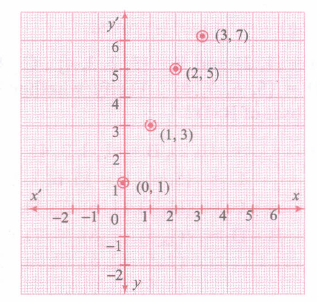
Let A = {0, 1, 2, 3} and B = {1, 3, 5, 7, 9} be two sets. Let f: A \(\rightarrow\)B be a function given by f(x) = 2x + 1. Represent this function as a graph.
43.
Let A = {0, 1, 2, 3} and B = {1, 3, 5, 7, 9} be two sets. Let f: A \(\rightarrow\)B be a function given by f(x) = 2x + 1. Represent this function as a table.
44.
Let A = {1,2, 3, 4} and B = {-1, 2, 3, 4, 5, 6, 7, 8, 9, 10, 11, 12} Let R = {(1, 3), (2, 6), (3, 10), (4, 9)} \(\subseteq \) A x B be a relation. Show that R is a function and find its domain, co-domain and the range of R.
45.
Determine the quadratic equations, whose sum and product of roots are
\(\frac {-3}{2}\), -1
46.
Find the square root of the following
(4x2 - 9x + 2)(7x2 - 13x - 2)(28x2 - 3x - 1)
47.
Check whether AD is bisector \(\angle\)A of \(\triangle\)ABC in each of the following AB = 4cm, AC = 6cm, BD = 1.6cm and CD = 2.4cm.
48.
Find the slope of the line which is perpendicular to 2x - 3y + 8 = 0
49.
Calculate the range of the following data..
| Income | 400-450 | 450-500 | 500-550 | 550-600 | 600-650 |
| Number of workers | 8 | 12 | 30 | 21 | 6 |
50.
Solve x2 - 3x - 2 = 0
51.
Find the sum of first n terms of the G.P
5, -3, \(\frac { 9 }{ 5 } ,-\frac { 27 }{ 25 } \),...,
52.
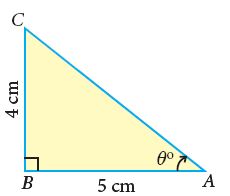
calculate \(\angle \)BAC in the given triangles (tan 38.7° = 0.8011 )
53.
54.
prove the following identity.
\(\sqrt { \frac { 1+sin\theta }{ 1-sin\theta } } =sec\theta +tan\theta\)
55.
Show that the given points are collinear: (-3, -4) , (7, 2) and (12, 5)
56.
A garden roller whose length is 3 m long and whose diameter is 2.8 m is rolled to level a garden. How much area will it cover in 8 revolutions?
57.
Write an A.P. whose first term is 20 and common difference is 8.
58.
Find the slope of a line joining the given points (- 6, 1) and (-3, 2)
59.
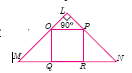
In the figure OPRQ is a square and \(\angle\)MLN = 90o. Prove that
\(\triangle\)LOP ~\(\triangle\)QMO
60.
A relation ‘f’ \(X \rightarrow Y\) is defined by f(x) = x2 - 2 where x \(\in \) {-2, -1, 0, 3} and Y = R
(i) List the elements of f
(ii) Is f a function?
61.
The shadow of a tower, when the angle of elevation of the sum is 45o is found to be 10 metres, longer than when it is 60o. find the height of the tower
62.
From a point on a bridge across a river, the angles of depression of the banks on opposite sides at the river are 30° and 45°, respectively. If the bridge is at a height at 3 m from the banks, find the width at the river.
63.
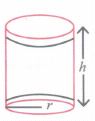
A wooden article was made by scooping out a hemisphere from each end of a cylinder as shown in figure. If the height of the cylinder is 10 cm and its base is of radius 3.5 cm find the total surface area of the article.
64.
S.D. of a data is 2102, mean is 36.6, then find its C.V.
65.
Find two consecutive natural numbers whose product is 20.
66.
A two digit number is such that the product of its digits is 12. When 36 is added to the number the digits interchange their places. Find the number.
67.
How many terms of the AP: 24, 21, 18, ... must be taken so that their sum is 78?
68.
If the sum of the first 14 terms of an AP is 1050 and its first term is 10, find the 20th term.
69.
Let A = {1, 2, 3, 4, 5}, B = N and f: A \(\rightarrow\)B be defined by f(x) = x2. Find the range of f. Identify the type of function.
70.
Find the value of k if the points A(2, 3), B(4, k) and (6, -3) are collinear.
71.
Let f = {(2, 7); (3, 4), (7, 9), (-1, 6), (0, 2), (5,3)} be a function from A = {-1,0, 2, 3, 5, 7} to B = {2, 3, 4, 6, 7, 9}. Is this
(i) an one-one function
(ii) an onto function,
(iii) both one and onto function?
72.
Find the equation of a straight line Passing through (-8, 4) and making equal intercepts on the coordinate axes
73.
Simplify
\(\frac { { b }^{ 2 }+3b-28 }{ { b }^{ 2 }+4b+4 } \div \frac { { b }^{ 2 }-49 }{ { b }^{ 2 }-5b-14 } \)
74.
Prices of peanut packets in various places of two cities are given below. In which city, prices were more stable?
| Prices in city A | 20 | 22 | 19 | 23 | 16 |
| Prices in city B | 10 | 20 | 18 | 12 | 15 |
75.
The standard deviation of some temperature data in degree celsius (0C) is 5. If the data were converted into degree Fahrenheit (0F) then what is the variance?
76.
For a group of 100 candidates the mean and standard deviation of their marks were found to be 60 and 15 respectively. Later on it was found that the scores 45 and 72 were wrongly entered as 40 and 27. Find the correct mean and standard deviation.
77.
A man is standing on the deck of a ship, which is 40 m above water level. He observes the angle of elevation of the top of a hill as 60° and the angle of depression of the base of the hill as 30° . Calculate the distance of the hill from the ship and the height of the hill. (\(\sqrt { 3 } \) = 1.732)
78.
If vertices of quadrilateral are at A(-5, 7), B(-4, k) , C(-1, -6) and D(4, 5) and its area is 72 sq. units. Find the value of k.
79.
O is any point inside a triangle ABC. The bisector of \(\angle AOB\), \(\angle BOC\) and \(\angle COA\) meet the sides AB, BC and CA in point D, E and F respectively. Show that AD x BE x CF = DB x EC x FA
80.
A hollow metallic cylinder whose external radius is 4.3 cm and internal radius is 1.1 cm and whole length is 4 cm is melted and recast into a solid cylinder of 12 cm long. Find the diameter of solid cylinder.
81.
82.
From a solid cylinder whose height is 2.4 cm and the diameter 1.4 cm, a cone of the same height and same diameter is carved out. Find the volume of the remaining solid to the nearest cm3.
83.
Find the values of a and b if the following polynomials are perfect squares
4x4 - 12x3 + 37x2 + bx + a
84.
Find the domain of the function f(x) = \(\sqrt { 1+\sqrt { 1-\sqrt { 1-x^{ 2 } } } } \).
85.
The internal and external diameters of a hollow hemispherical vessel are 20 cm and 28 cm respectively. Find the cost to paint the vessel all over at Rs. 0.14 per cm2.
86.
Rhombus \(\triangle\)QRB is inscribed in \(\triangle\)ABC such that \(\angle\)B is one of its angle. P, Q and R lie on AB, AC and BC respectively. If AB = 12 cm and BC = 6 cm, find the sides PQ, RB of the rhombus.
87.
prove that \(\frac { sinA }{ secA+tanA-1 } +\frac { cosA }{ cosecA+cotA-1 } =1\)
88.
Prove that sin2 Acos2 B + cos2 Asin2 B + cos2 Acos2 B + sin2 Asin2 B=1
89.
Draw the two tangents from a point which is 10 cm away from the centre of a circle of radius 5 cm. Also, measure the lengths of the tangents.
90.
Construct a triangle similar to a given triangle LMN with its sides equal to \(\frac { 4 }{ 5 } \) of the corresponding sides of the triangle LMN (scale factor \(\frac { 4 }{ 5 }<1\)).
1.
(d)
a2b2
2.
(d)
3.
(b)
m2+n2
4.
(b)
\(\frac { 1 }{ 4 } \)
5.
(b)
16
6.
(c)
\(\frac { 23 }{ 26 } \)
7.
(c)
15
8.
(c)
10 cm
9.
(b)
-6
10.
(d)
0
11.
(b)
\(\sqrt { { a }^{ 2 }-{ b }^{ 2 } } \)
12.
(c)
27 cm
13.
(d)
14.
(c)
2 equal halves
15.
(a)
x2-25
16.
(a) Capital employed - Goodwill + current liabilities
17.
(a)
\(\frac { 8 }{ 27 } \)
18.
(a)
b
19.
(d)
0
20.
(c)
5-9x
21.
(a)
y + 5
22.
(d)
-2,13
23.
(b)
24.
(a)
\(\frac{1}{3}\)πh1(r12+r22+r1r2)
25.
(d)
26.
(d)
225
27.
(d)
28.
(b)
\(\frac { 1 }{ 25 } \)
29.
(b)
\(\frac { 1 }{ 27 } \)
30.
(a)
1
31.
(a)
8x + 5y = 40
32.
(c)
(3, 5)
33.
(b)
34.
(a)
13 m
35.
(d)
frustum of a cone and a hemisphere
36.
(a)
3328\(\pi\) cm3
37.
(d)
(3,-2)
38.
(b)
2
39.
(c)
(ii) and (iv) only
40.
(b)
41.
A = { 1, 2, 3, 7}, B = { 3, 0, -1, 7}
A x B = {(1, 3), (1, 0), (1, - 1), (1, 7),(2,3), (2, 0), (2, -1), (2, 7), (3,3), (3, 0), (3, - 1), (3, 7), (7, 3)., (7, 0), (7, -1), (7 ,7)}
R4 = {(7, - 1), (0, 3), (3, 3), (0, 7)}
In this (0, 3) and (0, 7) ∈ R4
But (0, 3) and (0, 7) are not the elements of A x B.
Hence R4 is not a relation from A to B.
42.
A Graph f = {(x, f(x) / x \(\epsilon \) A}
{(0, 1), (1, 3), (2, 5), (3, 7)}
43.
A table
| x | 0 | 1 | 2 | 3 |
|---|---|---|---|---|
| f(x) | 1 | 3 | 5 | 7 |
44.
Domain of R = {1,2,3,4}
Co-domain of R = B = {-1, 2, 3,4,5,6, 7, 9, 10, 11,12}
Range of R = {3, 6,10, 9}
45.
Sum of the roots \(=\left( \frac { -3 }{ 2 } \right) \)
product of the roots (∝β) = (-1)
Required equation = x2 - (∝ + β)x + ∝β = 0
\({ x }^{ 2 }-\left( \frac { -3 }{ 2 } \right) x-1=0\)
2x2 + 3x - 2 = 0
46.
\(\sqrt { ({ 4x }^{ 2 }-9x+2)(7{ x }^{ 2 }-13x-2)({ 28x }^{ 2 }-3x-1) } \)
\(=\sqrt { (x-2)(4x-1)(x-2)(7x+1)(4x-1) } \)
\(\\ =\sqrt { { (x-2) }^{ 2 }{ (4x-1) }^{ 2 }{ (7x+1) }^{ 2 } } \)
|(x - 2)(7x + 1)(4x - 1)|
47.
AB = 4 cm,
AC = 6 cm,
BD = 1.6 cm,
CD = 2.4 cm.
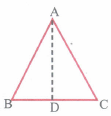
\( \frac{A B}{A C}=\frac{4}{6}=\frac{2}{3} \)
\(\frac{B D}{D C}=\frac{1.6}{2.4}=\frac{2}{3} \)
\(\frac{A B}{A C}=\frac{B D}{D C} \)
By the converse of the Angle Bisector theorem AD is the bisector of \(\angle\)A
48.
Given straight line is 2x - 3y + 8 = 0
Slope m = \(\frac { -2 }{ -3 } =\frac { 2 }{ 3 } \)
Since product of slope is −1 for perpendicular lines, slope of any line perpendicular to 2x - 3y + 8 = 0 is \(\frac { -1 }{ \frac { 2 }{ 3 } } =\frac { -3 }{ 2 } \)
49.
Here the largest value = 650
The smallest value = 400
\(\therefore\) Range = L- S
= 650 - 400
= 250
Range R = 250
50.
x2 - 3x - 2 = 0
x2 - 3x = 0 (Shifting the Constant to RHS)
x2 - 3x + \({ \left( \frac { 3 }{ 2 } \right) }^{ 2 }\) = 2 + \({ \left( \frac { 3 }{ 2 } \right) }^{ 2 }\) (Add [\(\frac {1}{2}\)(co-efficient of x)]2 to both sides)
\({ \left( x-\frac { 3 }{ 2 } \right) }^{ 2 }=\frac { 17 }{ 4 } \) (writing the LHS as complete square)
\(x-\frac { 3 }{ 2 } =\pm \frac { \sqrt { 17 } }{ 2 } \) (Taking the square root on both sides)
x = \(\frac { 3 }{ 2 } +\frac { \sqrt { 17 } }{ 2 } \) or x = \(\frac { 3 }{ 2 } -\frac { \sqrt { 17 } }{ 2 } \)
Therefore, x = \(\frac { 3+\sqrt { 17 } }{ 2 } , \frac { 3-\sqrt { 17 } }{ 2 } \)
51.
It is a geometric progression with
\(a=5, r=\frac{-3}{5} \neq 1\)
Sum upto n terms Sn = \(\frac{a\left(r^{n}-1\right)}{r-1}\)
\(=\frac{5\left[\left(\frac{-3}{5}\right)^{n}-1\right]}{\frac{-3}{5}-1}\)
\(=\frac{5\left[\left(\frac{-3}{5}\right)^{n}-1\right]}{\frac{-3-5}{5}}\)
\(=\frac{5\left[\left(\frac{-3}{5}\right)^{n}-1\right]}{\frac{-8}{5}}\)
\(=\frac{-25}{8}\left[\left(\frac{-3}{5}\right)^{n}-1\right]
\)
\(=\frac{25}{8}\left[1-\left(\frac{-3}{5}\right)^{n}\right]
\)
52.
in the right triangle ABC [see figure. (a)]
tan \(\theta \) =\(\frac { opposite\ side\ }{ adjacent\ side\ } =\frac { 4 }{ 5 } \)
= tan-1(0.8)
\(\theta \) = \(38.7°\)(since tan \(38.7°\) = 0.8011)
\(\angle \)BAC = \(38.7°\)
53.
54.
\( \sqrt{\frac{1+\sin \theta}{1-\sin \theta}} =\sec \theta+\tan \theta \)
\(\mathbf{L H S} =\sqrt{\frac{1+\sin \theta}{1-\sin \theta}} \)
\(=\sqrt{\frac{1+\sin \theta}{1-\sin \theta} \times \frac{1-\sin \theta}{1-\sin \theta}}\)
[Multiplying the Numerator and denominator by \(\sqrt{1-\sin \theta}\)]
\( =\sqrt{\frac{1^{2}-\sin ^{2} \theta}{(1-\sin \theta)^{2}}} \quad\left[\because(a+b)(a-b)=a^{2}-b^{2}\right] \)
\(=\sqrt{\frac{\cos ^{2} \theta}{(1-\sin \theta)^{2}}} \quad\left[\because 1-\sin ^{2} \theta=\cos ^{2} \theta\right] \)
\(=\frac{\cos \theta}{1-\sin \theta} \)
\(=\frac{\cos \theta}{1-\sin \theta} \times \frac{1+\sin \theta}{1+\sin \theta} \)
[Multiplying Numerator and denominator by \(1+\sin \theta\)]
\( =\frac{\cos \theta(1+\sin \theta)}{1^{2}-\sin ^{2} \theta}=\frac{\cos \theta(1+\sin \theta)}{\cos ^{2} \theta} \)
\({\left[\because(a+b)(a-b)=a^{2}-b^{2}\right]\left[1-\sin ^{2} \theta=\cos ^{2} \theta\right]} \)
\(=\frac{1+\sin \theta}{\cos \theta}=\frac{1}{\cos \theta}+\frac{\sin \theta}{\cos \theta} \)
\(=\sec \theta+\tan \theta=\text { RHS }\)
55.
Given points (- 3, - 4), (7, 2) and (12, 5)
Let the points be A (- 3, - 4),8 (2, 2) and C (12, 5)
Slope of a line = \(\frac{y_{1}-y_{2}}{x_{1}-x_{2}}\)
Slope of AB = \(\frac{-4-2}{-3-7}=\frac{-6}{-10}=\frac{3}{5}
\)
Slope of BC = \(\frac{2-5}{7-12}=\frac{-3}{-5}=\frac{3}{5}
\)
Slope of AB = Slope of BC
The points A, B and C are collinear
56.
Given that, diameter d = 2.8 m and height = 3 m
radius r = 1.4 m
Area covered in one revolution = curved surface area of the cylinder
= 2\(\pi\)rh sq. units
\(2\times \frac { 22 }{ 7 } \times 1.4\times 3=26.4\)
Area covered in 1 revolution = 26.4 m2
Area covered in 8 revolutions = 8 x 26.4 = 211.2
Therefore, area covered is 211.2 m2
57.
First term = a = 20; common difference = d = 8
Arithmetic Progression is a, a + d , a + 2d , a + 3d,....
In this case , we get 20, 20 + 8, 20 + 2 (8), 20 + 3(8),....
So, the required A.P is 20, 28, 36, 44,....
58.
(- 6, 1) and (-3, 2)
The slope \(\frac { { y }_{ 2 }-{ y }_{ 1 } }{ { x }_{ 2 }-{ x }_{ 1 } } =\frac { 2-1 }{ -3+6 } =\frac { 1 }{ 3 } \)
59.
In \(\Delta \)LOP & \(\Delta \)QMO,
\(\angle \)OLP = \(\angle \)MQO 90°
and \(\angle \)LOP =\(\angle \)OMQ (corresponding angles)
(by AA criterion of similarity)
\(\Delta \)LOP ~ \(\Delta \)QMO
60.
f(x) = x2 - 2 where x \(\in \){ -2, -1, 0, 3}
(i) f( -2) = ( -2)2 - 2 = 2; f( -1) = ( -1)2 - 2 = -1
f(0) = (0)2 - 2 = - 2 ; f(3) = (3)2 - 2 = 7
Therefore, f = {(-2, 2), (-1, -1), (0, -2), (3, 7)}
(ii) We note that each element in the domain of f has a unique image. Therefore f is a function.
61.
62.
A and B represent points on the bank on opposite sides at the river, so that AB is the width of the river. P is a point on the bridge at a height of 3m i.e., DP = 3 m. We are interested to determine the width at the river which is the length at the side AB of the ΔAPB.
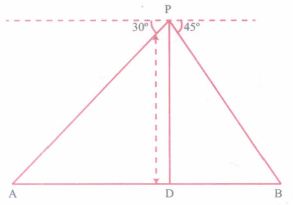
Now, AB = AD + DB
In right ΔAPD,
ㄥA = 30o
So, tan 30° = \(\frac { 1 }{ \sqrt { 3 } } =\frac { 3 }{ AD } \)
i.e., \(\frac { 1 }{ \sqrt { 3 } } =\frac { 3 }{ AD } \) (or) AD = 3\(\sqrt { 3 } \)
Also, in right ΔPBD,
B = 45o
So, BD = PD = 3m
Now, AB = BD + AD
= 3 + 3\(\sqrt { 3 } \) = 3(1+\(\sqrt { 3 } \))m
Therefore, the width at the river is 3(+\(\sqrt { 3 } \))m
63.
Radius of the cylinder be r
Height of the cylinder be h
Total surface area of the article
= CSA of cylinder + CSA of 2 hemispheres
= 2ㅠrh + 2πr2 = 2πr(h + 2r)
\(=2\times \frac { 22 }{ 7 } \times 3.5\times (10+2\times 3.5)\)
= 22 x 17 = 374 cm2
64.
σ = 21.2, \(\bar { x } \) = 36.6
CV = \(\frac { \sigma }{ \bar { x } } \) x 100 = \(\frac { 21.2 }{ 36.6 } \) x 100 = 57.92%
65.
Let a natural number be x.
The next number = x + 1
x (x + 1) = 20
X2+x-20 = 0
(x + 5)(x - 4) = 0
x=-5,4
∴ x=4
(∵ x≠-5, x is a natural number
The next number = 4 + 1= 5
Two consecutive numbers are 4,5.
66.
Let the ten's digit of the number be x. It is given that the product of the digits is 12.
Unit's digit \(\frac{12}{x}\)
Number =10x+\(\frac{12}{x}\)
It 36 is added to the number the digits interchange their places.
\(\therefore 10x+\frac { 12 }{ x } +36=10\times \frac { 12 }{ x } +x\)
\(\Rightarrow 10x+\frac { 12 }{ x } +36=\frac { 120 }{ x } +x\)
\(\Rightarrow 9x-\frac { 108 }{ x } +36=0\)
⇒9x2 - 108 + 36x = 0
⇒X2+ 4x - 12 = 0
⇒ (x + 6)(x - 2) = 0 (∵ (x + 6) ≠ 0 as x >0)
x=-6,2
But a number can never be (-ve). So, x = 2. The
number is 10x2+\(\frac{12}{2}\)=26
67.
Here a = 24, d = 21-24 = -3, Sn = 78. We need to find n.
We know that,
Sn= \(\frac{n}{2}\) (2a + (n - 1)d)
78 = \(\frac{n}{2}\) 48 + (n -1)(-3))
78 = \(\frac{n}{2}\) 2(51-3n)
or 3n2 - 51n + 156 = 0
n2 -17n + 52 = 0
(n - 4)(n - 13) = 0
n = 4 or 13
The number of terms are 4 or 13.
68.
Here S14 = 1050
n = 14
a = 10
Sn = \(\frac{n}{2}\) 2(2a + (n -1)d)
1050 = \(\frac{14}{2}\)(20 + 13d)
= 140 + 91d
910 = 91d
d = 10
a20 = 10 + (20 - 1) x 10
= 20
∴ 20th term = 200.
69.
A = {1,2,3,4,5}
B = {1,2,3,4, ... }
f: A \(\rightarrow\)B, f(x) = x2
\(\therefore\) f(1) = 12 = 1
f(2) = 22= 4
f(3) = 32 = 9
f(4) = 42= 16
f(5) = 52= 25
\(\therefore\) Range of f = {1, 4, 9, 16, 25}
Elements in A have been connected with different elements in B. Therefore it is one-one function. But not all the elements in B have preimages in A. Therefore it is not on-to function.
70.
Since the given points are collinear, the area a the triangle formed by them must be 0, i.e.,
= \(\frac { 1 }{ 2 } \) [2(k + 3) + 4(-3 - 3) + 6(3 - k)] = 0
= \(\frac { 1 }{ 2 } \) [-4k] = 0
k = 0
Area of ΔABC
= \(\frac { 1 }{ 2 } \)[2(0 + 3) + 4(-3 - 3) + 6(3 - 0)] = 0
71.
It is both one-one and onto function
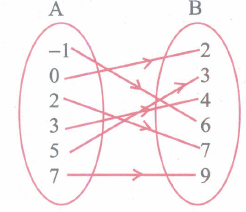
All the elements in A have their separate images in B. All the elements in B have their preimage in A. Therefore it is one-one and onto function.
72.
Given that intercepts are equal.
a = b
Equation of the line in intercepts form is
\(\frac{x}{a}+\frac{y}{b}=1
\)
\(\frac{x}{a}+\frac{y}{a}=1
\)
x + y = a
This passes through (- 8, 4)
-8 + 4 = a
a = -4
b = -4
Equation of the straight line is
\(\frac{x}{a}+\frac{y}{b}=1
\)
\(\frac{x}{-4}+\frac{y}{-4}=1
\)
x + y + 4 = 0.
73.
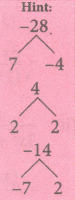
\(\frac { { b }^{ 2 }+3b-28 }{ { b }^{ 2 }+4b+4 } \div \frac { { b }^{ 2 }-49 }{ { b }^{ 2 }-5b-14 } \)
\(\frac { { b }^{ 2 }+3b-28 }{ { b }^{ 2 }+4b+4 } \times \frac { { b }^{ 2 }-5b-14 }{ { b }^{ 2 }-49 } \)
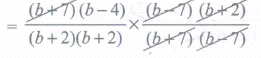
\(=\frac { b-4 }{ b+2 } \)
74.
| City A | City B | ||||
|---|---|---|---|---|---|
| x1 | d1 = x - \({ \overline { x } }_{ 1 }\) | d12 | x2 | d2 = x - \({ \overline { x } }_{ 2 }\) | d22 |
| 20 | 0 | 0 | 10 | -5 | 25 |
| 22 | 2 | 4 | 20 | 5 | 25 |
| 19 | -1 | 1 | 18 | 3 | 9 |
| 23 | -3 | 9 | 12 | -3 | 9 |
| 16 | -4 | 16 | 15 | 0 | 0 |
| 100 | 6 | 30 | 75 | 0 | 68 |
\(\bar { { x }_{ 1 } } =\frac { 100 }{ 5 } =20\)
\(\sigma =\sqrt { \frac { \sum { { d }^{ 2 } } }{ n } } \)
\(=\sqrt { \frac { 30 }{ 5 } } \)
\(=\sqrt { 6 } \)
= 2.44
\(CV=\frac { \sigma }{ \bar { x } } \times 100\)
\(=\frac { 2.44 }{ 20 } \times 100\)
= 12.2
\(\bar { { x }_{ 2 } } =\frac { \sum { x } }{ n } =\frac { 75 }{ 5 } =15\)
\(\sigma =\sqrt { \frac { \sum { { d }^{ 2 } } }{ n } } \)
\(=\sqrt { \frac { 68 }{ 5 } } \)
\(=\sqrt { 13.6 } \)
= 3.68
\(CV=\frac { \sigma }{ \bar { x } } \times 100\)
\(=\frac { 3.86 }{ 15 } \times 100\)
\(=\frac { 368 }{ 15 } \)
C.V. of city A < C.V of city B.
∴ City A is more consistents.
75.
Fo = (co x 1.8) + 32
σc = 5°C
σF = (1.8 x 5°C) . 9°F
Adding value to data doesn't affect standard deviation.
New variance = σ2F = 81°F.
76.
Mean x = 60
Standard deviation = 15
Wrong scores = 40 and 27
Correct scores = 45 and 72.
Old Mean \(=\frac{\sum x_{i}}{n}=60\)
\(\frac{\sum x_{i}}{100}=60\)
\(Old\ \Sigma x_{i}
\) = 60 x 100 = 6000
\(- Correct \ \Sigma x_{i}\) = 6000 - wrong scores + correct scores
= 6000 - (40 + 27) + (45 + 72)
= 6000 - 67 + 117
\(Correct \ \Sigma x_{i}\) = 6050
Correct Mean = \(\text { Correct } \frac{\Sigma x_{i}}{n}=\frac{6050}{100}\)
Correct Mean = 60.5
Old Standard deviation \(\sigma=15\)
\(\sigma =\sqrt{\frac{\sum x_{i}^{2}}{n}-\left(\frac{\sum x_{i}}{n}\right)^{2}}
\)
\(15 =\sqrt{\frac{\sum x_{i}^{2}}{n}-(60)^{2}}
\)
Squaring on both sides
\(225 =\frac{\Sigma x_{i}^{2}}{n}-3600
\)
\(225+3600 =\frac{\sum x_{i}^{2}}{100}
\)
\(\frac{\text { old } \Sigma x_{i}^{2}}{100} =3825
\)
\(Old \ \Sigma x_{i}^{2}
\) = 3825 x 100
\(Old \ \sum x_{i}^{2}
\) = 382500
\(Correct \ \sum x_{i}^{2}\) = 382500 - (wrong scores)2 + (correct scores)2
= 382500 - 402 - 272 + 452 + 722
= 382500 - 1600 -729 + 2025 + 5184
= 382500 - 2329 + 2025 + 5184
= 389709 - 2329
\(Correct \ \sum x_{i}^{2}\) = 387380
Correct \(\sigma =\sqrt{\frac{387380}{100}-(60.5)^{2}}
\)
\(=\sqrt{3873.80-3660.25}
\)
\(=\sqrt{213.55}
\)
\(\sigma =14.61
\)
Correct = 14.61; Correct Mean = 60.5
77.
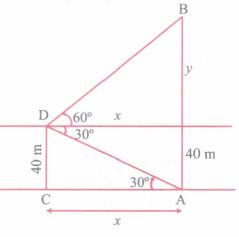
Let a man is standing on the deck of a ship at a point E
Such that AE = 40 m.
AE = BD = 40m
Also AB = ED
Let BC be the height of the hill.
(i) In right triangle \(\triangle\)ABE
\( \tan 30^{\circ} =\frac{A E}{A B} \)
\(\frac{1}{\sqrt{3}} =\frac{40}{A B} \)
\(A B =40 \sqrt{3} m \)
AB = 40 x 1.732 - 69.28 m
Distance of the hill from the ship = 69.28 m
(ii) In the right triangle \(\triangle\)CDE
\( \tan 60^{\circ} =\frac{C D}{E D} \)
\(\sqrt{3} =\frac{C D}{40 \sqrt{3}} \quad[\because A B=E D=40 \sqrt{3} \mathrm{~m}]\)
\(C D=40 \sqrt{3} \times \sqrt{3}=40 \times 3=120 \mathrm{~m}\)
Now height of the hill = BC = BD + DC
= 40 + 120 = 160m
Height of the hill = 160 m
Distance of the hill from ship = 69.28 m.
78.
Given vertices of a quadrilateral are A (-5, 7),
B (- 4, k), C (- 1, - 6) and D (4, 5)
Area of quadrilateral is 72 sq. units
\(\frac{1}{2}\left[\left(x_{1}-x_{3}\right)\left(y_{2}-y_{4}\right)-\left(x_{2}-x_{4}\right)\left(y_{1}-y_{3}\right)\right]=72\)
( -5 + 1)(k - 5) - (-4 - 4)(7 + 6) = 144
-4k + 20 + 104 = 144
-4k = 144 - 124 = 20
\(k=\frac{-20}{4}=-5\)
79.
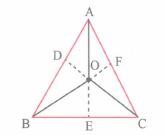
In \(\Delta AOB\) OD is the bisector of \(\angle AOB\)
\(\therefore \frac { OA }{ OB } =\frac { AD }{ DB } \) ...(1)
In \(\Delta BOC\) OE is the bisector of \(\angle BOC\)
\(\therefore \frac { OB }{ OC } =\frac { BE }{ EC } \) ...(2)
In \(\Delta COA\) OF is the bisector of \(\angle COA\)
\(\therefore \frac { OC }{ OA } =\frac { CF }{ FA } \) ...(3)
Multiplying the corresponding sides of (1), (2) and (3), we get
\(\frac{O A}{O B} \times \frac{O B}{O C} \times \frac{O C}{O A} \mid=\frac{A D}{D B} \times \frac{B E}{E C} \times \frac{C F}{F A}\)
\(1=\frac { AD }{ DB } \times \frac { BE }{ EC } \times \frac { CF }{ FA } \)
\(\Rightarrow \) DB x EC x FA = AD x BE x CF
AD x BE x CF = DB x EC x FA
Hence proved.
80.
Hollow metallic cylinder
External radius R = 4.3 cm
Internal radius r = 1.1 cm
Length = height = h = 4 cm
Volume \(=\pi\left(\mathrm{R}^{2}-\mathrm{r}^{2}\right) \mathrm{h} \text { cu. units }
\)
\(=\pi\left((4.3)^{2}-(1.1)^{2}\right)(4)
\)
\(=\pi(18.49-1.21) 4
\)
\(=69.12 \pi \mathrm{cm} 3
\)
Solid cylinder
height h = 12 cm
radius r = ?
volume \(=\pi r^{2} h\ sq. units
\)
\(=\pi r^{2}(12)
\)
Given, Hollow cylinder is melted to form solid cylinder
Volume of cylinder = Volume of hollow cylinder
\(\pi r^{2}(12) =69.12 \pi
\)
\(r^{2} =\frac{69.12}{12}=5.76
\)
r = 2.4 cm
Diameter of cylinder = 2r = 4.8 cm
81.
82.
Diameter of a solid cylinder = 1.4 cm
Radius of a solid cylinder = \(\frac{1.4}{2}=0.7 \mathrm{~cm}\)
Height of a solid cylinder = 2.4 cm
Volume of the cylinder = \(\pi r^{2} h \text { cu. units }\)
\(=\frac{22}{7} \times 0.7 \times 0.7 \times 2.4\)
Radius of cone = 0.7 cm
Height of cone = 2.4 cm
volume of cone \(=\frac{1}{3} \pi r^{2} h \text { cu. units }
\)
\(=\frac{1}{3} \times \frac{22}{7} \times 0.7 \times 0.7 \times 2.4
\)
Volume of the remaining solid = Volume of cylinder - Volume of cone
\(=\frac{22}{7} \times 0.7 \times 0.7 \times 2.4-\frac{1}{3} \times \frac{22}{7} \times 0.7 \times 0.7 \times 2.4
\)
\(=\frac{22}{7} \times 0.7 \times 0.7 \times 2.4\left(1-\frac{1}{3}\right)
\)
\(=\frac{22}{7} \times 0.7 \times 0.7 \times 2.4 \times \frac{2}{3}
\)
= 2.464 cm3
83.
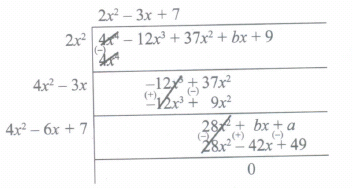
b=-42
a=49
84.
f(x) = \(\sqrt { 1+\sqrt { 1-\sqrt { 1-{ x }^{ 2 } } } } \)
\(
f(x)=\sqrt{1-t}
\)
\(where\ t=\sqrt{1-\sqrt{1-x^{2}}}\)
\(1-t \geq 0
\)
\(t \leq 1
\)
\(\sqrt{1-\sqrt{1-x^{2}}} \leq 1
\)
Squaring \(\sqrt{1-\sqrt{1-x^{2}}} \leq 1
\)
\(-\sqrt{1-x^{2}} \leq 0
\)
\(\sqrt{1-x^{2}} \geq 0
\)
\(1-x^{2} \geq 0
\)
\(x^{2} \leq 1
\)
= x [-1, 1] i.e., {- 1, 0, 1}
85.
Internal diameter = 20 cm
External diameter = 28 cm
Internal radius = 10 cm
External radius = 14 cm
Total surface area \(=\pi\left(3 \mathrm{R}^{2}+\mathrm{r}^{2}\right) \text { sq. units } \)
\(=\frac{22}{7}\left(3(14)^{2}+(10)^{2}\right) \)
\(=\frac{22}{7}[588+100] \)
\(=\frac{22}{7} \times 688 \)
\(=\frac{15136}{7} \mathrm{~cm}^{2} \)
Cost of painting per sq.cm = Rs 0.14
Total cost \(=\frac{15136}{7} \times 0.14\)
= Rs. 302.72
86.
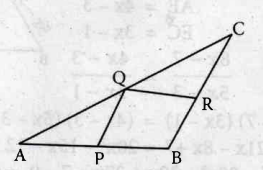
Given AB = 12 cm, BC = 6 cm
In \(\triangle\)APQ and \(\triangle\)QRC
By AA criterion of similarity, we have
\(\triangle A P Q \sim \triangle Q R C \)
\( \Rightarrow \frac{A P}{Q R}=\frac{P Q}{R C}=\frac{A Q}{Q C} \)
\(\frac{A P}{Q R}=\frac{P Q}{R C} \)
\(\frac{P Q}{A P}=\frac{R C}{Q R} \)
Now in \(\triangle\)APQ and \(\triangle\)ABC , we have
we have \(\triangle\)APQ - \(\triangle\)ABC
\(\frac{A P}{A B}=\frac{P Q}{B C}=\frac{A Q}{A C} \)
\(\frac{A P}{A B}=\frac{P Q}{B C} \)
\(\frac{P Q}{A P}=\frac{B C}{A B} \)
\(\frac{P Q}{A P}=\frac{6}{12} \)
Since PQRB is a rhombus, PQ = QR = RB = PB
\(\frac{P Q}{A B-P B}=\frac{6}{12} \)
\(\frac{P Q}{A B-P Q}=\frac{6}{12} \)
\(\frac{P Q}{12-P Q}=\frac{6}{12} \)
12 PQ = 6(12 - PQ)
12 PQ = 72- 6 PQ
12 PQ + 6 PQ = 72
18 PQ = 72
PQ = \(\frac{72}{18}=4\)
PQ = 4 cm
Since PQ = RB we have
PQ = RB = 4 cm
87.
\(\frac { sinA }{ secA+tanA-1 } +\frac { cosA }{ cosecA+cotA-1 } =1\)
\(=\frac { sinA(cosecA+cotA-1)+cosA(secA+tanA-1) }{ (secA+tanA-1)(cosecA+cotA-1) } \)
=\(\frac { sin\ A \ cosec \ A \ + \ sin \ A \ cot \ A \ - \ sin \ A\ +cos \ A \ sec \ A \ + cos \ A \ tan \ A \ - \ cos \ A }{ (sec \ A \ + \ tan \ A-1)(cosec \ A \ + \ cot \ A-1) } \)
=\(\frac { 1+cosA-sinA+1+sinA-cosA }{ \left( \frac { 1 }{ cosA } +\frac { sinA }{ cosA } -1 \right) \left( \frac { 1 }{ sinA } +\frac { cosA }{ sinA } -1 \right) } \)
=\(\frac { 2 }{ \left( \frac { 1+sinA-cosA }{ cosA } \right) \left( \frac { 1+cosA-sinA }{ sinA } \right) } \)
=\(\frac { 2sinAcosA }{ (1+sinA-cosA)(1+cosA-sinA) } \)
=\(\frac { 2 \ sin \ A \ cos \ A }{ [1+(sin \ A- \ cos \ A)][1-(sin \ A-cos \ A)] } =\frac { 2sinAcosA }{ 1-(sin \ A- \ cos \ A{ ) }^{ 2 } } \)
=\(\frac { 2sinAcosA }{ 1-(si{ n }^{ 2 }A+co{ s }^{ 2 }A-2sinAcosA) } =\frac { 2sinAcosA }{ 1-(1-2sinAcosA) } \)
=\(\frac { 2sinAcosA }{ 1-1+2sinAcosA } =\frac { 2sinAcosA }{ 2sinAcosA } =1.\)
88.
sin2 Acos2 B + cos2 Asin2 B + cos2 A + cos2 B+ sin2 Asin2 B
= sin2 Acos2 B + sin2 Asin2 B + cos2 A + cos2 B + sin2Asin2 B
= sin2 A(cos2 B + sin2 B) + cos2 A(sin2 B + cos2B)
= sin2 A(1) + cos2 A(1) (since sin2 B + cos2 B = 1)
= sin2 A + cos2 A = 1
89.
The distance between the point from the centre is 10 cm.
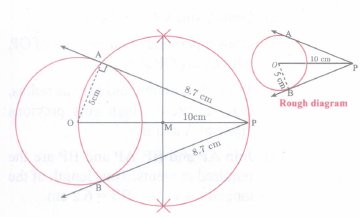
Length of the tangents PA - PB = 8.7 cm
Construction:
Steps:
(1) With O as centre, draw a circle of radius 5cm.
(2) Draw a line OP = 10 cm.
(3) Draw a perpendicular bisector of OP which cuts OP at M.
(4) With M as centre and MO as radius, draw a circle which cuts previous circle at A and B.
(5) Join AP and BP. AP and BP are the required tangents. Thus length of the tangents are PA and PB = 8.7 cm
90.
Given a triangle LMN, we are required to construct another triangle whose sides are \(\frac { 4 }{ 5 } \) of the corresponding sides of the \(\triangle\)LMN
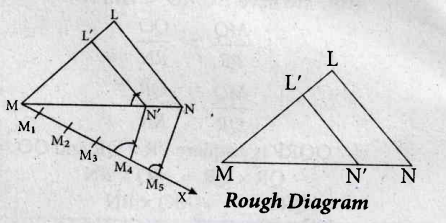
Steps of construction:
1. Constructed a LMN with any measurement
2. Drawn a ray MX making an acute angle with MN on the side opposite to the vertex L.
3. Located 5 points M1, M2, M3, M4, M5 on MX so that
MM1 = M1M2 = M2M3 = M3M4 = M4M5
4. Joined, M5N and drawn a line through M4 parallel to M5N to intersect MN at N.
5. Drawn a line through N, parallel to the line NL to intersect ML at L
Then L'MN' is the required triangle each of whose sides is four-fifth of the corresponding sides of LMN

10th Standard Syllabus & Materials
10th Standard
TN 10th English Prose - 2 - The Night the Ghost Got in Important Questions And Answers Study Material - QB365 Set A
NEW10th Standard
TN 10th English Supplementary - 1 - The Tempest Important Questions And Answers Study Material - QB365 Set A
NEW10th Standard
TN 10th English Poem - 1 - Life Important Questions And Answers Study Material - QB365 Set A
NEW10th Standard
TN 10th English Prose - 1 - His First Flight Important Questions And Answers Study Material - QB365 Set A



Tamilnadu Stateboard 10th Standard Subjects
Tamilnadu Stateboard Standards





