
 100% FREE ACCESS
10th Standard Syllabus & Materials
10th Standard
TN 10th English Prose - 4 - The Attic Important Questions And Answers Study Material - QB365 Set A
NEW10th Standard
TN 10th English Supplementary - 3 - The Story of Mulan Important Questions And Answers Study Material - QB365 Set A
NEW10th Standard
TN 10th English Poem - 3 - I am Every Woman Important Questions And Answers Study Material - QB365 Set A
NEW10th Standard
TN 10th English Prose - 3 - Empowered Women Navigating The World Important Questions And Answers Study Material - QB365 Set A
NEW10th Standard
TN 10th English Supplementary - 2 - Zigzag Important Questions And Answers Study Material - QB365 Set A
NEW10th Standard
TN 10th English Poem - 2 - The Grumble Family Important Questions And Answers Study Material - QB365 Set A

Published on: 06/02/2020
10th Standard Mathematics Book back and Creative Important Questions-II- 2020
Download Tamil Nadu 10th Standard Maths question papers, model tests, one-mark questions, important questions, and public exam papers in PDF format. Free study materials and answer keys for TN State Board students.
Questions + Answers key
Take MCQ Maths Test1.
When three coins are tossed, the probability of getting the same face on all the three coins is ___________
\(\frac { 1 }{ 8 } \)
\(\frac { 1 }{ 4 } \)
\(\frac { 3 }{ 8 } \)
\(\frac { 1 }{ 3 } \)
2.
3.
If the observations 1, 2, 3, ... 50 have the variance V1 and the observations 51, 52, 53, ... 100 have the variance V2 then \(\frac { { V }_{ 1 } }{ { V }_{ 2 } } \) is ___________
2
1
3
0
4.
A floating boat having a length 3m and breadth 2m is floating on a lake. The boat sinks by 1 cm when a man gets into it. The mass of the man is (density of water is 10000 kg/m3)
50 kg
60 kg
70 kg
80 kg
5.
A solid frustum is of height 8 cm. If the radii of its lower and upper ends are 3 cm and 9 cm respectively, then its slant height is ___________
15 cm
12 cm
10 cm
17 cm
6.
Find the equation of the line passing through the point (0, 4) and is parallel to 3x+5y+15 = 0 the line is ___________
3x+5y+15 = 0
3x+5y-20 = 0
2x+7y-20 = 0
4x+3y-15 = 0
7.
Find the value of 'a' if the lines 7y = ax + 4 and 2y = 3 - x are parallel
\(\frac { 7 }{ 2 } \)
\(-\frac { 2 }{ 7 } \)
\(\frac { 2 }{ 7 } \)
\(-\frac { 7 }{ 2 } \)
8.
Three circles are drawn with the vertices of a triangle as centres such that each circle touches the other two if the sides of the triangle are 2cm,3cm and 4 cm. find the diameter of the smallest circle.
1 cm
3 cm
5 cm
4 cm
9.
Two concentric circles if radii a and b where a>b are given. The length of the chord of the circle which touches the smaller circle is ____________
\(\sqrt { { a }^{ 2 }-{ b }^{ 2 } } \)
\(\sqrt { { a }^{ 2 }-{ b }^{ 2 } } \)
\(\sqrt { { a }^{ 2 }+{ b }^{ 2 } } \)
\(2\sqrt { { a }^{ 2 }+{ b }^{ 2 } } \)
10.
A line which intersects a circle at two distinct points is called ____________
Point of contact
secant
diameter
tangent
11.
The product of the sum and product of roots of equation (a2-b2)x2-(a+b)2x+(a3-b3) = 0 is ___________
\(\frac { { a }^{ 2 }+ab+{ b }^{ 2 } }{ (a-b) } \)
\(\frac { a-b }{ a+b } \)
\(\frac { a-b }{ a+b } \)
\(\frac { a-b }{ { a }^{ 2 }+ab+{ b }^{ 2 } } \)
12.
If \(\frac { p }{ q } =a\) then \(\frac { { p }^{ 2 }+{ q }^{ 2 } }{ { p }^{ 2 }-{ q }^{ 2 } } \) ___________
\(\frac { { a }^{ 2 }+1 }{ { a }^{ 2 }-1 } \)
\(\frac { 1+{ a }^{ 2 } }{ 1-{ a }^{ 2 } } \)
\(\frac { 1-{ a }^{ 2 } }{ 1-{ +a }^{ 2 } } \)
\(\frac { { a }^{ 2 }-1 }{ { a }^{ 2 }+1 } \)
13.
14.
In an A.P if the pth term is q and the qth term is p, then its nth term is ____________
p+q-n
p+q+n
p-q+n
p-q-n
15.
The difference between the remainders when 6002 and 601 are divided by 6 is ____________
2
1
0
3
16.
If f(x) = 2 - 3x, then f o f(1 - x) = ?
5x+9
9x-5
5-9x
5x-9
17.
The function t which maps temperature in degree Celsius into temperature in degree Fahrenheit is defined Fahrenheit degree is 95, then the value of C \(t(C)=\frac { 9c }{ 5 } +32\) is ___________
37
39
35
36
18.
If the order pairs (a, -1) and (5, b) belongs to {(x, y) | y = 2x + 3}, then a and b are __________
-13, 2
2, 13
2, -13
-2,13
19.
If f : R⟶R is defined by (x) = x2 + 2, then the preimage 27 are _________
0.5
5, -5
5, 0
\(\sqrt { 5 } ,-\sqrt { 5 } \)
20.
The volume of a frustum if a cone of height L and ends-radio and r1 and r2 is ___________
\(\frac{1}{3}\)πh1(r12+r22+r1r2)
\(\frac{1}{3}\)πh(r12+r22-r1r2)
πh(r12+r22+r1r2)
πh(r12+r22-r1r2)
21.
The radius of base of a cone 5 cm and height is 12 cm. The slant height of the cone ___________
13 cm
17 cm
7 cm
60 cm
22.
If a sin (90 - θ) of (90o - θ) = cos(90o - θ)tan equal to ___________
0
1
-1
2
23.
24.
25.
The probability a red marble selected at random from a jar containing p red, q blue and r green marbles is
\(\frac { q }{ p+q+r } \)
\(\frac { p }{ p+q+r } \)
\(\frac { p+q }{ p+q+r } \)
\(\frac { p+r }{ p+q+r } \)
26.
The range of the data 8, 8, 8, 8, 8. . . 8 is
0
1
8
3
27.
The angle of elevation of a cloud from a point h metres above a lake is \(\beta \). The angle of depression of its reflection in the lake is 45°. The height of location of the cloud from the lake is
\(\frac { h\left( 1+tan\beta \right) }{ 1-tan\beta } \)
\(\frac { h\left( 1-tan\beta \right) }{ 1+tan\beta } \)
h tan(45°-\(\beta \))
none of these
28.
a cot \(\theta \) + b cosec\(\theta \) = p and b cot \(\theta \) + a cosec\(\theta \) = q then p2- q2 is equal to
a2 - b2
b2 - a2
a2 + b2
b - a
29.
30.
The least number that is divisible by all the numbers from 1 to 10 (both inclusive) is
2025
5220
5025
2520
31.
A straight line has equation 8y = 4x + 21. Which of the following is true
The slope is 0.5 and the y intercept is 2.6
The slope is 5 and the y intercept is 1.6
The slope is 0.5 and the y intercept is 1.6
The slope is 5 and the y intercept is 2.6
32.
The slope of the line joining (12, 3), (4, a) is \(\frac 18\). The value of ‘a’ is
1
4
-5
2
33.
34.
In a given figure ST || QR, PS = 2 cm and SQ = 3 cm. Then the ratio of the area of \(\triangle\)PQR to the area \(\triangle\)PST is
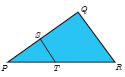
25 : 4
25 : 7
25 : 11
25 : 13
35.
A spherical ball of radius r1 units is melted to make 8 new identical balls each of radius r2 units. Then r1:r2 is
2:1
1:2
4:1
1:4
36.
In a hollow cylinder, the sum of the external and internal radii is 14 cm and the width is 4 cm. If its height is 20 cm, the volume of the material in it is
5600\(\pi\) cm3
1120\(\pi\) cm3
56\(\pi\) cm3
3600\(\pi\) cm3
37.
If g = {(1,1), (2,3), (3,5), (4,7)} is a function given by g(x) = αx + β then the values of α and β are
(-1,2)
(2,-1)
(-1,-2)
(1,2)
38.
Let n(A) = m and n(B) = n then the total number of non-empty relations that can be defined from A to B is
mn
nm
2mn-1
2mn
39.
For the given matrix A = \(\left( \begin{matrix} 1 \\ 2 \\ 9 \end{matrix}\begin{matrix} 3 \\ 4 \\ 11 \end{matrix}\begin{matrix} 5 \\ 6 \\ 13 \end{matrix}\begin{matrix} 7 \\ 8 \\ 15 \end{matrix} \right) \) the order of the matrix AT is
2 x 3
3 x 2
3 x 4
4 x 3
40.
The solution of (2x - 1)2 = 9 is equal to
-1
2
-1, 2
None of these
41.
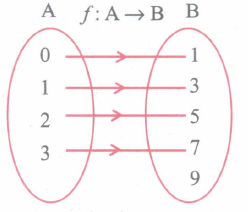
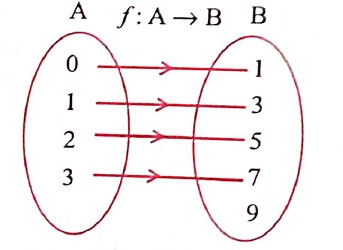
Let A = {0, 1, 2, 3} and B = {1, 3, 5, 7, 9} be two sets. Let f : A \(\rightarrow\)B be a function given by f(x) = 2x + 1. Represent this function as an arrow .
42.
State whether the graph represent a function. Use vertical line test.
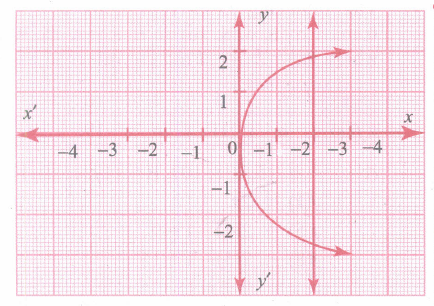
43.
Let A = {0, 1, 2, 3} and B = {1, 3, 5, 7, 9} be two sets. Let f: A \(\rightarrow\)B be a function given by f(x) = 2x + 1. Represent this function as a set of ordered pairs.
44.
In the matrix A = \(\left[ \begin{matrix} 8 \\ -1 \\ \begin{matrix} 1 \\ 6 \end{matrix} \end{matrix}\begin{matrix} 9 \\ \sqrt { 7 } \\ \begin{matrix} 4 \\ 8 \end{matrix} \end{matrix}\begin{matrix} 4 \\ \frac { \sqrt { 3 } }{ 2 } \\ \begin{matrix} 3 \\ -11 \end{matrix} \end{matrix}\begin{matrix} 3 \\ 5 \\ \begin{matrix} 0 \\ 1 \end{matrix} \end{matrix} \right] \), write The order of the matrix
45.
Solve the following quadratic equations by factorization method\(\sqrt { 2 } { x }^{ 2 }+7x+5\sqrt { 2 } =0\)
46.
Which of the following sequences form a Geometric Progression?
\(\frac { 1 }{ 2 } \), 1, 2, 4,....
47.
Find the intercepts made by the following lines on the coordinate axes. 4x + 3y + 12 = 0
48.
D is the mid point of side BC and AE \(\bot \) BC. If BC = a, AC = b, AB = c, ED = x, AD = p and AE = h, prove that
\({ c }^{ 2 }={ p }^{ 2 }-ax+\frac { { a }^{ 2 } }{ 4 } \)
49.
Find the nth term of the following sequences,
0,\(\frac { 1 }{ 2 } ,\frac { 2 }{ 3 } \),..
50.
Two coins are tossed together. What is the probability of getting different faces on the coins?
51.
Find the standard deviation of first 21 natural numbers.
52.
A road is flanked on either side by continuous rows of houses of height \( 4\sqrt { 3 } \)m with no space in between them. A pedestrian is standing on the median of the road facing a row house. The angle of elevation from the pedestrian to the top of the house is 30°. Find the width of the road.
53.
Find the angle of elevation of the top of a tower from a point on the ground, which is 30 m away from the foot of a tower of height \(10\sqrt { 3 } m\)
54.
Find the equation of a straight line passing through the point P(-5, 2) and parallel to the line joining the points Q(3, -2) and R(-5, 4).
55.
Find k if f o f(k) = 5 where f(k) = 2k - 1.
56.
If the total surface area of a cone of radius 7cm is 704 cm2, then find its slant height.
57.
A cylindrical drum has a height of 20 cm and base radius of 14 cm. Find its curved surface area and the total surface area.
58.
Using horizontal line test (Fig.1.35(a), 1.35(b), 1.35(c)), determine which of the following functions are one – one.
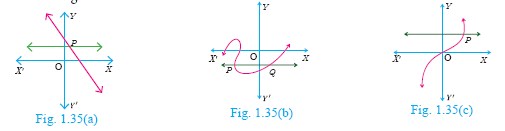
59.
Observe Fig and find \(\angle\)P
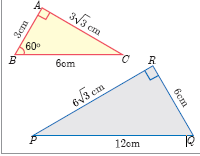
60.
If 15tan2 θ+4 sec2 θ=23 then find the value of (secθ+cosecθ)2 -sin2 θ
61.
Express cot 85° + cos 75° in terms of trigonometric ratios of angles between 0° and 45°.
62.
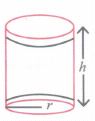
A wooden article was made by scooping out a hemisphere from each end of a cylinder as shown in figure. If the height of the cylinder is 10 cm and its base is of radius 3.5 cm find the total surface area of the article.
63.
| Team A | 50 | 20 | 10 | 30 | 30 |
| Team B | 40 | 60 | 20 | 20 | 10 |
Which team is more consistent?
64.
A two digit number is such that the product of its digits is 18, when 63 is subtracted from the number, the digits interchange their places. Find the number.
65.
A chess board contains 64 equal squares and the area of each square is 6.25 cm2, A border round the board is 2 cm wide.
66.
How many terms of the AP: 24, 21, 18, ... must be taken so that their sum is 78?
67.
In a flower bed, there are 23 rose plants in the first row, 21 in the second, 19 is the third, and so on. There are 5 rose plants in the last row. How many rows are there in the flower bed?
68.
Find a relation between x and y if the points (x, y) (1, 2) and (7, 0) are collinear.
69.
A function f: [-7,6) \(\rightarrow\) R is defined as follows.
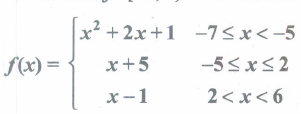
\(\cfrac { 4f(-3)+2f(4) }{ f(-6)-3f(1) } \)
70.
Let f = {(2, 7); (3, 4), (7, 9), (-1, 6), (0, 2), (5,3)} be a function from A = {-1,0, 2, 3, 5, 7} to B = {2, 3, 4, 6, 7, 9}. Is this
(i) an one-one function
(ii) an onto function,
(iii) both one and onto function?
71.
If α and β are the roots of the polynomial f(x) = x2 - 2x + 3, find the polynomial whose roots are
\(\frac { \alpha -1 }{ \alpha +1 } ,\frac { \beta -1 }{ \beta +1 } \)
72.
if sin\(\theta \) (1 + sin2\(\theta \)) = cos2\(\theta \), then prove that cos6\(\theta \) - 4cos4\(\theta \) + 8cos2\(\theta \) = 4
73.
Find the equation of a line whose intercepts on the x and y axes are given below. -5, \(\frac 34\)
74.
If the range and coefficient of range of the data are 20 and 0.2 respectively, then find the largest and smallest values of the data.
75.
If A, B, C are any three events such that probability of B is twice as that of probability of A and probability of C is thrice as that of probability of A and if P(A ∩ B) = \(\frac{1}{6}\) , P(B ∩ C) = \(\frac{1}{4}\), P(A ∩ C), \(\frac{1}{8}\), P(A P(A U B U C) = \(\frac{9}{10}\) , P(A ∩ B ∩ C) = \(\frac{1}{15}\), then find P(A), P(B) and P(C)?
76.
The temperature of two cities A and B in a winter season are given below.
| Temperature of city A (in degree Celsius) | 18 | 20 | 22 | 24 | 26 |
| Temperature of city B (in degree Celsius) | 11 | 14 | 15 | 17 | 18 |
Find which city is more consistent in temperature changes?
77.
If a cos\(\theta \) - bsin\(\theta \) = c, then prove that (a sin\(\theta \) + bcos\(\theta \)) = \(\pm \sqrt { { a }^{ 2 }+{ b }^{ 2 }-{ c }^{ 2 } } \)
78.
Two trains leave a railway station at the same time. The first train travels due west and the second train due north. The first train travels at a speed of 20 km/hr and the second train travels at 30 km/hr. After 2 hours, what is the distance between them?
79.
Let A = {1, 2} and B = {1, 2, 3, 4}, C = {5, 6} and D = {5, 6, 7, 8}, Verify whether A x C is a subset of B x D?
80.
81.
If \(\frac { cos\alpha }{ cos\beta } \) = m and \(\frac { cos\alpha }{ sin\beta } \) = n, then prove that (m2 + n2) cos2\(\beta\) = n2
82.
A container open at the top is in the form of a frustum of a cone of height 16 cm with radii of its lower and upper ends are 8 cm and 20 cm respectively. Find the cost of milk which can completely fill a container at the rate of Rs. 40 per litre.
83.
Calculate the mass of a hollow brass sphere if the inner diameter is 14 cm and thickness is 1mm, and whose density is 17.3 g/ cm3.
84.
Find the volume of the iron used to make a hollow cylinder of height 9 cm and whose internal and external radii are 21 cm and 28 cm respectively
85.
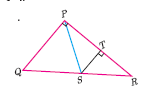
In figure \(\angle\)QPR = 90o, PS is its bisector. If ST\(\bot \)PR, prove that ST \(\times\) (PQ + PR) = PQ \(\times\) PR.
86.
Solve \(\frac { x }{ 2 } -1=\frac { y }{ 6 } +1=\frac { z }{ 7 } +2\); \(\frac { y }{ 3 } +\frac { z }{ 2 } =13\)
87.
The floor of a hall is covered with identical tiles which are in the shapes of triangles. One such triangle has the vertices at (-3, 2), (-1, -1) and (1, 2). If the floor of the hall is completely covered by 110 tiles, find the area of the floor.
88.
In a three-digit number, when the tens and the hundreds digit are interchanged the new number is 54 more than three times the original number. If 198 is added to the number, the digits are reversed. The tens digit exceeds the hundreds digit by twice as that of the tens digit exceeds the unit digit. Find the original number.
89.
90.
Draw the two tangents from a point which is 10 cm away from the centre of a circle of radius 5 cm. Also, measure the lengths of the tangents.
1.
(b)
\(\frac { 1 }{ 4 } \)
2.
(a)
3.
(b)
1
4.
(b)
60 kg
5.
(c)
10 cm
6.
(b)
3x+5y-20 = 0
7.
(d)
\(-\frac { 7 }{ 2 } \)
8.
(a)
1 cm
9.
(b)
\(\sqrt { { a }^{ 2 }-{ b }^{ 2 } } \)
10.
(b)
secant
11.
(a)
\(\frac { { a }^{ 2 }+ab+{ b }^{ 2 } }{ (a-b) } \)
12.
(a)
\(\frac { { a }^{ 2 }+1 }{ { a }^{ 2 }-1 } \)
13.
(c)
14.
(a)
p+q-n
15.
(b)
1
16.
(c)
5-9x
17.
(c)
35
18.
(d)
-2,13
19.
(b)
5, -5
20.
(a)
\(\frac{1}{3}\)πh1(r12+r22+r1r2)
21.
(a)
13 cm
22.
(a)
0
23.
(c)
24.
(b)
25.
(b)
\(\frac { p }{ p+q+r } \)
26.
(a)
0
27.
(a)
\(\frac { h\left( 1+tan\beta \right) }{ 1-tan\beta } \)
28.
(b)
b2 - a2
29.
(a)
30.
(d)
2520
31.
(a)
The slope is 0.5 and the y intercept is 2.6
32.
(d)
2
33.
(b)
34.
(a)
25 : 4
35.
(a)
2:1
36.
(b)
1120\(\pi\) cm3
37.
(b)
(2,-1)
38.
(c)
2mn-1
39.
(d)
4 x 3
40.
(c)
-1, 2
41.
An arrow diagram
42.
It is not a function as the vertical line PQ cuts the graph at two points
43.
A = {1,2,3},B = {1,3,5, 7,9}
f(x) = 2x + 1
f(0)) = 2(0) + 1 = 1
f(1) = 2(1) + 1=3
f(2) = 2(2) + 1 = 5
f(3) = 2(3) + 1 = 7
(i) A set of ordered pairs.
f = {(0, 1), (1, 3), (2, 5), (3, 7)}
(ii) A table
| x | 0 | 1 | 2 | 3 |
| f(x) | 1 | 3 | 5 | 7 |
(ii) An arrow diagram
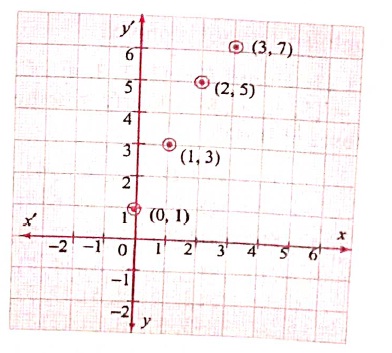
(iv) A Graph f = \(\{(x, f(x) / x \in A\}\)
= {(0, 1), (1, 3), (2, 5), (3, 7)}
44.
4 x 4
45.
\(\sqrt { 2 } { x }^{ 2 }+7x+5\sqrt { 2 } =0\)
\(\sqrt{2} x^{2}+2 x+5 x+5 \sqrt{2}=0\)
\(
\sqrt{2} x^{2}+\sqrt{2} \sqrt{2} x+5 x+5 \sqrt{2} =0
\)
\(\sqrt{2} x(x+\sqrt{2})+5(x+\sqrt{2}) =0
\)
\((x+\sqrt{2})(\sqrt{2} x+5) =0
\)
\(
x+\sqrt{2} =0
\) \(
\sqrt{2 x+5} =0
\)
\(x =-\sqrt{2}\) \(x =-\frac{5}{\sqrt{2}}\)
Solution is x \(=-\sqrt{2},-\frac{5}{\sqrt{2}}\)
46.
\(\frac { 1 }{ 2 } \), 1, 2, 4,...
\(\frac { { t }_{ 2 } }{ { t }_{ 1 } } =\frac { 1 }{ \frac { 1 }{ 2 } } =2;\frac { { t }_{ 3 } }{ { t }_{ 2 } } =\frac { 2 }{ 1 } =2;\frac { { t }_{ 4 } }{ { t }_{ 3 } } =\frac { 4 }{ 2 } =2\)
Here the ratios between successive terms are equal. Therefore the sequence \(\frac { 1 }{ 2 } \),1,2,4.... is a Geometric Progression with common ratio r = 2.
47.
4x + 3y + 12 = 0
4x + 3y = -12
Dividing by - 12
\(\Rightarrow \ \frac{4 x}{-12}+\frac{3 y}{-12} =1 \)
\(\Rightarrow \ \frac{x}{(-3)}+\frac{y}{(-4)} =1 \)
\(\frac{x}{a}+\frac{y}{b} =1 \)
x intercept = a = -3
y intercept = b = -4.
48.
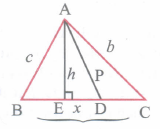
Again in \(\triangle A B C, \angle A E D=\angle A E B=90^{\circ}\)
By Pythagoras theorem.
AB2 = AE2 + EB2
= AD2 - DE2 + (BD - DE)2
= AD2 - DE2 + BD2 + DE2 -2BD.DE
= AD2 + BD2 - 2BD.DE
\( \mathrm{AB}^{2} =\mathrm{AD}^{2}+\left(\frac{1}{2} B C\right)^{2}-2 \cdot \frac{1}{2} \mathrm{BC} \cdot \mathrm{DE} \)
\(\mathrm{AB}^{2} =\mathrm{AD}^{2}+\frac{1}{4} B C^{2}-\mathrm{BC} \cdot \mathrm{DE} \)
\(\mathrm{AB}^{2} =\mathrm{AD}^{2}-\mathrm{BC} \cdot \mathrm{DE}+\frac{1}{4} B C^{2} \ldots(2) \)
\(\mathrm{c}^{2} =\mathrm{p}^{2}-\mathrm{ax}+\frac{a^{2}}{4}\)
49.
We see that the numerators of nth term is n - 1 and the denominators of nth term is n.
\(a_{n}=\frac{n-1}{n}\)
50.
When two coins are tossed together, the sample space is
S = {HH, HT, TH, TT} n(S) = 4
Let A be the event of getting different faces on the coins.
A = {HT, TH}; n(A) = 2
Probability of getting different faces on the coins is P(A) = \(\frac { n(A) }{ n(S) } =\frac { 2 }{ 4 } =\frac { 1 }{ 2 } \).
51.
Standard deviation of first n natural numbers
\(=\sqrt{\frac{n^{2}-1}{12}}\)
SD of first 21 natural numbers
\(
=\sqrt{\frac{21^{2}-1}{12}}
\)
\(=\sqrt{\frac{441-1}{12}}=\sqrt{\frac{440}{12}}
\)
\(=\sqrt{36.6666}=6.05\)
Standard deviation of first 21 natural numbers = 6.05
52.
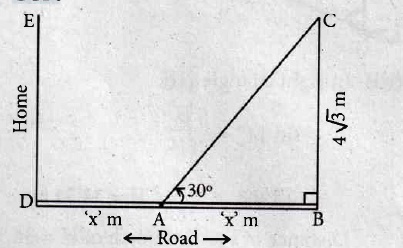
Let AB = x be the distance between foot of the house and the observer at the median of the road.
DB = 2x is the width of the road.
Height of the house BC = \(4 \sqrt{3} m\)
From the right triangle \(\triangle\) ABC
\(
\therefore \tan 30^{\circ} =\frac{B C}{A B}
\)
\(\frac{1}{\sqrt{3}}=\frac{4 \sqrt{3}}{x}
\)
\(x =4 \sqrt{3} \times \sqrt{3}=4 \times 3=12 \mathrm{~m}
\)
\(\text { Width of the road } =2 \times x=2 \times 12=24 \mathrm{~m}\)
Width of the road = 24 m.
53.
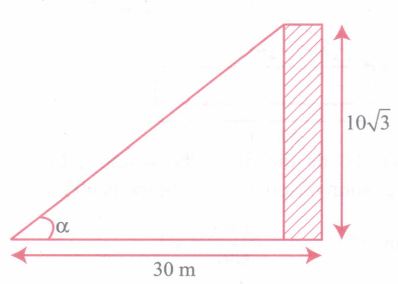
From the right \(\triangle\)ABC
\( \tan \theta =\frac{\text { Opposite side }}{\text { Adjacent side }}=\frac{A C}{B C} \)
\(=\frac{10 \sqrt{3} m}{30 m}=\frac{\sqrt{3}}{3} \)
\(=\frac{\sqrt{3}}{\sqrt{3} \sqrt{3}}=\frac{1}{\sqrt{3}} \)
\(\tan \theta =\frac{1}{\sqrt{3}} \)
\(\theta =\tan ^{-1}\left(\frac{1}{\sqrt{3}}\right)\)
0 = 30o
Angle of elevation is 30o
54.
The vertices Q(3, - 2) and R(- 5, 4)
slope of the line QR \(=\frac{y_{1}-y_{2}}{x_{1}-x_{2}}
\)
\(=\frac{-2-4}{3+5}=\frac{-6}{8}=\frac{-3}{4}
\)
Slope of the line parallel to QR is \(-\frac{3}{4}\)
Equation of the line passing through
P(- 5, 2) and having slope \(-\frac{3}{4}\) is
y - y1 = m(x - x1)
y - 2 = \(-\frac{3}{4}(x+5)\)
4y - 8 = -3x - 15
3x + 4y + 7 = 0
55.
f o f(k) = f(f(k))
= 2(2k - 1) -1 = 4k - 3
Thus, f o f(k) = 4k - 3
But, it is given that f o f(k) = 5
Therefore 4k - 3 = 5 ⇒ k = 2
56.
Given that, radius r = 7 cm
Now, total surface area of the cone = \(\pi\)r(l + r)sq. units
T.S.A = 704 cm2
704 = \(\frac{22}{7}\times7(l+7)\)
32 = l + 7 implies l = 25 cm
Therefore, slant height of the cone is 25 cm.
57.
Given that, height of the cylinder h = 20 cm ; radius r =14 cm
Now, C.S.A. of the cylinder = 2p\(\pi\)h sq. units
C.S.A. of the cylinder = \(2\times \frac { 22 }{ 7 } \times 14\times 20=2\times 22\times 2\times 20\)
T.S.A. of the cylinder \(=2\pi r(h+r)\)sq.units
\(=2\times \frac { 22 }{ 7 } \times 14\times (20+14)=2\times \frac { 22 }{ 7 } \times 14\times 34\)
= 2992 cm2
Therefore, C.S.A. = 1760 cm2 and T.S.A. = 2992 cm2
58.
The curves in Fig.1.35(a) and Fig.1.35(c) represent a one – one function as the horizontal lines meet the curves in only one point P.
The curve in Fig.1.35(b) does not represent a one–one function, since, the horizontal line meet the curve in two points P and Q.
59.
In \(\Delta BAC\) and \(\Delta PRQ,\quad \frac { AB }{ RQ } =\frac { 3 }{ 6 } =\frac { 1 }{ 2 } \)
\(\frac { BC }{ QP } =\frac { 6 }{ 12 } =\frac { 1 }{ 2 } ;\frac { CA }{ PR } =\frac { 3\sqrt { 3 } }{ 6\sqrt { 3 } } =\frac { 1 }{ 2 } \)
Therefore, \(\frac { AB }{ QP } =\frac { BC }{ QP } =\frac { CA }{ PR } \)
By SSS similarity, we have \(\triangle\)BAC~\(\triangle\)QRB
\(\angle\)P =\(\angle\)C (since the corresponding parts of similar triangle)
\(\angle\)P =\(\angle\)C 180o -\((\angle A+\angle B)={ 180 }^{ 0 }-({ 90 }^{ 0 }+{ 60 }^{ 0 })\)
\(\angle\)P = 180o - 150o = 30o
60.
61.
cot 85° + cos 75°
= cot(90° - 5°) + cos(90° - 15°)
= tan 5° + sin 15°
62.
Radius of the cylinder be r
Height of the cylinder be h
Total surface area of the article
= CSA of cylinder + CSA of 2 hemispheres
= 2ㅠrh + 2πr2 = 2πr(h + 2r)
\(=2\times \frac { 22 }{ 7 } \times 3.5\times (10+2\times 3.5)\)
= 22 x 17 = 374 cm2
63.
| Team A | ||
| x1 | d1 = x - 28 | d12 |
| 50 | 22 | 484 |
| 20 | -8 | 64 |
| 10 | -18 | 324 |
| 30 | 2 | 4 |
| 30 | 2 | 4 |
| 140 | Σd = 0 | 880 |
\(\bar { { x }_{ 1 } } \) =\(\frac { 140 }{ 5 } \) =28
σ1 =\(\sqrt { \frac { \Sigma d^{ 2 } }{ n } } =\sqrt { \frac { 880 }{ 5 } } \)
= \(\sqrt { 176 } \)
= 13.27
CV1 = \(\frac { \sigma }{ \bar { x_{ 1 } } } \) x 100
CV1 = \(\frac { 13.27 }{ 28 } \) x 100
= 47.39%
CV1 < CV2
| Team B | ||
| x2 | d2 = x - 28 | d2 |
| 40 | 10 | 100 |
| 60 | 30 | 900 |
| 20 | -10 | 100 |
| 20 | -10 | 100 |
| 10 | -20 | 400 |
| 150 | Σd = 0 | 1600 |
\(\bar { { x }_{ 2 } } =\frac { 150 }{ 5 } \) =30
σ2 =\(\sqrt { \frac { \Sigma d^{ 2 } }{ n } } =\sqrt { \frac { 1600 }{ 5 } } \)
= \(\sqrt { 320 } \)
=17.89
CV1 = \(\frac { { \sigma }_{ 2 } }{ \bar { { x }_{ 2 } } } \) x 100
CV2 = \(\frac { 17.89 }{ 30 } \) x 100
= 59.63%
∴ Team A is more consistent.
64.
Let the tens digits be x. Then the uints digits=\(\frac{18}{x}\)
∴ Number =10x+\(\frac{18}{x}\)
and number obtained by interchanging the digits =10x+\(\frac{18}{x}\)
\(\\ \therefore \left( 10x+\frac { 18 }{ x } \right) -\left( 10\times \frac { 18 }{ x } +x \right) =63\)
\(\Rightarrow 10x+\frac { 18 }{ x } -\frac { 180 }{ x } -x=0\)
\(\Rightarrow 9x-\frac { 162 }{ x } -63=0\)
⇒ 9x2-63x-162=0
⇒ x2-7x-18=0
⇒ (x-9)(x+2)=0⇒ x=9,-2
But a digit can never be (-ve), so x = 9.
So, the required number \(=10\times 9+\frac { 18 }{ 9 } =92\)
65.
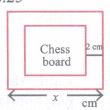
Let the length of the side of the chess board be x cm. Then
Area of 64 squares = (x - 4)2
(x - 4)2 = 64 x 6.25
⇒ x2-8x+ 16=400
⇒X2- 8x - 384 =0
⇒ X2- 24x + 16x - 384 = 0
⇒(x - 24)(x + 16) = 0
⇒ x=24 cm.
66.
Here a = 24, d = 21-24 = -3, Sn = 78. We need to find n.
We know that,
Sn= \(\frac{n}{2}\) (2a + (n - 1)d)
78 = \(\frac{n}{2}\) 48 + (n -1)(-3))
78 = \(\frac{n}{2}\) 2(51-3n)
or 3n2 - 51n + 156 = 0
n2 -17n + 52 = 0
(n - 4)(n - 13) = 0
n = 4 or 13
The number of terms are 4 or 13.
67.
The number of rose plants in the 1st, 2nd, 3rd, . . . rows are
23,21, 19, ... 5
It forms an A.P.
Let the number of rows in the flower bed be n.
Then a = 23, d = 21 - 23 = -2/a = 5.
As, an = a + (n - 1)d i.e. tn = a + (n - 1)d
We have 5 = 23 + (n - 1)(-2)
i.e. -18 = (n - 1)(-2)
n = 10
ஃ There are 10 rows in the flower bed.
68.
If A(-2, -1), B(a, 0), C(4, b) and D(1, 2) are the vertices of a parallelogram, find the values of a and b.
We know that the diagonals of a parallelogram bisect each other. Therefore the co-ordinates of the midpoint of AC are same as the co-ordinates of the mid-point of BD. i.e.
\(\left( \frac { -2+4 }{ 2 } ,\frac { -1+b }{ 2 } \right) =\left( \frac { a+1 }{ 2 } ,\frac { 0+2 }{ 2 } \right) \)
⇒ \(\left( 1,\frac { b-1 }{ 2 } \right) =\left( \frac { a+1 }{ 2 } ,1 \right) \)
⇒ \(\frac { a+1 }{ 2 } \) = 1 ⇒ a + 1 = 2 ⇒ a = 1
⇒ \(\frac { b-1 }{ 2 } \) = 1 ⇒ b - 1 = 2 ⇒ b = 3
69.
\(\cfrac { 4f(-3)+2f(4) }{ f(-6)-3f(1) } \)
For f(1) & f(3)
Since 1 & 3 lies between -5 ≤ x ≤2, We take, f(x) = x +5
f(1) = 1 + 5 = 6
f(-3) = -3 +5 = 2
For f(4): Since 4 lies between 2 < x < 6 We take, f(x) = x -1
f(4) = 4 -1 = 3
For f(-6): Since -6 lies between -7≤ x < -5 ,We take, f(x) = x² + 2x +1
f(-6) = (-6)² + 2(-6) + 1 = 36 -12 + 1 = 24 +1 = 25
Now ,\(\cfrac { 4f(-3)+2f(4) }{ f(-6)-3f(1) } \) =\(\frac{ 4(2) +2(3) }{ 25 - 3(6)}\)
= \(\frac{ 8 + 6 }{ 25 -18}\)
= \(\frac{14 }{ 7}\) = 2
Hence, the value of \(\cfrac { 4f(-3)+2f(4) }{ f(-6)-3f(1) } \) = 2
70.
It is both one-one and onto function
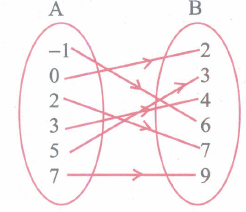
All the elements in A have their separate images in B. All the elements in B have their preimage in A. Therefore it is one-one and onto function.
71.
\(f(x)=\frac { 1{ x }^{ 2 } }{ a } -\frac { 2x }{ b } +\frac { 3 }{ c } \)
Sum of the roots \((\alpha +\beta )=\frac { -b }{ a } =-\frac { (-2) }{ 1 } \)
Product of the roots \((\alpha \beta )=\frac { c }{ a } =\frac { 3 }{ 1 } =3\)
\(\frac { \alpha -1 }{ \alpha +1 } ,\frac { \beta -1 }{ \beta +1 } \)
⇒ sum of the roots=\(\frac { \alpha -1 }{ \alpha +1 } ,\frac { \beta -1 }{ \beta +1 } \)
Sum\(=\frac { (\alpha -1)(\beta +1)+(\beta -1)(\alpha +1) }{ (\alpha +1)(\beta +1) } \)
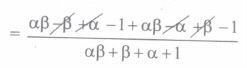
\(=\frac { \alpha \beta +\alpha \beta -2 }{ \alpha \beta +(\alpha +\beta )+1 } =\frac { 2\alpha \beta -2 }{ \alpha \beta +(\alpha +\beta )+1 } \)
Product=\(\frac { \alpha -1 }{ \alpha +1 } \times \frac { \beta -1 }{ \beta +1 } =\frac { (\alpha -1)(\beta -1) }{ (\alpha +1)(\beta +1) } \)
\(=\frac { \alpha \beta -\beta -\alpha +1 }{ \alpha \beta ++\alpha +1 } =\frac { \alpha \beta -(\alpha +\beta )+1 }{ \alpha \beta +(\alpha +\beta )+1 } \)
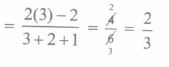
\(=\frac { 3-2+1 }{ 3+2+1 } \)
\(=\frac { 2 }{ 6 } =\frac { 1 }{ 3 } \)
∴ Required equation= \({ x }^{ 2 }-\frac { 2 }{ 3 } x+\frac { 1 }{ 3 } =0\)
⇒3x2 - 2x + 1 = 0
72.
Given sin \(\theta \) (1+ sin2 \(\theta \)) = cos2 \(\theta \)
Squaring on both the sides.
sin2 \(\theta \)(1+ sin2 \(\theta \))2 = cos4 \(\theta \)
\(\Rightarrow\left(1-\cos ^{2} \theta\right)\left\{1+\left(1-\cos ^{2} \theta\right)\right\}^{2}=\cos ^{4} \theta\)
\(\Rightarrow\left(1-\cos ^{2} \theta\right)\left\{1+\left(1-\cos ^{2} \theta\right)^{2}+2(1)\left(1-\cos ^{2} \theta\right)\right\}
=\cos ^{4} \theta
\)
\(\Rightarrow\left(1-\cos ^{2} \theta\right)\left(1+1+\cos ^{4} \theta-2(1) \cos ^{2} \theta\right.
\left.+2-2 \cos ^{2} \theta\right)=\cos ^{4} \theta
\)
\(\Rightarrow\left(1-\cos ^{2} \theta\right)\left(4-4 \cos ^{2} \theta+\cos ^{4} \theta\right)=\cos ^{4} \theta
\)
\(\Rightarrow 4-4 \cos ^{2} \theta+\cos ^{4} \theta-4 \cos ^{2} \theta+4 \cos ^{4} \theta-\cos ^{6} \theta
\ =\cos ^{4} \theta
\)
\(\Rightarrow \ 4-8 \cos ^{2} \theta+5 \cos ^{4} \theta-\cos ^{6} \theta=\cos ^{4} \theta
\)
\(4-8 \cos ^{2} \theta+4 \cos ^{4} \theta-\cos ^{6} \theta=0
\)
\(4=8 \cos ^{2} \theta-4 \cos ^{4} \theta+\cos ^{6} \theta
\)
\(\Rightarrow \cos ^{6} \theta-4 \cos ^{4} \theta+8 \cos ^{2} \theta=4
\)
73.
Given intercepts are -5, \(\frac 34\)
\(a=-5, b=\frac{3}{4}\)
Equation of the line in the intercepts form is
\(\frac{x}{a}+\frac{y}{b}=1
\)
\(\frac{x}{-5}+\frac{y}{\left(\frac{3}{4}\right)}=1
\)
\(\frac{x}{-5}+\frac{4 y}{3}=1
\)
3x - 20y = -15
3x - 20y + 15 = 0
74.
Range = L- S = 20
Co-efficient of range = \(\frac { L-S }{ L+S } \) = 0.2
L - S = 20 ...(1)
L - S = 0.2(L + S)
(L + S) 0.2 = 20 ...(2)
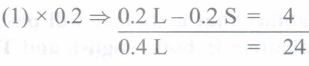
L = \(\frac{24}{0.4}\) = 60
Substitute L = 60 in (1)
60 - S = 20
-S = 20 - 60 =-40
S = 40
∴ The largest is 60, the smallest is 40°.
75.
\(\text { Given }
P(A \cap B)=\frac{1}{6}
\)
\(P(B \cap C) =\frac{1}{4}
\)
\(P(A \cap C) =\frac{1}{8}
\)
\(P(A \cup B \cup C)=\frac{9}{10}
\)
\(P(A \cap B \cap C)=\frac{1}{15}
\)
Also given that P(B) = 2 P(A)
P(C) = 3 P(A)
Now \(P(A \cup B \cup C)= P(A)+P(B)+P(C)-
P(A \cap B)-P(B \cap C)
-P(A \cap C)+P(A \cap B \cap C)
\)
\(\frac{9}{10}= \mathrm{P}(\mathrm{A})+2 \mathrm{P}(\mathrm{A})+3(\mathrm{P}(\mathrm{A}))-
\frac{1}{6}-\frac{1}{4}-\frac{1}{8}+\frac{1}{15}
\)
\(\frac{9}{10} =6 \mathrm{P}(\mathrm{A})-\frac{1}{6}-\frac{1}{4}-\frac{1}{8}+\frac{1}{15}
\)
\(6 \mathrm{P}(\mathrm{A}) =\frac{9}{10}+\frac{1}{6}+\frac{1}{4}+\frac{1}{8}-\frac{1}{15}
\)
\(6 \mathrm{P}(\mathrm{A}) =\frac{108+20+30+15-8}{120}
\)
\(6 \mathrm{P}(A) =\frac{165}{120}
\)
\(\mathrm{P}(\mathrm{A}) =\frac{165}{120 \times 6}=\frac{11}{48}
\)
\(\mathrm{P}(\mathrm{B}) =2 \times \frac{11}{48}=\frac{11}{24}
\)
\(\mathrm{P}(\mathrm{C}) =3 \times \frac{11}{48}=\frac{11}{16}
\)
\(\mathrm{P}(\mathrm{A}) =\frac{11}{48} ; \mathrm{P}(\mathrm{B})=\frac{11}{24} ; \mathrm{P}(\mathrm{C})=\frac{11}{16}
\)
76.
| City A | City B | ||||
|---|---|---|---|---|---|
| x1 | \({ d }_{ 1 }=x-\bar { x } \) | \({ d }_{ 1 }^{ 2 }\) | x1 | \(d=x-\bar { x } \) | \({ d }_{ 1 }^{ 2 }\) |
| 18 | -4 | 16 | 11 | -4 | 16 |
| 20 | -2 | 4 | 14 | -1 | 1 |
| 22 | 0 | 0 | 15 | 0 | 0 |
| 24 | 2 | 4 | 16 | 3 | 4 |
| 26 | 4 | 16 | 18 | 3 | 9 |
| 110 | 0 | 40 | 75 | 20 | |
\(\bar { { x }_{ 1 } } =\frac { { \Sigma x }_{ 1 } }{ n } \)
= \(\frac { 110 }{ 5 } \)
= 22
\({ \sigma }_{ 1 }=\sqrt { \frac { { \Sigma d }_{ 1 }^{ 2 } }{ n } } \)
= \(\sqrt { \frac { 40 }{ 5 } } \)
= \(\sqrt { 8 } \)
\(\bar { { x }_{ 2 } } =\frac { { \Sigma x }_{ 1 } }{ n } \)
= \(\frac { 75 }{ 5 } \)
= 15
\({ \sigma }_{ 2 }=\sqrt { \frac { { \Sigma d }_{ 2 }^{ 2 } }{ n } } \)
= \(\sqrt { \frac { 20 }{ 5 } } \)
= \(\sqrt { 4 } \)
= \(2\sqrt { 2 } \)
\(CV_{ 1 }=\frac { { { \sigma }_{ 1 } } }{ { x }_{ 1 } } \times 100\)
= \(\frac { 2.83 }{ 22 } \times 100\)
= 12.86
\({ CV }_{ 2 }=\frac { { \sigma }_{ 2 } }{ \bar { { x }_{ 2 } } } \times 100\)
= \(\frac { 2 }{ 15 } \times 100\)
= 13.33
\(\therefore\)Co-efficient of variation of City A is less than C.V of City B.
\(\therefore\) City A is more consistent.
77.
If a cos θ - b sin θ = c
Squaring on both the sides.
(a cos θ - b sin θ)2 = c2
a2 cos2 θ + b2 sin2 θ - 2ab cos θ sin θ = c2
\(a^{2}\left(1-\sin ^{2} \theta\right)+b^{2}\left(1-\cos ^{2} \theta\right)-2 a b \sin \theta \cos \theta=c^{2}
\)
\(a^{2}-a^{2} \sin ^{2} \theta+b^{2}-b^{2} \cos ^{2} \theta-2 a b \sin \theta \cos \theta=c^{2}
\)
\(a^{2}+b^{2}-c^{2}=a^{2} \sin ^{2} \theta+b^{2} \cos ^{2} \theta+2 a b \sin \theta \cos \theta
\)
\(a^{2}+b^{2}-c^{2}=(a \sin \theta+b \cos \theta)^{2}
\)
\(\pm \sqrt{a^{2}+b^{2}-c^{2}}=a \sin \theta+b \cos \theta
\)
\(\therefore \ a \sin \theta+b \cos \theta=\pm \sqrt{a^{2}+b^{2}-c^{2}}
\)
78.
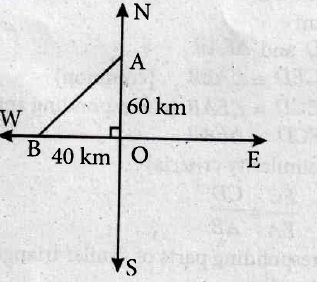
Distance travelled by the first train in 2 hours
= 2 x 20 = 40km
Distance travelled by the second train in 2 hours
= 2 x 30 = 60km
Let the distances are represents by OB and OA respectively
Now applying Pythagoras theorem,
Distance between the trains after 2 hours is AB.
we have AB2 = OA2 + OB2 = 602 + 402
= 3600 + 1600
= 5200
\( A B =\sqrt{5200} \)
\(=\sqrt{2^{2} \times 2^{2} \times 5 \times 5 \times 13} \)
\(=2^{2} \times 5 \sqrt{13} \)
\(=20 \sqrt{13} \mathrm{~km}\)
Distance between the trains after 2 hrs
\(=20 \sqrt{13} \mathrm{~km}\)
79.
A = {1, 2),B = {1, 2, 3, 4}, C = {5, 6},D = {5, 6, 7, 8}
A x C = {1, 2} x {5, 6}
\(\mathrm{A} \times \mathrm{C}=\{(1,5),(1,6),(2,5),(2,6)\}\)
B x D = { 1, 2, 3, 4} x { 5, 6, 7, 8}
\(\begin{array}{r} \mathrm{B} \times \mathrm{D}=\{({1,5}),(1,6),(1,7),(1,8) ({2,5}),(2,6),(2,7),(2,8) (3,5),(3,6),(3,7),(3,8) (4,5),(4,6),(4,7),(4,8)\} \end{array}\)
(A x C) is a subset of (B x D)
80.
81.
Given
\(
\frac{\cos \alpha}{\cos \beta}=m
\)
\(\frac{\cos \alpha}{\sin \beta} =n
\)
\(\text { LHS } =\left(m^{2}+n^{2}\right) \cos ^{2} \beta
\)
\(=\left(\frac{\cos ^{2} \alpha}{\cos ^{2} \beta}+\frac{\cos ^{2} \alpha}{\sin ^{2} \beta}\right) \cos ^{2} \beta
\)
\(=\frac{\left(\cos ^{2} \alpha \sin ^{2} \beta+\cos ^{2} \alpha \cos ^{2} \beta\right)}{\cos ^{2} \beta \sin ^{2} \beta} \cos ^{2} \beta
\)
\(=\frac{\cos ^{2} \alpha\left(\sin ^{2} \beta+\cos ^{2} \beta\right)}{\sin ^{2} \beta}
\)
\(=\frac{\cos ^{2} \alpha}{\sin ^{2} \beta}(1)
\)
\(=\left(\frac{\cos \alpha}{\sin \beta}\right)^{2}
\)
= n2 = RHS
82.
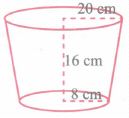
Given radius of lower end r = 8 cm
radius of upper end R = 20 cm
height h = 16 cm
Volume \(=\frac{\pi h}{3}\left(\mathrm{R}^{2}+\mathrm{Rr}+\mathrm{r}^{2}\right) \mathrm{cu} . units \)
\(=\frac{22 \times 16}{7 \times 3}\left((20)^{2}+(20)(8)+(8)^{2}\right) \)
\(=\frac{22 \times 16}{21}[400+160+64] \)
\(=\frac{22 \times 16}{21}(624)=10459.43 \mathrm{~cm}^{3} \)
\(=\frac{10459.43}{1000}\left[\because 1000 \mathrm{~cm}^{3}=1\right. litre ]\)
= 10.45943 litre
Cost of milk per litre = Rs. 40
Total cost = 10.459 x 40
= Rs. 418.36
83.
Let r and R be the inner and outer radii of the hollow sphere.
Given that, inner diameter d = 14 cm; inner radius r = 7 cm; thickness = 1 mm = \(\frac{1}{10}\)cm
Outer radius R = 7 + \(\frac { 1 }{ 10 } =\frac { 71 }{ 10 } =7.1cm\)
Volume of hollow sphere \(=\frac { 4 }{ 3 } \pi \left( { R }^{ 3 }-{ r }^{ 3 } \right) cu.cm\)
\(=\frac { 4 }{ 3 } \times \frac { 22 }{ 7 } (357.91-343)=62.48cm^{ 3 }\)
But, weight of brass in 1 cm3 = 17.3 gm
Total weight = 17362 x 62.48 = 1080.90 gm
Therefore, total weight is 1080.90 grams.
84.
Let r, R and h be the internal radius, external radius and height of the hollow cylinder respectively.
Given that, r = 21cm, R = 28 cm, h = 9 cm
Now, volume of hollow cylinder = \(\pi\)(R2 − r2)h cu. units
\(=\frac { 22 }{ 7 } \left( { 28 }^{ 2 }-21^{ 2 } \right) \times 9\)
\(=\frac { 22 }{ 7 } (784-441)\times 9=9702\)
Therefore, volume of iron used = 9702 cm3
85.
Given that PS is the bisector of \(\angle\)P of \(\triangle\)PQR
\(\frac{P Q}{P R}=\frac{Q S}{S R}\) [By Angle Bisector Theorem]
Adding 1 on both the sides
\( \frac{P Q}{P R}+1 =\frac{Q S}{S R}+1 \)
\(\frac{P Q+P R}{P R}=\frac{Q S+S R}{S R} \)
\(\frac{P Q+P R}{P R} =\frac{Q R}{S R} \) ..(2)
In \(\triangle\)RST and \(\triangle\)RQP we have
\( \angle S R T=\angle Q R P=\angle R \)
\(\angle Q P R=\angle S T R=90^{\circ}\)
By AA criterion for similarity, we have
\(\triangle R S T \sim \triangle R Q P \)
\(\frac{R S}{R Q}=\frac{S T}{Q P} \)
\(\frac{Q P}{S T}=\frac{Q R}{R S}\) ...(2)
From (1) and (2)
\(\frac{Q P}{S T}=\frac{P Q+P R}{P R}\)
PQ \(\times\) PR = ST(PQ + PR)
86.
Considering, \(\frac { x }{ 2 } -1=\frac { y }{ 6 } +1\)
\(\frac { x }{ 2 } -\frac { y }{ 6 } \) = 1 + 1 \(\frac { 6x-2y }{ 12 } \) = 2 we get, 3x - y = 12.... (1)
Considering \(\frac { x }{ 2 } -1=\frac { z }{ 7 } +2\)
\(\frac { x }{ 2 } -\frac { z }{ 7 } \) = 1 + 2 gives, \(\frac { 7x-2z }{ 14 } \) = 3 we get, 7x - 2z = 42... (2)
Also, from \(\frac { y }{ 3 } +\frac { z }{ 2 } \) = 13 \(\frac { 2y+3z }{ 6 } \) = 13 we get, 2y + 3z = 78 .(3)
Eliminating z from (2) and (3)
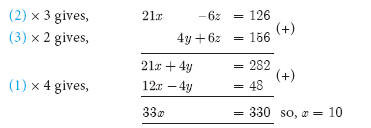
Substituting x = 10 in (1), 30 - y = 12 we get, y = 18
Substituting x = 10 in (2), 70 - 2x = 42 then, z = 14
Therefore, x = 10, y = 18, z = 14.
87.
Vertices of one triangular tile are at (-3, 2), (-1, -1) and (1, 2)
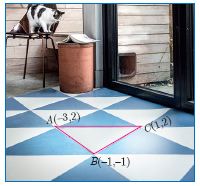
(-3, 2), (-1, -1) and (1, 2)
Area of this tile = \(\frac12\) {(3 - 2 + 2) - (- 2 - 1 - 6)} sq. units
= \(\frac12\) (12) = 6 sq. units
Since the floor is covered by 110 triangle shaped identical tiles,
Area of floor = 110 x 6 = 660 sq. units
88.
Let the
100's digit be 'x'
10's digit be 'y'
Unit's digit be 'z'
Given 100y+ 10x + z - 54 = 3(100x + 10y + z)
Substituting 290x - 70y + 22 = -54 ( /2)
145x - 35y + z = -27 .........(1)
l00x + 10y + z + 198 = 100z + 10y + x
Substituting 99x - 992 = - 198 (99)
x - z = - 2 ...........(2)
y = x + 2 (y - z)
x + y - 2z = 0 ..........(3)
Consider (1) and (3)
145x - 35y + z = -27 .......(1)
35x + 35y - 70z = 0 .......(4)
180x - 69z = -27 .......(5)
Consider (5) and (2)

\(x=\frac{111}{111}=1\)
Substituting x = 1 in .........(2)
1 - z = -z
z = 1 + 2 = 3
Substituting x - 1, z = 3 in (3)
1 + y - 6 = 0
y = 5
solution: x = 1, y = 5, z = 3
The number is 153.
89.
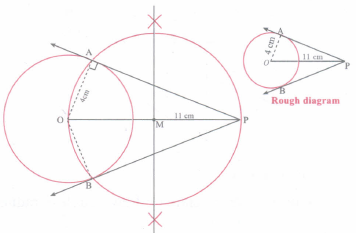
90.
The distance between the point from the centre is 10 cm.
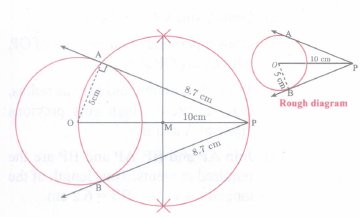
Length of the tangents PA - PB = 8.7 cm
Construction:
Steps:
(1) With O as centre, draw a circle of radius 5cm.
(2) Draw a line OP = 10 cm.
(3) Draw a perpendicular bisector of OP which cuts OP at M.
(4) With M as centre and MO as radius, draw a circle which cuts previous circle at A and B.
(5) Join AP and BP. AP and BP are the required tangents. Thus length of the tangents are PA and PB = 8.7 cm

10th Standard Syllabus & Materials
10th Standard
TN 10th English Prose - 2 - The Night the Ghost Got in Important Questions And Answers Study Material - QB365 Set A
NEW10th Standard
TN 10th English Supplementary - 1 - The Tempest Important Questions And Answers Study Material - QB365 Set A
NEW10th Standard
TN 10th English Poem - 1 - Life Important Questions And Answers Study Material - QB365 Set A
NEW10th Standard
TN 10th English Prose - 1 - His First Flight Important Questions And Answers Study Material - QB365 Set A



Tamilnadu Stateboard 10th Standard Subjects
Tamilnadu Stateboard Standards





