
 100% FREE ACCESS
10th Standard Syllabus & Materials
10th Standard
TN 10th English Prose - 4 - The Attic Important Questions And Answers Study Material - QB365 Set A
NEW10th Standard
TN 10th English Supplementary - 3 - The Story of Mulan Important Questions And Answers Study Material - QB365 Set A
NEW10th Standard
TN 10th English Poem - 3 - I am Every Woman Important Questions And Answers Study Material - QB365 Set A
NEW10th Standard
TN 10th English Prose - 3 - Empowered Women Navigating The World Important Questions And Answers Study Material - QB365 Set A
NEW10th Standard
TN 10th English Supplementary - 2 - Zigzag Important Questions And Answers Study Material - QB365 Set A
NEW10th Standard
TN 10th English Poem - 2 - The Grumble Family Important Questions And Answers Study Material - QB365 Set A

Published on: 06/02/2020
10th Standard Mathematics Book Back and Important Questions-I-2019-2020
Download Tamil Nadu 10th Standard Maths question papers, model tests, one-mark questions, important questions, and public exam papers in PDF format. Free study materials and answer keys for TN State Board students.
Questions + Answers key
Take MCQ Maths Test1.
The top of two poles of height 18.5m and 7m are connected by a wire. If the wire makes an angle of measures 360o with horizontal, then the length of the wire is ____________
23m
18m
28m
25.5m
2.
(sec A + tan A)(1 - sin A) is equal to ___________
sec A
sin A
cosec A
cos A
3.
4.
If an event occurs surely, then its probability is _________.
1
0
\(\frac { 1 }{ 2 } \)
\(\frac { 3 }{ 4 } \)
5.
If the co-efficient of variation and standard deviation of a data are 35% and 7.7 respectively then the mean is ___________
20
30
25
22
6.
If a letter is chosen at random from the English alphabets {a, b....,z}, then the probability that the letter chosen precedes x ____________
\(\frac { 12 }{ 13 } \)
\(\frac { 1 }{ 13 } \)
\(\frac { 23 }{ 26 } \)
\(\frac { 3 }{ 26 } \)
7.
A cylinder having radius 1 m and height 5 m is completely filled with milk. In how many conical flasks can this milk be filled if the radius and height is 50 cm each?
50
500
120
160
8.
9.
Find the equation of the line passing the point which is parallel to the y axis (5, 3) is ____________
y = 5
y = 3
x = 5
x = 3
10.
If ABC is a triangle and AD bisects A, AB = 4cm, BD = 6cm, DC = 8cm then the value of AC is ____________
\(\frac { 16 }{ 3 } cm\)
\(\frac { 32 }{ 3 } cm\)
\(\frac { 3 }{ 16 } cm\)
\(\frac { 1 }{ 2 } cm\)
11.
The ratio of the areas of two similar triangles is equal to ____________
The ratio of their corresponding sides
The cube of the ratio of their corresponding sides
The ratio of their corresponding attitudes
The square of the ratio of their corresponding sides
12.
If triangle PQR is similar to triangle LMN such that 4PQ = LM and QR = 6 cm then MN is equal to ____________
12 cm
24 cm
10 cm
36 cm
13.
14.
A Quadratic polynomial whose one zero is 5 and sum of the zeroes is 0 is given by ___________
x2-25
x2-5
x2-5x
x2-5x+5
15.
If \(\frac { p }{ q } =a\) then \(\frac { { p }^{ 2 }+{ q }^{ 2 } }{ { p }^{ 2 }-{ q }^{ 2 } } \) ___________
\(\frac { { a }^{ 2 }+1 }{ { a }^{ 2 }-1 } \)
\(\frac { 1+{ a }^{ 2 } }{ 1-{ a }^{ 2 } } \)
\(\frac { 1-{ a }^{ 2 } }{ 1-{ +a }^{ 2 } } \)
\(\frac { { a }^{ 2 }-1 }{ { a }^{ 2 }+1 } \)
16.
If pth, qth and rth terms of an A.P. are a, b, c respectively, then (a(q - r) + b(r - p) + c(p - q) is____________
0
a + b + c
p + q + r
pqr
17.
If a and b are the two positive integers when a > b and b is a factor of a then HCF (a, b) is ____________
b
a
ab
\(\frac { a }{ b } \)
18.
If f(x) + f(1 - x) = 2 then \(f\left( \frac { 1 }{ 2 } \right) \) is ___________
5
-1
-9
1
19.
20.
If f(x) = ax - 2, g(x) = 2x - 1 and fog = gof, the value of a is ___________
3
-3
\(\frac { 1 }{ 3 } \)
13
21.
If the order pairs (a, -1) and (5, b) belongs to {(x, y) | y = 2x + 3}, then a and b are __________
-13, 2
2, 13
2, -13
-2,13
22.
The volume of a frustum if a cone of height L and ends-radio and r1 and r2 is ___________
\(\frac{1}{3}\)πh1(r12+r22+r1r2)
\(\frac{1}{3}\)πh(r12+r22-r1r2)
πh(r12+r22+r1r2)
πh(r12+r22-r1r2)
23.
The radius of base of a cone 5 cm and height is 12 cm. The slant height of the cone ___________
13 cm
17 cm
7 cm
60 cm
24.
If a sin (90 - θ) of (90o - θ) = cos(90o - θ)tan equal to ___________
0
1
-1
2
25.
A page is selected at random from a book. The probability that the digit at units place of the page number chosen is less than 7 is
\(\frac{3}{10}\)
\(\frac{7}{10}\)
\(\frac{3}{9}\)
\(\frac{7}{9}\)
26.
Variance of first 20 natural numbers is
32.25
44.25
33.25
30
27.
The electric pole subtends an angle of 30° at a point on the same level as its foot. At a second point ‘b’ metres above the first, the depression of the foot of the pole is 60°. The height of the pole (in metres) is equal to
\(\sqrt { 3 } \) b
\(\frac { b }{ 3 } \)
\(\frac { b }{ 2 } \)
\(\frac { b }{ \sqrt { 3 } } \)
28.
29.
In an A.P., the first term is 1 and the common difference is 4. How many terms of the A.P. must be taken for their sum to be equal to 120?
6
7
8
9
30.
31.
(2, 1) is the point of intersection of two lines.
x - y - 3 = 0; 3x - y - 7 = 0
x + y = 3; 3x + y = 7
3x + y = 3; x + y = 7
x + 3y - 3 = 0; x - y - 7 = 0
32.
When proving that a quadrilateral is a parallelogram by using slopes you must find
The slopes of two sides
The slopes of two pair of opposite sides
The lengths of all sides
Both the lengths and slopes of two sides
33.
The two tangents from an external points P to a circle with centre at O are PA and PB. If \(\angle APB\) = 70o then the value of \(\angle AOB\) is
100°
110°
120°
130°
34.
The perimeters of two similar triangles ∆ABC and ∆PQR are 36 cm and 24 cm respectively. If PQ = 10 cm, then the length of AB is
\(6\frac { 2 }{ 3 } cm\)
\(\frac { 10\sqrt { 6 } }{ 3 } cm\)
\(66\frac { 2 }{ 3 } cm\)
15 cm
35.
The height and radius of the cone of which the frustum is a part are h1 units and r1 units respectively. Height of the frustum is h2 units and radius of the smaller base is r2 units. If h2 : h1 = 1:2 then r2 : r1 is
1:3
1:2
2:1
3:1
36.
In a hollow cylinder, the sum of the external and internal radii is 14 cm and the width is 4 cm. If its height is 20 cm, the volume of the material in it is
5600\(\pi\) cm3
1120\(\pi\) cm3
56\(\pi\) cm3
3600\(\pi\) cm3
37.
Let A = {1, 2, 3, 4} and B = {4, 8, 9, 10}. A function f: A ⟶ B given by f = {(1, 4), (2, 8), (3, 9), (4,10)} is a
Many-one function
Identity function
One-to-one function
Into function
38.
If {(a, 8 ),(6, b)}represents an identity function, then the value of a and b are respectively
(8,6)
(8,8)
(6,8)
(6,6)
39.
Find the matrix X if 2X + \(\left( \begin{matrix} 1 & 3 \\ 5 & 7 \end{matrix} \right) =\left( \begin{matrix} 5 & 7 \\ 9 & 5 \end{matrix} \right) \)
\(\left(\begin{array}{cc} -2 & -2 \\ 2 & -1 \end{array}\right)\)
\(\left(\begin{array}{cc} 2 & 2 \\ 2 & -1 \end{array}\right)\)
\(\left(\begin{array}{ll} 1 & 2 \\ 2 & 2 \end{array}\right)\)
\(\left(\begin{array}{ll} 2 & 1 \\ 2 & 2 \end{array}\right)\)
40.
The values of a and b if 4x4 - 24x3 + 76x2 + ax + b is a perfect square are
100, 120
10, 12
-120, 100
12, 10
41.
If ATB=90o then prove that
\(\sqrt { \frac { tanA\quad tanB+tanA\quad cotB }{ sinA\quad secB } } -\frac { { Sin }^{ 2 }A }{ { Cos }^{ 2 }A } =tanA\)
42.
Express cot 85° + cos 75° in terms of trigonometric ratios of angles between 0° and 45°.
43.
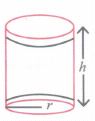
A wooden article was made by scooping out a hemisphere from each end of a cylinder as shown in figure. If the height of the cylinder is 10 cm and its base is of radius 3.5 cm find the total surface area of the article.
44.
| Team A | 50 | 20 | 10 | 30 | 30 |
| Team B | 40 | 60 | 20 | 20 | 10 |
Which team is more consistent?
45.
Find two consecutive natural numbers whose product is 20.
46.
The sum of two numbers is 15. If the sum of their reciprocals is \(\frac{3}{10}\), find the numbers.
47.
How many terms of the AP: 24, 21, 18, ... must be taken so that their sum is 78?
48.
If the sum of the first 14 terms of an AP is 1050 and its first term is 10, find the 20th term.
49.
Find a relation between x and y if the points (x, y) (1, 2) and (7, 0) are collinear.
50.
f(x) = (1+ x)
g(x) = (2x - 1)
Show that fo(g(x)) = gof(x)
51.
Let f = {(2, 7); (3, 4), (7, 9), (-1, 6), (0, 2), (5,3)} be a function from A = {-1,0, 2, 3, 5, 7} to B = {2, 3, 4, 6, 7, 9}. Is this
(i) an one-one function
(ii) an onto function,
(iii) both one and onto function?
52.
Prove that \(\frac { ta{ n }^{ 2 }\theta -1 }{ ta{ n }^{ 2 }\theta +1 } \) = 1 - 2cos2\(\theta \)
53.
Find the equation of a line whose intercepts on the x and y axes are given below. -5, \(\frac 34\)
54.
If A = \(\left[ \begin{matrix} 1 & -1 & 2 \end{matrix} \right] \), B = \(\left[ \begin{matrix} 1 & -1 \\ 2 & 1 \\ 1 & 3 \end{matrix} \right] \) and C = \(\left[ \begin{matrix} 1 & 2 \\ 2 & -1 \end{matrix} \right] \) show that (AB)C = A(BC)
55.
From a well-shuffled pack of 52 cards, a card is drawn at random. Find the probability of it being either a red king or a black queen.
56.
Two dice are rolled together. Find the probability of getting a doublet or sum of faces as 4.
57.
The temperature of two cities A and B in a winter season are given below.
| Temperature of city A (in degree Celsius) | 18 | 20 | 22 | 24 | 26 |
| Temperature of city B (in degree Celsius) | 11 | 14 | 15 | 17 | 18 |
Find which city is more consistent in temperature changes?
58.
A building and a statue are in opposite side of a street from each other 35 m apart. From a point on the roof of building the angle of elevation of the top of statue is 24°and the angle of depression of base of the statue is 34°. Find the height of the statue. (tan 24° = 0.4452, tan 34° = 0.6745)
59.
A ball rolls down a slope and travels a distance d = t2 - 0.75t feet in t seconds. Find the time when the distance travelled by the ball is 11.25 feet.
60.
Two ships are sailing in the sea on either sides of a lighthouse as observed from the ships are \(30°\) and \(45°\) respectively. if the lighthouse is 200 m high, find the distance between the two ships. \(\left( \sqrt { 3 } =1.732 \right) \)
61.
Show that the angle bisectors of a triangle are concurrent.
62.
A shuttle cock used for playing badminton has the shape of a frustum of a cone is mounted on a hemisphere. The diameters of the frustum are 5 cm and 2 cm. The height of the entire shuttle cock is 7 cm. Find its external surface area.
63.
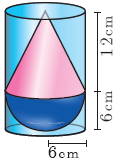
A solid consisting of a right circular cone of height 12 cm and radius 6 cm standing on a hemisphere of radius 6 cm is placed upright in a right circular cylinder full of water such that it touches the bottom. Find the volume of the water displaced out of the cylinder, if the radius of the cylinder is 6 cm and height is 18 cm.
64.
Find the square root of the expression \(\frac { { x }^{ 2 } }{ { y }^{ 2 } } -\frac { 10x }{ y } +27-\frac { 10y }{ x } +\frac { { y }^{ 2 } }{ { x }^{ 2 } } \)
65.
Let A = {1, 2} and B = {1, 2, 3, 4}, C = {5, 6} and D = {5, 6, 7, 8}, Verify whether A x C is a subset of B x D?
66.
P and Q are the mid-points of the sides CA and CB respectively of a \(\triangle\)ABC, right angled at C. Prove that 4(AQ2 + BP2) = 5AB2
67.
If the points A(2, 2), B(–2, –3), C(1, –3) and D(x, y) form a parallelogram then find the value of x and y.
68.
Construct a triangle \(\triangle\)PQR such that QR = 5 cm, \(\angle\)P = 30o and the altitude from P to QR is of length 4.2 cm.
69.
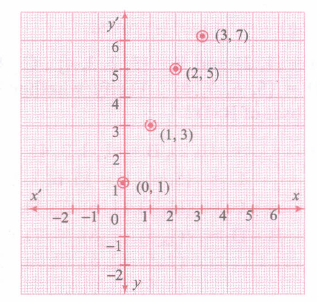
Let A = {0, 1, 2, 3} and B = {1, 3, 5, 7, 9} be two sets. Let f: A \(\rightarrow\)B be a function given by f(x) = 2x + 1. Represent this function as a graph.
70.
Let A = {0, 1, 2, 3} and B = {1, 3, 5, 7, 9} be two sets. Let f: A \(\rightarrow\)B be a function given by f(x) = 2x + 1. Represent this function as a table.
71.
Let A = {1,2, 3, 4} and B = {-1, 2, 3, 4, 5, 6, 7, 8, 9, 10, 11, 12} Let R = {(1, 3), (2, 6), (3, 10), (4, 9)} \(\subseteq \) A x B be a relation. Show that R is a function and find its domain, co-domain and the range of R.
72.
If α and β are the roots of x2 + 7x + 10 = 0 find the values of
\(\frac { \alpha }{ \beta } +\frac { \beta }{ \alpha } \)
73.
Find the number of terms in the following G.P. \(\frac { 1 }{ 3 } ,\frac { 1 }{ 9 } ,\frac { 1 }{ 27 } \),...\(\frac { 1 }{ 2187 } \)
74.
Simplify
\(\frac { 4x }{ { x }^{ 2 }-1 } -\frac { x+1 }{ x-1 } \)
75.
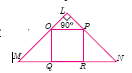
If figure OPRQ is a square and \(\angle\)MLN=90o. Prove that
\(\triangle\)LOP~\(\triangle\)RPN
76.
Write the domain of the following real functions
p(x) = \(\frac { -5 }{ 4x^{ 2 }+1 }\)
77.
Find the least positive value of x such that
5x \(\equiv \) 4 (mod 6)
78.
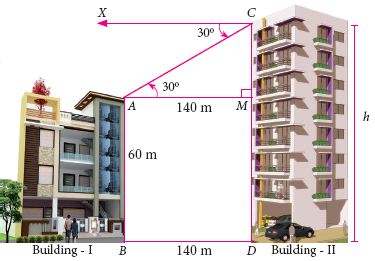
The horizontal distance between two buildings is 140 m. The angle of depression of the top of the first building when seen from the top of the second building is 30° . If the height of the first building is 60 m, find the height of the second building.(\(\sqrt { 3 } \) = 1.732)
79.
Two coins are tossed together. What is the probability of getting different faces on the coins?
80.
A road is flanked on either side by continuous rows of houses of height \( 4\sqrt { 3 } \)m with no space in between them. A pedestrian is standing on the median of the road facing a row house. The angle of elevation from the pedestrian to the top of the house is 30°. Find the width of the road.
81.
A conical flask is full of water. The flask has base radius r units and height h units, the water poured into a cylindrical flask of base radius xr units. Find the height of water in the cylindrical flask.
82.
Find the range and coefficient of range of the following data: 25, 67, 48, 53, 18, 39, 44.
83.
Find the equation of a line which passes through (5, 7) and makes intercepts on the axes equal in magnitude but opposite in sign.
84.
If the circumference of a conical wooden piece is 484 cm then find its volume when its height is 105 cm.
85.
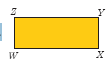
In the rectangle WXYZ, XY+YZ = 17 cm, and XZ + YW = 26 cm .Calculate the length and breadth of the rectangle
86.
Find the equation of a straight line whose Slope is 5 and y intercept is -9
87.
If f(x) = x2 - 1, g(x) = x - 2 find a, if g o f(a) = 1
88.
4 persons live in a conical tent whose slant height is 19 cm. If each person require 22 cm2 of the floor area, then find the height of the tent.
89.
Show that the given points are collinear: (-3, -4) , (7, 2) and (12, 5)
90.
Draw \(\angle\)PQR such that PQ = 6.8 cm, vertical angle is 50° and the bisector of the vertical angle meets the base at D where PD = 5.2 cm.
1.
(a)
23m
2.
(d)
cos A
3.
(a)
4.
(a)
1
5.
(d)
22
6.
(c)
\(\frac { 23 }{ 26 } \)
7.
(c)
120
8.
(d)
9.
(c)
x = 5
10.
(a)
\(\frac { 16 }{ 3 } cm\)
11.
(d)
The square of the ratio of their corresponding sides
12.
(b)
24 cm
13.
(c)
14.
(a)
x2-25
15.
(a)
\(\frac { { a }^{ 2 }+1 }{ { a }^{ 2 }-1 } \)
16.
(a)
0
17.
(a)
b
18.
(d)
1
19.
(a)
20.
(a)
3
21.
(d)
-2,13
22.
(a)
\(\frac{1}{3}\)πh1(r12+r22+r1r2)
23.
(a)
13 cm
24.
(a)
0
25.
(b)
\(\frac{7}{10}\)
26.
(c)
33.25
27.
(b)
\(\frac { b }{ 3 } \)
28.
(d)
29.
(c)
8
30.
(a)
31.
(b)
x + y = 3; 3x + y = 7
32.
(b)
The slopes of two pair of opposite sides
33.
(b)
110°
34.
(d)
15 cm
35.
(b)
1:2
36.
(b)
1120\(\pi\) cm3
37.
(c)
One-to-one function
38.
(a)
(8,6)
39.
(b)
\(\left(\begin{array}{cc} 2 & 2 \\ 2 & -1 \end{array}\right)\)
40.
(c)
-120, 100
41.
42.
cot 85° + cos 75°
= cot(90° - 5°) + cos(90° - 15°)
= tan 5° + sin 15°
43.
Radius of the cylinder be r
Height of the cylinder be h
Total surface area of the article
= CSA of cylinder + CSA of 2 hemispheres
= 2ㅠrh + 2πr2 = 2πr(h + 2r)
\(=2\times \frac { 22 }{ 7 } \times 3.5\times (10+2\times 3.5)\)
= 22 x 17 = 374 cm2
44.
| Team A | ||
| x1 | d1 = x - 28 | d12 |
| 50 | 22 | 484 |
| 20 | -8 | 64 |
| 10 | -18 | 324 |
| 30 | 2 | 4 |
| 30 | 2 | 4 |
| 140 | Σd = 0 | 880 |
\(\bar { { x }_{ 1 } } \) =\(\frac { 140 }{ 5 } \) =28
σ1 =\(\sqrt { \frac { \Sigma d^{ 2 } }{ n } } =\sqrt { \frac { 880 }{ 5 } } \)
= \(\sqrt { 176 } \)
= 13.27
CV1 = \(\frac { \sigma }{ \bar { x_{ 1 } } } \) x 100
CV1 = \(\frac { 13.27 }{ 28 } \) x 100
= 47.39%
CV1 < CV2
| Team B | ||
| x2 | d2 = x - 28 | d2 |
| 40 | 10 | 100 |
| 60 | 30 | 900 |
| 20 | -10 | 100 |
| 20 | -10 | 100 |
| 10 | -20 | 400 |
| 150 | Σd = 0 | 1600 |
\(\bar { { x }_{ 2 } } =\frac { 150 }{ 5 } \) =30
σ2 =\(\sqrt { \frac { \Sigma d^{ 2 } }{ n } } =\sqrt { \frac { 1600 }{ 5 } } \)
= \(\sqrt { 320 } \)
=17.89
CV1 = \(\frac { { \sigma }_{ 2 } }{ \bar { { x }_{ 2 } } } \) x 100
CV2 = \(\frac { 17.89 }{ 30 } \) x 100
= 59.63%
∴ Team A is more consistent.
45.
Let a natural number be x.
The next number = x + 1
x (x + 1) = 20
X2+x-20 = 0
(x + 5)(x - 4) = 0
x=-5,4
∴ x=4
(∵ x≠-5, x is a natural number
The next number = 4 + 1= 5
Two consecutive numbers are 4,5.
46.
Let the numbers be ∝, β
Sum of the roots = ∝ + β = 15 ...(1)
\(\frac { 1 }{ \alpha } +\frac { 1 }{ \beta } =\frac { 3 }{ 10 } \quad \quad \quad ...(2)\)
\(\\ \frac { +\alpha }{ \alpha \beta } =\frac { 3 }{ 10 } \)
10(∝+ β)= 3∝β ....(3)
30∝β=10x15=150
Products of the roots =∝β=50 ....(4)
∴ From (1) & (4), we have
x2-15x+50=0
(x-10)(x-5)=0⇒x=10,5
47.
Here a = 24, d = 21-24 = -3, Sn = 78. We need to find n.
We know that,
Sn= \(\frac{n}{2}\) (2a + (n - 1)d)
78 = \(\frac{n}{2}\) 48 + (n -1)(-3))
78 = \(\frac{n}{2}\) 2(51-3n)
or 3n2 - 51n + 156 = 0
n2 -17n + 52 = 0
(n - 4)(n - 13) = 0
n = 4 or 13
The number of terms are 4 or 13.
48.
Here S14 = 1050
n = 14
a = 10
Sn = \(\frac{n}{2}\) 2(2a + (n -1)d)
1050 = \(\frac{14}{2}\)(20 + 13d)
= 140 + 91d
910 = 91d
d = 10
a20 = 10 + (20 - 1) x 10
= 20
∴ 20th term = 200.
49.
If A(-2, -1), B(a, 0), C(4, b) and D(1, 2) are the vertices of a parallelogram, find the values of a and b.
We know that the diagonals of a parallelogram bisect each other. Therefore the co-ordinates of the midpoint of AC are same as the co-ordinates of the mid-point of BD. i.e.
\(\left( \frac { -2+4 }{ 2 } ,\frac { -1+b }{ 2 } \right) =\left( \frac { a+1 }{ 2 } ,\frac { 0+2 }{ 2 } \right) \)
⇒ \(\left( 1,\frac { b-1 }{ 2 } \right) =\left( \frac { a+1 }{ 2 } ,1 \right) \)
⇒ \(\frac { a+1 }{ 2 } \) = 1 ⇒ a + 1 = 2 ⇒ a = 1
⇒ \(\frac { b-1 }{ 2 } \) = 1 ⇒ b - 1 = 2 ⇒ b = 3
50.
f(x) = 1 + x
g(x) = (2x - 1)
fog(x) = f(g(x) = f(2x - 1)
= 1 + 2x - 1 = 2x ...(1)
gof(x) = g(f(x) = g(1 + x) = 2(1 + x) - 1
= 2 + 2x - 1
= 2x + 1 ...(2)
(1) \(\neq \)(2)
\(\therefore\) fog(x) \(\neq \) gof(x)
It is verified
51.
It is both one-one and onto function
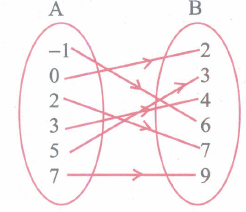
All the elements in A have their separate images in B. All the elements in B have their preimage in A. Therefore it is one-one and onto function.
52.
\(\frac{\tan ^{2} \theta-1}{\tan ^{2} \theta+1}=1-2 \cos ^{2} \theta\)
\( \text { LHS } =\frac{\tan ^{2} \theta-1}{\tan ^{2} \theta+1} \)
\(=\frac{\frac{\sin ^{2} \theta}{\cos ^{2} \theta}-1}{\frac{\sin ^{2} \theta}{\cos ^{2} \theta}+1}\)
\( =\frac{\frac{\sin ^{2} \theta-\cos ^{2} \theta}{\cos ^{2} \theta}}{\frac{\sin ^{2} \theta+\cos ^{2} \theta}{\cos ^{2} \theta}} \)
\(= \frac{\sin ^{2} \theta-\cos ^{2} \theta}{\cos ^{2} \theta} \times \frac{\cos ^{2} \theta}{\left(\sin ^{2} \theta+\cos ^{2} \theta\right)} \)
\(= \frac{\sin ^{2} \theta-\cos ^{2} \theta}{1}\left[\because \sin ^{2} \theta+\cos ^{2} \theta=1\right] \)
\(=\left(1-\cos ^{2} \theta\right)-\cos ^{2} \theta \)
\(=1-\cos ^{2} \theta-\cos ^{2} \theta \)
\(= 1-2 \cos ^{2} \theta=\text { RHS } \)
53.
Given intercepts are -5, \(\frac 34\)
\(a=-5, b=\frac{3}{4}\)
Equation of the line in the intercepts form is
\(\frac{x}{a}+\frac{y}{b}=1
\)
\(\frac{x}{-5}+\frac{y}{\left(\frac{3}{4}\right)}=1
\)
\(\frac{x}{-5}+\frac{4 y}{3}=1
\)
3x - 20y = -15
3x - 20y + 15 = 0
54.
LHS (AB)C
AB = \({ \left[ \begin{matrix} 1 & -1 & 2 \end{matrix} \right] }_{ 1\times 3 }{ \left[ \begin{matrix} 1 & -1 \\ 2 & 1 \\ 1 & 3 \end{matrix} \right] }_{ 3\times 2 }=\left[ \begin{matrix} 1-2+2 & -1-1+6 \end{matrix} \right] =\left[ \begin{matrix} 1 & 4 \end{matrix} \right] \)
(AB)C = \({ \left[ \begin{matrix} 1 & 4 \end{matrix} \right] }_{ 1\times 2 }\times { \left[ \begin{matrix} 1 & 2 \\ 2 & -1 \end{matrix} \right] }_{ 2\times 2 }=\left[ \begin{matrix} 1+8 & 2-4 \end{matrix} \right] =\left[ \begin{matrix} 9 & -2 \end{matrix} \right] \) ....(1)
RHS = A(BC)
BC = \({ \left[ \begin{matrix} 1 & -1 \\ 2 & 1 \\ 1 & 3 \end{matrix} \right] }_{ 3\times 2 }\times { \left[ \begin{matrix} 1 & 2 \\ 2 & -1 \end{matrix} \right] }_{ 2\times 2 }=\left[ \begin{matrix} 1-2 & 2+1 \\ 2+2 & 4-1 \\ 1+6 & 2-3 \end{matrix} \right] =\left[ \begin{matrix} -1 & 3 \\ 4 & 3 \\ 7 & -1 \end{matrix} \right] \)
A(BC) = \({ \left[ \begin{matrix} 1 & -1 & 2 \end{matrix} \right] }_{ 1\times 3 }{ \left[ \begin{matrix} -1 & 3 \\ 4 & 3 \\ 7 & -1 \end{matrix} \right] }_{ 3\times 2 }\)
A(BC) = \(\left[ \begin{matrix} -1-4+14 & 3-3-2 \end{matrix} \right] =\left[ \begin{matrix} 9 & -2 \end{matrix} \right] \) ....(2)
From (1) and (2), (AB)C = A(BC).
55.
Total number of cards = 52
n(S) = 52
Let 'A' be the event of getting a red king card
n(A) = 2
\(\mathrm{P}(\mathrm{A})=\frac{n(A)}{n(S)}=\frac{2}{52}\)
Let 'B' be the event of getting black queen card
n(B) = 2
\(\mathrm{P}(\mathrm{B})=\frac{n(B)}{n(S)}=\frac{2}{52}\)
Since A and B are mutually exclusive events
\( A \cap B =0 \)
\(\mathrm{P}(A \cup B) =\mathrm{P}(\mathrm{A})+\mathrm{P}(\mathrm{B})-\mathrm{P}(A \cap B) \)
\(\mathrm{P}(A \cup B) =\frac{2}{52}+\frac{2}{52}-0 \)
\(\mathrm{P}(A \cup B) =\frac{4}{52}=\frac{1}{13} \)
Probability of getting either a red kirrg or a black queen = \(\frac{1}{13} .\)
56.
When two dice are rolled together, there will be 6 x 6 = 36 outcomes. Let S be the sample space. Then n(S) = 36.
Let A be the event of getting a doublet and B be the event of getting face sum 4.
Then A = {(1,1),(2,2),(3,3),(4,4),(5,5),(6,6)}
B = {(1,3),(2,2),(3,1)
Therefore, A∩B = {(2,2)}
Then, n(A) = 6, n(B) = 3, n(A∩B) = 1
P(A) = \(\frac { n(A) }{ n(S) } =\frac { 6 }{ 36 } \)
P(B) = \(\frac { n(B) }{ n(S) } =\frac { 3 }{ 36 } \)
P(A∩B) = \(\frac { n(A\cap B) }{ n(S) } =\frac { 1 }{ 36 } \)
Therefore, P (getting a doublet or a total of 4) = P(AUB)
P(AUB) = P(A) + P(B) - P(A∩B)
=\(\frac { 6 }{ 36 } +\frac { 3 }{ 36 } -\frac { 1 }{ 36 } =\frac { 8 }{ 36 } =\frac { 2 }{ 9 } \)
Hence, the required probability is \(\frac { 2 }{ 9 } \).
57.
| City A | City B | ||||
|---|---|---|---|---|---|
| x1 | \({ d }_{ 1 }=x-\bar { x } \) | \({ d }_{ 1 }^{ 2 }\) | x1 | \(d=x-\bar { x } \) | \({ d }_{ 1 }^{ 2 }\) |
| 18 | -4 | 16 | 11 | -4 | 16 |
| 20 | -2 | 4 | 14 | -1 | 1 |
| 22 | 0 | 0 | 15 | 0 | 0 |
| 24 | 2 | 4 | 16 | 3 | 4 |
| 26 | 4 | 16 | 18 | 3 | 9 |
| 110 | 0 | 40 | 75 | 20 | |
\(\bar { { x }_{ 1 } } =\frac { { \Sigma x }_{ 1 } }{ n } \)
= \(\frac { 110 }{ 5 } \)
= 22
\({ \sigma }_{ 1 }=\sqrt { \frac { { \Sigma d }_{ 1 }^{ 2 } }{ n } } \)
= \(\sqrt { \frac { 40 }{ 5 } } \)
= \(\sqrt { 8 } \)
\(\bar { { x }_{ 2 } } =\frac { { \Sigma x }_{ 1 } }{ n } \)
= \(\frac { 75 }{ 5 } \)
= 15
\({ \sigma }_{ 2 }=\sqrt { \frac { { \Sigma d }_{ 2 }^{ 2 } }{ n } } \)
= \(\sqrt { \frac { 20 }{ 5 } } \)
= \(\sqrt { 4 } \)
= \(2\sqrt { 2 } \)
\(CV_{ 1 }=\frac { { { \sigma }_{ 1 } } }{ { x }_{ 1 } } \times 100\)
= \(\frac { 2.83 }{ 22 } \times 100\)
= 12.86
\({ CV }_{ 2 }=\frac { { \sigma }_{ 2 } }{ \bar { { x }_{ 2 } } } \times 100\)
= \(\frac { 2 }{ 15 } \times 100\)
= 13.33
\(\therefore\)Co-efficient of variation of City A is less than C.V of City B.
\(\therefore\) City A is more consistent.
58.
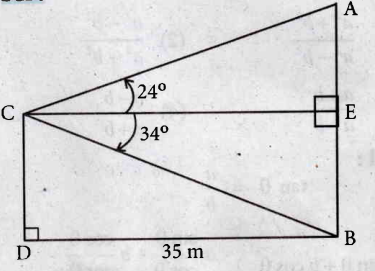
Let AB be the statue CD be the building Given
BD = 35 m
DB = CE = 35 m
In right triangle ECB
\(\tan 34^{\circ}=\frac{E B}{C E}\)
EB = CE x tan 34o
= 35 x 0.6745 m
EB = 23.61 m
In right AEC
\(\tan 24^{\circ}=\frac{A E}{E C}\)
AE = tan 24o x EC
= 0.4452 x 35
AE = 15.58 m
(1) + (2) + AE + EB = 15.58 + 23.61
AB = 39.19 m
Height of the statue = 39.19 m.
59.
Distance d = t2- 0.75t,
Given that d = 11.25 = t2- 0.75t.
\(t = {-b \pm \sqrt{b^2-4ac} \over 2a}\)
\(=\frac { (+0.75)\pm \sqrt { { (-0.75) }^{ 2 }-4\times 1\times -11.25 } }{ 2\times 1 } \)
\(=\frac { +0.75\pm \sqrt { 0.5625+45 } }{ 2 } \)
\(=\frac { +0.75\pm \sqrt { 45.5625 } }{ 2 } \)
\(=\frac { +0.75\pm 6.75 }{ 2 } \)
\(=\frac { 7.50 }{ 2 } or\frac { -6 }{ 2 } \)
= 3.75 or-3 It is not possible
∴ t = 3.75 s.
60.
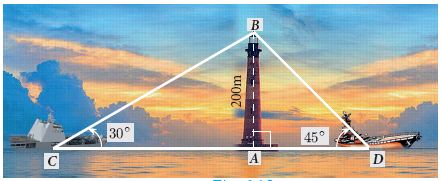
Let AB the lighthouse. Let C and D be the positions of the two ships.\(\times \)
Then, AB = 200m.
\(\angle ACB=30°,\angle ADB=45°\)
In right triangles BAC, tan30°= \(\frac { AB }{ Ac } \)
\(\frac { 1 }{ \sqrt { 3 } } =\frac { 200 }{ AC } \ gives\ AC=200\sqrt { 3 } \) ...(1)
In the right triangle BAD,tan45°= \(\frac { AB }{ AD } \)
\(1=\frac { 200 }{ AD } \) gives AD = 200 ...(2)
Now, CD = AC + AD = \(200\sqrt { 3 } +200\) [by(1) and (2)]
CD = 200\((\sqrt { 3 } +1)\) = 200 x 2.732 = 546.4
Distance between two ships is 546.4m
61.
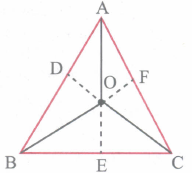
Let \(\triangle\)ABC be B triangle points D, E, F are angular bisectors of \(\angle A, \angle B \text { and } \angle C\) respectively. By angular bisector theorem we have
\( \frac{B D}{D C}=\frac{A B}{A C} \Rightarrow \mathrm{AB}=\frac{B D \times A C}{D C} \)
\(\frac{A C}{B C}=\frac{A F}{F B} \Rightarrow \mathrm{AC}=\frac{A F \times B C}{F B} \)
\(\frac{A E}{E C}=\frac{A B}{B C} \Rightarrow \mathrm{AB}=\frac{A E \times B C}{E C}\)
From (1) and (3), we have
\(\frac{B D \times A C}{D C}=\frac{A E \times B C}{E C}\)
Now substituting (2) in (4) we have
\( \frac{B D \times\left(\frac{A F \times B C}{F B}\right)}{D C} =\frac{A E \times B C}{E C} \)
\(\frac{B D \times A F \times B C}{D C \times F B} =\frac{A E \times B C}{E C} \)
\(B D \times A F \times E C =\frac{A E \times B C \times D C \times F B}{B C} \)
\(B D \times A F \times C E =E A \times F B \times D C \)
\(\therefore \frac{B D \times A F \times C E}{E A \times F B \times D C}=1\)
Hence by Ceva's theorem we conclude that the angle bisectors of a triangle are concurrent.
62.
External surface area of the cock = Surface area of frustum + CSA of hemisphere
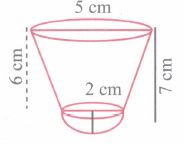
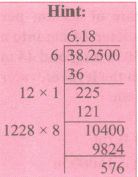
CSA of frustum = π(R + r)l sq. units.
Here R = \(\frac{5}{2}cm\)
\(r=\frac { 2 }{ 2 } =1cm\)
\(l=\sqrt { ({ R-r) }^{ 2 }+{ h }^{ 2 } } \)
\(=\sqrt { { (2.5-1) }^{ 2 }+{ 6 }^{ 2 } } \)
\(=\sqrt { { 1.5 }^{ 2 }+36 } \)
\(=\sqrt { 2.25+36 } \)
\(=\sqrt { 38.25 } \)
\(\cong 6.18\)
∴ CSA of the frustum \(=\frac { 22 }{ 7 } \times 3.5\times 6.1=\frac { 469.7 }{ 7 } \)
= 67.1 cm2
CSA of hemisphere = 2π2
\(=2\times \frac { 22 }{ 7 } \times 1\times 1\)
= 6.28cm2
∴ Total external surface area
= 67.1 + 6.28
= 73.38cm2
= 73.39 cm2(approx.)
63.
Radius of hemisphere = 6 cm
Volume of hemisphere \(=\frac{2}{3} \pi r^{3} \text { cu. units }\)
\(=\frac{2}{3} \pi(6)^{3}
\)
\(=\frac{2}{3} \pi(216)
\)
\(=144 \pi \mathrm{cm}^{3}
\)
base of cone = 6 cm
Height of the cone = 12 cm
Volume of the cone \(=\frac{1}{3} \pi r^{2} h \text { cu. units }
\)
\(=\frac{1}{3} \pi(6)^{2}(12)
\)
= 144 cm3
volume of the solid = Volume of cone + Volume of hemisphere
\(=144 \pi+144 \pi=288 \pi\)
Volume of water displaced
= Volume of the solid placed in the cylinder
\(=288 \pi=288 \times \frac{22}{7}\)
= 905.14 cm3
64.
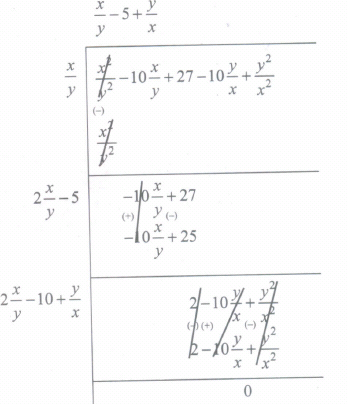
\(\therefore \sqrt { \frac { { x }^{ 2 } }{ { y }^{ 2 } } -10\frac { x }{ y } +27-10\frac { y }{ x } +\frac { { y }^{ 2 } }{ { x }^{ 2 } } } =\)\(\left| \frac { x }{ y } -5+\frac { y }{ x } \right| \)
65.
A = {1, 2),B = {1, 2, 3, 4}, C = {5, 6},D = {5, 6, 7, 8}
A x C = {1, 2} x {5, 6}
\(\mathrm{A} \times \mathrm{C}=\{(1,5),(1,6),(2,5),(2,6)\}\)
B x D = { 1, 2, 3, 4} x { 5, 6, 7, 8}
\(\begin{array}{r} \mathrm{B} \times \mathrm{D}=\{({1,5}),(1,6),(1,7),(1,8) ({2,5}),(2,6),(2,7),(2,8) (3,5),(3,6),(3,7),(3,8) (4,5),(4,6),(4,7),(4,8)\} \end{array}\)
(A x C) is a subset of (B x D)
66.
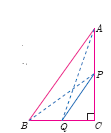
Since, \(\triangle\)QAQC is a right triangle at C, AQ2 = AC2 + QC2 ...(1)
Also, \(\triangle\)BPC is a right triangle at C, BP2 = BC2+ CP2 ...(2)
\(\triangle\) ABCC is a right triangle at C, AB2 = AC2 + BC2 ....(3)
From (1) and (2), AQ2+ BP2 = AC2+ QC2 + BC2 + CP2
4(AQ2 + BP2) = 4AC2 + 4QC2 + 4BC2 + 4CP2
= 4AC2 + (2QC)2+ ABC2 + (2CP)2
= 4AC2 + BC2 + 4BC2 + AC2 (Since P and Q are mid points)
= 5(AC2 + BC2) (From equation (3))
4(AQ2 + BP2) = 5AB2
67.
Given points A (2, 2), B (- 2,- 3), C (1, - 3) and D (x, y)
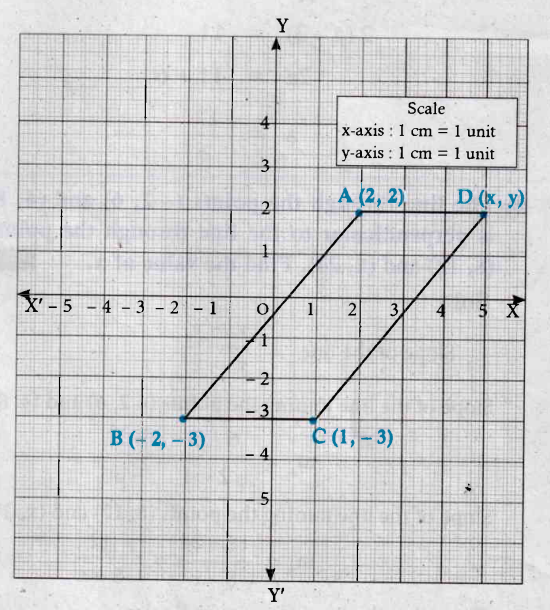
Slope of a line = \(\frac{y_{1}-y_{2}}{x_{1}-x_{2}} \)
Slope of AB = \(\frac{2+3}{2+2}=\frac{5}{4} \)
Slope of BC = \(\frac{-3+3}{-2-1}=0 \)
Slope of CD = \(-\frac{-3-y}{1-x} \)
Slope of AD = \(\frac{2-y}{2-x} \)
Since, the points form a parallelogram
AB is parallel to CD and BC is parallel to AD
Slope of AB = Slope of CD
\(\frac{5}{4}=\frac{-3-y}{1-x}\)
5(1 - x) = 4(-3 -y)
5 - 5x = -12 -4y
5x - 4y = 17
Slope of BC = Slope of AD
\(0=\frac{2-y}{2-x}\)
2 - y = 0
y = 2
Substituting in (1)
5x - 4(2) = 17
5x = 17 + 8 = 25
\(x=\frac{25}{5}=5\)
x = 5, y = 2
68.
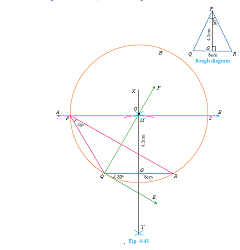
Construction
Step 1 : Draw a line segment QR = 5 cm.
Step 2 : At Q draw QE such that \(\angle\)RQE = 30o.
Step 3 : At Q draw QF such that \(\angle EQF\) = 90o
Step 4 : Draw the perpendicular bisector XY to QR which intersects QF at O and QR at G.
Step 5 : With O as centre and OQ as radius draw a circle.
Step 6: From G mark an arc in the line XY at M, such that GM = 42. cm.
Step 7 : Draw AB through M which is parallel to QR.
Step 8 : AB meets the circle at P and S.
Step 9 : Join QP and RP. Then\(\triangle\)PQR is the required triangle
69.
A Graph f = {(x, f(x) / x \(\epsilon \) A}
{(0, 1), (1, 3), (2, 5), (3, 7)}
70.
A table
| x | 0 | 1 | 2 | 3 |
|---|---|---|---|---|
| f(x) | 1 | 3 | 5 | 7 |
71.
Domain of R = {1,2,3,4}
Co-domain of R = B = {-1, 2, 3,4,5,6, 7, 9, 10, 11,12}
Range of R = {3, 6,10, 9}
72.
x2 + 7x + 10 here, a = -1, b = 7, c =10
if α and β are roots of the equation then,
α + β = \(\frac {-b}{a} = \frac {-7}{1}\) = -7; αβ = \(\frac {c}{a} = \frac {10}{1}\) = 10
\(\frac { \alpha }{ \beta } +\frac { \beta }{ \alpha } =\frac { { \alpha }^{ 2 }+{ \beta }^{ 2 } }{ \alpha \beta } =\frac { { \left( \alpha +\beta \right) }^{ 2 }-2\alpha \beta }{ \alpha \beta } =\frac { 49-20 }{ 10 } =\frac { 29 }{ 10 } \)
73.
Here \(\mathrm{a}=\frac{1}{3}, \mathrm{r}=\frac{t_{2}}{t_{1}}=\frac{1 / 9}{1 / 3}=\frac{1}{9} \times \frac{3}{1} \)
\(\mathrm{r}=\frac{1}{3} \)
nth term of the G.P. \(t_{n}=a r^{n-1}\)
\(\frac{1}{2187} =\frac{1}{3} r^{n-1} \)
\(\frac{3}{2187} =r^{n-1} \)
\(\frac{1}{729} =r^{n-1} \)
\(\left(\frac{1}{3}\right)^{6} =r^{n-1} \)
\(\mathrm{n}-1=6 \quad\left[\because r=\frac{1}{3}\right]\)
n = 6 + 1 = 7
The number of terms in this G.P. is 7.
74.
\(\frac { 4x }{ { x }^{ 2 }-1 } -\frac { x+1 }{ x-1 } =\frac { 4x }{ (x+1)(x-1) } -\frac { x+1 }{ (X-4) } \)
\(=\frac { 4x-(x+1)(x+1) }{ (x+1)(x-1) } \)
\(=\frac { -{ x }^{ 2 }+2x-1 }{ (x+1)(x-1) } =\frac { -({ x }^{ 2 }-2x+1) }{ (x+1)(x-1) } \)
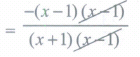
\(=\frac { -(x-1) }{ (x+1) } =\frac { 1-x }{ 1+x } \)
75.
In \(\Delta \)LOP & \(\Delta \)PRN,
we have
\(\angle \)PLO = \(\angle\)NRP = 90°
and \(\angle\)LPO = \(\angle\)PNR (corresponding angles)
By AA criterion of similarity
\(\Delta \)LOP~\(\Delta \)RPN
76.
Here, the expression is defined for all real values of 'x'
i.e., x \(\epsilon\) R
77.
5x ≡ 4 (mod 6)
5x - 4 = 6n for some integer n.
5x - 4 is a multiple of 6.
x = 2 is the least positive x.
78.
The height of the first building AB = 60 m. Now, AB = MD = 60 m
Let the height of the second building CD = h. Distance BD = 140 m
Now, AM = BD = 140 m
From the diagram,
\(\angle \)XCA = 30° =\(\angle \)CAM
In right triangle AMC, tan30° = \(\frac { CM }{ Am } \)
\(\frac { 1 }{ \sqrt { 3 } } =\frac { CM }{ 140 } \)
CM=\(\frac { 140 }{ \sqrt { 3 } } =\frac { 140\sqrt { 3 } }{ 3 } \)
\(=\frac { 140\times 1.732 }{ 3 } \)
CM = 80.78
Now, h = CD = CM + MD = 80.78 + 60 = 140.78
Therefore the height of the second building is 140.78 m
79.
When two coins are tossed together, the sample space is
S = {HH, HT, TH, TT} n(S) = 4
Let A be the event of getting different faces on the coins.
A = {HT, TH}; n(A) = 2
Probability of getting different faces on the coins is P(A) = \(\frac { n(A) }{ n(S) } =\frac { 2 }{ 4 } =\frac { 1 }{ 2 } \).
80.
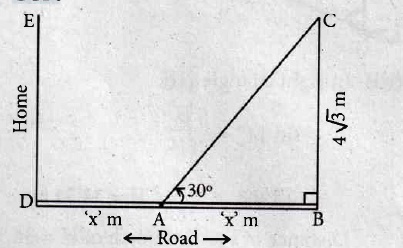
Let AB = x be the distance between foot of the house and the observer at the median of the road.
DB = 2x is the width of the road.
Height of the house BC = \(4 \sqrt{3} m\)
From the right triangle \(\triangle\) ABC
\(
\therefore \tan 30^{\circ} =\frac{B C}{A B}
\)
\(\frac{1}{\sqrt{3}}=\frac{4 \sqrt{3}}{x}
\)
\(x =4 \sqrt{3} \times \sqrt{3}=4 \times 3=12 \mathrm{~m}
\)
\(\text { Width of the road } =2 \times x=2 \times 12=24 \mathrm{~m}\)
Width of the road = 24 m.
81.
Radius of conical flask = 'r' units
Height of conical flask = 'h' units
Volume of conical flask = Volume of water
\(=\frac{1}{3} \pi r^{2} h \text { cu. units }\)
Since, water is poured into the cylindrical flask
Volume of cylinder = Volume of water
\(\pi(\mathrm{xr})^{2} H=\frac{1}{3} \pi r^{2} h\)
[xr - radius of cylinder, H - height]
\(\mathrm{X}^{2} \mathrm{r}^{2} \mathrm{H}=\frac{r^{2}}{3} h\)
Height of the water in cylinder flask
\(\mathrm{H}=\frac{h}{3 x^{2}}\)
82.
Largest value L = 67; Smallest value S =18
Range R = L = S = 67 - 18 = 49
Coefficient of range = \(\frac { L-S }{ L+S } \)
Coefficient of range = \(\frac { 67-18 }{ 67+18 } =\frac { 49 }{ 85 } \) = 0.576
83.
Let the x intercept be ‘a’ and y intercept be ‘– a’.
The equation of the line in intercept form is \(\frac { x }{ a } +\frac { y }{ b } =1\)
gives \(\frac { x }{ a } +\frac { y }{ -a } =1\) (Here b = – a)
Therefore, x − y = a ...(1)
Since (1) passes through (5, 7)
Therefore, 5 - 7 = a gives a = − 2
Thus the required equation of the straight line is x − y = − 2 ; or x − y + 2 = 0
84.
Given circumference = 484 cm
\(2 \pi r =484
\)
\(2 \times \frac{22}{7} \times r =484
\)
\(r =\frac{484 \times 7}{44}=77 \mathrm{~cm}
\)
height h = 105 cm
Volume of cone \(=\frac{1}{3} \pi r^{2} h \text { cu. units }
\)
\(=\frac{1}{3} \times \frac{22}{7} \times 77 \times 77 \times 105
\)
= 652190 cm3
85.
XY + CZ = 17cm
XZ + YW = 26cm
We know that diagonals if a rectangle bisect each other and the diagonals have equal length.
\(\therefore \text { Each diagonal }=\frac{26}{2}=13 \mathrm{~cm}\)
i.e., XZ = 13 cm and YW = 13 cm
Also given XY + YZ = 17 cm
Squaring on both sides (XY + YZ)2 = 172
\((\mathrm{XY})^{2}+(\mathrm{YZ})^{2}+2 \times(\mathrm{XY}) \times(\mathrm{YZ})=289\)
By Pythagoras theorem (XY)2 + (YZ)2 = XZ2
\(\therefore[\mathrm{XZ}]^{2}+2(\mathrm{XY}) \times(\mathrm{YZ})=289\)
132 + 2 x length x breadth = 289
2 x Area = 289 - 169
\(\text { Area }=\frac{289-169}{2}=\frac{120}{2}\)
The possible length and breadth are
(1,60) (2,30) (3,20) (4, 15), (5, 12) (6, 10).
In this pair the length and breadth should satisfy Pythagoras theorem for diagonal.
5,12 is the possible length and breadth.
86.
Given, Slope = 5, y intercept, c = −9
Therefore, equation of a straight line is y = mx + c
y = 5x − 9 gives 5x − y − 9 = 0
87.
f(x) = x2- 1, g(x) = x - 2
f(a) = a2 - 1
Given, (g o f) (a) = 1
g[f(a)] = 1
g[ a2 - 1] = 1
a2 - 1 - 2 = 1
a2 - 3 = 1
a2 = 1 + 3 = 4
a = ± 2
88.
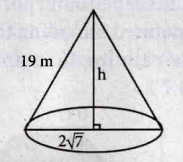
Each person requires 22 m2 of floor area.
Required base area = 22 x 4 = 88 m2
\(\pi r^{2} =88 \)
\(r^{2} =\frac{88 \times 7}{22}=4 \times 7 \)
\(r =2 \sqrt{7} \mathrm{~m} \)
slant height = 19 m
height of the tent, h \(=\sqrt{l^{2}-r^{2}}\)
\(=\sqrt{(191)^{2}-(2 \sqrt{7})^{2}} \)
\(=\sqrt{361-28} =\sqrt{330}=18.25 \mathrm{~m} \)
Height of the tent = 18.25 m
89.
Given points (- 3, - 4), (7, 2) and (12, 5)
Let the points be A (- 3, - 4),8 (2, 2) and C (12, 5)
Slope of a line = \(\frac{y_{1}-y_{2}}{x_{1}-x_{2}}\)
Slope of AB = \(\frac{-4-2}{-3-7}=\frac{-6}{-10}=\frac{3}{5}
\)
Slope of BC = \(\frac{2-5}{7-12}=\frac{-3}{-5}=\frac{3}{5}
\)
Slope of AB = Slope of BC
The points A, B and C are collinear
90.
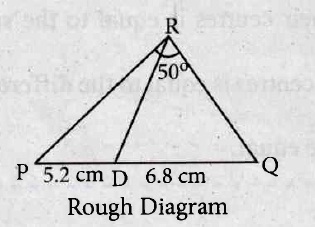
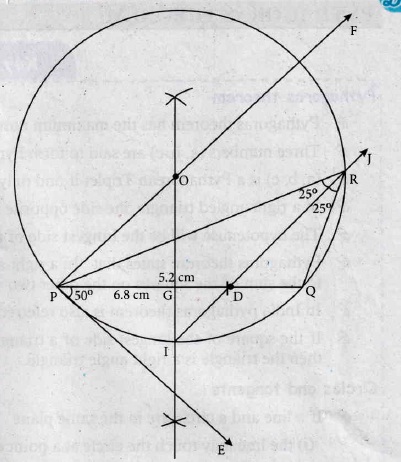
Construction:
Steps (1) Draw a line segment PQ = 6.8 cm
Steps (2) At P, draw PE such that \(\angle QPE={ 50 }^{ 0 }\)
Steps (3) At P, draw PF such that \(\angle FPE={ 90 }^{ 0 }\)
Steps (4) Drawn the perpendicular bisector to PQ, which intersects PF at 'O' and PQ at G.
Steps (5) With O as center and OP as radius drawn a circle.
Steps (6) From P, marked an arc of 5.2 cm on PQ at D
Steps (7) The perpendicular bisector intersects the circle at I. Joined ID
Steps (8) ID produced meets the circle at R now joining PR and QR, we get the required \(\triangle\)PQR.

10th Standard Syllabus & Materials
10th Standard
TN 10th English Prose - 2 - The Night the Ghost Got in Important Questions And Answers Study Material - QB365 Set A
NEW10th Standard
TN 10th English Supplementary - 1 - The Tempest Important Questions And Answers Study Material - QB365 Set A
NEW10th Standard
TN 10th English Poem - 1 - Life Important Questions And Answers Study Material - QB365 Set A
NEW10th Standard
TN 10th English Prose - 1 - His First Flight Important Questions And Answers Study Material - QB365 Set A



Tamilnadu Stateboard 10th Standard Subjects
Tamilnadu Stateboard Standards





