
 100% FREE ACCESS
10th Standard Syllabus & Materials
10th Standard
TN 10th English Prose - 4 - The Attic Important Questions And Answers Study Material - QB365 Set A
NEW10th Standard
TN 10th English Supplementary - 3 - The Story of Mulan Important Questions And Answers Study Material - QB365 Set A
NEW10th Standard
TN 10th English Poem - 3 - I am Every Woman Important Questions And Answers Study Material - QB365 Set A
NEW10th Standard
TN 10th English Prose - 3 - Empowered Women Navigating The World Important Questions And Answers Study Material - QB365 Set A
NEW10th Standard
TN 10th English Supplementary - 2 - Zigzag Important Questions And Answers Study Material - QB365 Set A
NEW10th Standard
TN 10th English Poem - 2 - The Grumble Family Important Questions And Answers Study Material - QB365 Set A

Published on: 06/02/2020
10th Standard Mathematics Book Back and Important Questions-II-2019-2020
Download Tamil Nadu 10th Standard Maths question papers, model tests, one-mark questions, important questions, and public exam papers in PDF format. Free study materials and answer keys for TN State Board students.
Questions + Answers key
Take MCQ Maths Test1.
A ladder of length 14m just reaches the top of a wall. If the ladder makes an angle of 60o with the horizontal, then the height of the wall is ____________
\(14\sqrt { 3 } \)
\(28\sqrt { 3 } \)
\(7\sqrt { 3 } \)
\(35\sqrt { 3 } \)
2.
A box contains some milk chocolates and some coco chocolates and there are 60 chocolates in the box. If the probability of taking a milk chocolate is \(\frac { 2 }{ 3 } \) then the number of coco chocolates is ___________
40
50
20
30
3.
If the co-efficient of variation and standard deviation of a data are 35% and 7.7 respectively then the mean is ___________
20
30
25
22
4.
If the data is multiplied by 4, then the corresponding variances is get multiplied by ___________
4
16
2
None
5.
The curved surface area of a cylinder is 264 cm2 and its volume is 924 cm2. The ratio of diameter to its height is ___________
3:7
7:3
6:7
7:6
6.
Find the slope and the y-intercept of the line \(3y-\sqrt { 3x } +1=0\) is ____________
\(\frac { 1 }{ \sqrt { 3 } } ,\frac { -1 }{ 3 } \)
\(-\frac { 1 }{ \sqrt { 3 } } ,\frac { -1 }{ 3 } \)
\(\sqrt { 3 } ,1\)
\(-\sqrt { 3 } ,3\)
7.
Find the value of P, given that the line \(\frac { y }{ 2 } =x-p\) passes through the point (-4, 4) is ____________
-4
-6
0
8
8.
In figure \(\angle OAB={ 60 }^{ o }\) and OA = 6cm then radius of the circle is ____________
\(\frac { 3 }{ 2 } \sqrt { 3 } cm\)
2 cm
\(3\sqrt { 3 } cm\)
\(2\sqrt { 3 } cm\)
9.
In a triangle, the internal bisector of an angle bisects the opposite side. Find the nature of the triangle.
right angle
equilateral
scalene
isosceles
10.
The ratio of the areas of two similar triangles is equal to ____________
The ratio of their corresponding sides
The cube of the ratio of their corresponding sides
The ratio of their corresponding attitudes
The square of the ratio of their corresponding sides
11.
Choose the correct answer
(i) Every scalar matrix is an identity matrix
(ii) Every identity matrix is a scalar matrix
(iii) Every diagonal matrix is an identity matrix
(iv) Every null matrix is a scalar matrix
(i) and (iii) only
(iii) only
(iv) only
(ii) and (iv) only
12.
The square root of 4m2 - 24m + 36 is ___________
4(m-3)
2(m-3)
(2m-3)2
(m-3)
13.
Which of the following are linear equation in three variables ___________
2x = z
2sin x + y cos y + z tan z = 2
x + 2y2 + z = 3
x - y - z = 7
14.
15.
16.
If f is identify function, then the value of f(1) - 2f(2) + f(3) is:
-1
-3
1
0
17.
If function f : N⟶N, f(x) = 2x then the function is, then the function is ___________
Not one - one and not onto
one-one and onto
Not one -one but not onto
one - one but not onto
18.
Let f(x) = x2 - x, then f(x- 1) - (x + 1) is ___________
4x
2-2x
2-4x
4x-2
19.
\((x-\frac { 1 }{ x } )={ x }^{ 2 }+\frac { 1 }{ { x }^{ 2 } } \) then f(x) =
x2 + 2
\({ x }^{ 2 }+\frac { 1 }{ { x }^{ 2 } } \)
x2- 2
\({ x }^{ 2 }-\frac { 1 }{ { x }^{ 2 } } \)
20.
A cylinder 10 cone and have there are of a equal base and have the same height. what is the ratio of there volumes?
3:1:2
3:2:1
1:2:3
1:3:2
21.
If S1 denotes the total surface area at a sphere of radius ૪ and S2 denotes the total surface area of a cylinder of base radius ૪ and height 2r, then ___________
S1 = S2
S1 > S2
S1
S1 = 2S2
22.
The radius of base of a cone 5 cm and height is 12 cm. The slant height of the cone ___________
13 cm
17 cm
7 cm
60 cm
23.
24.
If sin A + sin2A = 1, then the value of the expression (cos2A + cos4A) is ___________
1
\(\frac{1}{2}\)
2
3
25.
A page is selected at random from a book. The probability that the digit at units place of the page number chosen is less than 7 is
\(\frac{3}{10}\)
\(\frac{7}{10}\)
\(\frac{3}{9}\)
\(\frac{7}{9}\)
26.
The mean of 100 observations is 40 and their standard deviation is 3. The sum of squares of all observations is
40000
160900
160000
30000
27.
Two persons are standing ‘x’ metres apart from each other and the height of the first person is double that of the other. If from the middle point of the line joining their feet an observer finds the angular elevations of their tops to be complementary, then the height of the shorter person (in metres) is
\(\sqrt { 2 } \) x
\(\frac { x }{ 2\sqrt { 2 } } \)
\(\frac { x }{ \sqrt { 2 } } \)
2x
28.
If sin \(\theta \) + cos\(\theta \) = a and sec \(\theta \) + cosec \(\theta \) = b, then the value of b(a2 - 1) is equal to
2a
3a
0
2ab
29.
If A = 265 and B = 264 + 263 + 262 +...+ 20 Which of the following is true?
B is 264 more than A
A and B are equal
B is larger than A by 1
A is larger than B by 1
30.
Using Euclid’s division lemma, if the cube of any positive integer is divided by 9 then the possible remainders are
0, 1, 8
1, 4, 8
0, 1, 3
0, 1, 3
31.
(2, 1) is the point of intersection of two lines.
x - y - 3 = 0; 3x - y - 7 = 0
x + y = 3; 3x + y = 7
3x + y = 3; x + y = 7
x + 3y - 3 = 0; x - y - 7 = 0
32.
A man walks near a wall, such that the distance between him and the wall is 10 units. Consider the wall to be the Y axis. The path travelled by the man is
x = 10
y = 10
x = 0
y = 0
33.
Two poles of heights 6 m and 11 m stand vertically on a plane ground. If the distance between their feet is 12 m, what is the distance between their tops?
13 m
14 m
15 m
12.8 m
34.
In a given figure ST || QR, PS = 2 cm and SQ = 3 cm. Then the ratio of the area of \(\triangle\)PQR to the area \(\triangle\)PST is
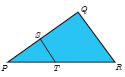
25 : 4
25 : 7
25 : 11
25 : 13
35.
A frustum of a right circular cone is of height 16 cm with radii of its ends as 8 cm and 20 cm. Then, the volume of the frustum is
3328\(\pi\) cm3
3228\(\pi\) cm3
3240\(\pi\) cm3
3340\(\pi\) cm3
36.
If two solid hemispheres of same base radius r units are joined together along their bases, then curved surface area of this new solid is
4\(\pi\)r2 sq.units
6\(\pi\)r2 sq.units
3\(\pi\)r2 sq.units
8\(\pi\)r2 sq.units
37.
f(x) = (x + 1)3 - (x - 1)3 represents a function which is
linear
cubic
reciprocal
quadratic
38.
If n(A x B) = 6 and A = {1,3} then n(B) is
1
2
3
6
39.
If number of columns and rows are not equal in a matrix then it is said to be a
diagonal matrix
rectangular matrix
square matrix
identity matrix
40.
The solution of the system x + y − 3z = −6, −7y + 7z = 7, 3z = 9 is
x = 1, y = 2, z = 3
x = −1, y = 2, z = 3
x = −1, y = −2, z = 3
x = 1, y = -2, z = 3
41.
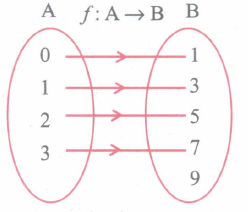
Let A = {0, 1, 2, 3} and B = {1, 3, 5, 7, 9} be two sets. Let f : A \(\rightarrow\)B be a function given by f(x) = 2x + 1. Represent this function as an arrow .
42.
Let A = {0, 1, 2, 3} and B = {1, 3, 5, 7, 9} be two sets. Let f: A \(\rightarrow\)B be a function given by f(x) = 2x + 1. Represent this function as a table.
43.
Let A = {0, 1, 2, 3} and B = {1, 3, 5, 7, 9} be two sets. Let f: A \(\rightarrow\)B be a function given by f(x) = 2x + 1. Represent this function as a set of ordered pairs.
44.
First term a and common difference d are given below. Find the corresponding A
a = \(\frac { 3 }{ 4 } \), d = \(\frac { 1 }{ 2 } \)
45.
Find the equation of a line through the given pair of points (2, 3) and (-7, -1)
46.
Simplify
\(\frac { 12{ t }^{ 2 }-22t+8 }{ 3t } \div \frac { 3{ t }^{ 2 }+2t-8 }{ 2{ t }^{ 2 }+4t } \)
47.
Write the domain of the following real functions
p(x) = \(\frac { -5 }{ 4x^{ 2 }+1 }\)
48.
The probability of happening of an event A is 0.5 and that of B is 0.3. If A and B are mutually exclusive events, then find the probability that neither A nor B happen.
49.
If A and B are two mutually exclusive events of a random experiment and P(not A) = 0.45, P(A U B) = 0.65, then find P(B).
50.
If the standard deviation of a data is 4.5 and if each value of the data is decreased by 5, then find the new standard deviation.
51.
If the difference between the roots of the equation x2 - 13x + k = 0 is 17. find k
52.
A road is flanked on either side by continuous rows of houses of height \( 4\sqrt { 3 } \)m with no space in between them. A pedestrian is standing on the median of the road facing a row house. The angle of elevation from the pedestrian to the top of the house is 30°. Find the width of the road.
53.
Two circles with centres O and O' of radii 3 cm and 4 cm, respectively intersect at two points P and Q, such that OP and O'P are tangents to the two circles. Find the length of the common chord PQ.
54.
The Cartesian product A x A has 9 elements among which (–1, 0) and (0, 1) are found. Find the set A and the remaining elements of A x A.
55.
56.
Find the equation of a line passing through the point (3, - 4) and having slope \(\frac { -5 }{ 7 } \)
57.
The volume of a solid right circular cone is 11088 cm3. If its height is 24 cm then find the radius of the cone.
58.
An insect 8 m away initially from the foot of a lamp post which is 6 m tall, crawls towards it moving through a distance. If its distance from the top of the lamp post is equal to the distance it has moved, how far is the insect away from the foot of the lamp post?
59.
Find the equation of the straight line passing through (5, 7) and is Parallel to X axis
60.
The radius of a conical tent is 7 m and the height is 24 m. Calculate the length of the canvas used to make the tent if the width of the rectangular canvas is 4 m?
61.
D and E are respectively the points on the sides AB and AC of a \(\triangle\)ABC such that AB = 5.6 cm, AD = 1.4 cm, AC = 7.2 cm and AE = 1.8 cm, show that DE || BC
62.
if a1 = 1, a2 = 1 and an = 2an - 1 + an - 2 n \(\ge\)3, n \(\in\) N, then find the first six terms of the sequence
63.
prove that \(\frac { sec\theta }{ sin\theta } -\frac { sin\theta }{ cos\theta } =cot\theta \)
64.
\(P.T\left( \frac { 1+{ tan }^{ 2 }A }{ 1+{ cot }^{ 2 }A } \right) ={ \left( \frac { 1-tan\quad A }{ 1-cot\quad A } \right) }^{ 2 }={ tan }^{ 2 }A\)
65.
From a point on a bridge across a river, the angles of depression of the banks on opposite sides at the river are 30° and 45°, respectively. If the bridge is at a height at 3 m from the banks, find the width at the river.
66.
A spherical ball of iron has been melted and made into small balls. If the radius of each smaller ball is one-fourth of the radius of the original one, how many such balls can be made?
67.
Final the probability of choosing a spade or a heart card from a deck of cards.
68.
A two digit number is such that the product of its digits is 18, when 63 is subtracted from the number, the digits interchange their places. Find the number.
69.
A chess board contains 64 equal squares and the area of each square is 6.25 cm2, A border round the board is 2 cm wide.
70.
Find the sum of first 24 terms of the list of numbers whose nth term is given by an = 3 + 2n.
71.
Find the area of the triangle formed by the points P(-1, 5, 3), Q(6, -2) and R(-3, 4).
72.
f(x) = (1+ x)
g(x) = (2x - 1)
Show that fo(g(x)) = gof(x)
73.
A function f: [-7,6) \(\rightarrow\) R is defined as follows.
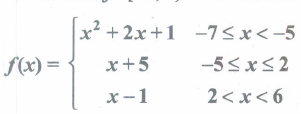
\(\cfrac { 4f(-3)+2f(4) }{ f(-6)-3f(1) } \)
74.
Which of the following list of numbers form an AP? If they form an AP, write the next two terms:
4,10,16, 22, ...
75.
If α and β are the roots of the polynomial f(x) = x2 - 2x + 3, find the polynomial whose roots are
\(\frac { \alpha -1 }{ \alpha +1 } ,\frac { \beta -1 }{ \beta +1 } \)
76.
Find the equation of a straight line Passing through (-8, 4) and making equal intercepts on the coordinate axes
77.
If two dice are rolled, then find the probability of getting the product of face value 6 or the difference of face values 5.
78.
A bag contains 12 blue balls and x red balls. If one ball is drawn at random (i) what is the probability that it will be a red ball? (ii) If 8 more red balls are put in the bag, and if the probability of drawing a red ball will be twice that of the probability in (i), then find x.
79.
From the top of a tree of height 13 m the angle of elevation and depression of the top and bottom of another tree are 45° and 30° respectively. Find the height of the second tree.(\(\sqrt { 3 } \) = 1.732)
80.
Find the equation of a line passing through the point of intersection of the lines 4x + 7y − 3 = 0 and 2x − 3y + 1 = 0 that has equal intercepts on the axes.
81.
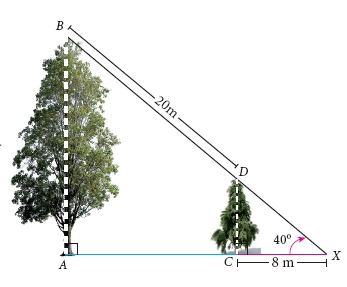
As shown in the figure, Two trees are standing on the flat ground. the angel of elevation of the top of both the trees from a point x on the ground is 40° .if the horizontal distance between x and the smaller tree is 8m and the distance of the top of the trees is 20m, calculate, the distance between the point x and the top of the smaller tree.
82.
A flock of swans contained x2 members. As the clouds gathered, 10x went to a lake and one-eighth of the members flew away to a garden. The remaining three pairs played about in the water. How many swans were there in total?
83.
A ball rolls down a slope and travels a distance d = t2 - 0.75t feet in t seconds. Find the time when the distance travelled by the ball is 11.25 feet.
84.
A vessel is in the form of a hemispherical bowl mounted by a hollow cylinder. The diameter is 14 cm and the height of the vessel is 13 cm. Find the capacity of the vessel.
85.
if \(\frac { cos\theta }{ 1+sin\theta } =\frac { 1 }{ a } \),then prove that \(\frac { { a }^{ 2 }-1 }{ a^{ 2 }+1 } \) = sin\(\theta \)
86.
Let A = {1, 2} and B = {1, 2, 3, 4}, C = {5, 6} and D = {5, 6, 7, 8}, Verify whether A x C is a subset of B x D?
87.
A right angled triangle PQR where ∠Q = 90o is rotated about QR and PQ. If QR = 16 cm and PR = 20 cm, compare the curved surface areas of the right circular cones so formed by the triangle.
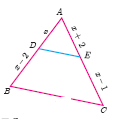
88.
In \(\triangle\) ABC, if DE||BC, AD = x, DB = x − 2, AE = x +2 and EC = x − 1 then find the lengths of the sides AB and AC.
89.
Draw a circle of radius 4 cm. At a point L on it draw a tangent to the circle using the alternate segment.
90.
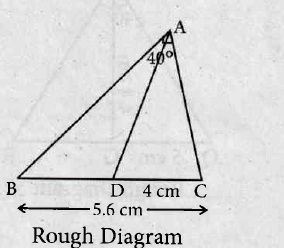
Draw a triangle ABC of base BC = 5.6 cm, \(\angle\)A = 40o and the bisector of \(\angle\)A meets BC at D such that CD = 4 cm.
1.
(c)
\(7\sqrt { 3 } \)
2.
(c)
20
3.
(d)
22
4.
(b)
16
5.
(b)
7:3
6.
(a)
\(\frac { 1 }{ \sqrt { 3 } } ,\frac { -1 }{ 3 } \)
7.
(b)
-6
8.
(c)
\(3\sqrt { 3 } cm\)
9.
(d)
isosceles
10.
(d)
The square of the ratio of their corresponding sides
11.
(d)
(ii) and (iv) only
12.
(b)
2(m-3)
13.
(d)
x - y - z = 7
14.
(c)
15.
(b)
16.
(d)
0
17.
(d)
one - one but not onto
18.
(c)
2-4x
19.
(a)
x2 + 2
20.
(a)
3:1:2
21.
(a)
S1 = S2
22.
(a)
13 cm
23.
(c)
24.
(a)
1
25.
(b)
\(\frac{7}{10}\)
26.
(b)
160900
27.
(b)
\(\frac { x }{ 2\sqrt { 2 } } \)
28.
(a)
2a
29.
(i) To check if h is one – one, we assume that h(b1) = h(b2)
Then we get 2.47b1 + 54.10 = 2.47 b2 + 54.10
2.47b1 = 2.47b2 ⇒ b1 = b2
Thus, h(b1) = h(b2) ⇒ b1 = b2, So, the function h is one – one.
(ii) If the length of the thigh bone b = 50, then the height is
h(50) = (2.47 x 50) + 54.10 = 177.6 cms
(iii) If the height of a person is 147.96 cms, then h(b) =147.96 and so the length of the thigh bone is given by 2.47b + 54.10 = 147.96.
b = \(\frac { 93.86 }{ 2.47 } \)
Therefore, the length of the thigh bone is 38 cms.
30.
(a)
0, 1, 8
31.
(b)
x + y = 3; 3x + y = 7
32.
(a)
x = 10
33.
(a)
13 m
34.
(a)
25 : 4
35.
(a)
3328\(\pi\) cm3
36.
(a)
4\(\pi\)r2 sq.units
37.
(d)
quadratic
38.
(c)
3
39.
(b)
rectangular matrix
40.
(a)
x = 1, y = 2, z = 3
41.
An arrow diagram
42.
A table
| x | 0 | 1 | 2 | 3 |
|---|---|---|---|---|
| f(x) | 1 | 3 | 5 | 7 |
43.
A = {1,2,3},B = {1,3,5, 7,9}
f(x) = 2x + 1
f(0)) = 2(0) + 1 = 1
f(1) = 2(1) + 1=3
f(2) = 2(2) + 1 = 5
f(3) = 2(3) + 1 = 7
(i) A set of ordered pairs.
f = {(0, 1), (1, 3), (2, 5), (3, 7)}
(ii) A table
| x | 0 | 1 | 2 | 3 |
| f(x) | 1 | 3 | 5 | 7 |
(ii) An arrow diagram
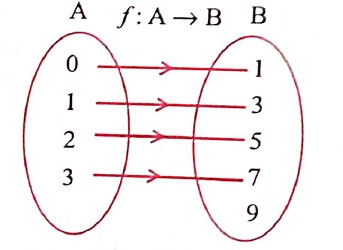
(iv) A Graph f = \(\{(x, f(x) / x \in A\}\)
= {(0, 1), (1, 3), (2, 5), (3, 7)}
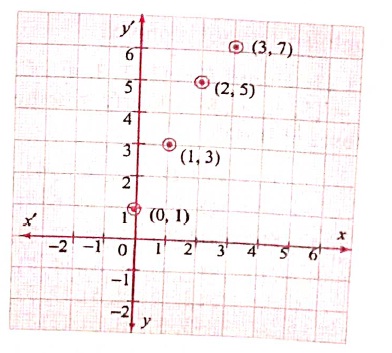
44.
A.P. is given by a + d, a + 2d, a + 3d,.....
In this case \(\frac{3}{4}, \frac{3}{4}+\frac{1}{2}, \frac{3}{4}+2\left(\frac{1}{2}\right), \frac{3}{4}+3\left(\frac{1}{2}\right), \ldots\)
\(\frac{3}{4}, \frac{3+2}{4}, \frac{3+4}{4}, \frac{3+6}{4}, \ldots
\)
\(\frac{3}{4}, \frac{5}{4}, \frac{7}{4}, \frac{9}{4}, \ldots
\)
The required A.P. is \(\frac{3}{4}, \frac{5}{4}, \frac{7}{4}, \frac{9}{4}, \ldots
\)
45.
Given points (2, 3) and (- 7, - 1)
Equation of the line passing through (x1 , y1) and (x2, y2) is
\( \frac{y-y_{1}}{y_{2}-y_{1}}=\frac{x-x_{1}}{x_{2}-x_{1}} \)
\(\frac{y-3}{-1-3}=\frac{x-2}{-7-2} \)
9 (y - 3) - 4 (x - 2)
9y - 27 = 4 x - 8
4 x - 9y +19 = 0
46.
\(\frac { 12{ t }^{ 2 }-22t+8 }{ 3t } \div \frac { 3{ t }^{ 2 }+2t-8 }{ 2{ t }^{ 2 }+4t } \)
\(=\frac { { 12 }^{ 2 }-2t+8 }{ 3t } \times \frac { 2{ t }^{ 2 }+4t }{ { 3t }^{ 2 }+2t-8 } \)
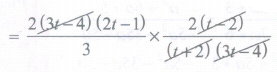
\(\frac { 4(2t-1) }{ 3 } \)
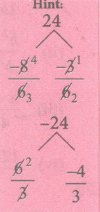
47.
Here, the expression is defined for all real values of 'x'
i.e., x \(\epsilon\) R
48.
P(A) = 0.5
P(B) = 0.3
Since A and B are mutually exclusive events
\(P(A \cap B)=0\)
\(
\mathrm{P}(\text { either } \mathrm{A} \text { or } \mathrm{B}) =\mathrm{P}(A \cup B)
\)
\(\mathrm{P}(A \cup B) =\mathrm{P}(\mathrm{A})+\mathrm{P}(\mathrm{B})-\mathrm{P}(A \cap B)
\)
\(\mathrm{P}(A \cup B) =0.5+0.3-0=0.8\)
P(neither A nor B) = \(\mathrm{P}(\overline{A \cup B})\)
\(\mathrm{P} \overline{(A \cup B)}=1-\mathrm{P}(A \cup B)=1-0.8=0.2\)
Probability of neither A nor B happen = 0.2
49.
Since A and B are mutually exclusive events
\(\mathrm{P}(A \cap B)=0\)
P(not A) = 0.45
P(A) = 1 - P(not A)
P(A) = 1 - 0.45 = 0.55
\(\mathrm{P}(A \cup B)=\mathrm{P}(\mathrm{A})+\mathrm{P}(\mathrm{B})-\mathrm{P}(A \cap B)\)
0.65 = 0.55 + P(B) - 0
P(B) = 0.65 - 0.55 = 0.1
50.
The standard deviation of a given data is 4.5. If we subtract some fixed constant from all the data, the standard deviation will not change.
Each value of the data decreased by 5, the new standard deviation will not change.
New standard deviation = 4.5
51.
x2 - 13x + k = 0 here, a = 1, b = -13, c = k
Let α, β be the roots of the equation. Then
α + β = \(\frac {-b}{a} = \frac {-(-13)}{1}\) = 13 ...... (1) also α - β = 17 ......(2)
(1) + (2) we get, 2α = 30 gives α = 15
Therefore, 15 + β = 13 (from (1)) gives β = -2
But, αβ = \(\frac {c}{a} = \frac {k}{1}\) gives 15 x (-2) = k we get, k = -30
52.
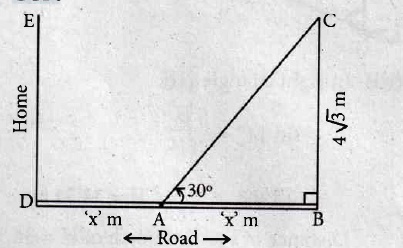
Let AB = x be the distance between foot of the house and the observer at the median of the road.
DB = 2x is the width of the road.
Height of the house BC = \(4 \sqrt{3} m\)
From the right triangle \(\triangle\) ABC
\(
\therefore \tan 30^{\circ} =\frac{B C}{A B}
\)
\(\frac{1}{\sqrt{3}}=\frac{4 \sqrt{3}}{x}
\)
\(x =4 \sqrt{3} \times \sqrt{3}=4 \times 3=12 \mathrm{~m}
\)
\(\text { Width of the road } =2 \times x=2 \times 12=24 \mathrm{~m}\)
Width of the road = 24 m.
53.
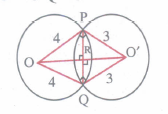
Since the tangents at a point to a circle is
perpendicular to the radius through the point of contact
\(\therefore \angle O P O^{\prime}=90^{\circ}\)
OP2 + OP2 = (OO')2
[By Pythagoras theorem]
32 + 42 = (OO')2
9+16 = (OO')2
25 = (OO')2
OO' = 5cm
Since the line joining the centres of two intersecting circles is perpendicular bisector of their common chord.
\(\mathrm{OR} \perp \mathrm{PQ} \text { and } O^{\prime} \mathrm{R} \perp \mathrm{PQ}\)
AIso PR = QR
Let OR = x, then O'R = 5 - x
AIso at PR = QR = y cm
\(\text { In } \triangle O R P \text { and } \Delta O^{\prime} R P\)
Applying Pythagoras theorem
OP2 = OR3 + RP2 and O'P'2 = O'R2 + RP2
\(3^{2}=x^{2}+y^{2} and 4^{2}=(5-x)^{2}+y_{i}^{2} \)
\(Subtracting \Rightarrow 4^{2}-3^{2}=\left\{(5-x)^{2}+y^{2}\right\}-\left(x^{2}+y^{2}\right) \)
\(16-9=25-10 x+x^{2}+y^{2}-x^{2}-y^{2} \)
7 - 25 = 10x
10x = 25 - 7
10x = 18
x = 1.8 cm
32 = x2 + y2
\(y=\sqrt{9-(1.8)^{2}}=\sqrt{5.76}\)
y = 2.4cm
Hence PR = QR = 2.4 cm
PQ = 2y = 4.8 cm
54.
Since A x A has 9 elements,
A would have 3 elements
A x A contains (- 1, 0) and (0, 1)
-1, 0 \(\in \) A
Similarly (0, 1) is in A x A
So, 0,1 \(\in \) A
From (1) and (2). = -1, 0, 1 \(\in \) A
A = {-1, 0 , 1}
A x A = {-1, 0, 1} x {1, 0, -1}
= {(-1, 1), (-1, 0), (-1, -1), (0, -1),(0,0), (0, 1), (1, -1), (1, 0),(1, 1)}
The remaining elements of A x A are
{(- 1, - 1), (- 1, 1), (0, - 1), (0, 0), (1, - 1), (1,0),(1, 1)}
55.
56.
Given, (x1, y1) = (3 , − 4) and m = \(\frac { -5 }{ 7 } \)
The equation of the point-slope form of the straight line is y - y1 = m(x - x1)
we write it as y + 4 = − \(\frac { 5 }{ 7 } \) (x - 3)
gives us 5x + 7y + 13 = 0
57.
Let r and h be the radius and height of the cone respectively.
Given that, volume of the cone = 11088 cm3
\(\frac { 1 }{ 3 } { \pi r }^{ 2 }h=11088\)
\(\frac { 1 }{ 3 } \times \frac { 22 }{ 7 } \times { r }^{ 2 }\times 24=11088\)
\({ r }^{ 2 }=441\)
Therefore, radius of the cone r = 21 cm.
58.
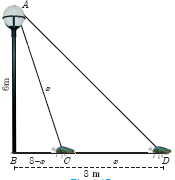
Distance between the insect and the foot of the lamp post BD = 8 m
The height of the lamp post, AB = 6 m
After moving a distance of x m, let the insect be at C
Let, AC = CD = x . Then BC = BD − CD = 8 − x
In \(\triangle\)ABC, \(\angle\)B = 90o
AC2 = AB2 + BC2 gives x2 = 62 + (8 - x)2
x2 = 36 + 64 − 16x + x2
16x = 100 then x = 6.25
Then, BC = 8 − x = 8 − 6.25 = 1.75m
Therefore the insect is 1.75 m away from the foot of the lamp post.
59.
The equation of any straight line parallel to X axis is y = b.
Since it passes through (5, 7), b = 7 .
Therefore, the required equation of the line is y = 7.
60.
Let r and h be the radius and height of the cone respectively.
Given that, radius r = 7 m and height h = 24 m
Hence, l = \(\sqrt { { r }^{ 2 }+{ h }^{ 2 } } \)
\(=\sqrt { 49+576 } \)
\(l=\sqrt { 625 } =25m\)
C.S.A. of the conical tent = \(\pi\)rl sq. units
Area of the canvas \(=\frac { 22 }{ 7 } \times 7\times 25={ 550 }m^{ 2 }\)
Now, length of the canvas \(\frac{Area\ of\ the\ canvas}{width}=\frac{550}{4}=137.5m\)
Therefore, the length of the canvas is 137.5 m
61.
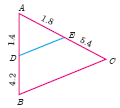
We have AB = 56.cm, AD = 14. cm, AC = 72. cm and AE = 18.cm.
BD = AB - AD = 5.6 –1.4 = 4.2 cm
and EC = AC – AE = 7.2–1.8 = 5.4 cm
\(\frac { AD }{ DB } =\frac { 1.4 }{ 4.2 } =\frac { 1 }{ 3 } \) and \(\frac { AE }{ EC } =\frac { 1.8 }{ 5.4 } =\frac { 1 }{ 3 } \)
\(\frac { AD }{ DB } =\frac { AE }{ EC } \)
Therefore, by converse of Basic Proportionality Theorem, we have DE is parallel to BC. Hence proved.
62.
Given first two terms of the sequence.
a1 = 1, a2 = 1,
For n > 3 an = 2an - 1 + an - 2
When n = 3 a3 = 2a(3 - 1) + a(3 - 2) = 2a2 + a1
a3 = 2 + 1 = 3
When n = 4 a4 = 2a(4-1) + a(4-2) = 2a3 + a1
a4 = 2 x 3 + 1 = 6 + 1 = 7
When n = 5 a5 = 2a(5-1) + a(5-2) = 2a4 + a3
a5 = 2 x 7 + 3 = 14 + 3 = 17
When n = 6 a6 = 2a(6-1) + a(6-2) = 2a5 + a4
a6 = 2 x 17+ 7 = 34 + 7 = 41
The first six terms of the sequence are 1, 1, 3, 7, 17, 41, ....
63.
\(\frac { sec\theta }{ sin\theta } -\frac { sin\theta }{ cos\theta } = \frac { \frac { 1 }{ cos\theta } }{ sin\theta } -\frac { sin\theta }{ cos\theta } =\frac { 1 }{ sin\theta cos\theta } -\frac { sin\theta }{ cos\theta } \)
\(=\frac { 1-si{ n }^{ 2 }\theta }{ sin\theta cos\theta } =cot\theta \)
64.
65.
A and B represent points on the bank on opposite sides at the river, so that AB is the width of the river. P is a point on the bridge at a height of 3m i.e., DP = 3 m. We are interested to determine the width at the river which is the length at the side AB of the ΔAPB.
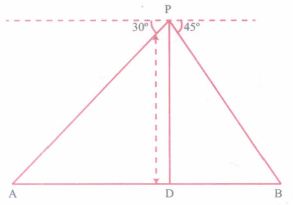
Now, AB = AD + DB
In right ΔAPD,
ㄥA = 30o
So, tan 30° = \(\frac { 1 }{ \sqrt { 3 } } =\frac { 3 }{ AD } \)
i.e., \(\frac { 1 }{ \sqrt { 3 } } =\frac { 3 }{ AD } \) (or) AD = 3\(\sqrt { 3 } \)
Also, in right ΔPBD,
B = 45o
So, BD = PD = 3m
Now, AB = BD + AD
= 3 + 3\(\sqrt { 3 } \) = 3(1+\(\sqrt { 3 } \))m
Therefore, the width at the river is 3(+\(\sqrt { 3 } \))m
66.
No. of balls required \(=\frac { \frac { 4 }{ 3 } \pi { r }^{ 3 } }{ \frac { 4 }{ 3 } \pi \times { \left( \frac { r }{ 4 } \right) }^{ 3 } } \)
\(={ r }^{ 3 }\times \frac { 4 }{ r } \times \frac { 4 }{ r } \times \frac { 4 }{ r } =64\)
67.
Total number of cards = 52
Event of selecting a spade card = A
Event of selecting a heart card = B
n(A) = 13, n(B) = 13
P(A) =\(\frac { 13 }{ 52 } =\frac { 1 }{ 4 } \), P(B) =\(\frac { 13 }{ 52 } =\frac { 1 }{ 4 } \).
A ⋂ B refers to a card is both spade and heart. It is not possible

A, B are exclusive events.
P(A,B) = P(A) + P(B) =\(\frac { 1 }{ 4 } +\frac { 1 }{ 4 } =\frac { 1 }{ 2 } \).
68.
Let the tens digits be x. Then the uints digits=\(\frac{18}{x}\)
∴ Number =10x+\(\frac{18}{x}\)
and number obtained by interchanging the digits =10x+\(\frac{18}{x}\)
\(\\ \therefore \left( 10x+\frac { 18 }{ x } \right) -\left( 10\times \frac { 18 }{ x } +x \right) =63\)
\(\Rightarrow 10x+\frac { 18 }{ x } -\frac { 180 }{ x } -x=0\)
\(\Rightarrow 9x-\frac { 162 }{ x } -63=0\)
⇒ 9x2-63x-162=0
⇒ x2-7x-18=0
⇒ (x-9)(x+2)=0⇒ x=9,-2
But a digit can never be (-ve), so x = 9.
So, the required number \(=10\times 9+\frac { 18 }{ 9 } =92\)
69.
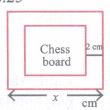
Let the length of the side of the chess board be x cm. Then
Area of 64 squares = (x - 4)2
(x - 4)2 = 64 x 6.25
⇒ x2-8x+ 16=400
⇒X2- 8x - 384 =0
⇒ X2- 24x + 16x - 384 = 0
⇒(x - 24)(x + 16) = 0
⇒ x=24 cm.
70.
an = 3 +2n
a1 = 3 + 2 = 5
a2 = 3 + 2 x 2 = 7
a3 = 3 + 2 x 3 = 9
List of numbers becomes 5, 7, 9, 11,.........
Here, 7 - 5 = 9 - 7 = 11 - 9 = 2 and so on. So, it forms an A.P. with common difference d = 2.
To find S24 we have n = 24, a = 5, d = 2.
S24 = \(\frac{24}{2}\) [2 x 5 + (24 - 1) x ]
= 12 [10 + 46] = 672.
So, sum of first 24 terms of the list of numbers is 672.
71.
The area of the triangle formed by the given points is equal to
= \(\frac { 1 }{ 2 } \) [-1.5 (-2 - 4) + 6 (4 - 3) + (-3) (3 + 2)]
= \(\frac { 1 }{ 2 } \) [9 + 6 - 15] = 0
We can have a triangle at area 0 square units? What does this mean?
If the area of a triangle is 0 square units, then its vertices will be collinear.
72.
f(x) = 1 + x
g(x) = (2x - 1)
fog(x) = f(g(x) = f(2x - 1)
= 1 + 2x - 1 = 2x ...(1)
gof(x) = g(f(x) = g(1 + x) = 2(1 + x) - 1
= 2 + 2x - 1
= 2x + 1 ...(2)
(1) \(\neq \)(2)
\(\therefore\) fog(x) \(\neq \) gof(x)
It is verified
73.
\(\cfrac { 4f(-3)+2f(4) }{ f(-6)-3f(1) } \)
For f(1) & f(3)
Since 1 & 3 lies between -5 ≤ x ≤2, We take, f(x) = x +5
f(1) = 1 + 5 = 6
f(-3) = -3 +5 = 2
For f(4): Since 4 lies between 2 < x < 6 We take, f(x) = x -1
f(4) = 4 -1 = 3
For f(-6): Since -6 lies between -7≤ x < -5 ,We take, f(x) = x² + 2x +1
f(-6) = (-6)² + 2(-6) + 1 = 36 -12 + 1 = 24 +1 = 25
Now ,\(\cfrac { 4f(-3)+2f(4) }{ f(-6)-3f(1) } \) =\(\frac{ 4(2) +2(3) }{ 25 - 3(6)}\)
= \(\frac{ 8 + 6 }{ 25 -18}\)
= \(\frac{14 }{ 7}\) = 2
Hence, the value of \(\cfrac { 4f(-3)+2f(4) }{ f(-6)-3f(1) } \) = 2
74.
4, 10, 16,22, ...
We have a2 - a2 = 10 - 4 = 6
a3 - a2 = 16 -10 = 6
ஃ It is an A.P. with common difference 6
ஃ The next two terms are, 
75.
\(f(x)=\frac { 1{ x }^{ 2 } }{ a } -\frac { 2x }{ b } +\frac { 3 }{ c } \)
Sum of the roots \((\alpha +\beta )=\frac { -b }{ a } =-\frac { (-2) }{ 1 } \)
Product of the roots \((\alpha \beta )=\frac { c }{ a } =\frac { 3 }{ 1 } =3\)
\(\frac { \alpha -1 }{ \alpha +1 } ,\frac { \beta -1 }{ \beta +1 } \)
⇒ sum of the roots=\(\frac { \alpha -1 }{ \alpha +1 } ,\frac { \beta -1 }{ \beta +1 } \)
Sum\(=\frac { (\alpha -1)(\beta +1)+(\beta -1)(\alpha +1) }{ (\alpha +1)(\beta +1) } \)
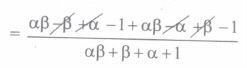
\(=\frac { \alpha \beta +\alpha \beta -2 }{ \alpha \beta +(\alpha +\beta )+1 } =\frac { 2\alpha \beta -2 }{ \alpha \beta +(\alpha +\beta )+1 } \)
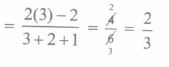
Product=\(\frac { \alpha -1 }{ \alpha +1 } \times \frac { \beta -1 }{ \beta +1 } =\frac { (\alpha -1)(\beta -1) }{ (\alpha +1)(\beta +1) } \)
\(=\frac { \alpha \beta -\beta -\alpha +1 }{ \alpha \beta ++\alpha +1 } =\frac { \alpha \beta -(\alpha +\beta )+1 }{ \alpha \beta +(\alpha +\beta )+1 } \)
\(=\frac { 3-2+1 }{ 3+2+1 } \)
\(=\frac { 2 }{ 6 } =\frac { 1 }{ 3 } \)
∴ Required equation= \({ x }^{ 2 }-\frac { 2 }{ 3 } x+\frac { 1 }{ 3 } =0\)
⇒3x2 - 2x + 1 = 0
76.
Given that intercepts are equal.
a = b
Equation of the line in intercepts form is
\(\frac{x}{a}+\frac{y}{b}=1
\)
\(\frac{x}{a}+\frac{y}{a}=1
\)
x + y = a
This passes through (- 8, 4)
-8 + 4 = a
a = -4
b = -4
Equation of the straight line is
\(\frac{x}{a}+\frac{y}{b}=1
\)
\(\frac{x}{-4}+\frac{y}{-4}=1
\)
x + y + 4 = 0.
77.
Product of face values 6: { (1, 6), (2, 3), (6, 1), (3,2)}
Difference of face value 5: {(1, 6), (6, 1)}
P(product 6) = \(\frac { 4 }{ 6\times 6 } =\frac { 4 }{ 36 } =\frac { 1 }{ 9 } \)
p( difference 5) = \(\frac { 2 }{ 2\times 6 } =\frac { 1 }{ 18 } \)
78.
Total number of balls = blue balls + red balls
n(S) = 12 + x
(i) The probability that it will be a red ball:
Let A be the event of selecting a red ball
n(A) = x
\(\mathrm{P}(\mathrm{A})=\frac{n(A)}{n(S)} \)
\(\mathrm{P}(\mathrm{A})=\frac{x}{12+x} \)
(ii) If 8 more red balls are put in the bag then the number of red balls = x + 8
Total number of balls = 12 + x + 8
Probability of drawing a red ball
\(\mathrm{P}(\mathrm{B}) =\frac{n(B)}{n(S)} \)
\(=\frac{x+8}{12+x+8}=\frac{x+8}{x+20} \)
If the probability of drawing a red ball will be twice that of the probability (i), then
\(\frac{x+8}{x+20}=2 \times\left[\frac{x}{12+x}\right]\)
(x + 8)(12 + x) = 2x (x + 20)
12x + 96 + x2 + 8x = 2x2 + 40x
2x2 - x2 + 40x - 12x - 8x - 96 = 0
x2 + 20x - 96 = 0
(x - 4) (x + 24) = 0
x = 4 and x = - 24 (not possible)
By applying the value of x in P(A)
we get P(A) \(=\frac{4}{12+4}=\frac{4}{16}\)
\(P(A)=\frac{1}{4}\)
x = 4
79.
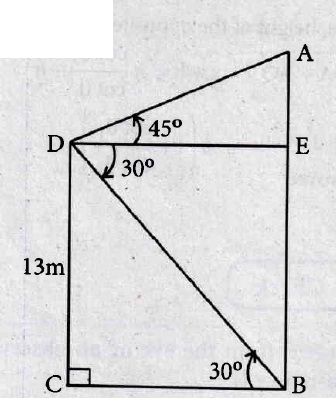
Let CD is the tree of height 13 m.
AB is another tree.
\( \angle A D E=45^{\circ} \)
\(\angle E D B=\angle D B C=30^{\circ}\)
CB = DE and CD = EB = 13m
In right triangle \(\triangle\)AED
\( \tan 45^{\circ} =\frac{A E}{D E} \)
\(1 =\frac{A E}{D E}\)
AE = DE ....(1)
In the right triangle \(\triangle\)DBC
\( \tan 30^{\circ} =\frac{D C}{B C} \)
\(\frac{1}{\sqrt{3}} =\frac{13}{B C} \)
\(B C =13 \sqrt{3} \mathrm{~m}\)
From (1) AE \( =13 \sqrt{3} \mathrm{~m}\)
Height of the tree = AB = AE + EB
(\(13 \sqrt{3} \mathrm{~m}\) + 13) m
= (13 x 1.732 + 13) m
= (22.516 + 13) m = 35.516 m - 35.52 m
Height of the second tree = 35.52 m
80.
Given lines 4x + 7y - 3 = 0 = 4x + 7y = 3 ..... (1)
2x - 3y + 1 = 0 = 2x - 3y = -1 ...(2)
Solving (1) and (2)
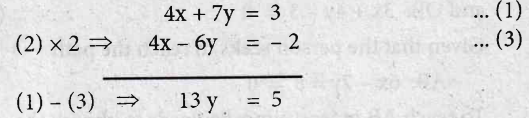
\(y=\frac{5}{13} \)
Substituting in (1) \(\Rightarrow \ 4 x+7\left(\frac{5}{13}\right)=3 \)
\(x=\frac{1}{13}\)
The point intersection of (1) and (2) is \(\left(\frac{1}{13}, \frac{5}{13}\right)\)
Given that the line has equal intercepts on the axes.
i.e., a = b
Now, intercept form of the line is \(\frac{x}{a}+\frac{y}{b}=1\)
\(\Rightarrow \quad \frac{x}{a}+\frac{y}{a}=1 \Rightarrow \mathrm{x}+\mathrm{y}=\mathrm{a}\)
This passes through \(\left(\frac{1}{13}, \frac{5}{13}\right)\)
\( \Rightarrow \ \frac{1}{13}+\frac{5}{13} =a \Rightarrow a=\frac{6}{13} \)
\(\therefore \ b =\frac{6}{13} \)
Hence the equation of a line is \(\frac{x}{\frac{6}{13}}+\frac{y}{\frac{6}{13}}=1\)
13x + 13y - 6 = 0
81.
Let AB be the height of the biggest tree and CD be the highest of the smaller tree and x is the point on the ground.
In the right triangle XCD, cos40° =\(\frac { CX }{ XD } \)
Therefore the distance between X and top of the smaller tree = XD =10.44m.
82.
As given there are x2 swans.
As per the given data x2 - 10x - \(\frac {1}{8}\)x2 = 6 we get, 7x2 - 80x - 48 = 0
x = \(\frac { 80\pm \sqrt { 6400-4\left( 7 \right) \left( -48 \right) } }{ 14 } =\frac { 80\pm 88 }{ 14 } \)
Therefore, x = 12, \(-\frac {4}{7}\)
Here x = \(-\frac {4}{7}\) is not possible as the number of swans cannot be negative.
Hence, x = 12. Therefore total number of swans is x2 = 144.
83.
Distance d = t2- 0.75t,
Given that d = 11.25 = t2- 0.75t.
\(t = {-b \pm \sqrt{b^2-4ac} \over 2a}\)
\(=\frac { (+0.75)\pm \sqrt { { (-0.75) }^{ 2 }-4\times 1\times -11.25 } }{ 2\times 1 } \)
\(=\frac { +0.75\pm \sqrt { 0.5625+45 } }{ 2 } \)
\(=\frac { +0.75\pm \sqrt { 45.5625 } }{ 2 } \)
\(=\frac { +0.75\pm 6.75 }{ 2 } \)
\(=\frac { 7.50 }{ 2 } or\frac { -6 }{ 2 } \)
= 3.75 or-3 It is not possible
∴ t = 3.75 s.
84.
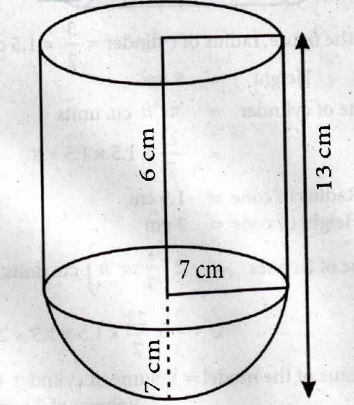
Diameter of the bowl = 14 cm
Radius r = 7 cm
Volume of hemisphere \(=\frac{2}{3} \pi r^{3} \text { cu. units } \)
\(=\frac{2}{3} \times \frac{22}{7} \times 7 \times 7 \times 7 \)
\(=\frac{2156}{3}=1718.67 \mathrm{~cm}^{3} \)
Radius of cylinder 'r' = 7 cm
Height 'h' = 6 cm
Volume of cylinder \(=\pi r^{2} h \text { cu. units } \)
\(=\frac{22}{7} \times 7 \times 7 \times 6 \)
= 924 cm3
capacity of the vessel = Volume of hemisphere + Volume of cylinder
= 718.67 + 924
= 1642.67 cm3
85.
Given \(\frac{\cos \theta}{1+\sin \theta}=\frac{1}{a}
\)
\(\therefore a=\frac{1+\sin \theta}{\cos \theta}
\)
\(\mathrm{LHS}=\frac{a^{2}-1}{a^{2}+1}
\)
\(=\frac{\left(\frac{1+\sin \theta}{\cos \theta}\right)^{2}-1}{\left(\frac{1+\sin \theta}{\cos \theta}\right)^{2}+1}\)
\(=\frac{\frac{1^{2}+\sin ^{2} \theta+2 \sin \theta}{\cos ^{2} \theta}-1}{\frac{1^{2}+\sin ^{2} \theta+2 \sin \theta}{\cos ^{2} \theta}+1}\)
\(=\frac{\frac{1+\sin ^{2} \theta+2 \sin \theta-\cos ^{2} \theta}{\cos ^{2} \theta}}{\frac{1+\sin ^{2} \theta+2 \sin \theta+\cos ^{2} \theta}{\cos ^{2} \theta}}\)
\(=\frac{\left(1-\cos ^{2} \theta\right)+\sin ^{2} \theta+2 \sin \theta}{\cos ^{2} \theta} \times \frac{\cos ^{2} \theta}{1+\left(\sin ^{2} \theta+\cos ^{2} \theta\right)+2 \sin \theta}\)
\(=\frac{\sin ^{2} \theta+\sin ^{2} \theta+2 \sin \theta}{1+1+2 \sin \theta}\)
\(=\frac{2 \sin ^{2} \theta+2 \sin \theta}{2+2 \sin \theta}
\)
\(=\frac{2 \sin \theta(\sin \theta+1)}{2(1+\sin \theta)}
\)
= sin \(\theta \) = RHS
86.
A = {1, 2),B = {1, 2, 3, 4}, C = {5, 6},D = {5, 6, 7, 8}
A x C = {1, 2} x {5, 6}
\(\mathrm{A} \times \mathrm{C}=\{(1,5),(1,6),(2,5),(2,6)\}\)
B x D = { 1, 2, 3, 4} x { 5, 6, 7, 8}
\(\begin{array}{r} \mathrm{B} \times \mathrm{D}=\{({1,5}),(1,6),(1,7),(1,8) ({2,5}),(2,6),(2,7),(2,8) (3,5),(3,6),(3,7),(3,8) (4,5),(4,6),(4,7),(4,8)\} \end{array}\)
(A x C) is a subset of (B x D)
87.
Right triangle PQR, right angled at Q and
PR = 20 cm, QR = 16 cm
PQ2 = PR2 - QR2
= (20)2 - (16)2
= 400 - 256 = 144
PQ = 12 cm
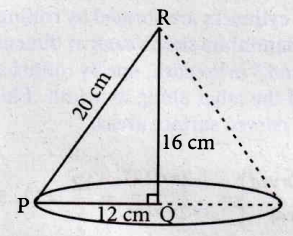
When right triangle PQR, rotates about QR, a right circular cone is formed with PQ = 12 cm as base radius and PR = 20 cm as
slant height.
C.S.A of the Cone = \(\pi r l\) sq. units
\(=\frac{22}{7} \times 12 \times 20=754.29 \mathrm{~cm}^{2}\)
When right triangle PQR, rotates about PQR, a right circular cone is formed with
QR = 16 cm as base radius and PR = 20 cm as slant height
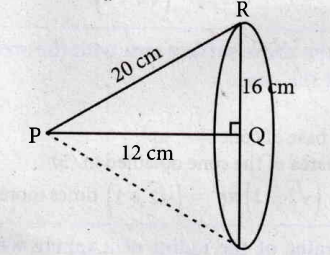
C.S.A of the Cone \(=\pi r l \text { sq.units } \)
\(=\frac{22}{7} \times 16 \times 20 \)
= 1005.71 cm2
Hence, C.S.A of the cone when rotates about PQ is larger.
88.
In \(\triangle\) ABC we have DE || BC.
By Thales theorem, we have \(\frac { AD }{ DB } =\frac { AE }{ EC } \)
\(\frac { x }{ x-2 } =\frac { x+2 }{ x-1 } \) gives x(x - 1) = (x - 2)(x + 2)
When x = 4, AD = 4, DB = x - 2, AE + x + 2 = 6, EC = x - 1 = 3
Hence, AB = AD + DB = 4 + 2 = 6, AC = AE + EC = 6 + 3 = 9
Therefore, AB = 6, AC = 9
89.
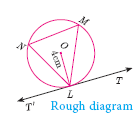
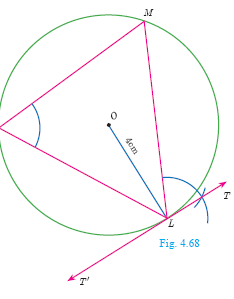
Given, radius = 4 cm
Construction
Step 1 : With O as the centre, draw a circle of radius 4 cm.
Step 2 : Take a point L on the circle. Through L draw any chord LM.
Step 3 : Take a point M distinct from L and N on the circle, so that L, M and N are in anti clockwise direction. Join LN and NM.
Step 4 : Through L draw a tangent TT' such that \(\angle\)TLM =\(\angle\)MNL
Step 5 : TT' is the required tangent.
90.
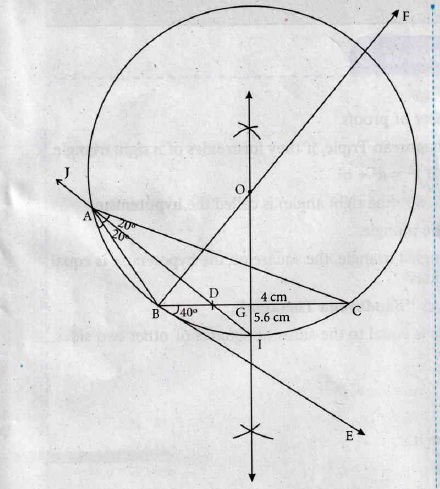
Construction:
Steps (1) Draw a line segment BC = 5.6 cm
Steps (2) At B, draw BE such that \(\angle CBE={ 60 }^{ 0 }\)
Steps (3) At B draw BF such that \(\angle EBF={ 90 }^{ 0 }\)
Steps (4) Drawn the perpendicular bisector to BC, which intersects BF at O and BC at G.
Steps (5) With O as centre and OB as radius draw a circle
Steps (6) From B, marked an arc of 4 cm on BC at D.
Steps (7) The perpendicular bisector intersects the circle at I. Joined ID.
Steps (8) ID produced meets the circle at A. Now joined AB and AC. Then \(\triangle\)ABC is the required triangle.

10th Standard Syllabus & Materials
10th Standard
TN 10th English Prose - 2 - The Night the Ghost Got in Important Questions And Answers Study Material - QB365 Set A
NEW10th Standard
TN 10th English Supplementary - 1 - The Tempest Important Questions And Answers Study Material - QB365 Set A
NEW10th Standard
TN 10th English Poem - 1 - Life Important Questions And Answers Study Material - QB365 Set A
NEW10th Standard
TN 10th English Prose - 1 - His First Flight Important Questions And Answers Study Material - QB365 Set A



Tamilnadu Stateboard 10th Standard Subjects
Tamilnadu Stateboard Standards





