
 100% FREE ACCESS
10th Standard Syllabus & Materials
10th Standard
TN 10th English Prose - 4 - The Attic Important Questions And Answers Study Material - QB365 Set A
NEW10th Standard
TN 10th English Supplementary - 3 - The Story of Mulan Important Questions And Answers Study Material - QB365 Set A
NEW10th Standard
TN 10th English Poem - 3 - I am Every Woman Important Questions And Answers Study Material - QB365 Set A
NEW10th Standard
TN 10th English Prose - 3 - Empowered Women Navigating The World Important Questions And Answers Study Material - QB365 Set A
NEW10th Standard
TN 10th English Supplementary - 2 - Zigzag Important Questions And Answers Study Material - QB365 Set A
NEW10th Standard
TN 10th English Poem - 2 - The Grumble Family Important Questions And Answers Study Material - QB365 Set A

Published on: 13/03/2020
10th Standard Mathematics English Medium All Chapter Book Back and Creative Five Marks Questions 2020
Download Tamil Nadu 10th Standard Maths question papers, model tests, one-mark questions, important questions, and public exam papers in PDF format. Free study materials and answer keys for TN State Board students.
Questions + Answers key
Take MCQ Maths Test1.
In figure 0 is any point inside a rectangle ABCD. Prove that OB2 + OD2 = OA2 + OC2
2.
In \(AD\bot BC\) prove that AB2 + CD2 = BD2 + AC2.
3.
Evaluate \(\frac { tan{ 65 }^{ o } }{ tan{ 25 }^{ o } } \)
4.
Express the ratios cos A, tan A and sec A in terms of sin A.
5.
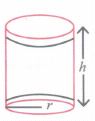
A wooden article was made by scooping out a hemisphere from each end of a cylinder as shown in figure. If the height of the cylinder is 10 cm and its base is of radius 3.5 cm find the total surface area of the article.
6.
Final the probability of choosing a spade or a heart card from a deck of cards.
7.
| Team A | 50 | 20 | 10 | 30 | 30 |
| Team B | 40 | 60 | 20 | 20 | 10 |
Which team is more consistent?
8.
Find the number of coins, 1.5 cm is diameter and 0.2 cm thick, to be melted to form a right circular cylinder of height 10 cm and diameter 4.5 cm.
9.
A two digit number is such that the product of its digits is 12. When 36 is added to the number the digits interchange their places. Find the number.
10.
The sum of two numbers is 15. If the sum of their reciprocals is \(\frac{3}{10}\), find the numbers.
11.
Determine the AP whose 3rd term is 5 and the 7th term is 9.
12.
Which of the following list of numbers form an AP? If they form an AP, write the next two terms:
-2, 2, -2, 2, -2
13.
If R = {(a, -2), (-5, b), (8, c), (d, -1)} represents the identity function, find the values of a, b, c and
14.
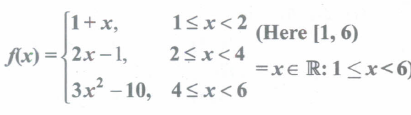
A function f: (1,6) \(\rightarrow\)R is defined as follows:
Find the value of f(5),
15.
Find the value of k if the points A(2, 3), B(4, k) and (6, -3) are collinear.
16.
Find the coordinates at the points of trisection (i.e. points dividing in three equal parts) of the line segment joining the points A(2, -2) and B(-7, 4).
17.
Find the sum of
52 + 102 + 152 +...+ 1052
18.
Find the sum to n terms of the series
3 + 33 + 333 + ...to n terms
19.
If two dice are rolled, then find the probability of getting the product of face value 6 or the difference of face values 5.
20.
The roots of the equation x2 + 6x - 4 = 0 are α, β. Find the quadratic equation whose roots are
α2 and β2
21.
22.
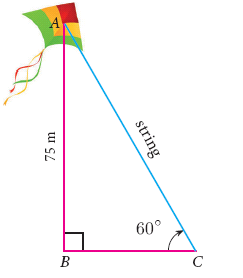
A kite is flying at a height of 75m above the ground, the string attached to the kite is temporarily tied to a point on the ground. The inclination of the string with the ground is \(60°\).find the length of the string ,assuming that there is no slack in the string.
23.
The internal and external diameter of a hollow hemispherical shell are 6 cm and 10 cm respectively. If it is melted and recast into a solid cylinder of diameter 14 cm, then find the height of the cylinder.
24.
A right angled triangle PQR where ∠Q = 90o is rotated about QR and PQ. If QR = 16 cm and PR = 20 cm, compare the curved surface areas of the right circular cones so formed by the triangle.
25.
A function f: [-5,9] ⟶ R is defined as follows:
\(f(x)=\left[\begin{array}{ll} 6 x+1 & \text { if }-5 \leq x<2 \\ 5 x^{2}-1 & \text { if } 2 \leq x<6 \\ 3 x-4 & \text { if } 6 \leq x \leq 9 \end{array}\right.\)
Find
i) f(-3) + f(2)
ii) f(7) - f(1)
iii) 2f(4) + f(8)
iv) \(\frac { 2f(-2)-f(6) }{ f(4)+f(-2) } \)
26.
prove that \(\frac { sinA }{ secA+tanA-1 } +\frac { cosA }{ cosecA+cotA-1 } =1\)
27.
If \(\triangle\)ABC~\(\triangle\)DEF such that area of \(\triangle\)ABC is 9cm2 and the area of \(\triangle\)DEF is 16cm2 and BC = 2.1 cm. Find the length of EF
28.
The floor of a hall is covered with identical tiles which are in the shapes of triangles. One such triangle has the vertices at (-3, 2), (-1, -1) and (1, 2). If the floor of the hall is completely covered by 110 tiles, find the area of the floor.
29.
If the points P(-1, -4), Q (b, c) and R(5, -1) are collinear and if 2b + c = 4, then find the values of b and c.
30.
Find the values of ‘k’, for which the quadratic equation kx2 - (8k + 4)x + 81 = 0 has real and equal roots?
31.
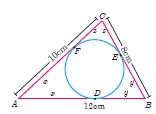
A circle is inscribed in \(\triangle\)ABC having sides 8 cm, 10 cm and 12 cm as shown in figure, find AD, BE and CF.
32.
Let f be a function f : N ⟶ N be defined by f(x) = 3x + 2, x \(\in \) N
(i) Find the images of 1, 2, 3
(ii) Find the pre-images of 29, 53
(iii) Identify the type of function
1.
Through O, draw PQIIBC so that P lies on AB and Q lies on DC
Now, PQ II BC
\(PQ\bot AB\quad PQ\bot OC\)
\(\left( \because \angle B={ 90 }^{ 0 }and\angle C={ 90 }^{ 0 } \right) \)
So, \(\angle BPQ={ 90 }^{ 0 }\quad \angle CQP={ 90 }^{ 0 }\)
Therefore BPQC and APQD are both rectangles. Now from \(\Delta OPB\)
OB2 = BP2 + OP2
Similarly from \(\Delta OQD\)
OD2 = OQ2 + DQ2
From \(\Delta OQC\)
OC2 = OQ2 + CQ2
\(\Delta OAP\) we have
OA2 = AP2 +OP2
Adding (1) and (2)
OB2 + OD2 = BP2 + OP2 + OQ2 + DQ2
(As BP = CQ and DQ = AP)
= CQ2 + OP2 + OQ2 + AP2
= CQ2 + OQ2 + OP2 + AP2
= OC2+ OA
[From (3) and (4)]
2.
From \(\Delta ADC\) we have
AC2 = AD2 + CD2 ....(1)
(Pythagoras theorem)
From \(\Delta ADB\) we have
AB2 = AD2 + BD2 ...(2)
(Pythagoras theorem)
Subtracting (1) from (2) we have,
AB2 - AC2 = BD2 - CD2
AB2 + CD2 = BD2 + AC2
3.
We know:
cot A = tan(90o - A)
So,
cot 25° = tan (90° - 25°) = tan 65°
\(\frac { tan{ 65 }^{ o } }{ tan{ 25 }^{ o } } \) = \(\frac { tan{ 65 }^{ o } }{ tan{ 25 }^{ o } } \) = 1
4.
Since
cos2A + sin2A = 1 therefore
cos2A = 1 - sin2A
i.e., cos A = 土 \(\sqrt { 1-{ sin }^{ 2 }A } \)
This gives cos A = \(\sqrt { 1-{ sin }^{ 2 }A } \)
Hence, \(tanA=\frac { sinA }{ cosA } =\frac { sinA }{ \sqrt { { 1-sin }^{ 2 }A } } \)
and \(secA=\frac { 1 }{ cosA } =\frac { 1 }{ \sqrt { 1-{ sin }^{ 2 }A } } \)
5.
Radius of the cylinder be r
Height of the cylinder be h
Total surface area of the article
= CSA of cylinder + CSA of 2 hemispheres
= 2ㅠrh + 2πr2 = 2πr(h + 2r)
\(=2\times \frac { 22 }{ 7 } \times 3.5\times (10+2\times 3.5)\)
= 22 x 17 = 374 cm2
6.
Total number of cards = 52
Event of selecting a spade card = A
Event of selecting a heart card = B
n(A) = 13, n(B) = 13
P(A) =\(\frac { 13 }{ 52 } =\frac { 1 }{ 4 } \), P(B) =\(\frac { 13 }{ 52 } =\frac { 1 }{ 4 } \).
A ⋂ B refers to a card is both spade and heart. It is not possible

A, B are exclusive events.
P(A,B) = P(A) + P(B) =\(\frac { 1 }{ 4 } +\frac { 1 }{ 4 } =\frac { 1 }{ 2 } \).
7.
| Team A | ||
| x1 | d1 = x - 28 | d12 |
| 50 | 22 | 484 |
| 20 | -8 | 64 |
| 10 | -18 | 324 |
| 30 | 2 | 4 |
| 30 | 2 | 4 |
| 140 | Σd = 0 | 880 |
\(\bar { { x }_{ 1 } } \) =\(\frac { 140 }{ 5 } \) =28
σ1 =\(\sqrt { \frac { \Sigma d^{ 2 } }{ n } } =\sqrt { \frac { 880 }{ 5 } } \)
= \(\sqrt { 176 } \)
= 13.27
CV1 = \(\frac { \sigma }{ \bar { x_{ 1 } } } \) x 100
CV1 = \(\frac { 13.27 }{ 28 } \) x 100
= 47.39%
CV1 < CV2
| Team B | ||
| x2 | d2 = x - 28 | d2 |
| 40 | 10 | 100 |
| 60 | 30 | 900 |
| 20 | -10 | 100 |
| 20 | -10 | 100 |
| 10 | -20 | 400 |
| 150 | Σd = 0 | 1600 |
\(\bar { { x }_{ 2 } } =\frac { 150 }{ 5 } \) =30
σ2 =\(\sqrt { \frac { \Sigma d^{ 2 } }{ n } } =\sqrt { \frac { 1600 }{ 5 } } \)
= \(\sqrt { 320 } \)
=17.89
CV1 = \(\frac { { \sigma }_{ 2 } }{ \bar { { x }_{ 2 } } } \) x 100
CV2 = \(\frac { 17.89 }{ 30 } \) x 100
= 59.63%
∴ Team A is more consistent.
8.
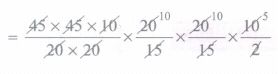
No. of coins required \(=\frac{Volume\ of\ the\ cylinder}{Volume\ of\ 1\ coin}\)
\(=\frac { \pi { r }_{ 1 }^{ 2 }{ h }_{ 1 } }{ \pi { r }_{ 2 }^{ 2 }{ h }_{ 2 } } =\frac { \pi \times \frac { 42 }{ 20 } \times \frac { 45 }{ 20 } \times 10 }{ \pi \times \frac { 15 }{ 20 } \times \frac { 15 }{ 20 } \times \frac { 2 }{ 10 } } \)
= 450
9.
Let the ten's digit of the number be x. It is given that the product of the digits is 12.
Unit's digit \(\frac{12}{x}\)
Number =10x+\(\frac{12}{x}\)
It 36 is added to the number the digits interchange their places.
\(\therefore 10x+\frac { 12 }{ x } +36=10\times \frac { 12 }{ x } +x\)
\(\Rightarrow 10x+\frac { 12 }{ x } +36=\frac { 120 }{ x } +x\)
\(\Rightarrow 9x-\frac { 108 }{ x } +36=0\)
⇒9x2 - 108 + 36x = 0
⇒X2+ 4x - 12 = 0
⇒ (x + 6)(x - 2) = 0 (∵ (x + 6) ≠ 0 as x >0)
x=-6,2
But a number can never be (-ve). So, x = 2. The
number is 10x2+\(\frac{12}{2}\)=26
10.
Let the numbers be ∝, β
Sum of the roots = ∝ + β = 15 ...(1)
\(\frac { 1 }{ \alpha } +\frac { 1 }{ \beta } =\frac { 3 }{ 10 } \quad \quad \quad ...(2)\)
\(\\ \frac { +\alpha }{ \alpha \beta } =\frac { 3 }{ 10 } \)
10(∝+ β)= 3∝β ....(3)
30∝β=10x15=150
Products of the roots =∝β=50 ....(4)
∴ From (1) & (4), we have
x2-15x+50=0
(x-10)(x-5)=0⇒x=10,5
11.
We have
a3 = a + (3 - 1)d = a + 2d = 5 (1)
a7 = a + (7 - 1)d = a + 6d = 9 (2)
(1) - (2) ⇒ -4d -4 ⇒ d = 1.
Sub, d = 1 in (1), we get
a + 2(1) = 5
a = 3
Hence the required A.P. is 3, 4, 5, 6, 7.
12.
-2, 2, -2, 2, -2
t2 - t1 = 2-(-2) = 4
t3 - t2 = -2 -2 = -4
t4 - t3 = 2 - (-2) = 4
It is not an A.P.
13.
R = {(a, -2), (-5, b), (8, c), (d, -1)} represents the identity function.
a = -2, b = -5, c = 8, d = -1.
14.
F(5) = 3x2 - 10
= 3(5)2- 10 = 75 - 10 = 65
15.
Since the given points are collinear, the area a the triangle formed by them must be 0, i.e.,
= \(\frac { 1 }{ 2 } \) [2(k + 3) + 4(-3 - 3) + 6(3 - k)] = 0
= \(\frac { 1 }{ 2 } \) [-4k] = 0
k = 0
Area of ΔABC
= \(\frac { 1 }{ 2 } \)[2(0 + 3) + 4(-3 - 3) + 6(3 - 0)] = 0
16.
Let P and Q be the points of trisection at AB.
i.e., AP = PQ = QB
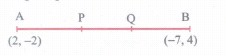
Therefore, P divides AB internally in the ratio 1:2. Therefore, the coordinates at P, by applying the section formula, are
\(\left[ \frac { 1(-7)+2(2) }{ 1+2 } ,\frac { 1(7)+2(-2) }{ 1+2 } \right] \) i.e., (-1,10)
Now, Q also divides AB internally in the ratio 2:1, so, the coordinates at Q are
\(\left[ \frac { 2(-7)+1(2) }{ 2+1 } ,\frac { 2(4)+(-2) }{ 2+1 } \right] \) i.e., (-4,2)
Therefore, the coordinates at the points at trisection of the line segment joining A and B are (-1, 0) and (-4, 2).
17.
52 + 102 + 152 +...+ 1052 = 52(12 + 22 + 32 +...+ 212)
= \(25\times \frac { 25\times \left( 21+1 \right) \left( 2\times 21+1 \right) }{ 6 } \)
= \(\frac { 25\times 21\times 22\times 43 }{ 6 } =82775\)
18.
3 + 33 + 333 + ... to n terms.
Let Sn = 3 + 33 + 333 + ...upto n terms
= 3( 1 + 11 + 111 + ... to n terms)
= \(\frac { 3 }{ 9 } \) (9 + 99 + 999 + ... to n terms)
(multiply and divide by 9)
= \(\frac { 1 }{ 3 } \)3[(10 - 1) + (100 - 1) + (1000 - 1) + to n terms]
= \(\frac { 1 }{ 3 } \) [(10 - 1) + (102 - 1) + (103 - 1) +... + n upto n terms]
= \(\frac { 1 }{ 3 } \) {[10 + 102 + 103 +...upto n terms] - n}
10 + 102 +... is a G.P. with a = 10, r = 10.
\(\therefore S_{n} =\frac{a\left(r^{n}-1\right)}{r-1}
\)
\(S_{n} =\frac{1}{3}\left\{\left[\frac{10\left(10^{n}-1\right)}{10-1}\right]-n\right\}
\)
\(=\frac{1}{3}\left[\frac{10\left(10^{n}-1\right)}{9}-n\right]
\)
\(=\frac{10}{27}\left(10^{n}-1\right)-\frac{n}{3}\)
3 + 33 + 333 + ... to n terms \(=\frac{10}{27}\left(10^{n}-1\right)-\frac{n}{3}\)
19.
Product of face values 6: { (1, 6), (2, 3), (6, 1), (3,2)}
Difference of face value 5: {(1, 6), (6, 1)}
P(product 6) = \(\frac { 4 }{ 6\times 6 } =\frac { 4 }{ 36 } =\frac { 1 }{ 9 } \)
p( difference 5) = \(\frac { 2 }{ 2\times 6 } =\frac { 1 }{ 18 } \)
20.
If the roots are given, the quadratic equation is X2 - (sum of the roots) x + product the roots =0. For the given equation.
x2 - 6x -4 = 0
∝+β = -6
∝β = -4
∝2+β2 = (∝+β)2-2∝β
= (-6)2-2(-4) = 36 + 8 = 44
∝2β2 = (∝β)2 = (-4)2 = 16
∴ The required equation = x2-44x+16 = 0
21.
22.
Let AB be the height of the kite above the ground. Then, AB = 75.
Let AC be the length of the string.
In right triangle ABC,\(\angle \)ACB = \(60°\)
\(sin\theta =\frac { AB }{ AC } \)
\(sin60°=\frac { 75 }{ AC } \)
gives \(\frac { \sqrt { 3 } }{ 2 } =\frac { 75 }{ AC } \) so, AC = \(\frac { 150 }{ \sqrt { 3 } } =50\sqrt { 3 } \)
Hence, the length of the string is 50\(\sqrt { 3 } m\)
23.
Hollow Hemisphere
Internal diameter = 6 cm
Internal radius 'r' = 3 cm
External diameter = 10 cm
External radius 'R' = 5 cm
\(\left.\begin{array}{l} \text { Volume of hemisphere (or) } \\ \text {Volume of material used } \end{array}\right\}=\frac{2}{3} \pi\left(\mathrm{R}^{3}-\mathrm{r}^{3}\right) \text { cu. units }\)
\(=\frac{2}{3} \pi\left(5^{3}-3^{3}\right) \)
\(=\frac{2}{3} \pi(125-27)=\frac{196 \pi}{3} \mathrm{~cm}^{3} \)
Cylinder
Diameter = 14 cm
radius = 7 cm
height = h
Volume of cylinder \(=\pi r^{2} h\ cu. units \)
\(=\pi(7)^{2} h \)
\(=49 \pi h \mathrm{~cm}^{3} \)
Given that hollow hemisphere is melted and cast into a solid cylinder
Volume of cylinder = volume of hollow hemisphere
\(49 \pi h =\frac{196 \pi}{3} \)
\(h =\frac{196}{3 \times 49}=\frac{4}{3}=1.33 \)
Height of the cylinder = 1.33 cm.
24.
Right triangle PQR, right angled at Q and
PR = 20 cm, QR = 16 cm
PQ2 = PR2 - QR2
= (20)2 - (16)2
= 400 - 256 = 144
PQ = 12 cm
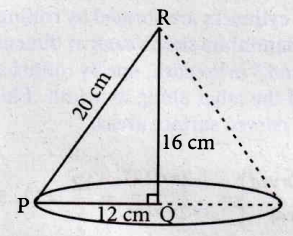
When right triangle PQR, rotates about QR, a right circular cone is formed with PQ = 12 cm as base radius and PR = 20 cm as
slant height.
C.S.A of the Cone = \(\pi r l\) sq. units
\(=\frac{22}{7} \times 12 \times 20=754.29 \mathrm{~cm}^{2}\)
When right triangle PQR, rotates about PQR, a right circular cone is formed with
QR = 16 cm as base radius and PR = 20 cm as slant height
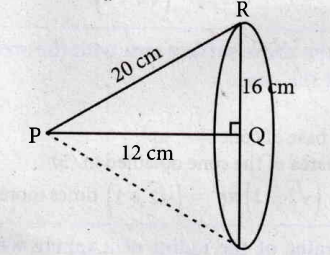
C.S.A of the Cone \(=\pi r l \text { sq.units } \)
\(=\frac{22}{7} \times 16 \times 20 \)
= 1005.71 cm2
Hence, C.S.A of the cone when rotates about PQ is larger.
25.
f: [-5,9] ⟶ R
(i) f(-3) + f(2)
= [6(-3) + 1 ] + [ 5(2)2 - 1]
= ( -18 + 1) + ( 20 - 1)
= -17 + 19 = 2.
(ii) f(7) - f(1)
= [ 3(7) - 4 ] - [6(1) + 1 ]
= (21 - 4) - (6 + 1)
=17 - 7 = 10
(iii) 2 f(4) + f(8)
= 2 [ 5(4)2 - 1] + [3(8) - 4]
= 2[80 - 1] + [ 24 - 4]
= 158 + 20 = 178
(iv) \(\frac { 2f(-2)-f(6) }{ f(4)+f(-2) } \)
f(-2) = 6x + 1 = 6(-2) + 1 = -11
f(6) = 3x - 4 = 3(6) - 4 = 14
f(4) = 5x2 - 1 = 5(42) - 1 = 79
f(-2) = 6x + 1 = 6(-2) + 1 =-11
\(\frac { 2f(-2)-f(6) }{ f(4)+f(-2) } =\frac { 2(-11)-14 }{ 79+(-11) } =\frac { -22-14 }{ 68 } \)
= \(\frac { -36 }{ 68 } =\frac { -9 }{ 17 } \)
26.
\(\frac { sinA }{ secA+tanA-1 } +\frac { cosA }{ cosecA+cotA-1 } =1\)
\(=\frac { sinA(cosecA+cotA-1)+cosA(secA+tanA-1) }{ (secA+tanA-1)(cosecA+cotA-1) } \)
=\(\frac { sin\ A \ cosec \ A \ + \ sin \ A \ cot \ A \ - \ sin \ A\ +cos \ A \ sec \ A \ + cos \ A \ tan \ A \ - \ cos \ A }{ (sec \ A \ + \ tan \ A-1)(cosec \ A \ + \ cot \ A-1) } \)
=\(\frac { 1+cosA-sinA+1+sinA-cosA }{ \left( \frac { 1 }{ cosA } +\frac { sinA }{ cosA } -1 \right) \left( \frac { 1 }{ sinA } +\frac { cosA }{ sinA } -1 \right) } \)
=\(\frac { 2 }{ \left( \frac { 1+sinA-cosA }{ cosA } \right) \left( \frac { 1+cosA-sinA }{ sinA } \right) } \)
=\(\frac { 2sinAcosA }{ (1+sinA-cosA)(1+cosA-sinA) } \)
=\(\frac { 2 \ sin \ A \ cos \ A }{ [1+(sin \ A- \ cos \ A)][1-(sin \ A-cos \ A)] } =\frac { 2sinAcosA }{ 1-(sin \ A- \ cos \ A{ ) }^{ 2 } } \)
=\(\frac { 2sinAcosA }{ 1-(si{ n }^{ 2 }A+co{ s }^{ 2 }A-2sinAcosA) } =\frac { 2sinAcosA }{ 1-(1-2sinAcosA) } \)
=\(\frac { 2sinAcosA }{ 1-1+2sinAcosA } =\frac { 2sinAcosA }{ 2sinAcosA } =1.\)
27.
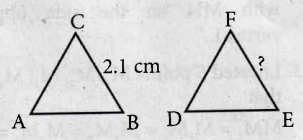
Given ABC - DEF
then we have
\(\frac{\operatorname{Area}(\Delta \mathrm{ABC})}{\text { Area }(\Delta \mathrm{DEF})}=\frac{A B^{2}}{D E^{2}}=\frac{B C^{2}}{E F^{2}}=\frac{A C^{2}}{D F^{2}} \)
\(\frac{9}{16}=\frac{B C^{2}}{E F^{2}} \)
\(\frac{9}{16} =\frac{2.1 \times 2.1}{E F^{2}} \)
\(\mathrm{EF}^{2} =\left(\frac{2.1 \times 4}{3}\right)^{2} \)
\(\mathrm{EF} =\frac{2.1 \times 4}{3}=2.8 \)
EF = 2.8 cm
28.
Vertices of one triangular tile are at (-3, 2), (-1, -1) and (1, 2)
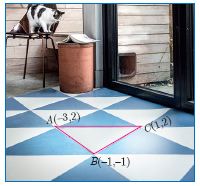
(-3, 2), (-1, -1) and (1, 2)
Area of this tile = \(\frac12\) {(3 - 2 + 2) - (- 2 - 1 - 6)} sq. units
= \(\frac12\) (12) = 6 sq. units
Since the floor is covered by 110 triangle shaped identical tiles,
Area of floor = 110 x 6 = 660 sq. units
29.
Since the three points P(-1, -4), Q(b, c) and R(5, -1) are collinear,
Area of triangle PQR = 0
\(\frac{1}{2}\) { (x1y2 + x2y3 + x3y1) - (x2y1 + x3y2 + x1y3) } = 0
\(\frac{1}{2}\) { (- c - b - 20) - (- 4b + 5c + 1) } = 0
- c - b - 20 + 4b - 5c - 1 = 0
b - 2c = 7 ...(1)
Also, 2b + c = 4 .....(2) (from given information)
Solving (1) and (2) we get b = 3, c = -2
30.
kx2 - (8k + 4) + 81 = 0
Since the equation has real and equal roots, Δ = 0
That is, b2 - 4ac = 0
Here, a = k, b = -(8k + 4), c = 81
That is, [-(8k + 4)]2 - 4(k)(81) = 0
64k2 + 64k + 16 - 324k = 0
64k2 - 260k + 16 = 0
dividing by 4 we get 16k2 - 65k + 4 = 0
(16k - 1)(k - 4) = 0 then, k = \(\frac {1}{16}\) or k = 4
31.
We know that the tangents drawn from are external point to a circle are equal.
Therefore AD AF = x
BD = BE = y
and CE = CF = z
Now, AB = 12 cm, BC = 8 cm, and CA = 10 cm.
x + y = 12,y + z = 8 and z + x = 10
(x + y) + (y + z) + (z + x) = 12 + 8 + 10
2(x + y + z) = 30
x+ y + z = 15
Now, x + y = 12 and x + y + z = 15
12 + z = 15
Z = 3
y + z = 8 and x + y + z = 15
\(x+8=15\Rightarrow x=7\)
and z + x = 10 and x + y + z = 15
\(10+y=15\Rightarrow y=5\)
Hence, AD = x = 7cm,
BE = y = 5 cm and
CF = z = 3 cm
32.
The function f : N ⟶ N is defined by f(x) = 3x + 2
(i) If x = 1, f(1) = 3(1) + 2 = 5
If x = 2, f(2) = 3(2) + 2 = 8
If x = 3, f(3) = 3(3) + 2 = 11
The images of 1, 2, 3 are 5, 8, 11 respectively.
(ii) If x is the pre-image of 29, then f(x) = 29, Hence 3x + 2 = 29
3x = 27 ⇒ x = 9
Similarly, if x is the pre-image of 53, then f(x) = 53. Hence 3x + 2 = 53
3x = 51 ⇒ x = 17
Thus the pre-images of 29 and 53 are 9 and 17 respectively.
(iii) Since different elements of N have different images in the co-domain, the function f is a one-one function.
The co-domain of f is N.
But the range of f = {5, 8, 11, 14, 17,....} is a proper subset of N.
Therefore f is not an onto function. That is, f is an into function.
Thus f is a one-one and into function.

10th Standard Syllabus & Materials
10th Standard
TN 10th English Prose - 2 - The Night the Ghost Got in Important Questions And Answers Study Material - QB365 Set A
NEW10th Standard
TN 10th English Supplementary - 1 - The Tempest Important Questions And Answers Study Material - QB365 Set A
NEW10th Standard
TN 10th English Poem - 1 - Life Important Questions And Answers Study Material - QB365 Set A
NEW10th Standard
TN 10th English Prose - 1 - His First Flight Important Questions And Answers Study Material - QB365 Set A



Tamilnadu Stateboard 10th Standard Subjects
Tamilnadu Stateboard Standards





