
 100% FREE ACCESS
10th Standard Syllabus & Materials
10th Standard
TN 10th English Prose - 4 - The Attic Important Questions And Answers Study Material - QB365 Set A
NEW10th Standard
TN 10th English Supplementary - 3 - The Story of Mulan Important Questions And Answers Study Material - QB365 Set A
NEW10th Standard
TN 10th English Poem - 3 - I am Every Woman Important Questions And Answers Study Material - QB365 Set A
NEW10th Standard
TN 10th English Prose - 3 - Empowered Women Navigating The World Important Questions And Answers Study Material - QB365 Set A
NEW10th Standard
TN 10th English Supplementary - 2 - Zigzag Important Questions And Answers Study Material - QB365 Set A
NEW10th Standard
TN 10th English Poem - 2 - The Grumble Family Important Questions And Answers Study Material - QB365 Set A

Published on: 06/02/2020
10th Standard Mathematics Important Question All Chapter-I- 2020
Download Tamil Nadu 10th Standard Maths question papers, model tests, one-mark questions, important questions, and public exam papers in PDF format. Free study materials and answer keys for TN State Board students.
Questions + Answers key
Take MCQ Maths Test1.
The angle of depression of a boat from a \(50\sqrt { 3 } \) m high bridge is 30o. The horizontal distance of the boat from the bridge is ___________
150 m
\(150\sqrt { 3 } \)
60m
\(60\sqrt { 3 } \)
2.
If x = a sec θ and = b tan θ, then b2x2 - a2y2 is equal to ___________
ab
a2-b2
a2+b2
a2b2
3.
When three coins are tossed, the probability of getting the same face on all the three coins is ___________
\(\frac { 1 }{ 8 } \)
\(\frac { 1 }{ 4 } \)
\(\frac { 3 }{ 8 } \)
\(\frac { 1 }{ 3 } \)
4.
5.
If the data is multiplied by 4, then the corresponding variances is get multiplied by ___________
4
16
2
None
6.
A purse contains 10 notes of Rs. 2000, 15 notes of Rs. 500, and 25 notes of Rs. 200.One note is drawn at random. What is the probability that the note is either a Rs. 500, note or Rs. 200 note?
\(\frac { 1 }{ 5 } \)
\(\frac { 3 }{ 10 } \)
\(\frac { 2 }{ 3 } \)
\(\frac { 4 }{ 5 } \)
7.
A spherical steel ball is melted to make 8 new identical balls. Then the radius each new ball is how much times the radius of the original ball?
\(\frac { 1 }{ 3 } \)
\(\frac { 1 }{ 4 } \)
\(\frac { 1 }{ 2 } \)
\(\frac { 1 }{ 8 } \)
8.
The curved surface area of a cylinder is 264 cm2 and its volume is 924 cm2. The ratio of diameter to its height is ___________
3:7
7:3
6:7
7:6
9.
The lines y = 5x - 3, y = 2x + 9 intersect at A. The coordinates of A are ___________
(2, 7)
(2, 3)
(4, 17)
(-4, 23)
10.
If the points (0, 0), (a, 0) and (0, b) are collinear, then ____________
a = b
a + b
ab = 0
a ≠ b
11.
Two concentric circles if radii a and b where a>b are given. The length of the chord of the circle which touches the smaller circle is ____________
\(\sqrt { { a }^{ 2 }-{ b }^{ 2 } } \)
\(\sqrt { { a }^{ 2 }-{ b }^{ 2 } } \)
\(\sqrt { { a }^{ 2 }+{ b }^{ 2 } } \)
\(2\sqrt { { a }^{ 2 }+{ b }^{ 2 } } \)
12.
The perimeter of a right triangle is 36 cm. Its hypotenuse is 15 cm, then the area of the triangle is ____________
108 cm2
54 cm2
27 cm2
216 cm2
13.
The height of an equilateral triangle of side a is
\(\frac { a }{ 2 } cm\)
\(\sqrt { 3a } \)
\(\frac { \sqrt { 3 } }{ 2 } a\)
\(\frac { \sqrt { 3 } }{ 4 } a\)
14.
15.
Choose the correct answer
(i) Every scalar matrix is an identity matrix
(ii) Every identity matrix is a scalar matrix
(iii) Every diagonal matrix is an identity matrix
(iv) Every null matrix is a scalar matrix
(i) and (iii) only
(iii) only
(iv) only
(ii) and (iv) only
16.
\(\frac { { x }^{ 2 }+7x12 }{ { x }^{ 2 }+8x+15 } \times \frac { { x }^{ 2 }+5x }{ { x }^{ 2 }+6x+8 } =\_ \_ \_ \_ \_ \_ \_ \_ \_ \)
x+2
\(\frac { x }{ x+2 } \)
\(\frac { 35{ x }^{ 2 }+60x }{ { 48x }^{ 2 }+120 } \)
\(\frac { 1 }{ x+2 } \)
17.
The sum of first n terms of the series a, 3a, 5a...is ____________
na
(2n - 1)a
n2 - a
n2a2
18.
44 ≡ 8 (mod12), 113 ≡ 85 (mod 12), thus 44 x 113 ≡______(mod 12):
4
3
2
1
19.
If f(x) = ax - 2, g(x) = 2x - 1 and fog = gof, the value of a is ___________
3
-3
\(\frac { 1 }{ 3 } \)
13
20.
If the order pairs (a, -1) and (5, b) belongs to {(x, y) | y = 2x + 3}, then a and b are __________
-13, 2
2, 13
2, -13
-2,13
21.
\((x-\frac { 1 }{ x } )={ x }^{ 2 }+\frac { 1 }{ { x }^{ 2 } } \) then f(x) =
x2 + 2
\({ x }^{ 2 }+\frac { 1 }{ { x }^{ 2 } } \)
x2- 2
\({ x }^{ 2 }-\frac { 1 }{ { x }^{ 2 } } \)
22.
If f : R⟶R is defined by (x) = x2 + 2, then the preimage 27 are _________
0.5
5, -5
5, 0
\(\sqrt { 5 } ,-\sqrt { 5 } \)
23.
If S1 denotes the total surface area at a sphere of radius ૪ and S2 denotes the total surface area of a cylinder of base radius ૪ and height 2r, then ___________
S1 = S2
S1 > S2
S1
S1 = 2S2
24.
25.
The mean of 100 observations is 40 and their standard deviation is 3. The sum of squares of all observations is
40000
160900
160000
30000
26.
The range of the data 8, 8, 8, 8, 8. . . 8 is
0
1
8
3
27.
The angle of depression of the top and bottom of 20 m tall building from the top of a multistoried building are 30° and 60° respectively. The height of the multistoried building and the distance between two buildings (in metres) is
20, 10\(\sqrt { 3 } \)
30, 5\(\sqrt { 3 } \)
20, 10
30, 10\(\sqrt { 3 } \)
28.
The value of \(si{ n }^{ 2 }\theta +\frac { 1 }{ 1+ta{ n }^{ 2 }\theta } \) is equal to
\(ta{ n }^{ 2 }\theta \)
1
\(cot^{ 2 }\theta \)
0
29.
Given F1 = 1, F2 = 3 and Fn = Fn-1 + Fn-2 then F5 is
3
5
8
11
30.
The sum of the exponents of the prime factors in the prime factorization of 1729 is
1
2
3
4
31.
The straight line given by the equation x = 11 is
parallel to X axis
parallel to Y axis
passing through the origin
passing through the point (0,11)
32.
A man walks near a wall, such that the distance between him and the wall is 10 units. Consider the wall to be the Y axis. The path travelled by the man is
x = 10
y = 10
x = 0
y = 0
33.
In figure CP and CQ are tangents to a circle with centre at O. ARB is another tangent touching the circle at R. If CP = 11 cm and BC = 7 cm, then the length of BR is
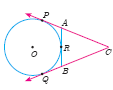
6 cm
5 cm
8 cm
4 cm
34.
In ∆LMN, \(\angle\)L = 60o, \(\angle\)M = 50o. If ∆LMN ~ ∆PQR then the value of \(\angle\)R is
40o
70°
30°
110°
35.
A solid sphere of radius x cm is melted and cast into a shape of a solid cone of same radius. The height of the cone is
3x cm
x cm
4x cm
2x cm
36.
In a hollow cylinder, the sum of the external and internal radii is 14 cm and the width is 4 cm. If its height is 20 cm, the volume of the material in it is
5600\(\pi\) cm3
1120\(\pi\) cm3
56\(\pi\) cm3
3600\(\pi\) cm3
37.
Let f(x) = \(\sqrt { 1+x^{ 2 } } \) then
f(xy) = f(x).f(y)
f(xy) ≥ f(x).f(y)
f(xy) ≤ f(x).f(y)
None of these
38.
Let n(A) = m and n(B) = n then the total number of non-empty relations that can be defined from A to B is
mn
nm
2mn-1
2mn
39.
If number of columns and rows are not equal in a matrix then it is said to be a
diagonal matrix
rectangular matrix
square matrix
identity matrix
40.
41.
Let A = {0, 1, 2, 3} and B = {1, 3, 5, 7, 9} be two sets. Let f : A \(\rightarrow\)B be a function given by f(x) = 2x + 1. Represent this function as an arrow .
42.
Let A = {0, 1, 2, 3} and B = {1, 3, 5, 7, 9} be two sets. Let f: A \(\rightarrow\)B be a function given by f(x) = 2x + 1. Represent this function as a set of ordered pairs.
43.
Let A = {1,2, 3, 4} and B = {-1, 2, 3, 4, 5, 6, 7, 8, 9, 10, 11, 12} Let R = {(1, 3), (2, 6), (3, 10), (4, 9)} \(\subseteq \) A x B be a relation. Show that R is a function and find its domain, co-domain and the range of R.
44.
prove the following identity tan4\(\theta \) + tan2\(\theta \) = sec4\(\theta \) - sec2\(\theta \) .
45.
Find the range and coefficient of range of the following data.
43.5, 13.6, 18.9, 38.4, 61.4, 29.8
46.
Find the equation of a straight line passing through the mid-point of a line segment joining the points (1, -5), (4, 2) and parallel to: Y axis
47.
Find the next three terms of the following sequence.
\(\frac { 1 }{ 4 } ,\frac { 2 }{ 9 } ,\frac { 3 }{ 16 } \)......
48.
Find the next three terms of the sequences.
5, 2, -1, -4,...,
49.
Reduce the rational expressions to its lowest form
\(\frac { { x }^{ 2 }-16 }{ { x }^{ 2 }+8x+16 } \)
50.
Using the functions f and g given below, find f o g and g o f. Check whether f o g = g o f
f(x) = \(\frac{2}{x}\), g(x) = 2x2- 1
51.
If P(A) = 0.37, P(B).= 0.42, P(A∩B) = 0.09 then find P(AUB).
52.
Find the values of ‘k’, for which the quadratic equation kx2 - (8k + 4)x + 81 = 0 has real and equal roots?
53.
Two circles with centres O and O' of radii 3 cm and 4 cm, respectively intersect at two points P and Q, such that OP and O'P are tangents to the two circles. Find the length of the common chord PQ.
54.
Find the volume of a cylinder whose height is 2 m and whose base area is 250 m2.
55.
Let f = {(-1, 3), (0, -1), (2, -9)}. be a linear function from Z into Z. Find f(x).
56.
57.
What is the slope of a line perpendicular to the line joining A(5, 1) and P where P is the mid-point of the segment joining (4, 2) and (-6, 4).
58.
Find the LCM of the given expressions.
4x2y, 8x3y2
59.
Vertices of given triangles are taken in order and their areas are provided aside. In each case, find the value of ‘p’?
| S. No | Vertices | Area (sq. units) |
| (i) | (0, 0), (p, 8), (6, 2) | 20 |
| (ii) | (p, p), (5, 6), (5, -2) | 32 |
60.
If \(\triangle\)ABC is similar to \(\triangle\)DEF such that BC = 3 cm, EF = 4 cm and area of \(\triangle\)ABC = 54 cm2. Find the area of \(\triangle\)DEF.
61.
prove that sec\(\theta \) - cos\(\theta \) = tan \(\theta \) sin\(\theta \)
62.
The shadow of a tower, when the angle of elevation of the sum is 45o is found to be 10 metres, longer than when it is 60o. find the height of the tower
63.
From a point on a bridge across a river, the angles of depression of the banks on opposite sides at the river are 30° and 45°, respectively. If the bridge is at a height at 3 m from the banks, find the width at the river.
64.
A spherical ball of iron has been melted and made into small balls. If the radius of each smaller ball is one-fourth of the radius of the original one, how many such balls can be made?
65.
Final the probability of choosing a spade or a heart card from a deck of cards.
66.
A two digit number is such that the product of its digits is 18, when 63 is subtracted from the number, the digits interchange their places. Find the number.
67.
Seven years ago, Varun's age was five times the square of Swati's age. Three years hence Swati's age will be two fifth of Varun's age. Find their present ages.
68.
How many terms of the AP: 24, 21, 18, ... must be taken so that their sum is 78?
69.
If the sum of the first 14 terms of an AP is 1050 and its first term is 10, find the 20th term.
70.
Find the area of the quadrilateral whose vertices, taken in order, are (-4, -2), (-3, -5), (3, -2) and (2, 3).
71.
A function f: [-7,6) \(\rightarrow\) R is defined as follows.
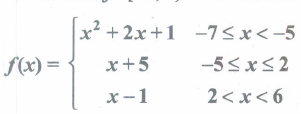
\(\cfrac { 4f(-3)+2f(4) }{ f(-6)-3f(1) } \)
72.
Let f = {(2, 7); (3, 4), (7, 9), (-1, 6), (0, 2), (5,3)} be a function from A = {-1,0, 2, 3, 5, 7} to B = {2, 3, 4, 6, 7, 9}. Is this
(i) an one-one function
(ii) an onto function,
(iii) both one and onto function?
73.
Find the equation of a straight line Passing through (-8, 4) and making equal intercepts on the coordinate axes
74.
The King, Queen and Jack of the suit spade are removed from a deck of 52 cards. One card is selected from the remaining cards. Find the probability of getting
(i) a diamond
(ii) a queen
(iii) a spade
(iv) a heart card bearing the number 5.
75.
Two dice are rolled. Find the probability that the sum of outcomes is (i) equal to 4 (ii) greater than 10 (iii) less than 13.
76.
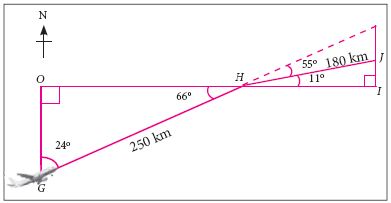
An Aeroplane sets of from G on bearing of 24° towards H, a point 250 km away, at H it changes course and heads towards J deviates further by 55° and a distance of 180 km away.
How far is H to the north of G?,
\(\left( \begin{matrix} sin24°=0.4067\quad sin11°=0.1908 \\ cos24°=0.9135\quad cos11°=0.9816 \end{matrix} \right) \)
.JPG)
77.
In the given figure AB || CD || EF. If AB = 6cm, CD = x cm, EF = 4 cm, BD = 5 cm and DE = y can. Final x and y
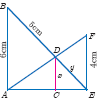
78.
The volume of a cone is 1005\(\frac{5}{7}\)cu. cm. The area of its base is 201\(\frac{1}{7}\)sq. cm. Find the slant height of the cone.
79.
Find the standard deviation of the following data 7, 4, 8, 10, 11. Add 3 to all the values then find the standard deviation for the new values.
80.
Two ships are sailing in the sea on either sides of a lighthouse as observed from the ships are \(30°\) and \(45°\) respectively. if the lighthouse is 200 m high, find the distance between the two ships. \(\left( \sqrt { 3 } =1.732 \right) \)
81.
If f(x) = \(\frac { x-1 }{ x+1 } \), x ≠ 1 show that f(f(x)) = -\(\frac{1}{x}\), provided x ≠ 0.
82.
Find the square root of the following expressions
16x2 + 9y2 - 24xy + 24x - 18y + 9
83.
The volume of a cylindrical water tank is 1.078 x 10⁶ litres. If the diameter of the tank is 7m, find its height.
84.
PQRS is a rhombus. Its diagonals PR and QS intersect at the point M and satisfy QS = 2PR. If the coordinates of S and M are (1, 1) and (2, - 1) respectively, find the coordinates of P.
85.
The frustum shaped outer portion of the table lamp has to be painted including the top part. Find the total cost of painting the lamp if the cost of painting 1 sq.cm is Rs. 2.
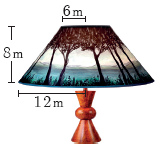
86.
if cosec\(\theta \) + cot\(\theta \) = p, then prove that cos\(\theta \) = \(\frac { { p }^{ 2 }-1 }{ { p }^{ 2 }+1 } \)
87.
The sum of the digits of a three-digit number is 11. If the digits are reversed, the new number is 46 more than five times the former number. If the hundreds digit plus twice the tens digit is equal to the units digit, then find the original three-digit number?
88.
Two vertical poles of heights 6 m and 3 m are erected above a horizontal ground AC. Find the value of y.

89.
Construct a △PQR which the base PQ = 4.5 cm, ∠R = 35oand the median RG from R to PG is 6 cm
90.
Construct a triangle similar to a given triangle LMN with its sides equal to \(\frac { 4 }{ 5 } \) of the corresponding sides of the triangle LMN (scale factor \(\frac { 4 }{ 5 }<1\)).
1.
(a)
150 m
2.
(d)
a2b2
3.
(b)
\(\frac { 1 }{ 4 } \)
4.
(a)
5.
(b)
16
6.
(d)
\(\frac { 4 }{ 5 } \)
7.
(c)
\(\frac { 1 }{ 2 } \)
8.
(b)
7:3
9.
(c)
(4, 17)
10.
(c)
ab = 0
11.
(b)
\(\sqrt { { a }^{ 2 }-{ b }^{ 2 } } \)
12.
(b)
54 cm2
13.
(c)
\(\frac { \sqrt { 3 } }{ 2 } a\)
14.
(c)
15.
(d)
(ii) and (iv) only
16.
(b)
\(\frac { x }{ x+2 } \)
17.
(c)
n2 - a
18.
(a)
4
19.
(a)
3
20.
(d)
-2,13
21.
(a)
x2 + 2
22.
(b)
5, -5
23.
(a)
S1 = S2
24.
(b)
25.
(b)
160900
26.
(a)
0
27.
(d)
30, 10\(\sqrt { 3 } \)
28.
(b)
1
29.
(d)
11
30.
(c)
3
31.
(b)
parallel to Y axis
32.
(a)
x = 10
33.
(d)
4 cm
34.
(b)
70°
35.
(c)
4x cm
36.
(b)
1120\(\pi\) cm3
37.
(c)
f(xy) ≤ f(x).f(y)
38.
(c)
2mn-1
39.
(b)
rectangular matrix
40.
(b)
41.
An arrow diagram
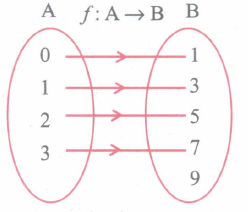
42.
A = {1,2,3},B = {1,3,5, 7,9}
f(x) = 2x + 1
f(0)) = 2(0) + 1 = 1
f(1) = 2(1) + 1=3
f(2) = 2(2) + 1 = 5
f(3) = 2(3) + 1 = 7
(i) A set of ordered pairs.
f = {(0, 1), (1, 3), (2, 5), (3, 7)}
(ii) A table
| x | 0 | 1 | 2 | 3 |
| f(x) | 1 | 3 | 5 | 7 |
(ii) An arrow diagram
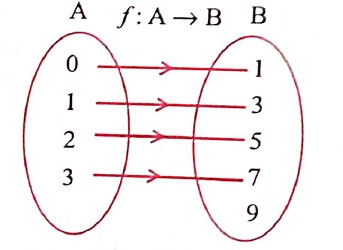
(iv) A Graph f = \(\{(x, f(x) / x \in A\}\)
= {(0, 1), (1, 3), (2, 5), (3, 7)}
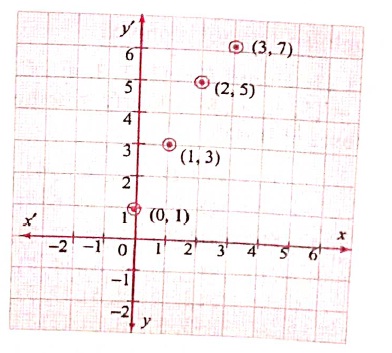
43.
Domain of R = {1,2,3,4}
Co-domain of R = B = {-1, 2, 3,4,5,6, 7, 9, 10, 11,12}
Range of R = {3, 6,10, 9}
44.
tan4\(\theta \) + tan2\(\theta \) = sec4\(\theta \) - sec2\(\theta \)
L.H.S = tan2θ (tan2θ + 1)
= tan2θ.sec2θ
= sec4θ - sec2θ
= R.H.S
45.
43.5, 13.6, 18.9,38.4,61.4,29.8
Largest value L= 61.4
Smallest value S = 13.6
R = L - S
= 61.4 - 13.6 = 4
Co-efficient of range = \(\frac { L-S }{ L+S } \)
= \(\frac { 47.8 }{ 75 } =0.64\)
Range = 47.8; co-efficient of range = 0.64.
46.
Given points (1, - 5) and (4, 2)
Mid-point of the line joining the points (1, - 5), (4, 2)
\(=\left(\frac{x_{1}+x_{2}}{2}, \frac{y_{1}+y_{2}}{2}\right)=\left(\frac{1+4}{2}, \frac{-5+2}{2}\right)
\)
\(=\left(\frac{5}{2},-\frac{3}{2}\right)
\)
Equation of a straight line passing through
\(\left(\frac{5}{2},-\frac{3}{2}\right)
\) and parallel to Y-axis is x = a
\(\text { i.e., } x=\frac{5}{2} \Rightarrow 2 x-5=0\)
47.
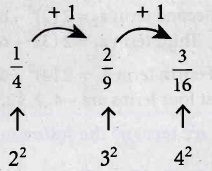
This sequence is generated by an \(=\frac{n}{(n+1)^{2}}\)
The numerator is increased by 1 in successive terms.
The denominators are 22, 32, 42,..........
\(\therefore a_{4}=\frac{4}{5^{2}}=\frac{4}{25}
\)
\(a_{5}=\frac{5}{6^{2}}=\frac{5}{36}
\)
\(a_{6}=\frac{6}{7^{2}}=\frac{6}{49}
\)
The next three terms are \(\frac{4}{25}, \frac{5}{36}, \frac{6}{49}\)
48.
.JPG)
Here each term is decreased by 3. So the next three terms are -7, -10, -13.
49.
\(\frac { { x }^{ 2 }-16 }{ { x }^{ 2 }+8x+16 } =\frac { \left( x+4 \right) \left( x-4 \right) }{ { \left( x+4 \right) }^{ 2 } } =\frac { x-4 }{ x+4 } \)
50.
f(x) = \(\frac{2}{x}\), g(x) = 2x2 - 1
fog(x) = f(g)x)) = f(2x2 - 1) = \(\frac { 2 }{ 2x^{ 2 }-1 } \) ..(1)
gof(x) = g(f(x)) = \(g\left( \frac { 2 }{ x } \right) =2\left( \frac { 2 }{ x } \right) ^{ 2 }\) -1
= 2\(\left( \frac { 4 }{ { x }^{ 2 } } \right) -1=\frac { 8 -x^2}{ { x }^{ 2 } } \)
fog ≠ gof
51.
P(A) = 0.37, P(B) = 0.42, P(A∩B) = 0.09
P(AUB) = P(A) + P(B) - P(A∩B)
P(AUB) = 0.37 + 0.42 - 0.09 = 0.7
52.
kx2 - (8k + 4) + 81 = 0
Since the equation has real and equal roots, Δ = 0
That is, b2 - 4ac = 0
Here, a = k, b = -(8k + 4), c = 81
That is, [-(8k + 4)]2 - 4(k)(81) = 0
64k2 + 64k + 16 - 324k = 0
64k2 - 260k + 16 = 0
dividing by 4 we get 16k2 - 65k + 4 = 0
(16k - 1)(k - 4) = 0 then, k = \(\frac {1}{16}\) or k = 4
53.
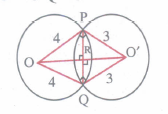
Since the tangents at a point to a circle is
perpendicular to the radius through the point of contact
\(\therefore \angle O P O^{\prime}=90^{\circ}\)
OP2 + OP2 = (OO')2
[By Pythagoras theorem]
32 + 42 = (OO')2
9+16 = (OO')2
25 = (OO')2
OO' = 5cm
Since the line joining the centres of two intersecting circles is perpendicular bisector of their common chord.
\(\mathrm{OR} \perp \mathrm{PQ} \text { and } O^{\prime} \mathrm{R} \perp \mathrm{PQ}\)
AIso PR = QR
Let OR = x, then O'R = 5 - x
AIso at PR = QR = y cm
\(\text { In } \triangle O R P \text { and } \Delta O^{\prime} R P\)
Applying Pythagoras theorem
OP2 = OR3 + RP2 and O'P'2 = O'R2 + RP2
\(3^{2}=x^{2}+y^{2} and 4^{2}=(5-x)^{2}+y_{i}^{2} \)
\(Subtracting \Rightarrow 4^{2}-3^{2}=\left\{(5-x)^{2}+y^{2}\right\}-\left(x^{2}+y^{2}\right) \)
\(16-9=25-10 x+x^{2}+y^{2}-x^{2}-y^{2} \)
7 - 25 = 10x
10x = 25 - 7
10x = 18
x = 1.8 cm
32 = x2 + y2
\(y=\sqrt{9-(1.8)^{2}}=\sqrt{5.76}\)
y = 2.4cm
Hence PR = QR = 2.4 cm
PQ = 2y = 4.8 cm
54.
Let r and h be the radius and height of the cylinder respectively.
Given that, height h = 2 m, base area = 250 m2
Now, volume of a cylinder = \(\pi\)r h 2 cu. units
= base area x h
= 250 x 2 = 500 m3
Therefore, volume of the cylinder = 500 m3
55.
f = {(-1, 3), (0, -1), 2, -9)
Since 'f' is a linear function
f(x) = (ax) + b
in (0 , -1) , when x = 0 , f(0) = -1
a(0) + b = -1 , b = -1
in (-1 , 3) , when x = -1 , f(-1) = 3
a( -1) + b = 3 ,a - 1 = 3
-a = 4, a = -4
f(x) = - 4x - 1
56.
57.
Mid point of line segment joining (4, 2) and (-6, 4)
\(\text { Mid point } =\left(\frac{x_{1}+x_{2}}{2}, \frac{y_{1}+y_{2}}{2}\right) \)
\(=P\left(\frac{4-6}{2}, \frac{2+4}{2}\right)
\)
\(=P\left(-\frac{2}{2}, \frac{6}{2}\right)=\mathrm{P}(-1,3)
\)
Now, slope of a line joining A (5, 1) and P (- 1, 3)
\(\mathrm{m}=\frac{y_{1}-y_{2}}{x_{1}-x}=\frac{1-3}{5+1}=\frac{-2}{6}=-\frac{1}{3}\)
Slope of a perpendicular to the line joining A and P
\(=-\frac{1}{m}=-\frac{1}{\left(-\frac{1}{3}\right)}=3\)
58.
4x2y, 8x3y2
LCM of (4, 8) = 8
LCM of (x2y, x3y2) = x3y2
LCM of (4x2y, 8x3y2) = 8x3y2
59.
(i) Given vertices are (0, 0), (P, 8) and (6,2)
Area of triangle = 20 sq. units.
Area of triangle = \(\frac{1}{2}\left[x_{1}\left(y_{2}-y_{3}\right)+\right. \left.x_{2}\left(y_{3}-y_{1}\right)+x_{3}\left(y_{1}-y_{2}\right)\right] \)
\(\frac{1}{2}\) [(8 - 2) + p (2 - 0) + 6 (0 - 8)] = 20
2p - 48 = 40
2P = 40 + 48
2P = 88
\(p=\frac{88}{2}=44\)
(ii) Given vertices are (p, p), (5,6) and (5, - 2)
Area of triangle = 32 sq. units
Area of triangle = \(\frac{1}{2}\left[x_{1}\left(y_{2}-y_{3}\right)+\right. \left.x_{2}\left(y_{3}-y_{1}\right)+x_{3}\left(y_{1}-y_{2}\right)\right] \)
\(\frac{1}{2}\) [p( 6 + 2) + 5(- 2 -p) + 5(P - 6) = 32
8p -10 - 5P + 5P - 30 = 64
8p - 40 = 64
8P = 64 + 40 = 104
\(p=\frac{104}{8}=13\)
60.
Since the ratio of area of two similar triangles is equal to the ratio of the squares of any two corresponding sides, we have
\(\frac { Area(\Delta ABC) }{ Area(\Delta DEF) } =\frac { { BC }^{ 2 } }{ { EF }^{ 2 } } \) gives \(\frac { 54 }{ Area(\Delta DEF) } =\frac { { 3 }^{ 2 } }{ { 4 }^{ 2 } } \)
\(Area(\Delta DEF)=\frac { 16\times 54 }{ 9 } =96{ cm }^{ 2 }\)
61.
sec\(\theta \) - cos\(\theta \) = \(\frac { 1 }{ cos\theta } -cos\theta =\frac { 1-co{ s }^{ 2 }\theta }{ cos\theta } \)
= \(\frac { si{ n }^{ 2 }\theta }{ cos\theta } \) [since 1 - cos2\(\theta \) = sin2\(\theta \)]
= \(\frac { sin\theta }{ cos\theta } \times sin\theta =tan\theta sin\theta \)
62.
63.
A and B represent points on the bank on opposite sides at the river, so that AB is the width of the river. P is a point on the bridge at a height of 3m i.e., DP = 3 m. We are interested to determine the width at the river which is the length at the side AB of the ΔAPB.
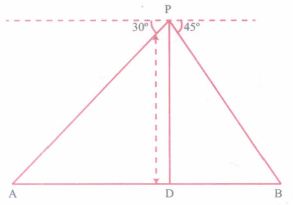
Now, AB = AD + DB
In right ΔAPD,
ㄥA = 30o
So, tan 30° = \(\frac { 1 }{ \sqrt { 3 } } =\frac { 3 }{ AD } \)
i.e., \(\frac { 1 }{ \sqrt { 3 } } =\frac { 3 }{ AD } \) (or) AD = 3\(\sqrt { 3 } \)
Also, in right ΔPBD,
B = 45o
So, BD = PD = 3m
Now, AB = BD + AD
= 3 + 3\(\sqrt { 3 } \) = 3(1+\(\sqrt { 3 } \))m
Therefore, the width at the river is 3(+\(\sqrt { 3 } \))m
64.
No. of balls required \(=\frac { \frac { 4 }{ 3 } \pi { r }^{ 3 } }{ \frac { 4 }{ 3 } \pi \times { \left( \frac { r }{ 4 } \right) }^{ 3 } } \)
\(={ r }^{ 3 }\times \frac { 4 }{ r } \times \frac { 4 }{ r } \times \frac { 4 }{ r } =64\)
65.
Total number of cards = 52
Event of selecting a spade card = A
Event of selecting a heart card = B
n(A) = 13, n(B) = 13
P(A) =\(\frac { 13 }{ 52 } =\frac { 1 }{ 4 } \), P(B) =\(\frac { 13 }{ 52 } =\frac { 1 }{ 4 } \).
A ⋂ B refers to a card is both spade and heart. It is not possible

A, B are exclusive events.
P(A,B) = P(A) + P(B) =\(\frac { 1 }{ 4 } +\frac { 1 }{ 4 } =\frac { 1 }{ 2 } \).
66.
Let the tens digits be x. Then the uints digits=\(\frac{18}{x}\)
∴ Number =10x+\(\frac{18}{x}\)
and number obtained by interchanging the digits =10x+\(\frac{18}{x}\)
\(\\ \therefore \left( 10x+\frac { 18 }{ x } \right) -\left( 10\times \frac { 18 }{ x } +x \right) =63\)
\(\Rightarrow 10x+\frac { 18 }{ x } -\frac { 180 }{ x } -x=0\)
\(\Rightarrow 9x-\frac { 162 }{ x } -63=0\)
⇒ 9x2-63x-162=0
⇒ x2-7x-18=0
⇒ (x-9)(x+2)=0⇒ x=9,-2
But a digit can never be (-ve), so x = 9.
So, the required number \(=10\times 9+\frac { 18 }{ 9 } =92\)
67.
Seven years ago, let Swathi's age be x years .
Seven years ago, let Varun's age was 5x2 years.
Swathi's present age = x + 7 years
Varun's present age = (5x2 + 7) years
3 years hence, we have
Swathi's age = x + 7 + 3 years
=x + 10 years
Varun's age = 5x2 + 7 + 3 years
= 5x2 + 10 years
It is given that 3 years hence Swathi's age will
be \(\frac{2}{5}\) of Varun's age.
∴ x+10=\(\frac{2}{5}\)(5x2+10)
⇒ x+10=2x2+4
⇒ 2x2-x-6=0
⇒ 2x(x-2)+3(x-2)=0
⇒(2x+3)(x-2)=0
⇒ x-2=0
⇒ x=2(∵2x+3≠0 as x>0)
Hence Swathi's present age = (2 + 7) years
= 9 years
Varun's present age = (5 x 22 + 7) years
= 27 years
68.
Here a = 24, d = 21-24 = -3, Sn = 78. We need to find n.
We know that,
Sn= \(\frac{n}{2}\) (2a + (n - 1)d)
78 = \(\frac{n}{2}\) 48 + (n -1)(-3))
78 = \(\frac{n}{2}\) 2(51-3n)
or 3n2 - 51n + 156 = 0
n2 -17n + 52 = 0
(n - 4)(n - 13) = 0
n = 4 or 13
The number of terms are 4 or 13.
69.
Here S14 = 1050
n = 14
a = 10
Sn = \(\frac{n}{2}\) 2(2a + (n -1)d)
1050 = \(\frac{14}{2}\)(20 + 13d)
= 140 + 91d
910 = 91d
d = 10
a20 = 10 + (20 - 1) x 10
= 20
∴ 20th term = 200.
70.
We have Area of the quadrilateral
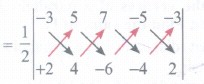
=\(\frac { 1 }{ 2 } \) [(-12 - 30 - 28 -10) - (+ 10 + 28 + 30 + 12)]
\(\frac { 1 }{ 2 } \) [-80 - (80)]
\(\frac { 1 }{ 2 } \)[-160] = -80 = 80 square units.
(∵ Area is always +ve).
71.
\(\cfrac { 4f(-3)+2f(4) }{ f(-6)-3f(1) } \)
For f(1) & f(3)
Since 1 & 3 lies between -5 ≤ x ≤2, We take, f(x) = x +5
f(1) = 1 + 5 = 6
f(-3) = -3 +5 = 2
For f(4): Since 4 lies between 2 < x < 6 We take, f(x) = x -1
f(4) = 4 -1 = 3
For f(-6): Since -6 lies between -7≤ x < -5 ,We take, f(x) = x² + 2x +1
f(-6) = (-6)² + 2(-6) + 1 = 36 -12 + 1 = 24 +1 = 25
Now ,\(\cfrac { 4f(-3)+2f(4) }{ f(-6)-3f(1) } \) =\(\frac{ 4(2) +2(3) }{ 25 - 3(6)}\)
= \(\frac{ 8 + 6 }{ 25 -18}\)
= \(\frac{14 }{ 7}\) = 2
Hence, the value of \(\cfrac { 4f(-3)+2f(4) }{ f(-6)-3f(1) } \) = 2
72.
It is both one-one and onto function
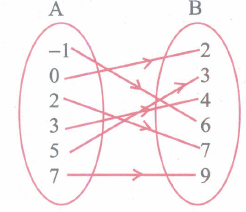
All the elements in A have their separate images in B. All the elements in B have their preimage in A. Therefore it is one-one and onto function.
73.
Given that intercepts are equal.
a = b
Equation of the line in intercepts form is
\(\frac{x}{a}+\frac{y}{b}=1
\)
\(\frac{x}{a}+\frac{y}{a}=1
\)
x + y = a
This passes through (- 8, 4)
-8 + 4 = a
a = -4
b = -4
Equation of the straight line is
\(\frac{x}{a}+\frac{y}{b}=1
\)
\(\frac{x}{-4}+\frac{y}{-4}=1
\)
x + y + 4 = 0.
74.
King spade, Queen spade, Jack spade are removed
∴ total number of cards = 52 - 3 = 49.
(i) Probability (diamond)= \(\frac { 13 }{ 49 } \)
(ii) Probability (queen) \(\frac { 4-1 }{ 49 } =\frac { 3 }{ 49 } \)
(iii) Probability (spade) = \(\frac { 13-3 }{ 49 } =\frac { 10 }{ 49 } \)
(iv) Probability (heart bearing number 5) = \(\frac { 13-5 }{ 49 } =\frac { 8 }{ 49 } \)
75.
When we roll two dice, the sample space is given by
S = \(\{ (1,1),(1,2),(1,3),(1,4),(1,5),(1,6)\\ (2,1),(2,2),(2,3),(2,4),(2,5),(2,6)\\ (3,1),(3,2),(3,3),(3,4),(3,5),(3,6)\\ (4,1),(4,2),(4,3),(4,4),(4,5),(4,6)\\ (5,1),(5,2),(5,3),(5,4),(5,5),(5,6)\\ (6,1),(6,2),(6,3),(6,4),(6,5),(6,6)\} \)
n(S) = 36
(i) Let A be the event of getting the sum of outcome values equal to 4.
Then A = {(1, 3),(2, 2),(3, 1)}; n(A) = 3.
Probability of getting the sum of outcomes equal to 4 is P(A) = \(\frac { n(A) }{ n(S) } =\frac { 3 }{ 36 } =\frac { 1 }{ 12 } \)
(ii) Let B be the event of getting the sum of outcome values greater than 10.
Then B = {(5,6),(6,5),(6,6)}; n(B) = 3
Probability of getting the sum of outcomes greater than 10 is P(B) = \(\frac { n(B) }{ n(S) } =\frac { 3 }{ 36 } =\frac { 1 }{ 12 } \)
(iii) Let C be the event of getting the sum of outcomes less than 13. Here all the outcomes have the sum value less than 13. Hence C = S
Therefore, n(C) = n(S) = 36
Probability of getting the sum value less than 13 is P(C) = \(\frac { n(C) }{ n(S) } =\frac { 36 }{ 36 } \) = 1
76.
In the right triangle GOH, cos 24° = \(\frac { OG }{ GH } \)
0.9135 = \(\frac { OG }{ 250 } \); OG = 228.38 km
Distance of H to the north of G = 228.38 km.
77.
Given AB || CD || EF
AB = 6 cm, BD = 5 cm, EF = 4 cm, CD = x cm, DE = y cm
\(\text { In } \triangle E C D \text { and } \triangle E A B\)
\( \angle C E D=\angle A E B \) [common]
\(\angle E C D=\angle E A B \) [corresponding angles]
\(\triangle E C D \sim \triangle E A B\)
[By AA similarity criteria] ...(1)
\(\therefore \ \frac{E C}{E A}=\frac{C D}{A B}\)
[ Corresponding parts of similar triangles are proportional]
\(\frac{E C}{E A}=\frac{x}{6}\) ....(2)
In \(\triangle A C D\ and\ \triangle A E F \)
\(\angle C A D=\angle E A F\) [Common]
\( \angle A C D =\angle A E F \) [Corresponding angles]
\(\triangle A C D \sim \triangle A E F \) [By AA similarity]
\(\frac{A C}{A E} =\frac{C D}{E F}\)
[Corresponding parts of similar triangle are proportional]
\(\therefore \quad \frac{A C}{A E}=\frac{x}{4}\) ....(3)
Adding (2) and (3)
\( \frac{E C}{E A}+\frac{A C}{A E} =\frac{x}{6}+\frac{x}{4} \)
\(\frac{E C+A C}{A E} =\frac{4 x+6 x}{24} \)
\(\frac{A E}{A E} =\frac{10 x}{24} \)
\(1 =\frac{10 x}{24} \)
\(\mathrm{x} =\frac{24}{10}=\frac{12}{5} \mathrm{~cm}\)
From (1) \(\triangle E C D \sim \triangle E A B\)
\( \frac{D C}{A B} =\frac{E D}{E B} \)
\(\frac{x}{6} =\frac{y}{5+y} \)
\(\because \mathrm{x}=\frac{12}{5} \Rightarrow \frac{12 / 5}{6} =\frac{y}{5+y} \)
\(\frac{12}{5 \times 6} =\frac{y}{5+y} \)
12(5 + y) = 30 y
60 + 12y = 30 y
60 = 30y - 12y
18y = 60
\( y=\frac{60}{18} \)
\(y=\frac{10}{3} \mathrm{~cm}\)
78.
Volume of a cone = 1005 \(\frac{5}{7}\) cu.cm
\(\text { i.e., } \frac{1}{3} \pi r^{2} h=1005 \frac{5}{7}\)
area of base = area of circle
\(
=201 \frac{1}{7} \text { sq. units }
\)
\(i.e
\ \pi r^{2}=201 \frac{1}{7} \Rightarrow r^{2}=64
\)
Substituting in (1), r = 8 cm
\(\frac{1}{3}\left(201 \frac{1}{7}\right) \mathrm{h}=1005 \frac{5}{7}
\)
\(\frac{1}{3}\left(\frac{1408}{7}\right) \mathrm{h}=\frac{7040}{7}
\)
\(h=\frac{7040}{7} \times \frac{7}{1408} \times 3=15 \mathrm{~cm}\)
Slant height of cone \(l =\sqrt{h^{2}+r^{2}}
\)
\(=\sqrt{15^{2}+8^{2}}=\sqrt{225+64}
\)
\(=\sqrt{289}=17 \mathrm{~cm}
\)
79.
Arranging the values in ascending order we get, 4, 7, 8, 10, 11 and n = 5
| xi | xi2 |
| 4 | 16 |
| 7 | 49 |
| 8 | 64 |
| 10 | 100 |
| 11 | 121 |
| Σxi = 40 | Σxi2 = 350 |
Standard deviation
σ = \(\sqrt { \frac { { \Sigma d }_{ i }^{ 2 } }{ n } -\left( \frac { { \Sigma d }_{ i } }{ n } \right) ^{ 2 } } \)
= \(\sqrt { \frac { 350 }{ 5 } -\left( \frac { 40 }{ 5 } \right) ^{ 2 } } \)
σ = \(\sqrt { 6 } \) ⋍ 2.45
When we add 3 to all the values, we get the new values as 7, 10, 11, 13, 14.
| xi | xi2 |
| 7 | 9 |
| 10 | 100 |
| 11 | 121 |
| 13 | 169 |
| 14 | 196 |
| Σxi = 55 | Σxi2 = 635 |
Standard deviation
σ = \(\sqrt { \frac { { \Sigma d }_{ i }^{ 2 } }{ n } -\left( \frac { { \Sigma d }_{ i } }{ n } \right) ^{ 2 } } \)
= \(\sqrt { \frac { 635 }{ 5 } -\left( \frac { 55 }{ 5 } \right) ^{ 2 } } \)
σ = \(\sqrt { 6 } \) ⋍ 2.45
80.
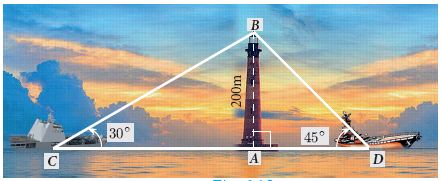
Let AB the lighthouse. Let C and D be the positions of the two ships.\(\times \)
Then, AB = 200m.
\(\angle ACB=30°,\angle ADB=45°\)
In right triangles BAC, tan30°= \(\frac { AB }{ Ac } \)
\(\frac { 1 }{ \sqrt { 3 } } =\frac { 200 }{ AC } \ gives\ AC=200\sqrt { 3 } \) ...(1)
In the right triangle BAD,tan45°= \(\frac { AB }{ AD } \)
\(1=\frac { 200 }{ AD } \) gives AD = 200 ...(2)
Now, CD = AC + AD = \(200\sqrt { 3 } +200\) [by(1) and (2)]
CD = 200\((\sqrt { 3 } +1)\) = 200 x 2.732 = 546.4
Distance between two ships is 546.4m
81.
\(f(x)=\frac { x-1 }{ x+1 } ,x\neq 0\)
\(f(f(x))=f\left( \frac { x-1 }{ x+1 } \right) =\frac { \left( \frac { x-1 }{ x+1 } \right) -1 }{ \left( \frac { x-1 }{ x+1 } \right) +1 } \)
\(=\frac{\frac{\not x-1-x-1}{(\not x+1)}}{\frac{\not x-1+x+1}{(\not x+1)}}=\frac{-2}{2 x}=\frac{-1}{x}\)
Hence it is proved.
82.
\(\sqrt { 16{ x }^{ 2 }+9{ y }^{ 2 }-24xy+24x-18y+9 } \)
= \(\sqrt { { \left( 4x \right) }^{ 2 }+{ \left( -3y \right) }^{ 2 }+{ \left( 3 \right) }^{ 2 }+2{ \left( 4x \right) }\left( -3y \right) +2\left( -3y \right) \left( 3 \right) +2\left( 4x \right) \left( 3 \right) } \)
= \(\sqrt { { \left( 4x+-3y+3 \right) }^{ 2 } } \) = |4x - 3y + 3|
83.
Let r and h be the radius and height of the cylinder respectively.
Given that, volume of the tank = 1.078 x 106 = 1078000 litre
1078 m3 (since 1l = \(\frac{1}{1000}m^3\))
diameter = 7m gives radius = \(\frac{7}{2}\)m
volume of the tank = \(\pi\)r h 2 cu. units
1078 = \(\frac { 22 }{ 7 } \times \frac { 7 }{ 2 } \times \frac { 7 }{ 2 } \times h\)
Therefore, height of the tank is 28 m
84.
.JPG)
QS = 2 PR
\(\frac { { x }_{ 2 }+1 }{ 2 } =2\Rightarrow { x }_{ 2 }=3\)
\(\frac { { y }_{ 2 }+1 }{ 2 } =2\Rightarrow { y }_{ 2 }=3\)
\(\Rightarrow Q=(3,-3)\)
\(\because QS=2PR\)
\(QS=\sqrt { { (-3-1) }^{ 2 }+{ (3-1) }^{ 2 } } \)
\(=\sqrt { { (-4) }^{ 2 }+{ (2) }^{ 2 } } =\sqrt { 20 } \)
\(\Rightarrow PR=\frac { \sqrt { 20 } }{ 2 } \)
\(\Rightarrow \sqrt { { { (x }_{ 3 }-{ x }_{ 1 }) }^{ 2 }+{ { (y }_{ 3 }-{ y }_{ 1 }) }^{ 2 } } =\frac { \sqrt { 20 } }{ 2 } \)
form (3),
\(\Rightarrow \sqrt { { \left[ 2({ y }_{ 3 }-{ y }_{ 1 }) \right] }^{ 2 }+({ { y }_{ 3 }-{ y }_{ 1 }) }^{ 2 } } =\frac { \sqrt { 20 } }{ 2 } \)
\(\Rightarrow \sqrt { 5{ ({ y }_{ 3 }-{ y }_{ 1 }) }^{ 2 } } =\frac { \sqrt { 20 } }{ 2 } \)
\(\Rightarrow \left(y_{3}-y_{1}\right) \times \sqrt{\not 5}=\frac{\sqrt{\not5} \times \sqrt{4}}{2}\)
\(\Rightarrow { y }_{ 3 }-{ y }_{ 1 }=1\rightarrow (4)\)
\(\therefore { x }_{ 3 }-{ x }_{ 1 }=2\rightarrow (5)\)
∵ Diagram bisect each other at right angle in rhombus, \(\frac { { x }_{ 1 }+{ x }_{ 2 } }{ 2 } =2\) and \(\frac { { y }_{ 1 }+{ y }_{ 2 } }{ 2 } =-1\)
\(\left( \frac { { y }_{ 3 }-{ y }_{ 1 } }{ { x }_{ 3 }-{ x }_{ 1 } } \right) \times \left( 3-1\frac { -3-1 }{ 3-1 } \right) =-1\)
\(\{ { m }_{ 1 }\times { m }_{ 2 }=-1\} \)
\(\Rightarrow \frac { { y }_{ 3 }-{ y }_{ 1 } }{ { x }_{ 3 }-{ x }_{ 1 } } =\frac { 1 }{ 2 } \Rightarrow { x }_{ 3 }-{ x }_{ 1 }=2({ y }_{ 3 }-{ y }_{ 1 })\quad ...(3)\)
From (2), y1 + y3 = -2
(3), x1 + x3 = 4
Solving (4) and (2),
(4) + (2) ⇒ 2y3 = -1 ⇒ y3 = \(\frac { -1 }{ 2 } \)
(4) - (2) ⇒ -2y1 = 3 ⇒ y1= \(\frac { -3 }{ 2 } \)
Solving (5) and (1),
(5) + (1) ⇒ 2x3 = 6 ⇒ x3 = 3
(5) - (1) ⇒ -2x1 = -2 ⇒ x1 = +1
\(\therefore P=\left( +1,\frac { -3 }{ 2 } \right) \)
85.
From the figure
r = 6 cm
R = 12 cm
h = 8 cm
\(l =\sqrt{h^{2}+(\mathrm{R}-\mathrm{r})^{2}} \)
\(=\sqrt{8^{2}+(12-6)^{2}} \)
\(=\sqrt{64+36} \)
\(=\sqrt{100}=10 \mathrm{~cm} \)
Area to be painted = C.S.A + area of top circular region
\(=\pi(R+r) l+\pi r^{2} \)
\(=\frac{22}{7}(12+6)(10)+\frac{22}{7}(6)^{2} \)
\(=\frac{22}{7}(180)+\frac{22}{7}(36) \)
\(=\frac{22}{7}(180+36) \)
\(=\frac{22}{7}(216)=\frac{4752}{7}=678.86 \)
Cost of painting per sq. cm = Rs. 2
Total cost = 678.86 x 2 = Rs. 1357.72
86.
Given cosec\(\theta \) + cot\(\theta \) = p ...(1)
cosec2\(\theta \) - cot2\(\theta \) = 1 (identity)
\(\operatorname{cosec} \theta-\cot \theta=\frac{1}{\operatorname{cosec} \theta+\cot \theta}\)
cosec\(\theta \) - cot\(\theta \) =\(\frac { 1 }{ { p } } \) .... (2)
Adding(1) and (2) we get, 2cosec\(\theta \) = \(p+\frac { 1 }{ p } \)
2cosec\(\theta \)\(\frac { { p }^{ 2 }+1 }{ p } \) ....(3)
Subtracting (2) from (1), we get, 2cot\(\theta \) = \(p-\frac { 1 }{ p } \)
2cot\(\theta \) = \(\frac { { p }^{ 2 }-1 }{ p } \) ...(4)
Dividing (4) by (3) we get,\(\frac { 2cot\theta }{ 2cosec\theta } =\frac { { p }^{ 2 }-1 }{ p } \times \frac { p }{ { p }^{ 2 }+1 } gives,cos\theta =\frac { { p }^{ 2 }-1 }{ { p }^{ 2 }+1 } \)
87.
Let the 100t digit be 'x', 10's be 'y' and Unit digit be 'z'.
The three digit number is 100x + 10y + z.
Now given, x + y + z = 11 . ..(1)
100z +10y + x = 5 (100x + 10y + z) + 46
Simplifying
499x + 40y - 95z = - 46 .........(2)
x + 2y = z
x + 2y - z = 0 ....(3)
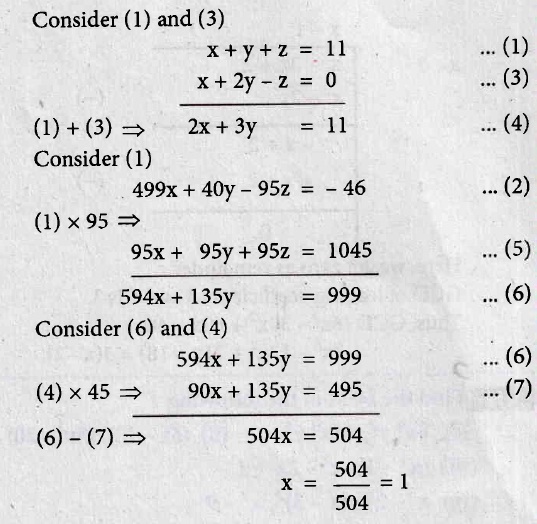
Substituting the value x = 1 in(4)
2(1) + 3y = 11
3y = 11 - 2 = 9
\(y=\frac{9}{3}=3\)
Substituting x = 1, y = 3 in (1)
1 + 3 + z = 11
z = 11 - 4 = 7
x = 1, y = 3, z = 7
The original three digit number is 137
i.e., 100(1) + 10(3) + 1(7) = 100+ 30 + 7 =137
88.
Let AP and CR be the vertical poles of height 6 m and 3 m respectively
Let BQ = ym
In CRA and BQA
By AA criterion of similarity
\(\triangle C R A \sim \triangle B Q A\)
Their corresponding sides are Proportional
\(\frac{A C}{A B}=\frac{C R}{B Q} \)
\(\frac{A C}{A B}=\frac{3}{y} \)
\(\mathrm{AB}=\frac{A C \times y}{3}\)
In CBQ and CAP
\(\frac{C B}{C A}=\frac{B Q}{A P} \)
\(\frac{C B}{C A}=\frac{y}{6} \)
\(B C=\frac{y \times C A}{6} \)
\((1)+(2) \Rightarrow A B+B C =\frac{A C \times y}{3}+\frac{y \times C A}{6} \)
\(A C=y \times A C\left(\frac{1}{3}+\frac{1}{6}\right) \)
\(\frac{A C}{A C} =y\left(\frac{2+1}{6}\right) \)
\(1 =y\left(\frac{3}{6}\right) \)
\(1 =\frac{1}{2} y \)
y = 2m.
89.
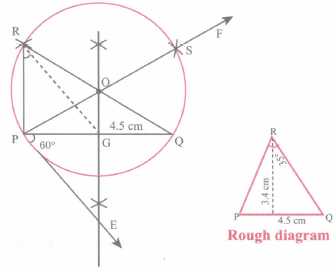
Construction:
Step (1) Draw a line segment PQ = 4.5 cm
Step (2) At P, draw PE such that \(\angle QPE={ 35 }^{ 0 }\)
Step (3) At P, draw PF such that \(\angle EPF={ 90 }^{ 0 }\)
Step (4) Draw \(\bot \) bisector to PQ which intersects PF at O.
Step (5) With O centre OP as radius draw a circle.
Step (6) From G, marked arcs of radius 6 cm on the circle marked them as R and S.
Step (7) Joined PR and RQ. Then \(\triangle\)PQR is the required triangle
Step (8) \(\triangle\)PQS is the required triangle
90.
Given a triangle LMN, we are required to construct another triangle whose sides are \(\frac { 4 }{ 5 } \) of the corresponding sides of the \(\triangle\)LMN
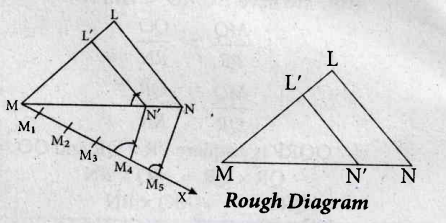
Steps of construction:
1. Constructed a LMN with any measurement
2. Drawn a ray MX making an acute angle with MN on the side opposite to the vertex L.
3. Located 5 points M1, M2, M3, M4, M5 on MX so that
MM1 = M1M2 = M2M3 = M3M4 = M4M5
4. Joined, M5N and drawn a line through M4 parallel to M5N to intersect MN at N.
5. Drawn a line through N, parallel to the line NL to intersect ML at L
Then L'MN' is the required triangle each of whose sides is four-fifth of the corresponding sides of LMN

10th Standard Syllabus & Materials
10th Standard
TN 10th English Prose - 2 - The Night the Ghost Got in Important Questions And Answers Study Material - QB365 Set A
NEW10th Standard
TN 10th English Supplementary - 1 - The Tempest Important Questions And Answers Study Material - QB365 Set A
NEW10th Standard
TN 10th English Poem - 1 - Life Important Questions And Answers Study Material - QB365 Set A
NEW10th Standard
TN 10th English Prose - 1 - His First Flight Important Questions And Answers Study Material - QB365 Set A



Tamilnadu Stateboard 10th Standard Subjects
Tamilnadu Stateboard Standards





