
 100% FREE ACCESS
10th Standard Syllabus & Materials
10th Standard
TN 10th English Prose - 4 - The Attic Important Questions And Answers Study Material - QB365 Set A
NEW10th Standard
TN 10th English Supplementary - 3 - The Story of Mulan Important Questions And Answers Study Material - QB365 Set A
NEW10th Standard
TN 10th English Poem - 3 - I am Every Woman Important Questions And Answers Study Material - QB365 Set A
NEW10th Standard
TN 10th English Prose - 3 - Empowered Women Navigating The World Important Questions And Answers Study Material - QB365 Set A
NEW10th Standard
TN 10th English Supplementary - 2 - Zigzag Important Questions And Answers Study Material - QB365 Set A
NEW10th Standard
TN 10th English Poem - 2 - The Grumble Family Important Questions And Answers Study Material - QB365 Set A

Published on: 06/02/2020
10th Standard Mathematics Important Question All Chapter Questions -II- 2019-2020
Download Tamil Nadu 10th Standard Maths question papers, model tests, one-mark questions, important questions, and public exam papers in PDF format. Free study materials and answer keys for TN State Board students.
Questions + Answers key
Take MCQ Maths Test1.
If sin(α + β) = 1 then cos(α - β) can be reduced to ___________
sin α
cos β
sin 2β
cos 2β
2.
If x = r sin θ cos φ y = r sin θ. Then x2 + y2 + z2___________
r
r2
\(\cfrac { { r }^{ 2 } }{ 2 } \)
2r2
3.
4.
A letter is selected at random from the the word 'PROBABILITY'. The probability that its is nota vowel is _______.
\( \frac { 4 }{ 11 } \)
\(\frac { 7 }{ 11 } \)
\(\frac { 3 }{ 11 } \)
\(\frac { 6 }{ 11 } \)
5.
Th4e batsman A is more consistent than batsman B if ___________
C.V of A > C.V of B
C.V of A < C.V of B
C.V of a =C.V of B
C.V of A≥C.V of B
6.
A floating boat having a length 3m and breadth 2m is floating on a lake. The boat sinks by 1 cm when a man gets into it. The mass of the man is (density of water is 10000 kg/m3)
50 kg
60 kg
70 kg
80 kg
7.
A solid frustum is of height 8 cm. If the radii of its lower and upper ends are 3 cm and 9 cm respectively, then its slant height is ___________
15 cm
12 cm
10 cm
17 cm
8.
The radius of a wire is decreased to one-third of the original. If volume the same, then the length will be increased _______of the original.
3 times
6 times
9 times
27 times
9.
The lines y = 5x - 3, y = 2x + 9 intersect at A. The coordinates of A are ___________
(2, 7)
(2, 3)
(4, 17)
(-4, 23)
10.
If the mid-point of the line segment joining \(A\left( \frac { x }{ 2 } ,\frac { y+1 }{ 2 } \right) \) and B(x + 1, y-3) is C(5, -2) then find the values of x, y ____________
(6, -1)
(-6, 1)
(-2, 1)
(3, 5)
11.
A line which intersects a circle at two distinct points is called ____________
Point of contact
secant
diameter
tangent
12.
The height of an equilateral triangle of side a is
\(\frac { a }{ 2 } cm\)
\(\sqrt { 3a } \)
\(\frac { \sqrt { 3 } }{ 2 } a\)
\(\frac { \sqrt { 3 } }{ 4 } a\)
13.
S and T are points on sides PQ and PR respectively of \(\Delta PQR\) If PS = 3cm, AQ = 6 cm, PT = 5 cm, and TR = 10 cm and then QR
4 ST
5 ST
3 ST
3 QR
14.
The real roots of the quadratic equation x2-x-1 are ___________
1, 1
-1, 1
\(\frac { 1+\sqrt { 5 } }{ 2 } ,\frac { 1-\sqrt { 5 } }{ 2 } \)
None
15.
Consider the following statements:
(i) The HCF of x+y and x8-y8 is x+y
(ii) The HCF of x+y and x8+y8 is x+y
(iii) The HCF of x-y nd x8+y8 is x-y
(iv) The HCF of x-y and x8-y8 is x-y
(i) and (ii)
(ii) and (iii)
(i) and (iv)
(ii) and (iv)
16.
17.
In an A.P if the pth term is q and the qth term is p, then its nth term is ____________
p+q-n
p+q+n
p-q+n
p-q-n
18.
What is the HCF of the least prime and the least composite number?
1
2
3
4
19.
If f is constant function of value \(\frac { 1 }{ 10 } \), the value of f(1) + f(2) + ... + f(100) is _________
\(\frac { 1 }{ 100 } \)
100
\(\frac { 1 }{ 10 } \)
10
20.
If f(x) = 2 - 3x, then f o f(1 - x) = ?
5x+9
9x-5
5-9x
5x-9
21.
If function f : N⟶N, f(x) = 2x then the function is, then the function is ___________
Not one - one and not onto
one-one and onto
Not one -one but not onto
one - one but not onto
22.
If f : R⟶R is defined by (x) = x2 + 2, then the preimage 27 are _________
0.5
5, -5
5, 0
\(\sqrt { 5 } ,-\sqrt { 5 } \)
23.
How many balls, each of radius 1 cm, can be made from a solid sphere of lead of radius cm?
64
216
512
16
24.
25.
The probability a red marble selected at random from a jar containing p red, q blue and r green marbles is
\(\frac { q }{ p+q+r } \)
\(\frac { p }{ p+q+r } \)
\(\frac { p+q }{ p+q+r } \)
\(\frac { p+r }{ p+q+r } \)
26.
The sum of all deviations of the data from its mean is
Always positive
always negative
zero
non-zero integer
27.
(1 + tan \(\theta \) + sec\(\theta \)) (1 + cot\(\theta \) - cosec\(\theta \)) is equal to
0
1
2
-1
28.
If x = a tan\(\theta \) and y = b sec\(\theta \) then
\(\frac { { y }^{ 2 } }{ { b }^{ 2 } } -\frac { { x }^{ 2 } }{ { a }^{ 2 } } =1\)
\(\frac { x^{ 2 } }{ a^{ 2 } } -\frac { y^{ 2 } }{ b^{ 2 } } =1\)
\(\frac { x^{ 2 } }{ a^{ 2 } } +\frac { y^{ 2 } }{ b^{ 2 } } =1\)
\(\frac { x^{ 2 } }{ a^{ 2 } } -\frac { y^{ 2 } }{ b^{ 2 } } =0\)
29.
If the sequence t1, t2, t3... are in A.P. then the sequence t6, t12, t18,.... is
a Geometric Progression
an Arithmetic Progression
neither an Arithmetic Progression nor a Geometric Progression
a constant sequence
30.
An A.P. consists of 31 terms. If its 16th term is m, then the sum of all the terms of this A.P. is
16 m
62 m
31 m
\(\frac { 31 }{ 2 } \) m
31.
If A is a point on the Y axis whose ordinate is 8 and B is a point on the X axis whose abscissae is 5 then the equation of the line AB is
8x + 5y = 40
8x - 5y = 40
x = 8
y = 5
32.
If (5, 7), (3, p) and (6, 6) are collinear, then the value of p is
3
6
9
12
33.
34.
The perimeters of two similar triangles ∆ABC and ∆PQR are 36 cm and 24 cm respectively. If PQ = 10 cm, then the length of AB is
\(6\frac { 2 }{ 3 } cm\)
\(\frac { 10\sqrt { 6 } }{ 3 } cm\)
\(66\frac { 2 }{ 3 } cm\)
15 cm
35.
36.
A shuttle cock used for playing badminton has the shape of the combination of
a cylinder and a sphere
a hemisphere and a cone
a sphere and a cone
frustum of a cone and a hemisphere
37.
Let f(x) = \(\sqrt { 1+x^{ 2 } } \) then
f(xy) = f(x).f(y)
f(xy) ≥ f(x).f(y)
f(xy) ≤ f(x).f(y)
None of these
38.
If f(x) = 2x2 and g(x) = \(\frac{1}{3x}\), then f o g is
\(\\ \frac { 3 }{ 2x^{ 2 } } \)
\(\\ \frac { 2 }{ 3x^{ 2 } } \)
\(\\ \frac { 2 }{ 9x^{ 2 } } \)
\(\\ \frac { 1 }{ 6x^{ 2 } } \)
39.
If number of columns and rows are not equal in a matrix then it is said to be a
diagonal matrix
rectangular matrix
square matrix
identity matrix
40.
\(\frac {3y - 3}{y} \div \frac {7y - 7}{3y^{2}}\) is
\(\frac {9y}{7}\)
\(\frac {9y^{2}}{(21y - 21)}\)
\(\frac {21y^2 - 42y + 21}{3y^{2}}\)
\(\frac {7(y^{2} - 2y + 1)}{y^{2}}\)
41.
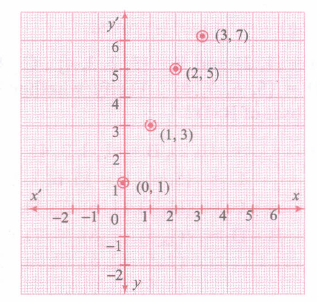
Let A = {0, 1, 2, 3} and B = {1, 3, 5, 7, 9} be two sets. Let f: A \(\rightarrow\)B be a function given by f(x) = 2x + 1. Represent this function as a graph.
42.
Let A = {0, 1, 2, 3} and B = {1, 3, 5, 7, 9} be two sets. Let f: A \(\rightarrow\)B be a function given by f(x) = 2x + 1. Represent this function as a table.
43.
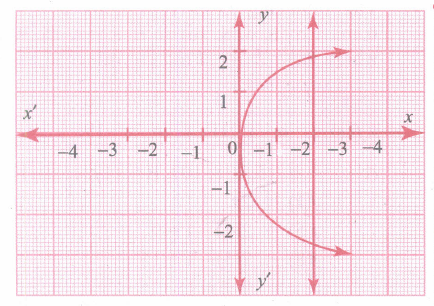
State whether the graph represent a function. Use vertical line test.
44.
prove the following identity.
\(\frac { cos\theta }{ 1+sin\theta } \) = sec \(\theta \) - tan \(\theta \)
45.
Determine the nature of the roots for the following quadratic equations
\(9{ y }^{ 2 }-6\sqrt { 2 } y+2\) = 0
46.
Find the equation of a straight line passing through the mid-point of a line segment joining the points (1, -5), (4, 2) and parallel to: Y axis
47.
Check whether the following sequences are in A.P. or not?
\(3\sqrt { 2 } ,5\sqrt { 2 } ,7\sqrt { 2 } ,9\sqrt { 2 } \),.....
48.
Using the functions f and g given below, find f o g and g o f. Check whether f o g = g o f
f(x) = \(\frac { x+6 }{ 3 } \), g(x) = 3 - x
49.
A and B are two candidates seeking admission to IIT. The probability that A getting selected is 0.5 and the probability that both A and B getting selected is 0.3. Prove that the probability of B being selected is allmost 0.8.
50.
The standard deviation and coefficient of variation of a data are 1.2 and 25.6 respectively. Find the value of mean.
51.
If the range and the smallest value of a set of data are 36.8 and 13.4 respectively, then find the largest value.
52.
Solve x2 + 2x - 2 = 0 by formula method
53.
Find the slope of the line which is parallel to 3x - 7y = 11
54.
Find the number of terms in the following G.P.
4, 8,16,…,8192
55.
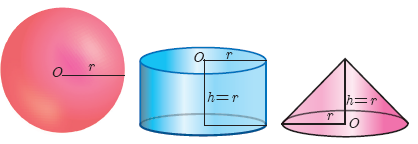
A sphere, a cylinder and a cone are of the same radius, where as cone and cylinder are of same height. Find the ratio of their curved surface areas.
56.
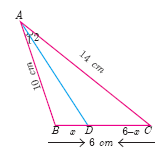
In the Figure, AD is the bisector of \(\angle\)BAC, if A = 10 cm, AC = 14 cm and BC = 6 cm. Find BD and DC.
57.
The line r passes through the points (–2, 2) and (5, 8) and the line s passes through the points (–8, 7) and (–2, 0). Is the line r perpendicular to s ?
58.
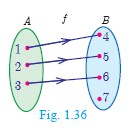
Let A = {1,2,3}, B = {4, 5, 6,7}, and f = {(1, 4),(2, 5),(3, 6)} be a function from A to B. Show that f is one – one but not onto function.
59.
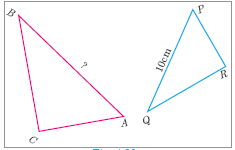
The perimeters of two similar triangles ABC and PQR are respectively 36 cm and 24 cm. If PQ = 10 cm, find AB
60.
prove that sec\(\theta \) - cos\(\theta \) = tan \(\theta \) sin\(\theta \)
61.
If tanθ+sinθ=P; tanθ-sinθ=q P.T P2-q2=4\(\sqrt{pq}\)
62.
Express cot 85° + cos 75° in terms of trigonometric ratios of angles between 0° and 45°.
63.
A spherical ball of iron has been melted and made into small balls. If the radius of each smaller ball is one-fourth of the radius of the original one, how many such balls can be made?
64.
Final the probability of choosing a spade or a heart card from a deck of cards.
65.
Find two consecutive natural numbers whose product is 20.
66.
A chess board contains 64 equal squares and the area of each square is 6.25 cm2, A border round the board is 2 cm wide.
67.
How many terms of the AP: 24, 21, 18, ... must be taken so that their sum is 78?
68.
Which of the following list of numbers form an AP? If they form an AP, write the next two terms:
1,-1,-3, -5, ...
69.
Let A = {1, 2, 3, 4, 5}, B = N and f: A \(\rightarrow\)B be defined by f(x) = x2. Find the range of f. Identify the type of function.
70.
Find the value of k if the points A(2, 3), B(4, k) and (6, -3) are collinear.
71.
Let f = {(2, 7); (3, 4), (7, 9), (-1, 6), (0, 2), (5,3)} be a function from A = {-1,0, 2, 3, 5, 7} to B = {2, 3, 4, 6, 7, 9}. Is this
(i) an one-one function
(ii) an onto function,
(iii) both one and onto function?
72.
Find the square root of the following polynomials by division method
37x2 - 28x3 + 4x4 + 42x + 9
73.
Two ships are sailing in the sea on either side of the lighthouse. The angles of depression of two ships as observed from the top of the lighthouse are 60° and 45° respectively. If the distance between the ships is 200\(\left( \frac { \sqrt { 3 } +1 }{ \sqrt { 3 } } \right) \) metres, find the height of the lighthouse.
74.
The top of a 15 m high tower makes an angle of elevation of 60° with the bottom of an electronic pole and angle of elevation of 30° with the top of the pole. What is the height of the electric pole?
75.
To a man standing outside his house, the angles of elevation of the top and bottom of a window are 60° and 45° respectively. If the height of the man is 180 cm and if he is 5 m away from the wall, what is the height of the window?(\( \sqrt { 3 } \) = 1.732)
76.
The area of a triangle is 5 sq. units. Two of its vertices are (2,1) and (3, –2). The third vertex is (x, y) where y = x + 3. Find the coordinates of the third vertex.
77.
48 students were asked to write the total number of hours per week they spent on watching television. With this information find the standard deviation of hours spent for watching television.
| x | 6 | 7 | 8 | 9 | 10 | 11 | 12 |
| f | 3 | 6 | 9 | 13 | 8 | 5 | 4 |
78.
O is any point inside a triangle ABC. The bisector of \(\angle AOB\), \(\angle BOC\) and \(\angle COA\) meet the sides AB, BC and CA in point D, E and F respectively. Show that AD x BE x CF = DB x EC x FA
79.
Find the standard deviation of the data 2, 3, 5, 7, 8. Multiply each data by 4. Find the standard deviation of the new values.
80.
Find the equation of a straight line Passing through (1, -4) and has intercepts which are in the ratio 2:5
81.
An aluminium sphere of radius 12 cm is melted to make a cylinder of radius 8 cm. Find the height of the cylinder.
82.
A vessel is in the form of a hemispherical bowl mounted by a hollow cylinder. The diameter is 14 cm and the height of the vessel is 13 cm. Find the capacity of the vessel.
83.
If 9x4 + 12x3 + 28x2 + ax + b is a perfect square, find the values of a and b.
84.
If f(x) = \(\frac { x-1 }{ x+1 } \), x ≠ 1 show that f(f(x)) = -\(\frac{1}{x}\), provided x ≠ 0.
85.
A conical container is fully filled with petrol. The radius is 10 m and the height is 15 m. If the container can release the petrol through its bottom at the rate of 25 cu. metre per minute, in how many minutes the container will be emptied. Round off your answer to the nearest minute.
86.
The internal and external diameters of a hollow hemispherical vessel are 20 cm and 28 cm respectively. Find the cost to paint the vessel all over at Rs. 0.14 per cm2.
87.
Given A = \(\left( \begin{matrix} p & 0 \\ 0 & 2 \end{matrix} \right) \), B = \(\left( \begin{matrix} 0 & -q \\ 1 & 0 \end{matrix} \right) \), C = \(\left( \begin{matrix} 2 & -2 \\ 2 & 2 \end{matrix} \right) \) and if BA = C2, find p and q.
88.
Draw a circle of radius 4.5 cm. Take a point on the circle. Draw the tangent at that point using the alternate segment theorem.
89.
Construct a triangle similar to a given triangle PQR with its sides equal to \(\frac { 2 }{ 3 } \) of the corresponding sides of the triangle PQR (scale factor \(\frac { 2 }{ 3 } <1\)).
1.
(c)
sin 2β
2.
(b)
r2
3.
(a)
4.
(b)
\(\frac { 7 }{ 11 } \)
5.
(b)
C.V of A < C.V of B
6.
(b)
60 kg
7.
(c)
10 cm
8.
(c)
9 times
9.
(c)
(4, 17)
10.
(a)
(6, -1)
11.
(b)
secant
12.
(c)
\(\frac { \sqrt { 3 } }{ 2 } a\)
13.
(c)
3 ST
14.
(c)
\(\frac { 1+\sqrt { 5 } }{ 2 } ,\frac { 1-\sqrt { 5 } }{ 2 } \)
15.
(a) Capital employed - Goodwill + current liabilities
16.
(c)
17.
(a)
p+q-n
18.
(b)
2
19.
(d)
10
20.
(c)
5-9x
21.
(d)
one - one but not onto
22.
(b)
5, -5
23.
(a)
64
24.
(d)
25.
(b)
\(\frac { p }{ p+q+r } \)
26.
(c)
zero
27.
(c)
2
28.
(a)
\(\frac { { y }^{ 2 } }{ { b }^{ 2 } } -\frac { { x }^{ 2 } }{ { a }^{ 2 } } =1\)
29.
(b)
an Arithmetic Progression
30.
(i) To check if h is one – one, we assume that h(b1) = h(b2)
Then we get 2.47 b1 + 54.10 = 2.47 b2 + 54.10
2.47b1 = 2.47b2 ⇒ b1 = b2
Thus, h(b1) = h(b2) ⇒ b1 = b2, So, the function h is one – one.
(ii) If the length of the thigh bone b = 50, then the height is
h(50) = (2.47 x 50) + 54.10 = 177.6 cms
(iii) If the height of a person is 147.96 cms, then h(b) = 147.96 and so the length of the thigh bone is given by 2.47b + 54.10 = 147.96.
b = \(\frac { 93.86 }{ 2.47 } \)
Therefore, the length of the thigh bone is 38 cms.
31.
(a)
8x + 5y = 40
32.
(c)
9
33.
(b)
34.
(d)
15 cm
35.
(a)
36.
(d)
frustum of a cone and a hemisphere
37.
(c)
f(xy) ≤ f(x).f(y)
38.
(c)
\(\\ \frac { 2 }{ 9x^{ 2 } } \)
39.
(b)
rectangular matrix
40.
(a)
\(\frac {9y}{7}\)
41.
A Graph f = {(x, f(x) / x \(\epsilon \) A}
{(0, 1), (1, 3), (2, 5), (3, 7)}
42.
A table
| x | 0 | 1 | 2 | 3 |
|---|---|---|---|---|
| f(x) | 1 | 3 | 5 | 7 |
43.
It is not a function as the vertical line PQ cuts the graph at two points
44.
\( \frac{\cos \theta}{1+\sin \theta} =\sec \theta-\tan \theta \)
\(\text { LHS } =\frac{\cos \theta}{1+\sin \theta} \)
\(=\frac{\cos \theta}{1+\sin \theta} \times \frac{1-\sin \theta}{1-\sin \theta} \)
[Multiplying the Numerator and Denominator by 1 - sin\(\theta\)]
\( =\frac{\cos \theta(1-\sin \theta)}{1^{2}-\sin ^{2} \theta} \)
\(\left[\because(a+b)(a-b)=a^{2}-b^{2}\right] \)
\(=\frac{\cos \theta(1-\sin \theta)}{\cos ^{2} \theta} \)
\(\left[\because 1-\sin ^{2} \theta=\cos ^{2} \theta\right] \)
\(=\frac{(1-\sin \theta)}{\cos \theta} \)
\(=\frac{1}{\cos \theta}-\frac{\sin \theta}{\cos \theta} \)
\(=\sec \theta-\tan \theta \)
= RHS
45.
9y2 - 6√2y + 2 = 0
a = 9, b = -6√2, c = 2
∆ = b2 - 4ac
= (-6√2)2 - 4 x 9 x 2
= 36 x 2 - 72
= 72 - 72 = 0
∴ The roots are real and equal.
46.
Given points (1, - 5) and (4, 2)
Mid-point of the line joining the points (1, - 5), (4, 2)
\(=\left(\frac{x_{1}+x_{2}}{2}, \frac{y_{1}+y_{2}}{2}\right)=\left(\frac{1+4}{2}, \frac{-5+2}{2}\right)
\)
\(=\left(\frac{5}{2},-\frac{3}{2}\right)
\)
Equation of a straight line passing through
\(\left(\frac{5}{2},-\frac{3}{2}\right)
\) and parallel to Y-axis is x = a
\(\text { i.e., } x=\frac{5}{2} \Rightarrow 2 x-5=0\)
47.
t2 - t1 = 5\(\sqrt { 2 } \) - 3\(\sqrt { 2 } \) = 2\(\sqrt { 2 } \)
t3 - t1 = 7\(\sqrt { 2 } \) - 5\(\sqrt { 2 } \) = 2\(\sqrt { 2 } \)
t4 - t3 =9\(\sqrt { 2 } \) - 7\(\sqrt { 2 } \) = 2\(\sqrt { 2 } \)
Thus, the differences between consecutive terms are equal. Hence the terms of the sequence 3\(\sqrt { 2 } \), 5\(\sqrt { 2 } \), 7\(\sqrt { 2 } \), 9\(\sqrt { 2 } \) ..... are in A.P
48.
f(x) =\(\frac { x+6 }{ 3 } \), g(x) = 3 - x
fog(x) = f(g(x)) = f(3 - x) = \(\frac { 3-x+6 }{ 3 } \) = \(\frac { 9-x }{ 3 } \) ..(1)
gof(x) = g(f(x)) = g\(\left( \frac { x+6 }{ 3 } \right) =3-\frac { x+6 }{ 3 } \)
=\(\frac { 9-x+6 }{ 3 } =\frac { 3-x }{ 3 } \)..(2)
f o g ≠ g o f
49.
P(A) = 0.5, P(A ∩ B) = 0.3
We have P(A U B) ≤ 1
P(A) + P(B) - P(A ∩ B) ≤ 1
0.5 + P(B) - 0.3 ≤ 1
P(B) ≤ 1 - 0.2
P(B) ≤ 0.8
Therefore, probability of B getting selected is allmost 0.8.
50.
Standard deviation = 12
Coefficient of variation = 25.6
Coefficient of variation\(\text { C.V }=\frac{\sigma}{x} \times 100 \%\)
\(25.6 =\frac{1.2}{\bar{x}} \times 100 \% \)
\(\bar{x} =\frac{1.2}{25.6} \times 100=4.687 \)
Mean \(\bar{x} =4.69 \)
51.
If the range = 36.8 and
the smallest value =13.4
Range R = L - S
36.8 = L-13.4
= 36.8 + 13.4 = 50.2
The largest value L = 50.2
52.
Compare x2 + 2x - 2 with the standard form ax2 + bx + c = 0
a = 1, b = 2, c = -2
x = \({-b \pm \sqrt{b^2-4ac} \over 2a}\)
substituting the values of a, b and c in the formula we get,
x = \(\frac { -2\pm \sqrt { { \left( 2 \right) }^{ 2 }-4\left( 1 \right) \left( -2 \right) } }{ 2\left( 1 \right) } =\frac { -2\pm \sqrt { 12 } }{ 2 } =-1\pm \sqrt { 3 } \)
Therefore, x = \(-1+\sqrt { 3 } , -1-\sqrt { 3 } \)
53.
Given straight line is 3x - 7y = 11
gives 3x - 7y - 11 = 0
Slope m = \(\frac { -3 }{ -7 } =\frac { 3 }{ 7 } \)
Since parallel line have same slopes, slope of any line parallel to
3x - 7y = 11 is \(\frac { 3 }{ 7 } \)
54.
\(a=4, r=\frac{8}{4}=2\)
nth term of a G.P. tn = arn-1
8192 = 4rn-1
\(r^{n-1} =\frac{8192}{4}
\)
\(r^{n-1} =2048=2^{11}
\)
n - 1 = 11
n = 11 + 1 = 12
Number of terms in the given G.P. is 12
55.
Required Ratio = C.S.A. of the sphere: C.S.A. of the cylinder : C.S.A. of the cone
\(4\pi { r }^{ 2 }:2\pi rh:\pi rl,\ (l=\sqrt { { r }^{ 2 }+{ h }^{ 2 } } =\sqrt { { 2r }^{ 2 } } =\sqrt { 2r } units)\)
\(=4:2:\sqrt { 2 } =2\sqrt { 2 } :\sqrt { 2 } :1\).
56.
Let BD = x cm, then DC = (6 – x)cm
AD is bisector of\(\angle\) A
Therefore by Angle Bisector Theorem
\(\frac { AB }{ AC } =\frac { BD }{ DC } \)
\(\frac { 10 }{ 14 } =\frac { x }{ 6-x } \quad \frac { 5 }{ 7 } =\frac { x }{ 6-x } \)
So, 12x = 30 we get, \(x=\frac { 30 }{ 12 } =2.5\)
Therefore, BD = 2.5 cm, DC = 6−x = 6−2.5 = 3.5 cm
57.
Th e slope of line r is m1 \(=\frac { 8-2 }{ 5+2 } =\frac { 6 }{ 7 } \)
The slope of line θ is m2 \(=\frac { 0-7 }{ -2+8 } =\frac { -7 }{ 6 } \)
The product of slopes \(=\frac { 6 }{ 7 } \times \frac { -7 }{ 6 } =-1\)
That is, m1m2 = -1
58.
A = {1, 2, 3}, B = {4, 5, 6, 7}; f = {(1, 4),(2, 5),(3, 6)}
Then f is a function from A to B and for different elements in A, there are different images in B. Hence f is one–one function. Note that the element 7 in the co-domain does not have any pre-image in the domain. Hence f is not onto.
Therefore f is one–one but not an onto function.
59.
The ratio of the corresponding sides of similar triangles is same as the ratio of their perimeters.
Since, \(\Delta ABC\sim \Delta PQR\)
\(\frac { AB }{ PQ } =\frac { BC }{ QR } =\frac { AC }{ PR } =\frac { 36 }{ 24 } \)
\(\frac { AB }{ PQ } =\frac { 36 }{ 24 } \ \frac { AB }{ 10 } =\frac { 36 }{ 24 } \)
\(AB=\frac { 36\times 10 }{ 24 } =15cm\)
60.
sec\(\theta \) - cos\(\theta \) = \(\frac { 1 }{ cos\theta } -cos\theta =\frac { 1-co{ s }^{ 2 }\theta }{ cos\theta } \)
= \(\frac { si{ n }^{ 2 }\theta }{ cos\theta } \) [since 1 - cos2\(\theta \) = sin2\(\theta \)]
= \(\frac { sin\theta }{ cos\theta } \times sin\theta =tan\theta sin\theta \)
61.
62.
cot 85° + cos 75°
= cot(90° - 5°) + cos(90° - 15°)
= tan 5° + sin 15°
63.
No. of balls required \(=\frac { \frac { 4 }{ 3 } \pi { r }^{ 3 } }{ \frac { 4 }{ 3 } \pi \times { \left( \frac { r }{ 4 } \right) }^{ 3 } } \)
\(={ r }^{ 3 }\times \frac { 4 }{ r } \times \frac { 4 }{ r } \times \frac { 4 }{ r } =64\)
64.
Total number of cards = 52
Event of selecting a spade card = A
Event of selecting a heart card = B
n(A) = 13, n(B) = 13
P(A) =\(\frac { 13 }{ 52 } =\frac { 1 }{ 4 } \), P(B) =\(\frac { 13 }{ 52 } =\frac { 1 }{ 4 } \).
A ⋂ B refers to a card is both spade and heart. It is not possible

A, B are exclusive events.
P(A,B) = P(A) + P(B) =\(\frac { 1 }{ 4 } +\frac { 1 }{ 4 } =\frac { 1 }{ 2 } \).
65.
Let a natural number be x.
The next number = x + 1
x (x + 1) = 20
X2+x-20 = 0
(x + 5)(x - 4) = 0
x=-5,4
∴ x=4
(∵ x≠-5, x is a natural number
The next number = 4 + 1= 5
Two consecutive numbers are 4,5.
66.
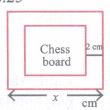
Let the length of the side of the chess board be x cm. Then
Area of 64 squares = (x - 4)2
(x - 4)2 = 64 x 6.25
⇒ x2-8x+ 16=400
⇒X2- 8x - 384 =0
⇒ X2- 24x + 16x - 384 = 0
⇒(x - 24)(x + 16) = 0
⇒ x=24 cm.
67.
Here a = 24, d = 21-24 = -3, Sn = 78. We need to find n.
We know that,
Sn= \(\frac{n}{2}\) (2a + (n - 1)d)
78 = \(\frac{n}{2}\) 48 + (n -1)(-3))
78 = \(\frac{n}{2}\) 2(51-3n)
or 3n2 - 51n + 156 = 0
n2 -17n + 52 = 0
(n - 4)(n - 13) = 0
n = 4 or 13
The number of terms are 4 or 13.
68.
1,-1,-3, -5, ...
t2 - t1 = -1 - 1 = -2
t3 - t2 = -3 - (-1)= -2
t4 - t3 = -5 - (-3) = -2
The given list of numbers form an A.P with the common difference -2.
The next two terms are (-5 + (-2)) = -7, -7 + (-2) = -9.
69.
A = {1,2,3,4,5}
B = {1,2,3,4, ... }
f: A \(\rightarrow\)B, f(x) = x2
\(\therefore\) f(1) = 12 = 1
f(2) = 22= 4
f(3) = 32 = 9
f(4) = 42= 16
f(5) = 52= 25
\(\therefore\) Range of f = {1, 4, 9, 16, 25}
Elements in A have been connected with different elements in B. Therefore it is one-one function. But not all the elements in B have preimages in A. Therefore it is not on-to function.
70.
Since the given points are collinear, the area a the triangle formed by them must be 0, i.e.,
= \(\frac { 1 }{ 2 } \) [2(k + 3) + 4(-3 - 3) + 6(3 - k)] = 0
= \(\frac { 1 }{ 2 } \) [-4k] = 0
k = 0
Area of ΔABC
= \(\frac { 1 }{ 2 } \)[2(0 + 3) + 4(-3 - 3) + 6(3 - 0)] = 0
71.
It is both one-one and onto function
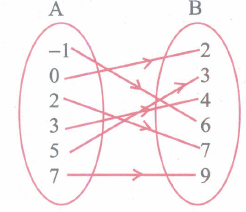
All the elements in A have their separate images in B. All the elements in B have their preimage in A. Therefore it is one-one and onto function.
72.
\(\sqrt { { 37x }^{ 2 }-28{ x }^{ 3 }+4{ x }^{ 4 }+42x+9 } =?\)
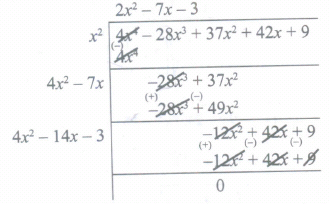
\(\therefore \sqrt { { 37x }^{ 2 }-28{ x }^{ 3 }+4{ x }^{ 4 }+42x+9 } \)
=|2x2 - 7x - 3|
73.
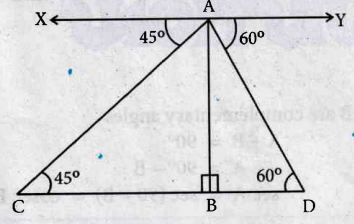
Let C and D are two ships.
Let AB be the height of the light house.
\(\mathrm{CD}=200\left(\frac{\sqrt{3}+1}{\sqrt{3}}\right) m\)
In the right ABD
\(\tan 60^{\circ}=\frac{A B}{B D} \)
\(\sqrt{3}=\frac{A B}{B D} \)
\(\mathrm{BD}=\frac{A B}{\sqrt{3}} \)
In the right triangle ABC
\(\tan 45^{\circ} =\frac{A B}{B C} \)
\(1 =\frac{A B}{B C} \)
\(B C =A B \)
\((1)+(2) \Rightarrow B D +B C=\frac{A B}{\sqrt{3}}+A B \)
\(\mathrm{CD}=A B\left(\frac{1}{\sqrt{3}}+1\right) \quad[\because \mathrm{CB}+\mathrm{BD}=\mathrm{CD}] \)
\(\frac{C D}{\left(\frac{1}{\sqrt{3}}+1\right)}=\mathrm{AB} \)
\(A B=\frac{200\left(\frac{\sqrt{3}+1}{\sqrt{3}}\right)}{\left(\frac{\sqrt{3}+1}{\sqrt{3}}\right)}\)
AB = 200 m
Height of the light house is 200 m.
74.
Let AD be the electronic pole and BC be the tower.
From the right triangle \(\triangle\) ABC
\(\tan 60^{\circ}=\frac{B C}{A B}\)
\(\sqrt{3}=\frac{15}{A B}\)
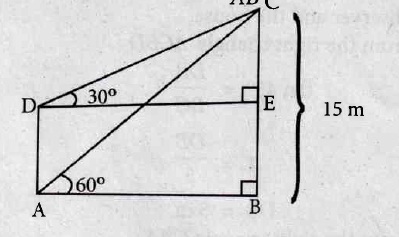
\(A B=\frac{15}{\sqrt{3}}\) ....(1)
\(\tan 30^{\circ}=\frac{C E}{D E}\)
\(
\frac{1}{\sqrt{3}}=\frac{C B-E B}{A B} \quad[\because \mathrm{DE}=\mathrm{AB} \text { and } \mathrm{CE}=\mathrm{CB}-\mathrm{EB}]
\)
\(\frac{1}{\sqrt{3}}= \frac{15-D A}{A B} \quad[\because \mathrm{EB}=\mathrm{DA}]
\)
\(\mathrm{AB} =(15-\mathrm{AD}) \sqrt{3}\) ...(2)
\(
\frac{15}{\sqrt{3}} =(15-A D) \sqrt{3}
\)
\(15 =(15-A D) \sqrt{3} \cdot \sqrt{3}\)
= (15 - AD)3
15 = 45 - 3AD
3AD = 45-15
3AD = 30
\(\mathrm{AD}=\frac{30}{3}=10 \mathrm{~m}\)
Height of the electric pole = 10 m
75.
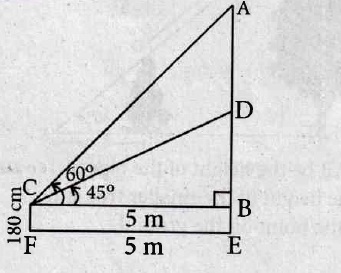
Let CF be the height of the man; AD be the height of the window; BC is the distance between the observer and the house.
From the right triangle \(\triangle\)CBD
\( \tan 45^{\circ} =\frac{D B}{B C} \)
\(1 =\frac{D B}{5} \)
DB = 5m ...(1)
From the right triangle CBA
\( \tan 60^{\circ} =\frac{A B}{C B} \)
\(\sqrt{3} =\frac{A D+D B}{5} \)
\(5 \sqrt{3} =\mathrm{AD}+5 \quad[\because \text { from }(1) D B=5 \mathrm{~m}] \)
\(\mathrm{AD} =5 \sqrt{3}-5=5(\sqrt{3}-1) \)
\(\mathrm{AD} =5(1.732-1) \)
\( {[\text {Given } \sqrt{3}=1.732] }\)
= 5 x 0.732 = 3.660
Height of the window = 3.66 m
76.
Given area of triangle is 5
Vertices of triangle are (2, 1), (3, - 2) and (x, y)
Area of triangle = \(\frac{1}{2}\left[x_{1}\left(y_{2}-y_{3}\right)+x_{2}\left(y_{3}-y_{1}\right)+x_{3}\left(y_{1}-y_{2}\right)\right]=5\)
2(-2 - y) + 3(y - 1) + x(1 + 2) = 10
-4 - 2y + 3y - 3 + 3x = 10
3x + y = 17
Given that Y = x + 3, Substituting in (1)
3x + x + 3 = 17
4x = 4
x = 7/2
and y = 7/2 + 3
= 13/2
Third vertex is (7/2, 13/2)
77.
| xi | fi | xifi | di = xi - \(\bar { x } \) | di2 | fidi2 |
| 6 | 3 | 18 | -3 | 9 | 27 |
| 7 | 6 | 42 | -2 | 4 | 24 |
| 8 | 9 | 72 | -1 | 1 | 9 |
| 9 | 13 | 117 | 0 | 0 | 0 |
| 10 | 8 | 80 | 1 | 1 | 8 |
| 11 | 5 | 55 | 2 | 4 | 20 |
| 12 | 4 | 48 | 3 | 9 | 36 |
| N = 48 | Σxifi = 432 | Σdi = 0 | Σfidi2 = 124 |
Mean
\(\bar { x } =\frac { \Sigma { x }_{ i }{ f }_{ i } }{ N } =\frac { 432 }{ 48 } \) = 9 (Since N = Σfi)
Standard deviation
σ =\(\sqrt { \frac { \Sigma { f }_{ i }{ d }_{ i }^{ 2 } }{ N } } =\sqrt { \frac { 124 }{ 48 } } =\sqrt { 2.58 } \)
σ ≃ 1.6
Assumed Mean method:
Let x1, x2, x3, ......x4 be the given data with frequencies f1, f2, f3, ... fn respectively.
Let \(\bar { x } \) be their mean and A be the assumed mean
di = xi - A
Standard deviation σ = \(\sqrt { \frac { \Sigma { f }_{ i }{ d }_{ i }^{ 2 } }{ N } -\left( \frac { \Sigma { f }_{ i }{ d }_{ i } }{ N } \right) ^{ 2 } } \).
78.
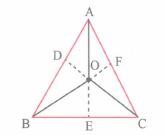
In \(\Delta AOB\) OD is the bisector of \(\angle AOB\)
\(\therefore \frac { OA }{ OB } =\frac { AD }{ DB } \) ...(1)
In \(\Delta BOC\) OE is the bisector of \(\angle BOC\)
\(\therefore \frac { OB }{ OC } =\frac { BE }{ EC } \) ...(2)
In \(\Delta COA\) OF is the bisector of \(\angle COA\)
\(\therefore \frac { OC }{ OA } =\frac { CF }{ FA } \) ...(3)
Multiplying the corresponding sides of (1), (2) and (3), we get
\(\frac{O A}{O B} \times \frac{O B}{O C} \times \frac{O C}{O A} \mid=\frac{A D}{D B} \times \frac{B E}{E C} \times \frac{C F}{F A}\)
\(1=\frac { AD }{ DB } \times \frac { BE }{ EC } \times \frac { CF }{ FA } \)
\(\Rightarrow \) DB x EC x FA = AD x BE x CF
AD x BE x CF = DB x EC x FA
Hence proved.
79.
Given, n = 5
| xi | xi2 |
| 2 | 49 |
| 3 | 9 |
| 5 | 25 |
| 7 | 49 |
| 8 | 64 |
| Σxi = 25 | Σxi2 = 151 |
Standard deviation
σ = \(\sqrt { \frac { { \Sigma d }_{ i }^{ 2 } }{ n } -\left( \frac { { \Sigma d }_{ i } }{ n } \right) ^{ 2 } } \)
σ = \(\sqrt { \frac { 151 }{ 5 } -\left( \frac { 25 }{ 5 } \right) ^{ 2 } } =\sqrt { 30.2-25 } =\sqrt { 5.2 } \) ≃ 2.28
When we multiply each data by 4, we get the new values as 8, 12, 20, 28, 32.
| xi | xi2 |
| 8 | 64 |
| 12 | 144 |
| 20 | 400 |
| 28 | 784 |
| 32 | 1024 |
| Σxi = 100 | Σxi2 = 2416 |
Standard deviation
σ = \(\sqrt { \frac { { \Sigma d }_{ i }^{ 2 } }{ n } -\left( \frac { { \Sigma d }_{ i } }{ n } \right) ^{ 2 } } \)
= \(\sqrt { \frac { 2416 }{ 5 } -\left( \frac { 100 }{ 5 } \right) ^{ 2 } } =\sqrt { 483.2-400 } =\sqrt { 83.2 } \)
σ = \(\sqrt { 16\times 5.2 } =4\sqrt { 5.2 } \) ≃ 9.12
80.
Given that intercepts are in the ratio 2 : 5
\(\frac{a}{b} =\frac{2}{5} \)
\(a =\frac{2 b}{5} \)
Equation of the line in Intercepts form is \(\frac{x}{a}+\frac{y}{b}=1\)
\(\frac{x}{\left(\frac{2 b}{5}\right)}+\frac{y}{b}=1 \)
\(\frac{5 x}{2 b}+\frac{y}{b}=1 \)
5x + 2y = 2b
This passes through ( 1, - 4)
5(1) + 2(-4) = 2b
\(5-8=2 b \Rightarrow b=-\frac{3}{2} \)
\(a =\frac{2 b}{5}=\frac{2\left(-\frac{3}{2}\right)}{5}=-\frac{3}{5} \)
Equation of a straight line is
\(\frac{x}{a}+\frac{y}{b}=1 \Rightarrow \frac{x}{\left(-\frac{3}{5}\right)}+\frac{y}{\left(-\frac{3}{2}\right)}=1\)
\(\frac{5 x}{-3}+\frac{2 y}{-3}=1\)
5x + 2y + 3 = 0.
81.
Radius of sphere = 12 cm
Volume of sphere = \(\frac{4}{3} \pi r^{3} cu. units
\)
= \(\frac{4}{3} \pi(12)^{3}
\)
\(=2304 \pi \mathrm{cm}^{3}\)
Radius of cylinder = 8 cm
height = h cm
Volume of cylinder = \(\pi r^{2} h
\) cu. units
= \(\pi(8)^{2} h
\)
= \(64 \pi \mathrm{h} \mathrm{cm}^{3}\)
Given that sphere is melted and cast into a cylinder
Volume of cylinder = Volume of sphere
\(64 \pi h =2304 \pi
\)
\(h =\frac{2304 \pi}{64 \pi}=36
\)
Height of the cylinder = 36 cm.
82.
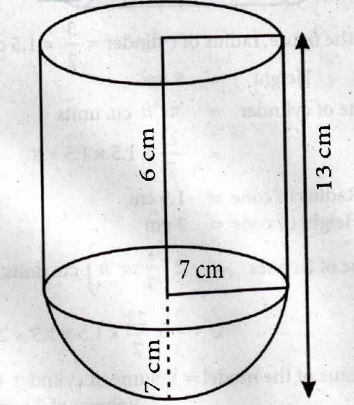
Diameter of the bowl = 14 cm
Radius r = 7 cm
Volume of hemisphere \(=\frac{2}{3} \pi r^{3} \text { cu. units } \)
\(=\frac{2}{3} \times \frac{22}{7} \times 7 \times 7 \times 7 \)
\(=\frac{2156}{3}=1718.67 \mathrm{~cm}^{3} \)
Radius of cylinder 'r' = 7 cm
Height 'h' = 6 cm
Volume of cylinder \(=\pi r^{2} h \text { cu. units } \)
\(=\frac{22}{7} \times 7 \times 7 \times 6 \)
= 924 cm3
capacity of the vessel = Volume of hemisphere + Volume of cylinder
= 718.67 + 924
= 1642.67 cm3
83.
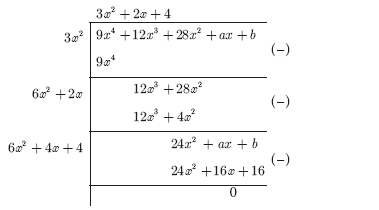
Because the given polynomial is a perfect square a - 16 = 0, b - 16 = 0
Therefore, a = 16, b = 16.
84.
\(f(x)=\frac { x-1 }{ x+1 } ,x\neq 0\)
\(f(f(x))=f\left( \frac { x-1 }{ x+1 } \right) =\frac { \left( \frac { x-1 }{ x+1 } \right) -1 }{ \left( \frac { x-1 }{ x+1 } \right) +1 } \)
\(=\frac{\frac{\not x-1-x-1}{(\not x+1)}}{\frac{\not x-1+x+1}{(\not x+1)}}=\frac{-2}{2 x}=\frac{-1}{x}\)
Hence it is proved.
85.
Radius of conical container = 10 m
Height of conical container = 15 m
Volume \(=\frac{1}{3} \pi r^{2} h \text { cu. units } \)
\(=\frac{1}{3} \times \frac{22}{7} \times 10 \times 10 \times 15 \)
\(=\frac{11000}{7} m^{3} \)
water is released at the rate of 25 m3 / min
Time required to empty the container
\(= \frac{11000}{7} \)
\(= \frac{11000}{25}=62.85 \)
= 63 minutes (approx)
86.
Internal diameter = 20 cm
External diameter = 28 cm
Internal radius = 10 cm
External radius = 14 cm
Total surface area \(=\pi\left(3 \mathrm{R}^{2}+\mathrm{r}^{2}\right) \text { sq. units } \)
\(=\frac{22}{7}\left(3(14)^{2}+(10)^{2}\right) \)
\(=\frac{22}{7}[588+100] \)
\(=\frac{22}{7} \times 688 \)
\(=\frac{15136}{7} \mathrm{~cm}^{2} \)
Cost of painting per sq.cm = Rs 0.14
Total cost \(=\frac{15136}{7} \times 0.14\)
= Rs. 302.72
87.
\(A=\left[ \begin{matrix} p & 0 \\ 0 & 2 \end{matrix} \right] ,B=\left[ \begin{matrix} 0 & -q \\ 1 & 0 \end{matrix} \right] ,C=\left[ \begin{matrix} 2 & -2 \\ 2 & 2 \end{matrix} \right] \)
\(BA={ C }^{ 2 }\Rightarrow \left[ \begin{matrix} 0 & -q \\ 1 & 0 \end{matrix} \right] \left[ \begin{matrix} p & 0 \\ 0 & 2 \end{matrix} \right] \)
\(=\left[ \begin{matrix} 2 & -2 \\ 2 & 2 \end{matrix} \right] \left[ \begin{matrix} 2 & -2 \\ 2 & 2 \end{matrix} \right] \)
\(\Rightarrow \left[ \begin{matrix} 0 & -2q \\ p & 0 \end{matrix} \right] =\left[ \begin{matrix} (4-4) & (-4-4) \\ (4+4) & (-4+4) \end{matrix} \right] \)
\({ -2q=-8\\ q=4 }{ | }{ p=8\\ q=4 }\)
88.
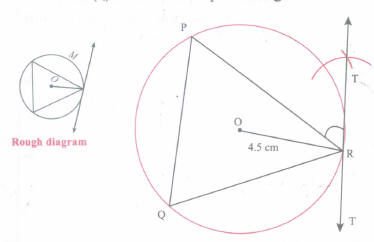
Construction:
(1) With O as the centre, draw a circle of radius 4.5 cm.
(2) Taken a point L on the circle through L drawn as chord LM
(3) Taken a point M distinct from L and N on the circle so that L, M, N are anti-clock wise direction. Joined LN and NM.
(4) Through 'L' drawn a tangent TT' such that \(\angle T L M=\angle M N L\)
(5) TT' is the required tangent.
89.
Given a triangle PQR, we are required to construct another triangle whose sides are \(\frac { 3 }{ 5 } \) of the corresponding sides of the triangle PQR
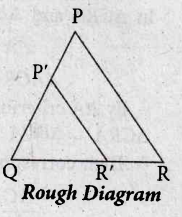
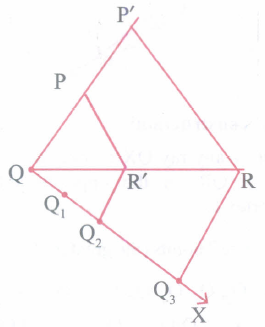
Steps of construction:
1. Constructed a PQR with any measurement.
2. Drawn a ray QX making an acute angle with QR on the side opposite to the vertex P.
Located 3 points Q1, Q2 and Q3 on QX so that Q Q1 = Q1 Q2 = Q2 Q3
4. Joined Q3R and drawn a line through Q2 parallel to Q3R to intersect QR at R'.
5. Drawn a line through R' parallel to the line RP to intersect QP at P'. Then PQR is the required triangle each of whose sides is two-thirds of the corresponding sides of PQR.

10th Standard Syllabus & Materials
10th Standard
TN 10th English Prose - 2 - The Night the Ghost Got in Important Questions And Answers Study Material - QB365 Set A
NEW10th Standard
TN 10th English Supplementary - 1 - The Tempest Important Questions And Answers Study Material - QB365 Set A
NEW10th Standard
TN 10th English Poem - 1 - Life Important Questions And Answers Study Material - QB365 Set A
NEW10th Standard
TN 10th English Prose - 1 - His First Flight Important Questions And Answers Study Material - QB365 Set A



Tamilnadu Stateboard 10th Standard Subjects
Tamilnadu Stateboard Standards





