
 100% FREE ACCESS
10th Standard Syllabus & Materials
10th Standard
TN 10th English Prose - 4 - The Attic Important Questions And Answers Study Material - QB365 Set A
NEW10th Standard
TN 10th English Supplementary - 3 - The Story of Mulan Important Questions And Answers Study Material - QB365 Set A
NEW10th Standard
TN 10th English Poem - 3 - I am Every Woman Important Questions And Answers Study Material - QB365 Set A
NEW10th Standard
TN 10th English Prose - 3 - Empowered Women Navigating The World Important Questions And Answers Study Material - QB365 Set A
NEW10th Standard
TN 10th English Supplementary - 2 - Zigzag Important Questions And Answers Study Material - QB365 Set A
NEW10th Standard
TN 10th English Poem - 2 - The Grumble Family Important Questions And Answers Study Material - QB365 Set A

Published on: 29/10/2022
QB365 provides a detailed and simple solution for every Possible Creative Questions in Class 10 Maths Subject -Algebra , English Medium. It will help Students to get more practice questions, Students can Practice these question papers in addition to score best marks.
Download Tamil Nadu 10th Standard Maths question papers, model tests, one-mark questions, important questions, and public exam papers in PDF format. Free study materials and answer keys for TN State Board students.
Questions + Answers key
Take MCQ Maths Test1.
A garment shop announces a 50% discount on every purchase of items for their customers. Draw the graph for the relation between the Marked Price and the Discount. Hence find
(i) the marked price when a customer gets a discount of Rs.3250 (from graph)
(ii) the discount when the marked price is Rs.2500.
2.
A car left 30 minutes later than the scheduled time. In order to reach its destination 150 km away in time, it has to increase its speed by 25 km/br from its usual speed. Find its usual speed
3.
A train covered a certain distance at a uniform speed. If the train would have been 10 km/hr faster it would have taken 2 hour less than the scheduled time and if the train were slower by 10 km/hr, it would have taken 3 hour more than the scheduled time. Find the distance covered by the train.
4.
Simplify : \(\frac{a^{2}-16}{a^{3}-8} \times \frac{2 a^{2}-3 a-2}{2 a^{2}+9 a+4} \div \frac{3 a^{2}-11 a-4}{a^{2}-2 a+4}\)
5.
solve the equation \(\frac{1}{x+1}+\frac{2}{x+2}=\frac{4}{x+4}, \text { where }x+1 \neq 0, x+2 \neq 0 \text { and } x+4 \neq 0 \text { using quadratic formula.}\)
6.
Find the values of a and b if \(16 x^{4}-24 x^{3}+(a-1) x^{2}+(b+1) x+49 \text { is a perfect square. }\)
7.
\(\text { Solve }: 2 x+y+4 z=15, x-2 y+3 z=13,3 x+y-z=2\)
8.
\(\text { Given } \mathbf{A}=\left[\begin{array}{ccc} 1 & 1 & -1 \\ 2 & 0 & 3 \\ 3 & -1 & 2 \end{array}\right], B=\left[\begin{array}{ll} 1 & 3 \\ 0 & 2 \\ 1 & 4 \end{array}\right] \text { and }C=\left[\begin{array}{cccc} 1 & 2 & 3 & -4 \\ 2 & 0 & -2 & 1 \end{array}\right], \text { show that }(A B) C=A BC.\)
9.
\(\text { If } A=\left[\begin{array}{rr} 1 & 0 \\ -1 & 7 \end{array}\right] \text { and } I=\left[\begin{array}{ll} 1 & 0 \\ 0 & 1 \end{array}\right], \text { then prove }\text { that } \mathrm{A}^{2}-8 \mathrm{~A}+7 \mathrm{I}=0\)
10.
\(\text { If } \mathbf{A}=\left[\begin{array}{cc} 1 & -1 \\ 2 & 3 \end{array}\right], B=\left[\begin{array}{ll} 2 & 1 \\ 1 & 0 \end{array}\right], \text { verify that } (A+B)^{2} \neq A^{2}+2 A B+B^{2}\)
11.
A plane left 30 minutes later than the scheduled time and in order to reach its destination 1500 km away in time it has to increase its speed by 250 km/hr from its usual speed. Find its usual speed.
12.
Two water taps together can fill a tank in \(9 \frac{3}{8}\) hours. The tap of lager diameter takes 10 hours less than the smaller one to fill the tank separately. Find the time in which each tap can separately fill the tank.
13.
Sum of the areas of two squares is 468 m2. If the difference of their perimeters is 24 m, find the sides of the two squares
14.
\(\text { Solve } x=3 z-5,2 x+2 z=y+16,7 x-5 z=3 y+19\)
15.
\(\text { Solve } 4 x-2 y+3 z=1, x+3 y-4 z=-7,3 x+y+2 z=5\)
1.
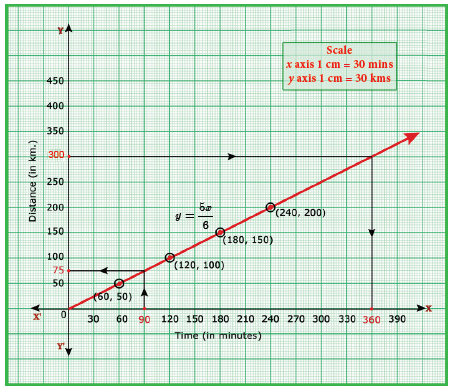
Let x be the time taken in minutes and y be the distance travelled in km.
\(\begin{array}{|l|l|l|l|l|} \hline \text { Time taken } \mathbf{x} \text { (in minutes) } & 60 & 120 & 180 & 240 \\ \hline \text { Distance } \mathbf{y} \text { (in km) } & 50 & 100 & 150 & 200 \\ \hline \end{array}\)
(i) Observe that as time increases, the distance travelled also increases. Therefore, the variation is a direct variation. It is of the form y = kx .
Constant of variation
\(k=\frac{y}{x}=\frac{50}{60}=\frac{100}{120}=\frac{150}{180}=\frac{200}{240}=\frac{5}{6}\)
Hence, the relation may be given as
\(y=k x \ \Rightarrow \ y=\frac{5}{6} x\)
(ii) From the graph, \(y=\frac{5 x}{6},\) if x = 90 , then \(y=\frac{5}{6} \times 90=75 \mathrm{~km}\)
The distance travelled for \(1 \frac{1}{2}\)hours (i.e.,) 90 minutes is 75 km.
(iii) From the graph, \(y=\frac{5 x}{6}, \text { if } y=300\) then \(x=\frac{6 y}{5}=\frac{6}{5} \times 300=360\) minutes (or) 6 hours.
The time taken to cover 300 km is 360 minutes, that is 6 hours.
2.
Usual speed = x km/hr
After increasing speed = x + 25 km/hr
Distance = 150 km
\(\text { Time }=\frac{\text { Distance }}{\text { speed }}\)
\(\frac{150}{x}-\frac{150}{x+25}=\frac{1}{2} h r \ \left[\because 30 \mathrm{~min}=\frac{1}{2} h r\right]\)
\(150 x+\frac{150 \times 25}{x(x+25)}-150 x=\frac{1}{2}\)
\(150 \times 25 \times 2 =x(x+25) \)
\(7500 =x^{2}+25 x \)
\(x^{2}+25 x-750 =0 \)
\((x-75)(x+100) =0 \)
\(x =75 \text { (or) } x=-100 \)
x is +ve
x = 75km/hr
speed = 75 km/hr
3.
Let speed be x
and time be y
Distance = speed x time
Therefore Distance = xy
\((x+10)(y-2)=x y \)
\(x y-2 x+10 y-20=x y \)
\(-2 x+10 y=20 \)
\(x-5 y=-10 \)
\(\text {From condition(2) }\)
\((x-10)(y+3)=x y \)
\(x y+3 x-10 y-30=x y \)
\(3 x-10 y=30 \)
\((2) \Rightarrow 3 x-10 y=30\)
\(\text { (1) } \times 3 \Rightarrow 3 x-15 y =-30 \)
\(5 y =60 \)
\(y =12 \)
\(\text { (1) } \Rightarrow x-5(12) =-10 \)
\(x-60 =-10 \)
\(x =50 \mathrm{~km} / \mathrm{hr} \)
\(\text { Distance } =x y \)
\(=50 \times 12 \)
\(=600 \mathrm{~km} \)
4.
\(\frac{a^{2}-16}{a^{3}-8} \times \frac{2 a^{2}-3 a-2}{2 a^{2}+9 a+4} \div \frac{3 a^{2}-11 a-4}{a^{2}-2 a+4}\)
\(\frac{(a+4)(a-4)}{(a-2)\left(a^{2}+2 a+4\right)} \times \frac{(2 a+1)(a-2)}{(2 a+1)(a+4)} \times \frac{a^{2}-2 a+4}{(3 a+1)(a-4)}\)
\(=\frac{a^{2}-2 a+4}{(3 a+1)\left(a^{2}+2 a+4\right)}\)
5.
\(\frac{1}{x+1}+\frac{2}{x+2} =\frac{4}{x+4} \)
\(\frac{x+2+2 x+2}{(x+1)(x+2)} =\frac{4}{x+4} \)
\((3 x+4)(x+4) =4(x+1)(x+2) \)
\(3 x^{2}+16 x+16 =4\left(x^{2}+3 x+2\right) \)
\(3 x^{2}+16 x+16 =4 x^{2}+12 x+8
\)
\(3 x^{2}+16 x+16-4 x^{2}-12 x-8=0 \)
\(-x^{2}+4 x+8=0 \)
\(\Rightarrow x^{2}-4 x-8=0
\)
\(\text { By formula method, }\)
\(x =\frac{-b \pm \sqrt{b^{2}-4 a c}}{2 a} \)
\(a =1, b=-4, c=-8 \)
\(x =\frac{4 \pm \sqrt{16+32}}{2}=\frac{4 \pm \sqrt{48}}{2} \)
\(=\frac{4 \pm 4 \sqrt{3}}{2} \)
\(x =2 \pm 2 \sqrt{3}
\)
6.
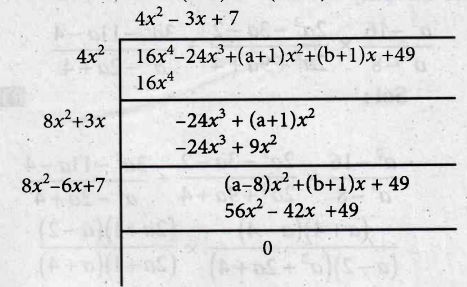
\(16 x^{2}-24 x^{3}+(a-1) x^{2}+(b+1) x+49\)
Case: I
a - 8 - 56 = 0
b + 1 + 42 = 0
a = 65, b = -43
Case: II
a - 8 - 56 = 0
b + 1 + 42 = 0
a + 48 = 0 , b - 41 = 0
a = -48, b = 41
7.
\(2 x+y+4 z=15 \) ...(1)
\(x-2 y+3 z=13 \) ...(2)
\(3 x+y-z=2 \) ...(3)
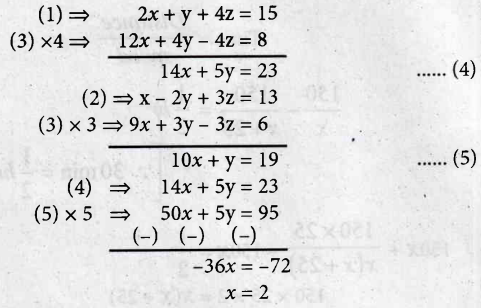
\(\text { Sub } x=2 \text { in }(5), \)
\(10(2)+y =19 \)
\(20+y =19 \)
\(y =19-20 \Rightarrow y=-1 \)
\(\text { Sub : } x=2 \text { and } y=-1 \text { in (1) }\)
\(2(2)-1+4 z =15 \)
\(3+4 z =15 \)
\(4 z =15-3 \)
\(4 z =12 \)
\(z =3 \)
\(x=2 ; y =1 ; z=3 \)
8.
\(A B=\left[\begin{array}{ccc}
1 & 1 & -1 \\
2 & 0 & 3 \\
3 & -1 & 2
\end{array}\right]\left[\begin{array}{ll}
1 & 3 \\
0 & 2 \\
1 & 4
\end{array}\right]\)
\(=\left[\begin{array}{cc}
1+0-1 & 3+2-4 \\
2+0+3 & 6+0+12 \\
3+0+2 & 9-2+8
\end{array}\right]\)
\(=\left[\begin{array}{cc}
0 & 1 \\
5 & 18 \\
5 & 15
\end{array}\right]\)
LHS = (AB) C
\(=\left[\begin{array}{cc}
0 & 1 \\
5 & 18 \\
5 & 15
\end{array}\right]\left[\begin{array}{cccc}
1 & 2 & 3 & -4 \\
2 & 0 & -2 & 1
\end{array}\right]\)
\(=\left[\begin{array}{cccc}
0+2 & 0+0 & 0-2 & 0+1 \\
5+36 & 10+0 & 15-36 & -20+18 \\
5+30 & 10+0 & 15-30 & -20+15
\end{array}\right]\)
\(=\left[\begin{array}{cccc}
2 & 0 & -2 & 1 \\
41 & 10 & -21 & -2 \\
35 & 10 & -15 & -5
\end{array}\right]\)
\(\text { Now, } B C=\left[\begin{array}{ll}
1 & 3 \\
0 & 2 \\
1 & 4
\end{array}\right]\left[\begin{array}{rrrr}
1 & 2 & 3 & -4 \\
2 & 0 & -2 & 1
\end{array}\right]\)
\(=\left[\begin{array}{cccc}
1+6 & 2+0 & 3-6 & -4+3 \\
0+4 & 0+0 & 0-4 & 0+2 \\
1+8 & 2+0 & 3-8 & -4+4
\end{array}\right]\)
\(=\left[\begin{array}{cccc}
7 & 2 & -3 & -1 \\
4 & 0 & -4 & 2 \\
9 & 2 & -5 & 0
\end{array}\right]\)
\(A(B C)=\left[\begin{array}{ccc}
1 & 1 & -1 \\
2 & 0 & 3 \\
3 & -1 & 2
\end{array}\right]\left[\begin{array}{rrrr}
7 & 2 & -3 & -1 \\
4 & 0 & -4 & 2 \\
9 & 2 & -5 & 0
\end{array}\right]\)
\(=\left[\begin{array}{rrrr}
7+4-9 & 2+0-2 & -3-4+5 & -1+2+0 \\
14+0+27 & 4+0+6 & -6+0-15 & -2+0+0 \\
21-4+18 & 6+0+4 & -9+4-10 & -3-2+0
\end{array}\right]\)
\(=\left[\begin{array}{cccc}
2 & 0 & -2 & 1 \\
41 & 10 & -21 & -2 \\
35 & 10 & -15 & -5
\end{array}\right]\)
LHS = RHS
\(\therefore\) (AB)C = A(BC)
Hence proved
9.
\(\mathrm{A}^{2}=\mathrm{A} \cdot \mathrm{A}\)
\(=\left[\begin{array}{rr}
1 & 0 \\
-1 & 7
\end{array}\right]\left[\begin{array}{rr}
1 & 0 \\
-1 & 7
\end{array}\right] \)
\(=\left[\begin{array}{rr}
1+0 & 0+0 \\
-1-7 & 0+49
\end{array}\right] \)
\(=\left[\begin{array}{rr}
1 & 0 \\
-8 & 49
\end{array}\right]
\)
\(8 A=8\left[\begin{array}{rr}
1 & 0 \\
-1 & 7
\end{array}\right]=\left[\begin{array}{rr}
8 & 0 \\
-8 & 56
\end{array}\right]\)
\(7 I=7\left[\begin{array}{ll}
1 & 0 \\
0 & 1
\end{array}\right]=\left[\begin{array}{ll}
7 & 0 \\
0 & 7
\end{array}\right]\)
\(\therefore A^{2}-8 A+7 I=\left[\begin{array}{rr}
1 & 0 \\
-8 & 49
\end{array}\right]-\left[\begin{array}{rr}
8 & 0 \\
-8 & 56
\end{array}\right]+\left[\begin{array}{cc}
7 & 0 \\
0 & 7
\end{array}\right]\)
\(=\left[\begin{array}{rr}
-7+7 & 0 \\
0+0 & -7+7
\end{array}\right]\)
\(=\left[\begin{array}{ll}
0 & 0 \\
0 & 0
\end{array}\right]=0\)
Hence proved
10.
\(A+B=\left[\begin{array}{cc}
1 & -1 \\
2 & 3
\end{array}\right]+\left[\begin{array}{ll}
2 & 1 \\
1 & 0
\end{array}\right]=\left[\begin{array}{ll}
3 & 0 \\
3 & 3
\end{array}\right]\)
\((A+B)^{2}=(A+B)(A+B)\)
\(=\left[\begin{array}{ll}
3 & 0 \\
3 & 3
\end{array}\right]\left[\begin{array}{ll}
3 & 0 \\
3 & 3
\end{array}\right]\)
\(=\left[\begin{array}{ll}
9+0 & 0+0 \\
9+9 & 0+9
\end{array}\right]=\left[\begin{array}{rr}
9 & 0 \\
18 & 9
\end{array}\right]\)
\(\text { Now } A^{2}=A \cdot A=\left[\begin{array}{cc}
1 & -1 \\
2 & 3
\end{array}\right]\left[\begin{array}{cc}
1 & -1 \\
2 & 3
\end{array}\right]\)
\(=\left[\begin{array}{ll}
1-2 & -1-3 \\
2+6 & -2+9
\end{array}\right]=\left[\begin{array}{rr}
-1 & -4 \\
8 & 7
\end{array}\right]\)
\(A B=\left[\begin{array}{cc}
1 & -1 \\
2 & 3
\end{array}\right]\left[\begin{array}{ll}
2 & 1 \\
1 & 0
\end{array}\right]\)
\(=\left[\begin{array}{ll}
2-1 & 1+0 \\
4+3 & 2+0
\end{array}\right]=\left[\begin{array}{ll}
1 & 1 \\
7 & 2
\end{array}\right]\)
\(B^{2}=B \cdot B\)
\(=\left[\begin{array}{ll}
2 & 1 \\
1 & 0
\end{array}\right]\left[\begin{array}{ll}
2 & 1 \\
1 & 0
\end{array}\right] \)
\(=\left[\begin{array}{cc}
4+1 & 2+0 \\
2+0 & 1+0
\end{array}\right] \)
\(=\left[\begin{array}{ll}
5 & 2 \\
2 & 1
\end{array}\right]
\)
\(\text { Now } A^{2}+2 A B+B^{2}\)
\(=\left[\begin{array}{rr}
-1 & -4 \\
8 & 7
\end{array}\right]+\left[\begin{array}{rr}
2 & 2 \\
14 & 4
\end{array}\right]+\left[\begin{array}{ll}
5 & 2 \\
2 & 1
\end{array}\right]\)
\(=\left[\begin{array}{rr}
6 & 0 \\
24 & 12
\end{array}\right]\)
\(\text { from }(1),(2),(\mathrm{A}+\mathrm{B})^{2} \neq \mathrm{A}^{2}+2 \mathrm{AB}+\mathrm{B}^{2}\)
11.
Let the usual speed of the plane be x km/hr and usual time to cover 1500 km \(=\frac{1500}{x} \mathrm{hrs}\)
Given that speed increased by 250 km/hr.
Time taken to cover the distance with new speed = \(\frac{1500}{x+150}\)
\(\therefore \frac{1500}{x+250}-\frac{1500}{x}=\frac{1}{2}\)
On Simplifying we get, x2 + 250x - 750000 = 0
x(x+ 1000) -750 (x+ 1000) = 0
(x - 750) (x + 1000) = 0
x = 750, x = - 1000 is not possible.
\(\therefore\) The usual speed of the plane is 750 km/hr.
12.
Let the larger tap fill the tank in 'x' hours.
\(\therefore\) Smaller tap fill the tank in (x + 10) hours (given)
Portion of tank filled by larger tap in I hour \(= \frac{1}{x}\)
Portion of tank filled by smaller tap in t hour \(=\frac{1}{x+10}\)
\(\text { Given, Both the taps can fill the tank in } 9 \frac{3}{8}=\frac{75}{8} \text {Hours}\)
[Time and work done are reciprocals of each other]
\(\frac{1}{x}+\frac{1}{x+10}=\frac{8}{75} \)
\(\frac{x+10+x}{x(x+10)}=\frac{8}{75} \)
\(75(2 x+10) =8\left(x^{2}+10 x\right) \)
\(8 x^{2}-70 x-750 =0 \)
\(4 x^{2}-35 x-375 =0 \)
\(4 x^{2}-60 x+25 x-375 =0 \)
\(4 x(x-15)+25(x-15) =0 \)
\((4 x+25)(x-15) =0 \)
\(\mathrm{x}=15, \ \mathrm{x}=\frac{-25}{7} \text { is not possible. }\)
\(\therefore\) Time required to fill the tank by the 1st tap is 15 hrs and by the 2nd tap is 25 hours.
13.
Let the sides of two squares be 'x' and 'y' respectively
Sum of areas x2 + y2 = 468
Difference of perimeters 4x - 4y = 24 [\(\because\) x > y ]
x - y = 6
y = x - 6
Substituting in (1)
\(x^{2}+(x-6)^{2} =468 \)
\(x^{2}+x^{2}-12 x+36-468 =0 \)
\(2 x^{2}-12 x-432 =0 \)
\(x^{2}-6 x-216 =0 \)
\((x-18)(x+12) =0 \)
\(x= 18\)
When x = 18:y = 18 - 6 = 12
\(\therefore\)The sides of two squares are 18 m and 12 m respectively.
14.
Standard form of the given equations
\(x-3 z=-5 \) ...(1)
\(2 x-y+2 z=16 \) ...(2)
\(7 x-3 y-5 z=19\) ...(3)
Consider (2) and (3)
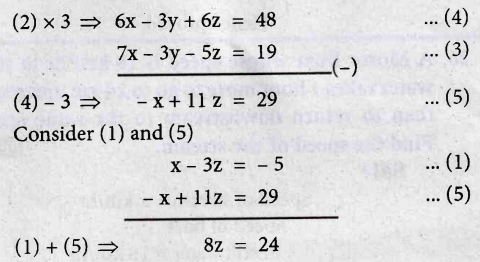
\(z=\frac{24}{8}=3\)
Substituting, \(z =3 \text { in }(1) \)
\(x =3(3)-5 \)
\(=9-5=4 \)
\(\text {Substituting,} \space x=4, z=3 \text { in (2) } \)
\(2(4)-y+2(3)=16\)
\(8+6-16=y\)
\(\Rightarrow \mathrm{y}=14-16=-2\)
\(\therefore \text { solution is } x=4, y=-2, z=3\)
15.
\(4 x-2 y+3 z =1 \)
\(x+3 y-4 z =-7 \)
\(3 x+y+2 z =5
\)
\(\text { Consider (2) and (3) }\)
\((3) \times(3) \Rightarrow \)
\(\begin{aligned}
&\begin{array}{r}
9 x+3 y+6 z=15 \\
x+3 y-4 z=-7 \\
\hline
\end{array}\\
&\text { (4) }-(2) \Rightarrow 8 x+10 z=22
\end{aligned}\)
Now consider (1) and (3)
\(\begin{aligned}
&(3) \times 2 \Rightarrow 6 x+2 y+4 z=10 \\
&4 x-2 y+3 z=1 \\
&\hline (6) +(1) \Rightarrow 10 x+7 z=11
\end{aligned}\)
Consider (5) and (7)
\(\begin{array}{r}
(5) \times 7 \Rightarrow 56 x+70 z=154 \\
(7) \times 10 \Rightarrow 100 x+70 z=110 \\
\hline (8)-(9) \Rightarrow -44 x=44
\end{array}\)
\(x=\frac{44}{44}=-1\)
Substituting, x = -1 is in (7)
10(-1) + 7z = 11
-10 + 7z = 11
7z = 11 + 10
\(z=\frac{21}{7}=3\)
Substituting, x = - 1,z = 3 is in (3)
3(-1) + y + 2(3) = 5
-3 + y + 6 = 5
y = 5 - 3 = 2
\(\therefore\) solution x = - 1,y = 2,z = 3

10th Standard Syllabus & Materials
10th Standard
TN 10th English Prose - 2 - The Night the Ghost Got in Important Questions And Answers Study Material - QB365 Set A
NEW10th Standard
TN 10th English Supplementary - 1 - The Tempest Important Questions And Answers Study Material - QB365 Set A
NEW10th Standard
TN 10th English Poem - 1 - Life Important Questions And Answers Study Material - QB365 Set A
NEW10th Standard
TN 10th English Prose - 1 - His First Flight Important Questions And Answers Study Material - QB365 Set A



Tamilnadu Stateboard 10th Standard Subjects
Tamilnadu Stateboard Standards





