
 100% FREE ACCESS
10th Standard Syllabus & Materials
10th Standard
TN 10th English Prose - 4 - The Attic Important Questions And Answers Study Material - QB365 Set A
NEW10th Standard
TN 10th English Supplementary - 3 - The Story of Mulan Important Questions And Answers Study Material - QB365 Set A
NEW10th Standard
TN 10th English Poem - 3 - I am Every Woman Important Questions And Answers Study Material - QB365 Set A
NEW10th Standard
TN 10th English Prose - 3 - Empowered Women Navigating The World Important Questions And Answers Study Material - QB365 Set A
NEW10th Standard
TN 10th English Supplementary - 2 - Zigzag Important Questions And Answers Study Material - QB365 Set A
NEW10th Standard
TN 10th English Poem - 2 - The Grumble Family Important Questions And Answers Study Material - QB365 Set A

Published on: 31/10/2022
QB365 provides a detailed and simple solution for every Possible Book Back Questions in Class 10 Maths Subject -Coordinate Geometry , English Medium. It will help Students to get more practice questions, Students can Practice these question papers in addition to score best marks.
Download Tamil Nadu 10th Standard Maths question papers, model tests, one-mark questions, important questions, and public exam papers in PDF format. Free study materials and answer keys for TN State Board students.
Questions + Answers key
Take MCQ Maths Test1.
Show that the given vertices form a right angled triangle and check whether its satisfies Pythagoras theorem A(1, - 4) , B(2, - 3) and C(4, - 7)
2.
The line through the points (-2, 6) and (4, 8) is perpendicular to the line through the points (8, 12) and (x, 24) . Find the value of x.
3.
4.
If the three points (3, - 1) , (a, 3) and (1, - 3) are collinear, find the value of a.
5.
Show that the given points are collinear: (-3, -4) , (7, 2) and (12, 5)
6.
What is the slope of a line perpendicular to the line joining A(5, 1) and P where P is the mid-point of the segment joining (4, 2) and (-6, 4).
7.
Find the slope of a line joining the points \(\left( 5,\sqrt { 5 } \right) \) with the origin
8.
What is the inclination of a line whose slope is 0
9.
What is the slope of a line whose inclination with positive direction of x - axis is 900
10.
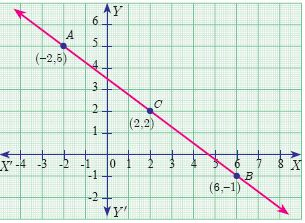
Show that the points (-2, 5), (6, -1) and (2, 2) are collinear
11.
The line p passes through the points (3, - 2), (12, 4) and the line q passes through the points (6, -2) and (12, 2). Is parallel to q ?
12.
The line r passes through the points (–2, 2) and (5, 8) and the line s passes through the points (–8, 7) and (–2, 0). Is the line r perpendicular to s ?
13.
Vertices of given triangles are taken in order and their areas are provided aside. In each case, find the value of ‘p’?
| S. No | Vertices | Area (sq. units) |
| (i) | (0, 0), (p, 8), (6, 2) | 20 |
| (ii) | (p, p), (5, 6), (5, -2) | 32 |
14.
Determine whether the sets of points are collinear? \((-\frac12 ,3)\), (- 5, 6) and (-8, 8)
15.
Find the area of the triangle formed by the points (1, –1), (–4, 6) and (–3, –5)
1.
Given vertices A(1, - 4) , B(2, - 3) and C(4, - 7)
Slope of the line = \(\frac{y_{1}-y_{2}}{x_{1}-x_{2}}\)
Slope of AB = \(\frac{-4+3}{1-2}=\frac{-1}{-1}=1
\)
Slope of BC = \(\frac{-3+7}{2-4}=\frac{4}{-2}=-2
\)
Slope of AC = \(\frac{-4+7}{1-4}=\frac{3}{-3}=-1
\)
(Slope of AB) x (Slope of AC) = - 1
AB is perpendicular to AC.
Hence, the given vertices form a right angled triangle
Distance between the points (x1, y1) and (x2, y2) is \(\sqrt{\left.\left(x_{1}-x_{2}\right)^{2}+y_{1}-y_{2}\right)^{2}}\) units
\(A B =\sqrt{(1-2)^{2}+(-4+3)^{2}}=\sqrt{1+1}=\sqrt{2}
\)
\(A B^{2} =(\sqrt{2})^{2}=2
\)
\(B C =\sqrt{(2-4)^{2}+(-3+7)^{2}}=\sqrt{4+16}=\sqrt{20}
\)
BC2 = 20
\(A C=\sqrt{(1-4)^{2}+(-4+7)^{2}}=\sqrt{9+9}=\sqrt{18}\)
AC2 = 18
Now, AB2 + AC2 = BC2
Hence, the Pythagoras theorem is satisfied.
2.
slope of the line = \(\frac{y_{1}-y_{2}}{x_{1}-x_{2}}\)
Slope of the line joining the points (- 2,6) and (4, 8)
\(m_{1}=\frac{6-8}{-2-4}=\frac{-2}{-6}=\frac{1}{3}\)
Slope of the line joining the points (8, 12) and (x, 24)
\(m_{2}=\frac{12-24}{8-x}=-\frac{12}{8-x}\)
Given that the lines are Perpendicular
m1 x m2 = -1
\(\frac{1}{3} \times \frac{-12}{8-x}=-1\)
4 = 8 - x
x = 8 - 4
X = 4.
3.
4.
Given points (3, - 1), (a, 3) and (1, - 3)
Let the points be A (3, - 1), B (a, 3) and C (1,- 3)
Slope of AB = \(\frac{y_{1}-y_{2}}{x_{1}-x_{2}}=\frac{-1-3}{3-a}=\frac{-4}{3-a}
\)
Slope of BC = \(\frac{y_{1}-y_{2}}{x_{1}-x_{2}}=\frac{3+3}{a-1}=\frac{6}{a-1}
\)
Since, the points A, B and C are collinear.
Slope of AB = Slope of BC
\(\frac{-4}{3-a}=\frac{6}{a-1}\)
-2 (a - 1) = 3(3 - a)
-2a + 2 = 9 - 3a
3a - 2a = 9 - 2
a = 7
5.
Given points (- 3, - 4), (7, 2) and (12, 5)
Let the points be A (- 3, - 4),8 (2, 2) and C (12, 5)
Slope of a line = \(\frac{y_{1}-y_{2}}{x_{1}-x_{2}}\)
Slope of AB = \(\frac{-4-2}{-3-7}=\frac{-6}{-10}=\frac{3}{5}
\)
Slope of BC = \(\frac{2-5}{7-12}=\frac{-3}{-5}=\frac{3}{5}
\)
Slope of AB = Slope of BC
The points A, B and C are collinear
6.
Mid point of line segment joining (4, 2) and (-6, 4)
\(\text { Mid point } =\left(\frac{x_{1}+x_{2}}{2}, \frac{y_{1}+y_{2}}{2}\right) \)
\(=P\left(\frac{4-6}{2}, \frac{2+4}{2}\right)
\)
\(=P\left(-\frac{2}{2}, \frac{6}{2}\right)=\mathrm{P}(-1,3)
\)
Now, slope of a line joining A (5, 1) and P (- 1, 3)
\(\mathrm{m}=\frac{y_{1}-y_{2}}{x_{1}-x}=\frac{1-3}{5+1}=\frac{-2}{6}=-\frac{1}{3}\)
Slope of a perpendicular to the line joining A and P
\(=-\frac{1}{m}=-\frac{1}{\left(-\frac{1}{3}\right)}=3\)
7.
Given points \(\left( 5,\sqrt { 5 } \right) \) and (0, 0)
Slope of a line = \(\frac{y_{1}-y_{2}}{x_{1}-x_{2}}(\text { or }) \frac{y_{2}-y_{1}}{x_{2}-x_{1}}\)
\(=\frac{\sqrt{5}-0}{5-0}=\frac{\sqrt{5}}{5}=\frac{1}{\sqrt{5}}\)
8.
Given slope 'm' = 0
tan θ = 0 = tan 00
θ = 00
9.
Given angle of inclination θ = 900
Slope of a line = tan θ
= tan900 = ∝ (undefined)
10.
Th e vertices are A(-2, 5) , B(6, -1) and C(2, 2).
Slope of AB = \(\frac { -1-5 }{ 6+2 } =\frac { -6 }{ 8 } =\frac { -3 }{ 4 } \)
Slope of BC = \(\frac { 2+1 }{ 2-6 } =\frac { 3 }{ -4 } =\frac { -3 }{ 4 } \)
We get, Slope of AB = Slope of BC
Therefore, the points A, B, C all lie in a same straight line.
Hence the points A, B and C are collinear.
11.
The slope of line p is m1 = \(\frac { 4+2 }{ 12-3 } =\frac { 6 }{ 9 } =\frac { 2 }{ 3 } \)
The slope of line p is m2 = \(\frac { 2+2 }{ 12-6 } =\frac { 4 }{ 6 } =\frac { 2 }{ 3 } \)
Thus, slope of line p = slope of line q.
Therefore, the line p is parallel to the line q.
12.
Th e slope of line r is m1 \(=\frac { 8-2 }{ 5+2 } =\frac { 6 }{ 7 } \)
The slope of line θ is m2 \(=\frac { 0-7 }{ -2+8 } =\frac { -7 }{ 6 } \)
The product of slopes \(=\frac { 6 }{ 7 } \times \frac { -7 }{ 6 } =-1\)
That is, m1m2 = -1
13.
(i) Given vertices are (0, 0), (P, 8) and (6,2)
Area of triangle = 20 sq. units.
Area of triangle = \(\frac{1}{2}\left[x_{1}\left(y_{2}-y_{3}\right)+\right. \left.x_{2}\left(y_{3}-y_{1}\right)+x_{3}\left(y_{1}-y_{2}\right)\right] \)
\(\frac{1}{2}\) [(8 - 2) + p (2 - 0) + 6 (0 - 8)] = 20
2p - 48 = 40
2P = 40 + 48
2P = 88
\(p=\frac{88}{2}=44\)
(ii) Given vertices are (p, p), (5,6) and (5, - 2)
Area of triangle = 32 sq. units
Area of triangle = \(\frac{1}{2}\left[x_{1}\left(y_{2}-y_{3}\right)+\right. \left.x_{2}\left(y_{3}-y_{1}\right)+x_{3}\left(y_{1}-y_{2}\right)\right] \)
\(\frac{1}{2}\) [p( 6 + 2) + 5(- 2 -p) + 5(P - 6) = 32
8p -10 - 5P + 5P - 30 = 64
8p - 40 = 64
8P = 64 + 40 = 104
\(p=\frac{104}{8}=13\)
14.
Given points are \((-\frac12 ,3)\), (- 5, 6) and (-8, 8)
Let us use area of triangle formula
Area of triangle = \(\frac{1}{2}\left[x_{1}\left(y_{2}-y_{3}\right)+\right.
\left.\quad x_{2}\left(y_{3}-y_{1}\right)+x_{3}\left(y_{1}-y_{2}\right)\right]
\)
\(=\frac{1}{2}\left[-\frac{1}{2}(6-8)-5(8-3)-8(3-6)\right]
\)
\(=\frac{1}{2}\left[-\frac{1}{2}(-2)-5(5)-8(-3)\right]
\)
\(=\frac{1}{2}[1-25+24]=\frac{1}{2}(0)=0
\)
Since, the area of triangle is zero, the given points are collinear.
15.
(1,–1), (–4, 6) and (–3, –5)
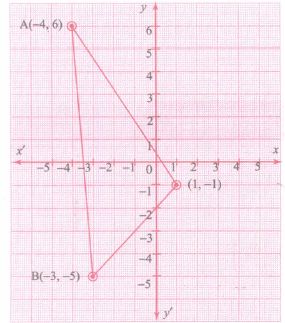
A(-4, 6), B(-3, -5), C(1, -1)
Area of triangle ABC \(
=\frac{1}{2}\left[\left(x_{1} y_{2}+x_{2} y_{3}+x_{3} y_{1}\right)\right.
\left.-\left(x_{2} y_{1}+x_{3} y_{2}+x_{1} y_{3}\right)\right]
\)
\(=\frac{1}{2}\left[x_{1}\left(y_{2}-y_{3}\right)+x_{2}\left(y_{3}-y_{1}\right)\right.
\left.+x_{3}\left(y_{1}-y_{2}\right)\right] \text { sq. units }
\)
\(=\frac{1}{2}[-4(-5+1)-3(-1-6)+1(6+5)]
\)
\(=\frac{1}{2}[-4 \times(-4)-3 \times(-7)+1 \times(11)]
\)
\(=\frac{1}{2}[16+21+11]
\)
\(=\frac{1}{2}(48)=24 \text { sq. units. }
\)

10th Standard Syllabus & Materials
10th Standard
TN 10th English Prose - 2 - The Night the Ghost Got in Important Questions And Answers Study Material - QB365 Set A
NEW10th Standard
TN 10th English Supplementary - 1 - The Tempest Important Questions And Answers Study Material - QB365 Set A
NEW10th Standard
TN 10th English Poem - 1 - Life Important Questions And Answers Study Material - QB365 Set A
NEW10th Standard
TN 10th English Prose - 1 - His First Flight Important Questions And Answers Study Material - QB365 Set A



Tamilnadu Stateboard 10th Standard Subjects
Tamilnadu Stateboard Standards





