
 100% FREE ACCESS
10th Standard Syllabus & Materials
10th Standard
TN 10th English Prose - 4 - The Attic Important Questions And Answers Study Material - QB365 Set A
NEW10th Standard
TN 10th English Supplementary - 3 - The Story of Mulan Important Questions And Answers Study Material - QB365 Set A
NEW10th Standard
TN 10th English Poem - 3 - I am Every Woman Important Questions And Answers Study Material - QB365 Set A
NEW10th Standard
TN 10th English Prose - 3 - Empowered Women Navigating The World Important Questions And Answers Study Material - QB365 Set A
NEW10th Standard
TN 10th English Supplementary - 2 - Zigzag Important Questions And Answers Study Material - QB365 Set A
NEW10th Standard
TN 10th English Poem - 2 - The Grumble Family Important Questions And Answers Study Material - QB365 Set A

Published on: 31/10/2022
QB365 provides a detailed and simple solution for every Possible Book Back Questions in Class 10 Maths Subject -Geometry , English Medium. It will help Students to get more practice questions, Students can Practice these question papers in addition to score best marks.
Download Tamil Nadu 10th Standard Maths question papers, model tests, one-mark questions, important questions, and public exam papers in PDF format. Free study materials and answer keys for TN State Board students.
Questions + Answers key
Take MCQ Maths Test1.
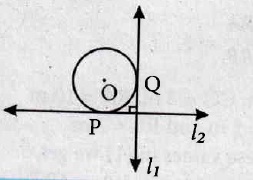
Can we draw two tangents perpendicular to each other on a circle?
2.
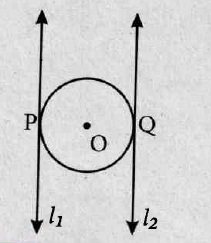
Can we draw two tangents parallel to each other on a circle?
3.
Can all the three sides of a right angled triangle be odd numbers? Why?
4.
Write down any five Pythagorean triplets?
5.
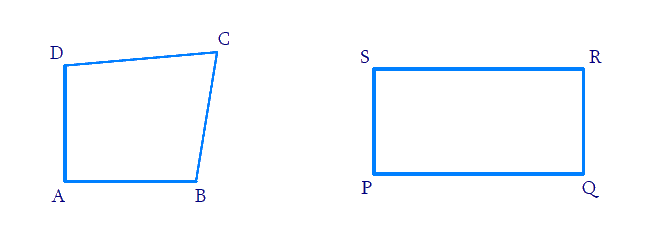
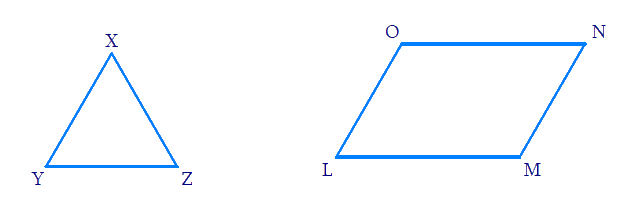
Give two different examples of pair of non-similar figures?
6.
Are any two right angled triangles similar? If so why?
7.
Are a rectangle and a parallelogram similar. Discuss.
8.
Are square and a rhombus similar or congruent. Discuss.
9.
D is the mid point of side BC and AE \(\bot \) BC. If BC = a, AC = b, AB = c, ED = x, AD = p and AE = h, prove that
\({ b }^{ 2 }+{ c }^{ 2 }={ 2p }^{ 2 }+\frac { { a }^{ 2 } }{ 2 } \)
10.
D is the mid point of side BC and AE \(\bot \) BC. If BC = a, AC = b, AB = c, ED = x, AD = p and AE = h, prove that
\({ c }^{ 2 }={ p }^{ 2 }-ax+\frac { { a }^{ 2 } }{ 4 } \)
11.
Check whether AD is bisector \(\angle\)A of \(\triangle\)ABC in each of the following AB = 4cm, AC = 6cm, BD = 1.6cm and CD = 2.4cm.
12.
In fig. if PQ || BC and PR || CD prove that
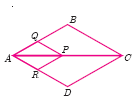
\(\frac { QB }{ AQ } =\frac { DR }{ AR } \)
13.
If figure OPRQ is a square and \(\angle\)MLN = 90o. Prove that
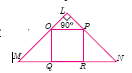
QR2 = MQ x RN
14.
If figure OPRQ is a square and \(\angle\)MLN=90o. Prove that
\(\triangle\)QMO ~\(\triangle\)RPN
15.
If figure OPRQ is a square and \(\angle\)MLN=90o. Prove that
\(\triangle\)LOP~\(\triangle\)RPN
16.
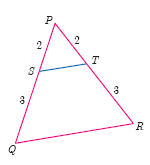
Show that \(\triangle\)PST~\(\triangle\)PQR
17.
D is the mid point of side BC and AE \(\bot \) BC. If BC = a, AC = b, AB = c, ED = x, AD = p and AE = h, prove that
\({ b }^{ 2 }={ p }^{ 2 }+ax+\frac { { a }^{ 2 } }{ 4 } \)
18.
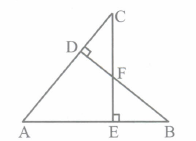
In the figure, if BD\(\bot \)AC and CE \(\bot \) AB, prove that
(i) \(\Delta AEC\sim \Delta ADB\)
(ii) \(\frac { CA }{ AB } =\frac { CE }{ DB } \)
19.
Two circles with centres O and O' of radii 3 cm and 4 cm, respectively intersect at two points P and Q, such that OP and O'P are tangents to the two circles. Find the length of the common chord PQ.
20.
In two concentric circles, a chord of length 16 cm of larger circle becomes a tangent to the smaller circle whose radius is 6 cm. Find the radius of the larger circle.
21.
A tangent ST to a circle touches it at B. AB is a chord such that \(\angle\)ABT= 65o. Find \(\angle\)AOB, where “O” is the centre of the circle.
22.
PQ is a tangent drawn from a point P to a circle with centre O and QOR is a diameter of the circle such that \(\angle\)PQR = 120o. Find \(\angle\)OPQ.
23.
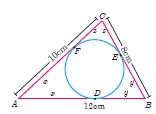
A circle is inscribed in \(\triangle\)ABC having sides 8 cm, 10 cm and 12 cm as shown in figure, find AD, BE and CF.
24.
\(\triangle\) LMN is a right angled triangle with \(\angle\)L = 90o. A circle is inscribed in it. The lengths of the sides containing the right angle are 6 cm and 8 cm. Find the radius of the circle.
25.
The length of the tangent to a circle from a point P, which is 25 cm away from the centre is 24 cm. What is the radius of the circle?
26.
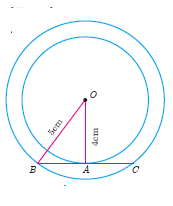
If radii of two concentric circles are 4 cm and 5 cm then find the length of the chord of one circle which is a tangent to the other circle
27.
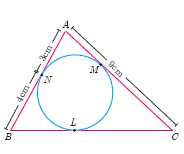
In Fig, \(\triangle\) ABC is circumscribing a circle. Find the length of BC.
28.
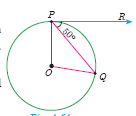
In Figure, O is the centre of a circle. PQ is a chord and the tangent PR at P makes an angle of 50o with PQ. Find \(\angle\)POQ,
29.
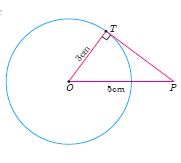
Find the length of the tangent drawn from a point whose distance from the centre of a circle is 5 cm and radius of the circle is 3 cm.
30.
The hypotenuse of a right triangle is 6 m more than twice of the shortest side. If the third side is 2 m less than the hypotenuse, find the sides of the triangle.
31.
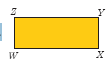
In the rectangle WXYZ, XY+YZ = 17 cm, and XZ + YW = 26 cm .Calculate the length and breadth of the rectangle
32.
A man goes 18 m due east and then 24 m due north. Find the distance of his current position from the starting point?
33.
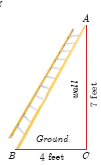
What length of ladder is needed to reach a height of 7 ft along the wall when the base of the ladder is 4 ft from the wall? Round off your answer to the next tenth place.
34.
An insect 8 m away initially from the foot of a lamp post which is 6 m tall, crawls towards it moving through a distance. If its distance from the top of the lamp post is equal to the distance it has moved, how far is the insect away from the foot of the lamp post?
35.
Check whether AD is bisector \(\angle\)A of \(\triangle\)ABC in each of the following AB = 5cm, AC = 10cm, BD = 1.5cm and CD = 3.5cm
36.
In \(\triangle\)ABC, AD is the bisector of \(\angle\)A meeting side BC at D, if AB = 10 cm, AC = 14 cm and BC = 6 cm, find BD and DC
37.
In fig. if PQ || BC and PR ||CD prove that
\(\frac { AB }{ AD } =\frac { AQ }{ AB } \)
38.
In \(\triangle\)ABC, D and E are points on the sides AB and AC respectively. For each of the following cases show that DE||BC
AB = 12 cm, AD = 8 cm, AE = 12 cm and AC = 18 cm.
39.
ABCD is a trapezium in which AB || DC and P,Q are points on AD and BC respectively, such that PQ || DC if PD = 18 cm, BQ = 35 cm and QC = 15 cm, find AD.
40.
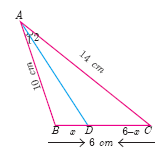
In the Figure, AD is the bisector of \(\angle\)BAC, if A = 10 cm, AC = 14 cm and BC = 6 cm. Find BD and DC.
41.
In the figure, AD is the bisector of \(\angle\)A. If BD = 4 cm, DC = 3 cm and AB = 6 cm, find AC.
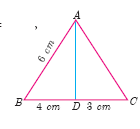
42.
D and E are respectively the points on the sides AB and AC of a \(\triangle\)ABC such that AB = 5.6 cm, AD = 1.4 cm, AC = 7.2 cm and AE = 1.8 cm, show that DE || BC
43.
In the figure OPRQ is a square and \(\angle\)MLN = 90o. Prove that
\(\triangle\)LOP ~\(\triangle\)QMO
44.
In the adjacent figure, \(\triangle\) ACB~\(\triangle\) APQ. If BC = 8 cm, PQ = 4 cm, BA = 6.5 cm and AP = 2.8 cm, find CA and AQ.
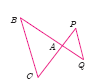
45.
In the adjacent figure, \(\triangle\)ABC is right angled at C and DE\(\bot \) AB. Prove that \(\triangle\)ABC~\(\triangle\)ADE and hence find the lengths of AE and DE.
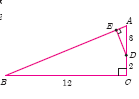
46.
Two triangles QPR and QSR, right angled at P and S respectively are drawn on the same base QR and on the same side of QR. If PR and SQ intersect at T, prove that PT x TR = ST x TQ. \(\triangle\)
47.
A vertical stick of length 6 m casts a shadow 400 cm long on the ground and at the same time a tower casts a shadow 28 m long. Using similarity, find the height of the tower.
48.
Check whether the triangles are similar and find the value of x.
(i)
.png)
(ii)
.png)
49.
If \(\triangle\)ABC is similar to \(\triangle\)DEF such that BC = 3 cm, EF = 4 cm and area of \(\triangle\)ABC = 54 cm2. Find the area of \(\triangle\)DEF.
50.
The perimeters of two similar triangles ABC and PQR are respectively 36 cm and 24 cm. If PQ = 10 cm, find AB
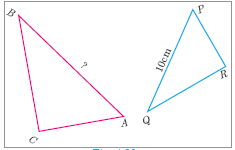
51.
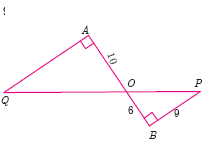
QA and PB are perpendiculars to AB. If AO = 10 cm, BO = 6 cm and PB = 9 cm. Find AQ.
52.
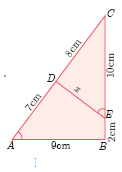
\(\angle A=\angle CED\) prove that \(\Delta\ CAB \sim \Delta CED\) Also find the value of x.
53.
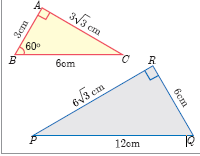
Observe Fig and find \(\angle\)P
54.
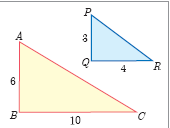
Is \(\triangle\)ABC ~ \(\triangle\)PQR?
55.
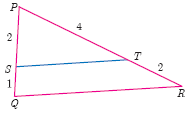
Show that \(\triangle\) PST~\(\triangle\) PQR
1.
Yes. we can draw two tangents perpendicular to each other.
2.
Yes. we can draw two tangents parallel to each other on a circle in two different points on the circle.
3.
No, AII the three sides of a right angled triangle cannot be odd numbers
If \(\triangle\)ABC is right angled triangle with \(\angle\)B = 90o, then AC2 = AB2 + BC2
If AB and BC are odd, then their squares AB2 and BC2 are odd numbers.
Their sum AB2 + BC2 is an even number.
Square root of AB2 + BC2 is also an even number.
AC is even
So three measures cannot be odd.
4.
(3,4,5), (9, 12, l5), (12,16,20), (8, 15,17) (15, 20, 25)
5.
Give two different examples of pair of
(i) similar figures
(ii) non-similar figures
(i) Two examples of pair of similar figures.
Two equilateral triangles of sides 2 cm and 6 cm.
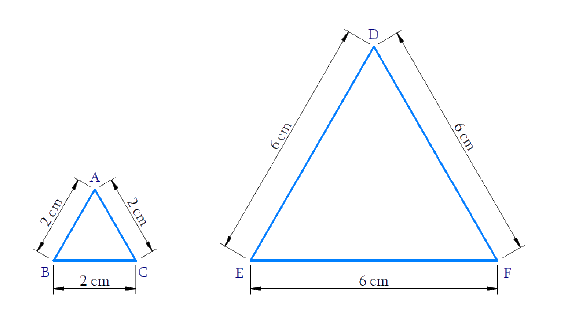
∆ABC ~ ∆DEF (~ denotes similar to)
Two squares of sides 3 cm and 5 cm
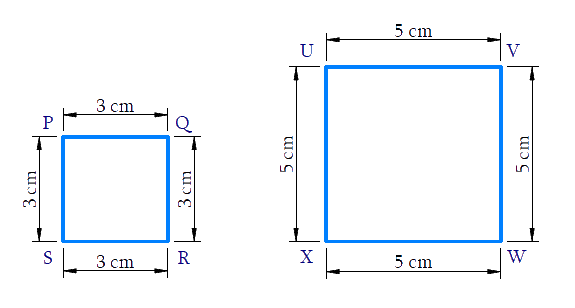
PQRS ∼ UVWX
(ii) Two examples of pair of non-similar figures.
A quadrilateral and a rectangle.
A triangle and a parallelogram.
6.
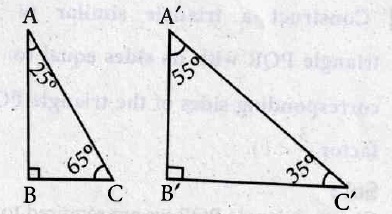
For any two right angled triangles.
The angles other than right angle need not be equal.
The corresponding sides need not be proportional.
Any two right angled triangles need not be similar.
7.
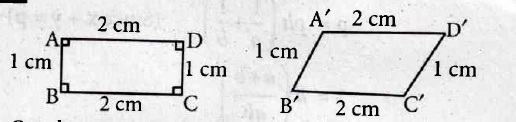
On observing the given figures.
Their corresponding sides are proportional but their corresponding angles are not equal.
The shapes parallelogram and rectangle are not similar.
8.
For a rhombus
1. All sides are equal.
2. The diagonals of a rhombus are perpendicular bisectors of one another.
3. Opposite angles are equal.
For a square
1. All sides are equal
2. All angles are 90o.
3. Diagonals are equal and perpendicular bisectors of each other.
For both the shapes the angles are not equal, but corresponding sides are proportional. so they are neither similar nor congruent.
9.
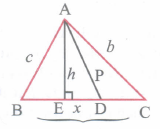
From (i) and (ii) we get
\(\begin{array}{r} A C^{2}+A B^{2}=A D^{2}+B C \cdot D E+\frac{1}{4} B C^{2}+A D^{2}- B C \cdot D E+\frac{B C^{2}}{4} \end{array}\)
\(=2 A D^{2}+2\left(\frac{B C^{2}}{4}\right)\)
\(A C^{2}+A B^{2}=2 A D^{2}+\frac{B C^{2}}{2}\)
\(b^{2}+c^{2}=2 p^{2}+\frac{a^{2}}{2}\)
10.
Again in \(\triangle A B C, \angle A E D=\angle A E B=90^{\circ}\)
By Pythagoras theorem.
AB2 = AE2 + EB2
= AD2 - DE2 + (BD - DE)2
= AD2 - DE2 + BD2 + DE2 -2BD.DE
= AD2 + BD2 - 2BD.DE
\( \mathrm{AB}^{2} =\mathrm{AD}^{2}+\left(\frac{1}{2} B C\right)^{2}-2 \cdot \frac{1}{2} \mathrm{BC} \cdot \mathrm{DE} \)
\(\mathrm{AB}^{2} =\mathrm{AD}^{2}+\frac{1}{4} B C^{2}-\mathrm{BC} \cdot \mathrm{DE} \)
\(\mathrm{AB}^{2} =\mathrm{AD}^{2}-\mathrm{BC} \cdot \mathrm{DE}+\frac{1}{4} B C^{2} \ldots(2) \)
\(\mathrm{c}^{2} =\mathrm{p}^{2}-\mathrm{ax}+\frac{a^{2}}{4}\)
11.
AB = 4 cm,
AC = 6 cm,
BD = 1.6 cm,
CD = 2.4 cm.
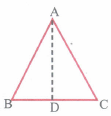
\( \frac{A B}{A C}=\frac{4}{6}=\frac{2}{3} \)
\(\frac{B D}{D C}=\frac{1.6}{2.4}=\frac{2}{3} \)
\(\frac{A B}{A C}=\frac{B D}{D C} \)
By the converse of the Angle Bisector theorem AD is the bisector of \(\angle\)A
12.
From (1) and (2) we have
\(\frac{A Q}{A B} =\frac{A R}{A D}
\)
\(\frac{A B}{A Q} =\frac{A D}{A R}
\)
\(\frac{A Q+Q B}{A Q} =\frac{A R+R D}{A R}
\)
\(1+\frac{Q B}{A Q} =1+\frac{R D}{A R}
\)
\(\Rightarrow \frac{Q B}{A Q} =\frac{D R}{A R}
\)
13.
We have
\(\Delta \)QMO ~ \(\Delta \)RPN
\(\frac { MQ }{ RP } =\frac { QO }{ RN } \)
\(\frac{M Q}{Q R}=\frac{Q R}{R N}\)
[ \(\because\)OQRP is a square PR = QR and QO = QR]
QR x QR = MQ x RN
QR2 = MQ x RN
14.
Also In \(\Delta \)QMO & \(\Delta \)RPN
\(\angle \)QMO~\(\angle \)RPN = 90o
we have \(\Delta \) LOP ~ \(\Delta \)QMO and \(\Delta \)LOP ~ \(\Delta \)RPN
\(\Delta \)QMO ~ \(\Delta \)RPN
15.
In \(\Delta \)LOP & \(\Delta \)PRN,
we have
\(\angle \)PLO = \(\angle\)NRP = 90°
and \(\angle\)LPO = \(\angle\)PNR (corresponding angles)
By AA criterion of similarity
\(\Delta \)LOP~\(\Delta \)RPN
16.
In \(\triangle\)PST and \(\triangle\)PQR
\(\frac { PS }{ PQ } =\frac { 2 }{ 2+3 } =\frac { 2 }{ 5 } ,\frac { PT }{ PR } =\frac { 2 }{ 2+3 } =\frac { 2 }{ 5 } \)
Thus, \(\frac { PS }{ PQ } =\frac { PT }{ PR } \) and \(\angle\)P is is common
Therefore, by SAS similarity,
\(\triangle\)PST~\(\triangle\)PQR
17.
From the figure, D is the mid point of BC.
We have \(\angle A E D=90^{\circ}\)
Given BC = a, AC = b, AB = c, ED = x, AD = P and AE = h
In \(\triangle\)AEC, by Pythagoras theorem
AC2 = AE2 + EC2
AC2 = AE2 + (ED + DC)2
AC2 = AE2 + ED2 + DC2 + 2.E.D. DC
AC2 = (AE2 + ED2) + DC2 + 2 ED . DC
AC2 = AD2 + DC2 + 2 ED. DC
\(\mathrm{AC}^{2}=\mathrm{AD}^{2}+\left(\frac{1}{2} B C\right)^{2}+2\left(\frac{1}{2} B C\right) D E\)
[D is the mid point of BC, BD,= DC]
\( A C^{2} =A D^{2}+\mathrm{BC} \cdot \mathrm{DE}+\frac{1}{4} B C^{2} \ldots .(1) \)
\(\text { i.e., } b^{2} =\mathrm{P}^{2}+\mathrm{ax}+\frac{1}{4} a^{2} \)
\(\mathrm{~b}^{2} =\mathrm{p}^{2}+\mathrm{ax}+\frac{a^{2}}{4}\)
18.
\(\Delta AEC\quad \Delta ADB\)
\(\angle AEC=\angle ADB={ 90 }^{ 0 }\)
\(\angle C A E=\angle B A D\)
[common By AA similarity criteria]
\(\Delta AEC\sim \Delta ADB\)
(ii) Their corresponding sides are Proportional
\(\frac{C A}{A B}=\frac{C E}{D B}\)
Hence proved.
19.
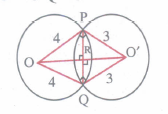
Since the tangents at a point to a circle is
perpendicular to the radius through the point of contact
\(\therefore \angle O P O^{\prime}=90^{\circ}\)
OP2 + OP2 = (OO')2
[By Pythagoras theorem]
32 + 42 = (OO')2
9+16 = (OO')2
25 = (OO')2
OO' = 5cm
Since the line joining the centres of two intersecting circles is perpendicular bisector of their common chord.
\(\mathrm{OR} \perp \mathrm{PQ} \text { and } O^{\prime} \mathrm{R} \perp \mathrm{PQ}\)
AIso PR = QR
Let OR = x, then O'R = 5 - x
AIso at PR = QR = y cm
\(\text { In } \triangle O R P \text { and } \Delta O^{\prime} R P\)
Applying Pythagoras theorem
OP2 = OR3 + RP2 and O'P'2 = O'R2 + RP2
\(3^{2}=x^{2}+y^{2} and 4^{2}=(5-x)^{2}+y_{i}^{2} \)
\(Subtracting \Rightarrow 4^{2}-3^{2}=\left\{(5-x)^{2}+y^{2}\right\}-\left(x^{2}+y^{2}\right) \)
\(16-9=25-10 x+x^{2}+y^{2}-x^{2}-y^{2} \)
7 - 25 = 10x
10x = 25 - 7
10x = 18
x = 1.8 cm
32 = x2 + y2
\(y=\sqrt{9-(1.8)^{2}}=\sqrt{5.76}\)
y = 2.4cm
Hence PR = QR = 2.4 cm
PQ = 2y = 4.8 cm
20.
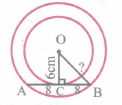
Let o be the center of concentric circles and APB be the chord of length 16 cm of the larger circle touching the smaller circle at p.
Then OP \(\perp\) AB and p is the midpoint of AB.
AP = PB = 8 cm
In LOPA, we have
OA2 = OP2 + AP2 [By Pythagoras Theorem]
OA2 = 62 + 82
OA2 = 36 + 64
OA2 = 100
OA = 10cm
Radius of the larger circle in 10 cm
21.
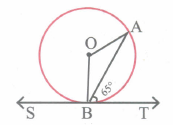
Given TB is the tangent from the external point T and OB-radius
\(\angle OBT={ 90 }^{ 0 }\)
\( \angle A B T =65^{\circ} \)
\(\therefore \angle O B A =\angle O B T-\angle A B T \)
= 90o - 65o = 25o
Since OA = OB [radius]
\(\triangle\)ABO is an isosceles triangle.
Angles opposite to equal sides are equal.
\( \therefore \angle O B A=\angle B A O=25^{\circ} \)
\(Now\ in\ \triangle A O B, \)
\(\angle A O B+\angle O B A+\angle O A B =180^{\circ} \)
\(\angle A O B+25^{\circ}+25^{\circ} =180^{\circ}\) [sum of angles of a triangle]
\(\angle\)AOB +50o = 180o
\(\angle\)AOB = 180o - 50o = 130o
\(\angle\)AOB = 130o
22.
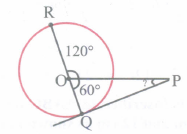
Given PQ is the tangent from the point P outside the circle and OQ is the radius.
We know that tangent meet the radius perpendicularly
\( \therefore \angle P Q O =90^{\circ} \)
\(\angle P O Q =180-120=60^{\circ} \)
\( [\because\ \angle\ P O Q \ and\ \angle P O R\ are \ linear\ pair \ of\ angles]\)
\( In \ \triangle P O O \angle P O O+\angle P O O+\angle O P Q=180^{\circ}\)
[sum of angles of a triangle]
60o + 90o + \(\angle\)OPQ = 180o
\(\angle\)OPQ = 180o - 150o
\(\angle\)OPQ = 30o
23.
We know that the tangents drawn from are external point to a circle are equal.
Therefore AD AF = x
BD = BE = y
and CE = CF = z
Now, AB = 12 cm, BC = 8 cm, and CA = 10 cm.
x + y = 12,y + z = 8 and z + x = 10
(x + y) + (y + z) + (z + x) = 12 + 8 + 10
2(x + y + z) = 30
x+ y + z = 15
Now, x + y = 12 and x + y + z = 15
12 + z = 15
Z = 3
y + z = 8 and x + y + z = 15
\(x+8=15\Rightarrow x=7\)
and z + x = 10 and x + y + z = 15
\(10+y=15\Rightarrow y=5\)
Hence, AD = x = 7cm,
BE = y = 5 cm and
CF = z = 3 cm
24.
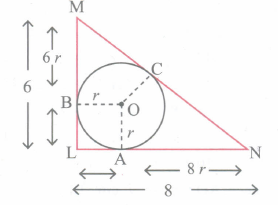
Given \(\triangle\)LMN is a right angled triangle with \(\angle\)L = 90o
By Pythagoras theore
Since PL ∥ OQ,PL= r = OP
we have NR=NP=NL−PL
[ NR and NP are tangents]
= (6 - r)cm
MR = MQ = ML- LQ = (8 - r) cm
[MR and MQ are tangents]
NM = NR+ RM
= (6 - r + 8 - r)cm
= (14 - 2r) cm
Now NM2 = NL2 + LM2 [By pythagoras Theorem]
(14-2r)2 = 82+62
(14-2r)2 = 64+36
25.
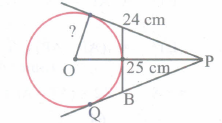
Let 'O' be the center of the circle AP be the tangent.
Given OA = 25 cm; AP = 24 cm. Op is the radius.
Tangent and radius through the point are perpendicular to each other.
In the right triangle \(\triangle\)OPA,
OA2 = OP2 + PA2
252 = OP2 + 242
625 = OP2 + 576
OP2 = 625 - 576 = 49
OP = 7cm
Radius = 7cm
26.
OA = 4 cm, OB = 5 cm; also OA\(\bot \)BC.
OB2 = OA2 + AB2
52 = 42 + AB2 gives AB2 = 9
Therefore AB = 3 cm
BC = 2AB hence BC = 2 x 3 = 6 cm
27.
AN = AM = 3 cm (Tangents drawn from same external point are equal)
BN = BL = 4 cm
CL = CM = AC - AM = 9 - 3 = 6 cm
Gives BC = BL + CL = 4 + 6 = 10 cm
28.
\(\angle\)OPQ = 90o - 50o = 40o (angle between the radius and tangent is 90o)
OP = OQ (Radii of a circle are equal)
\(\angle\)OPQ = \(\angle\)OQP = 40o (\(\triangle\)OPQ is isosceles)
\(\angle POQ={ 180 }^{ 0 }-\angle OPQ-\angle OQP\)
\(\angle\)POQ = 180o - 40o- 40o = 100o.
29.
Given OP = 5 cm, radius r = 3 cm
To find the length of tangent PT.
In right angled \(\triangle\)OTP
OP2 = OT2 + PT2 gives PT2 = 25 - 9 = 16
Length of the tangent PT = 4cm
30.
Let \(\triangle\)ABC be the right triangle with \(\angle\)B = 90 o
Let the shortest side of the right triangle be x m.
Then Hypotenuse AC = (2x + 6) m
Third side BC = [(2x + 6) - 2] m
= (2x + 6 - 2)m
= (2x + 4) m
By Pythagoras theorem
AC2 = AB2 + BC2
(2x+ 6)2 - x2 + [2x + 4]2
4x2 +36 + 24x = x2 + 4x2 + 16+ 16x
4x2 + 24x + 36 = 5x2 + 16x + 16
5x2 + 16x+ 16- 4x2 -24x- 36 = 0
x2 - 8x - 20 = 0
(x + 2)(x - 10) = 0
x = -2 or x = 10
Length cannot be negative.
x = 10m
AB = 10m
BC = 2x + 4 = 2(10) + 4
= 24m
AC = 2x + 6 = 2(10) + 6 = 26m
The sides of the triangle are 10 m, 24m, 26m.
31.
XY + CZ = 17cm
XZ + YW = 26cm
We know that diagonals if a rectangle bisect each other and the diagonals have equal length.
\(\therefore \text { Each diagonal }=\frac{26}{2}=13 \mathrm{~cm}\)
i.e., XZ = 13 cm and YW = 13 cm
Also given XY + YZ = 17 cm
Squaring on both sides (XY + YZ)2 = 172
\((\mathrm{XY})^{2}+(\mathrm{YZ})^{2}+2 \times(\mathrm{XY}) \times(\mathrm{YZ})=289\)
By Pythagoras theorem (XY)2 + (YZ)2 = XZ2
\(\therefore[\mathrm{XZ}]^{2}+2(\mathrm{XY}) \times(\mathrm{YZ})=289\)
132 + 2 x length x breadth = 289
2 x Area = 289 - 169
\(\text { Area }=\frac{289-169}{2}=\frac{120}{2}\)
The possible length and breadth are
(1,60) (2,30) (3,20) (4, 15), (5, 12) (6, 10).
In this pair the length and breadth should satisfy Pythagoras theorem for diagonal.
5,12 is the possible length and breadth.
32.
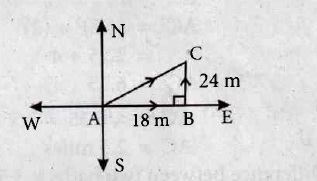
Let the initial position of the man be A and his final position.be C
Since the man goes 18 m east and then 24 m north, LABC is a right angled triangle with \(\angle\)B =90o; AB = 18 m and BC = 24m.
By Pythagoras theorem, we have
AC2 - AB2 + BC2
AC2 = 182 + 242
AC2 = 324 + 576
AC2 = 900 = 30 x 30
AC = 30m
His current distance from starting point = 30 m
33.
Let x be the length of the ladder. BC = 4 ft, AC = 7 fit.
By Pythagoras theorem we have, AB2 = AC2 + BC2
x2 = 72 + 42 gives x2 = 49 + 16
x2 = 65, Hence \(x=\sqrt { 65 } \)
The number \(\sqrt { 65 } \) is between 8 and 8.1.
82 = 64 < 65.61 = 8.12
Therefore, the length of the ladder is approximately 8.1ft
34.
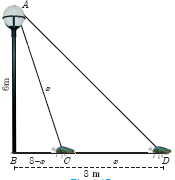
Distance between the insect and the foot of the lamp post BD = 8 m
The height of the lamp post, AB = 6 m
After moving a distance of x m, let the insect be at C
Let, AC = CD = x . Then BC = BD − CD = 8 − x
In \(\triangle\)ABC, \(\angle\)B = 90o
AC2 = AB2 + BC2 gives x2 = 62 + (8 - x)2
x2 = 36 + 64 − 16x + x2
16x = 100 then x = 6.25
Then, BC = 8 − x = 8 − 6.25 = 1.75m
Therefore the insect is 1.75 m away from the foot of the lamp post.
35.
AB = 5 cm,
AC = 10 cm,
BD = 1.5 cm,
CD = 3.5 cm.
\( \frac{A B}{A C}=\frac{5}{10}=\frac{1}{2} \)
\(\frac{B D}{D C}=\frac{1.5}{3.5}=\frac{3}{7} \)
\(\frac{A B}{A C} \neq \frac{B D}{D C} \)
By the converse of the angle bisector theorem, AD is not a bisector of \(\angle\)A
36.

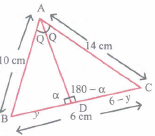
Assume BD=y
BC-CD =y
6-CD =y
CD =6-y
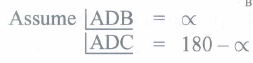
In, \(\Delta ABD,\frac { BD }{ sin\theta } =\frac { AB }{ sin\propto } \Rightarrow \frac { 10 }{ sin\propto } \)
\(\Rightarrow sin\propto =\frac { 10 }{ y } sin\theta \)
In \(\Delta ACD,\frac { CD }{ sin\theta } =\frac { AC }{ sin\left( 180-\propto \right) } \)
\(\Rightarrow \frac { 6-y }{ sin\theta } =\frac { 14 }{ sin\propto } \)
Substituting (1) in (2),
\(\frac { 6-y }{ sin\theta } =\frac { 14 }{ \frac { 10 }{ y } sin\theta } \Rightarrow 6-y=\frac { 14y }{ 10 } \)
\(\Rightarrow y\left( 1+\frac { 14 }{ 10 } \right) =6\Rightarrow y\left( \frac { 24 }{ 10 } \right) =6\)
\(\Rightarrow y=\frac { 60 }{ 24 } \Rightarrow y=2.5\)
\(\therefore\) BD = 2.5 km and CD = 3.5 cm
37.
In \(\triangle\)ACB,
PQ || CB
Using Basic Proportionality theorem, we have
\(\frac{A Q}{A B}=\frac{A P}{A C}\)
Again in \(\triangle\)ACD PR || CD
Using Basic Proportionality theorem
\(\frac{A P}{A C}=\frac{A R}{A D}\)
From (1) and (2)
\(\frac{A Q}{A B}=\frac{A P}{A C}=\frac{A R}{A D} \)
Thus we have \(\frac{A R}{A D}=\frac{A Q}{A B} \)
38.
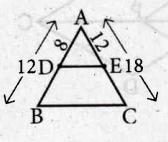
Given AB = 12 cm, AD = 8 cm, AE = 12 cm, AC = 18 cm
By basic proportionality theorem \(\frac{A D}{D B}=\frac{A E}{E C}\)
\(\frac{A D}{D B}=\frac{8}{A B-A D}=\frac{8}{12-8} \)
\(\frac{A D}{D B}=\frac{8}{4}=2 \)
\(\frac{A E}{E C}=\frac{12}{A C-A E} \)
\(\frac{A E}{E C}=\frac{12}{18-12}=\frac{12}{6}=2 \)
From (1) and (2)
\(\frac{A D}{D B}=\frac{A E}{E C}\)
DE || BC
39.
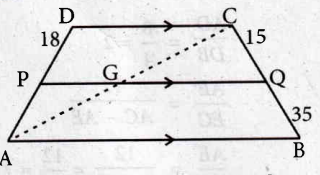
Join AC such that it meets PQ at G.
AB || DC and PQ || DC
PQ || AB
IN ADC
PG || DC
\(\frac{A P}{P D}=\frac{A G}{G C}\)
In CAB
\(\frac{A G}{G C}=\frac{B Q}{Q C}\)
From (1) and (2) we get
\(\frac{A P}{P D} =\frac{B Q}{Q C} \)
\(\frac{A P}{18} =\frac{35}{15} \)
\(A P =\frac{35 \times 18}{15} \)
AP = 42cm
Now AD = AP + PD
= 42 + 18 = 60 cm
AD = 60 cm
40.
Let BD = x cm, then DC = (6 – x)cm
AD is bisector of\(\angle\) A
Therefore by Angle Bisector Theorem
\(\frac { AB }{ AC } =\frac { BD }{ DC } \)
\(\frac { 10 }{ 14 } =\frac { x }{ 6-x } \quad \frac { 5 }{ 7 } =\frac { x }{ 6-x } \)
So, 12x = 30 we get, \(x=\frac { 30 }{ 12 } =2.5\)
Therefore, BD = 2.5 cm, DC = 6−x = 6−2.5 = 3.5 cm
41.
In \(\triangle\)ABC, AD is the bisector of \(\angle\)A
Therefore by Angle Bisector of \(\angle\)A
\(\frac { AB }{ AC } =\frac { BD }{ DC } \)
\(\frac{4}{3}=\frac{6}{A C}\) gives 4AC = 18. Hence, AC \(=\frac{9}{2}=4.5 \mathrm{~cm}\)
42.
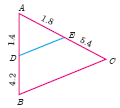
We have AB = 56.cm, AD = 14. cm, AC = 72. cm and AE = 18.cm.
BD = AB - AD = 5.6 –1.4 = 4.2 cm
and EC = AC – AE = 7.2–1.8 = 5.4 cm
\(\frac { AD }{ DB } =\frac { 1.4 }{ 4.2 } =\frac { 1 }{ 3 } \) and \(\frac { AE }{ EC } =\frac { 1.8 }{ 5.4 } =\frac { 1 }{ 3 } \)
\(\frac { AD }{ DB } =\frac { AE }{ EC } \)
Therefore, by converse of Basic Proportionality Theorem, we have DE is parallel to BC. Hence proved.
43.
In \(\Delta \)LOP & \(\Delta \)QMO,
\(\angle \)OLP = \(\angle \)MQO 90°
and \(\angle \)LOP =\(\angle \)OMQ (corresponding angles)
(by AA criterion of similarity)
\(\Delta \)LOP ~ \(\Delta \)QMO
44.
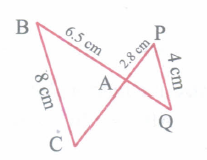
Given \(\Delta ABC\sim \Delta APQ\)
Their corresponding sides are proportional
\(\frac{A C}{A P}=\frac{C B}{P Q}=\frac{A B}{A Q} \)
\(\frac{A C}{2.8}=\frac{8}{4}=\frac{6.5}{A Q} \)
Taking
\(\frac{A C}{2.8}=\frac{8}{4} \)
\(A C=\frac{8 \times 2.8}{4}=5.6 \mathrm{~cm} \)
AC = 5.6 cm
Also taking \(\frac{8}{4} =\frac{6.5}{A Q} \)
\(\mathrm{AQ} =\frac{6.5}{8} \times 4=3.25 \mathrm{~cm} \)
AQ = 3.25 cm
45.
46.
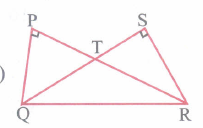
Given
PR and SQ intersect at T.
In \(\triangle\)QPT and \(\triangle\)RST
< QSR =
Given
By AA similarity criteria
\(\triangle P Q T \sim \triangle S R T\)
Their corresponding sides are proportional
\(\frac{P T}{S T}=\frac{T Q}{T R}\)
PT x TR = ST x TQ
Hence proved
47.
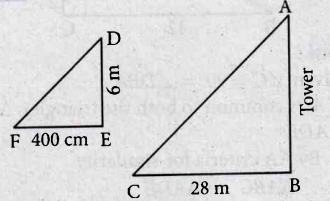
Let DE be the vertical stick and AB is the tower,
DE = 6 m, EF = 400 cm = 4 m, BC = 28 m
From DFE and ACB
Using similarity criteria
\(\frac{A B}{D E}=\frac{B C}{E F}\)
\(\frac{A B}{6}=\frac{28}{4} \)
\(A B=\frac{28 \times 6}{4}=42 \mathrm{~m} \)
Height of the tower = 42 m
48.
(i) In ABC and ADE <A is common
\(
\frac{A E}{E C}=\frac{2}{3 \frac{1}{2}}=\frac{\frac{2}{7}}{2}=\frac{2 \times 2}{7}=\frac{4}{7}
\)
\(\frac{A D}{D B}=\frac{3}{5}
\)
\(Here\ \frac{4}{7} \pm \frac{3}{5}
\)
\(\frac{A E}{E C} \neq \frac{A D}{D B}
\)
The corresponding sides are not proportional.
ABC and ADE are not similar
(ii) In CPQ and CAB <C is common
<PQC = 180o - 110o = 70o
[ <PQC and <PQB are liner pair of angles]
<ABC = 70o
<BAC = <QPC
[ sum of three angles of a triangle are 180]
<PCQ = 180o - (< QPC + 70o)
<ABC = <PQC = 70o
<C common and <BAC = <QPC
By AAA similarity criteria, <ABC <PQC
Corresponding sides are Proportional
\(\frac{A B}{P Q} =\frac{B C}{Q C}
\)
\(\frac{5}{\sqrt{x}} =\frac{6}{3}
\)
[BC = BQ + QC = 3 + 3 = 6]
\(x=\frac{5}{6} \times 3=2.5\)
x = 2.5
49.
Since the ratio of area of two similar triangles is equal to the ratio of the squares of any two corresponding sides, we have
\(\frac { Area(\Delta ABC) }{ Area(\Delta DEF) } =\frac { { BC }^{ 2 } }{ { EF }^{ 2 } } \) gives \(\frac { 54 }{ Area(\Delta DEF) } =\frac { { 3 }^{ 2 } }{ { 4 }^{ 2 } } \)
\(Area(\Delta DEF)=\frac { 16\times 54 }{ 9 } =96{ cm }^{ 2 }\)
50.
The ratio of the corresponding sides of similar triangles is same as the ratio of their perimeters.
Since, \(\Delta ABC\sim \Delta PQR\)
\(\frac { AB }{ PQ } =\frac { BC }{ QR } =\frac { AC }{ PR } =\frac { 36 }{ 24 } \)
\(\frac { AB }{ PQ } =\frac { 36 }{ 24 } \ \frac { AB }{ 10 } =\frac { 36 }{ 24 } \)
\(AB=\frac { 36\times 10 }{ 24 } =15cm\)
51.
\(\Delta AOQ\) and \(\Delta BOP,\angle OAQ=\angle OBP=90^{ 0 } \)
\(\angle AOQ=\angle BOP\) (Vertically opposite angles)
Therefore, by AA Criterion of similarity,
\(\Delta AOQ\sim \Delta BOP\)
\(\frac { AO }{ BO } =\frac { OQ }{ OP } =\frac { AQ }{ BP } \)
\(\frac { 10 }{ 6 } =\frac { AQ }{ 9 } \) gives \(AQ=\frac { 10\times 9 }{ 6 } =15cm\)
52.
\(\Delta \ CAB\) and \(\Delta CED\),\(\angle C\) is common, \(\angle A=\angle CED\)
Therefore, \(\Delta CAB\sim \Delta CED\)
Hence, \(\frac { CA }{ CE } =\frac { AB }{ DE } =\frac { CB }{ CD } \)
\(\frac { AB }{ DE } =\frac { CB }{ CD } \quad \frac { 9 }{ x } =\frac { 10+2 }{ 8 } ,x=\frac { 8\times 9 }{ 12 } =6\) cm.
53.
In \(\Delta BAC\) and \(\Delta PRQ,\quad \frac { AB }{ RQ } =\frac { 3 }{ 6 } =\frac { 1 }{ 2 } \)
\(\frac { BC }{ QP } =\frac { 6 }{ 12 } =\frac { 1 }{ 2 } ;\frac { CA }{ PR } =\frac { 3\sqrt { 3 } }{ 6\sqrt { 3 } } =\frac { 1 }{ 2 } \)
Therefore, \(\frac { AB }{ QP } =\frac { BC }{ QP } =\frac { CA }{ PR } \)
By SSS similarity, we have \(\triangle\)BAC~\(\triangle\)QRB
\(\angle\)P =\(\angle\)C (since the corresponding parts of similar triangle)
\(\angle\)P =\(\angle\)C 180o -\((\angle A+\angle B)={ 180 }^{ 0 }-({ 90 }^{ 0 }+{ 60 }^{ 0 })\)
\(\angle\)P = 180o - 150o = 30o
54.
In Is \(\triangle\)ABC ~ \(\triangle\)PQR
\(\frac { PQ }{ AB } =\frac { 3 }{ 6 } =\frac { 1 }{ 2 } ;\frac { QR }{ BC } =\frac { 4 }{ 10 } =\frac { 2 }{ 5 } \)
Since \(\frac { 1 }{ 2 } \neq \frac { 2 }{ 5 } ,\frac { PQ }{ AB } \neq \frac { QR }{ BC } \)
The corresponding sides are not proportional.
Therefore \(\triangle\)ABC is not similar to \(\triangle\)PQR.
55.
In \(\triangle\)PST and \(\triangle\)PQR,
\(\frac { PS }{ PQ } =\frac { 2 }{ 2+1 } =\frac { 2 }{ 3 } ,\frac { PT }{ PR } =\frac { 4 }{ 4+2 } =\frac { 2 }{ 3 } \)
Thus, \(\frac { PS }{ PQ } =\frac { PT }{ PR } \) and \(\angle\)P is common
Therefore, by SAS similarity,
\(\triangle\) PST~\(\triangle\)PQR

10th Standard Syllabus & Materials
10th Standard
TN 10th English Prose - 2 - The Night the Ghost Got in Important Questions And Answers Study Material - QB365 Set A
NEW10th Standard
TN 10th English Supplementary - 1 - The Tempest Important Questions And Answers Study Material - QB365 Set A
NEW10th Standard
TN 10th English Poem - 1 - Life Important Questions And Answers Study Material - QB365 Set A
NEW10th Standard
TN 10th English Prose - 1 - His First Flight Important Questions And Answers Study Material - QB365 Set A



Tamilnadu Stateboard 10th Standard Subjects
Tamilnadu Stateboard Standards





