
 100% FREE ACCESS
10th Standard Syllabus & Materials
10th Standard
TN 10th English Prose - 4 - The Attic Important Questions And Answers Study Material - QB365 Set A
NEW10th Standard
TN 10th English Supplementary - 3 - The Story of Mulan Important Questions And Answers Study Material - QB365 Set A
NEW10th Standard
TN 10th English Poem - 3 - I am Every Woman Important Questions And Answers Study Material - QB365 Set A
NEW10th Standard
TN 10th English Prose - 3 - Empowered Women Navigating The World Important Questions And Answers Study Material - QB365 Set A
NEW10th Standard
TN 10th English Supplementary - 2 - Zigzag Important Questions And Answers Study Material - QB365 Set A
NEW10th Standard
TN 10th English Poem - 2 - The Grumble Family Important Questions And Answers Study Material - QB365 Set A

Published on: 31/10/2022
QB365 provides a detailed and simple solution for every Possible Book Back Questions in Class 10 Maths Subject -Geometry , English Medium. It will help Students to get more practice questions, Students can Practice these question papers in addition to score best marks.
Download Tamil Nadu 10th Standard Maths question papers, model tests, one-mark questions, important questions, and public exam papers in PDF format. Free study materials and answer keys for TN State Board students.
Questions + Answers key
Take MCQ Maths Test1.
Show that in a triangle, the medians are concurrent.
2.
Two concentric circles have a common center 'O' the chord AB to the bigger circles touches the smaller circle at P. If OP = 3 cm and AB = 8 cm then find the radius of the bigger circle.
3.
Prove that the tangents drawn at the ends of a chord of a circle make equal angles with the chord.
4.
Prove that three times the square of any side of an equilateral triangle in equal to four times the square of the altitude.
5.
A ladder 15 m long reaches a window which is 9 m above the ground on one side of a street. Keeping its foot at the same point, the ladder is turned to other side of the street to reach a window 12 m high. Find the width of the street.
6.
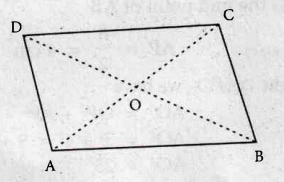
If the diagonal BD of a quadrilateral ABCD bisects both \(\angle B \text { and } \angle D,\text { Show that } \frac{A B}{B C}=\frac{A D}{C D} \text {. }\)
7.
The bisector of interior \(\angle\)A of \(\Delta\)ABC meets BC in D and the bisector of exterior \(\angle\)A meets BC produced in E. prove that \(\frac{B D}{B E}=\frac{C D}{C E}\)
8.
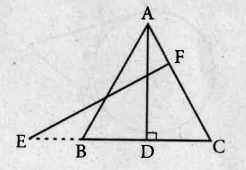
In the figure E is a point on side CB produced of an isosceles triangle ABC with AB = AC. If \(\mathrm{AD}+\mathrm{BC} \text { and } \mathrm{EF} \perp \mathrm{AC} .\text { Prove that } \triangle A B D-\triangle E C F\)
9.
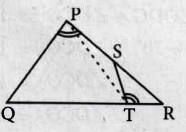
S and T are points on sides PR and QR of \(\triangle P Q R \text { such that } \angle P=\angle R T S\)
\(\text { Show that } \triangle R P Q \sim \triangle R T S\)
10.
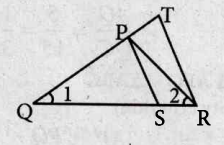
\(\text { In the figure } \frac{Q R}{Q S}=\frac{Q T}{P R} \text { and } \angle 1=\angle 2 \text { show }\text { that } \triangle P Q S \sim \triangle T Q R\)
11.
In the figure \(\triangle O D C \sim \triangle O B A, \angle B O C=125^{\circ} \text { and }\angle C D O=70^{\circ} \text {, find } \angle D O C, \angle D C O \text { and } \angle O A B\)
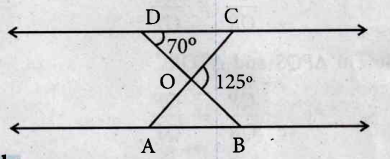
12.
The perpendicular from A on side BC at a \(\triangle\)ABC intersects BC at D such that DB = 3 CD. Prove that 2AB2 = 2AC2 + BC2.
13.
In \(\angle ACD={ 90 }^{ 0 }\) and \(CD\bot AB\) Prove that \(\cfrac { { BC }^{ 2 } }{ { AC }^{ 2 } } =\cfrac { BD }{ AD } \)
14.
In figure 0 is any point inside a rectangle ABCD. Prove that OB2 + OD2 = OA2 + OC2
15.
A ladder is placed against a wall such that its foot is at a distance of 2.5 m from the wall and its top reaches a window 6 m above the ground. Find the length of the ladder.
16.
Prove that in a right triangle, the square of 8. the hypotenuse is equal to the sum of the squares of the others two sides.
17.
BL and CM are medians of a triangle ABC right angled at A.
Prove that 4(BL2 + CM2) = 5BC2.
18.
In \(AD\bot BC\) prove that AB2 + CD2 = BD2 + AC2.
1.
Solution Medians are line segments joining each vertex to the midpoint of the corresponding opposite sides.
Thus medians are the cevians where D, E, F are midpoints of BC, CA and AB respectively
Since D is a midpoint of BC, BD = DC so \(\frac { BD }{ DC } =1\) ..(1)
Since, E is a midpoint of CA,CE = EA so \(\frac { CE }{ EA } =1\) ..(2)
Since, F is a midpoint of AB, AF FB so \(\frac { AF }{ FB } =1\) ...(3)
Thus, multiplying (1), (2) and (3) we get,
\(\frac { BD }{ DC } \times \frac { CE }{ EA } \times \frac { AF }{ FB } =1\times 1\times 1=1\)
And so, Ceva’s theorem is satisfied.
Hence the Medians are concurrent.
2.
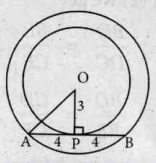
\(\therefore\) AB touches the smaller circle at P
\(\therefore \mathrm{OP} \perp \mathrm{AB} \Rightarrow \angle O P A=90^{\circ}\)
Now AB is the chord of the bigger circle. Since the perpendicular from the centre to a chord, bisects the chord.
\(\therefore\) P is the mid point of AB
\(\mathrm{AP}=\frac{8}{2}=4 \mathrm{~cm}\)
\(\text { In right } \triangle A P O \text {, we have }\)
\(\mathrm{AO}^{2}=\mathrm{OP}^{2}+\mathrm{AP}^{2} \)
\(\mathrm{AO}^{2}=3^{2}+4^{2}=9+16 \)
\(\mathrm{AO}^{2}=25 \)
\(\mathrm{AO}=5 \mathrm{~cm} \)
\(\therefore \text { The radius of the bigger circle }=5 \mathrm{~cm} \text {. }\)
3.
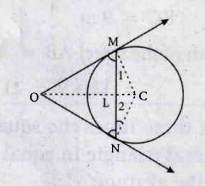
Let NM be the chord of a circle with centre C. Let the tangents at M and N meet at O
\(\therefore\) OM is a tangent at M
\(\therefore\) \(\angle\)OMC = 90o
Similarly \(\angle\)ONC : 90o
Since CM = CN
In \(\Delta\)CMN \(\angle\)1 = \(\angle\)2
[\(\because\) Angles opposite to equal sides are equal in a triangle]
\(\angle\)OMC - \(\angle\) 1 = \(\angle\)ONC - \(\angle\)2
\(\angle\)OML = \(\angle\)ONL
Thus tangents make equal angles with the chord.
4.
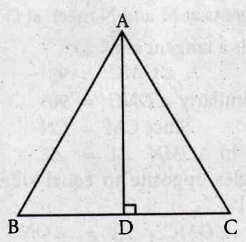
Let ABC be an equilateral triangle and AD \(\perp\) BC.
In \(\Delta\)ADB and \(\Delta\)ADC , we have
AB = AC
\(\angle\)B = \(\angle\)C
and \(\angle\)ADB = \(\angle\)ADC
By RHS Criteria
\(\triangle A D B \cong \triangle A D C\)
\(\mathrm{BD}=\mathrm{DC} \ [\because \text { By CPCTC] }\)
\(\Rightarrow \mathrm{BD}=\mathrm{DC}=\frac{1}{2} \mathrm{BC}\)
\(\text { Since } \triangle A D B \text { is right triangle right angled at } \mathrm{D}\)
\(A B^{2} =A D^{2}+B D^{2} \)
\(\Rightarrow A B^{2} =A D^{2}+\left(\frac{1}{2} B C\right)^{2} \)
\(\Rightarrow A B^{2} =A D^{2}+\frac{B C^{2}}{4} \)
\(A B^{2} =A D^{2}+\frac{A B^{2}}{4} \quad[\because B C=A B] \)
\(\mathrm{AD}^{2} =\mathrm{AB}^{2}-\frac{A B^{2}}{4} \)
\(=\frac{4 A B^{2}-A B^{2}}{4} \)
\(\mathrm{AD}^{2} =\frac{3 A B^{2}}{4} \)
\(4 \mathrm{AD}^{2} =3 \mathrm{AB}^{2} \)
5.
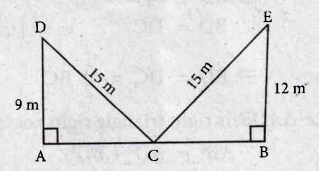
Let AB be the width of the street; C be the foot of the ladder. Let D and E be the windows at heights of 9 m and 12 m respectively from the ground.
Then CD and CE are the two positions of the ladder.
Clearly AD = 9m,BE = 12m,CD = CE = 15m
From the right triangle \(\Delta\)ACD we have
\(C D^{2} =A C^{2}+A D^{2} \)
\(15^{2} =A C^{2}+9^{2} \)
\(A C^{2} =225-81=144 \)
\(A C =12 \mathrm{~m} \)
\(\text { In } \triangle B C E \text {, we have }\)
\(C E^{2} =B C^{2}+B E^{2} \)
\(15^{2} =B C^{2}+12^{2} \)
\(B C^{2} =225-144=81 \)
\(B C =9 \mathrm{~m} \)
\(\text { Hence width of the street } \mathrm{AB}=\mathrm{AC}+\mathrm{CB}\)
\(=12+9=21 \mathrm{~m}\)
6.
Given: A quadrilateral ABCD in which the diagonal BD bisects \(\angle\)B and \(\angle\)D
\(\text { To prove: } \frac{A B}{B C}=\frac{A D}{C D}\)
Construction: join AC intersecting BD in O.
Proof
In \(\Delta\)ABC , BO is the bisector of \(\angle\)B.
\(\frac{A O}{O C}=\frac{B A}{B C} \)
\(\frac{O A}{O C}=\frac{A B}{B C} \)
\(\text { In } \triangle A D C, \mathrm{DO} \text { is the bisector of } \angle D\)
\(\frac{A O}{O C}=\frac{D A}{D C} \)
\(\frac{O A}{O C}=\frac{A D}{C D} \)
\(\text { From (1) and (2) we get }\)
\(\frac{A B}{B C}=\frac{A D}{C D}\)
7.
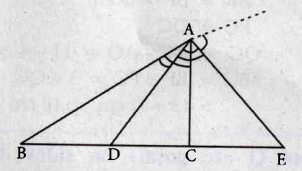
Given: In \(\Delta\)ABC AD and AE respectively the bisectors of the interior and exterior angles at A.
\(\text { To prove: } \frac{B D}{B E}=\frac{C D}{C E}\)
Proof : Since AD is the internal bisector of \(\angle\)A meeting BC at D.
\(\frac{A B}{A C}=\frac{B D}{D C}\)
Since AE is the external bisector of \(\angle\)A meeting BC produced in E.
\(\frac{A B}{A C}=\frac{B E}{C E}\)
From (1) and (2) we get
\(\frac{B D}{D C}=\frac{B E}{C E} \)
\(\frac{B D}{B E}=\frac{C D}{C E} \)
8.
We have an isosceles triangle \(\Delta\)ABC in which
AB = AC.
\(\text { In } \triangle A B D \text { and } \Delta E C F\)
\(\mathrm{AB}=\mathrm{AC}\)
\(\Rightarrow \text { Angles opposite to them are equal. }\)
\(\therefore \angle A C B =\angle A B C \)
\(\angle E C F =\angle A B D\)
\(\mathrm{AD} \perp \mathrm{BC} \text { and } \mathrm{EF} \perp \mathrm{AC}\)
\(\angle A D B=\angle E F C=90^{\circ}\)
From (1) and (2) we have
By AA criteria of similarity
\(\triangle A B D \sim \triangle E C F\)
9.
T is a point on QR and S is a point or PR such that
\(\angle R T S=\angle P\)
\(\text { Now in } \triangle R P Q \text { and } \triangle R T S\)
\(\angle R P Q=\angle R T S \)
\(\angle P R Q=\angle T R S \)
\(\therefore \text { Using AA similarity, we have }\)
\(\Delta R P Q \sim \Delta R T S\)
10.
Given \(\text { In } \triangle P Q R \angle 1=\angle 2\)
\(\mathrm{PR}=\mathrm{QP}\)
[\(\because\) In a triangle, sides opposite to equal angles are equal]
\(\text { Given } \frac{Q R}{Q S}=\frac{Q T}{P R}\)
\(\text { From (1) and (2) }\)
\(\frac{Q R}{Q S}=\frac{Q T}{Q P} \)
\(\frac{Q S}{Q R}=\frac{Q P}{Q T} \)
\(\text { Now in } \triangle P Q S \text { and } \Delta T Q R\)
\(\frac{Q S}{Q R}=\frac{Q P}{Q T}\)
\(\angle S Q P=\angle R Q T=\angle 1[\text { From (3) }]\)
\(\therefore \text { Using SAS similarity criteria }\)
\(\triangle P Q S \sim \triangle T Q R\)
11.
\(\text { We have } \angle B O C=125^{\circ} \text { and }\)
\(\angle C D O=70^{\circ}\)
\(\text { Since } \left.\angle D O C+\angle B O C=180^{\circ} \text { [linear pair }\right]\)
\(\angle D O C=180^{\circ}-125^{\circ}=55^{\circ}\)
\(\text { In } \triangle D O C \text { Using angle sum property, we get }\)
\(\angle D O C+\angle O D C+\angle D C O =180^{\circ} \)
\(55^{\circ}+70^{\circ}+\angle D C O =180^{\circ} \)
\(\angle D C O =180^{\circ}-55^{\circ}-70^{\circ} \)
\(\angle D C O=55^{\circ}\)
\(\text { Again } \ \triangle O D C \sim \triangle O B A \ \text { (given) }\)
\(\therefore \text { Their corresponding angles are equal. }\)
\(\angle O C D=\angle O A B = 55^{o}\)
\(\therefore \text { From }(1),(2) \text { and (3) }\)
\(\angle D O C=55^{\circ} \)
\(\angle D C O=55^{\circ} \text { and } \)
\(\angle O A B=55^{\circ} \)
12.
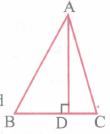
We have DB = 3 CD.
BC = BD + DC
BC = 3CD + CD
BC = 4CD
\(CD=\cfrac { 1 }{ 4 } BC\)
\(CD=\cfrac { 1 }{ 4 } BC\)
\(BD=3cD=\cfrac { 3 }{ 4 } BC\)
Since \(\Delta ABD\) is a right triangle (i) right angled at D.
AB2 = AD2 + BD2
By \(\Delta ACD\) is a right triangle right angled at D
AC2 = AD2 + CD2
Subtracting equation (iii) from equation (ii), we got
AB2 - AC2 = BD2 - CD2
\(\Rightarrow { AB }^{ 2 }-{ AC }^{ 2 }=\left( \cfrac { 3 }{ 4 } BC \right) ^{ 2 }-\left( \cfrac { 1 }{ 4 } BC \right) ^{ 2 }\)
\((from \ CD=\cfrac { 1 }{ 4 } BC,BD=\cfrac { 3 }{ 4 } BC)\)
(i) \(\Rightarrow { AB }^{ 2 }-{ AC }^{ 2 }=\cfrac { 9 }{ 16 } { BC }^{ 2 }-\cfrac { 1 }{ 16 } { BC }\)
\(\Rightarrow { AB }^{ 2 }-{ AC }^{ 2 }=\cfrac { 1 }{ 2 } { BC }^{ 2 }\)
\(\Rightarrow { AB }^{ 2 }-{ AC }^{ 2 }=\cfrac { 1 }{ 2 } BC{ 2 }^{ 2 }\)
\(\Rightarrow 2({ AB }^{ 2 }-{ AC }^{ 2 })={ BC }^{ 2 }\)
\(\Rightarrow { 2AB }^{ 2 }=2{ AC }^{ 2 }+{ BC }^{ 2 }\)
13.
\(\Delta ACD\sim \Delta ABC\)
So,
\(\cfrac { AC }{ AB } =\cfrac { AD }{ AC } \)
AC2 = AB ·AD
Similarly \(\Delta BCD\sim \Delta BAC\)
So,
\(\cfrac { BC }{ BA } =\cfrac { BD }{ BC } \)
BC2 = BA·BD
From (1) and (2)
\(\cfrac { { BC }^{ 2 } }{ AC^{ 2 } } =\cfrac { BA.BD }{ AB.AD } =\cfrac { BD }{ AD } \)
14.
Through O, draw PQIIBC so that P lies on AB and Q lies on DC
Now, PQ II BC
\(PQ\bot AB\quad PQ\bot OC\)
\(\left( \because \angle B={ 90 }^{ 0 }and\angle C={ 90 }^{ 0 } \right) \)
So, \(\angle BPQ={ 90 }^{ 0 }\quad \angle CQP={ 90 }^{ 0 }\)
Therefore BPQC and APQD are both rectangles. Now from \(\Delta OPB\)
OB2 = BP2 + OP2
Similarly from \(\Delta OQD\)
OD2 = OQ2 + DQ2
From \(\Delta OQC\)
OC2 = OQ2 + CQ2
\(\Delta OAP\) we have
OA2 = AP2 +OP2
Adding (1) and (2)
OB2 + OD2 = BP2 + OP2 + OQ2 + DQ2
(As BP = CQ and DQ = AP)
= CQ2 + OP2 + OQ2 + AP2
= CQ2 + OQ2 + OP2 + AP2
= OC2+ OA
[From (3) and (4)]
15.
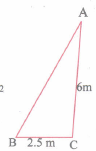
Let AB be the ladder and CA be the wall with . the window at A.
Also, BC = 2.5 m and CA = 6 m
From Pythagoras theorem
AB2 = BC2+ CA2
= (2.5)2 + (6)2
= 42.25
AB = 6.5
Thus, length at the ladder is 6.5 m.
16.
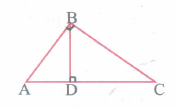
We are given a right triangle ABC right angled at B.
We need to prove that AC2 = AB2 + BC2
Let us draw \(BD\bot AC\)
Now,\(\Delta ADB\sim \Delta ABC\)
\(\cfrac { AD }{ DB } =\cfrac { BC }{ AC } \)
(sides are proportional)
Also,
\(\Delta BDC\sim \Delta ABC\)
\(\cfrac { CD }{ BC } =\cfrac { BC }{ AC } \)
CD·AC = BC2 ..(2)
Adding (1) and (2)
AD .AC + CD . AC = AB2+ BC2
AC(AD + CD) = AB2 + BC2
AC.AC = AB2 + BC2
AC = AB2 + BC2
17.
BL and CM are medians at the \(\triangle\)ABC in which
\(A=\angle { 90 }^{ 0 }\)
From \(\triangle\)ABC
BC2 = AB2 + AC2
(Pythagoras theorem)
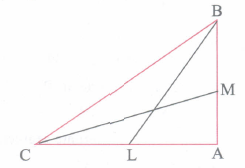
From \(\Delta ABL\)
BL2 = AL2 + AB2
\({ BL }^{ 2 }=\left( \cfrac { { AC }^{ 2 } }{ 2 } \right) +{ AB }^{ 2 }\)
(L is the mid-point at AC)
\({ BL }^{ 2 }=\cfrac { { AC }^{ 2 } }{ 4 } +{ AB }^{ 2 }\)
4BL2 = AC2 + 4AB2
From \(\Delta CMA\)
CM2 = AC2 + AM2
\({ CM }^{ 2 }={ Ac }^{ 2 }+\left( \cfrac { AB }{ 2 } \right) ^{ 2 }\)
(M is the mid-point at AB)
\({ CM }^{ 2 }={ AC }^{ 2 }+\cfrac { { AB }^{ 2 } }{ 4 } \)
4CM2 = 4AC2+ AB2
Adding (2) and (3), we have
4(BL2 + CM2) = 5(AC2 + AB2)
4(BL2 + CM2) = 5BC2
18.
From \(\Delta ADC\) we have
AC2 = AD2 + CD2 ....(1)
(Pythagoras theorem)
From \(\Delta ADB\) we have
AB2 = AD2 + BD2 ...(2)
(Pythagoras theorem)
Subtracting (1) from (2) we have,
AB2 - AC2 = BD2 - CD2
AB2 + CD2 = BD2 + AC2

10th Standard Syllabus & Materials
10th Standard
TN 10th English Prose - 2 - The Night the Ghost Got in Important Questions And Answers Study Material - QB365 Set A
NEW10th Standard
TN 10th English Supplementary - 1 - The Tempest Important Questions And Answers Study Material - QB365 Set A
NEW10th Standard
TN 10th English Poem - 1 - Life Important Questions And Answers Study Material - QB365 Set A
NEW10th Standard
TN 10th English Prose - 1 - His First Flight Important Questions And Answers Study Material - QB365 Set A



Tamilnadu Stateboard 10th Standard Subjects
Tamilnadu Stateboard Standards





