
 100% FREE ACCESS
10th Standard Syllabus & Materials
10th Standard
TN 10th English Prose - 4 - The Attic Important Questions And Answers Study Material - QB365 Set A
NEW10th Standard
TN 10th English Supplementary - 3 - The Story of Mulan Important Questions And Answers Study Material - QB365 Set A
NEW10th Standard
TN 10th English Poem - 3 - I am Every Woman Important Questions And Answers Study Material - QB365 Set A
NEW10th Standard
TN 10th English Prose - 3 - Empowered Women Navigating The World Important Questions And Answers Study Material - QB365 Set A
NEW10th Standard
TN 10th English Supplementary - 2 - Zigzag Important Questions And Answers Study Material - QB365 Set A
NEW10th Standard
TN 10th English Poem - 2 - The Grumble Family Important Questions And Answers Study Material - QB365 Set A

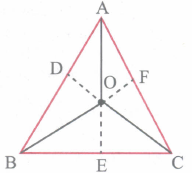
Published on: 31/10/2022
QB365 provides a detailed and simple solution for every Possible Creative Questions in Class 10 Maths Subject -Geometry , English Medium. It will help Students to get more practice questions, Students can Practice these question papers in addition to score best marks.
Download Tamil Nadu 10th Standard Maths question papers, model tests, one-mark questions, important questions, and public exam papers in PDF format. Free study materials and answer keys for TN State Board students.
Questions + Answers key
Take MCQ Maths Test1.
Converse of Basic Proportionality Theorem
2.
State and Prove - Angle Bisector Theorem
3.
State the Alternate Segment theorem
4.
Pythagoras Theorem
5.
Converse of Angle Bisector Theorem
6.
Basic Proportionality Theorem (BPT) or State and prove Thales theorem?
7.
In \(\triangle\)ABC, D and E are points on the sides AB and AC respectively such that DE||BC
If AD = 8x - 7, DB = 5x - 3, AE = 4x - 3, and EC = 3x - 1, find the value of x.
8.
Let ABC be a triangle and D,E,F are points on the respective sides AB, BC, AC (or their extensions). Let AD:DB = 5 : 3, BE : EC = 3 : 2 and AC = 21. Find the length of the line segment CF.
9.
Two circles intersect at A and B. From a point P on one of the circles lines PAC and PBD are drawn intersecting the second circle at C and D. Prove that CD is parallel to the tangent at P.
10.
An Emu which is 8 feet tall is standing at the foot of a pillar which is 30 feet high. It walks away from the pillar. The shadow of the Emu falls beyond Emu. What is the relation between the length of the shadow and the distance from the Emu to the pillar?
11.
A man whose eye-level is 2 m above the ground wishes to find the height of a tree. He places a mirror horizontally on the ground 20 m from the tree and finds that if he stands at a point C which is 4 m from the mirror B, he can see the reflection of the top of the tree. How height is the tree?
12.
Two trains leave a railway station at the same time. The first train travels due west and the second train due north. The first train travels at a speed of 20 km/hr and the second train travels at 30 km/hr. After 2 hours, what is the distance between them?
13.
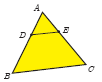
In the figure, ABC is a triangle in which AB = AC. Points D and E are points on the side AB and AC respectively such that AD = AE. Show that the points B, C, E and D lie on a same circle.
14.
O is any point inside a triangle ABC. The bisector of \(\angle AOB\), \(\angle BOC\) and \(\angle COA\) meet the sides AB, BC and CA in point D, E and F respectively. Show that AD x BE x CF = DB x EC x FA
15.
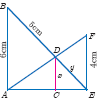
In the given figure AB || CD || EF. If AB = 6cm, CD = x cm, EF = 4 cm, BD = 5 cm and DE = y can. Final x and y
16.
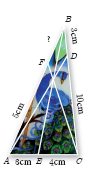
An artist has created a triangular stained glass window and has one strip of small length left before completing the window. She needs to figure out the length of left out portion based on the lengths of the other sides as shown in the figure.
17.
In \(\triangle\)ABC , with \(\angle\)B=90° , BC = 6 cm and AB = 8 cm, D is a point on AC such that AD = 2 cm and E is the midpoint of AB. Join D to E and extend it to meet at F. Find BF.
18.
Show that the angle bisectors of a triangle are concurrent.
19.
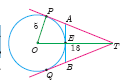
In figure, O is the centre of the circle with radius 5 cm. T is a point such that OT = 13 cm and OT intersects the circle E, if AB is the tangent to the circle at E, find the length of AB
20.
In a garden containing several trees, three particular trees P, Q, R are located in the following way, BP = 2 m, CQ = 3 m, RA = 10 m, PC = 6 m, QA = 5 m, RB = 2 m, where A, B, C are points such that P lies on BC, Q lies on AC and R lies on AB. Check whether the trees P, Q, R lie on a same straight line.
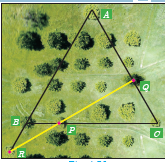
21.
In \(\triangle\)ABC , points D,E,F lies on BC, CA, AB respectively. Suppose AB, AC and BC have lengths 13, 14 and 15 respectively. If \(\frac { AF }{ FB } =\frac { 2 }{ 5 } \quad \frac { CE }{ EA } =\frac { 5 }{ 8 } \). Find BD an DC
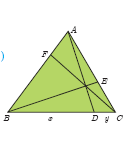
22.
In Fig, ABC is a triangle with \(\angle\)B=90o, BC=3cm and AB=4 cm. D is point on AC such that AD=1 cm and E is the midpoint of AB. Join D and E and extend DE to meet CB at F. Find BF.
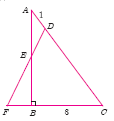
23.
Show that in a triangle, the medians are concurrent.
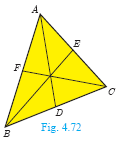
24.
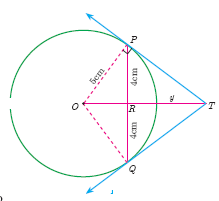
PQ is a chord of length 8 cm to a circle of radius 5 cm. The tangents at P and Q intersect at a point T. Find the length of the tangent TP.
25.
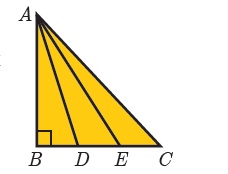
In the adjacent figure, ABC is a right angled triangle with right angle at B and points D, E trisect BC. Prove that 8AE2 = 3AC2 + 5AD2
26.
The perpendicular PS on the base QR of a \(\triangle\)PQR intersects QR at S, such that QS = 3 SR. Prove that 2PQ2 = 2PR2 + QR2
27.
5 m long ladder is placed leaning towards a vertical wall such that it reaches the wall at a point 4m high. If the foot of the ladder is moved 1.6 m towards the wall, then find the distance by which the top of the ladder would slide upwards on the wall
28.
To get from point A to point B you must avoid walking through a pond. You must walk 34 m south and 41 m east. To the nearest meter, how many meters would be saved if it were possible to make a way through the pond?
29.
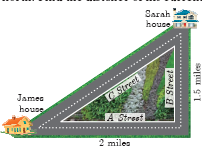
There are two paths that one can choose to go from Sarah’s house to James house. One way is to take C street, and the other way requires to take B street and then A street. How much shorter is the direct path along C street? (Using figure).
30.
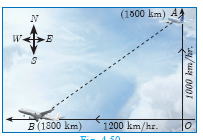
An Aeroplane after take off from an airport and flies due north at a speed of 1000 km/hr. At the same time, another aeroplane leaves the same airport and flies due west at a speed of 1200 km/hr. How far apart will be the two planes after 1½ hours?
31.
P and Q are the mid-points of the sides CA and CB respectively of a \(\triangle\)ABC, right angled at C. Prove that 4(AQ2 + BP2) = 5AB2
32.
ABCD is a quadrilateral in which AB=AD, the bisector of \(\angle\)BAC and \(\angle\)CAD intersect the sides BC and CD at the points E and F respectively. Prove that EF||BD
33.
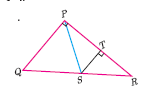
In figure \(\angle\)QPR = 90o, PS is its bisector. If ST\(\bot \)PR, prove that ST \(\times\) (PQ + PR) = PQ \(\times\) PR.
34.
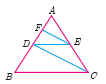
In figure DE || BC and CD. Prove that AD2 = AB x AF
35.
In trapezium ABCD, AB || DC, E and F are points on non-parallel sides AD and BC respectively, such that EF || AB. Show that \(\frac { AE }{ ED } =\frac { BF }{ FC } \)
36.
Rhombus \(\triangle\)QRB is inscribed in \(\triangle\)ABC such that \(\angle\)B is one of its angle. P, Q and R lie on AB, AC and BC respectively. If AB = 12 cm and BC = 6 cm, find the sides PQ, RB of the rhombus.
37.
Construct a triangle \(\triangle\)PQR such that QR = 5 cm, \(\angle\)P = 30o and the altitude from P to QR is of length 4.2 cm.
38.
Construct a \(\triangle\)PQR in which PQ = 8 cm, \(\angle\)R = 60o and the median RG from R to PQ is 5.8 cm. Find the length of the altitude from R to PQ.
39.
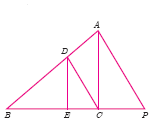
In the figure DE||AC and DC||AP. Prove that \(\frac { BE }{ CE } =\frac { BC }{ CP } \)
40.
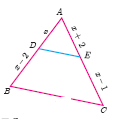
In \(\triangle\) ABC, if DE||BC, AD = x, DB = x − 2, AE = x +2 and EC = x − 1 then find the lengths of the sides AB and AC.
41.
Two vertical poles of heights 6 m and 3 m are erected above a horizontal ground AC. Find the value of y.

42.
If \(\triangle\)ABC~\(\triangle\)DEF such that area of \(\triangle\)ABC is 9cm2 and the area of \(\triangle\)DEF is 16cm2 and BC = 2.1 cm. Find the length of EF
43.
A girl looks at the reflection of the top of the lamp post on the mirror which is 6.6 m away from the foot of the lamp post. The girl whose height is 12.5 m is standing 2.5 m away from the mirror. Assuming the mirror is placed on the ground facing the sky and the girl, mirror and the lamp post are in the same line, find the height of the lamp post.
44.
Two poles of height ‘a’ metres and ‘b’ metres are ‘p’ metres apart. Prove that the height of the point of intersection of the lines joining the top of each pole to the foot of the opposite pole is given by \(\frac { ab }{ a+b } \) meters
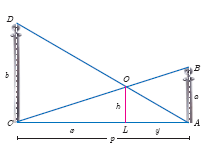
45.
A boy of height 90cm is walking away from the base of a lamp post at a speed of 1.2m/sec. If the lamppost is 3.6m above the ground, find the length of his shadow cast after 4 seconds.
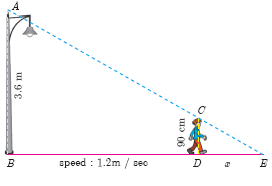
46.
In \(\triangle\)ABC,D and E are points on the sides AB and AC respectively such that DE||BC \(\frac { AD }{ DB } =\frac { 3 }{ 4 } \) and AC = 15cm find AE.
1.
Statement
If a straight line divides any two sides of a triangle in the same ratio, then the line must be parallel to the third side.
Proof
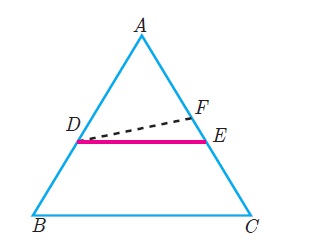
Given
\(\text { In } \triangle A B C, \frac{A D}{D B}=\frac{A E}{E C}\)
To prove : DE \(\|\) BC
Construction : If DE is not parallel to BC, draw DF \(\|\) BC .
| No. | Statement | Reason |
| 1 | \(\frac{A D}{D B}=\frac{A E}{E C}\)...(1) | Given |
| 2 | \(\triangle A B C, D F \| B C\) | Construction |
| 3 | \(\frac{A D}{D B}=\frac{A F}{F C}\)....(2) | Thales theorem |
| 4 | \( \frac{A E}{E C} =\frac{A F}{F C} \) \(\frac{A E}{E C}+1 =\frac{A F}{F C}+1 \) \(\frac{A E+E C}{E C} =\frac{A F+F C}{F C} \) \(\frac{A C}{E C} =\frac{A C}{F C} \) Therefore, E = F Thus DE \(\|\) BC |
From (1) and (2) Adding 1 to both sides Cancelling AC on both sides |
2.
Statement :
The internal bisector of an angle of a triangle divides the opposite side internally in the ratio of the corresponding sides containing the angle
Proof
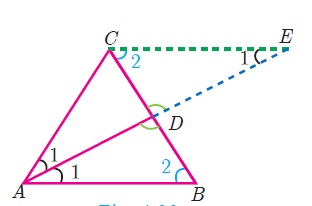
Given : In ΔABC,AD is the internal bisector
To prove : \(\frac{A B}{A C}=\frac{B D}{C D}\)
Construction : Draw a line through C parallel to AB. Extend AD to meet line through C at E
| No | Statement | Reason |
|---|---|---|
| 1. | ∠AEC =∠BAE =∠1 | Two parallel lines cut by a transversal make alternate angles equal |
| 2. | ΔACE is isosceles AC = CE … (1) |
In ΔACE,∠CAE = ∠CEA |
| 3. | ΔABD∼ΔECD \(\frac{A B}{C E}=\frac{B D}{C D}\) |
By AA Similarity |
| 4. | \(\frac{A B}{A C}=\frac{B D}{C D}\) | From (1) AC = CE Hence proved |
3.
Statement
If a line touches a circle and from the point of contact a chord is drawn, the angles between the tangent and the chord are respectively equal to the angles in the corresponding alternate segments.
Proof
Given : A circle with centre at O, tangent AB touches the circle at P and PQ is a chord. S and T are two points on the circle in the opposite sides of chord PQ.
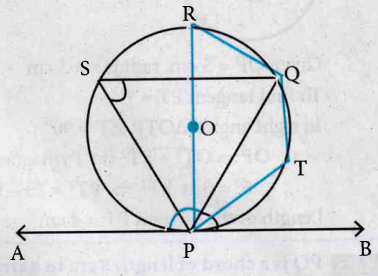
To prove : (i) \(\angle\)QPB = \(\angle\)PSQ and (ii)\(\angle\)QPA = \(\angle\)PTQ
Construction: Draw the diameter POR. Draw QR, QS and PS.
| No. | Statement | Reason |
| 1 | \(\angle\) RPB = 90o Now, \(\angle\)RPQ +\(\angle\)QPB =90° ...(1) |
Diameter RP is perpendicular to tangent AB |
| 2 | In \(\triangle\)RPQ, \(\angle\)PQR = 90° ...(2) | Angle in a semicircle is 90°. |
| 3 | \(\angle\)QRP +\(\angle\)RPQ = 90° ...(3) | In a right angled triangle, sum of the two acute angles is 90°. |
| 4 | \(\angle\)RPQ +\(\angle\)QPB = \(\angle\)QRP +\(\angle\)RPQ \(\angle\)QPB = \(\angle\)QRP ...(4) |
From (1) and (3). |
| 5 | \(\angle\)QRP = \(\angle\)PSQ ...(5) | Angles in the same segment are equal. |
| 6 | \(\angle\)QPB = \(\angle\)PSQ ...(6) | From (4) and (5); Hence (i) is proved. |
| 7 | \(\angle\)QPB +\(\angle\)QPA = 180° ...(7) | Linear pair of angles |
| 8 | \(\angle\)PSQ +\(\angle\)PTQ = 180° ...(8) | Sum of opposite angles of a cyclic quadrilateral is 180°. |
| 9 | \(\angle\)QPB +\(\angle\)QPA = \(\angle\)PSQ +\(\angle\)PTQ | From (7) and (8). |
| 10 | \(\angle\)QPB +\(\angle\)QPA = \(\angle\)QPB +\(\angle\)PTQ | \(\angle\)QPB = \(\angle\)PSQ from (6) |
| 11 | \(\angle\)QPA = \(\angle\)PTQ | Hence (ii) is proved. This completes the proof |
4.
Statement
In a right angle triangle, the square on the hypotenuse is equal to the sum of the squares on the other two sides.
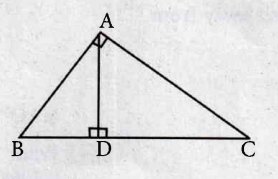
Proof
Given : In \(\triangle\)ABC , \(\angle\)A = 90°
To prove : AB2 +AC2 = BC2
Construction : Draw AD \(\perp\) BC
| No. | Statement | Reason |
| 1. | Compare \(\triangle\)ABC and \(\triangle\)DBA ÐB is common \(\angle\)BAC = \(\angle\)BDA = 90° Therefore, \(\triangle\)ABC \(\sim\) \(\triangle\)DBA \(\frac{A B}{B D}=\frac{B C}{A B}\) AB2 = BC x BD ........(1) |
Given \(\angle\)BAC = 90° and by construction \(\angle\)BDA = 90° By AA similarity |
| 2. | Compare \(\triangle\)ABC and \(\triangle\)DAC \(\angle\)C is common \(\angle\)BAC = \(\angle\)ADC = 90o Therefore, \(\triangle\)ABC \(\sim\) \(\triangle\)DAC \(\frac{B C}{A C}=\frac{A C}{D C}\) AC2 = BC x DC ...(2) |
Given \(\angle\)BAC = 90° and by construction \(\angle\)ADC = 90° By AA similarity |
Adding (1) and (2) we get
AB2 +AC2 = BC x BD +BC x DC
= BC(BD +DC) = BC x BC
AB2 +AC2 = BC2 .
Hence the theorem is proved.
5.
Statement
If a straight line through one vertex of a triangle divides the opposite side internally in the ratio of the other two sides, then the line bisects the angle internally at the vertex.
Proof
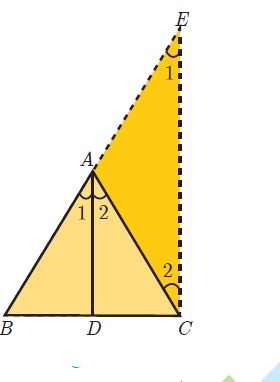
Given : ABC is a triangle. AD divides BC in the ratio of the sides containing the angles \(\angle\)A to meet BC at D.
That is \(\frac{A B}{A C}=\frac{B D}{D C}\)
To prove : AD bisects \(\angle\)A i.e. \(\angle\)1 = \(\angle\)2
Construction : Draw CE \(\|\)DA . Extend BA to meet at E.
| No | Statement | Reason |
|---|---|---|
| 1. | \(\text { Let } \angle B A D=\angle 1 \text { and } \angle D A C=\angle 2\) | Assumption |
| 2. | \(\angle B A D=\angle A E C=\angle 1\) | Since DA\(\|\)CE and AC is transversal, corresponding angles are equal |
| 3. | \(\angle D A C=\angle A C E=\angle 2\) | Since DA\(\|\)CE and AC is transversal, Alternate angles are equal |
| 4. | \(\frac{B A}{A E}=\frac{B D}{D C} \ldots(2)\) | In \(\triangle\)BCE by Thales theorem |
| 5 | \(\frac{A B}{A C}=\frac{B D}{D C}\) | From (1) |
| 6 | \(\frac{A B}{A C}=\frac{B A}{A E}\) | From (1) and (2) |
| 7 | AC = AE … (3) | Cancelling AB |
| 8 | \(\angle\)1 = \(\angle\)2 | \(\triangle\)ACE is isosceles by (3) |
| 9 | AD bisects \(\angle\)A | Since, \(\angle\)1 = \(\angle\)BAD = \(\angle\)2 = \(\angle\)DAC . Hence proved |
6.
Statement
A straight line drawn parallel to a side of triangle intersecting the other two sides, divides the sides in the same ratio.
Proof
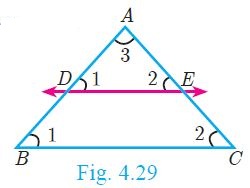
In \(\Delta ABC\) ,D is a point on AB and E is a point on AC
To prove : \(\cfrac { AD }{ DB } =\cfrac { AE }{ EC } \)
Construction: Draw a line DE || BC
| No. | Statement | Reason |
| 1. | \(\angle ABC=\angle ADE=\angle 1\) | Corresponding angles are equal because DE || BC |
| 2. | \(\angle ACB=\angle AED=\angle 2\) | Corresponding angles are equal because DE || BC |
| 3. | \(\\ \angle DAE=\angle BAC=\angle 3\) | Both triangles have a common angle |
| 4. | \(\Delta ABC\sim \Delta ADE\) | By AAA similarity |
| \(\frac { AB }{ AD } =\frac { AC }{ CE } \) | Corresponding sides are proportional | |
| \(\frac { AD+DB }{ AD } =\frac { AE+EC }{ AE } \) | Split AB and AC using the points D and E. | |
| \(1+\frac { DB }{ AD } =1+\frac { EC }{ AE } \) | On simplification | |
| \(\frac { DB }{ AD } =\frac { EC }{ AE } \) | Cancelling 1 on both sides | |
| \(\frac { AD }{ DB } =\frac { AE }{ EC } \) | Taking reciprocals | |
| Hence proved |
7.
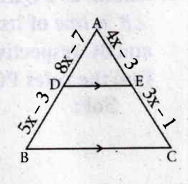
\(\frac{A D}{D B}=\frac{A E}{E C}\)
Given AD = 8x - 7
DB = 5x - 3
AE = 4x - 3
EC = 3x - 1
\(\frac{8 x-7}{5 x-3}=\frac{4 x-3}{3 x-1}\)
(8x - 7) (3x - 1) = (4x - 3) (5x- 3)
24x2 - 21x - 8x + 7 - 20x2 - 15x - 12 x + 9
24x2 - 20x2 - 29x + 27x + 7 - 9 = 0
4x2 - 2x - 2 = 0
by 2 2x2 - x - 1 = 0
2x (x - 1) + 1(x - 1) = 0
(x - 1)(2x + 1) = 0
x - 1 = 0 or 2x + 1 = 0
x = 1 or \(x=-\frac{1}{2}\)
x cannot be negative
x = 1
8.
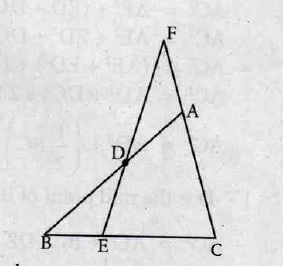
Let \(\triangle\)ABC be the given triangle and D, E, F are points on the respectives sides AB, BC AC (or their extension).
Given AD : DB = 5 : 3;
BE : EC = 3 : 2.
Let AD = 5k1; DB = 3k1; BE = 3k2; EC = 2k2.
Now by Menelaus Theorem, we have
\( \frac{B E}{E C} \times \frac{C F}{F A} \times \frac{A D}{D B}=-1 \)
\(\frac{3 k_{2}}{2 k_{2}} \times \frac{C F}{F C-A C} \times \frac{5 k_{1}}{3 k_{1}}=-1 \)
\(\frac{3}{2} \times \frac{C F}{F C-21} \times \frac{5}{3}=-1 \)
\(\frac{C F}{F C-21}=\frac{-1 \times 2}{5} \)
\(\frac{C F}{(-C F)-21}=\frac{-2}{5}\)
5 CF = -2 [(-CF) - 21]
5CF = 2CF + 42 [FC = -CF]
5CF - 2CF = 42
3CF = 42
\(C F=\frac{42}{3}=14 \text { units. }\)
9.
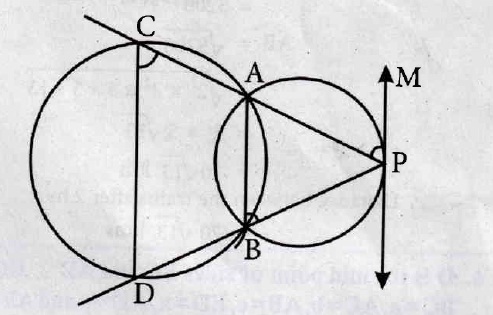
Let MP is the tangent at p Join AB.
\(\angle M P A=\angle P B A\) ...(1)
[Angles in the alternate segment]
\(\angle P B A=\angle A C D\) ...(2)
[Exterior angle of a cyclic quadrilateral
ABCD is equal to its interior opposite angle]
From (1) and (2), we have
\( \angle M P A =\angle A C D \)
\(\Rightarrow \ \angle M P C =\angle P C D \)
But these are a pair of alternate interior angles.
\(M P \| C D\)
10.
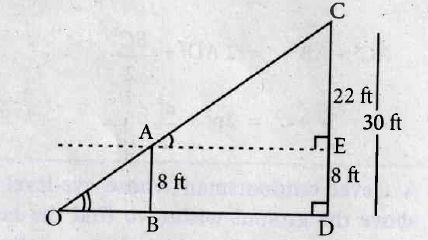
Let AB be the emu = 8 ft
CD be the pillar = 30 ft
OB be the shadow, BD be the distance between the pillar and the emu.
Draw AE || OD at a distance of 8 ft from OD.
Now, \( \angle C A E=\angle A O B \) [corresponding angles]
\(\angle O B A=\angle A E C=90^{\circ}\)
By AA similarity criteria
\( \triangle C E A \sim \triangle A B O \)
\(\frac{C E}{A B} =\frac{E A}{B O} \)
\(\frac{22}{8} =\frac{B D}{O B} \quad[\because \mathrm{EA}=\mathrm{BD}] \)
\(\frac{11}{4} =\frac{\text { distance }}{\text { shadow }} \)
\(\text { Shadow } =\frac{4}{11} \times \text { distance }\)
11.
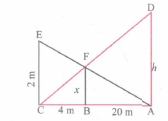
Let CP be the man whose eye level is 2 m above the ground
AT be the height of the tree
In triangles \(\triangle C B P \text { and } \triangle A B T\)
\(\angle C=\angle A=90^{\circ}\)
Since \(\mathrm{CA} \perp \mathrm{PC} \text { and } \mathrm{CA} \perp \mathrm{TA}\)
\(\angle C B P=\angle A B T \text { as } \angle C B P\) is the angle of reflection and \(\angle\)ABT is the angle of incident.
By AA similarity criteria
\( \triangle C B P \sim \triangle A B T \)
\(\therefore \ \frac{C B}{A B} =\frac{B P}{B T}=\frac{C P}{A T} \)
\(\frac{C B}{A B} =\frac{C P}{A T} \)
\(\frac{4}{20} =\frac{2}{A T} \)
\(\mathrm{AT} =\frac{2 \times 20}{4}=10 \mathrm{~m}\)
Height of the tree is 10 m.
12.
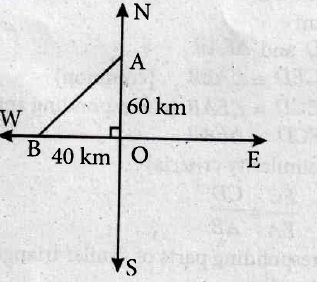
Distance travelled by the first train in 2 hours
= 2 x 20 = 40km
Distance travelled by the second train in 2 hours
= 2 x 30 = 60km
Let the distances are represents by OB and OA respectively
Now applying Pythagoras theorem,
Distance between the trains after 2 hours is AB.
we have AB2 = OA2 + OB2 = 602 + 402
= 3600 + 1600
= 5200
\( A B =\sqrt{5200} \)
\(=\sqrt{2^{2} \times 2^{2} \times 5 \times 5 \times 13} \)
\(=2^{2} \times 5 \sqrt{13} \)
\(=20 \sqrt{13} \mathrm{~km}\)
Distance between the trains after 2 hrs
\(=20 \sqrt{13} \mathrm{~km}\)
13.
To prove the points B, C, E and D lie on a same circle, it is sufficient to show that \(\angle ABC+\angle CED={ 180 }^{ 0 }\) and \(\angle ACB+\angle BDE={ 180 }^{ 0 }\) to prove opposite angles of the quadrilateral BCED are supplementary
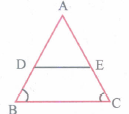
In \(\Delta ABC\) we have
AB = AC AD = AE.
\(\Rightarrow AB-AD=AC-AE\)
\(\Rightarrow DB=EC\)
Thus we have
AD = AE and DB = EC.
\(\Rightarrow \frac { AD }{ DB } =\frac { AE }{ EC }\)
\( \Rightarrow DE||AE\) [By the converse of Thales's theorem]
\(\Rightarrow \angle ABC=\angle ADE\) (corresponding angles)
\(\Rightarrow \angle ABC+\angle BDE=\angle ADE+\angle BDE\) (Adding \(\angle BDE\) on both sides)
\(\Rightarrow \angle ABC+\angle BDE={ 180 }^{ 0 }\)
\(\Rightarrow \angle ACB+\angle BDE={ 180 }^{ 0 }\) ...(1)
\(\left( \because AB=AC\therefore \angle ABC=\angle ACB \right) \)
Again DE IIBC
\(\Rightarrow \angle ACB=\angle AED\)
\(\Rightarrow \angle ACB+\angle CED=\angle AED+\angle CED\) (Adding \(\angle CED\) on both sides).
\(\Rightarrow \angle ACB+\angle CED={ 180 }^{ 0 }\) \(\left( \because \angle ABC=\angle ACB \right) \)
\(\Rightarrow \angle ABC+\angle CED={ 180 }^{ 0 }\) ...(2)
From (1) and (2),
Thus BDEC is a quadrilateral such that
\(\Rightarrow \angle ACB+\angle BDE={ 180 }^{ 0 }\) and
\(\Rightarrow \angle ABC+\angle CED={ 180 }^{ 0 }\)
\(\therefore\) BDEC is a cyclic quadrilateral.
Points B, C, E and D lie on a same circle.
14.
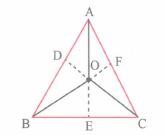
In \(\Delta AOB\) OD is the bisector of \(\angle AOB\)
\(\therefore \frac { OA }{ OB } =\frac { AD }{ DB } \) ...(1)
In \(\Delta BOC\) OE is the bisector of \(\angle BOC\)
\(\therefore \frac { OB }{ OC } =\frac { BE }{ EC } \) ...(2)
In \(\Delta COA\) OF is the bisector of \(\angle COA\)
\(\therefore \frac { OC }{ OA } =\frac { CF }{ FA } \) ...(3)
Multiplying the corresponding sides of (1), (2) and (3), we get
\(\frac{O A}{O B} \times \frac{O B}{O C} \times \frac{O C}{O A} \mid=\frac{A D}{D B} \times \frac{B E}{E C} \times \frac{C F}{F A}\)
\(1=\frac { AD }{ DB } \times \frac { BE }{ EC } \times \frac { CF }{ FA } \)
\(\Rightarrow \) DB x EC x FA = AD x BE x CF
AD x BE x CF = DB x EC x FA
Hence proved.
15.
Given AB || CD || EF
AB = 6 cm, BD = 5 cm, EF = 4 cm, CD = x cm, DE = y cm
\(\text { In } \triangle E C D \text { and } \triangle E A B\)
\( \angle C E D=\angle A E B \) [common]
\(\angle E C D=\angle E A B \) [corresponding angles]
\(\triangle E C D \sim \triangle E A B\)
[By AA similarity criteria] ...(1)
\(\therefore \ \frac{E C}{E A}=\frac{C D}{A B}\)
[ Corresponding parts of similar triangles are proportional]
\(\frac{E C}{E A}=\frac{x}{6}\) ....(2)
In \(\triangle A C D\ and\ \triangle A E F \)
\(\angle C A D=\angle E A F\) [Common]
\( \angle A C D =\angle A E F \) [Corresponding angles]
\(\triangle A C D \sim \triangle A E F \) [By AA similarity]
\(\frac{A C}{A E} =\frac{C D}{E F}\)
[Corresponding parts of similar triangle are proportional]
\(\therefore \quad \frac{A C}{A E}=\frac{x}{4}\) ....(3)
Adding (2) and (3)
\( \frac{E C}{E A}+\frac{A C}{A E} =\frac{x}{6}+\frac{x}{4} \)
\(\frac{E C+A C}{A E} =\frac{4 x+6 x}{24} \)
\(\frac{A E}{A E} =\frac{10 x}{24} \)
\(1 =\frac{10 x}{24} \)
\(\mathrm{x} =\frac{24}{10}=\frac{12}{5} \mathrm{~cm}\)
From (1) \(\triangle E C D \sim \triangle E A B\)
\( \frac{D C}{A B} =\frac{E D}{E B} \)
\(\frac{x}{6} =\frac{y}{5+y} \)
\(\because \mathrm{x}=\frac{12}{5} \Rightarrow \frac{12 / 5}{6} =\frac{y}{5+y} \)
\(\frac{12}{5 \times 6} =\frac{y}{5+y} \)
12(5 + y) = 30 y
60 + 12y = 30 y
60 = 30y - 12y
18y = 60
\( y=\frac{60}{18} \)
\(y=\frac{10}{3} \mathrm{~cm}\)
16.
Clearly In \(\triangle\)ABC, D, E, F are points on lines BC, CA, AB respectively using Ceva's theorem, we have
\(\frac{A E}{E C} \times \frac{C D}{D B} \times \frac{B F}{F A}=1\) ...(1)
From the diagram it is clear that
AE = 3, EC = 4, CD = 10, DB = 3, FA = 5
Substituting these values in (1)
\(
\frac{3}{4} \times \frac{10}{3} \times \frac{B F}{5} =1
\)
\(B F =\frac{1 \times 4 \times 3 \times 5}{3 \times 10}=2 \mathrm{~cm}\)
17.
Consider DABC, Then D, E, F are respective points on the sides CA, AB and Be. By construction D, E, F are collinear
By Menelaus' Theorem, \(\frac { AE }{ EB } \times \frac { BF }{ FC } \times \frac { CD }{ DA } =1\)
FC = FB + BC = BF + 6
By Pythagoras Theorem AC2 = AB2 + BC2
=64+36=100
\(\therefore \) AC = 10, CD = 8
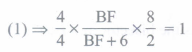
\(4BF=BF+6\Rightarrow BF=2cm\)
18.
Let \(\triangle\)ABC be B triangle points D, E, F are angular bisectors of \(\angle A, \angle B \text { and } \angle C\) respectively. By angular bisector theorem we have
\( \frac{B D}{D C}=\frac{A B}{A C} \Rightarrow \mathrm{AB}=\frac{B D \times A C}{D C} \)
\(\frac{A C}{B C}=\frac{A F}{F B} \Rightarrow \mathrm{AC}=\frac{A F \times B C}{F B} \)
\(\frac{A E}{E C}=\frac{A B}{B C} \Rightarrow \mathrm{AB}=\frac{A E \times B C}{E C}\)
From (1) and (3), we have
\(\frac{B D \times A C}{D C}=\frac{A E \times B C}{E C}\)
Now substituting (2) in (4) we have
\( \frac{B D \times\left(\frac{A F \times B C}{F B}\right)}{D C} =\frac{A E \times B C}{E C} \)
\(\frac{B D \times A F \times B C}{D C \times F B} =\frac{A E \times B C}{E C} \)
\(B D \times A F \times E C =\frac{A E \times B C \times D C \times F B}{B C} \)
\(B D \times A F \times C E =E A \times F B \times D C \)
\(\therefore \frac{B D \times A F \times C E}{E A \times F B \times D C}=1\)
Hence by Ceva's theorem we conclude that the angle bisectors of a triangle are concurrent.
19.
Since OP is the radius and PT tangent
\(\angle O P T=90^{\circ}\)
Applying Pythagoras theorem in \(\triangle\)OPT, we have
OT2 = OP2 + PT2
132 = 52 + PT2
PT2 = 169 - 25
PT2 = 144
PT = 12cm
Since the lengths of tangents drawn from an exterior point to a circle are equal.
AP = AE = x(say)
AT = PT - AP = (12-x)cm
Since AB is the tangent to the circle at E
\( \therefore \mathrm{OE} \perp \mathrm{AB} \)
\(\ \Rightarrow \angle O E A =90^{\circ} \)
\(\\ \Rightarrow \angle A E T =90^{\circ}\)
\( \\ \mathrm{AT}^{2} =\mathrm{AE}^{2}+\mathrm{ET}^{2}\)
[Applying Pythagoras theorem in \(\triangle\)AET ]
(12 - x)2 = x2 +(13 -5)2
144 - 24 + x2 = x2 +64
24x = 144 - 64
24x = 80
3x = 10
\( x=\frac{10}{3} \mathrm{~cm} \)
\(Similarly\ B E=\frac{10}{3} \mathrm{~cm}\)
AB = AE + BE
\( =\left(\frac{10}{3}+\frac{10}{3}\right) \mathrm{cm} \)
\(A B =\frac{20}{3} \mathrm{~cm}\)
20.
By Menelaus' Theorem, the trees P, Q, R will be collinear (lie on same straight line)
If \(\frac { BP }{ PC } \times \frac { CQ }{ QA } \times \frac { RA }{ RB } \)
Given BP = 2 m, CQ = 3 m, RA = 10 m, PC = 6 m, QA = 5 m and RB = 2 m
Substituting these values in (1) we get,
\(\frac { BP }{ PC } \times \frac { CQ }{ QA } \times \frac { RA }{ RB } =\frac { 2 }{ 6 } \times \frac { 3 }{ 5 } \times \frac { 10 }{ 2 } =\frac { 60 }{ 60 } \)
Hence the trees P, Q, R lie on a same straight line.
21.
Given that AB = 13, AC = 14 and BC = 15
Let BD = x and DC = y
Using Ceva’s theorem, we have, \(\frac { BD }{ DC } \times \frac { CE }{ EA } \times \frac { AF }{ FB } =1\)
Substitute the values of \(\frac { AF }{ FB } \ and \ \frac { CE }{ EA } \) in (1)
we have \(\frac { BD }{ DC } \times \frac { 5 }{ 8 } \times \frac { 2 }{ 5 } =1\)
\(\frac { x }{ y } \times \frac { 10 }{ 40 } =1\) we get \(\frac { x }{ y } \times \frac { 1 }{ 4 } \), Hence x = 4y ...(2)
BC = BD + DC = 15 so, x + y = 15 ..(3)
From (2), using x = 4y in (3) we get, 4y + y = 15 gives 5y = 15 then y = 3
Substitute y = 3 in (3) we get, x = 12. Hence BD = 12, DC = 3.
22.
Consider\(\triangle\)ABC. Then D, E and F are respective points on the sides CA, AB and BC. By construction D, E, F are collinear
By Menelaus’ theorem \(\frac { AE }{ EB } \times \frac { BF }{ FC } \times \frac { CD }{ DA } =1\)
By assumption, AE = EB = 2, DA = 1 and
FC = FB + BC = BF + 3
By Pythagoras theorem,AC2=AB2+BC2=16+9=25. Therefore AC=5
and So, CD = AC – AD = 5 – 1 = 4.
Substituting the values of FC, AE, EB, DA, CD in (1)
we get, \(\frac { 2 }{ 2 } \times \frac { BF }{ BF+3 } \times \frac { 4 }{ 1 } =1\)
4BF=BF+3
4F-BF=8 therefore BF=1
23.
Medians are line segments joining each vertex to the midpoint of the corresponding opposite sides.
Thus medians are the cevians where D, E, F are midpoints of BC, CA and AB respectively
Since D is a midpoint of BC, BD = DC so \(\frac { BD }{ DC } =1\) ..(1)
Since, E is a midpoint of CA, CE = EA so \(\frac { CE }{ EA } =1\) ..(2)
Since, F is a midpoint of AB, AF FB so \(\frac { AF }{ FB } =1\) ...(3)
Thus, multiplying (1), (2) and (3) we get,
\(\frac { BD }{ DC } \times \frac { CE }{ EA } \times \frac { AF }{ FB } =1\times 1\times 1=1\)
And so, Ceva’s Theorem is satisfied.
Hence the Medians are concurrent.
24.
Let TR = y. Since, OT is perpendicular bisector of PQ
PR = QR = 4 cm
In\(\triangle\)ORP, OP2 = OR2 + PR2
OR2 = OP2 - PR2
OR2 = 52 - 42 = 25 - 16 = 9 \(\Rightarrow\) OR = 3cm
OT = OR + RT = 3 + y ..(1)
In \(\triangle\)PRT, TP2 + TR2 + PR2 ..(2)
and \(\triangle\)OPT we have, OT2 = TP2 + OP2
OT2 = (TR2 + PR2) + OP2 (substitute for TP2 from (2))
(3 + y)2 = y2 + 42 + 52 (substitute for OT from (1))
9 + 6y2 + 16 + 25 therefore \(y=TR=\frac { 16 }{ 3 } \)
6y = 41 - 9 we get \(y=\frac { 16 }{ 3 } \)
From (2), TP2 = TR2 + PR2
\(TP2=\left( \frac { 16 }{ 3 } \right) +4^{ 2 }=\frac { 256 }{ 9 } +16=\frac { 400 }{ 9 } \)so, \(TP=\frac { 20 }{ 3 } \)
25.
Since D and E are the points of trisection of BC,
therefore BD = DE = CE
Let BD = DE = CE = x
Then BE = 2x and BC = 3x
In right triangles ABD, ABE and ABC, (using Pythagoras theorem)
We have AD2 = AB2 + BD2
\(\Rightarrow \) AD2 = AB2 + x2 ... (1)
\(\text { In rt } \triangle \mathrm{ABE} \text {, }\) AE2 = AB2 + BE2
= AB2 + (2x)2
\(\Rightarrow \) AE2 = AB2 + 4x2 ..(2)
\(\text { In rt } \triangle \mathrm{ABC}, \quad A C^{2}=A B^{2}+B C^{2}\)
AC2 = AB2 + (3x)2
AC2 = AB2 + 9x2 ..(3)
8AE2 - 3AC2 - 5AD2 = 8(AB2 + 4x2) - 3
(AB2 + 9x2) - 5(AB2 + x2)
8AB2 + 32x2 - 3AB2 - 27x2- 5AB2 - 5x2
8AE2 - 3AC2 - 5AD2 = 0
8AE2 = 3AC2 + 5AD2
Hence proved.
26.
We have
DB = 3CD (given)
\(\because \) BC = BD + DC
\(\Rightarrow\) BC = 3CD + CD
\(\Rightarrow\) BC = 4CD
\(\Rightarrow CD=\frac { 1 }{ 4 } BC\)
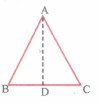
Since \(\triangle\)ABD is a right triangle right angled at D.
\(\therefore { AB }^{ 2 }=AD^{ 2 }+{ BD }^{ 2 }\)
Similarly \(\Delta ACD\) is a right triangle right angled at D.
AC2 = AD2 + CD8
Subtracting equation (3) from equation (2)
We get AB2 - AC2 = BD2 - CD2
\(\Rightarrow { AB }^{ 2 }-{ AX }^{ 2 }=\left( \frac { k }{ 4 } BC \right) ^{ 2 }-\left( \frac { 1 }{ 4 } BC \right) ^{ 2 }\)
\((from\ (1)CD=\frac { 1 }{ 4 } BC,BD=\frac { 3 }{ 4 } BD)\)
\(\Rightarrow { AB }^{ 2 }-{ AC }^{ 2 }=\frac { 9 }{ 16 } { BC }^{ 2 }-\frac { 1 }{ 16 } { BC }^{ 2 }\)
\(\Rightarrow { AB }^{ 2 }-{ AC }^{ 2 }=\frac { 1 }{ 2 } { BC }^{ 2 }\)
\(\Rightarrow 2{ AB }^{ 2 }=2{ AC }^{ 2 }+{ BC }^{ 2 }\)
Hence it is proved.
27.
Clearly the ladder AC make a right triangle with the wall AB force at a distance BC. \(\angle\)B - 90o
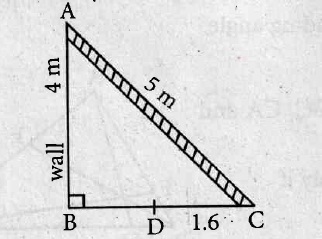
By Pythagoras theorem
AC2 = AB2 + BC2
52 = 42 + BC2
BC2 = 25 - 16
BC2 = 9
BC = 3m
If C moves 1.6 m towards the wall BC becomes
3m - 1.6m = 1.4m
Now in \(\triangle\)ABC
AC2 = AB2 + BC2
52 = AB2 +(1.4)2
25 - 1.96 = AB2
AB2 = 23.04
AB = 4.8m
The new height of the wall = 4.8 m
Difference =4.8 - 4 = -0.8m
The ladder would be placed 0.8 m upward the wall.
28.
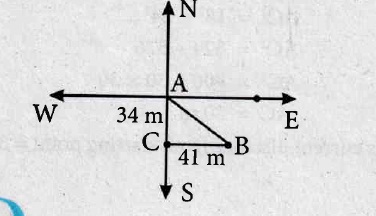
Let A be the starting position and 'B' be the final position. C be the position south of A at 34 m distance.
Clearly C = 90o in \(\triangle\)ACB
AC2 + CB2 = AB2
[By Pythagoras theorem]
342 + 412 = AB2
1156 + 1681 = AB2
2837 = AB2
AB = 53.26 m
Distance from A to B through the pond = 53.26 m
Distance through C = 34m + 41 m = 75 m
Difference = 75 - 53.26 = 21.74 m
21.74 m would be saved if it is possible to walk through the pond.
29.
Let Sarah's house is at A and James's house is at 'B' from the picture.
Distance between Sarah's house to James house through Street B and C
= 1.5 miles + 2 miles = 3.5 miles
Distance through street C is AC2 = AB2 + BC2
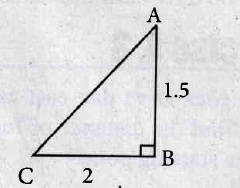
AC2 = = (1.5)2 + (2),
= 2.25 + 4
= 6.25
\(A C=\sqrt{6.25}=2.5\)
AC = 2.5 miles
Difference between two paths = 3.5 - 2.5 = 1 mile
Direct path along C street is 1 mile shorter
30.
Let the first aeroplane starts from O and goes upto A towards north, (Distance=Speed × time)
where \(OA=\left( 100\times \frac { 3 }{ 2 } \right) km=1500km\)
Let the second aeroplane starts from O at the same time and goes upto B towards west,
where \(OB=(1200\times \frac { 3 }{ 2 } )=1800km\)
The required distance to be found is BA.
In right angled triangle AOB, AOB, AB2 = OA2 + OB2
AB2 = (1500)2 + (1800)2 = 1002 (152 +182)
= 1002 x 549 = 1002 x 9 x 61
\(AB=100\times 3\times \sqrt { 61 } =300\sqrt { 61 } kms.\)
31.
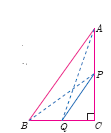
Since, \(\triangle\)QAQC is a right triangle at C, AQ2 = AC2 + QC2 ...(1)
Also, \(\triangle\)BPC is a right triangle at C, BP2 = BC2+ CP2 ...(2)
\(\triangle\) ABCC is a right triangle at C, AB2 = AC2 + BC2 ....(3)
From (1) and (2), AQ2+ BP2 = AC2+ QC2 + BC2 + CP2
4(AQ2 + BP2) = 4AC2 + 4QC2 + 4BC2 + 4CP2
= 4AC2 + (2QC)2+ ABC2 + (2CP)2
= 4AC2 + BC2 + 4BC2 + AC2 (Since P and Q are mid points)
= 5(AC2 + BC2) (From equation (3))
4(AQ2 + BP2) = 5AB2
32.
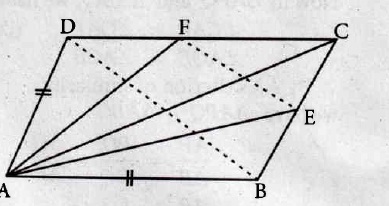
Given: A quadrilateral ABCD in which AB = AD and the bisectors of \(\angle\)BAC and \(\angle\)CAD meet the sides BC and CD at E and F respectively.
To prove: EF || BD
Construction: Join AC, BD and EF.
Proof: In \(\triangle\)CAB, AE is the bisector of \(\angle\)BAC
\(\therefore \frac{A C}{A B}=\frac{C E}{B E}\) ......(1)
In \(\triangle\)ACD , AF is the bisector of \(\angle\)CAD
\( \frac{A C}{A D} =\frac{C F}{D F} \)
\(\Rightarrow \ \frac{A C}{A B} =\frac{C F}{D F}\) ......(2)
From (1) and (2) we get
\( \frac{C E}{B E}=\frac{C F}{D F} \)
\(\frac{C E}{E B}=\frac{C F}{F D}\)
Thus in \(\triangle\)CBD, E and F divide the sides CB and CD respectively in the same ratio.
By the converse of Thales theorem, we have EF || BD.
33.
Given that PS is the bisector of \(\angle\)P of \(\triangle\)PQR
\(\frac{P Q}{P R}=\frac{Q S}{S R}\) [By Angle Bisector Theorem]
Adding 1 on both the sides
\( \frac{P Q}{P R}+1 =\frac{Q S}{S R}+1 \)
\(\frac{P Q+P R}{P R}=\frac{Q S+S R}{S R} \)
\(\frac{P Q+P R}{P R} =\frac{Q R}{S R} \) ..(2)
In \(\triangle\)RST and \(\triangle\)RQP we have
\( \angle S R T=\angle Q R P=\angle R \)
\(\angle Q P R=\angle S T R=90^{\circ}\)
By AA criterion for similarity, we have
\(\triangle R S T \sim \triangle R Q P \)
\(\frac{R S}{R Q}=\frac{S T}{Q P} \)
\(\frac{Q P}{S T}=\frac{Q R}{R S}\) ...(2)
From (1) and (2)
\(\frac{Q P}{S T}=\frac{P Q+P R}{P R}\)
PQ \(\times\) PR = ST(PQ + PR)
34.
In ABC , we have DE || BC
\(\frac{A B}{A D}=\frac{A C}{A E}\) [By Thales Theorem] ..(1)
In ADC, we have
\(\frac{A D}{A F}=\frac{A C}{A E}\) [By Thales Theorem] .....(2)
From (1) and (2) we get
\(\frac{A B}{A D}=\frac{A D}{A F}\)
AD2 = AB x AF
35.
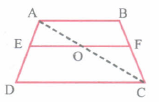
Given: ABCD is a trapezium in which DC || AB and EF || AB
To prove that \(\frac { AE }{ ED } =\frac { BF }{ FC } \)
Construction : join AC meeting EF at G
Proof:
In ADC, we have
EG || DC
\(\Rightarrow \frac{A E}{E D}=\frac{A G}{G C}\) [By Thales theorem] ...(1)
In ABC , we have
\(\frac{A G}{G C}=\frac{B F}{F C}\) [By Thales theorem] ....(2)
From (1) and (2), we get
\(\frac{A E}{E D}=\frac{B F}{F C}\)
36.
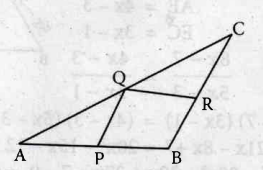
Given AB = 12 cm, BC = 6 cm
In \(\triangle\)APQ and \(\triangle\)QRC
By AA criterion of similarity, we have
\(\triangle A P Q \sim \triangle Q R C \)
\( \Rightarrow \frac{A P}{Q R}=\frac{P Q}{R C}=\frac{A Q}{Q C} \)
\(\frac{A P}{Q R}=\frac{P Q}{R C} \)
\(\frac{P Q}{A P}=\frac{R C}{Q R} \)
Now in \(\triangle\)APQ and \(\triangle\)ABC , we have
we have \(\triangle\)APQ - \(\triangle\)ABC
\(\frac{A P}{A B}=\frac{P Q}{B C}=\frac{A Q}{A C} \)
\(\frac{A P}{A B}=\frac{P Q}{B C} \)
\(\frac{P Q}{A P}=\frac{B C}{A B} \)
\(\frac{P Q}{A P}=\frac{6}{12} \)
Since PQRB is a rhombus, PQ = QR = RB = PB
\(\frac{P Q}{A B-P B}=\frac{6}{12} \)
\(\frac{P Q}{A B-P Q}=\frac{6}{12} \)
\(\frac{P Q}{12-P Q}=\frac{6}{12} \)
12 PQ = 6(12 - PQ)
12 PQ = 72- 6 PQ
12 PQ + 6 PQ = 72
18 PQ = 72
PQ = \(\frac{72}{18}=4\)
PQ = 4 cm
Since PQ = RB we have
PQ = RB = 4 cm
37.
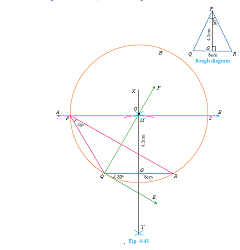
Construction
Step 1 : Draw a line segment QR = 5 cm.
Step 2 : At Q draw QE such that \(\angle\)RQE = 30o.
Step 3 : At Q draw QF such that \(\angle EQF\) = 90o
Step 4 : Draw the perpendicular bisector XY to QR which intersects QF at O and QR at G.
Step 5 : With O as centre and OQ as radius draw a circle.
Step 6: From G mark an arc in the line XY at M, such that GM = 42. cm.
Step 7 : Draw AB through M which is parallel to QR.
Step 8 : AB meets the circle at P and S.
Step 9 : Join QP and RP. Then\(\triangle\)PQR is the required triangle
38.
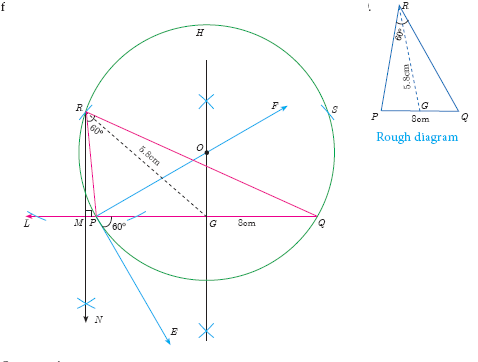
Construction
Step 1: Draw a line segment PQ = 8cm.
Step 2: At P, draw PE such that \(\angle\)QPE = 60o.
Step3: At P, draw PF such that\(\angle\)EPF = 90o.
Step 4: Draw the perpendicular bisector to PQ, which intersects PF at O and PQ at G.
Step 5: With O as centre and OP as radius draw a circle.
Step 6: From G mark arcs of radius 5.8 cm on the circle. Mark them as R and S.
Step 7: Join PR and RQ. Then \(\triangle\)PQR is the required triangle.
Step 8: From R draw a line RN perpendicular to \(\angle\)Q. \(\angle\)Q meets RN at M
Step 9: The length of the altitude is RM = 3.8 cm.
39.
In \(\triangle\)BPA, we have DE||AP By Basic Proportionality Theorem,
We have \(\frac { BC }{ CP } =\frac { BD }{ DA } \) ..(i)
In \(\triangle\)BCA, we have DE||AC By Basic Proportionality Theorem,
we have,
\(\frac { BE }{ EC } =\frac { BD }{ DA } \) ..(2)
From (1) and (2) we get, \(\frac { BE }{ EC } =\frac { BC }{ CP } \), Hence proved.
40.
In \(\triangle\) ABC we have DE || BC.
By Thales theorem, we have \(\frac { AD }{ DB } =\frac { AE }{ EC } \)
\(\frac { x }{ x-2 } =\frac { x+2 }{ x-1 } \) gives x(x - 1) = (x - 2)(x + 2)
When x = 4, AD = 4, DB = x - 2, AE + x + 2 = 6, EC = x - 1 = 3
Hence, AB = AD + DB = 4 + 2 = 6, AC = AE + EC = 6 + 3 = 9
Therefore, AB = 6, AC = 9
41.
Let AP and CR be the vertical poles of height 6 m and 3 m respectively
Let BQ = ym
In CRA and BQA
By AA criterion of similarity
\(\triangle C R A \sim \triangle B Q A\)
Their corresponding sides are Proportional
\(\frac{A C}{A B}=\frac{C R}{B Q} \)
\(\frac{A C}{A B}=\frac{3}{y} \)
\(\mathrm{AB}=\frac{A C \times y}{3}\)
In CBQ and CAP
\(\frac{C B}{C A}=\frac{B Q}{A P} \)
\(\frac{C B}{C A}=\frac{y}{6} \)
\(B C=\frac{y \times C A}{6} \)
\((1)+(2) \Rightarrow A B+B C =\frac{A C \times y}{3}+\frac{y \times C A}{6} \)
\(A C=y \times A C\left(\frac{1}{3}+\frac{1}{6}\right) \)
\(\frac{A C}{A C} =y\left(\frac{2+1}{6}\right) \)
\(1 =y\left(\frac{3}{6}\right) \)
\(1 =\frac{1}{2} y \)
y = 2m.
42.
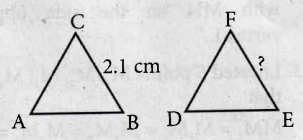
Given ABC - DEF
then we have
\(\frac{\operatorname{Area}(\Delta \mathrm{ABC})}{\text { Area }(\Delta \mathrm{DEF})}=\frac{A B^{2}}{D E^{2}}=\frac{B C^{2}}{E F^{2}}=\frac{A C^{2}}{D F^{2}} \)
\(\frac{9}{16}=\frac{B C^{2}}{E F^{2}} \)
\(\frac{9}{16} =\frac{2.1 \times 2.1}{E F^{2}} \)
\(\mathrm{EF}^{2} =\left(\frac{2.1 \times 4}{3}\right)^{2} \)
\(\mathrm{EF} =\frac{2.1 \times 4}{3}=2.8 \)
EF = 2.8 cm
43.
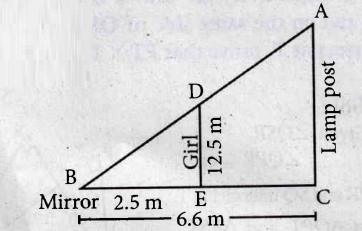
Let AC is the lamp post and ED is the girl.
From the triangles ABC and DBE
o
By AA criteria
Their sides are Proportional
\(\frac{A C}{D E}=\frac{B C}{B E} \)
\( \frac{A C}{12.5}=\frac{6.6}{2.5} \)
\(A C= \frac{6.6 \times 12.5}{2.5}=\frac{6.6 \times 12.5^{5}}{2.5}=33 \mathrm{~m} \)
Height of the lamp post = 33 m
44.
Let AB and CD be two poles of height ‘a’ metres and ‘b’ metres respectively such that the poles are ‘p’ metres apart. That is AC = p metres. Suppose the lines AD and BC meet at O, such that OL = h metres
Let CL = x and LA = y.
Then, x + y = p
In \(\Delta ABC\) and \(\Delta LOC\), we have
\(\angle CAB=\angle CLO\) [each equal to 90o]
\(\angle C=\angle C\) [ C is common]
\(\Delta CAB\sim \Delta CLO\) [By AA similarity]
\(\frac { CA }{ CL } =\frac { AB }{ LO } \) gives \(\frac { P }{ x } =\frac { a }{ h } \)
so, \(x=\frac { ph }{ a } \) ..(1)
In \(\Delta ALO\) and \(\Delta ACD\), we have
\(\angle ALO=\angle ACD\) [each equal to 90° ]
\(\angle A=\angle A[\mathrm{~A} \text { is common }]\)
\(\frac { AL }{ AC } =\frac { OL }{ DC } \) gives \(\frac { y }{ p } =\frac { h }{ b } \) we get, \(y=\frac { ph }{ b } \) ....(2)
(1) + (2) gives \(x+y=\frac { ph }{ a } +\frac { ph }{ b } \)
\(p=ph\left( \frac { 1 }{ a } +\frac { 1 }{ b } \right) \) (since x + y = p)
\(1=h\left( \frac { a+b }{ ab } \right) \)
Therefore, \(h=\frac { ab }{ a+b } \)
Hence, the height of the intersection of the lines joining the top of each pole to the foot of the opposite pole is \(\frac { ab }{ a+b } \) meters.
45.
Given, Speed = 1.2 m/s,
time = 4 seconds
Distance = speed x time
= 1.2 x 4
= 4.8 m
Let x be the length of the shadow after 4 seconds
\(\Delta ABE\sim \Delta CDE,\frac { BE }{ DE } =\frac { AB }{ CD } \) gives \(\frac { 4.8+x }{ x } =\frac { 3.6 }{ 0.9 } =\frac { 3.6 }{ 0.9 } =4\) (since 90 cm = 0.9 m)
4.8 + x = 4x, gives 3x = 4.8 so, x = 1.6m
The length of his DE = 1.6m
46.
Given \(\frac{A D}{D B}=\frac{3}{4}\)
AC = 15 cm
EC = AC - AE
= 15 - AE
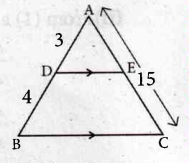
By Basic proportionality theorem
We have \(\frac{A D}{D B} =\frac{A E}{E C} \)
\(\frac{3}{4} =\frac{A E}{A C-A E} \)
\(\frac{3}{4} =\frac{A E}{15-A E} \)
3(15 - AE) = 4AE
45 - 3AE = 4AE
45 = 4AE + 3AE
7AE = 45
\(\mathrm{AE}=\frac{45}{7}=6.43 \mathrm{~cm}\)

10th Standard Syllabus & Materials
10th Standard
TN 10th English Prose - 2 - The Night the Ghost Got in Important Questions And Answers Study Material - QB365 Set A
NEW10th Standard
TN 10th English Supplementary - 1 - The Tempest Important Questions And Answers Study Material - QB365 Set A
NEW10th Standard
TN 10th English Poem - 1 - Life Important Questions And Answers Study Material - QB365 Set A
NEW10th Standard
TN 10th English Prose - 1 - His First Flight Important Questions And Answers Study Material - QB365 Set A



Tamilnadu Stateboard 10th Standard Subjects
Tamilnadu Stateboard Standards





