
 100% FREE ACCESS
10th Standard Syllabus & Materials
10th Standard
TN 10th English Prose - 4 - The Attic Important Questions And Answers Study Material - QB365 Set A
NEW10th Standard
TN 10th English Supplementary - 3 - The Story of Mulan Important Questions And Answers Study Material - QB365 Set A
NEW10th Standard
TN 10th English Poem - 3 - I am Every Woman Important Questions And Answers Study Material - QB365 Set A
NEW10th Standard
TN 10th English Prose - 3 - Empowered Women Navigating The World Important Questions And Answers Study Material - QB365 Set A
NEW10th Standard
TN 10th English Supplementary - 2 - Zigzag Important Questions And Answers Study Material - QB365 Set A
NEW10th Standard
TN 10th English Poem - 2 - The Grumble Family Important Questions And Answers Study Material - QB365 Set A

Published on: 31/10/2022
QB365 provides a detailed and simple solution for every Possible Book Back Questions in Class 10 Maths Subject -Geometry , English Medium. It will help Students to get more practice questions, Students can Practice these question papers in addition to score best marks.
Download Tamil Nadu 10th Standard Maths question papers, model tests, one-mark questions, important questions, and public exam papers in PDF format. Free study materials and answer keys for TN State Board students.
Questions + Answers key
Take MCQ Maths Test1.
A circle ls touching the side BC of a \(\triangle\)ABC at P and touching AB and AC produced at Q and R. Prove that \(\left.A Q=\frac{1}{2} \text { (Perimeter of } \triangle A B C\right)\)
2.
Draw a tangent to the circle from the point P having radius 3.6 cm, and centre at O. Point P is at a distance 7.2 cm from the centre.
3.
Draw the two tangents from a point which is 5 cm away from the centre of a circle of diameter 6 cm. Also, measure the lengths of the tangents
4.
5.
Draw the two tangents from a point which is 10 cm away from the centre of a circle of radius 5 cm. Also, measure the lengths of the tangents.
6.
Draw a circle of radius 4.5 cm. Take a point on the circle. Draw the tangent at that point using the alternate segment theorem.
7.
Draw a tangent at any point R on the circle of radius 3.4 cm and centre at P ?
8.
Draw a circle of diameter 6 cm from a point P, which is 8 cm away from its centre. Draw the two tangents PA and PB to the circle and measure their lengths.
9.
Draw a circle of radius 4 cm. At a point L on it draw a tangent to the circle using the alternate segment.
10.
Draw a circle of radius 3 cm. Take a point P on this circle and draw a tangent at P.
11.
Draw \(\angle\)PQR such that PQ = 6.8 cm, vertical angle is 50° and the bisector of the vertical angle meets the base at D where PD = 5.2 cm.
12.
Draw a triangle ABC of base BC = 5.6 cm, \(\angle\)A = 40o and the bisector of \(\angle\)A meets BC at D such that CD = 4 cm.
13.
Construct a \(\triangle\)ABC such that AB = 5.5 cm, \(\angle\)C = 25o and the altitude from C to AB is 4 cm.
14.
Construct a \(\triangle\)PQR such that QR = 6.5 cm,\(\angle\)P = 60oand the altitude from P to QR is of length 4.5 cm.
15.
Construct a \(\triangle\)PQR in which QR = 5 cm, \(\angle\)P = 40o and the median PG from P to QR is 4.4 cm. Find the length of the altitude from P to QR.
16.
Construct a △PQR which the base PQ = 4.5 cm, ∠R = 35oand the median RG from R to PG is 6 cm
17.
18.
Construct a triangle similar to a given triangle PQR with its sides equal to \(\frac { 7 }{ 3 } \) of the corresponding sides of the triangle PQR (scale factor\(\frac { 7 }{ 3 } >1\))
19.
Construct a triangle similar to a given triangle ABC with its sides equal to \(\frac { 6 }{ 5 } \) of the corresponding sides of the triangle ABC (scale factor \(\frac { 6 }{ 5 } >1\)).
20.
Construct a triangle similar to a given triangle LMN with its sides equal to \(\frac { 4 }{ 5 } \) of the corresponding sides of the triangle LMN (scale factor \(\frac { 4 }{ 5 }<1\)).
21.
Construct a triangle similar to a given triangle PQR with its sides equal to \(\frac { 2 }{ 3 } \) of the corresponding sides of the triangle PQR (scale factor \(\frac { 2 }{ 3 } <1\)).
22.
Construct a triangle similar to a given triangle PQR with its sides equal to \(\frac { 7 }{ 4 } \) of the corresponding sides of the triangle PQR (scale factor \(\frac { 7 }{ 4 } \)>1)
23.
Construct a triangle similar to a given triangle PQR with its sides equal to \(\frac{3}{5}\) of the corresponding sides of the triangle PQR (scale factor \(\frac { 3 }{ 5 } <1\))
1.
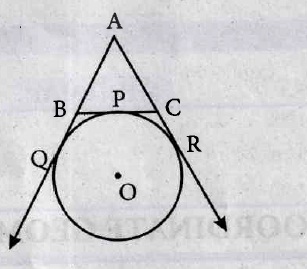
Since the two tangents drawn to a circle from an external point are equal.
AQ = AR ...(1)
Similarly, BQ = BP ...(2)
and CR = CP ..(3)
Now perimeter of \(\triangle\)ABC
= AB + BC + AC
= AB + (BP + PC) + AC
= AB + (BQ + CR) + AC
= (AB + BQ) + (CR + AC)
= AQ + AR
= AQ + AQ
= 2AQ
\(\left.A Q=\frac{1}{2} \text { (Perimeter of } \triangle A B C\right)\)
2.
Given radius r = 3.6 cm
Length of the tangents PA = PB = 6.2cm
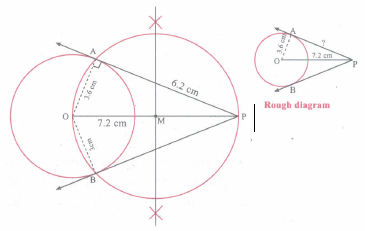
Construction:
Steps
(1) with centre at o, drawn a circle of radius 3.6 cm.
(2) Draw a line OP = 7.2 cm,
(3) Draw a perpendicular bisector of OP, which cuts OP at M.
(4) With M as centre and MO as radius, draw a circle which cuts previous circle at A and B.
(5) Join AP and BP. AP and BP are the required tangents. Thus length of the tangents are PA = PB = 6.2 cm.
3.
Diameter = 6 cm
Radius =\(\frac { 6 }{ 2 } =3cm\)
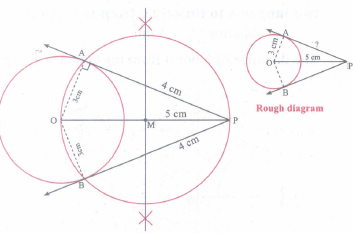
Length of the tangents PA = PB = 4 cm
Construction:
Steps:
(1) With centre O, draw a circle of radius 3cm.
(2) Draw a line OP = 5 cm
(3) Draw a bisector of OP, which cuts OP and M
(4) With M as centre and MO as radius draw a circle which cuts previous circle at A and B
(5) Join AP and BP. AP and BP are the required tangents. Thus length of the tangents are PA = PB = 4 cm.
4.
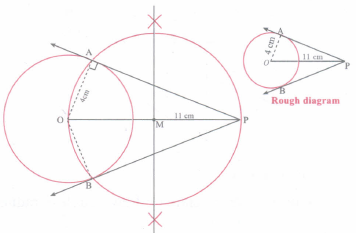
5.
The distance between the point from the centre is 10 cm.
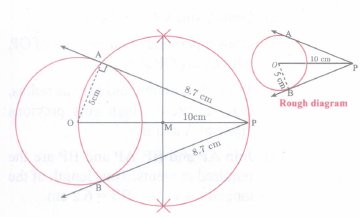
Length of the tangents PA - PB = 8.7 cm
Construction:
Steps:
(1) With O as centre, draw a circle of radius 5cm.
(2) Draw a line OP = 10 cm.
(3) Draw a perpendicular bisector of OP which cuts OP at M.
(4) With M as centre and MO as radius, draw a circle which cuts previous circle at A and B.
(5) Join AP and BP. AP and BP are the required tangents. Thus length of the tangents are PA and PB = 8.7 cm
6.
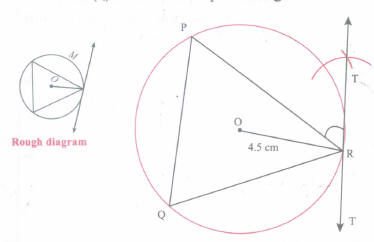
Construction:
(1) With O as the centre, draw a circle of radius 4.5 cm.
(2) Taken a point L on the circle through L drawn as chord LM
(3) Taken a point M distinct from L and N on the circle so that L, M, N are anti-clock wise direction. Joined LN and NM.
(4) Through 'L' drawn a tangent TT' such that \(\angle T L M=\angle M N L\)
(5) TT' is the required tangent.
7.
Radius = 3.4 cm
Centre = P
Tangent at any point R
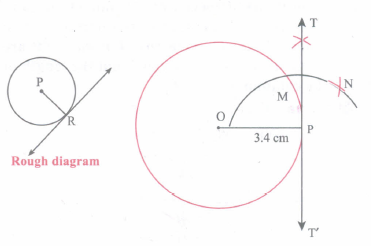
Construction
Steps
(1) Draw a circle with centre O of radius 3.4cm
(2) Take a point P on the circle. Join OP
(3) Drawn perpendicular line TT' to PR which passes through R.
(4) TTI is the required tangent.
8.
Given, diameter (d) = 6 cm, we find radius \((r)=\cfrac { 6 }{ 2 } =3cm\)
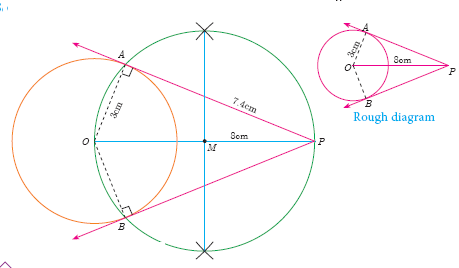
Construction
Step 1: With centre at O, draw a circle of radius 3 cm.
Step 2: Draw a line OP of length 8 cm.
Step 3: Draw a perpendicular bisector of OP, which cuts OP at M.
Step 4: With M as centre and MO as radius, draw a circle which cuts previous circle at A and B.
Step5: Join AP and BP. AP and BP are the required tangents. Thus length of the tangents are PA = PB = 7.4 cm.
Verification : In the right angle triangle OAP,PA2 = OP2 - OA2 = 64 -9 = 55
\(PA=\sqrt { 55= } 7.4\ cm\) (approximately) .
9.
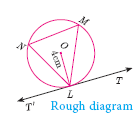
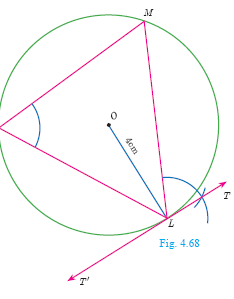
Given, radius = 4 cm
Construction
Step 1 : With O as the centre, draw a circle of radius 4 cm.
Step 2 : Take a point L on the circle. Through L draw any chord LM.
Step 3 : Take a point M distinct from L and N on the circle, so that L, M and N are in anti clockwise direction. Join LN and NM.
Step 4 : Through L draw a tangent TT' such that \(\angle\)TLM =\(\angle\)MNL
Step 5 : TT' is the required tangent.
10.
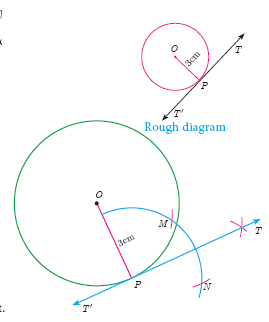
Given, radius r = 3 cm
Construction
Step 1: Draw a circle with centre at O of radius 3 cm.
Step 2: Take a point P on the circle. Join OP.
Step 3: Draw perpendicular line to OP which passes through P.
Step 4: TT' is the required tangent.
11.
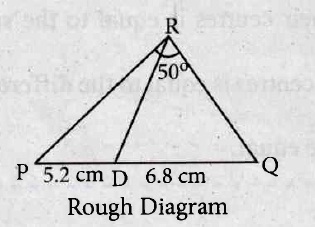
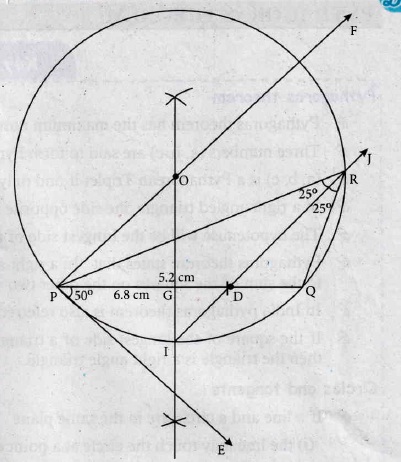
Construction:
Steps (1) Draw a line segment PQ = 6.8 cm
Steps (2) At P, draw PE such that \(\angle QPE={ 50 }^{ 0 }\)
Steps (3) At P, draw PF such that \(\angle FPE={ 90 }^{ 0 }\)
Steps (4) Drawn the perpendicular bisector to PQ, which intersects PF at 'O' and PQ at G.
Steps (5) With O as center and OP as radius drawn a circle.
Steps (6) From P, marked an arc of 5.2 cm on PQ at D
Steps (7) The perpendicular bisector intersects the circle at I. Joined ID
Steps (8) ID produced meets the circle at R now joining PR and QR, we get the required \(\triangle\)PQR.
12.
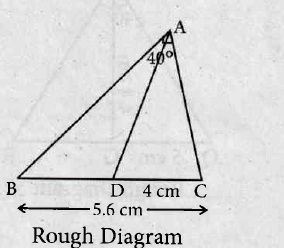
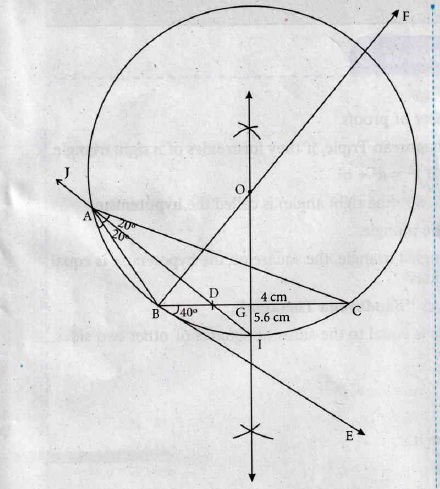
Construction:
Steps (1) Draw a line segment BC = 5.6 cm
Steps (2) At B, draw BE such that \(\angle CBE={ 60 }^{ 0 }\)
Steps (3) At B draw BF such that \(\angle EBF={ 90 }^{ 0 }\)
Steps (4) Drawn the perpendicular bisector to BC, which intersects BF at O and BC at G.
Steps (5) With O as centre and OB as radius draw a circle
Steps (6) From B, marked an arc of 4 cm on BC at D.
Steps (7) The perpendicular bisector intersects the circle at I. Joined ID.
Steps (8) ID produced meets the circle at A. Now joined AB and AC. Then \(\triangle\)ABC is the required triangle.
13.
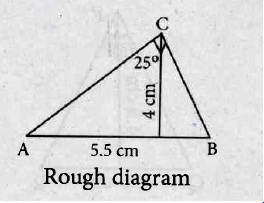
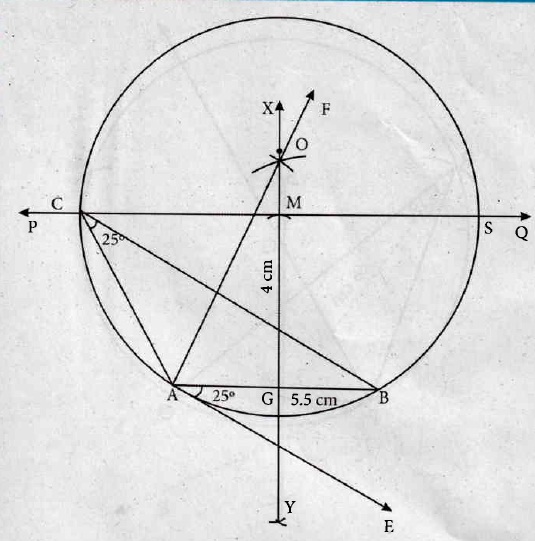
Construction:
Step (1) Draw \(\bar { AB } =5.5cm\)
Step (2) Draw \(\angle BAE={ 25 }^{ 0 }\)
Step (3) Draw \(\angle FAE={ 90 }^{ 0 }\)
Step (4) Drawn the perpendicular bisector XY to AB which intersects AF at O and AB at G.
Step (5) With O as center and OA as radius drawn a circle
Step (6) XY intersects AB at G. On XY from G marked an arc at M such that GM = 4 cm
Step (7) Drawn PQ through M which is parallel to AB.
Step (8) PQ meets the circle at C and S.
Step (9) Joined AC and BC. Now \(\triangle\)ABC is the required triangle
14.
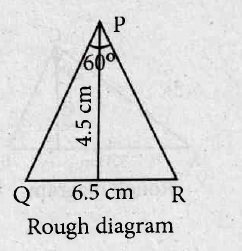
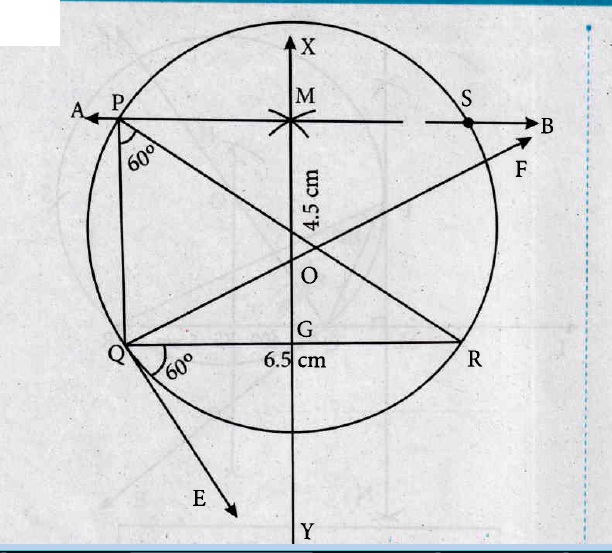
Construction:
Steps (1) Draw QR = 6.5 cm.
Steps (2) Draw \(\angle RQE={ 60 }^{ 0 }\)
Steps (3) Draw \(\angle FQE={ 90 }^{ 0 }\)
Steps (4) Drawn the perpendicular bisector XY to ER which intersects QF at O and ER at G.
Steps (5) With O as center and OQ as radius drawn a circle
Steps (6) XY intersects QR at G. On XY, from G marked an arc at M, such that GM = 4.5 cm
Steps (7) Drawn AB through M which is parallel to QR
Steps (8) AB meets the circle at P and S
Steps (9) Joined QP and RP Then \(\triangle\)PQR is the required triangle.
Steps (10) Here \(\triangle\)SQR is also another required triangle.
15.
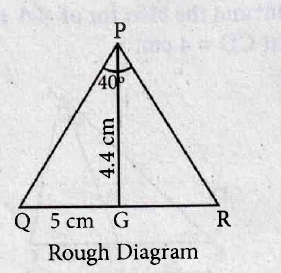
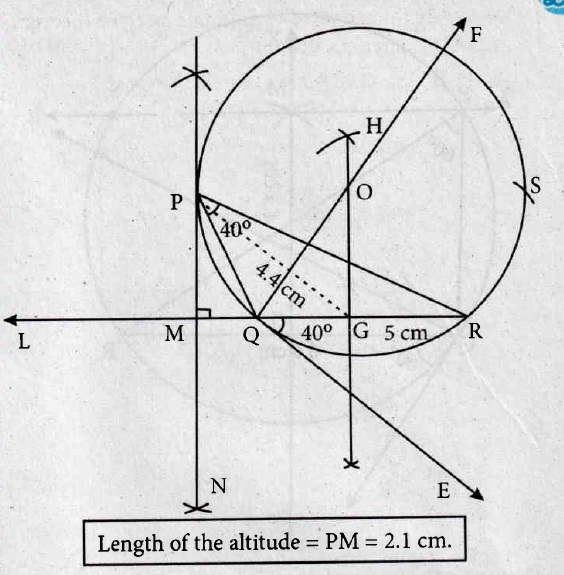
Construction:
Step (1) Draw a line segment QR = 5 cm.
Step (2) At Q, draw QE such that \(\angle RQE\) = 40°.
Step (3) At Q, draw QF such that \(\angle EQF\) = 90o
Step (4)Drawn a perpendicular bisector to QR, which intersects QF at 'O' and QR at G.
Step (5) With O as centre and OQ as radius, draw a circle
Step (6) From G marked arcs of radius 4.4 cm on the circle. Marked them as P and S.
Step (7) Joined QP and PR. Now \(\triangle\)PQR is the required triangle
Step (8) From P draw a line PN which is \(\bot \) to LR. LR meets PN at M.
Step (9) The length of the altitude is PM = 2.1cm
16.
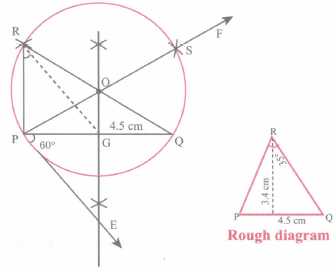
Construction:
Step (1) Draw a line segment PQ = 4.5 cm
Step (2) At P, draw PE such that \(\angle QPE={ 35 }^{ 0 }\)
Step (3) At P, draw PF such that \(\angle EPF={ 90 }^{ 0 }\)
Step (4) Draw \(\bot \) bisector to PQ which intersects PF at O.
Step (5) With O centre OP as radius draw a circle.
Step (6) From G, marked arcs of radius 6 cm on the circle marked them as R and S.
Step (7) Joined PR and RQ. Then \(\triangle\)PQR is the required triangle
Step (8) \(\triangle\)PQS is the required triangle
17.
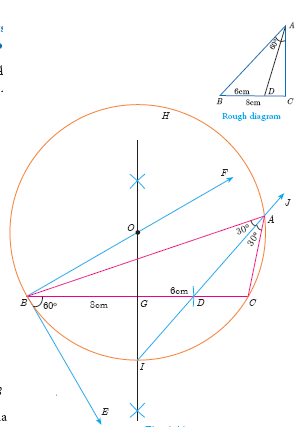
18.
Given a triangle \(\triangle\)PQR. We have to construct another triangle whose sides are \(\frac { 7 }{ 3 } \) of the corresponding sides of the given \(\triangle\)PQR.
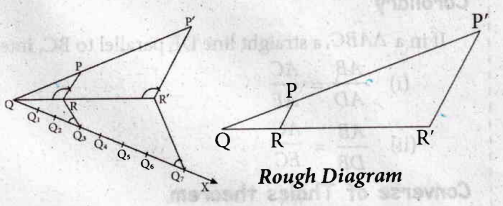
Steps of construction:
1. Constructed a PQR with any measurement.
2. Drawn a ray QX making an acute angle with QR on the side opposite to the vertex P.
3. Joined Q3 to R and drawn a line through Q7 parallel to Q3R, intersecting the extended line segment QR at R'
4. Drawn a line through R' parallel to RP intersecting the extended line segment QP at P.
5. Then PQR' is the required triangle each of whose sides is seven-thirds of the corresponding sides of PQR.
19.
Given a triangle ABC, we are required to construct another triangle whose sides are \(\frac { 6 }{ 5 } \) of the corresponding sides of the ABC
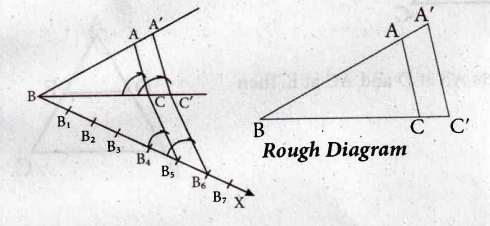
Steps of construction:
1. Constructed a ABC with any measurement
2. Drawn a ray BX making an acute angle with BC on the side opposite to the vertex A.
3. Joined B5 to C and drawn a line through B6 parallel to B5C intersecting the extended line segment BC at C.
4. Drawn a line through C' parallel to CA intersecting the extended BA at A'.
5. Then A'BC' is the required triangle each of whose sides is six-fifths of the corresponding sides of ABC.
20.
Given a triangle LMN, we are required to construct another triangle whose sides are \(\frac { 4 }{ 5 } \) of the corresponding sides of the \(\triangle\)LMN
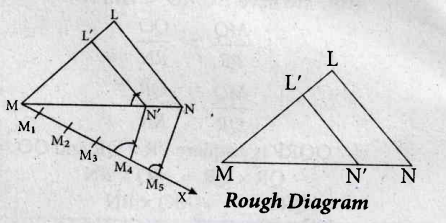
Steps of construction:
1. Constructed a LMN with any measurement
2. Drawn a ray MX making an acute angle with MN on the side opposite to the vertex L.
3. Located 5 points M1, M2, M3, M4, M5 on MX so that
MM1 = M1M2 = M2M3 = M3M4 = M4M5
4. Joined, M5N and drawn a line through M4 parallel to M5N to intersect MN at N.
5. Drawn a line through N, parallel to the line NL to intersect ML at L
Then L'MN' is the required triangle each of whose sides is four-fifth of the corresponding sides of LMN
21.
Given a triangle PQR, we are required to construct another triangle whose sides are \(\frac { 3 }{ 5 } \) of the corresponding sides of the triangle PQR
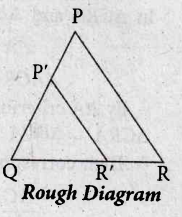
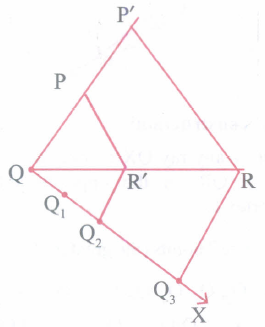
Steps of construction:
1. Constructed a PQR with any measurement.
2. Drawn a ray QX making an acute angle with QR on the side opposite to the vertex P.
Located 3 points Q1, Q2 and Q3 on QX so that Q Q1 = Q1 Q2 = Q2 Q3
4. Joined Q3R and drawn a line through Q2 parallel to Q3R to intersect QR at R'.
5. Drawn a line through R' parallel to the line RP to intersect QP at P'. Then PQR is the required triangle each of whose sides is two-thirds of the corresponding sides of PQR.
22.
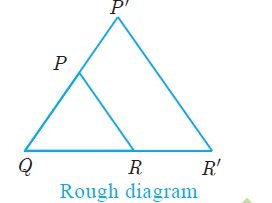
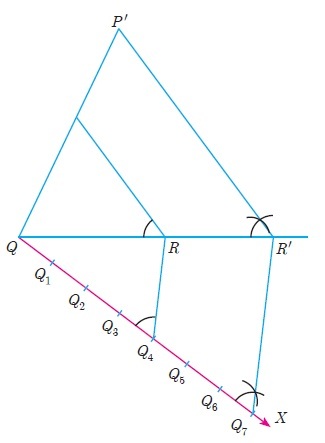
Given a triangle PQR, we are required to construct another triangle whose sides are \(\frac { 7 }{ 4 } \) of the corresponding sides of the triangle PQR.
Steps of construction
1. Construct a DPQR with any measurement.
2. Draw a ray QX making an acute angle with QR on the side opposite to vertex P.
3. Locate 7 points (the greater of 7 and 4 in \(\frac { 7 }{ 4 } \))
Q1,Q2,Q3,Q4,Q5,Q6 and Q7 on QX so that
QQ1 = Q1Q2 = Q2Q3 = Q4Q5 = Q5Q6 = Q6Q7
4. Join Q4 (the 4th point, 4 being smaller of 4 and 7 in \(\frac { 7 }{ 4 } \)) to R and draw a line through Q7 parallel to Q4R, intersecting the extended line segment QR at R'.
5. Draw a line through R' parallel to RP intersecting the extended line segment QP at P'.
Then \(\triangle\)P'QR' is the required triangle each of whose sides is seven-fourths of the corresponding sides of \(\triangle\)PQR.
23.
Given a triangle PQR we are required to construct another triangle whose sides are \(\frac{3}{5}\) of the corresponding sides of the triangle PQR.

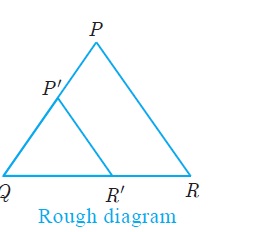
Steps of construction
1. Construct a \(\triangle\) PQR with any measurement
2. Draw a ray QX making an acute angle with QR on the side opposite to vertex P.
3. Locate 5 (the greater of 3 and 5 in \(\frac { 3 }{ 5 } \)) points.
Q1Q2, Q3, Q4 and Q5 on QX so that QQ1 = Q1Q2 = Q2Q3 = Q4Q5
4. Join Q5R and draw a line through Q3 (the third point, 3 being smaller of 3 and 5 in \(\frac { 3 }{ 5 } \)) parallel to Q5R to intersect QR at R'.
5. Draw line through R' parallel to the line RP to intersect QP at P'.
Then, \(\triangle\)P'QR' is the required triangle each of whose sides is three-fifths of the corresponding sides of \(\triangle\) PQR.

10th Standard Syllabus & Materials
10th Standard
TN 10th English Prose - 2 - The Night the Ghost Got in Important Questions And Answers Study Material - QB365 Set A
NEW10th Standard
TN 10th English Supplementary - 1 - The Tempest Important Questions And Answers Study Material - QB365 Set A
NEW10th Standard
TN 10th English Poem - 1 - Life Important Questions And Answers Study Material - QB365 Set A
NEW10th Standard
TN 10th English Prose - 1 - His First Flight Important Questions And Answers Study Material - QB365 Set A



Tamilnadu Stateboard 10th Standard Subjects
Tamilnadu Stateboard Standards





