
 100% FREE ACCESS
10th Standard Syllabus & Materials
10th Standard
TN 10th English Prose - 4 - The Attic Important Questions And Answers Study Material - QB365 Set A
NEW10th Standard
TN 10th English Supplementary - 3 - The Story of Mulan Important Questions And Answers Study Material - QB365 Set A
NEW10th Standard
TN 10th English Poem - 3 - I am Every Woman Important Questions And Answers Study Material - QB365 Set A
NEW10th Standard
TN 10th English Prose - 3 - Empowered Women Navigating The World Important Questions And Answers Study Material - QB365 Set A
NEW10th Standard
TN 10th English Supplementary - 2 - Zigzag Important Questions And Answers Study Material - QB365 Set A
NEW10th Standard
TN 10th English Poem - 2 - The Grumble Family Important Questions And Answers Study Material - QB365 Set A

Published on: 31/10/2022
QB365 provides a detailed and simple solution for every Possible Creative Questions in Class 10 Maths Subject -Geometry , English Medium. It will help Students to get more practice questions, Students can Practice these question papers in addition to score best marks.
Download Tamil Nadu 10th Standard Maths question papers, model tests, one-mark questions, important questions, and public exam papers in PDF format. Free study materials and answer keys for TN State Board students.
Questions + Answers key
Take MCQ Maths Test1.
Construct a \(\triangle\) PQR in which PQ = 8 cm
2.
Draw a circle of radius 5 cm. Consider a point P at a distance of 8 cm from the circle's centre and draw two tangents from P.
3.
Show that the alternates of a triangle are concurrent.
4.
A point O in the interior of a rectangle ABCD is joined with each of the vertices A, B, C and D. Prove that OB2 + OD2 = OC2 + OA2
5.
ABC is a right triangle right angled at C and \(\mathrm{AC}=\sqrt{3} \mathrm{BC} \text {. Prove that } \angle A B C=60^{\circ} \text {. }\)
6.
P and Q are points on the sides CA and CB respectively of \(\Delta\)ABC right angled at C. Prove that AC2 + BP2 = AB2 + PQ2.
7.
The bisectors of the angle B and C of a triangle ABC, meet the opposite sides in D and E respectively. If DE DE || BC BC, prove that the triangle is isosceles
8.
In AD is the median of \(\Delta\)ABC The bisector of \(\angle\)ADB and \(\angle\)ADC meet AB and AC in E and F respectively. Prove that EF || BC
9.
O is any point inside a triangle \(\Delta\)ABC The bisector of \(\angle A O B, \angle B O C, \angle C O A\) meet the sides AB, BC and CA in point D, E and F respectively. Show that AD x BE x CF = DB x EC x FA.
10.
Construct an isosceles triangle whose base is 8 cm and altitude 4 cm and then another triangle whose sides are \(1 \frac{1}{2}\) times the corresponding sides of the isosceles triangle.
11.
Prove that the area of an equilateral triangle described on one side of a square in equal to half the area of the equilateral triangle described on one of its diagonals.
12.
In the figure, if \(\triangle A B E \cong \triangle \text { ACD, show that }\triangle A D E \sim \triangle A B C\)
1.
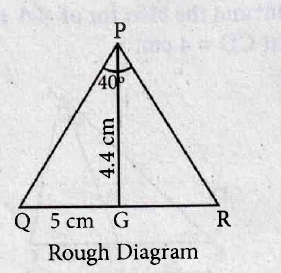
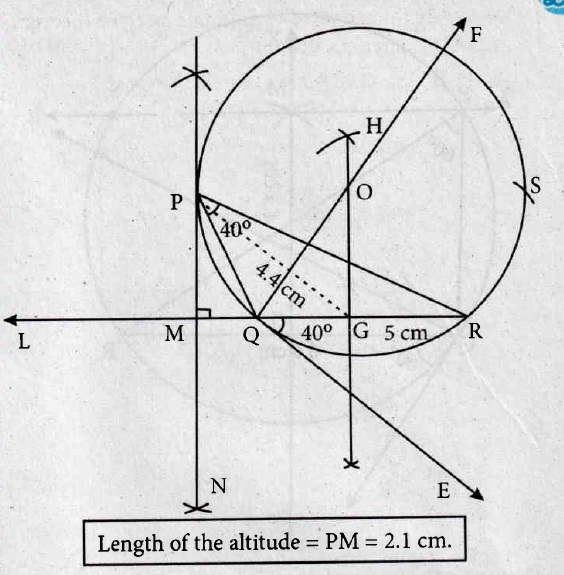
Construction:
Step (1) Draw a line segment QR = 5 cm.
Step (2) At Q, draw QE such that \(\angle RQE\) = 40°.
Step (3) At Q, draw QF such that \(\angle EQF\) = 90o
Step (4)Drawn a perpendicular bisector to QR, which intersects QF at 'O' and QR at G.
Step (5) With O as centre and OQ as radius, draw a circle
Step (6) From G marked arcs of radius 4.4 cm on the circle. Marked them as P and S.
Step (7) Joined QP and PR. Now \(\triangle\)PQR is the required triangle
Step (8) From P draw a line PN which is \(\bot \) to LR. LR meets PN at M.
Step (9) The length of the altitude is PM = 2.1cm
2.
| AP = BP = 6.2cm |
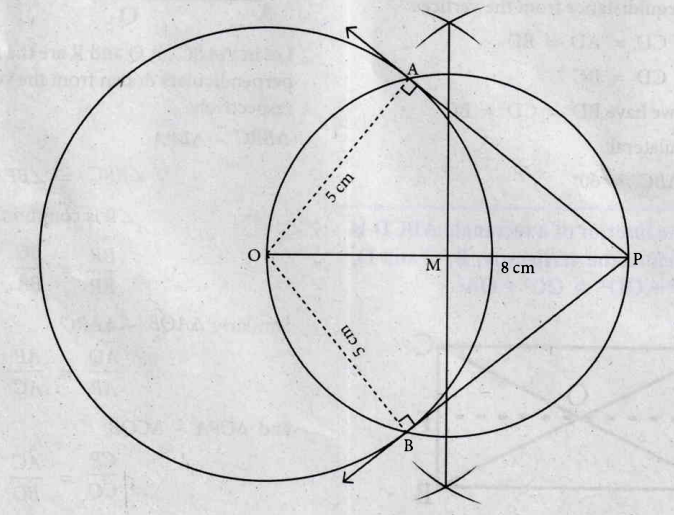
Construction:
Step 1: With center 'O' drawn a circle of radius 5 cm
Step 2: Drawn a line OP = 8 cm
Step 3: Draw a perpendicular bisector of OP which cuts OP at M
Step 4: With M as center and MO as radius drawn a circle which cuts previous circle at A and B.
Step 5: Joined AP and BP. AP and BP are the required tangents.
AP = BP = 6.2 cm.
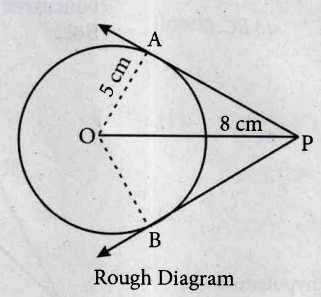
3.
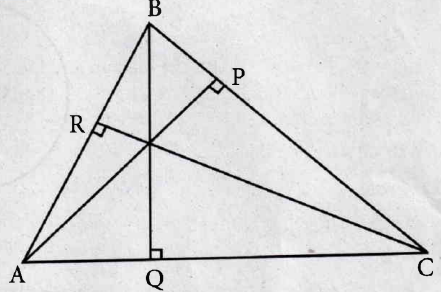
Let in \(\Delta\)ABC , B Q and R are the foot of the perpendiculars drawn from the vertices A, B and C respectively.
\(\Delta B R C \sim \Delta B P A\)
\(\because \angle B R C=\angle B P A=90^{\circ}\)
\(\angle \mathrm{B} \text { is common }[\therefore \text { By AA criteria }]\)
\(\frac{B R}{B P}=\frac{B C}{B A}\)
\(\text { Similarly } \triangle A Q B \sim \triangle A R C\)
\(\frac{A Q}{A R}=\frac{A P}{A C}\)
\(\text { and } \Delta C P A \sim \Delta C Q B\)
\(\frac{C P}{C Q}=\frac{A C}{B C}\)
\(\text { Multiplying (1), (2) and (3), we have }\)
\(\frac{B R}{B P} \times \frac{A Q}{A R} \times \frac{C P}{C Q}=\frac{B C}{A B} \times \frac{A B}{A C} \times \frac{A C}{B C}=1\)
\(\therefore \text { By Ceva's theorem altitudes are concurrent. }\)
4.
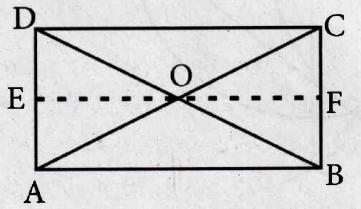
Let ABCD be the given rectangle. Let 'O' be the point within it. Join OA, OB, OC and OD.
Through O draw EOF || AB. Then ABFE is a rectangle.
In right triangles \(\triangle O E A \text { and } \triangle O F C \text {, }\) we have
\(\mathrm{OA}^{2} =\mathrm{OE}^{2}+\mathrm{AE}^{2} \text { and } \mathrm{OC}^{2}=\mathrm{OF}^{2}+\mathrm{CF}^{2} \)
\(\mathrm{OA}^{2}+\mathrm{OC}^{2} =\left(\mathrm{OE}^{2}+\mathrm{AE}^{2}\right)+\left(\mathrm{OF}^{2}+\mathrm{CF}^{2}\right) \)
\(\mathrm{OA}^{2}+\mathrm{OC}^{2} =\mathrm{OE}^{2}+\mathrm{OF}^{2}+\mathrm{AE}^{2}+\mathrm{CF}^{2} \)
\(\text { Now in right triangles } \triangle O F B \text { and } \triangle D O E \text { we have }\)
\(\mathrm{OB}^{2}= \mathrm{OF}^{2}+\mathrm{FB}^{2} \text { and } \mathrm{OD}^{2}=\mathrm{OE}^{2}+\mathrm{DE}^{2} \)
\(\mathrm{OB}^{2}+\mathrm{OD}^{2}=\left(\mathrm{OF}^{2}+\mathrm{FB}^{2}\right)+\left(\mathrm{OE}^{2}+\mathrm{DE}^{2}\right) \)
\(\mathrm{OB}^{2}+\mathrm{OD}^{2}= \mathrm{OE}^{2}+\mathrm{OF}^{2}+\mathrm{DE}^{2}+\mathrm{BF}^{2} \)
\(\mathrm{OB}^{2}+\mathrm{OD}^{2}= \mathrm{OE}^{2}+\mathrm{OF}^{2}+\mathrm{CF}^{2}+\mathrm{AE}^{2} \)
\([\because \mathrm{DE}=\mathrm{CF} \text { and } \mathrm{AE}=\mathrm{BF}] \)
\(\text { From }(1) \text { and }(2) \text { we get } \mathrm{OA}^{2}+\mathrm{OC}^{2}=\mathrm{OB}^{2}+\mathrm{OD}^{2}\)
5.
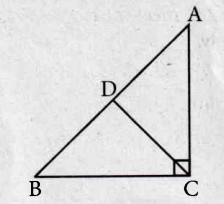
Let D be the midpoint of AB. join CD.
Since ABC is a right angled triangle, \(A C B=90^{\circ}\)
\(\mathrm{AB}^{2}=\mathrm{AC}^{2}+\mathrm{BC}^{2}\)
\(\mathrm{AB}^{2}=(\sqrt{3} B C)^{2}+\mathrm{BC}^{2}\)
\([\because \mathrm{AC}=\sqrt{3} \mathrm{BC} \text { given }]\)
\(\mathrm{AB}^{2} =3 \mathrm{BC}^{2}+\mathrm{BC}^{2} \)
\(\Rightarrow \mathrm{AB}^{2} =4 \mathrm{BC}^{2} \)
\(\mathrm{AB} =2 \mathrm{BC} \)
\(\text { But } \mathrm{BD} =\frac{1}{2} \mathrm{AB} \)
\(\mathrm{AB} =2 \mathrm{BD} \)
\(\text { (1) and (2) } \Rightarrow \mathrm{BD}=\mathrm{BC}\)
We know that the midpoint of the hypotenuse of a right triangle is equidistance from the vertices
\(\therefore \mathrm{CD}=\mathrm{AD}=\mathrm{BD} \)
\(\Rightarrow \mathrm{CD}=\mathrm{BC} \)
\(\text { Thus in } \triangle A B C \text { we have } \mathrm{BD}=\mathrm{CD}=\mathrm{BC}\)
\(\therefore \triangle B C D \text { is equilateral }\)
\(\Rightarrow \therefore \angle A B C=60^{\circ}\)
6.
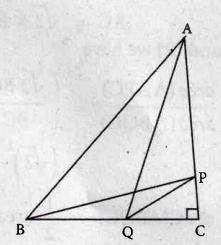
In right angled triangles ACQ and PCB, we have
\(\mathrm{AQ}^{2} =\mathrm{AC}^{2}+\mathrm{CQ}^{2} \text { and } \)
\(\mathrm{PB}^{2} =\mathrm{PC}^{2}+\mathrm{CB}^{2} \)
\(\Rightarrow \mathrm{AQ}^{2}+\mathrm{BP}^{2} =\left(\mathrm{AC}^{2}+\mathrm{CQ}^{2}\right)+\left(\mathrm{PC}^{2}+\mathrm{CB}^{2}\right) \)
\(\Rightarrow \mathrm{AQ}^{2}+\mathrm{BP}^{2} =\left(\mathrm{AC}^{2}+\mathrm{BC}^{2}\right)+\left(\mathrm{PC}^{2}+\mathrm{QC}^{2}\right) \)
[By Pythagoras theorem we have
\(\left.A C^{2}+B C^{2}=A B^{2} \text { and } P C^{2}+Q C^{2}=P Q^{2}\right] \)
\(\therefore \ A Q^{2}+B P^{2}=A B^{2}+P Q^{2} \)
7.
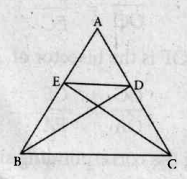
Given: \(\Delta\)ABC is a triangle in which the bisectors of \(\angle\)B and \(\angle\)C meet the sides AC and AB at D and E respectively.
To prove: AB = AC
Construction: join DE
Proof : In \(\Delta\)ABC, BD is the bisector of \(\angle\)B
\(\therefore \frac{A B}{B C}=\frac{A D}{D C}\)
\(\text { In } \triangle A B C, C E \text { is the bisector of } \angle C\)
\(\therefore \frac{A C}{B C}=\frac{A E}{B E}\)
\(\text { Now DE } \| \mathrm{BC}\)
\(\Rightarrow \frac{A E}{B E}=\frac{A D}{D C}\) [By Thales theorem]
From (1), (2) and (3), we have
\(\frac{A B}{B C}=\frac{A C}{B C} \Rightarrow A B=A C\)
Hence \(\Delta\)ABC is isosceles.
8.
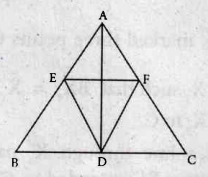
Given: In \(\Delta\)ABC,, AD is the median and DE and DF are the bisectors of \(\angle\)ADB and \(\angle\)ADC respectively
meeting AB and AC in E and F respectively.
To prove: EF || BC
Proof
In \(\Delta\)ADB, DE is the bisector of \(\angle\)ADB
\(\therefore \frac{A D}{D B}=\frac{A E}{E B}\)
\(\text { In } \triangle A D C, \text { DF is the bisector of } \angle A D C\)
\( \frac{A D}{D C}=\frac{A F}{F C} \)
\(\Rightarrow \frac{A D}{D B}=\frac{A F}{F C} \)
\([\because \mathrm{AD} \text { is the median } \mathrm{BD}=\mathrm{DC}]\)
From (1) and (2), we get
\(\frac{A E}{E B}=\frac{A F}{F C}\)
9.
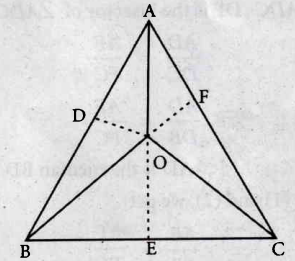
\(\text { In } \triangle A O B, O D \text { is the bisector of } \angle A O B\)
\(\frac{O A}{O B}=\frac{A D}{D B}\)
\(\text { In } \triangle B O C, O E \text { in the bisector of } \angle B O C\)
\(\frac{O B}{O C}=\frac{B E}{E C}\)
\(\text { In } \triangle C O A, O F \text { is the bisector of } \angle C O A\)
\(\frac{O C}{O A}=\frac{C F}{F A}\)
Multiplying the corresponding sides of (1), (2) and (3) we get
\(\frac{O A}{O B} \times \frac{O B}{O C} \times \frac{O C}{O A}=\frac{A D}{D B} \times \frac{B E}{E C} \times \frac{C F}{F A}\)
\(1=\frac{A D}{D B} \times \frac{B E}{E C} \times \frac{C F}{F A}\)
\(\mathrm{DB} \times \mathrm{EC} \times \mathrm{FA}=\mathrm{AD} \times \mathrm{BE} \times \mathrm{CF} \)
\(\mathrm{AD} \times \mathrm{BE} \times \mathrm{CF}=\mathrm{DB} \times \mathrm{EC} \times \mathrm{FA} \)
10.
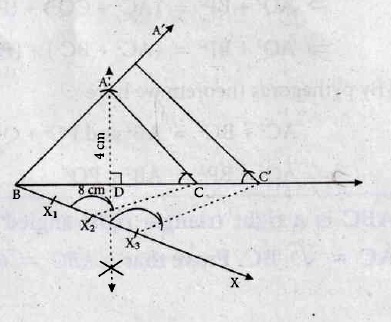
Steps of construction:
l. Drawn BC = 8 cm.
2. Drawn the perpendicular bisector of BC which intersects BC at D.
3. Marked a point A on the above perpendicular such that DA = 4 cm.
4. joined AB and AC. Thus \(\Delta\)ABC is the required isosceles triangle.
5. Then drawn array BX such that \(\angle\)CBX is an acute angle.
5. On BX, marked three points (since \(\left.1 \frac{1}{2}=\frac{3}{2}\right) X_{1}X_{2} \text { and } X_{3} \text { such that } B X_{1}=X_{1} X_{2}=X_{2} X_{3}\)
7. Joined X2 to C.
8. Drawn a line through X3, parallel to X2C and intersecting BC extended to C'.
9. Drawn a line through C' parallel to CA intersecting BA extended at A'. Thus \(\Delta\)A'BC' is the required triangle.
11.
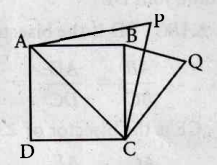
We have a square ABCD, whose diagonal AC.
Equilateral triangle \(\Delta\)BQC is described on the side BC and another equilateral \(\Delta\)APC is described on the diagonal AC.
\(\therefore\) All equilateral triangles are similar.
\(\triangle A P C \sim \triangle B Q C\)
\(\therefore\)The ratio of their areas is equal to the square of the ratio of their corresponding sides.
\(\frac{\text { area }(\Delta \mathrm{APC})}{\text { area }(\triangle \mathrm{BOC})}=\left(\frac{A C}{B C}\right)^{2}\)
Since the length of a diagonal of a square \(=\sqrt{2} \times \operatorname{side}\)
\(\mathrm{AC}=\sqrt{2} \times B C\)
From (1) and (2) we have
\(\frac{\text { area }(\Delta \mathrm{APC})}{\operatorname{area}(\Delta \mathrm{BQC})}=\left(\frac{\sqrt{2} \mathrm{BC}}{B C}\right)^{2}\)
\(=(\sqrt{2})^{2}=2\)
\(\therefore \text { area }(\Delta B Q C)=\frac{1}{2} \operatorname{area}(\triangle A P C)\)
12.
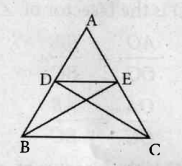
We have \(\triangle A B E \cong \triangle \text { ACD, }\)
Their corresponding parts are equal.
\(\mathrm{AB} =\mathrm{AC} \)
\(\mathrm{AE} =\mathrm{AD} \)
\(\therefore \frac{A B}{A C} =\frac{A E}{A D} \Rightarrow \frac{A B}{A E}=\frac{A C}{A D} \)
\(\Rightarrow \frac{A B}{A D} =\frac{A C}{A E} \quad[\because \mathrm{AE}=\mathrm{AD}] \)
\(\text { Now in } \triangle A D E \text { and } \triangle A B C\)
\(\frac{A B}{A D} =\frac{A C}{A E} \)
\(\angle D A E =\angle B A C \)
\(\text { Using SAS similarity criteria we have }\)
\(\triangle A D E \sim \triangle A B C\)

10th Standard Syllabus & Materials
10th Standard
TN 10th English Prose - 2 - The Night the Ghost Got in Important Questions And Answers Study Material - QB365 Set A
NEW10th Standard
TN 10th English Supplementary - 1 - The Tempest Important Questions And Answers Study Material - QB365 Set A
NEW10th Standard
TN 10th English Poem - 1 - Life Important Questions And Answers Study Material - QB365 Set A
NEW10th Standard
TN 10th English Prose - 1 - His First Flight Important Questions And Answers Study Material - QB365 Set A



Tamilnadu Stateboard 10th Standard Subjects
Tamilnadu Stateboard Standards





