
 100% FREE ACCESS
10th Standard Syllabus & Materials
10th Standard
TN 10th English Prose - 4 - The Attic Important Questions And Answers Study Material - QB365 Set A
NEW10th Standard
TN 10th English Supplementary - 3 - The Story of Mulan Important Questions And Answers Study Material - QB365 Set A
NEW10th Standard
TN 10th English Poem - 3 - I am Every Woman Important Questions And Answers Study Material - QB365 Set A
NEW10th Standard
TN 10th English Prose - 3 - Empowered Women Navigating The World Important Questions And Answers Study Material - QB365 Set A
NEW10th Standard
TN 10th English Supplementary - 2 - Zigzag Important Questions And Answers Study Material - QB365 Set A
NEW10th Standard
TN 10th English Poem - 2 - The Grumble Family Important Questions And Answers Study Material - QB365 Set A

Published on: 09/05/2020
10th Standard Maths English Medium Book back Important 2 Marks Questions
Download Tamil Nadu 10th Standard Maths question papers, model tests, one-mark questions, important questions, and public exam papers in PDF format. Free study materials and answer keys for TN State Board students.
Questions + Answers key
Take MCQ Maths Test1.
Let A = {1, 2, 3, 7} and B = {3, 0, –1, 7}, which of the following are relation from A to B ?
R3 = {(2, –1), (7, 7), (1, 3)}
2.
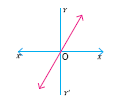
Determine whether the graph given below represent functions. Give a reason for your answer concerning the graph.
3.
prove the following identity.
\(\frac { cos\theta }{ 1+sin\theta } \) = sec \(\theta \) - tan \(\theta \)
4.
prove the following identity tan4\(\theta \) + tan2\(\theta \) = sec4\(\theta \) - sec2\(\theta \) .
5.
Determine the nature of the roots for the following quadratic equations
9a2b2x2 - 24abcdx + 16c2d2 = 0, a ≠ 0, b ≠ 0
6.
Determine the nature of the roots for the following quadratic equations
x2 - x - 1 = 0
7.
Solve the following quadratic equations by formula method
\(\sqrt { 2 } { f }^{ 2 }-6f+3\sqrt { 2 } \) = 0
8.
Find the sum and product of the roots for each of the following quadratic equations
x2 + 3x = 0
9.
Determine the quadratic equations, whose sum and product of roots are
-(2 - a)2, (a + 5)2
10.
Which of the following sequences form a Geometric Progression?
\(\frac { 1 }{ 2 } \), 1, 2, 4,....
11.
Find the equation of a line through the given pair of points (2, 3) and (-7, -1)
12.
Simplify
\(\frac { x+2 }{ x+3 } +\frac { x-1 }{ x-2 } \)
13.
D is the mid point of side BC and AE \(\bot \) BC. If BC = a, AC = b, AB = c, ED = x, AD = p and AE = h, prove that
\({ b }^{ 2 }+{ c }^{ 2 }={ 2p }^{ 2 }+\frac { { a }^{ 2 } }{ 2 } \)
14.
In \(\triangle\)ABC, D and E are points on the sides AB and AC respectively. For each of the following cases show that DE || BC AB = 5.6 cm, AD = 1.4 cm, AC = 7.2 cm and AE = 1.8 cm.
15.
Find the area of the triangle formed by the points :(–10, –4), (–8, –1) and (–3, –5)
16.
If figure OPRQ is a square and \(\angle\)MLN = 90o. Prove that
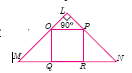
QR2 = MQ x RN
17.
Multiply \(\frac { { x }^{ 4 }{ b }^{ 2 } }{ x-1 } \) by \(\frac { { x }^{ 2 }-1 }{ { a }^{ 4 }{ b }^{ 3 } } \)
18.
Find the first four terms of the sequences whose nth terms are given by
an = 2n2 - 6
19.
Write the domain of the following real functions
p(x) = \(\frac { -5 }{ 4x^{ 2 }+1 }\)
20.
Find the general term for the following sequences.
\(\frac { 1 }{ 2 } ,\frac { 2 }{ 3 } ,\frac { 3 }{ 4 } \)
21.
Find the least positive value of x such that
78 + x \(\equiv \) 3 (mod 5)
22.
Find k, if f(k) = 2k - 1 and f o f(k) = 5.
23.
Reduce the rational expressions to its lowest form
\(\frac { { x }^{ 2 }-16 }{ { x }^{ 2 }+8x+16 } \)
24.
Using the functions f and g given below, find f o g and g o f. Check whether f o g = g o f
f(x) = 3 + x, g(x) = x - 4
25.
Find the LCM and GCD for the following and verify that f(x) x g(x) = LCM x GCD
(x3 - 1)(x + 1), (x3 + 1)
26.
Find the equation of a straight line whose Inclination is 450 and y intercept is 11
27.
If A = \(\left[ \begin{matrix} 2 & 5 \\ 4 & 3 \end{matrix} \right] \), B = \(\left[ \begin{matrix} 1 & -3 \\ 2 & 5 \end{matrix} \right] \) find AB, BA and check if AB = BA?
28.
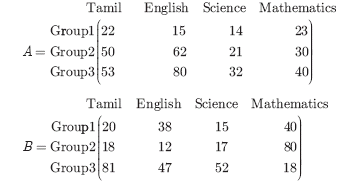
Two examinations were conducted for three groups of students namely group 1, group 2, group 3 and their data on average of marks for the subjects Tamil, English, Science and Mathematics are given below in the form of matrices A and B. Find the total marks of both the examinations for all the three groups.
29.
If A = \(\left[ \begin{matrix} 1 & 2 & 3 \\ 4 & 5 & 6 \\ 7 & 8 & 9 \end{matrix} \right] \), B = \(\left[ \begin{matrix} 1 & 7 & 0 \\ 1 & 3 & 1 \\ 2 & 4 & 0 \end{matrix} \right] \), find A + B.
30.
If P(A) = \(\frac{2}{3}\), P(B) = \(\frac{2}{5}\), P(A U B) = \(\frac{1}{3}\) then find P(A ∩ B).
31.
Find the values of x, y and z from the following equations
\(\left[ \begin{matrix} 12 & 3 \\ x & \frac { 3 }{ 2 } \end{matrix} \right] =\left[ \begin{matrix} y & z \\ 3 & 5 \end{matrix} \right] \)
32.
Write the sample space for tossing three coins using tree diagram.
33.
What is the probability that a leap year selected at random will contain 53 saturdays. (Hint: 366 = 52 x 7 + 2)
34.
If n = 5 , \(\bar { x } \) = 6, Σx2 = 765 then calculate the coefficient of variation.
35.
The following table gives the values of mean and variance of heights and weights of the 10th standard students of a school.
| Height | Weight | |
| Mean | 155 cm | 46.50 kg |
| Variance | 72.25 cm2 | 28.09 kg |
Which is more varying than the other?
36.
If α, β are the roots of the equation 2x2 - x - 1 = 0, then form the equation whose roots are
\(\frac { 1 }{ \alpha } ,\frac { 1 }{ \beta } \)
37.
38.
Find the angle of elevation of the top of a tower from a point on the ground, which is 30 m away from the foot of a tower of height \(10\sqrt { 3 } m\)
39.
Calculate the range of the following data..
| Income | 400-450 | 450-500 | 500-550 | 550-600 | 600-650 |
| Number of workers | 8 | 12 | 30 | 21 | 6 |
40.
Find the range and coefficient of range of the following data. 63, 89, 98, 125, 79, 108, 117, 68
41.
Find the equation of a straight line passing through the point P(-5, 2) and parallel to the line joining the points Q(3, -2) and R(-5, 4).
42.
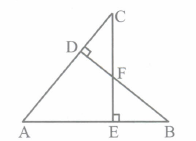
In the figure, if BD\(\bot \)AC and CE \(\bot \) AB, prove that
(i) \(\Delta AEC\sim \Delta ADB\)
(ii) \(\frac { CA }{ AB } =\frac { CE }{ DB } \)
43.
Find the sum of
12 + 22 +...+ 192
44.
Find the maximum volume of a cone that can be carved out of a solid hemisphere of radius r units.
45.
Find the sum of
1 + 3 + 5 +..+ to 40 terms
46.
Find the rational form of the number 0.6666....
47.
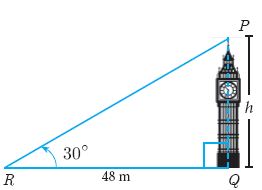
A tower stands vertically on the ground. from a point on the ground, which is 48m away from the foot of the tower, the angel of elevation of the top of the tower is 30°.find the height of the tower.
48.
If a, b, c are in A.P. then show that 3a, 3b, 3c are in G.P
49.
Write the first three terms of the G.P. whose first term and the common ratio are given below
a = 6, r = 3
50.
Find the range and coefficient of range of the following data: 25, 67, 48, 53, 18, 39, 44.
51.
Find the intercepts made by the line 4x − 9y + 36 = 0 on the coordinate axes.
52.
A man repays a loan of Rs. 65,000 by paying Rs. 400 in the first month and then increasing the payment by Rs. 300 every month. How long will it take for him to clear the loan?
53.
4 persons live in a conical tent whose slant height is 19 cm. If each person require 22 cm2 of the floor area, then find the height of the tent.
54.
55.
Show that the given vertices form a right angled triangle and check whether its satisfies Pythagoras theorem A(1, - 4) , B(2, - 3) and C(4, - 7)
56.
What is the inclination of a line whose slope is 0
57.
If f(x) = 3x - 2, g(x) = 2x + k and if f o g = f o f, then find the value of k..
58.
First term a and common difference d are given below. Find the corresponding A.P
a = 5, d = 6
59.
Find the diameter of a sphere whose surface area is 154 m2.
60.
A garden roller whose length is 3 m long and whose diameter is 2.8 m is rolled to level a garden. How much area will it cover in 8 revolutions?
61.
Find the LCM of the following
8x4y2, 48x2y4
62.
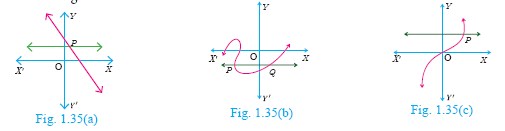
Using horizontal line test (Fig.1.35(a), 1.35(b), 1.35(c)), determine which of the following functions are one – one.
63.
In each of the following, find the value of ‘a’ for which the given points are collinear. (2, 3), (4, a) and (6, –3)
64.
Vertices of given triangles are taken in order and their areas are provided aside. In each case, find the value of ‘p’?
| S. No | Vertices | Area (sq. units) |
| (i) | (0, 0), (p, 8), (6, 2) | 20 |
| (ii) | (p, p), (5, 6), (5, -2) | 32 |
65.
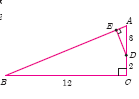
In the adjacent figure, \(\triangle\)ABC is right angled at C and DE\(\bot \) AB. Prove that \(\triangle\)ABC~\(\triangle\)ADE and hence find the lengths of AE and DE.
66.
Two triangles QPR and QSR, right angled at P and S respectively are drawn on the same base QR and on the same side of QR. If PR and SQ intersect at T, prove that PT x TR = ST x TQ. \(\triangle\)
67.
Let f{(x, y)| x, y \(\in \) N and y = 2x}. be a relation on ℕ. Find the domain, co-domain and range. Is this relation a function?
68.
Find the number of integer solutions of 3x \(\equiv \) 1 (mod 15).
69.
prove that \(\frac { sec\theta }{ sin\theta } -\frac { sin\theta }{ cos\theta } =cot\theta \)
70.
if m, n are natural numbers , for what values of m, does 2n x 5m ends in 5?
71.
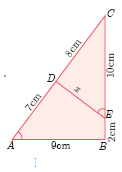
\(\angle A=\angle CED\) prove that \(\Delta\ CAB \sim \Delta CED\) Also find the value of x.
72.
Can the number 6n, n being a natural number end with the digit 5 ? Give reason for your answer.
73.
Let A = {3,4,7,8} and B = {1,7,10}. Which of the following sets are relations from A to B?
R1 = {(3,7), (4,7), (7,10), (8,1)}
74.
A cone of height 24 cm is made up of modeling clay. A child reshapes it in the form of a cylinder of same radius as cone. Find the height of the cylinder.
75.
Find the value of k, such that f o g = g o f
f(x) = 3x + 2, g(x) = 6x - k
76.
A solid iron cylinder has total surface area of 1848 sq.m. Its curved surface area is five – sixth of its total surface area. Find the radius and height of the iron cylinder.
77.
Find the area of the triangle whose vertices are (-3, 5) , (5, 6) and (5, - 2)
1.
A = { 1, 2, 3, 7}, B = { 3, 0, -1, 7}
A x B = {(1, 3), (1, 0), (1, - 1), (1, 7),(2,3), (2, 0), (2, -1), (2, 7), (3,3), (3, 0), (3, - 1), (3, 7), (7, 3)., (7, 0), (7, -1), (7 ,7)}
R3 = {( 2, -1), (7, 7) , (1, 3)}
It is clear that \(R_{3} \subseteq A \times B\)
R3 is a relation from A to B.
2.
It is a function. Since a Vertical line intersects the curve at only one point.
3.
\( \frac{\cos \theta}{1+\sin \theta} =\sec \theta-\tan \theta \)
\(\text { LHS } =\frac{\cos \theta}{1+\sin \theta} \)
\(=\frac{\cos \theta}{1+\sin \theta} \times \frac{1-\sin \theta}{1-\sin \theta} \)
[Multiplying the Numerator and Denominator by 1 - sin\(\theta\)]
\( =\frac{\cos \theta(1-\sin \theta)}{1^{2}-\sin ^{2} \theta} \)
\(\left[\because(a+b)(a-b)=a^{2}-b^{2}\right] \)
\(=\frac{\cos \theta(1-\sin \theta)}{\cos ^{2} \theta} \)
\(\left[\because 1-\sin ^{2} \theta=\cos ^{2} \theta\right] \)
\(=\frac{(1-\sin \theta)}{\cos \theta} \)
\(=\frac{1}{\cos \theta}-\frac{\sin \theta}{\cos \theta} \)
\(=\sec \theta-\tan \theta \)
= RHS
4.
tan4\(\theta \) + tan2\(\theta \) = sec4\(\theta \) - sec2\(\theta \)
L.H.S = tan2θ (tan2θ + 1)
= tan2θ.sec2θ
= sec4θ - sec2θ
= R.H.S
5.
9a2b2x2 - 24abcdx + 16c2d2 = 0
a b c
∆ = b2-4ac
= (-24abcd)2 - 4 x 9a2b2 x 16c2d2
= 576a2b2c2d2 - 576a2b2c2d2
= 0
∴ The roots are real and equal.
6.
x2-x-1 = 0, Here a = 1, b = -1, c = -1
∆ = b2-4ac = (-1)2-4 x 1 x -1
= 1 + 4
= 5 > 0
∴ The roots are real and unequal
7.
\(\sqrt { 2 } { f }^{ 2 }-6f+3\sqrt { 2 } \) = 0
a b c
\(x=\frac { -b\sqrt { { b }^{ 2 }-4ac } }{ 2a } \)
Here \(f=\frac { -(-6)\pm \sqrt { { (-6) }^{ 2 }-4\times \sqrt { 2 } \times 3\sqrt { 2 } } }{ 2\times \sqrt { 2 } } \)
\(=\frac { 6\pm \sqrt { 36-24 } }{ 2\sqrt { 2 } } \)
\(=\frac { 6\pm \sqrt { 12 } }{ 2\sqrt { 2 } } \Rightarrow \frac { 3+\sqrt { 3 } }{ \sqrt { 2 } } ,\frac { 3-\sqrt { 3 } }{ 2 } \)
8.
x2 + 3x = 0
Comparing with ax2 + bx + c = 0
a = 1,b = 3, c = 0
Sum of the roots \(-\frac{b}{a}=-\frac{3}{1}=-3\)
Products of the roots \(\frac{c}{a}=\frac{0}{1}=0\)
9.
Given sum of the roots = -(2 - a)2
product of the roots = (a + 5)2
General form of the Quadratic equation is x2 - (∝β) x - ∝β = 0
⇒ x2 - (-(2 - a)2)x + (a + 5)2 = 0
10.
\(\frac { 1 }{ 2 } \), 1, 2, 4,...
\(\frac { { t }_{ 2 } }{ { t }_{ 1 } } =\frac { 1 }{ \frac { 1 }{ 2 } } =2;\frac { { t }_{ 3 } }{ { t }_{ 2 } } =\frac { 2 }{ 1 } =2;\frac { { t }_{ 4 } }{ { t }_{ 3 } } =\frac { 4 }{ 2 } =2\)
Here the ratios between successive terms are equal. Therefore the sequence \(\frac { 1 }{ 2 } \),1,2,4.... is a Geometric Progression with common ratio r = 2.
11.
Given points (2, 3) and (- 7, - 1)
Equation of the line passing through (x1 , y1) and (x2, y2) is
\( \frac{y-y_{1}}{y_{2}-y_{1}}=\frac{x-x_{1}}{x_{2}-x_{1}} \)
\(\frac{y-3}{-1-3}=\frac{x-2}{-7-2} \)
9 (y - 3) - 4 (x - 2)
9y - 27 = 4 x - 8
4 x - 9y +19 = 0
12.
\(\frac { x+2 }{ x+3 } +\frac { x-1 }{ x-2 } =\frac { (x-2)(x+2)+(x+3)(x-1) }{ (x+3)(x-2) } \)
\(=\frac { { x }^{ 2 }-4+{ x }^{ 2 }+2x-3 }{ (x+3)(x-2) } \)
\(=\frac { 2{ x }^{ 2 }+2x-7 }{ \left( x+3 \right) \left( x-2 \right) } \)
13.
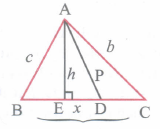
From (i) and (ii) we get
\(\begin{array}{r} A C^{2}+A B^{2}=A D^{2}+B C \cdot D E+\frac{1}{4} B C^{2}+A D^{2}- B C \cdot D E+\frac{B C^{2}}{4} \end{array}\)
\(=2 A D^{2}+2\left(\frac{B C^{2}}{4}\right)\)
\(A C^{2}+A B^{2}=2 A D^{2}+\frac{B C^{2}}{2}\)
\(b^{2}+c^{2}=2 p^{2}+\frac{a^{2}}{2}\)
14.
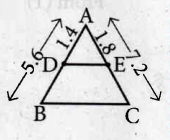
Given AB = 5.6 cm; AD = 1.4 cm;
AC = 7.2 cm; AE = 1.8 cm
DB = AB - AD
= 5.6 - L.4 = 4.2 cm
EC = AC - AE
= 7.2 - 1.8 = 5.4 cm
Now \(\frac{A D}{D B}=\frac{1.4}{4.2} \)
\(\frac{A D}{D B}=\frac{1}{3} \)
\(\frac{A E}{E C}=\frac{1.8}{5.4} \)
\(\frac{A E}{E C}=\frac{1}{3} \)
From (1) and (2)
\(\frac{A D}{D B}=\frac{A E}{E C}\)
DE || BC
15.
(–10, –4), (–8, –1) and (–3, –5)
.JPG)
Area of triangle \(=\frac{1}{2}\left[x_{1}\left(y_{2}-y_{3}\right)+x_{2}\left(y_{3}-y_{1}\right)+\right.
\left.x_{3}\left(y_{1}-y_{2}\right)\right] \text { sq. units }
\)
\(=\frac{1}{2}[-10(-1+5)-8(-5+4)-3(-4+1)]
\)
\(=\frac{1}{2}[-10(4)-8(-1)-3(-3)]
\)
\(=\frac{1}{2}[-40+8+9]
\)
\(=\frac{1}{2}[-40+17]=-\frac{23}{2}=-11.5
\)
[ Area cannot be negative ]
Area of triangle = 11.5 sq. units.
16.
We have
\(\Delta \)QMO ~ \(\Delta \)RPN
\(\frac { MQ }{ RP } =\frac { QO }{ RN } \)
\(\frac{M Q}{Q R}=\frac{Q R}{R N}\)
[ \(\because\)OQRP is a square PR = QR and QO = QR]
QR x QR = MQ x RN
QR2 = MQ x RN
17.
\(\frac { { x }^{ 4 }{ b }^{ 2 } }{ x-1 } \times \frac { { x }^{ 2 }-1 }{ { a }^{ 4 }{ b }^{ 3 } } =\frac { { x }^{ 4 }\times { b }^{ 2 } }{ x-1 } \times \frac { \left( x+1 \right) \left( x-1 \right) }{ { a }^{ 4 }\times { b }^{ 3 } } =\frac { { x }^{ 4 }\left( x+1 \right) }{ { a }^{ 4 }b } \)
18.
an = 2n2 - 6
nth term is given by an = 2n2 - 6
First term a1 = 2(1)2 - 6 = - 4
Second term a2 = 2(2)2 - 6 = 2
Third term a3 = 2(3)2 - 6 = 12
Fourth term a4 = 2(4)2 - 6 = 26
∴ The first four terms are -4, 2, 12, 26, ...
19.
Here, the expression is defined for all real values of 'x'
i.e., x \(\epsilon\) R
20.
\(\frac { 1 }{ 2 } ,\frac { 2 }{ 3 } ,\frac { 3 }{ 4 } \)
a1 = \(\frac { 1 }{ 2 } \); a2 = \(\frac { 2 }{ 3 } \); a3 = \(\frac { 3 }{ 4 } \)
We see that the numerator of nth term is n, and the denominator is one more than the numerator. Hence, \({ a }_{ n }=\frac { n }{ n+1 } \) n \(\in\) N
21.
78 + x ≡ 3 (mod 5)
78 + x - 3 = 5n for some integer n.
75 + x = 5n for some integer n
75 + x is a multiple of 5.
Least positive value of x = 5.
22.
f(k) - 2k - 1
f o f(k) = 5
f(f(k)) = f(2k - 1) = 5
⇒ 2(2k-1) -1 = 5
4k - 2 -1 = 5 ⇒ 4k = 8
k = 2
23.
\(\frac { { x }^{ 2 }-16 }{ { x }^{ 2 }+8x+16 } =\frac { \left( x+4 \right) \left( x-4 \right) }{ { \left( x+4 \right) }^{ 2 } } =\frac { x-4 }{ x+4 } \)
24.
f(x) = 3 + x, g(x) = x - 4
fog(x) = f(g(x)) =f(x - 4) = 3 + x - 4 = x - 1
gof(x) = g(f(x)) = g(3 + x) = 3 + x - 4 = x - 1
f o g = g o f
25.
f(x) = (x3 - 1) (x + 1)
= (x - 1) (x2 + x + 1) (x + 1)
g(x) = x3 + 1 = (x + 1) (x2 - x + 1)
GCD = x + 1
LCM = (x + 1) (x - 1) (x2 + x + 1) (x2 - x + 1)
f(x) x g(x) = (x3 - 1) (x + 1) (x3 + 1)
= ( x + 1) ((x3)2 - (1)2 )
= ( x + 1) (x6 - 1)
LCM x GCD = (x + 1) (x - 1) (x2 + x + 1) (x2 - x + 1) (x + 1)
= (x + 1) (x2 - x + 1) (x - 1) (x2 + x + 1) (x + 1)
= (x3 + 1) (x - 1)(x + 1)
= (x6 - 1)(x + 1)
f(x) x g(x) = LCM x GCD
Hence verified.
26.
Given, θ = 450, y intercept, c = 11
Slope m = tan θ = tan 450 = 1
Therefore, equation of a straight line is of the form y = mx + c
Hence we get, y = x + 11 gives x − y + 11 = 0
27.
\(A=\left[\begin{array}{ll}
2 & 5 \\
4 & 3
\end{array}\right], B=\left[\begin{array}{cc}
1 & -3 \\
2 & 5
\end{array}\right]\)
\(A B=\left[\begin{array}{ll}
2 & 5 \\
4 & 3
\end{array}\right]\left[\begin{array}{cc}
1 & -3 \\
2 & 5
\end{array}\right]\)
\(=\left[\begin{array}{cc}
2+10 & -6+25 \\
4+6 & -12+15
\end{array}\right]=\left[\begin{array}{cc}
12 & 19 \\
10 & 3
\end{array}\right]\)
\(\mathrm{BA}=\left[\begin{array}{cc}
1 & -3 \\
2 & 5
\end{array}\right]\left[\begin{array}{ll}
2 & 5 \\
4 & 3
\end{array}\right]\)
\(=\left[\begin{array}{cc}
2-12 & 5-9 \\
4+20 & 10+15
\end{array}\right]=\left[\begin{array}{cc}
-10 & -4 \\
24 & 25
\end{array}\right]\)
\(\therefore A B \neq B A\)
28.
The total marks in both the examinations for all the three groups is the sum of the given matrices.
A + B = \(\left[ \begin{matrix} 22+20 \\ 50+18 \\ 53+81 \end{matrix}\begin{matrix} 15+38 \\ 62+12 \\ 80+47 \end{matrix}\begin{matrix} 14+15 \\ 21+17 \\ 32+52 \end{matrix}\begin{matrix} 23+40 \\ 30+80 \\ 40+18 \end{matrix} \right] =\left[ \begin{matrix} 42 \\ 68 \\ 134 \end{matrix}\begin{matrix} 53 \\ 74 \\ 127 \end{matrix}\begin{matrix} 29 \\ 38 \\ 84 \end{matrix}\begin{matrix} 63 \\ 110 \\ 58 \end{matrix} \right] \)
29.
A + B = \(\left[ \begin{matrix} 1 & 2 & 3 \\ 4 & 5 & 6 \\ 7 & 8 & 9 \end{matrix} \right] +\left[ \begin{matrix} 1 & 7 & 0 \\ 1 & 3 & 1 \\ 2 & 4 & 0 \end{matrix} \right] =\left[ \begin{matrix} 1+1 & 2+7 & 3+0 \\ 4+1 & 5+3 & 6+1 \\ 7+2 & 8+4 & 9+0 \end{matrix} \right] =\left[ \begin{matrix} 2 & 9 & 3 \\ 5 & 8 & 7 \\ 9 & 12 & 9 \end{matrix} \right] \)
30.
\(
\mathrm{P}(A \cup B) =\mathrm{P}(\mathrm{A})+\mathrm{P}(\mathrm{B})-\mathrm{P}(A \cap B)
\)
\(\frac{1}{3} =\frac{2}{3}+\frac{2}{5}-\mathrm{P}(A \cap B)
\)
\(\mathrm{P}(A \cap B) =\frac{2}{3}+\frac{2}{5}-\frac{1}{3}
\)
\(\mathrm{P}(A \cap B) =\frac{10+6-5}{15}=\frac{16-5}{15}=\frac{11}{15}
\)
31.
\(\left[ \begin{matrix} 12 & 3 \\ x & \frac { 3 }{ 2 } \end{matrix} \right] =\left[ \begin{matrix} y & z \\ 3 & 5 \end{matrix} \right] \)
x = 3
y = 12
z = 3
32.
When we toss three coins the outcome will be
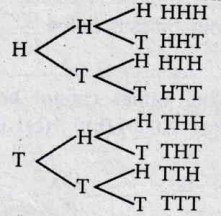
The sample space = { HHH, HHT, HTH, HTT, THH, THT, TTH, TTT}
Total number of outcomes = 8
33.
leap year has 366 days. So it has 52 full weeks and 2 days. 52 Saturdays must be in 52 full weeks.
The possible chances for the remaining two days will be the sample space.
S = {(Sun-Mon, Mon-Tue, Tue-Wed, Wed-Thu, Thu-Fri, Fri-Sat, Sat-Sun)}
n(S) = 7
Let A be the event of getting 53rd Saturday.
Then A = {Fri-Sat, Sat-Sun}; n(A) = 2
Probability of getting 53 Saturdays in a leap year is P(A0 = \(\frac { n(A) }{ n(S) } =\frac { 2 }{ 7 } \).
34.
To find the coefficient of variation we need standard deviation
\(\sigma =\sqrt{\frac{\Sigma x_{i}^{2}}{n}-\left(\frac{\Sigma x_{i}}{n}\right)^{2}}
\)
\(\frac{\Sigma x^{2}}{n} =\frac{765}{5}=153
\)
\(\left(\frac{\Sigma x}{n}\right)^{2} =(\bar{x})^{2}=6^{2}=36
\)
\(\sigma =\sqrt{(153)-36}=\sqrt{117}
\)
\(=\sqrt{3 \times 3 \times 13}
\)
\(\sigma =3 \sqrt{13}
\)
Coefficient of variation \(=\frac{\sigma}{x} \times 100 \%\)
\(=\frac{3 \sqrt{13}}{6} \times 100 \%=\frac{\sqrt{13}}{2} \times 100 \%=\frac{3.60555}{2} \times 100 \%
\)
\(=1.80277 \times 100 \%=180.277 \%
\)
Coefficient of variation = 180.28 %
35.
For comparing two data, first we have to find their coefficient of variations
Mean \(\bar { { x }_{ 1 } } \) = 155 cm, variance σ12 = 72.25 cm2
Therefore standard deviation σ1 = 8.5
Coefficient of variation C.V1 = \(\frac { { \sigma }_{ 1 } }{ \bar { { x }_{ 1 } } } \) x 100%
C.V1 = \(\frac { 8.5 }{ 15.5 } \) x 100% = 5.48% (for heights)
Mean \(\bar { { x }_{ 2 } } \) = 155 cm, variance σ22 = 72.25 kg2
Standard deviation σ2 = 5.3 kg
Coefficient of variation CV2 = \(\frac { { \sigma }_{ 2 } }{ \bar { { x }_{ 2 } } } \) x 100%
C.V2 = \(\frac { 5.3 }{ 46.50 } \) x 100% = 11.40% (for weights)
C.V1 = 5.48% = and CV2 = 11.40%
Since C.V2 > C.V1, the weight of the students is more varying than the height.
36.
2x2 - x - 1 = 0 here, a = 2, b = -1, c = -1
α + β = \(\frac {-b}{a} = \frac {-(-1)}{2} = \frac {1}{2}\), αβ = \(\frac {c}{a} = -\frac {1}{2}\)
Given roots are \(\frac { 1 }{ \alpha } ,\frac { 1 }{ \beta } \)
Sum of the roots = \(\frac { 1 }{ \alpha } +\frac { 1 }{ \beta } =\frac { \alpha +\beta }{ \alpha \beta } =\frac { \frac { 1 }{ 2 } }{ -\frac { 1 }{ 2 } } \) = -1
Product of the roots = \(\frac { 1 }{ \alpha } \times \frac { 1 }{ \beta } =\frac { 1 }{ \alpha \beta } =\frac { 1 }{ -\frac { 1 }{ 2 } } \) = -2
The required equation is x2 – (Sum of the roots)x + (Product of the roots) = 0
x2 - (-1)x - 2 = 0 gives x2 + x - 2 = 0
37.
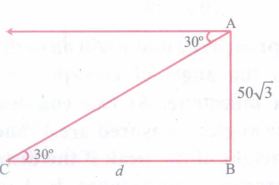
38.
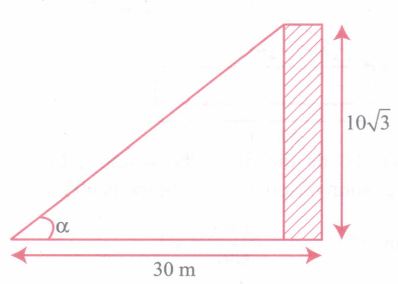
From the right \(\triangle\)ABC
\( \tan \theta =\frac{\text { Opposite side }}{\text { Adjacent side }}=\frac{A C}{B C} \)
\(=\frac{10 \sqrt{3} m}{30 m}=\frac{\sqrt{3}}{3} \)
\(=\frac{\sqrt{3}}{\sqrt{3} \sqrt{3}}=\frac{1}{\sqrt{3}} \)
\(\tan \theta =\frac{1}{\sqrt{3}} \)
\(\theta =\tan ^{-1}\left(\frac{1}{\sqrt{3}}\right)\)
0 = 30o
Angle of elevation is 30o
39.
Here the largest value = 650
The smallest value = 400
\(\therefore\) Range = L- S
= 650 - 400
= 250
Range R = 250
40.
63,89,98, 125,79,108, 117,68
Largest value L = 125
Smallest value S = 63
\(\therefore\) R = L - S = 125- 63 = 62
Co-efficient of range = \(\frac { L-S }{ L+S } \)
=\(\frac {125-63 }{ 125+63 } \)
\(=\frac{62}{188}=0.329=0.33\)
Range = 62; coefficient of range = 0.33
41.
The vertices Q(3, - 2) and R(- 5, 4)
slope of the line QR \(=\frac{y_{1}-y_{2}}{x_{1}-x_{2}}
\)
\(=\frac{-2-4}{3+5}=\frac{-6}{8}=\frac{-3}{4}
\)
Slope of the line parallel to QR is \(-\frac{3}{4}\)
Equation of the line passing through
P(- 5, 2) and having slope \(-\frac{3}{4}\) is
y - y1 = m(x - x1)
y - 2 = \(-\frac{3}{4}(x+5)\)
4y - 8 = -3x - 15
3x + 4y + 7 = 0
42.
\(\Delta AEC\quad \Delta ADB\)
\(\angle AEC=\angle ADB={ 90 }^{ 0 }\)
\(\angle C A E=\angle B A D\)
[common By AA similarity criteria]
\(\Delta AEC\sim \Delta ADB\)
(ii) Their corresponding sides are Proportional
\(\frac{C A}{A B}=\frac{C E}{D B}\)
Hence proved.
43.
12 + 22 +...+ 192 = \(\frac { 19\times \left( 19+1 \right) \left( 2\times 19+1 \right) }{ 6 } =\frac { 19\times 20\times 39 }{ 6 } =2470\)
44.
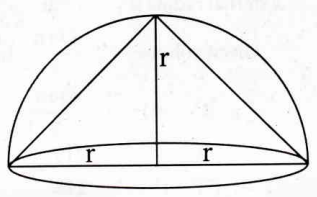
Radius of hemisphere = r units
Radius of cone = Radius of hemisphere
Height of cone = Radius of hemisphere
Maximum volume of cone = \(\frac{1}{3} \pi r^{2} h \text { cu. units }\)
\(=\frac{1}{3} \pi\left(r^{2}\right) r=\frac{1}{3} \pi r^{3} \text { cu. units }\)
45.
1 + 3 + 5 + ...40 terms = 402 = 1600
46.
We can express the number 0.6666 ....as follows
0.6666 ..... = 0.6 + 0.06 + 0.006 + 0.0006 + .....
We now see that numbers 0.6,0.06,0.006....forms an G.P Whose first term a = 0.6 and common ration r = \(\frac { 0.06 }{ 0.6 } \) = 0.1
Also - 1 < r = 0.1 < 1
Using the infinite G.P. formula, we have
0.6666.... = 0.6 + 0.06 + 0.006 + 0.0006 + .... =\(\frac { 0.6 }{ 1-0.1 } =\frac { 0.6 }{ 0.9 } =\frac { 2 }{ 3 } \)
Thus the rational number equivalent of 0.6666..is \(\frac { 2 }{ 3 } \)
47.
Let PQ the height of the tower.
Take PQ = h and QR is the distance between the tower and the point R.in right triangle PQR,\(\angle \)PRQ=30°
tan\(\theta =\frac { PQ }{ QR } \)
tan30° = \(\frac { h }{ 48 } \) gives,\(\frac { 1 }{ \sqrt { 3 } } =\frac { h }{ 48 } \) so, h =\(16\sqrt { 3 } \)
Therefore the height of the tower \(16\sqrt { 3 } \) m
48.
Given a, b, c are in A.P
t2 - t1 = t3 - t2
b - a = c - b
b + b = c + a
2b = c + a
If we multiply both the sides by same number value will not change
32b = 3a+c
3b + b = 3a+c
3b . 3b = 3a . 3c
\(\frac{3^{b}}{3^{a}}=\frac{3^{c}}{3^{b}}\)
Thus 3a, 3b, 3c are in G.P.
49.
a = 6, r = 3
The three terms of G.P. are a, ar, ar2
= 6, 6 x 3,6 (3)2
= 6, 18, 54
First three terms are 6, 18, 54
50.
Largest value L = 67; Smallest value S =18
Range R = L = S = 67 - 18 = 49
Coefficient of range = \(\frac { L-S }{ L+S } \)
Coefficient of range = \(\frac { 67-18 }{ 67+18 } =\frac { 49 }{ 85 } \) = 0.576
51.
Equation of the given line is 4x − 9y + 36 = 0
we write it as 4x - 9y = − 36 (bring it to the normal form)
Dividing by - 36 we get, \(\frac { x }{ -9 } +\frac { y }{ 4 } =1\) ...(1)
Comparing (1) with intercept form, we get x intercept a = −9 ; y intercept b = 4
52.
Total amount to repay = Rs. 65000
He pays Rs. 400 in the first installment and increasing the payment by Rs. 300 every month.
This form an A.P.
i.e., 400, 700, 1000, .....
a = 400,.d = 300
Sum upto n terms
\(\mathrm{S}_{\mathrm{n}} =\frac{n}{2}[2 a+(n-1) d] \)
\(65000 =\frac{n}{2}[2(400)+(n-1) 300] \)
\(65000 =\frac{n}{2} \times 2[400+(n-1) 150] \)
= n[400 + 150n - 150]
= n[150 n + 250]
65000 = 150n2 + 250n
Divided by 50
1300 = 3n2 + 5n
3n2 + 5n - 1300 = 0
\(\mathrm{n} =\frac{-b \pm \sqrt{b^{2}-4 a c}}{2 a} \)
\(=\frac{-5 \pm \sqrt{5^{2}-4(3)(-1300)}}{2(3)} \)
\(=\frac{-5 \pm \sqrt{25+15600}}{6}=\frac{-5 \pm \sqrt{15625}}{6} \)
\(=\frac{-5 \pm 125}{6} \)
\(n =\frac{-5-125}{6}, \frac{-5+125}{6} \)
\(\mathrm{n} =\frac{-130}{6}, \frac{120}{6} \)
\(=\frac{-130}{6}, 20 \)
n cannot be negative
n = 20.
He will clear the loan by 20 months
53.
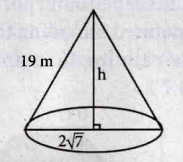
Each person requires 22 m2 of floor area.
Required base area = 22 x 4 = 88 m2
\(\pi r^{2} =88 \)
\(r^{2} =\frac{88 \times 7}{22}=4 \times 7 \)
\(r =2 \sqrt{7} \mathrm{~m} \)
slant height = 19 m
height of the tent, h \(=\sqrt{l^{2}-r^{2}}\)
\(=\sqrt{(191)^{2}-(2 \sqrt{7})^{2}} \)
\(=\sqrt{361-28} =\sqrt{330}=18.25 \mathrm{~m} \)
Height of the tent = 18.25 m
54.
55.
Given vertices A(1, - 4) , B(2, - 3) and C(4, - 7)
Slope of the line = \(\frac{y_{1}-y_{2}}{x_{1}-x_{2}}\)
Slope of AB = \(\frac{-4+3}{1-2}=\frac{-1}{-1}=1
\)
Slope of BC = \(\frac{-3+7}{2-4}=\frac{4}{-2}=-2
\)
Slope of AC = \(\frac{-4+7}{1-4}=\frac{3}{-3}=-1
\)
(Slope of AB) x (Slope of AC) = - 1
AB is perpendicular to AC.
Hence, the given vertices form a right angled triangle
Distance between the points (x1, y1) and (x2, y2) is \(\sqrt{\left.\left(x_{1}-x_{2}\right)^{2}+y_{1}-y_{2}\right)^{2}}\) units
\(A B =\sqrt{(1-2)^{2}+(-4+3)^{2}}=\sqrt{1+1}=\sqrt{2}
\)
\(A B^{2} =(\sqrt{2})^{2}=2
\)
\(B C =\sqrt{(2-4)^{2}+(-3+7)^{2}}=\sqrt{4+16}=\sqrt{20}
\)
BC2 = 20
\(A C=\sqrt{(1-4)^{2}+(-4+7)^{2}}=\sqrt{9+9}=\sqrt{18}\)
AC2 = 18
Now, AB2 + AC2 = BC2
Hence, the Pythagoras theorem is satisfied.
56.
Given slope 'm' = 0
tan θ = 0 = tan 00
θ = 00
57.
f(x) = 3 x -2, g(x) = 2x + k
f o g = f(g(x)) = f(2x + k) = 3(2x + k) - 2 = 6x + k - 2
Thus, f o g(x) = 6x + 3k - 2
g o f(x) = g(3x - 2) = 2(3x - 2) + k
Thus, g o f(x) = 6x - 4 + k
Given that f o g = g o f
Therefore, 6x + 3k-2 = 6z - 4 + k
6x - 6x + 3k - k = -4 + 2 ⇒ -1
58.
First term a = 5; common difference d = 6.
A.P.is given by., a + d, a + 2d, a + 3d,......
In this case 5, 5 + 6, 5 + 2(6),5 + 3 (6),...
5, 11, 17 ,23,...
The required A.P. is 5, 11,17,23,....
59.
Let r be the radius of the sphere. Given that, surface area of sphere = 154 m2
4\(\pi\)r2 = 154
\(4\times \frac { 22 }{ 7 } \times { r }^{ 2 }=154\)
gives \({ r }^{ 2 }=154\times \frac { 1 }{ 4 } \times \frac { 7 }{ 22 } \)
hence, \({ r }^{ 2 }=\frac { 49 }{ 4 } \)We get r = \(\frac{7}{2}\)
Therefore, diameter is 7 m
60.
Given that, diameter d = 2.8 m and height = 3 m
radius r = 1.4 m
Area covered in one revolution = curved surface area of the cylinder
= 2\(\pi\)rh sq. units
\(2\times \frac { 22 }{ 7 } \times 1.4\times 3=26.4\)
Area covered in 1 revolution = 26.4 m2
Area covered in 8 revolutions = 8 x 26.4 = 211.2
Therefore, area covered is 211.2 m2
61.
8x4y2, 48x2y4
First let us find the LCM of the numerical coefficients.
That is, LCM (8, 48) = 2 x 2 x 2 x 6 = 48
Then find the LCM of the terms involving variables.
That is, LCM (x4y2, x2y4) = x4y4
Finally find the LCM of the given expression.
We conclude that the LCM of the given expression is the product of the LCM of the numerical coefficient and the LCM of the terms with variables.
Therefore, LCM (8x4y2, 48x2y4) = 48 x4y4
62.
The curves in Fig.1.35(a) and Fig.1.35(c) represent a one – one function as the horizontal lines meet the curves in only one point P.
The curve in Fig.1.35(b) does not represent a one–one function, since, the horizontal line meet the curve in two points P and Q.
63.
Given points are (2, 3), (4, a) and (6, - 3)
Since the points are colinear, Area of triangle is zero
\(\text { i.e., } \frac{1}{2}\left[x_{1}\left(y_{2}-y_{3}\right)+x_{2}\left(y_{3}-y_{1}\right)+x_{3}\left(y_{1}-y_{2}\right)\right]=0\)
2(a + 3) + 4(- 3 -3) + 6(3 - a) = 0
2a + 6 - 24 + 18 - 6a = 0
-4a + 0 = 0
-4a = 0
a = 0
64.
(i) Given vertices are (0, 0), (P, 8) and (6,2)
Area of triangle = 20 sq. units.
Area of triangle = \(\frac{1}{2}\left[x_{1}\left(y_{2}-y_{3}\right)+\right. \left.x_{2}\left(y_{3}-y_{1}\right)+x_{3}\left(y_{1}-y_{2}\right)\right] \)
\(\frac{1}{2}\) [(8 - 2) + p (2 - 0) + 6 (0 - 8)] = 20
2p - 48 = 40
2P = 40 + 48
2P = 88
\(p=\frac{88}{2}=44\)
(ii) Given vertices are (p, p), (5,6) and (5, - 2)
Area of triangle = 32 sq. units
Area of triangle = \(\frac{1}{2}\left[x_{1}\left(y_{2}-y_{3}\right)+\right. \left.x_{2}\left(y_{3}-y_{1}\right)+x_{3}\left(y_{1}-y_{2}\right)\right] \)
\(\frac{1}{2}\) [p( 6 + 2) + 5(- 2 -p) + 5(P - 6) = 32
8p -10 - 5P + 5P - 30 = 64
8p - 40 = 64
8P = 64 + 40 = 104
\(p=\frac{104}{8}=13\)
65.
66.
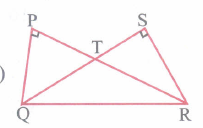
Given
PR and SQ intersect at T.
In \(\triangle\)QPT and \(\triangle\)RST
< QSR =
Given
By AA similarity criteria
\(\triangle P Q T \sim \triangle S R T\)
Their corresponding sides are proportional
\(\frac{P T}{S T}=\frac{T Q}{T R}\)
PT x TR = ST x TQ
Hence proved
67.
f = {(x, y) / x, y \(\in \) N and y = 2x}
Given that y = 2x
x = {1,2,3,..}
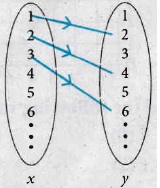
f = {(1,2), (2, 4), (3, 6), (4, 8)..}
Domain of f = {1, 2, 3, 4...........}
Codomain = {1,2,3, 4.......}
Range of f = {2,4,6, 8......}
Here, the first elements (x) are having unique images. So, this relation is a function.
68.
3x \(\equiv \) 1 (mod 15) can be written as
3x - 1 = 15k for some integer k
3x = 15k + 1
\(x=\frac { 15k+1 }{ 3 } \)
\(x=5k+\frac { 1 }{ 3 } \)
Since 5k is an integer , 5k + \(\frac { 1 }{ 3 } \) cannot be an integer
So there is no integer solution
69.
\(\frac { sec\theta }{ sin\theta } -\frac { sin\theta }{ cos\theta } = \frac { \frac { 1 }{ cos\theta } }{ sin\theta } -\frac { sin\theta }{ cos\theta } =\frac { 1 }{ sin\theta cos\theta } -\frac { sin\theta }{ cos\theta } \)
\(=\frac { 1-si{ n }^{ 2 }\theta }{ sin\theta cos\theta } =cot\theta \)
70.
Consider 2n \(\times\) 5m
Since the product has 2 as a factor
2n \(\times\) 5m is even
But if a number ends with the digit 5, then the number is an odd number
It is impossible.
For no value of m, 2n \(\times\) 5m ends in 5.
71.
\(\Delta \ CAB\) and \(\Delta CED\),\(\angle C\) is common, \(\angle A=\angle CED\)
Therefore, \(\Delta CAB\sim \Delta CED\)
Hence, \(\frac { CA }{ CE } =\frac { AB }{ DE } =\frac { CB }{ CD } \)
\(\frac { AB }{ DE } =\frac { CB }{ CD } \quad \frac { 9 }{ x } =\frac { 10+2 }{ 8 } ,x=\frac { 8\times 9 }{ 12 } =6\) cm.
72.
Since 6n = (2 x 3)n = 2n x 3n
2 is a factor of 6n. So, 6 n is always even.
But any number whose last digit is 5 is always odd.
Hence, 6n cannot end with the digit 5
73.
A x B = {(3,1), (3,7), (3,10), (4,1), (4,7), (4,10), (7,1), (7,7), (7,10), (8,1), (8,7), (8,10)}
We note that, R1 ⊆ A x B. Thus, R1 is a relation from A to B.
74.
Let h1 and h2 be the heights of a cone and cylinder respectively.
Also, let r be the radius of the cone.
Given that, height of the cone h1 = 24 cm; radius of the cone and cylinder r = 6 cm
Since, Volume of cylinder = Volume of cone
\({ \pi r }^{ 2 }=\frac { 1 }{ 3 } { \pi r }^{ 2 }{ h }_{ 1 }\)
\({ h }_{ 2 }=\frac { 1 }{ 3 } \times { h }_{ 1 }\quad gives\quad { h }_{ 2 }=\frac { 1 }{ 3 } \times 24=8\)
Therefore, height of cylinder is 8 cm
75.
f(x) = 3x + 2, g(x) = 6x - k
f o g = f{g(x)) = f{6x - k)
= 3(6x - k) + 2
= 18x- 3k + 2
g o f = g(f(x)) = 6(3x + 2) - k
= 18x + 12 - k
Given f o g = g o f
18x - 3k + 2 = 18x + 12 - k
3k - k = -12 + 2
2k = -10
k = -5
76.
Given total surface area of cylinder
= 1848 sq.m
(h + r) = 1848
It is given that C.S.A \(=\frac{5}{6}(\text { T.S.A })\)
\(\text { C.S.A }=\frac{5}{6}(1848)=1540
\)
\(\text { C.S.A }=\frac{5}{6}(\text { T.S.A })
\)
\(2 \pi r h=\frac{5}{6}(2 \pi r(h+r))
\)
h = 5r
We have C.S.A = 1540
2rh = 1540
\(2 \times \frac{22}{7} \times r \times 5 r =1540
\)
\(r^{2} =\frac{1540 \times 7}{44 \times 5}=49
\)
r = 7
h = 5r = 5(7) = 35
radius = 7 m , height = 35 m
77.
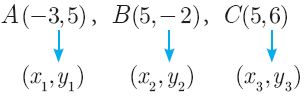
Plot the points in a rough diagram and take them in counter-clockwise order.
Let the vertices be
JPG.JPG)
The area of Δ ABC is
= \(\frac{1}{2}\) { (x1y2 + x2y3 + x3y1) - (x2y1 + x3y2 + x1y3) }
= \(\frac{1}{2}\) { (6 + 30 + 25) - (25 - 10 18) }
= \(\frac{1}{2}\) { 61 + 3 }
= \(\frac{1}{2}\) (64) = 32 sq. units

10th Standard Syllabus & Materials
10th Standard
TN 10th English Prose - 2 - The Night the Ghost Got in Important Questions And Answers Study Material - QB365 Set A
NEW10th Standard
TN 10th English Supplementary - 1 - The Tempest Important Questions And Answers Study Material - QB365 Set A
NEW10th Standard
TN 10th English Poem - 1 - Life Important Questions And Answers Study Material - QB365 Set A
NEW10th Standard
TN 10th English Prose - 1 - His First Flight Important Questions And Answers Study Material - QB365 Set A



Tamilnadu Stateboard 10th Standard Subjects
Tamilnadu Stateboard Standards





