
 100% FREE ACCESS
10th Standard Syllabus & Materials
10th Standard
TN 10th English Prose - 4 - The Attic Important Questions And Answers Study Material - QB365 Set A
NEW10th Standard
TN 10th English Supplementary - 3 - The Story of Mulan Important Questions And Answers Study Material - QB365 Set A
NEW10th Standard
TN 10th English Poem - 3 - I am Every Woman Important Questions And Answers Study Material - QB365 Set A
NEW10th Standard
TN 10th English Prose - 3 - Empowered Women Navigating The World Important Questions And Answers Study Material - QB365 Set A
NEW10th Standard
TN 10th English Supplementary - 2 - Zigzag Important Questions And Answers Study Material - QB365 Set A
NEW10th Standard
TN 10th English Poem - 2 - The Grumble Family Important Questions And Answers Study Material - QB365 Set A

Published on: 09/05/2020
10th Standard Maths English Medium Book back Important 5 Marks Questions
Download Tamil Nadu 10th Standard Maths question papers, model tests, one-mark questions, important questions, and public exam papers in PDF format. Free study materials and answer keys for TN State Board students.
Questions + Answers key
Take MCQ Maths Test1.
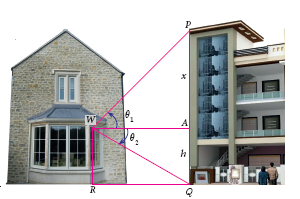
From a window (h metres high above the ground) of a house in a street, the angles of elevation and depression of the top and the foot of another house on the opposite side of the street are θ1 and θ2 respectively. Show that the height of the opposite house is h \(\left( 1+\frac { cot{ \theta }_{ 2 } }{ { cot\theta }_{ 1 } } \right) \)
2.
Let A = \(\left[ \begin{matrix} 1 & 2 \\ 1 & 3 \end{matrix} \right] \), B = \(\left[ \begin{matrix} 4 & 0 \\ 1 & 5 \end{matrix} \right] \), C = \(\left[ \begin{matrix} 2 & 0 \\ 1 & 2 \end{matrix} \right] \) Show that (A − B)T = AT − BT
3.
A bird is flying from A towards B at an angle of 35°, a point 30 km away from A. At B it changes its course of flight and heads towards C on a bearing of 48° and distance 32 km away.
How far is C to the North of B? (sin 55° = 0.8192, cos 55° = 0.5736, sin 42° = 0.6691. cos 42° = 0.7431)
4.
A bird is flying from A towards B at an angle of 35°, a point 30 km away from A. At B it changes its course of flight and heads towards C on a bearing of 48° and distance 32 km away.
How far is B to the West of A? (sin 55° = 0.8192, cos 55° = 0.5736, sin 42° = 0.6691.cos 42° = 0.7431)
5.
Find the equation of a straight line Passing through (-8, 4) and making equal intercepts on the coordinate axes
6.
You are downloading a song. The percent y (in decimal form) of mega bytes remaining to get downloaded in x seconds is given by y = -0.1x + 1.
Find the total MB of the song.
7.
If lth , mth and nth terms of an A.P are x, y, z respectively, then show that (x - y)n + (y - z)l + (z - x)m = 0
8.
A circular garden is bounded by East Avenue and Cross Road. Cross Road intersects North Street at D and East Avenue at E. AD is tangential to the circular garden at A(3, 10). Using the figure.
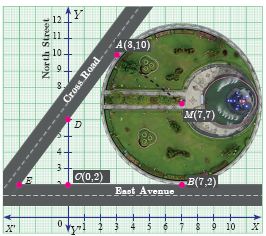
Where does the Cross Road intersect the
(i) East Avenue ?
(ii) North Street ?
9.
The graph relates temperatures y (in Fahrenheit degree) to temperatures x (in Celsius degree) Write an equation of the line
10.
Let A = The set of all natural numbers less than 8, B = The set of all prime numbers less than 8, C = The set of even prime number. Verify that
A x ( B - C) = (A x B) - (A x C)
11.
Discuss the nature of solutions of the following system of equations
\(\frac { y+z }{ 4 } =\frac { z+x }{ 3 } =\frac { x+y }{ 2 } \) x + y + z = 27
12.
The frequency distribution is given below.
| x | k | 2k | 3k | 4k | 5k | 6k |
| f | 2 | 1 | 1 | 1 | 1 | 1 |
In the table, k is a positive integer, has a variance of 160. Determine the value of k.
13.
Two dice are rolled once. Find the probability of getting an even number on the first die or a total of face sum 8.
14.
Two customers Priya and Amuthan are visiting a particular shop in the same week (Monday to Saturday). Each is equally likely to visit the shop on any one day as on another day. What is the probability that both will visit the shop on
(i) the same day
(ii) different days
(iii) consecutive days?
15.
Three fair coins are tossed together. Find the probability of getting
(i) all heads
(ii) atleast one tail
(iii) at most one head
(iv) at most two tails
16.
Two dice are rolled. Find the probability that the sum of outcomes is (i) equal to 4 (ii) greater than 10 (iii) less than 13.
17.
The consumption of number of guava and orange on a particular week by a family are given below.
| Number of Guavas | 3 | 5 | 6 | 4 | 3 | 5 | 4 |
| Number of Oranges | 1 | 3 | 7 | 9 | 2 | 6 | 2 |
Which fruit is consistently consumed by the family?
18.
Two ships are sailing in the sea on either side of the lighthouse. The angles of depression of two ships as observed from the top of the lighthouse are 60° and 45° respectively. If the distance between the ships is 200\(\left( \frac { \sqrt { 3 } +1 }{ \sqrt { 3 } } \right) \) metres, find the height of the lighthouse.
19.
A traveler approaches a mountain on highway. He measures the angle of elevation to the peak at each milestone. At two consecutive milestones the angles measured are 4° and 8°. What is the height of the peak if the distance between consecutive milestones is 1 mile. (tan4° =0.0699, tan8° =0.1405)
20.
Without using distance formula, show that points (-2, -1) , (4, 0), (3, 3) and (-3, 2) are the vertices of a parallelogram
21.
Find the G.P. in which the 2nd term is \(\sqrt { 6 } \) and the 6th term is 9\(\sqrt { 6 } \)
22.
Marks of the students in a particular subject of a class are given below:
| Marks | 0-10 | 10-20 | 20-30 | 30-40 | 40-50 | 50-60 | 60-70 |
| Number of students | 8 | 12 | 17 | 14 | 9 | 7 | 4 |
Find its standard deviation.
23.
The sum of the cubes of the first n natural numbers is 2025. then Find the value of n.
24.
Find the equation of the perpendicular bisector of the line joining the points A(-4, 2) and B(6, -4).
25.
The volume of a cone is 1005\(\frac{5}{7}\)cu. cm. The area of its base is 201\(\frac{1}{7}\)sq. cm. Find the slant height of the cone.
26.
The slant height of a frustum of a cone is 4 m and the perimeter of circular ends are 18 m and 16 m. Find the cost of painting its curved surface area at Rs.100 per sq. m
27.
A hollow metallic cylinder whose external radius is 4.3 cm and internal radius is 1.1 cm and whole length is 4 cm is melted and recast into a solid cylinder of 12 cm long. Find the diameter of solid cylinder.
28.
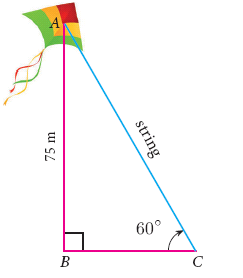
A kite is flying at a height of 75m above the ground, the string attached to the kite is temporarily tied to a point on the ground. The inclination of the string with the ground is \(60°\).find the length of the string ,assuming that there is no slack in the string.
29.
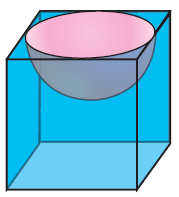
A hemispherical section is cut out from one face of a cubical block such that the diameter l of the hemisphere is equal to side length of the cube. Determine the surface area of the remaining solid.
30.
Let A = {1, 2} and B = {1, 2, 3, 4}, C = {5, 6} and D = {5, 6, 7, 8}, Verify whether A x C is a subset of B x D?
31.
If f(x) = x2, g(x) = 3x and h(x) = x - 2, Prove that (f o g) o h = f o (g o h).
32.
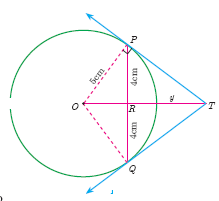
PQ is a chord of length 8 cm to a circle of radius 5 cm. The tangents at P and Q intersect at a point T. Find the length of the tangent TP.
33.
Find the domain of the function f(x) = \(\sqrt { 1+\sqrt { 1-\sqrt { 1-x^{ 2 } } } } \).
34.
A brick staircase has a total of 30 steps. The bottom step requires 100 bricks. Each successive step requires two bricks less than the previous step.
(i) How many bricks are required for the top most step?
(ii) How many bricks are required to build the stair case?
35.
Find the sum of all natural numbers between 602 and 902 which are not divisible by 4.
36.
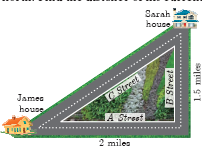
There are two paths that one can choose to go from Sarah’s house to James house. One way is to take C street, and the other way requires to take B street and then A street. How much shorter is the direct path along C street? (Using figure).
37.
Find the volume of the iron used to make a hollow cylinder of height 9 cm and whose internal and external radii are 21 cm and 28 cm respectively
38.
A quadrilateral has vertices A(- 4, - 2), B(5, - 1), C(6, 5) and D(- 7, 6). Show that the mid-points of its sides form a parallelogram.
39.
If the points A(2, 2), B(–2, –3), C(1, –3) and D(x, y) form a parallelogram then find the value of x and y.
40.
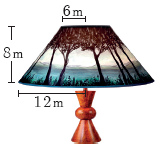
The frustum shaped outer portion of the table lamp has to be painted including the top part. Find the total cost of painting the lamp if the cost of painting 1 sq.cm is Rs. 2.
41.
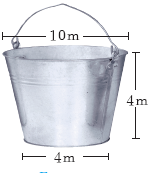
An industrial metallic bucket is in the shape of the frustum of a right circular cone whose top and bottom diameters are 10 m and 4 m and whose height is 4 m. Find the curved and total surface area of the bucket.
42.
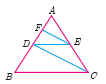
In figure DE || BC and CD. Prove that AD2 = AB x AF
43.
In trapezium ABCD, AB || DC, E and F are points on non-parallel sides AD and BC respectively, such that EF || AB. Show that \(\frac { AE }{ ED } =\frac { BF }{ FC } \)
44.
Construct a triangle \(\triangle\)PQR such that QR = 5 cm, \(\angle\)P = 30o and the altitude from P to QR is of length 4.2 cm.
45.
If the function f: R⟶ R defined by
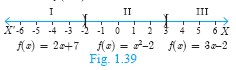
\(f(x)=\left\{\begin{array}{l} 2 x+7, x<-2 \\ x^{2}-2,-2 \leq x<3 \\ 3 x-2, x \geq 3 \end{array}\right.\)
(i) f( 4)
(ii) f( -2)
(iii) f(4) + 2f(1)
(iv) \(\frac { f(1)-3f(4) }{ f(-3) } \)
46.
if cosec\(\theta \) + cot\(\theta \) = p, then prove that cos\(\theta \) = \(\frac { { p }^{ 2 }-1 }{ { p }^{ 2 }+1 } \)
47.
The sum of the digits of a three-digit number is 11. If the digits are reversed, the new number is 46 more than five times the former number. If the hundreds digit plus twice the tens digit is equal to the units digit, then find the original three-digit number?
48.
Discuss the nature of solutions of the following system of equations
x + 2y - z = 6; -3x - 2y + 5z = -12; x - 2z = 3
49.
Forensic scientists can determine the height (in cms) of a person based on the length of their thigh bone. They usually do so using the function h(b) = 2.47b + 54.10 where b is the length of the thigh bone.
(i) Check if the function h is one – one or not
(ii) Also find the height of a person if the length of his thigh bone is 50 cm.
(iii) Find the length of the thigh bone if the height of a person is 147.96 cm.
50.
The sum of thrice the first number, second number and twice the third number is 5. If thrice the second number is subtracted from the sum of first number and thrice the third we get 2. If the third number is subtracted from the sum of twice the first, thrice the second, we get 1. Find the numbers.
51.
if cos\(\theta \) + sin\(\theta \) =\(\sqrt { 2 } \) cos \(\theta \), then prove that cos\(\theta \) - sin\(\theta \) =\(\sqrt { 2 } \) sin\(\theta \)
52.
Find the remainder when 281 is divided by 17.
53.
Arul, Mohan and Ram working together can clean a store in 6 hours. Working alone, Mohan takes twice as long to clean the store as Arul does. Ram needs three times as long as Arul does. How long would it take each if they are working alone?
54.
In a three-digit number, when the tens and the hundreds digit are interchanged the new number is 54 more than three times the original number. If 198 is added to the number, the digits are reversed. The tens digit exceeds the hundreds digit by twice as that of the tens digit exceeds the unit digit. Find the original number.
55.
One hundred and fifty students are admitted to a school. They are distributed over three sections A, B and C. If 6 students are shifted from section A to section C, the sections will have equal number of students. If 4 times of students of section C exceeds the number of students of section A by the number of students in section B, find the number of students in the three sections.
56.
Given A = {1,2,3}, B = {2,3,5}, C = {3,4} and D = {1,3,5}, check if (A ∩ C) x (B ∩ D) = (A x B) ∩ (C x D) is true?
57.
Let A = {x \(\in \) N| 1 < x < 4}, B = {x \(\in \) W| 0 ≤ x < 2) and C = {x \(\in \) N| x < 3} Then verify that
(i) A x (B U C) = (A x B) U (A x C)
(ii) A x (B ∩ C) = (A x B) ∩ (A x C)
58.
Construct a triangle similar to a given triangle PQR with its sides equal to \(\frac { 7 }{ 3 } \) of the corresponding sides of the triangle PQR (scale factor\(\frac { 7 }{ 3 } >1\))
59.
Construct a triangle similar to a given triangle PQR with its sides equal to \(\frac { 7 }{ 4 } \) of the corresponding sides of the triangle PQR (scale factor \(\frac { 7 }{ 4 } \)>1)
60.
The probability of happening of an event A is 0.5 and that of B is 0.3. If A and B are mutually exclusive events, then find the probability that neither A nor B happen.
61.
If 13 + 23 + 33+...k3 = 44100 then find 1 + 2 + 3 +...+ k
62.
If 1 + 2 + 3 +...+ k = 325, then find 13 + 23 + 33 +...K3.
63.
64.
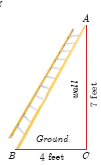
What length of ladder is needed to reach a height of 7 ft along the wall when the base of the ladder is 4 ft from the wall? Round off your answer to the next tenth place.
1.
Let W be the point on the window where the angles of elevation and depression are measured. Let PQ be the house on the opposite side.
Then WA is the width of the street.
Height of the window = h metres
= AQ (WR = AQ)
Let PA = x metres
In right triangle \(\triangle\)PAW, \(tan{ \theta }_{ 1 }=\frac { AP }{ Aw } \)
gives \(tan{ \theta }_{ 1 }=\frac { x }{ AW } \)
so, \(AW=\frac { x }{ tan{ \theta }_{ 1 } } \)
we get, AW = x cot θ ...(1)
In right triangle \(\triangle\)QAW, tan θ2 = \(\frac { AQ }{ AW } \)
gives tan θ2 = \(\frac { h }{ AW } \)
we get, AW = h cot θ2 ...(2)
From (1) and (2) we get, x cot θ1 = h cot θ2
gives, x = h\(\frac { cot{ \theta }_{ 2 } }{ { cot\theta }_{ 1 } } \)
Therefore, height of the opposite house = PA + AQ = x + h = h\(\frac { cot{ \theta }_{ 2 } }{ { cot\theta }_{ 1 } } \)\(\left( 1+\frac { cot{ \theta }_{ 2 } }{ { cot\theta }_{ 1 } } \right) \)
Hence Proved.
2.
(A - B)T= AT-BT
L.H.S = \((A-B)=\left[ \begin{matrix} 1 & 2 \\ 1 & 3 \end{matrix} \right] -\left[ \begin{matrix} 4 & 0 \\ 1 & 5 \end{matrix} \right] =\left[ \begin{matrix} -3 & 2 \\ 0 & -2 \end{matrix} \right] ...(2)\)
\({ (A-B) }^{ T }=\left[ \begin{matrix} -3 & 0 \\ 2 & -2 \end{matrix} \right] ...(1)\)
\({ A }^{ T }=\left[ \begin{matrix} 1 & 1 \\ 2 & 3 \end{matrix} \right] ,{ B }^{ T }=\left[ \begin{matrix} 4 & 1 \\ 0 & 5 \end{matrix} \right] \)
\(=\left[\begin{array}{rr} -3 & 0 \\ 2 & -2 \end{array}\right]\)
From (1) and (2)
(A - B)T= AT-BT
Hence verified.
3.
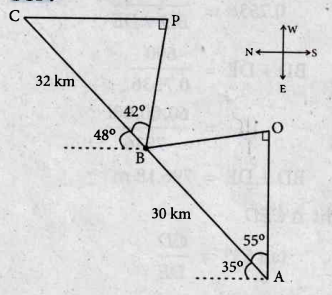
Let A be the initial position of the bird.
B be the position after travelling 30 km at an angle of 35o from A.
Let C be the position after travelling 32 km at an angle of 48o from B.
[complementary angle]
\(\sin 42^{\circ}=\frac{P C}{B C} \)
\(0.6691=\frac{P C}{32} \)
PC = 32 x 0.6691 = 21.41 km
C is 21.41 km to the North of B.
4.
Let A be the initial position of the bird.
B be the position after travelling 30 km at an angle of 35o from A.
Let C be the position after travelling 32 km at an angle of 48o from B.
[complementary angle]
From the right triangle AOB
\(\cos 55^{\circ}=\frac{O A}{A B} \)
\(0.5736=\frac{O A}{30} \)
OA = 30 x 0.5736 = 17.21 km
B is 17 .21 km to the West of A
5.
Given that intercepts are equal.
a = b
Equation of the line in intercepts form is
\(\frac{x}{a}+\frac{y}{b}=1
\)
\(\frac{x}{a}+\frac{y}{a}=1
\)
x + y = a
This passes through (- 8, 4)
-8 + 4 = a
a = -4
b = -4
Equation of the straight line is
\(\frac{x}{a}+\frac{y}{b}=1
\)
\(\frac{x}{-4}+\frac{y}{-4}=1
\)
x + y + 4 = 0.
6.
y = -0.1x + 1
Initially, time x = 0 y = 1
Total MB of the song is 1.
7.
On subtracting equation (2) from equation (1), equation (3) from equation (2)and equation (1) from equation (3), we get
x - y = (l - m)d
y - z = (m - n)d
z - x = (n -l)d
(x - y)n + (y - z)l + (z - x)m = [(l -m)n + (m -n)l + (n -l)m]d
= [ln - mn + lm - nl + nm - lm]d = 0
8.
(i) If D is (0,k) then D is a point on the Cross Road.
Therefore, substituting x = 0, y = k in the equation of Cross Road,
we get, 0 - 3k + 18 = 0
Value of k = 6
Therefore, D is (0, 6)
(ii) To find E, let E be (q, 2)
Put y = 2 in the equation of the Cross Road,
we get, 4q - 6 + 18 = 0
4q = - 12 gives q = - 3
Therefore, The point E is (-3, 2)
Thus the Cross Road meets the North Street at D(0, 6) and
East Avenue at E (-3, 2)
9.
Use the slope and y intercept to write an equation
The equation is y = \(\frac { 9 }{ 5 } x\) + 32
10.
Given
A = {1,2,3,4,5,6,7}
B = {2,3,5,7}
C = {2}
A x ( B - C) = (A x B) - (A x C)
B - C = {2,3,5,7} - {2}
= {3,5,7}
A x (B-C) = {1,2,3,4,5,6,7} x {3.5.7}
={(1,3),(1,5),(1,7),(2,3),(2,5),(2,7) (3,3),(3,5),(3,7),(4,3),(4,5),(4,7) (5,7),(5,3),(5,5) (6,3),(6,5),(6,7),(7,3),(7,5),(7,7)} ....(1)
A x B = {1,2,3,4,5,6,7} x {2,3,5,7}
= {(1,2),(1,3),(1,5),(1,7),(2,2),(2,3),(2,5),(2,7) (3,2),(3,3),(3,5),(3,7),(4,2),(4,3),(4,5),(4,7) (5,2),(5,3),(5,5),(5,7),(6,2),(6,3),(6,5),(6,7) (7,2),(7,3),(7,5),(7,7)}
A x C = {1,2,3,4,5,6,7} x {2}
= {(1,2),(2,2),(3,2),(4,2),(5,2)(6,2),(7,2)}
(A x B) - (A x C) = {(1,3),(1,5),(1,7),(2,3) (2,5),(2,7),(3,3),(3,5) (3,7),(4,3),(4,5),(4,7), (5,3),(5,5),(5,7),(6,3) (6,5),(6,7),(7,3),(7,5),(7,7)} ..(2)
From (1) and (2), it is clear that
A x ( B - C) = (A x B) - (A x C)
Hence verified
11.
\(\frac { y+z }{ 4 } =\frac { z+x }{ 3 } =\frac { x+y }{ 2 } \)
x + y + z = 27
\(\frac { y+z }{ 4 } =\frac { z+x }{ 3 }\)
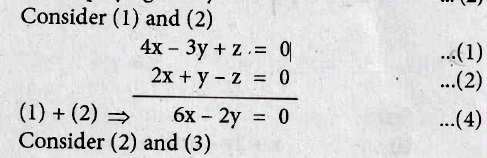
We get, 4x - 3y+ z = 0 .(1)
Equating \(\frac{y+z}{4}=\frac{x+y}{2}\)
On simplifying 2x + y - z = 0 ........(2)
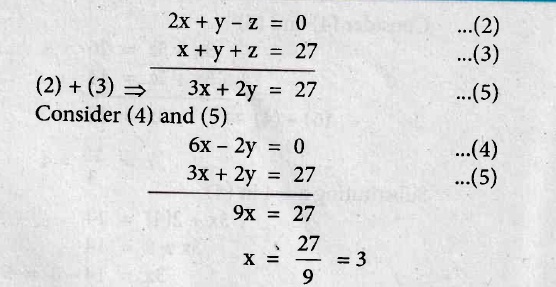
Substituting the value x = 2 in (4)
6(3) - 2y = 0
-2y = -18
\(y=\frac{18}{2}=9\)
Substituting x = 3,y = 9 in (3)
3 + 9 + z = 27
z = 27 - 12
z = 15
Solution: x = 3, y = 9, z = 15
12.
| x | f | fx | d = x - \(\overline { x } \) | d2 |
|---|---|---|---|---|
| k | 2 | 2k | \(\frac { -15 }{ 7 } k\) | \({ \left( \frac { -15 }{ 7 } k \right) }^{ 2 }\) |
| 2k | 1 | 2k | \(\frac { -8 }{ 7 } k\) | \({ \left( \frac { -8 }{ 7 } k \right) }^{ 2 }\) |
| 3k | 1 | 3k | \(\frac { -1 }{ 7 } k\) | \({ \left( \frac { -1 }{ 7 } k \right) }^{ 2 }\) |
| 4k | 1 | 4k | \(\frac { 6k }{ 7 } \) | \({ \left( \frac { 6k }{ 7 } \right) }^{ 2 }\) |
| 5k | 1 | 5k | \(\frac { 13 }{ 7 } k\) | \({ \left( \frac { 13 }{ 7 } k \right) }^{ 2 }\) |
| 6k | 1 | 6k | \(\frac { 20 }{ 7 } k\) | \({ \left( \frac { 20 }{ 7 } k \right) }^{ 2 }\) |
\(\overline { x } =\frac { \sum { fx } }{ \sum { f } } =\frac { 22k }{ 7 } \)
\({ \sigma }^{ 2 }=\frac { \sum { { f }_{ i }{ { { d }^{ 2 } }_{ 1 } } } }{ \sum { f } } \)
\(=\frac { { k }^{ 2 } }{ { 7 }^{ 2 } } \frac { [{ 1 }^{ 2 }+{ 6 }^{ 2 }+{ 8 }^{ 2 }+{ 13 }^{ 2 }+{ 15 }^{ 2 }+{ 20 }^{ 2 }] }{ 7 } \)
\(160=\frac { { k }^{ 2 } }{ { 7 }^{ 2 } } \times 1120\)
\({ k }^{ 2 }=\frac { 160\times { 7 }^{ 3 } }{ 1120 } \)
= 49 ⇒ k 土 7
k = 7 since k is a +ve number .
13.
When two dice are rolled once, the Sample space
S = \(\left\{ \begin{matrix} (1,1) \\ (2,1) \\ \begin{matrix} (3,1) \\ (4,1) \\ \begin{matrix} (5,1) \\ (6,1) \end{matrix} \end{matrix} \end{matrix}\begin{matrix} (1,2) \\ (2,2) \\ \begin{matrix} (3,2) \\ (4,2) \\ \begin{matrix} (5,2) \\ (6,2) \end{matrix} \end{matrix} \end{matrix}\begin{matrix} (1,3) \\ (2,3) \\ \begin{matrix} (3,3) \\ (4,3) \\ \begin{matrix} (5,3) \\ 6,3) \end{matrix} \end{matrix} \end{matrix}\begin{matrix} (1,4) \\ (2,4) \\ \begin{matrix} (3,4) \\ (4,4) \\ \begin{matrix} (5,4) \\ (6,4) \end{matrix} \end{matrix} \end{matrix}\begin{matrix} (1,5) \\ (2,5) \\ \begin{matrix} (3,5) \\ (4,5) \\ \begin{matrix} (5,5) \\ (6,5) \end{matrix} \end{matrix} \end{matrix}\begin{matrix} (1,6) \\ (2,6) \\ \begin{matrix} (3,6) \\ (4,6) \\ \begin{matrix} (5,6) \\ (6,6) \end{matrix} \end{matrix} \end{matrix} \right\} \)
n(S) = 36
Let 'A' be the event of getting an even number on the first die.
\(A=\left\{ \begin{matrix} (2,1), & (2,2), & \begin{matrix} (2,3), & (2,4), & \begin{matrix} (2,5), & (2,6) \end{matrix} \end{matrix} \\ (4,1), & (4,2), & \begin{matrix} (4,3), & (4,4), & \begin{matrix} (4,5), & (4,6) \end{matrix} \end{matrix} \\ (6,1), & (6,2), & \begin{matrix} (6,3), & (6,4), & \begin{matrix} (6,5), & (6,6) \end{matrix} \end{matrix} \end{matrix} \right\} \)
n(A) = 18
\(P(A)=\frac { n(A) }{ n(S) } =\frac { 18 }{ 36 } \)
Let B be the event of getting total face sum 8.
B = {(2, 6), (3,5), (4, 4), (5, 3), (6, 2)}
n(B) = 5
\(P(A)=\frac { n(B) }{ n(S) } =\frac { 5 }{ 36 } \)
(A ∩ B) = {(2, 6), (4,4), (6, 2)}
n(A ∩ B) = 3
p(A ∩ B) = \(\frac{(A∩B)}{n(S)}=\frac{3}{36}\)
∴ P(A U B) = P(A) + P(B)+ P(A ∩ B)
\( =\frac{18}{36}+\frac{5}{36}-\frac{3}{36} \)
\(\mathrm{P}(A \cup B)=\frac{18+5-3}{36}=\frac{23-3}{36}=\frac{20}{36}=\frac{5}{9} \)
Probability of getting even number in the first die or a total face sum 8 is \(\frac{5}{9} .\)
14.
If Priya and Vidhya are visiting the shop in the same week, the sample space
S = {(Mon, Mon) (Mon, Tue) (Mon, Wed) (Mon, Thur) (Mon, Fri) (Mon, Sat) (Tue, Mon) (Tue, Tue) (Tue, Wed) (Tue, Thur) (Tue, Fri) (Tue, Sat) (Wed, Mon) (Wed, Tue) (Wed, Wed) (Wed, Thur) (Wed, Fri) (Wed, Sat) (Thur, Mon) (Thur, Tue) (Thur, Wed) (Thur, Thur) (Thur, Fri) (Thur, Sat) (Fri, Mon) (Fri, Tue) (Fri, Wed) (Fri, Thur) (Fri, Fri) (Fri, Sat) (Sat, Mon) (Sat, Tue) (Sat, Wed) (Sat, Thur) (Sat, Fri) (Sat, Sat)}
n(S) = 36
(i) Let 'A' be the event that both will visit the shop on the same day
4 = {(Mon, Mon) (Tue, Tue) (Wed, Wed) (Thur, Thur) (Fri, Fri) (Sat, Sat)}
n(A) = 6
\(\mathrm{P}(\mathrm{A})=\frac{n(A)}{n(S)}=\frac{6}{36}=\frac{1}{6}\)
(ii) Both will visit the shop on different days
\(\mathrm{P}(\bar{A})=1-\mathrm{P}(\mathrm{A})=1-\frac{1}{6}
\)
\(\mathrm{P}(\bar{A})=\frac{6-1}{6}=\frac{5}{6}
\)
i.e., probability that both will visit the shop on different days \(=\frac{5}{6}\)
(iii) Let 'B' be the event that both will visit the shop on consecutive days
B = {(Mon, Tue) (Tue, Wed) (Wed, Thur) (Thur, Fri) (Fri, Sat)}
n(B) = 5
\(\mathrm{P}(\mathrm{B})=\frac{n(B)}{n(S)}=\frac{5}{36}\)
15.
When three fair coins are tossed together, the sample space
S = {(HHH), (THH), (HTH),(HHT), (TTH), (THT), (HTT), (TTT)}
N(s) = 8
(i) Let A be the event of getting all heads
A = {HHH}
n(A) = 1
\(P(A)=\frac{n(A)}{n(S)}=\frac{1}{8}\)
(ii) Let B be the event of getting atleast one tail
B = {HHT, HTH, HTT, THH, THT, TTH, TTT}
n(B) = 7
\(\mathrm{P}(\mathrm{B})=\frac{n(B)}{n(S)}=\frac{7}{8}\)
(iii) Let C be the event of getting at most one head
C = {HTT, THT, TTH, TTT}
n(C) = 4
\(\mathrm{P}(\mathrm{C})=\frac{n(C)}{n(S)}=\frac{4}{8}=\frac{1}{2}\)
(iv) Let D be the event of getting at most two tails
P = {HHH, HHT, HTH, HTT, THH, THT, TTH}
n(D) = 7
\(\mathrm{P}(\mathrm{D})=\frac{n(D)}{n(S)}=\frac{7}{8}\)
16.
When we roll two dice, the sample space is given by
S = \(\{ (1,1),(1,2),(1,3),(1,4),(1,5),(1,6)\\ (2,1),(2,2),(2,3),(2,4),(2,5),(2,6)\\ (3,1),(3,2),(3,3),(3,4),(3,5),(3,6)\\ (4,1),(4,2),(4,3),(4,4),(4,5),(4,6)\\ (5,1),(5,2),(5,3),(5,4),(5,5),(5,6)\\ (6,1),(6,2),(6,3),(6,4),(6,5),(6,6)\} \)
n(S) = 36
(i) Let A be the event of getting the sum of outcome values equal to 4.
Then A = {(1, 3),(2, 2),(3, 1)}; n(A) = 3.
Probability of getting the sum of outcomes equal to 4 is P(A) = \(\frac { n(A) }{ n(S) } =\frac { 3 }{ 36 } =\frac { 1 }{ 12 } \)
(ii) Let B be the event of getting the sum of outcome values greater than 10.
Then B = {(5,6),(6,5),(6,6)}; n(B) = 3
Probability of getting the sum of outcomes greater than 10 is P(B) = \(\frac { n(B) }{ n(S) } =\frac { 3 }{ 36 } =\frac { 1 }{ 12 } \)
(iii) Let C be the event of getting the sum of outcomes less than 13. Here all the outcomes have the sum value less than 13. Hence C = S
Therefore, n(C) = n(S) = 36
Probability of getting the sum value less than 13 is P(C) = \(\frac { n(C) }{ n(S) } =\frac { 36 }{ 36 } \) = 1
17.
First we find the coefficient of variation for guavas and oranges separately.
Number of guavas, n=7
| xi | xi2 |
| 3 | 9 |
| 5 | 25 |
| 6 | 36 |
| 4 | 16 |
| 3 | 9 |
| 5 | 25 |
| 4 | 16 |
| Σxi=30 | Σxi2=136 |
Mean \(\bar { { x }_{ 1 } } \)=\(\frac { 30 }{ 7 } \)=4.29
Standard deviation σ1=\(\sqrt { \frac { \Sigma { x }_{ i }^{ 2 } }{ n } -\left( \frac { { \Sigma x }_{ i } }{ n } \right) ^{ 2 } } \)
σ1=\(\sqrt { \frac { 136 }{ 7 } -\left( \frac { 30 }{ 7 } \right) ^{ 2 } } =\sqrt { 19.43-18.40 } \) ≃ 1.01
Coefficient of variation for guavas
C.V1=\(\frac { { \sigma }_{ 1 } }{ \bar { { x }_{ 1 } } } \times 100\)% = \(\frac { 1.01 }{ 4.29 } \) x 100% =23.54%
| xi | xi2 |
| 1 | 1 |
| 3 | 9 |
| 7 | 49 |
| 9 | 81 |
| 2 | 4 |
| 6 | 36 |
| 2 | 4 |
| Σxi=30 | Σxi2=184 |
Number of oranges n=7
Mean \(\bar { { x }_{ 2 } } \)=\(\frac { 30 }{ 7 } \)=4.29
Standard deviation σ1=\(\sqrt { \frac { \Sigma { x }_{ i }^{ 2 } }{ n } -\left( \frac { { \Sigma x }_{ i } }{ n } \right) ^{ 2 } } \)
σ2=\(\\ \sqrt { \frac { 184 }{ 7 } -\left( \frac { 30 }{ 7 } \right) ^{ 2 } } =\sqrt { 26.29-18.40 } \)=2.81
Coefficient of variation for oranges
C.V1=\(\frac { { \sigma }_{ 2 } }{ \bar { { x }_{ 2 } } } \) x 100% = \(\frac { 2.81 }{ 4.29 } \) x 100% = 65.50%
CV1=23.54%, CV2=65.50%. Since, C.V1 < C.V2, we can conclude that the consumption of guavas is more consistent than oranges.
18.
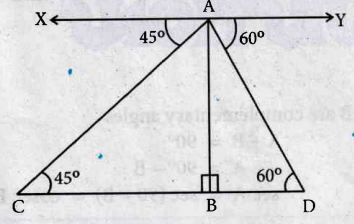
Let C and D are two ships.
Let AB be the height of the light house.
\(\mathrm{CD}=200\left(\frac{\sqrt{3}+1}{\sqrt{3}}\right) m\)
In the right ABD
\(\tan 60^{\circ}=\frac{A B}{B D} \)
\(\sqrt{3}=\frac{A B}{B D} \)
\(\mathrm{BD}=\frac{A B}{\sqrt{3}} \)
In the right triangle ABC
\(\tan 45^{\circ} =\frac{A B}{B C} \)
\(1 =\frac{A B}{B C} \)
\(B C =A B \)
\((1)+(2) \Rightarrow B D +B C=\frac{A B}{\sqrt{3}}+A B \)
\(\mathrm{CD}=A B\left(\frac{1}{\sqrt{3}}+1\right) \quad[\because \mathrm{CB}+\mathrm{BD}=\mathrm{CD}] \)
\(\frac{C D}{\left(\frac{1}{\sqrt{3}}+1\right)}=\mathrm{AB} \)
\(A B=\frac{200\left(\frac{\sqrt{3}+1}{\sqrt{3}}\right)}{\left(\frac{\sqrt{3}+1}{\sqrt{3}}\right)}\)
AB = 200 m
Height of the light house is 200 m.
19.
Let AB denote the height of the peak and be 'h'.
In ΔABC,
tan 8o = \(\frac { AB }{ BC } =\frac { h }{ m } \)
m = \(\frac { AB }{ BC } =\frac { h }{ m } \) ...(1)
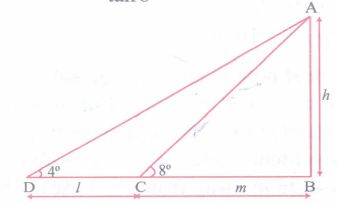
In Δ ABC,
tan 40o =\(\frac { AB }{ BC } =\frac { h }{ m } \)
m+1 = \(\frac { h }{ tan4 } \) ..(2)
From (1) and (2)
\(\frac { h }{ tan8 } +1=\frac { h }{ tan4 } \)
\(1=\frac { h }{ tan4 } -\frac { h }{ tan8 } \)
\(h\left[ \frac { tan8-tan4 }{ tan4tan8 } \right] =1\)
h = \(\frac { tan4\times tan8 }{ tan8-tan4 } \)
= 0.14 mile (approx)
20.
Given points (-2, -1), (4, 0), (3, 3) and (-3, 2) let the points be A (-2, -1), B (4, 0), C (3, 3) and D (-3,2)
Slope = \(\frac{y_{1}-y_{2}}{x_{1}-x_{2}}
\)
Slope of AB = \(\frac{-1-0}{-2-4}=\frac{1}{6}
\)
Slope of BC = \(\frac{0-3}{4-3}=\frac{-3}{1}=-3
\)
Slope of CD = \(\frac{3-2}{3+3}=\frac{1}{6}
\)
Slope of DA = \(\frac{2+1}{-3+2}=\frac{3}{-1}=-3
\)
Slope of AB = Slope of CD = AB is parallel to CD
Slope of BC = Slope of DA = BC is parallel to DA
Hence, the given points form a parallelogram
21.
nth term of a G.P = arn-1
Given \(2^{\text {nd }} \text { term } =\sqrt{6} \)
\(a r^{2-1} =\sqrt{6} \)
\(a r =\sqrt{6} \)
\(6^{\text {th }} \text { term } =9 \sqrt{6} \)
\(a r^{6-1} =9 \sqrt{6} \)
\(a r^{5} =9 \sqrt{6} \)
\(\therefore \frac{a r^{5}}{a r} =\frac{9 \sqrt{6}}{\sqrt{6}} \)
r4 = 9
r2 = 3
\( r=\sqrt{3} \)
\(Also\ ar =\sqrt{6} \)
\(a=\frac{\sqrt{6}}{r}=\frac{\sqrt{2} \sqrt{3}}{\sqrt{3}} \)
\(a=\sqrt{2} \)
The G.P. is a, ar, ar2,...
\(=\sqrt{2}, \sqrt{6}, \sqrt{2}(\sqrt{3})^{2} \ldots \ldots \)
\(=\sqrt{2}, \sqrt{6}, 3 \sqrt{2} \ldots . \)
22.
Let the assumed mean, A = 35, c = 10
| Marks | Mid value (xi) |
fi | di = xi-A | di = \(\frac { x_{ i }-A }{ c } \) | fidi | fidi2 |
| 0-10 | 5 | 8 | -30 | -3 | -24 | 72 |
| 10-20 | 15 | 12 | -20 | -2 | -24 | 48 |
| 20-30 | 25 | 17 | -10 | -1 | -17 | 17 |
| 30-40 | 35 | 14 | 0 | 0 | 0 | 0 |
| 40-50 | 45 | 9 | 10 | 1 | 9 | 9 |
| 50-60 | 55 | 7 | 20 | 2 | 14 | 28 |
| 60-70 | 65 | 4 | 30 | 3 | 12 | 36 |
| N = 71 | Σfidi = -30 | Σfidi2 = 210 |
Standard deviation σ = \(c\times \sqrt { \frac { \Sigma { f }_{ i }{ d }_{ i }^{ 2 } }{ N } -\left( \frac { \Sigma { f }_{ i }{ d }_{ i } }{ N } \right) ^{ 2 } } \)
σ = \(10\times \sqrt { \frac { 210 }{ 71 } -\left( \frac { 30 }{ 71 } \right) ^{ 2 } } =10\times \sqrt { \frac { 210 }{ 71 } -\frac { 900 }{ 5041 } } \)
= 10 x \(\sqrt { 2.779 } \); σ ≃ 16.67
23.
12 + 22 + 32 + ... + n2 = 2025
\({\left[\frac{n(n+1)}{2}\right]^{2}=2025=(45)^{2}}
\)
\(\Rightarrow \frac{n(n+1)}{2}=45
\)
n2 + n = 90
n2 + n - 90 = 0
(n - 9) (n + 10) = 0
n = 9, - 10
n = -10 is not possible
n = 9
24.
Given points A(- 4, 2) and B( 6, - 4)
Mid point of AB \(=\left(\frac{x_{1}+x_{2}}{2}, \frac{y_{1}+y_{2}}{2}\right) \)
\(=\left(\frac{-4+6}{2}, \frac{2-4}{2}\right)=(1,-1) \)
slope of AB = \(\frac{y_{1}-y_{2}}{x_{1}-x_{2}}=\frac{2+4}{-4-6}=\frac{6}{-10}=\frac{-3}{5}\)
Slope of perpendicular line = \(\frac{5}{3}\)
Perpendicular bisector is passing through (1, -1) and having slope \(\frac{5}{3}\)
The equation of perpendicular bisector is
y - y1 = m(x - x1)
y + 1 = \(\frac{5}{3}(x-1)\)
3y + 3 = 5x - 5
5x - 3y - 8 = 0
25.
Volume of a cone = 1005 \(\frac{5}{7}\) cu.cm
\(\text { i.e., } \frac{1}{3} \pi r^{2} h=1005 \frac{5}{7}\)
area of base = area of circle
\(
=201 \frac{1}{7} \text { sq. units }
\)
\(i.e
\ \pi r^{2}=201 \frac{1}{7} \Rightarrow r^{2}=64
\)
Substituting in (1), r = 8 cm
\(\frac{1}{3}\left(201 \frac{1}{7}\right) \mathrm{h}=1005 \frac{5}{7}
\)
\(\frac{1}{3}\left(\frac{1408}{7}\right) \mathrm{h}=\frac{7040}{7}
\)
\(h=\frac{7040}{7} \times \frac{7}{1408} \times 3=15 \mathrm{~cm}\)
Slant height of cone \(l =\sqrt{h^{2}+r^{2}}
\)
\(=\sqrt{15^{2}+8^{2}}=\sqrt{225+64}
\)
\(=\sqrt{289}=17 \mathrm{~cm}
\)
26.
Slant height l = 4 m
Perimeter of larger circle = 2nR = 18 cm
\(R=\frac{9}{\pi}=\frac{63}{22} \mathrm{~m}\)
Perimeter of smaller circle = \(2 \pi r\) = 16 m
\(r=\frac{8}{\pi}=\frac{56}{22} \mathrm{~m}\)
C.S.A of Frustum of cone = \(\pi l(\mathrm{R}+r) \text { sq. units }\)
\(=\frac{22}{7} \times 4 \times\left(\frac{63}{22}+\frac{56}{22}\right) \)
\(=\frac{4}{7}(119)=68 \mathrm{~m}^{2} \)
Cost of painting per sq. m = Rs. 100
Cost of painting for 68 sq. m = 68 x 100
= Rs.6800
27.
Hollow metallic cylinder
External radius R = 4.3 cm
Internal radius r = 1.1 cm
Length = height = h = 4 cm
Volume \(=\pi\left(\mathrm{R}^{2}-\mathrm{r}^{2}\right) \mathrm{h} \text { cu. units }
\)
\(=\pi\left((4.3)^{2}-(1.1)^{2}\right)(4)
\)
\(=\pi(18.49-1.21) 4
\)
\(=69.12 \pi \mathrm{cm} 3
\)
Solid cylinder
height h = 12 cm
radius r = ?
volume \(=\pi r^{2} h\ sq. units
\)
\(=\pi r^{2}(12)
\)
Given, Hollow cylinder is melted to form solid cylinder
Volume of cylinder = Volume of hollow cylinder
\(\pi r^{2}(12) =69.12 \pi
\)
\(r^{2} =\frac{69.12}{12}=5.76
\)
r = 2.4 cm
Diameter of cylinder = 2r = 4.8 cm
28.
Let AB be the height of the kite above the ground. Then, AB = 75.
Let AC be the length of the string.
In right triangle ABC,\(\angle \)ACB = \(60°\)
\(sin\theta =\frac { AB }{ AC } \)
\(sin60°=\frac { 75 }{ AC } \)
gives \(\frac { \sqrt { 3 } }{ 2 } =\frac { 75 }{ AC } \) so, AC = \(\frac { 150 }{ \sqrt { 3 } } =50\sqrt { 3 } \)
Hence, the length of the string is 50\(\sqrt { 3 } m\)
29.
Let r be the radius of the hemisphere.
Given that, diameter of the hemisphere = side of the cube = l
Radius of the hemisphere = \(\frac{l}{2}\)
TSA of the remaining solid = Surface area of the cubical part + C.S.A. of the hemispherical part − Area of the base of the hemispherical part
= 6 x (Edge)2 + 2\(\pi\)r2−\(\pi\)r2
= 6 x (Edge)2 + \(\pi\)r2
\(=6{ \times (l) }^{ 2 }+\pi { \left( \frac { l }{ 2 } \right) }^{ 2 }=\frac { 1 }{ 4 } (24+\pi ){ l }^{ 2 }\)
Total surface area of the remaining solid \(=\frac { 1 }{ 4 } (24+\pi ){ l }^{ 2 }\)sq. units
30.
A = {1, 2),B = {1, 2, 3, 4}, C = {5, 6},D = {5, 6, 7, 8}
A x C = {1, 2} x {5, 6}
\(\mathrm{A} \times \mathrm{C}=\{(1,5),(1,6),(2,5),(2,6)\}\)
B x D = { 1, 2, 3, 4} x { 5, 6, 7, 8}
\(\begin{array}{r} \mathrm{B} \times \mathrm{D}=\{({1,5}),(1,6),(1,7),(1,8) ({2,5}),(2,6),(2,7),(2,8) (3,5),(3,6),(3,7),(3,8) (4,5),(4,6),(4,7),(4,8)\} \end{array}\)
(A x C) is a subset of (B x D)
31.
f(x) = x2, g(x) = 3x, h(x) = x - 2
f o g = f [g(x)] = f (3x)
= (3x)2 - 9x2
(f o g) o h = (f o g) [h (x)] = (f o g) [x - 2]
= 9 ( x - 2)2
g o h = g [h (x)] = g[x - 2] = 3 (x - 2)
f o (g o h) = f [g (h(x))]
= f [3(x - 2)] = [3(x - 2))]2 = 9 (x - 2)2
(f o g) o h = f o( g o h)
Hence proved.
32.
Let TR = y. Since, OT is perpendicular bisector of PQ
PR = QR = 4 cm
In\(\triangle\)ORP, OP2 = OR2 + PR2
OR2 = OP2 - PR2
OR2 = 52 - 42 = 25 - 16 = 9 \(\Rightarrow\) OR = 3cm
OT = OR + RT = 3 + y ..(1)
In \(\triangle\)PRT, TP2 + TR2 + PR2 ..(2)
and \(\triangle\)OPT we have, OT2 = TP2 + OP2
OT2 = (TR2 + PR2) + OP2 (substitute for TP2 from (2))
(3 + y)2 = y2 + 42 + 52 (substitute for OT from (1))
9 + 6y2 + 16 + 25 therefore \(y=TR=\frac { 16 }{ 3 } \)
6y = 41 - 9 we get \(y=\frac { 16 }{ 3 } \)
From (2), TP2 = TR2 + PR2
\(TP2=\left( \frac { 16 }{ 3 } \right) +4^{ 2 }=\frac { 256 }{ 9 } +16=\frac { 400 }{ 9 } \)so, \(TP=\frac { 20 }{ 3 } \)
33.
f(x) = \(\sqrt { 1+\sqrt { 1-\sqrt { 1-{ x }^{ 2 } } } } \)
\(
f(x)=\sqrt{1-t}
\)
\(where\ t=\sqrt{1-\sqrt{1-x^{2}}}\)
\(1-t \geq 0
\)
\(t \leq 1
\)
\(\sqrt{1-\sqrt{1-x^{2}}} \leq 1
\)
Squaring \(\sqrt{1-\sqrt{1-x^{2}}} \leq 1
\)
\(-\sqrt{1-x^{2}} \leq 0
\)
\(\sqrt{1-x^{2}} \geq 0
\)
\(1-x^{2} \geq 0
\)
\(x^{2} \leq 1
\)
= x [-1, 1] i.e., {- 1, 0, 1}
34.
Total number of steps n = 30.
Bottom step requires a = 100 bricks
Each successive steps requires 2 less than the previous step.
Number of bricks in each step form an A.P. 100, 98, 96, ....upto 30 terms
a = 100,d = -2,n = 30
(i) Number of bricks required for the topmost step is l
l = -a + (n - 1)d
= 100 + (30 - 1)(-2)
= 100 + 29 (-2)
= 100 - 58 = 42.
Topmost step requires 42 bricks
(ii) Number of bricks required to build the staircase,
\(\mathrm{S}_{\mathrm{n}}=\frac{n}{2}(l+a)=\frac{30}{2}(100+42)\)
= 15 x 142 = 2130
Total number of bricks required = 2130
35.
\(\left\{\begin{array}{l} \text { Sum of natural numbers between } \\ 602 \text { and } 902 \text { not divisible by } 4 \end{array}\right\}=\) \(\left\{\begin{array}{l} \text { Sum of all natural } \\ \text { numbers between } \\ 602 \text { and } 902 \end{array}\right\}-\left\{\begin{array}{l} \text { Sum of all natural } \\ \text { numbers between } \\ 602 \text { and } 902 \text { divisible } \\ \text { by } 4 \end{array}\right\}\)
\(\mathrm{S}_{\mathrm{n}}=\frac{n}{2}[2 a+(n-1) d]\)
Sum of Natural numbers upto \(\mathrm{n}=\frac{n(n+1)}{2}\)
603 + 604 +..... + 901 = (1 + 2+ ... + 901) - (1 + 2 + 3 +...+ 602)
\(=\frac{901 \times(901+1)}{2}-\frac{602 \times(602+1)}{2} \)
\(=\frac{901 \times 902}{2}-\frac{602 \times 603}{2} \)
= 4,06,351 - 1,81,503
= 2,24,848
Again numbers divisible by 4 between 602 and 902 are 604 + 608 + .... + 900
\(\mathrm{n} =\left(\frac{l-a}{d}\right)+1=\left(\frac{900-604}{4}\right)+1 \)
\(=\left(\frac{296}{4}\right)+1=74+1=75 \)
\(\mathrm{~S}_{\mathrm{n}} =\frac{75}{2}[2(604)+(75-1)(4)] \)
\(=\frac{75}{2} \times 2[604+(74 \times 2)] \)
= 75 x 752 = 56400
Required sum =. 224848 - 56400
= 1,68,448
36.
Let Sarah's house is at A and James's house is at 'B' from the picture.
Distance between Sarah's house to James house through Street B and C
= 1.5 miles + 2 miles = 3.5 miles
Distance through street C is AC2 = AB2 + BC2
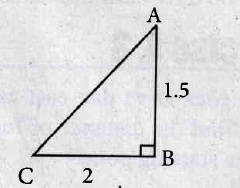
AC2 = = (1.5)2 + (2),
= 2.25 + 4
= 6.25
\(A C=\sqrt{6.25}=2.5\)
AC = 2.5 miles
Difference between two paths = 3.5 - 2.5 = 1 mile
Direct path along C street is 1 mile shorter
37.
Let r, R and h be the internal radius, external radius and height of the hollow cylinder respectively.
Given that, r = 21cm, R = 28 cm, h = 9 cm
Now, volume of hollow cylinder = \(\pi\)(R2 − r2)h cu. units
\(=\frac { 22 }{ 7 } \left( { 28 }^{ 2 }-21^{ 2 } \right) \times 9\)
\(=\frac { 22 }{ 7 } (784-441)\times 9=9702\)
Therefore, volume of iron used = 9702 cm3
38.
.JPG)
Given, vertices of a quadrilateral arc
A(- 4, - 2), B(5, - 1), C(6, 5) and D(- 7 ,6).
Let B Q, R and S be the mid points of the sides
AB, BC, CD and AD respectively
Mid point of
\(\mathrm{AB}=\left(\frac{x_{1}+x_{2}}{2}, \frac{y_{1}+y_{2}}{2}\right) =\mathrm{P}\left(\frac{-4+5}{2}, \frac{-2-1}{2}\right) \)
\(=\mathrm{P}\left(\frac{1}{2},-\frac{3}{2}\right) \)
Mid point of BC
\(=Q\left(\frac{5+6}{2}, \frac{-1+5}{2}\right)=Q\left(\frac{11}{2}, 2\right)\)
Mid point of CD
\(=R\left(\frac{6-7}{2}, \frac{5+6}{2}\right)=R\left(-\frac{1}{2}, \frac{11}{2}\right)\)
Mid point of AD
\(=S\left(\frac{-4-7}{2}, \frac{-2+6}{2}\right)=S\left(-\frac{11}{2}, 2\right)\)
Slope of PQ \(=\frac{y_{1}-y_{2}}{x_{1}-x_{2}}=\frac{-\frac{3}{2}-2}{\frac{1}{2}-\frac{11}{2}}=\frac{-\frac{7}{2}}{-\frac{10}{2}}=\frac{7}{10}\)
Slope of QR \(= \frac{2-\frac{11}{2}}{\frac{11}{2}+\frac{1}{2}}=\frac{-\frac{7}{2}}{\frac{12}{2}}=-\frac{7}{12} \)
Slope of RS \(= \frac{\frac{11}{2}-2}{-\frac{1}{2}+\frac{11}{2}}=\frac{\frac{7}{2}}{\frac{10}{2}}=\frac{7}{10} \)
Slope of PS \(= \frac{-\frac{3}{2}-2}{\frac{1}{2}+\frac{11}{2}}=\frac{-\frac{7}{2}}{\frac{12}{2}}=-\frac{7}{12} \)
Slope of PQ = Slope of RS = PQ || RS
Slope of QR = Slope of PS = QR || PS
Hence, the mid points form a parallelogram.
39.
Given points A (2, 2), B (- 2,- 3), C (1, - 3) and D (x, y)
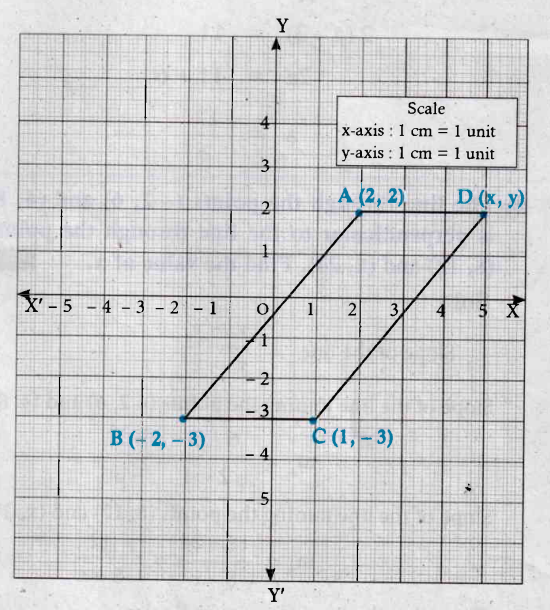
Slope of a line = \(\frac{y_{1}-y_{2}}{x_{1}-x_{2}} \)
Slope of AB = \(\frac{2+3}{2+2}=\frac{5}{4} \)
Slope of BC = \(\frac{-3+3}{-2-1}=0 \)
Slope of CD = \(-\frac{-3-y}{1-x} \)
Slope of AD = \(\frac{2-y}{2-x} \)
Since, the points form a parallelogram
AB is parallel to CD and BC is parallel to AD
Slope of AB = Slope of CD
\(\frac{5}{4}=\frac{-3-y}{1-x}\)
5(1 - x) = 4(-3 -y)
5 - 5x = -12 -4y
5x - 4y = 17
Slope of BC = Slope of AD
\(0=\frac{2-y}{2-x}\)
2 - y = 0
y = 2
Substituting in (1)
5x - 4(2) = 17
5x = 17 + 8 = 25
\(x=\frac{25}{5}=5\)
x = 5, y = 2
40.
From the figure
r = 6 cm
R = 12 cm
h = 8 cm
\(l =\sqrt{h^{2}+(\mathrm{R}-\mathrm{r})^{2}} \)
\(=\sqrt{8^{2}+(12-6)^{2}} \)
\(=\sqrt{64+36} \)
\(=\sqrt{100}=10 \mathrm{~cm} \)
Area to be painted = C.S.A + area of top circular region
\(=\pi(R+r) l+\pi r^{2} \)
\(=\frac{22}{7}(12+6)(10)+\frac{22}{7}(6)^{2} \)
\(=\frac{22}{7}(180)+\frac{22}{7}(36) \)
\(=\frac{22}{7}(180+36) \)
\(=\frac{22}{7}(216)=\frac{4752}{7}=678.86 \)
Cost of painting per sq. cm = Rs. 2
Total cost = 678.86 x 2 = Rs. 1357.72
41.
Let h, l, R and r be the height, slant height, outer radius and inner radius of the frustum.
Given that, diameter of the top = 10 m; radius of the top R = 5 m.
diameter of the bottom = 4 m; radius of the bottom r = 2 m, height h = 4 m
Now, \(l=\sqrt { { h }^{ 2 }+\left( R-{ r } \right) ^{ 2 } } \)
\(=\sqrt { { 4 }^{ 2 }+(5-2)^{ 2 } } \)
\(l=\sqrt { 16+9 } =\sqrt { 25 } =5m\)
Here, C.S.A. = \(\pi\)(R + r)l sq. units
\(\frac { 22 }{ 7 } (5+2)\times 5={ 110m }^{ 2 }\)
T.S.A. = \(\pi\)(R + r)l + \(\pi\)R2 + \(\pi\)r2 sq. units
\(\frac { 22 }{ 7 } \left[ (5+2)5+25+4 \right] =\frac { 1408 }{ 7 } =201.14\)
Therefore, C.S.A. = 110 m2 and T.S.A. = 201.14 m2
42.
In ABC , we have DE || BC
\(\frac{A B}{A D}=\frac{A C}{A E}\) [By Thales Theorem] ..(1)
In ADC, we have
\(\frac{A D}{A F}=\frac{A C}{A E}\) [By Thales Theorem] .....(2)
From (1) and (2) we get
\(\frac{A B}{A D}=\frac{A D}{A F}\)
AD2 = AB x AF
43.
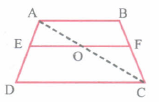
Given: ABCD is a trapezium in which DC || AB and EF || AB
To prove that \(\frac { AE }{ ED } =\frac { BF }{ FC } \)
Construction : join AC meeting EF at G
Proof:
In ADC, we have
EG || DC
\(\Rightarrow \frac{A E}{E D}=\frac{A G}{G C}\) [By Thales theorem] ...(1)
In ABC , we have
\(\frac{A G}{G C}=\frac{B F}{F C}\) [By Thales theorem] ....(2)
From (1) and (2), we get
\(\frac{A E}{E D}=\frac{B F}{F C}\)
44.
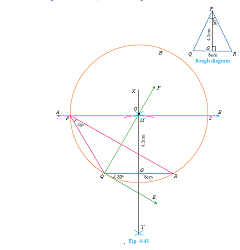
Construction
Step 1 : Draw a line segment QR = 5 cm.
Step 2 : At Q draw QE such that \(\angle\)RQE = 30o.
Step 3 : At Q draw QF such that \(\angle EQF\) = 90o
Step 4 : Draw the perpendicular bisector XY to QR which intersects QF at O and QR at G.
Step 5 : With O as centre and OQ as radius draw a circle.
Step 6: From G mark an arc in the line XY at M, such that GM = 42. cm.
Step 7 : Draw AB through M which is parallel to QR.
Step 8 : AB meets the circle at P and S.
Step 9 : Join QP and RP. Then\(\triangle\)PQR is the required triangle
45.
The function f is defined by three values in intervals I, II, III as shown by the side.
For a given value of x = a, find out the interval at which the point a is located, there after find
f(a) using the particular value defined in that interval.
(i) First, we see that, x = 4 lie in the third interval.
Therefore, f(x) = 3x - 2; f(4) = 3(4) = 10
(ii) x = -2 lies in the second interval
Therefore, f(x) = x2 - 2; f(-2) = (-2)2 - 2 = 2
(iii) From (i), f(4) =10.
To find f(1) first we see that x = 1 lies in the second interval.
Therefore, f(x) = x2-2 ⇒ f(1) = 12 - 2 = -1
So, f(4) + 2f(1) = 10 + 2(-1) = 8
(iv) We know that f(1) = -1 and f(4) = 10
For finding f(-3), we see that x = −3, lies in the first interval.
Therefore, f(x) = 2x + 7; thus, f(-3) = 2(-3) + 7 = 1
Hence, \(\frac { f(1)-3f(4) }{ f(-3) } =\frac { -2-3(10) }{ 1 } \) = - 31
46.
Given cosec\(\theta \) + cot\(\theta \) = p ...(1)
cosec2\(\theta \) - cot2\(\theta \) = 1 (identity)
\(\operatorname{cosec} \theta-\cot \theta=\frac{1}{\operatorname{cosec} \theta+\cot \theta}\)
cosec\(\theta \) - cot\(\theta \) =\(\frac { 1 }{ { p } } \) .... (2)
Adding(1) and (2) we get, 2cosec\(\theta \) = \(p+\frac { 1 }{ p } \)
2cosec\(\theta \)\(\frac { { p }^{ 2 }+1 }{ p } \) ....(3)
Subtracting (2) from (1), we get, 2cot\(\theta \) = \(p-\frac { 1 }{ p } \)
2cot\(\theta \) = \(\frac { { p }^{ 2 }-1 }{ p } \) ...(4)
Dividing (4) by (3) we get,\(\frac { 2cot\theta }{ 2cosec\theta } =\frac { { p }^{ 2 }-1 }{ p } \times \frac { p }{ { p }^{ 2 }+1 } gives,cos\theta =\frac { { p }^{ 2 }-1 }{ { p }^{ 2 }+1 } \)
47.
Let the 100t digit be 'x', 10's be 'y' and Unit digit be 'z'.
The three digit number is 100x + 10y + z.
Now given, x + y + z = 11 . ..(1)
100z +10y + x = 5 (100x + 10y + z) + 46
Simplifying
499x + 40y - 95z = - 46 .........(2)
x + 2y = z
x + 2y - z = 0 ....(3)
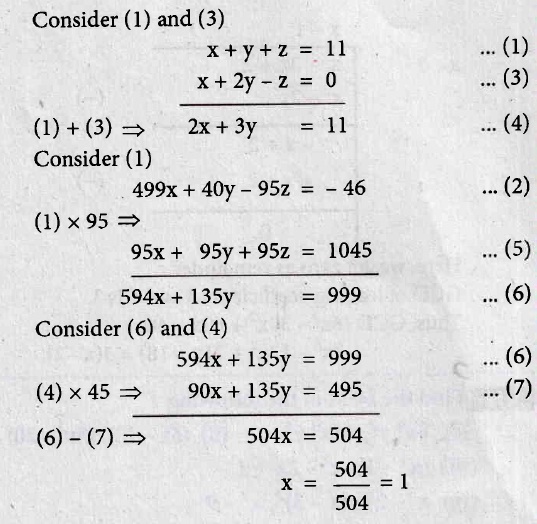
Substituting the value x = 1 in(4)
2(1) + 3y = 11
3y = 11 - 2 = 9
\(y=\frac{9}{3}=3\)
Substituting x = 1, y = 3 in (1)
1 + 3 + z = 11
z = 11 - 4 = 7
x = 1, y = 3, z = 7
The original three digit number is 137
i.e., 100(1) + 10(3) + 1(7) = 100+ 30 + 7 =137
48.
x + 2y - z = 6 ...(1)
-3x - 2y + 5z = -12 ....(2)
x- 2z = 3 ....(3)
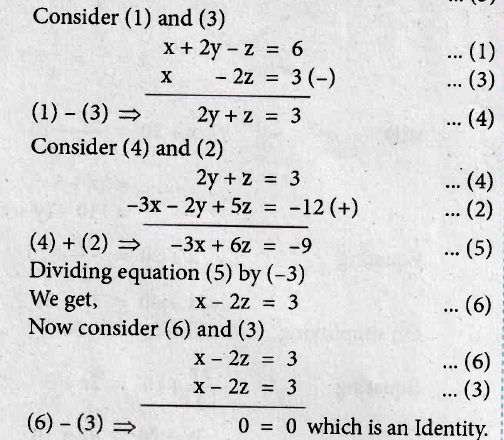
The system of equations has infinitely many solutions
49.
(i) To check if h is one – one, we assume that h(b1) = h(b2)
Then we get 2.47b1 + 54.10 = 2.47b2 + 54.10
2.47b1 = 2.47b2
⇒ b1 = b2
Thus, h(b1) = h(b2) ⇒ b1 = b2, So, the function h is one – one.
(ii) If the length of the thigh bone b = 50, then the height is
h(50) = (2.47 x 50) + 54.10 =177.6 cms
(iii) If the height of a person is 147.96 cms, then h(b) = 147.96 and so the length of the thigh bone is given by
2.47b + 54.10 = 147.96.
2. 47 = 147. 96 - 54. 10 = 93. 86
b = \(\frac { 93.86 }{ 2.47 } \)
Therefore, the length of the thigh bone is 38 cm.
50.
Let the three numbers be x, y, z
From the given data we get the following equations,
3x + y + 2z = 5 .....(1)
x + 3z - 3y = 2 .....(2)
2x + 3y - z = 1 .....(3)
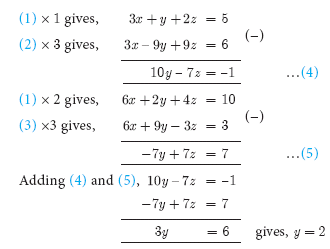
Substituting y = 2 in (5), -14 + 7x = 7 gives, z = 3
Substituting y = 2 and z = 3 in (1), 3x + 2 + 6 = 5 we get x = -1
Therefore, x = –1, y = 2, z = 3.
51.
Now,cos\(\theta \) + sin\(\theta \) =\(\sqrt { 2 } \) cos\(\theta \)
Squaring both sides,
(cos\(\theta \) + sin\(\theta \) )2 =(\(\sqrt { 2 } \) cos\(\theta \) )2
cos2 \(\theta \) + sin2 \(\theta \) + 2sin\(\theta \) cos\(\theta \) = 2cos2\(\theta \)
2cos2\(\theta \) - cos2\(\theta \) - sin2\(\theta \) = 2sin\(\theta \) cos\(\theta \)
cos2\(\theta \) - sin2\(\theta \) = 2sin\(\theta \) cos\(\theta \)
(cos\(\theta \) + sin\(\theta \) ) (cos\(\theta \) + sin\(\theta \) ) = 2sin\(\theta \) cos\(\theta \)
cos\(\theta \) - sin\(\theta \) = \(\frac { 2sin\theta cos\theta }{ cos\theta +sin\theta } \) =\(\frac { 2sin\theta cos\theta }{ \sqrt { 2 } cos\theta } \) [since cos\(\theta \) + sin\(\theta \) =\(\sqrt { 2 } \) cos\(\theta \) ]
=\(\sqrt { 2 } \) cos\(\theta \)
Therefore cos\(\theta \) - sin\(\theta \) =\(\sqrt { 2 } \) cos\(\theta \)
52.
First take 25 ≡ 15 (mod 17)
(25)2 ≡ 152 (mod 17)
≡ 4 (mod 17)
210 ≡ 4 (mod 17)
(210)4 ≡ 44 (mod 17)
240 ≡ 1 mod 17
(240)2 ≡ 12 mod 17
2.280 ≡ 2 x 1 (mod 17)
281 ≡ 2 mod 17
Remainder when 281 is divided by 17 is 2.
53.
Let Arul's speed of working be x
Let Mohan's speed of working be y
Let Ram's speed of working be z
given that they are working together.
Let 'w' be the quantum of work.
Also given that Mohan takes twice the time as Arul for finishing the work.
\(\therefore \frac { w }{ y } =2\times \frac { w }{ x } \therefore x=2y\)
\(\therefore y=\frac { x }{ 2 } \) (2)
Also Ram takes 3 times the time as Arul for finishing the work.
\(\therefore \frac { w }{ z } =3\times \frac { w }{ x } \)
\(\therefore x=3z\quad \therefore z=\frac { x }{ 3 } \)
Substitute (2) and (3) in (1),
\(x+\frac { x }{ 2 } +\frac { x }{ 3 } =\frac { w }{ 6 } \)
∴ 6x + 3x + 2x = w
11x = w
\(x=\frac { w }{ 11 } ,y=\frac { w }{ 22 } ,z=\frac { w }{ 33 } \)
Working alone time taken as
\(Arul:\frac { w }{ x } =\frac { w }{ w/11 } =11hrs.\)
\(Mohan:\frac { w }{ y } =\frac { w }{ w/22 } =22hrs.\)
\(Ram:\frac { w }{ z } =\frac { w }{ w/33 } =33hrs\)
54.
Let the
100's digit be 'x'
10's digit be 'y'
Unit's digit be 'z'
Given 100y+ 10x + z - 54 = 3(100x + 10y + z)
Substituting 290x - 70y + 22 = -54 ( /2)
145x - 35y + z = -27 .........(1)
l00x + 10y + z + 198 = 100z + 10y + x
Substituting 99x - 992 = - 198 (99)
x - z = - 2 ...........(2)
y = x + 2 (y - z)
x + y - 2z = 0 ..........(3)
Consider (1) and (3)
145x - 35y + z = -27 .......(1)
35x + 35y - 70z = 0 .......(4)
180x - 69z = -27 .......(5)
Consider (5) and (2)

\(x=\frac{111}{111}=1\)
Substituting x = 1 in .........(2)
1 - z = -z
z = 1 + 2 = 3
Substituting x - 1, z = 3 in (3)
1 + y - 6 = 0
y = 5
solution: x = 1, y = 5, z = 3
The number is 153.
55.
Let the number of students in sections A, B and C be 'x', 'y' and 'z' respectively
Given x + y + z = 150 ........(1)
x - 6 = z + 6
x - z = 12 .....(2)
4z = x + y
x + y - 4z = 0 ..........(3)
consider (1) and (3)
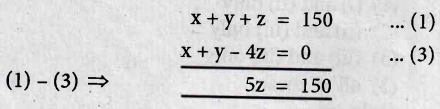
\(z=\frac{150}{5}=30\)
substituting in (2)
x - 30 = 12
x = 30 + 12
x = 42
substituting x = 42, z = 30 in (1)
42 + y + 30 = 150
y = 150 - 72
y = 78
The number of students in sections A, B and C are 42, 78, 30 respectively.
56.
Given: A = {1,2,3} , B = {2,3,5} , C = {3,4} ,D = {1,3,5}
\(A\cap C\) = {3}
\(B\cap D\) = {3,5}
\((A\cap C)\times(B\cap D)=\{ 3\} \times \{ 3,5\} \)
= {(3,3),(3,5)} ..(1)
A x B = {(1,2),(1,3),(1,5),(2,2),(2,3),(2,5),(3,2),(3,3),(3,5)}
C x D = {(3,1),(3,3),(3,5),(4,1),(4,3),(4,5)}
\((A\times B)\cap (C\times D)\) = {(3,3),(3,5)} ....(2)
From (1) and (2),it is clear that
(A ∩ C) x (B ∩ D) = (A x B) ∩ (C x D)
Hence it is true.
57.
A = {x \(\in \) N| 1 < x < 4} = {2,3), B = {x \(\in \) W| 0 ≤ x < 2) = (0,1), C = {x \(\in \) N| x < 3} = (1,2)
(i) A x (B U C) = (A x B) U (A x C)
B U C = (0,1) U (1,2) = {0,1,2}
A x (B U C) = {2,3) x {0,1,2} = {(2,0),(2,1)(2,2)(3,0)(3,1),(3,2) ..(1)
A x B = {2,3} x {0,1} = {(2,0),(2,1),(3,0),(3,1)}
A x C = {2,3} x {1,2} = {(2,1),(2,2),(3,1)(3,2)}
(A x B) U (A x C) = {(2,0),(2,1),(3,0),(3,1)} U {(2,1),(2,2),(3,1),(3,2)}
= {(2,0),(2,1),(2,2),(3,0),(3,1),(3,2)} ...(2)
From (1) and (2), A x (B U C) = (A x B) U (A x C) is verified.
(ii) A x (B ∩ C) = (A x B) ∩ (A x C)
(B ∩ C) = {0,1} ∩ {1,2} = {1}
A x (B ∩ C) = {2,3} x {1} = {(2,1),(3,1)} .... (3)
A x B = {2,3} x {0,1} = {(2,0),(2,1),(3,0),(3,1)}
A x C = {2,3} x {1,2} = {(2,1),(2,2),(3,1),(3,2)
(A x B) ∩ (A x C) = {(2,0),(2,1),(3,0),(3,1)} ∩ {(2,1),(2,2),(3,1),(3,2)}
= {(2,1),(3,1)} .... (4)
From (3) and (4), A x (B ∩ C) = (A x B) ∩ (A x C) is verified.
58.
Given a triangle \(\triangle\)PQR. We have to construct another triangle whose sides are \(\frac { 7 }{ 3 } \) of the corresponding sides of the given \(\triangle\)PQR.
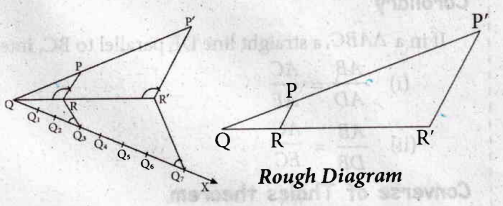
Steps of construction:
1. Constructed a PQR with any measurement.
2. Drawn a ray QX making an acute angle with QR on the side opposite to the vertex P.
3. Joined Q3 to R and drawn a line through Q7 parallel to Q3R, intersecting the extended line segment QR at R'
4. Drawn a line through R' parallel to RP intersecting the extended line segment QP at P.
5. Then PQR' is the required triangle each of whose sides is seven-thirds of the corresponding sides of PQR.
59.
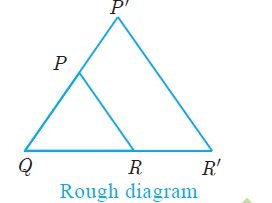
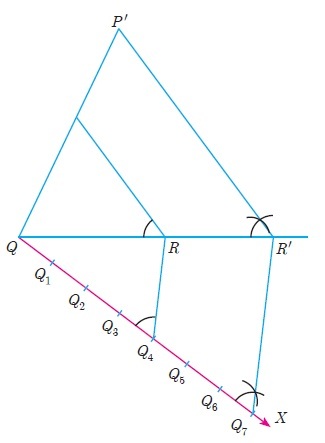
Given a triangle PQR, we are required to construct another triangle whose sides are \(\frac { 7 }{ 4 } \) of the corresponding sides of the triangle PQR.
Steps of construction
1. Construct a DPQR with any measurement.
2. Draw a ray QX making an acute angle with QR on the side opposite to vertex P.
3. Locate 7 points (the greater of 7 and 4 in \(\frac { 7 }{ 4 } \))
Q1,Q2,Q3,Q4,Q5,Q6 and Q7 on QX so that
QQ1 = Q1Q2 = Q2Q3 = Q4Q5 = Q5Q6 = Q6Q7
4. Join Q4 (the 4th point, 4 being smaller of 4 and 7 in \(\frac { 7 }{ 4 } \)) to R and draw a line through Q7 parallel to Q4R, intersecting the extended line segment QR at R'.
5. Draw a line through R' parallel to RP intersecting the extended line segment QP at P'.
Then \(\triangle\)P'QR' is the required triangle each of whose sides is seven-fourths of the corresponding sides of \(\triangle\)PQR.
60.
P(A) = 0.5
P(B) = 0.3
Since A and B are mutually exclusive events
\(P(A \cap B)=0\)
\(
\mathrm{P}(\text { either } \mathrm{A} \text { or } \mathrm{B}) =\mathrm{P}(A \cup B)
\)
\(\mathrm{P}(A \cup B) =\mathrm{P}(\mathrm{A})+\mathrm{P}(\mathrm{B})-\mathrm{P}(A \cap B)
\)
\(\mathrm{P}(A \cup B) =0.5+0.3-0=0.8\)
P(neither A nor B) = \(\mathrm{P}(\overline{A \cup B})\)
\(\mathrm{P} \overline{(A \cup B)}=1-\mathrm{P}(A \cup B)=1-0.8=0.2\)
Probability of neither A nor B happen = 0.2
61.
13 + 23 + 33 +...K3 = \(\left[\frac{k(k+1)}{2}\right]^{2}=44100=(210)^{2}\)
1 + 2 + 3 +...+ k = \(\frac{k(k+1)}{2}=210\)
1 + 2 + 3 +...+ k = 210
62.
Sum of first k natural numbers = \(\frac{k(k+1)}{2}=325\)
Sum of cube of first k natural numbers
\(=\left[\frac{k(k+1)}{2}\right]^{2}
\)
\(=(325)^{2}=1,05,625
\)
\(1^{3}+2^{3}+3^{3}+\ldots+k^{3}=1,05,625
\)
63.
64.
Let x be the length of the ladder. BC = 4 ft, AC = 7 fit.
By Pythagoras theorem we have, AB2 = AC2 + BC2
x2 = 72 + 42 gives x2 = 49 + 16
x2 = 65, Hence \(x=\sqrt { 65 } \)
The number \(\sqrt { 65 } \) is between 8 and 8.1.
82 = 64 < 65.61 = 8.12
Therefore, the length of the ladder is approximately 8.1ft

10th Standard Syllabus & Materials
10th Standard
TN 10th English Prose - 2 - The Night the Ghost Got in Important Questions And Answers Study Material - QB365 Set A
NEW10th Standard
TN 10th English Supplementary - 1 - The Tempest Important Questions And Answers Study Material - QB365 Set A
NEW10th Standard
TN 10th English Poem - 1 - Life Important Questions And Answers Study Material - QB365 Set A
NEW10th Standard
TN 10th English Prose - 1 - His First Flight Important Questions And Answers Study Material - QB365 Set A



Tamilnadu Stateboard 10th Standard Subjects
Tamilnadu Stateboard Standards





