
 100% FREE ACCESS
10th Standard Syllabus & Materials
10th Standard
TN 10th English Prose - 4 - The Attic Important Questions And Answers Study Material - QB365 Set A
NEW10th Standard
TN 10th English Supplementary - 3 - The Story of Mulan Important Questions And Answers Study Material - QB365 Set A
NEW10th Standard
TN 10th English Poem - 3 - I am Every Woman Important Questions And Answers Study Material - QB365 Set A
NEW10th Standard
TN 10th English Prose - 3 - Empowered Women Navigating The World Important Questions And Answers Study Material - QB365 Set A
NEW10th Standard
TN 10th English Supplementary - 2 - Zigzag Important Questions And Answers Study Material - QB365 Set A
NEW10th Standard
TN 10th English Poem - 2 - The Grumble Family Important Questions And Answers Study Material - QB365 Set A

Published on: 09/05/2020
10th Standard Maths English Medium Creative Important 5 Marks Questions
Download Tamil Nadu 10th Standard Maths question papers, model tests, one-mark questions, important questions, and public exam papers in PDF format. Free study materials and answer keys for TN State Board students.
Questions + Answers key
Take MCQ Maths Test1.
The angle of elevation of a tower at a point is 45o, After going 20 meters towards the foot of the tower the angle of elevation of the tower becomes 60o calculate the height of the tower.
2.
If 15tan2 θ+4 sec2 θ=23 then find the value of (secθ+cosecθ)2 -sin2 θ
3.
If ATB=90o then prove that
\(\sqrt { \frac { tanA\quad tanB+tanA\quad cotB }{ sinA\quad secB } } -\frac { { Sin }^{ 2 }A }{ { Cos }^{ 2 }A } =tanA\)
4.
The perpendicular from A on side BC at a \(\triangle\)ABC intersects BC at D such that DB = 3 CD. Prove that 2AB2 = 2AC2 + BC2.
5.
In \(\angle ACD={ 90 }^{ 0 }\) and \(CD\bot AB\) Prove that \(\cfrac { { BC }^{ 2 } }{ { AC }^{ 2 } } =\cfrac { BD }{ AD } \)
6.
In figure 0 is any point inside a rectangle ABCD. Prove that OB2 + OD2 = OA2 + OC2
7.
A ladder is placed against a wall such that its foot is at a distance of 2.5 m from the wall and its top reaches a window 6 m above the ground. Find the length of the ladder.
8.
Prove that in a right triangle, the square of 8. the hypotenuse is equal to the sum of the squares of the others two sides.
9.
Evaluate \(\frac { tan{ 65 }^{ o } }{ tan{ 25 }^{ o } } \)
10.
If sin (A - B) = \(\frac12\), cos (A + B) = \(\frac12\), 0o < A + ≤ 90°, A > B, find A and B.
11.
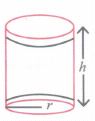
A wooden article was made by scooping out a hemisphere from each end of a cylinder as shown in figure. If the height of the cylinder is 10 cm and its base is of radius 3.5 cm find the total surface area of the article.
12.
A spherical ball of iron has been melted and made into small balls. If the radius of each smaller ball is one-fourth of the radius of the original one, how many such balls can be made?
13.
Final the probability of choosing a spade or a heart card from a deck of cards.
14.
| Team A | 50 | 20 | 10 | 30 | 30 |
| Team B | 40 | 60 | 20 | 20 | 10 |
Which team is more consistent?
15.
S.D. of a data is 2102, mean is 36.6, then find its C.V.
16.
Find the number of coins, 1.5 cm is diameter and 0.2 cm thick, to be melted to form a right circular cylinder of height 10 cm and diameter 4.5 cm.
17.
What is the ratio of the volume of a cylinder, a cone, and a sphere. If each has the same diameter and same height?
18.
C.V. of a data is 69%, S.D. is 15.6, then find its mean.
19.
Find the co-efficient of variation for the following data: 16, 13, 17,21, 18.
20.
Σx = 99, n = 9, Σ(x - 10)2 = 79, then find,
(i) Σx2
(ii) Σ(x - \(\bar { x } \))2
21.
A two digit number is such that the product of its digits is 18, when 63 is subtracted from the number, the digits interchange their places. Find the number.
22.
Find two consecutive natural numbers whose product is 20.
23.
A chess board contains 64 equal squares and the area of each square is 6.25 cm2, A border round the board is 2 cm wide.
24.
Seven years ago, Varun's age was five times the square of Swati's age. Three years hence Swati's age will be two fifth of Varun's age. Find their present ages.
25.
The sum of two numbers is 15. If the sum of their reciprocals is \(\frac{3}{10}\), find the numbers.
26.
Find the sum of first 24 terms of the list of numbers whose nth term is given by an = 3 + 2n.
27.
How many terms of the AP: 24, 21, 18, ... must be taken so that their sum is 78?
28.
If the sum of the first 14 terms of an AP is 1050 and its first term is 10, find the 20th term.
29.
Determine the AP whose 3rd term is 5 and the 7th term is 9.
30.
If R = {(a, -2), (-5, b), (8, c), (d, -1)} represents the identity function, find the values of a, b, c and
31.
A function f: (1,6) \(\rightarrow\)R is defined as follows:
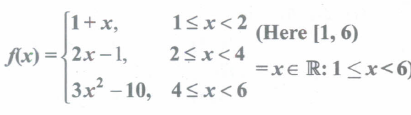
Find the value of f(5),
32.
Find the value of k if the points A(2, 3), B(4, k) and (6, -3) are collinear.
33.
Find the area of the quadrilateral whose vertices, taken in order, are (-4, -2), (-3, -5), (3, -2) and (2, 3).
34.
f(x) = (1+ x)
g(x) = (2x - 1)
Show that fo(g(x)) = gof(x)
35.
A function f: [-7,6) \(\rightarrow\) R is defined as follows.
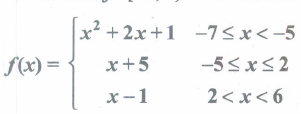
f(-7) - f(-3)
36.
A function f: [-7,6) \(\rightarrow\) R is defined as follows.
find 2f(-4) + 3f(2)
37.
Which of the following list of numbers form an AP? If they form an AP, write the next two terms:
4,10,16, 22, ...
38.
Find the area of a triangle vertices are(1, -1), (-4, 6) and (-3, -5).
39.
If the points A(6, 1), B(8, 2), C(9, 4) and D(P, 3) are the vertices of a parallelogram, taken in order. Find the value of P.
40.
Find the coordinates at the points of trisection (i.e. points dividing in three equal parts) of the line segment joining the points A(2, -2) and B(-7, 4).
1.
2.
3.
4.
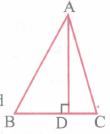
We have DB = 3 CD.
BC = BD + DC
BC = 3CD + CD
BC = 4CD
\(CD=\cfrac { 1 }{ 4 } BC\)
\(CD=\cfrac { 1 }{ 4 } BC\)
\(BD=3cD=\cfrac { 3 }{ 4 } BC\)
Since \(\Delta ABD\) is a right triangle (i) right angled at D.
AB2 = AD2 + BD2
By \(\Delta ACD\) is a right triangle right angled at D
AC2 = AD2 + CD2
Subtracting equation (iii) from equation (ii), we got
AB2 - AC2 = BD2 - CD2
\(\Rightarrow { AB }^{ 2 }-{ AC }^{ 2 }=\left( \cfrac { 3 }{ 4 } BC \right) ^{ 2 }-\left( \cfrac { 1 }{ 4 } BC \right) ^{ 2 }\)
\((from \ CD=\cfrac { 1 }{ 4 } BC,BD=\cfrac { 3 }{ 4 } BC)\)
(i) \(\Rightarrow { AB }^{ 2 }-{ AC }^{ 2 }=\cfrac { 9 }{ 16 } { BC }^{ 2 }-\cfrac { 1 }{ 16 } { BC }\)
\(\Rightarrow { AB }^{ 2 }-{ AC }^{ 2 }=\cfrac { 1 }{ 2 } { BC }^{ 2 }\)
\(\Rightarrow { AB }^{ 2 }-{ AC }^{ 2 }=\cfrac { 1 }{ 2 } BC{ 2 }^{ 2 }\)
\(\Rightarrow 2({ AB }^{ 2 }-{ AC }^{ 2 })={ BC }^{ 2 }\)
\(\Rightarrow { 2AB }^{ 2 }=2{ AC }^{ 2 }+{ BC }^{ 2 }\)
5.
\(\Delta ACD\sim \Delta ABC\)
So,
\(\cfrac { AC }{ AB } =\cfrac { AD }{ AC } \)
AC2 = AB ·AD
Similarly \(\Delta BCD\sim \Delta BAC\)
So,
\(\cfrac { BC }{ BA } =\cfrac { BD }{ BC } \)
BC2 = BA·BD
From (1) and (2)
\(\cfrac { { BC }^{ 2 } }{ AC^{ 2 } } =\cfrac { BA.BD }{ AB.AD } =\cfrac { BD }{ AD } \)
6.
Through O, draw PQIIBC so that P lies on AB and Q lies on DC
Now, PQ II BC
\(PQ\bot AB\quad PQ\bot OC\)
\(\left( \because \angle B={ 90 }^{ 0 }and\angle C={ 90 }^{ 0 } \right) \)
So, \(\angle BPQ={ 90 }^{ 0 }\quad \angle CQP={ 90 }^{ 0 }\)
Therefore BPQC and APQD are both rectangles. Now from \(\Delta OPB\)
OB2 = BP2 + OP2
Similarly from \(\Delta OQD\)
OD2 = OQ2 + DQ2
From \(\Delta OQC\)
OC2 = OQ2 + CQ2
\(\Delta OAP\) we have
OA2 = AP2 +OP2
Adding (1) and (2)
OB2 + OD2 = BP2 + OP2 + OQ2 + DQ2
(As BP = CQ and DQ = AP)
= CQ2 + OP2 + OQ2 + AP2
= CQ2 + OQ2 + OP2 + AP2
= OC2+ OA
[From (3) and (4)]
7.
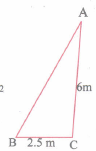
Let AB be the ladder and CA be the wall with . the window at A.
Also, BC = 2.5 m and CA = 6 m
From Pythagoras theorem
AB2 = BC2+ CA2
= (2.5)2 + (6)2
= 42.25
AB = 6.5
Thus, length at the ladder is 6.5 m.
8.
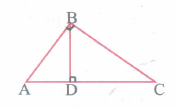
We are given a right triangle ABC right angled at B.
We need to prove that AC2 = AB2 + BC2
Let us draw \(BD\bot AC\)
Now,\(\Delta ADB\sim \Delta ABC\)
\(\cfrac { AD }{ DB } =\cfrac { BC }{ AC } \)
(sides are proportional)
Also,
\(\Delta BDC\sim \Delta ABC\)
\(\cfrac { CD }{ BC } =\cfrac { BC }{ AC } \)
CD·AC = BC2 ..(2)
Adding (1) and (2)
AD .AC + CD . AC = AB2+ BC2
AC(AD + CD) = AB2 + BC2
AC.AC = AB2 + BC2
AC = AB2 + BC2
9.
We know:
cot A = tan(90o - A)
So,
cot 25° = tan (90° - 25°) = tan 65°
\(\frac { tan{ 65 }^{ o } }{ tan{ 25 }^{ o } } \) = \(\frac { tan{ 65 }^{ o } }{ tan{ 25 }^{ o } } \) = 1
10.
Since, sin(A - B) = \(\frac12\), ∴ A-B = 30° ..... (1)
Also, since cos (A + B) = \(\frac12\)
∴ A + B = 60° ...(2)
Solving (1) and (2)
A - B + A + B = 30o + 60o
2A = 90o
A = 45o
We get,
A = 45° and B = 15°
11.
Radius of the cylinder be r
Height of the cylinder be h
Total surface area of the article
= CSA of cylinder + CSA of 2 hemispheres
= 2ㅠrh + 2πr2 = 2πr(h + 2r)
\(=2\times \frac { 22 }{ 7 } \times 3.5\times (10+2\times 3.5)\)
= 22 x 17 = 374 cm2
12.
No. of balls required \(=\frac { \frac { 4 }{ 3 } \pi { r }^{ 3 } }{ \frac { 4 }{ 3 } \pi \times { \left( \frac { r }{ 4 } \right) }^{ 3 } } \)
\(={ r }^{ 3 }\times \frac { 4 }{ r } \times \frac { 4 }{ r } \times \frac { 4 }{ r } =64\)
13.
Total number of cards = 52
Event of selecting a spade card = A
Event of selecting a heart card = B
n(A) = 13, n(B) = 13
P(A) =\(\frac { 13 }{ 52 } =\frac { 1 }{ 4 } \), P(B) =\(\frac { 13 }{ 52 } =\frac { 1 }{ 4 } \).
A ⋂ B refers to a card is both spade and heart. It is not possible

A, B are exclusive events.
P(A,B) = P(A) + P(B) =\(\frac { 1 }{ 4 } +\frac { 1 }{ 4 } =\frac { 1 }{ 2 } \).
14.
| Team A | ||
| x1 | d1 = x - 28 | d12 |
| 50 | 22 | 484 |
| 20 | -8 | 64 |
| 10 | -18 | 324 |
| 30 | 2 | 4 |
| 30 | 2 | 4 |
| 140 | Σd = 0 | 880 |
\(\bar { { x }_{ 1 } } \) =\(\frac { 140 }{ 5 } \) =28
σ1 =\(\sqrt { \frac { \Sigma d^{ 2 } }{ n } } =\sqrt { \frac { 880 }{ 5 } } \)
= \(\sqrt { 176 } \)
= 13.27
CV1 = \(\frac { \sigma }{ \bar { x_{ 1 } } } \) x 100
CV1 = \(\frac { 13.27 }{ 28 } \) x 100
= 47.39%
CV1 < CV2
| Team B | ||
| x2 | d2 = x - 28 | d2 |
| 40 | 10 | 100 |
| 60 | 30 | 900 |
| 20 | -10 | 100 |
| 20 | -10 | 100 |
| 10 | -20 | 400 |
| 150 | Σd = 0 | 1600 |
\(\bar { { x }_{ 2 } } =\frac { 150 }{ 5 } \) =30
σ2 =\(\sqrt { \frac { \Sigma d^{ 2 } }{ n } } =\sqrt { \frac { 1600 }{ 5 } } \)
= \(\sqrt { 320 } \)
=17.89
CV1 = \(\frac { { \sigma }_{ 2 } }{ \bar { { x }_{ 2 } } } \) x 100
CV2 = \(\frac { 17.89 }{ 30 } \) x 100
= 59.63%
∴ Team A is more consistent.
15.
σ = 21.2, \(\bar { x } \) = 36.6
CV = \(\frac { \sigma }{ \bar { x } } \) x 100 = \(\frac { 21.2 }{ 36.6 } \) x 100 = 57.92%
16.
No. of coins required \(=\frac{Volume\ of\ the\ cylinder}{Volume\ of\ 1\ coin}\)
\(=\frac { \pi { r }_{ 1 }^{ 2 }{ h }_{ 1 } }{ \pi { r }_{ 2 }^{ 2 }{ h }_{ 2 } } =\frac { \pi \times \frac { 42 }{ 20 } \times \frac { 45 }{ 20 } \times 10 }{ \pi \times \frac { 15 }{ 20 } \times \frac { 15 }{ 20 } \times \frac { 2 }{ 10 } } \)
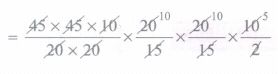
= 450
17.
Volume of a cylinder \(=\pi { r }^{ 2 }h\)
Volume of a cone \(=\frac { 1 }{ 3 } \pi { r }^{ 2 }h\)
Volume of a sphere \(=\frac { 4 }{ 3 } \pi { r }^{ 3 }\)
Their ratio V1 : V2 : V3
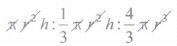
\(h:\frac { h }{ 3 } :\frac { 4r }{ 3 } \)
3h: h: 4r
3h : h : 2(2r) (where 2r = h)
∴ V1 : V2 : V3 = 3: 1 : 2
18.
CV =\(\frac { \sigma }{ \bar { x } } \) x 100 ⇒ \(\bar { x } =\frac { \sigma }{ CV } \) x 100
\(\bar { x } =\frac { 15.6 }{ 6.9 } \) x 100 = 22.6
19.
Mean \(\bar { x } \) = \(\frac { 16+13+17+21+18 }{ 5 } =\frac { 85 }{ 5 } \) = 17
| x | d = x - 17 | d2 |
| 16 | -1 | 1 |
| 13 | -4 | 16 |
| 17 | 0 | 0 |
| 21 | 4 | 16 |
| 18 | 1 | 1 |
| Σd = 0 | Σd2 = 34 |
σ =\(\sqrt { \frac { \Sigma d^{ 2 } }{ n } } =\sqrt { \frac { 34 }{ 5 } } =\sqrt { 638 } \)
σ = 2.61
Co-efficient of variation
CV = \(\frac { \sigma }{ \bar { x } } \) x 100 = \(\frac { 2.61 }{ 17 } \) x 100
= 15.35%
20.
Σ(x -10)2 = 79 = Σx2- 20x + 100 = 79
= Σx2- 20Σx + 100 x 9 = 79
= Σx2- 20 x 99 + 900 = 79
Σx2 = 79 + 1980 - 900 = 1159
Σ(x - \(\bar { x } \))2 = Σ(x - 11)2 = Σ(x2 - 22x + 121)
= Σx2 - 22Σx + 121 x 9
= 1159 - 22 x 99 + 1089 = 70
∴ Σx2 = 1159, Σ(x - \(\bar { x } \))2 = 70
21.
Let the tens digits be x. Then the uints digits=\(\frac{18}{x}\)
∴ Number =10x+\(\frac{18}{x}\)
and number obtained by interchanging the digits =10x+\(\frac{18}{x}\)
\(\\ \therefore \left( 10x+\frac { 18 }{ x } \right) -\left( 10\times \frac { 18 }{ x } +x \right) =63\)
\(\Rightarrow 10x+\frac { 18 }{ x } -\frac { 180 }{ x } -x=0\)
\(\Rightarrow 9x-\frac { 162 }{ x } -63=0\)
⇒ 9x2-63x-162=0
⇒ x2-7x-18=0
⇒ (x-9)(x+2)=0⇒ x=9,-2
But a digit can never be (-ve), so x = 9.
So, the required number \(=10\times 9+\frac { 18 }{ 9 } =92\)
22.
Let a natural number be x.
The next number = x + 1
x (x + 1) = 20
X2+x-20 = 0
(x + 5)(x - 4) = 0
x=-5,4
∴ x=4
(∵ x≠-5, x is a natural number
The next number = 4 + 1= 5
Two consecutive numbers are 4,5.
23.
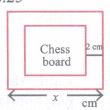
Let the length of the side of the chess board be x cm. Then
Area of 64 squares = (x - 4)2
(x - 4)2 = 64 x 6.25
⇒ x2-8x+ 16=400
⇒X2- 8x - 384 =0
⇒ X2- 24x + 16x - 384 = 0
⇒(x - 24)(x + 16) = 0
⇒ x=24 cm.
24.
Seven years ago, let Swathi's age be x years .
Seven years ago, let Varun's age was 5x2 years.
Swathi's present age = x + 7 years
Varun's present age = (5x2 + 7) years
3 years hence, we have
Swathi's age = x + 7 + 3 years
=x + 10 years
Varun's age = 5x2 + 7 + 3 years
= 5x2 + 10 years
It is given that 3 years hence Swathi's age will
be \(\frac{2}{5}\) of Varun's age.
∴ x+10=\(\frac{2}{5}\)(5x2+10)
⇒ x+10=2x2+4
⇒ 2x2-x-6=0
⇒ 2x(x-2)+3(x-2)=0
⇒(2x+3)(x-2)=0
⇒ x-2=0
⇒ x=2(∵2x+3≠0 as x>0)
Hence Swathi's present age = (2 + 7) years
= 9 years
Varun's present age = (5 x 22 + 7) years
= 27 years
25.
Let the numbers be ∝, β
Sum of the roots = ∝ + β = 15 ...(1)
\(\frac { 1 }{ \alpha } +\frac { 1 }{ \beta } =\frac { 3 }{ 10 } \quad \quad \quad ...(2)\)
\(\\ \frac { +\alpha }{ \alpha \beta } =\frac { 3 }{ 10 } \)
10(∝+ β)= 3∝β ....(3)
30∝β=10x15=150
Products of the roots =∝β=50 ....(4)
∴ From (1) & (4), we have
x2-15x+50=0
(x-10)(x-5)=0⇒x=10,5
26.
an = 3 +2n
a1 = 3 + 2 = 5
a2 = 3 + 2 x 2 = 7
a3 = 3 + 2 x 3 = 9
List of numbers becomes 5, 7, 9, 11,.........
Here, 7 - 5 = 9 - 7 = 11 - 9 = 2 and so on. So, it forms an A.P. with common difference d = 2.
To find S24 we have n = 24, a = 5, d = 2.
S24 = \(\frac{24}{2}\) [2 x 5 + (24 - 1) x ]
= 12 [10 + 46] = 672.
So, sum of first 24 terms of the list of numbers is 672.
27.
Here a = 24, d = 21-24 = -3, Sn = 78. We need to find n.
We know that,
Sn= \(\frac{n}{2}\) (2a + (n - 1)d)
78 = \(\frac{n}{2}\) 48 + (n -1)(-3))
78 = \(\frac{n}{2}\) 2(51-3n)
or 3n2 - 51n + 156 = 0
n2 -17n + 52 = 0
(n - 4)(n - 13) = 0
n = 4 or 13
The number of terms are 4 or 13.
28.
Here S14 = 1050
n = 14
a = 10
Sn = \(\frac{n}{2}\) 2(2a + (n -1)d)
1050 = \(\frac{14}{2}\)(20 + 13d)
= 140 + 91d
910 = 91d
d = 10
a20 = 10 + (20 - 1) x 10
= 20
∴ 20th term = 200.
29.
We have
a3 = a + (3 - 1)d = a + 2d = 5 (1)
a7 = a + (7 - 1)d = a + 6d = 9 (2)
(1) - (2) ⇒ -4d -4 ⇒ d = 1.
Sub, d = 1 in (1), we get
a + 2(1) = 5
a = 3
Hence the required A.P. is 3, 4, 5, 6, 7.
30.
R = {(a, -2), (-5, b), (8, c), (d, -1)} represents the identity function.
a = -2, b = -5, c = 8, d = -1.
31.
F(5) = 3x2 - 10
= 3(5)2- 10 = 75 - 10 = 65
32.
Since the given points are collinear, the area a the triangle formed by them must be 0, i.e.,
= \(\frac { 1 }{ 2 } \) [2(k + 3) + 4(-3 - 3) + 6(3 - k)] = 0
= \(\frac { 1 }{ 2 } \) [-4k] = 0
k = 0
Area of ΔABC
= \(\frac { 1 }{ 2 } \)[2(0 + 3) + 4(-3 - 3) + 6(3 - 0)] = 0
33.
We have Area of the quadrilateral
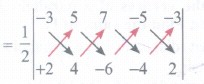
=\(\frac { 1 }{ 2 } \) [(-12 - 30 - 28 -10) - (+ 10 + 28 + 30 + 12)]
\(\frac { 1 }{ 2 } \) [-80 - (80)]
\(\frac { 1 }{ 2 } \)[-160] = -80 = 80 square units.
(∵ Area is always +ve).
34.
f(x) = 1 + x
g(x) = (2x - 1)
fog(x) = f(g(x) = f(2x - 1)
= 1 + 2x - 1 = 2x ...(1)
gof(x) = g(f(x) = g(1 + x) = 2(1 + x) - 1
= 2 + 2x - 1
= 2x + 1 ...(2)
(1) \(\neq \)(2)
\(\therefore\) fog(x) \(\neq \) gof(x)
It is verified
35.
f(-7) = x2 + 2x + 1
= (-7)2 + 2(-7) + 1
= 49 - 14 + 1 = 36
f(3) = x + 5 = -3 + 5 = 2
f(-7) - f(-3) = 36 + 2 = 38
36.
2f(-4) + 3f(2)
f(-4) = x + 5 = -4 + 5 = 1
2f(-4) = 2 x 1 = 2
f(2) = x + 5 = 2 + 5 = 7
3f(2) = 3(7) = 21
∴ 2f(-4) + 3f(2) = 2 + 21 = 23
37.
4, 10, 16,22, ...
We have a2 - a2 = 10 - 4 = 6
a3 - a2 = 16 -10 = 6
ஃ It is an A.P. with common difference 6
ஃ The next two terms are, 
38.
The area of the triangle formed by the vertices A(1, -1), B(-4, 6) and C(-3, -5), by using the formula above, is given by
= \(\frac { 1 }{ 2 } \)[1(6 + 5) +(-4) (-5 + 1) + (-3)(-1 - 6)]
= \(\frac { 1 }{ 2 } \)[11 + 16 + 21] = 24 square units.
39.
We know that diagonals at a parallelogram bisect each other.
So, the coordinates of the mid-point at AC = coordinates of the mid-point at BD.
i.e., \(\left[ \frac { 6+9 }{ 2 } ,\frac { 1+4 }{ 2 } \right] =\left[ \frac { 8+P }{ 2 } ,\frac { 2+3 }{ 2 } \right] \)
\(\left[ \frac { 15 }{ 2 } ,\frac { 5 }{ 2 } \right] =\left[ \frac { 8+P }{ 2 } ,\frac { 5 }{ 2 } \right] \)
\(\frac { 15 }{ 2 } =\frac { 8+P }{ 2 } \)
P = 7
40.
Let P and Q be the points of trisection at AB.
i.e., AP = PQ = QB
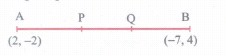
Therefore, P divides AB internally in the ratio 1:2. Therefore, the coordinates at P, by applying the section formula, are
\(\left[ \frac { 1(-7)+2(2) }{ 1+2 } ,\frac { 1(7)+2(-2) }{ 1+2 } \right] \) i.e., (-1,10)
Now, Q also divides AB internally in the ratio 2:1, so, the coordinates at Q are
\(\left[ \frac { 2(-7)+1(2) }{ 2+1 } ,\frac { 2(4)+(-2) }{ 2+1 } \right] \) i.e., (-4,2)
Therefore, the coordinates at the points at trisection of the line segment joining A and B are (-1, 0) and (-4, 2).

10th Standard Syllabus & Materials
10th Standard
TN 10th English Prose - 2 - The Night the Ghost Got in Important Questions And Answers Study Material - QB365 Set A
NEW10th Standard
TN 10th English Supplementary - 1 - The Tempest Important Questions And Answers Study Material - QB365 Set A
NEW10th Standard
TN 10th English Poem - 1 - Life Important Questions And Answers Study Material - QB365 Set A
NEW10th Standard
TN 10th English Prose - 1 - His First Flight Important Questions And Answers Study Material - QB365 Set A



Tamilnadu Stateboard 10th Standard Subjects
Tamilnadu Stateboard Standards





