
 100% FREE ACCESS
10th Standard Syllabus & Materials
10th Standard
TN 10th English Prose - 4 - The Attic Important Questions And Answers Study Material - QB365 Set A
NEW10th Standard
TN 10th English Supplementary - 3 - The Story of Mulan Important Questions And Answers Study Material - QB365 Set A
NEW10th Standard
TN 10th English Poem - 3 - I am Every Woman Important Questions And Answers Study Material - QB365 Set A
NEW10th Standard
TN 10th English Prose - 3 - Empowered Women Navigating The World Important Questions And Answers Study Material - QB365 Set A
NEW10th Standard
TN 10th English Supplementary - 2 - Zigzag Important Questions And Answers Study Material - QB365 Set A
NEW10th Standard
TN 10th English Poem - 2 - The Grumble Family Important Questions And Answers Study Material - QB365 Set A

Published on: 09/05/2020
10th Standard Maths English Medium Important 8 Marks Questions
Download Tamil Nadu 10th Standard Maths question papers, model tests, one-mark questions, important questions, and public exam papers in PDF format. Free study materials and answer keys for TN State Board students.
Questions + Answers key
Take MCQ Maths Test1.
Graph the following quadratic equations and state their nature of solutions.
(2x - 3)(x + 2) = 0
2.
Graph the following quadratic equations and state their nature of solutions.
x2 - 9 = 0
3.
Graph the following quadratic equations and state their nature of solutions.
x2 + x + 7 = 0
4.
Graph the following quadratic equations and state their nature of solutions.
x2 - 4x + 4 = 0
5.
Draw the graph of y = (x - 1) (x + 3) and hence solve x2 - x - 6 = 0
6.
Draw the graph of y = 2x2 - 3x - 5 and hence solve 2x2 - 4x - 6 = 0
7.
Draw the graph of y = x2 - 4 and hence solve x2 + 1 = 0
8.
Draw the graph of y = x2 - 4 and hence solve x2 - x - 12 = 0
9.
Graph the following quadratic equations and state their nature of solutions x2 - 9x + 20 = 0.
10.
Draw the graph of y = x2 + 4x + 3 and hence find the roots of x2 + x + 1 = 0
11.
Draw a tangent to the circle from the point P having radius 3.6 cm, and centre at O. Point P is at a distance 7.2 cm from the centre.
12.
Draw the two tangents from a point which is 5 cm away from the centre of a circle of diameter 6 cm. Also, measure the lengths of the tangents
13.
Draw a circle of radius 4.5 cm. Take a point on the circle. Draw the tangent at that point using the alternate segment theorem.
14.
Draw a circle of diameter 6 cm from a point P, which is 8 cm away from its centre. Draw the two tangents PA and PB to the circle and measure their lengths.
15.
Draw a circle of radius 3 cm. Take a point P on this circle and draw a tangent at P.
16.
Draw a triangle ABC of base BC = 5.6 cm, \(\angle\)A = 40o and the bisector of \(\angle\)A meets BC at D such that CD = 4 cm.
17.
Construct a \(\triangle\)PQR in which QR = 5 cm, \(\angle\)P = 40o and the median PG from P to QR is 4.4 cm. Find the length of the altitude from P to QR.
18.
Construct a △PQR which the base PQ = 4.5 cm, ∠R = 35oand the median RG from R to PG is 6 cm
1.
(2x-3)(x+2)=0
2x2 - 3x + 4x - 6 = 0
2x2 + 1x-6 = 0
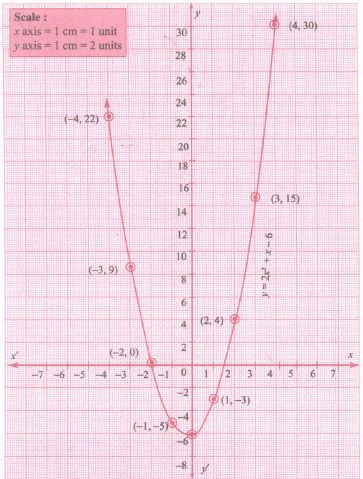
Let y = 2x2 +X - 6= 0
| x | -4 | -3 | -2 | -1 | 0 | 1 | 2 | 3 | 4 |
| x2 | 16 | 9 | 4 | 1 | 0 | 1 | 4 | 9 | 16 |
| 2x2 | 32 | 18 | 8 | 2 | 0 | 2 | 8 | 18 | 32 |
| x | -4 | -3 | -2 | -1 | 0 | 1 | 2 | 3 | 4 |
| -6 | -6 | -6 | -6 | -6 | -6 | -6 | -6 | -6 | -6 |
| y=x2-x-6 | 22 | 9 | 0 | -5 | -6 | -3 | -4 | 15 | 30 |
Step 2:
The points to be plotted: (-4,22), (-3, 9), (-2, 0), (-1, -5), (0, -6), (1, -3), (2,4), (3,15), (4, 30)
Step 3:
Draw. the parabola and mark the co-ordinates of the intersecting point of the parabola with the x-axis.
Step 4:
The points of intersection of the parabola with the x-axis are (-2, 0) and (1.5,0).
Since the parabola intersects the x-axis at two points, the equation has real and unequal roots
∴ Solution {-2, 1.5}
2.
x2-9=0
Let y=x2-9
Step 1:
| x | -4 | -3 | -2 | -1 | 0 | 1 | 2 | 3 | 4 |
| x2 | 16 | 9 | 4 | 1 | 0 | 1 | 4 | 9 | 16 |
| -9 | -9 | -9 | -9 | -9 | -9 | -9 | -9 | -9 | -9 |
| y=x2-7 | 7 | 0 | -5 | -8 | -9 | -8 | -5 | 0 | 7 |
Step 2:
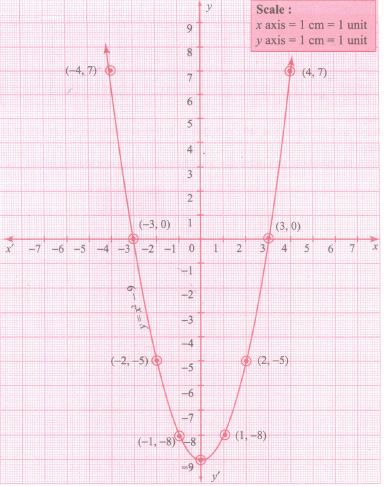
The points to be plotted: (-4,7), (-3, 0), (-2, -5), (-1, -8), (0, -9), (1, -8), (2, -5), (3, 0), (4, 7)
(v) Real and equal roots
Step 3:
Draw the parabola and mark the co-ordinates of the parabola which intersect the x-axis.
Step 4:
The roots of the equation are the co-ordinates of the intersecting points (-3, 0) and (3, 0) of the parabola with the x-axis which are -3 and 3 respectively.
Step 5:
Since there are two points of intersection with the x axis, the quadratic equation has real and unequal roots.
∴ Solution{-3, 3}
3.
x2 + x + 7 = 0
Let y=x2+x+7
Step 1:
| x | -4 | -3 | -2 | -1 | 0 | 1 | 2 | 3 | 4 |
| x2 | 16 | 9 | 4 | 1 | 0 | 1 | 4 | 9 | 16 |
| 7 | 7 | 7 | 7 | 7 | 7 | 7 | 7 | 7 | 7 |
| y=x2-x+7 | 19 | 13 | 9 | 7 | 7 | 9 | 13 | 19 | 27 |
Step 2:
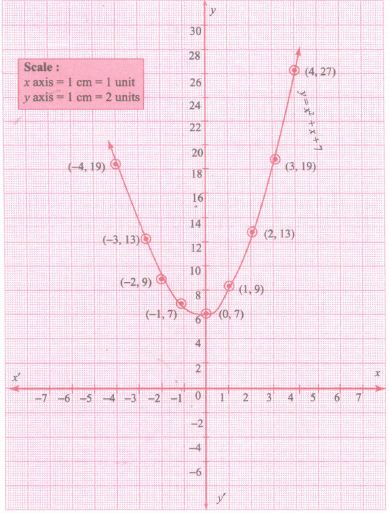
Points to be plotted: (-4, 19), (-3, 13), (-2, 9), (-1, 7), (0, 7), (1, 9), (2, 13), (3, 19), (4, 27)
Step 3:
Draw the parabola and mark the co-ordinates of the parabola which intersect with the x-axis.
Step 4:
The roots of the equation are the points of intersection of the parabola with the x axis. Here the parabola does not intersect the x axis at any point.
So, we conclude that there is no real roots for the given quadratic equation.
4.
x2 - 4x + 4 = 0
| x | -4 | -3 | -2 | -1 | 0 | 1 | 2 | 3 | 4 |
| x2 | 16 | 9 | 4 | 1 | 0 | 1 | 4 | 9 | 16 |
| -4x | 16 | 12 | 8 | 4 | 0 | -4 | -8 | -12 | -16 |
| 4 | 4 | 4 | 4 | 4 | 4 | 4 | 4 | 4 | 4 |
| y=x2-4x+4 | 36 | 25 | 16 | 9 | 4 | 1 | 0 | 1 | 4 |
Step 1: Points to be plotted: (-4,36), (-3, 25), (-2, 16), (-1, 9), (0, 4), (1, 1), (2, 0), (3, 1), (4,4)
Step 2: The point of intersection of the curve with x axis is (2, 0)
Step 3:
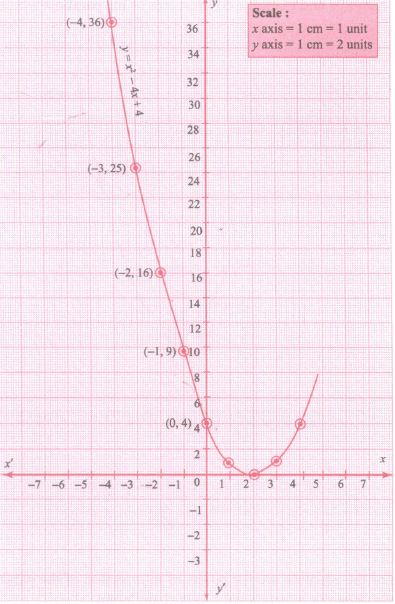
Since there is only one point of intersection with x axis, the quadratic equation X2 - 4x + 4 = 0 has real and equal roots.
∴ Solution{2,2}
5.
| x | -4 | -3 | -2 | -1 | 0 | 1 | 2 | 3 | 4 |
| x2 | 16 | 9 | 4 | 1 | 0 | 1 | 4 | 9 | 16 |
| 2x | -8 | -6 | -4 | -2 | 0 | 2 | 4 | 6 | 8 |
| -3 | -3 | -3 | -3 | -3 | -3 | -3 | -3 | -3 | -3 |
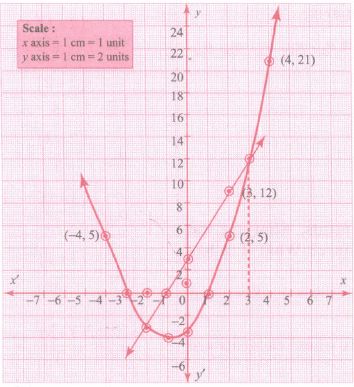
| y=x2+2x-3 | 5 | 0 | -3 | -4 | -3 | 0 | 5 | 12 | 21 |
Draw the parabola using the points (-4, 5), (-3, 0), (-2, -3), (-1, -4), (0, -3), (1, 0), (2, 5), (3,12), (4, 21)
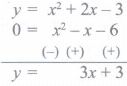 is a straight line
| x | -2 | -1 | 0 | 2 |
| 3x | -6 | -3 | 0 | 6 |
| 3 | 3 | 3 | 3 | 3 |
| y=3x+3 | -3 | 0 | 3 | 9 |
Plotting the points (-2, -3), (-1, 0), (0, 3), (2, 9), we get a straight line.
The points of intersection of the parabola with the straight line gives the roots of the equation. The coordinates of the points of intersection forms the solution set.
∴ Solution {-2, 3}
6.
| x | -4 | -3 | -2 | -1 | 0 | 1 | 2 | 3 | 4 |
| x2 | 16 | 9 | 4 | 1 | 0 | 1 | 4 | 9 | 16 |
| -2x2 | 32 | 18 | 8 | 2 | 0 | 2 | 8 | 18 | 32 |
| -3x | 12 | 9 | 6 | 3 | 0 | -3 | -6 | -9 | -12 |
| -5 | -5 | -5 | -5 | -5 | -5 | -5 | -5 | -5 | -5 |
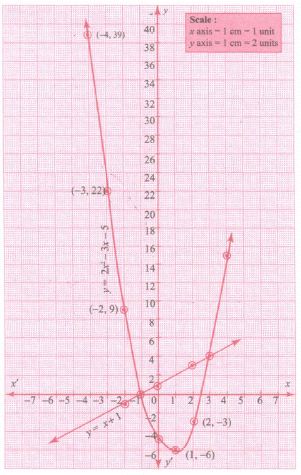
| y=x2-3x-5 | 39 | 22 | 9 | 0 | -5 | -6 | -3 | 4 | 15 |
Draw the parabola using the points (-4, 39), (-3, 22), (-2, 9), (-1, 10), (0, -5), (1, -6), (2, -3), (3, 4), (4, 15).
To solve 2x2- 4x - 6 = 0, subtract it from y = 2x2- 3x - 5
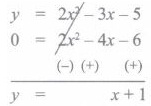 is a straight line
| x | -2 | 0 | 2 |
| 1 | 1 | 1 | 1 |
| y=x+1 | -1 | 1 | 3 |
Draw a straight line using the points (-2, -1), (0, 1), (2, 3). The points of intersection of the parabola and the straight line forms the roots of the equation.
The x-coordinates of the points of intersection forms the solution set.
∴ Solution {-1, 3}
7.
| x | -4 | -3 | -2 | -1 | 0 | 1 | 2 | 3 | 4 | 5 |
| x2 | 16 | 9 | 4 | 1 | 0 | 1 | 4 | 9 | 16 | 25 |
| +x | -4 | -3 | -2 | -1 | 0 | 1 | 2 | 3 | 4 | 5 |
| y=x2+x | 12 | 6 | 2 | 0 | 0 | 2 | 6 | 12 | 20 | 30 |
Draw the parabola by the plotting the points (-4, 12), (-3, 6), (-2, 2), (-1, 0), (0, 0), (1, 2), (2, 6), (3, 12), (4,20), (5, 30)
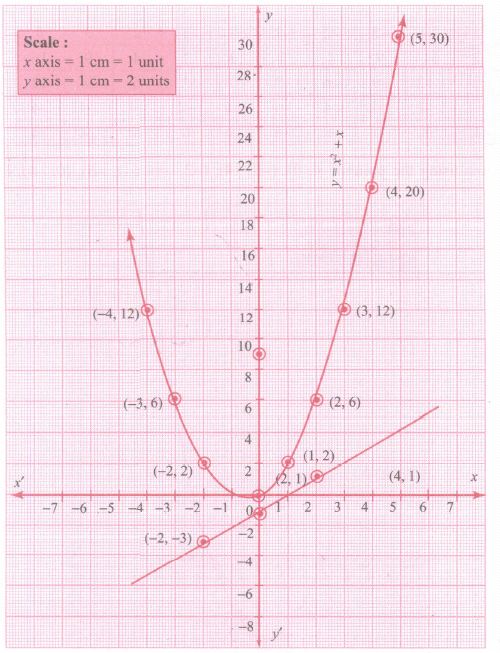
To solve: X2 + 1 = 0, subtract X2 + 1 = 0 from y = X2 + x.
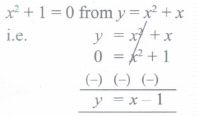
This is a straight line.
Draw the line y = x - 1.
| x | -2 | 0 | 2 |
| -1 | -1 | -1 | -1 |
| y | -3 | -1 | 1 |
Plotting the points (-2, -3), (0, -1), (2, 1) we get a straight line. This line does not intersect the parabola. Therefore there is no real roots for the equation X2 + 1 = 0.
8.
| x | -4 | -3 | -2 | -1 | 0 | 1 | 2 | 3 | 4 |
| x2 | 16 | 9 | 4 | 1 | 0 | 1 | 4 | 9 | 16 |
| -4 | -4 | -4 | -4 | -4 | -4 | -4 | -4 | -4 | -4 |
| x2-4 | 12 | 5 | 0 | -3 | -4 | -3 | 0 | 5 | 12 |
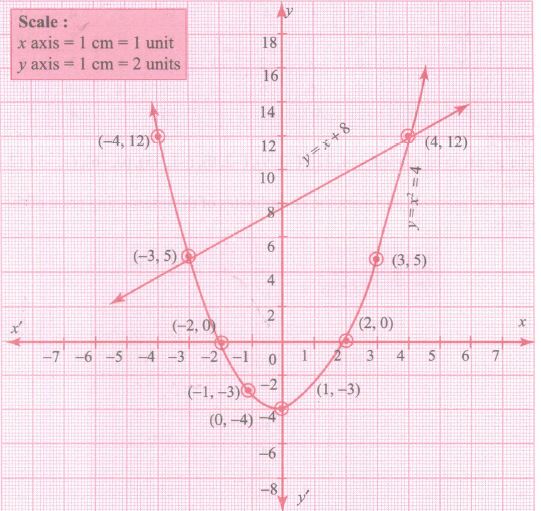
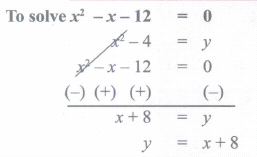
| x | -4 | -3 | -2 | -1 | 0 | 1 | 2 | 3 | 4 |
| 8 | 8 | 8 | 8 | 8 | 8 | 8 | 8 | 8 | 8 |
| x-8 | 4 | 5 | 6 | 7 | 8 | 9 | 10 | 11 | 12 |
Point of intersection (-3,5), (4, 12) solution of x2 -x - 12 = 0 is -3, 4
9.
x2 - 9x + 20 = 0
| x | -4 | -3 | -2 | -1 | 0 | 1 | 2 | 3 | 4 |
| x2 | 16 | 9 | 4 | 1 | 0 | 1 | 4 | 9 | 16 |
| -9x | +36 | 27 | 18 | 9 | 0 | -9 | -18 | -27 | -36 |
| 20 | 20 | 20 | 20 | 20 | 20 | 20 | 20 | 20 | 20 |
| 72 | 56 | 42 | 30 | 20 | 12 | 6 | 2 | 0 |
Step 1:
Points to be plotted: (-4, 72), (-3,56), (-2,42), (-1, 30), (0, 20), (1, 12), (2, 6), (3, 2), (4, 0)
Step 2:
The point of intersection of the curve with x axis is (4, 0)
Step 3:
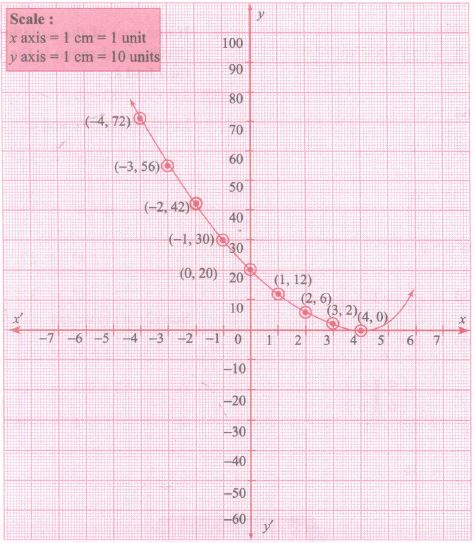
Since there is only one point of intersection with X axis, the quadratic equation x2 + 9x + 20 = 0 has real and equal roots.
∴ Solution {4,4}
10.
Step 1 : Draw the graph of y = x2 + 4x + 3 by preparing the table of values as below
| x | -4 | -3 | -2 | -1 | 0 | 1 | 2 |
| y | 3 | 0 | -1 | 0 | 3 | 8 | 15 |
Step 2 : To solve x2 + x + 1 = 0, subtract x2 + x + 1 = 0 from y = x2 + 4x + 3 that is,
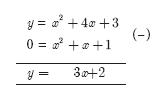
The equation represent a straight line. Draw the graph of y = 3x + 2 forming the table of values as below
| x | -2 | -1 | 0 | 1 | 2 |
| y | -4 | -1 | 2 | 5 | 3 |
Step 3 : Observe that the graph of y = 3x + 2 does not intersect or touch the graph of the parabola y = x2 + 4x + 3.
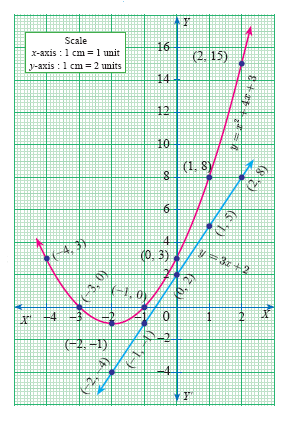
Thus x2 + x + 1 = 0 has no real roots.
11.
Given radius r = 3.6 cm
Length of the tangents PA = PB = 6.2cm
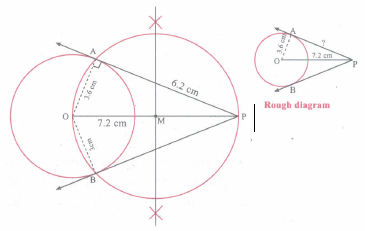
Construction:
Steps
(1) with centre at o, drawn a circle of radius 3.6 cm.
(2) Draw a line OP = 7.2 cm,
(3) Draw a perpendicular bisector of OP, which cuts OP at M.
(4) With M as centre and MO as radius, draw a circle which cuts previous circle at A and B.
(5) Join AP and BP. AP and BP are the required tangents. Thus length of the tangents are PA = PB = 6.2 cm.
12.
Diameter = 6 cm
Radius =\(\frac { 6 }{ 2 } =3cm\)
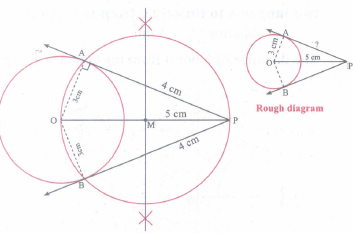
Length of the tangents PA = PB = 4 cm
Construction:
Steps:
(1) With centre O, draw a circle of radius 3cm.
(2) Draw a line OP = 5 cm
(3) Draw a bisector of OP, which cuts OP and M
(4) With M as centre and MO as radius draw a circle which cuts previous circle at A and B
(5) Join AP and BP. AP and BP are the required tangents. Thus length of the tangents are PA = PB = 4 cm.
13.
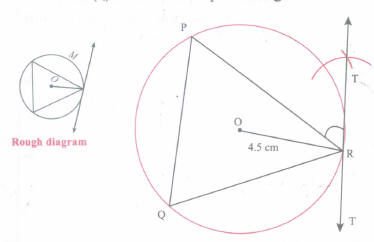
Construction:
(1) With O as the centre, draw a circle of radius 4.5 cm.
(2) Taken a point L on the circle through L drawn as chord LM
(3) Taken a point M distinct from L and N on the circle so that L, M, N are anti-clock wise direction. Joined LN and NM.
(4) Through 'L' drawn a tangent TT' such that \(\angle T L M=\angle M N L\)
(5) TT' is the required tangent.
14.
Given, diameter (d) = 6 cm, we find radius \((r)=\cfrac { 6 }{ 2 } =3cm\)
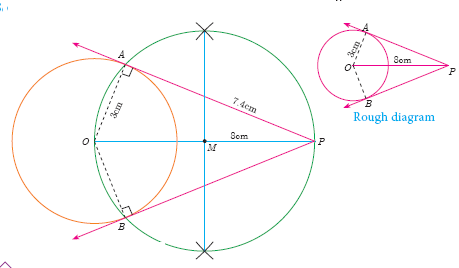
Construction
Step 1: With centre at O, draw a circle of radius 3 cm.
Step 2: Draw a line OP of length 8 cm.
Step 3: Draw a perpendicular bisector of OP, which cuts OP at M.
Step 4: With M as centre and MO as radius, draw a circle which cuts previous circle at A and B.
Step5: Join AP and BP. AP and BP are the required tangents. Thus length of the tangents are PA = PB = 7.4 cm.
Verification : In the right angle triangle OAP,PA2 = OP2 - OA2 = 64 -9 = 55
\(PA=\sqrt { 55= } 7.4\ cm\) (approximately) .
15.
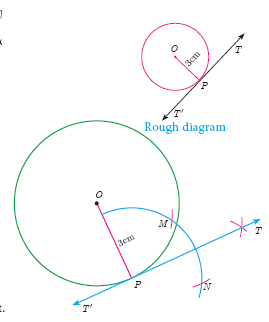
Given, radius r = 3 cm
Construction
Step 1: Draw a circle with centre at O of radius 3 cm.
Step 2: Take a point P on the circle. Join OP.
Step 3: Draw perpendicular line to OP which passes through P.
Step 4: TT' is the required tangent.
16.
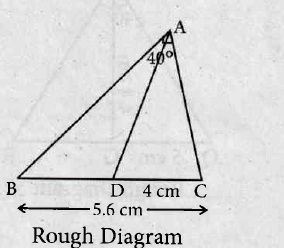
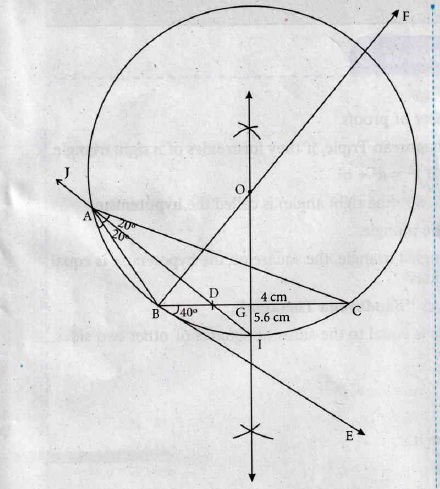
Construction:
Steps (1) Draw a line segment BC = 5.6 cm
Steps (2) At B, draw BE such that \(\angle CBE={ 60 }^{ 0 }\)
Steps (3) At B draw BF such that \(\angle EBF={ 90 }^{ 0 }\)
Steps (4) Drawn the perpendicular bisector to BC, which intersects BF at O and BC at G.
Steps (5) With O as centre and OB as radius draw a circle
Steps (6) From B, marked an arc of 4 cm on BC at D.
Steps (7) The perpendicular bisector intersects the circle at I. Joined ID.
Steps (8) ID produced meets the circle at A. Now joined AB and AC. Then \(\triangle\)ABC is the required triangle.
17.
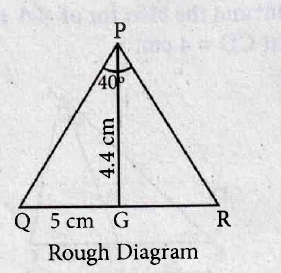
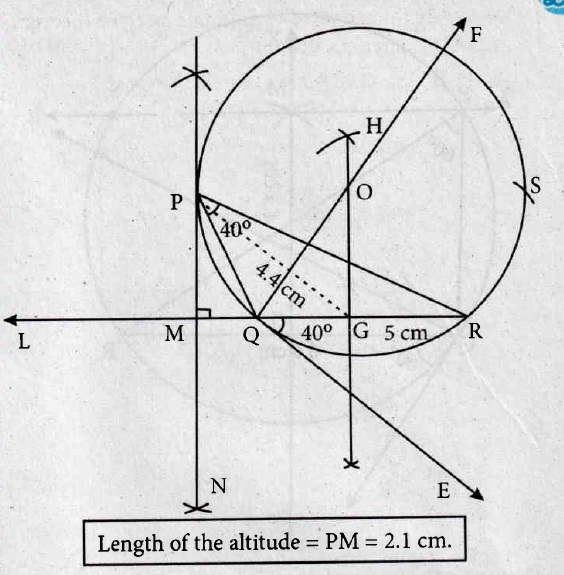
Construction:
Step (1) Draw a line segment QR = 5 cm.
Step (2) At Q, draw QE such that \(\angle RQE\) = 40°.
Step (3) At Q, draw QF such that \(\angle EQF\) = 90o
Step (4)Drawn a perpendicular bisector to QR, which intersects QF at 'O' and QR at G.
Step (5) With O as centre and OQ as radius, draw a circle
Step (6) From G marked arcs of radius 4.4 cm on the circle. Marked them as P and S.
Step (7) Joined QP and PR. Now \(\triangle\)PQR is the required triangle
Step (8) From P draw a line PN which is \(\bot \) to LR. LR meets PN at M.
Step (9) The length of the altitude is PM = 2.1cm
18.
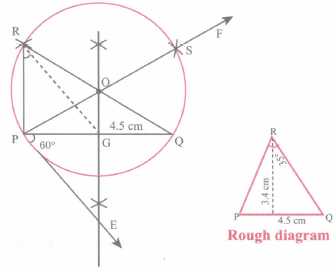
Construction:
Step (1) Draw a line segment PQ = 4.5 cm
Step (2) At P, draw PE such that \(\angle QPE={ 35 }^{ 0 }\)
Step (3) At P, draw PF such that \(\angle EPF={ 90 }^{ 0 }\)
Step (4) Draw \(\bot \) bisector to PQ which intersects PF at O.
Step (5) With O centre OP as radius draw a circle.
Step (6) From G, marked arcs of radius 6 cm on the circle marked them as R and S.
Step (7) Joined PR and RQ. Then \(\triangle\)PQR is the required triangle
Step (8) \(\triangle\)PQS is the required triangle

10th Standard Syllabus & Materials
10th Standard
TN 10th English Prose - 2 - The Night the Ghost Got in Important Questions And Answers Study Material - QB365 Set A
NEW10th Standard
TN 10th English Supplementary - 1 - The Tempest Important Questions And Answers Study Material - QB365 Set A
NEW10th Standard
TN 10th English Poem - 1 - Life Important Questions And Answers Study Material - QB365 Set A
NEW10th Standard
TN 10th English Prose - 1 - His First Flight Important Questions And Answers Study Material - QB365 Set A



Tamilnadu Stateboard 10th Standard Subjects
Tamilnadu Stateboard Standards





