
 100% FREE ACCESS
10th Standard Syllabus & Materials
10th Standard
TN 10th English Prose - 4 - The Attic Important Questions And Answers Study Material - QB365 Set A
NEW10th Standard
TN 10th English Supplementary - 3 - The Story of Mulan Important Questions And Answers Study Material - QB365 Set A
NEW10th Standard
TN 10th English Poem - 3 - I am Every Woman Important Questions And Answers Study Material - QB365 Set A
NEW10th Standard
TN 10th English Prose - 3 - Empowered Women Navigating The World Important Questions And Answers Study Material - QB365 Set A
NEW10th Standard
TN 10th English Supplementary - 2 - Zigzag Important Questions And Answers Study Material - QB365 Set A
NEW10th Standard
TN 10th English Poem - 2 - The Grumble Family Important Questions And Answers Study Material - QB365 Set A

Published on: 31/10/2022
QB365 provides a detailed and simple solution for every Possible Book Back Questions in Class 10 Maths Subject -Mensuration , English Medium. It will help Students to get more practice questions, Students can Practice these question papers in addition to score best marks.
Download Tamil Nadu 10th Standard Maths question papers, model tests, one-mark questions, important questions, and public exam papers in PDF format. Free study materials and answer keys for TN State Board students.
Questions + Answers key
Take MCQ Maths Test1.
Is it possible to obtain the volume of the full cone when the volume of the frustum is known?
2.
Give any two real life examples of sphere and hemisphere
3.
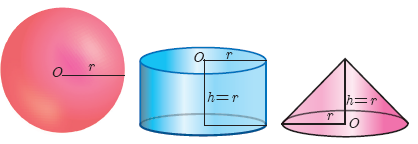
A cone, a hemisphere and a cylinder have equal bases. The heights of the cone and cylinder are equal and are same as the common radius. Are they equal in volume?
4.
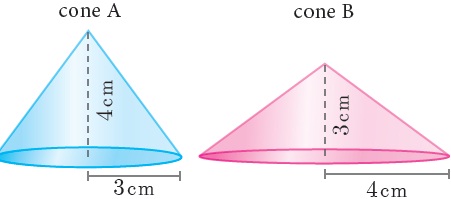
Consider the cones given in Fig
(i) Without doing any calculation, find out whose volume is greater?
(ii) Verify whether the cone with greater volume has greater surface area.
(iii) Volume of cone A : Volume of cone B = ?
5.
There are two cones with equal volumes. What will be the ratio of their radius and height?
6.
Is it possible to find a right circular cone with equal
(a) height and slant height
(b) radius and slant height
(c) height and radius.
7.
What happens to the volume of the cylinder with radius r and height h, when its
(a) radius is halved (b) height is halved
8.
If the height is inversely proportional to the square of its radius, the volume of the cylinder is ____________.
9.
Can a hemisphere be considered as a frustum of a sphere
10.
Give two real life examples for a frustum of a cone.
11.
How many hemispheres can be obtained from a given sphere?
12.
T.S.A of a hemisphere is equal to how many times the area of its base?
13.
Shall we get a hemisphere when a sphere is cut along the small circle?
14.
Find the surface area of the earth whose diameter is 12756 kms.
15.
How many great circles can a sphere have?
16.
Find the value of the radius of a sphere whose surface area is 36\(\pi\) sq. units
17.
When a sector of a circle is transformed to form a cone, then match the conversions taking place between the sector and the cone.
| Sector | Cone |
| Radius | Circumference of the base |
| Area | Slant height |
| Arc length | Curved surface area |
18.
Compare the above surface area with the area of the base of the cone
19.
Find surface area of a cone in terms of its radius when height is equal to radius
20.
Give practical example of solid cone.
21.
Two circular cylinders are formed by rolling two rectangular aluminum sheets each of dimensions 12 m length and 5 m breadth, one by rolling along its length and the other along its width. Find the ratio of their curved surface areas.
22.
When the radius of a cylinder is double its height, find the relation between its C.S.A. and base area.
23.
When ‘h’ coins each of radius ‘r’ units and thickness 1 unit is stacked one upon the other, what would be the solid object you get ? Also find its C.S.A.
24.
Find the maximum volume of a cone that can be carved out of a solid hemisphere of radius r units.
25.
A hemi-spherical tank of radius 1.75 m is full of water. It is connected with a pipe which empties the tank at the rate of 7 litre per second. How much time will it take to empty the tank completely?
26.
The barrel of a fountain-pen cylindrical in shape, is 7 cm long and 5 mm in diameter. A full barrel of ink in the pen will be used for writing 330 words on an average. How many words can be written using a bottle of ink containing one fifth of a litre?
27.
A conical flask is full of water. The flask has base radius r units and height h units, the water poured into a cylindrical flask of base radius xr units. Find the height of water in the cylindrical flask.
28.
Water is flowing at the rate of 15 km per hour through a pipe of diameter 14 cm into a rectangular tank which is 50 m long and 44 m wide. Find the time in which the level of water in the tanks will rise by 21 cm.
29.
30.
If the circumference of a conical wooden piece is 484 cm then find its volume when its height is 105 cm.
31.
A 14 m deep well with inner diameter 10 m is dug and the earth taken out is evenly spread all around the well to form an embankment of width 5 m. Find the height of the embankment.
32.
The ratio of the volumes of two cones is 2 : 3. Find the ratio of their radii if the height of second cone is double the height of the first.
33.
The volume of a solid right circular cone is 11088 cm3. If its height is 24 cm then find the radius of the cone.
34.
Find the volume of a cylinder whose height is 2 m and whose base area is 250 m2.
35.
The radius of a sphere increases by 25%. Find the percentage increase in its surface area.
36.
The ratio of the radii of two right circular cones of same height is 1 : 3. Find the ratio of their curved surface area when the height of each cone is 3 times the radius of the smaller cone.
37.
4 persons live in a conical tent whose slant height is 19 cm. If each person require 22 cm2 of the floor area, then find the height of the tent.
38.
The external radius and the length of a hollow wooden log are 16 cm and 13 cm respectively. If its thickness is 4 cm then find its T.S.A.
39.
40.
A sphere, a cylinder and a cone are of the same radius, where as cone and cylinder are of same height. Find the ratio of their curved surface areas.
41.
If the base area of a hemispherical solid is 1386 sq. metres, then find its total surface area?
42.
The radius of a spherical balloon increases from 12 cm to 16 cm as air being pumped into it. Find the ratio of the surface area of the balloons in the two cases.
43.
Find the diameter of a sphere whose surface area is 154 m2.
44.
If the total surface area of a cone of radius 7cm is 704 cm2, then find its slant height.
45.
The radius of a conical tent is 7 m and the height is 24 m. Calculate the length of the canvas used to make the tent if the width of the rectangular canvas is 4 m?
46.
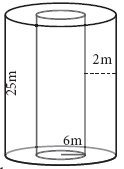
If one litre of paint covers 10 m2, how many litres of paint is required to paint the internal and external surface areas of a cylindrical tunnel whose thickness is 2 m, internal radius is 6 m and height is 25 m.
47.
A garden roller whose length is 3 m long and whose diameter is 2.8 m is rolled to level a garden. How much area will it cover in 8 revolutions?
48.
The curved surface area of a right circular cylinder of height 14 cm is 88 cm2 . Find the diameter of the cylinder.
49.
A cylindrical drum has a height of 20 cm and base radius of 14 cm. Find its curved surface area and the total surface area.
1.
Not possible
2.
Sphere - Globe, Ball
Hemisphere - Left side of the brain
3.
No
4.
(i) Volume of cone B is greater as the radius is greater
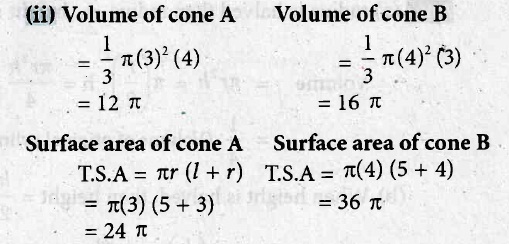
(iii) Surface area of cone B > Surface area of cone A
\(\frac{\text { Volume of cone } A}{\text { Volume of cone B }}=\frac{12 \pi}{16 \pi}=3: 4\)
5.
Ratios of radii and heights are same
6.
(i) height = Slant height
i.e., h = l = cone is not possible
(b) r = l = cone is not possible
(c) h = r = cone is possible.
7.
(a) radius is halved then radius \(\frac{r}{2}\) height is h
\(
\text { Volume } =\pi r^{2} h=\pi\left(\frac{r}{2}\right)^{2} \mathrm{~h}=\frac{\pi r^{2} h}{4}
\)
\(=\frac{1}{4} \text { (Volume of original cylinder). }
\)
(b) When height is halved., then height = \(\frac{h}{2}\)
\(
\text { Volume } =\pi r^{2}\left(\frac{h}{2}\right)=\frac{\pi r^{2} h}{2}
\)
\(=\frac{1}{2} \text { (Volume of original cylinder). }\)
8.
\(
\text { Height } \alpha \frac{1}{(\text { radius })^{2}}
\)
\(\text { Height } =k\left(\frac{1}{(\text { radius })^{2}}\right)[\because k \text { - constant }]
\)
\(\text { Volume } =\pi r^{2} h
\)
\(=\pi r^{2}\left(\frac{k}{r^{2}}\right)=k \pi\)
9.
No
10.
Bucket, Table lamp.
11.
2 hemispheres
12.
3 times.
13.
No, it is not possible to get the hemisphere, when a sphere is cut along the small circle.
14.
Diameter of earth = 12756 kms
Radius \(r=\frac{12756}{2}=6378 \mathrm{kms}\)
Surface Area \(
=4 \pi r^{2}=4 \times \frac{22}{7} \times(6378)^{2}
\)
\(=\frac{3579741792}{7}\)
= 511391584.571 sq. km
15.
Two circles
16.
surface area = 36 \(\pi\)
\(4 \pi r^{2}=36 \pi \Rightarrow r^{2}=9 \Rightarrow r=3\)
17.
| Sector | Cone |
| Radius | Slant height |
| Area | Curved surface area |
| Arc length | Circumference of the base |
18.
Area of base of cone = \(\pi\)r2
Surface area of the cone obtained in (5)
\(=(\sqrt{2}+1) \pi r^{2}=(\sqrt{2}+1) \text { times more }\)
19.
h = r,
\(
l =\sqrt{h^{2}+r^{2}}=\sqrt{r^{2}+r^{2}}=\sqrt{2} r
\)
\(\text { Surface Area } =\pi r(l+r)
\)
\(=\pi r(\sqrt{2} r+r)
\)
\(=\pi r^{2}(\sqrt{2}+1)
\)
20.
Ice cream Cone
21.
\(\left.\begin{array}{l} \text { ratio of curved } \\ \text { surface areas } \end{array}\right\}=\frac{2 \pi r(12)}{2 \pi r(5)}=\frac{12}{5}=12: 5\)
22.
Radius is double the height r = 2h
\( \text { C.S.A }=4 \pi h^{2} \text { as } 2 \pi(2 \mathrm{~h}) \mathrm{h} \)
\(\text{ Base area} =4 \pi h^{2}\ as \ \pi(2 h)^{2}\)
C.S.A = Base area
23.
The solid is a cylinder
radius = r
height = h x 1 = h
C.S.A = 2\(\pi\)rh sq. units
24.
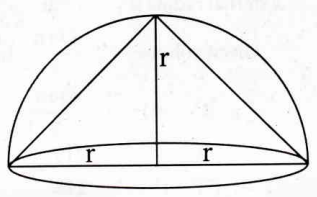
Radius of hemisphere = r units
Radius of cone = Radius of hemisphere
Height of cone = Radius of hemisphere
Maximum volume of cone = \(\frac{1}{3} \pi r^{2} h \text { cu. units }\)
\(=\frac{1}{3} \pi\left(r^{2}\right) r=\frac{1}{3} \pi r^{3} \text { cu. units }\)
25.
Radius of hemispherical tank 'r' = 1.75 m
Volume of hemispherical tank \(=\frac{2}{3} \pi r^{3} \text { cu. units }\)
\(=\frac{2}{3} \times \frac{22}{7} \times(1.75)^{3}\)
= 11.225 m3
= 11225 litre
Given that cylindrical pipe empties the tank at the rate of 7 litre per second.
Time Required to empty the tank completely
\(=\frac{\text { Volume }}{\text { Rate }}
\)
\(=\frac{11225}{7}=1604 \sec (\mathrm{app})
\)
= 27 min (app)
26.
Height of the barrel = h = 7 cm
Diameter = 5 mm
radius r = \(\frac{5}{2}=2.5 \mathrm{~mm}=0.25 \mathrm{~cm}\)
Volume of cylindrical barrel = \(\pi r^{2} h\)
\(=\frac{22}{7} \times 0.25 \times 0.25 \times 7\)
= 1.375 cm2
Given 1.375 cm3 of ink is used for writing 330 words
Number of words that can be written with one - fifth of a litre
\({\left[\because 1000 \mathrm{~cm}^{3}=1 \mathrm{ltr} ; \frac{1}{5} \times 1000 \mathrm{~cm}^{3} ; 200 \mathrm{~cm}^{3}\right]}
\)
\(=\frac{330}{1.375} \times 200=48000 \text { words }
\)
27.
Radius of conical flask = 'r' units
Height of conical flask = 'h' units
Volume of conical flask = Volume of water
\(=\frac{1}{3} \pi r^{2} h \text { cu. units }\)
Since, water is poured into the cylindrical flask
Volume of cylinder = Volume of water
\(\pi(\mathrm{xr})^{2} H=\frac{1}{3} \pi r^{2} h\)
[xr - radius of cylinder, H - height]
\(\mathrm{X}^{2} \mathrm{r}^{2} \mathrm{H}=\frac{r^{2}}{3} h\)
Height of the water in cylinder flask
\(\mathrm{H}=\frac{h}{3 x^{2}}\)
28.
Diameter of cylindrical pipe = 14 cm
Radius = 7 cm
Length of the pipe = Speed of the water
= 15 km = 15000 m
Length of the water tank = 50 m
Width of the water tank = 44 m
Height of the water tank = Water level
= 21 cm
= 0.21 cm
volume of water tank = l x b x h cu. units
= 50 x 44 x 0.21 = 462 m3
Volume of cylindrical Pipe = Volume of Rectangular tank
\(\frac{\pi r^{2} h}{} h =462
\)
\(\frac{22}{7} \times 0.07 \times 0.07 \times h =462
\)
\(\mathrm{h} =\frac{462 \times 7}{22 \times 0.07 \times 0.07}
\)
\(=\frac{3234}{0.1078}=30000
\)
Time required \(=\frac{30000}{15000}=2 \text { hrs. }
\)
29.
30.
Given circumference = 484 cm
\(2 \pi r =484
\)
\(2 \times \frac{22}{7} \times r =484
\)
\(r =\frac{484 \times 7}{44}=77 \mathrm{~cm}
\)
height h = 105 cm
Volume of cone \(=\frac{1}{3} \pi r^{2} h \text { cu. units }
\)
\(=\frac{1}{3} \times \frac{22}{7} \times 77 \times 77 \times 105
\)
= 652190 cm3
31.
Radius of well = 5 m
Depth of well = 14 m
Volume of earth taken out \(=\pi r^{2} h \)
\(=\frac{22}{7} \times(5)^{2} \times 14 \)
= 1100 m3
Now, it is spread to form an embankment, which is in the form of hollow cylinder
Inner radius = 5m
Width of embankment = 5 m
Outer radius = 5 + 5 = 10 m
height = h
Volume of hollow cylinder = \(\pi h\left(\mathrm{R}^{2}-\mathrm{r}^{2}\right)\)
\(\therefore \pi h\left(\mathrm{R}^{2}-\mathrm{r}^{2}\right)=1100 \)
\(\frac{22}{7} \times h\left(10^{2}-5^{2}\right)=1100 \)
height of the embankment
\(h=\frac{1100 \times 7}{22 \times 75}=4.67 \mathrm{~m}\)
32.
Let r1 and h1 be the radius and height of the cone - I and let r2 and h2 be the radius and height of the cone-II.
Given h2 = 2h1 = 2 and \(\frac { Volume\ of\ the\ cone\ I }{ Volume\ of\ the\ cone\ II } =\frac { 2 }{ 3 } \)
\(\frac { \frac { 1 }{ 3 } { \pi r }_{ 1 }^{ 2 }{ h }_{ 1 } }{ \frac { 1 }{ 3 } { \pi r }_{ 2 }^{ 2 }{ h }_{ 2 } } =\frac { 2 }{ 3 } \)
\(\frac { { r }_{ 1 }^{ 2 } }{ { r }_{ 2 }^{ 2 } } \times \frac { { h }_{ 1 } }{ 2{ h }_{ 2 } } =\frac { 2 }{ 3 } \)
\(\frac { { r }_{ 1 }^{ 2 } }{ { r }_{ 2 }^{ 2 } } =\frac { 4 }{ 3 } \text {gives} \frac { { r }_{ 1 } }{ { r }_{ 2 } } =\frac { 2 }{ \sqrt { 3 } } \)
Therefore, ratio of their radii = 2 : \(\sqrt3\)
33.
Let r and h be the radius and height of the cone respectively.
Given that, volume of the cone = 11088 cm3
\(\frac { 1 }{ 3 } { \pi r }^{ 2 }h=11088\)
\(\frac { 1 }{ 3 } \times \frac { 22 }{ 7 } \times { r }^{ 2 }\times 24=11088\)
\({ r }^{ 2 }=441\)
Therefore, radius of the cone r = 21 cm.
34.
Let r and h be the radius and height of the cylinder respectively.
Given that, height h = 2 m, base area = 250 m2
Now, volume of a cylinder = \(\pi\)r h 2 cu. units
= base area x h
= 250 x 2 = 500 m3
Therefore, volume of the cylinder = 500 m3
35.
Let the radius of the sphere be 'r' cm
Surface area = \(4 \pi r^{2}\)
when radius is increased by 25% ,then new diameter = r + 25% + r
\(=r+\frac{25 r}{100}=\frac{5 r}{4}\)
Surface area of new sphere
\(=4 \pi\left(\frac{5 r}{4}\right)^{2} \)
\(=4 \pi\left(\frac{25 r^{2}}{16}\right) \)
\(=\frac{25 \pi r^{2}}{4} \)
Increase in surface area = \(\frac{25 \pi r^{2}}{4}-4 \pi r^{2}\)
\(=\frac{25 \pi r^{2}-16 \pi r^{2}}{4} \)
\(=\frac{9 \pi r^{2}}{4} \)
Percentage increase in surface area
\(=\frac{9 \pi r^{2} / 4}{4 \pi r^{2}} \times 100 \% \)
\(=\frac{900}{16} \%=56.25 \% \)
36.
Let the radii of two cones be r1 and r2 and heights be h1 and h2
Given ratio of their radii = \(\frac{r_{1}}{r_{2}}=\frac{1}{3}\)
\(r_{1}=\frac{r_{2}}{3}
\)
\(h_{1}=3 r_{1}, h_{2}=3 r_{1}
\)
[ r1 is the radius of smaller cone]
Slant heights \(l_{1} =\sqrt{h_{1}^{2}+r_{1}^{2}}
\)
\(=\sqrt{9 r_{1}^{2}+r_{1}^{2}}=\sqrt{10} r_{1}
\)
\(l_{2} =\sqrt{h_{2}^{2}+r_{2}^{2}}
\)
\(=\sqrt{9 r_{1}^{2}+9 r_{1}^{2}}=\sqrt{18 r_{1}^{2}}=3 \sqrt{2} r_{1}\)
Ratio of curved surface areas
\(=\frac{\text { CSA of I cone }}{\text { CSA of II cone }}
\)
\(=\frac{\pi r_{1} l_{1}}{\pi r_{2} l_{2}} =\frac{r_{1}\left(\sqrt{10} r_{1}\right)}{\left(3 r_{1}\right)\left(3 \sqrt{2} r_{1}\right)}
\)
\(=\frac{\sqrt{10}}{9 \sqrt{2}}= \frac{\sqrt{5} \sqrt{2}}{9 \sqrt{2}}=\frac{\sqrt{5}}{9}
\)
Ratio of C.S.A = \(\sqrt{5}: 9\)
37.
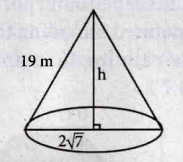
Each person requires 22 m2 of floor area.
Required base area = 22 x 4 = 88 m2
\(\pi r^{2} =88 \)
\(r^{2} =\frac{88 \times 7}{22}=4 \times 7 \)
\(r =2 \sqrt{7} \mathrm{~m} \)
slant height = 19 m
height of the tent, h \(=\sqrt{l^{2}-r^{2}}\)
\(=\sqrt{(191)^{2}-(2 \sqrt{7})^{2}} \)
\(=\sqrt{361-28} =\sqrt{330}=18.25 \mathrm{~m} \)
Height of the tent = 18.25 m
38.
External radius of hollow cylinder R = 16 cm
length h = 13 cm
Thickness R - r = 4
16 - r = 4
r = 12 cm
Total surface area of hollow cylinder \(=2 \pi(\mathrm{R}+\mathrm{r})(\mathrm{R}-\mathrm{r}+\mathrm{h}) \text { sq. units }\)
\(=2 \times \frac{22}{7} \times(16+12)(4+13) \)
\(=2 \times \frac{22}{7} \times 28 \times 17 \)
= 2992 sq. cm
39.
40.
Required Ratio = C.S.A. of the sphere: C.S.A. of the cylinder : C.S.A. of the cone
\(4\pi { r }^{ 2 }:2\pi rh:\pi rl,\ (l=\sqrt { { r }^{ 2 }+{ h }^{ 2 } } =\sqrt { { 2r }^{ 2 } } =\sqrt { 2r } units)\)
\(=4:2:\sqrt { 2 } =2\sqrt { 2 } :\sqrt { 2 } :1\).
41.
Let r be the radius of the hemisphere.
Given that, base area = \(\pi\)r2 = 1386 sq. m
T.S.A. = 3 \(\pi\)r2 sq.m
= 3 x 1386 = 4158
Therefore, T.S.A. of the hemispherical solid is 4158 m2.
42.
Let r1 and r2 be the radii of the balloons.
Given that, \(\frac { { r }_{ 1 } }{ { r }_{ 2 } } =\frac { 12 }{ 16 } =\frac { 3 }{ 4 } \)
Now, ratio of C.S.A. of balloons \(=\frac { 4\pi { r }_{ 1 }^{ 2 } }{ 4\pi { r }_{ 2 }^{ 2 } } =\frac { { r }_{ 1 }^{ 2 } }{ { r }_{ 2 }^{ 2 } } ={ \left( \frac { { r }_{ 1 } }{ { r }_{ 2 } } \right) }^{ 2 }={ \left( \frac { 3 }{ 4 } \right) }^{ 2 }=\frac { 9 }{ 16 } \)
Therefore, ratio of C.S.A. of balloons is 9:16.
43.
Let r be the radius of the sphere. Given that, surface area of sphere = 154 m2
4\(\pi\)r2 = 154
\(4\times \frac { 22 }{ 7 } \times { r }^{ 2 }=154\)
gives \({ r }^{ 2 }=154\times \frac { 1 }{ 4 } \times \frac { 7 }{ 22 } \)
hence, \({ r }^{ 2 }=\frac { 49 }{ 4 } \)We get r = \(\frac{7}{2}\)
Therefore, diameter is 7 m
44.
Given that, radius r = 7 cm
Now, total surface area of the cone = \(\pi\)r(l + r)sq. units
T.S.A = 704 cm2
704 = \(\frac{22}{7}\times7(l+7)\)
32 = l + 7 implies l = 25 cm
Therefore, slant height of the cone is 25 cm.
45.
Let r and h be the radius and height of the cone respectively.
Given that, radius r = 7 m and height h = 24 m
Hence, l = \(\sqrt { { r }^{ 2 }+{ h }^{ 2 } } \)
\(=\sqrt { 49+576 } \)
\(l=\sqrt { 625 } =25m\)
C.S.A. of the conical tent = \(\pi\)rl sq. units
Area of the canvas \(=\frac { 22 }{ 7 } \times 7\times 25={ 550 }m^{ 2 }\)
Now, length of the canvas \(\frac{Area\ of\ the\ canvas}{width}=\frac{550}{4}=137.5m\)
Therefore, the length of the canvas is 137.5 m
46.
Given that, height h = 25 Given that, height h = 25 m; thickness = 2 m.
internal radius r = 6 m
Now, external radius R = 6 + 2 = 8m
C.S.A. of the cylindrical tunnel = C.S.A. of the hollow cylinder
C.S.A. of the hollow cylinder = 2\(\pi\)(R + r)h sq.units
\(2\times \frac { 22 }{ 7 } (8+6)\times 25\)
Hence, C.S.A. of the cylindrical tunnel = 2200 m2
Area covered by one litre of paint = 10 m2
Number of litres required to paint the tunnel \(=\frac { 2200 }{ 10 } =220\)
Therefore, 220 litres of paint is needed to paint the tunnel.
47.
Given that, diameter d = 2.8 m and height = 3 m
radius r = 1.4 m
Area covered in one revolution = curved surface area of the cylinder
= 2\(\pi\)rh sq. units
\(2\times \frac { 22 }{ 7 } \times 1.4\times 3=26.4\)
Area covered in 1 revolution = 26.4 m2
Area covered in 8 revolutions = 8 x 26.4 = 211.2
Therefore, area covered is 211.2 m2
48.
Given that, C.S.A. of the cylinder = 88 sq. cm
2\(\pi\)rh = 88
\(2\times \frac { 22 }{ 7 } \times 14=88\) (given h = 14cm)
2r = \(\frac { 88\times 7 }{ 22\times 14 } =2\)
Therefore, diameter = 2 cm
49.
Given that, height of the cylinder h = 20 cm ; radius r =14 cm
Now, C.S.A. of the cylinder = 2p\(\pi\)h sq. units
C.S.A. of the cylinder = \(2\times \frac { 22 }{ 7 } \times 14\times 20=2\times 22\times 2\times 20\)
T.S.A. of the cylinder \(=2\pi r(h+r)\)sq.units
\(=2\times \frac { 22 }{ 7 } \times 14\times (20+14)=2\times \frac { 22 }{ 7 } \times 14\times 34\)
= 2992 cm2
Therefore, C.S.A. = 1760 cm2 and T.S.A. = 2992 cm2

10th Standard Syllabus & Materials
10th Standard
TN 10th English Prose - 2 - The Night the Ghost Got in Important Questions And Answers Study Material - QB365 Set A
NEW10th Standard
TN 10th English Supplementary - 1 - The Tempest Important Questions And Answers Study Material - QB365 Set A
NEW10th Standard
TN 10th English Poem - 1 - Life Important Questions And Answers Study Material - QB365 Set A
NEW10th Standard
TN 10th English Prose - 1 - His First Flight Important Questions And Answers Study Material - QB365 Set A



Tamilnadu Stateboard 10th Standard Subjects
Tamilnadu Stateboard Standards





