
 100% FREE ACCESS
10th Standard Syllabus & Materials
10th Standard
TN 10th English Prose - 4 - The Attic Important Questions And Answers Study Material - QB365 Set A
NEW10th Standard
TN 10th English Supplementary - 3 - The Story of Mulan Important Questions And Answers Study Material - QB365 Set A
NEW10th Standard
TN 10th English Poem - 3 - I am Every Woman Important Questions And Answers Study Material - QB365 Set A
NEW10th Standard
TN 10th English Prose - 3 - Empowered Women Navigating The World Important Questions And Answers Study Material - QB365 Set A
NEW10th Standard
TN 10th English Supplementary - 2 - Zigzag Important Questions And Answers Study Material - QB365 Set A
NEW10th Standard
TN 10th English Poem - 2 - The Grumble Family Important Questions And Answers Study Material - QB365 Set A

Published on: 31/10/2022
QB365 provides a detailed and simple solution for every Possible Book Back Questions in Class 10 Maths Subject -Mensuration , English Medium. It will help Students to get more practice questions, Students can Practice these question papers in addition to score best marks.
Download Tamil Nadu 10th Standard Maths question papers, model tests, one-mark questions, important questions, and public exam papers in PDF format. Free study materials and answer keys for TN State Board students.
Questions + Answers key
Take MCQ Maths Test1.
A metallic sheet in the form of a sector of a circle of radius 21 cm has central angle of 216°. The sector is made into a cone by bringing the bounding radii together. Find the volume of the cone formed.
2.
The volume of a cone is 1005\(\frac{5}{7}\)cu. cm. The area of its base is 201\(\frac{1}{7}\)sq. cm. Find the slant height of the cone.
3.
A hemi-spherical hollow bowl has material of volume \(\frac{436\pi}{3}\)cubic cm. Its external diameter is 14 cm. Find its thickness.
4.
The slant height of a frustum of a cone is 4 m and the perimeter of circular ends are 18 m and 16 m. Find the cost of painting its curved surface area at Rs.100 per sq. m
5.
A hollow metallic cylinder whose external radius is 4.3 cm and internal radius is 1.1 cm and whole length is 4 cm is melted and recast into a solid cylinder of 12 cm long. Find the diameter of solid cylinder.
6.
Find the number of coins, 1.5 cm in diameter and 2 mm thick, to be melted to form a right circular cylinder of height 10 cm and diameter 4.5 cm.
7.
An oil funnel of tin sheet consists of a cylindrical portion 10 cm long attached to a frustum of a cone. If the total height is 22 cm, the diameter of the cylindrical portion be 8cm and the diameter of the top of the funnel be 18 cm, then find the area of the tin sheet required to make the funnel.
8.
A hemispherical bowl is filled to the brim with juice. The juice is poured into a cylindrical vessel whose radius is 50% more than its height. If the diameter is same for both the bowl and the cylinder then find the percentage of juice that can be transferred from the bowl into the cylindrical vessel.
9.
A solid sphere of radius 6 cm is melted into a hollow cylinder of uniform thickness. If the external radius of the base of the cylinder is 5 cm and its height is 32 cm, then find the thickness of the cylinder.
10.
The internal and external diameter of a hollow hemispherical shell are 6 cm and 10 cm respectively. If it is melted and recast into a solid cylinder of diameter 14 cm, then find the height of the cylinder.
11.
A right circular cylinder just enclose a sphere of radius r units. Calculate
(i) the surface area of the sphere
(ii) the curved surface area of the cylinder
(iii) the ratio of the areas obtained in (i) and (ii).
12.
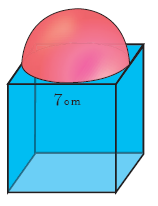
As shown in figure a cubical block of side 7 cm is surmounted by a hemisphere. Find the surface area of the solid.
13.
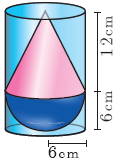
A solid consisting of a right circular cone of height 12 cm and radius 6 cm standing on a hemisphere of radius 6 cm is placed upright in a right circular cylinder full of water such that it touches the bottom. Find the volume of the water displaced out of the cylinder, if the radius of the cylinder is 6 cm and height is 18 cm.
14.
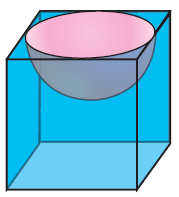
A hemispherical section is cut out from one face of a cubical block such that the diameter l of the hemisphere is equal to side length of the cube. Determine the surface area of the remaining solid.
15.
A funnel consists of a frustum of a cone attached to a cylindrical portion 12 cm long attached at the bottom. If the total height be 20 cm, diameter of the cylindrical portion be 12 cm and the diameter of the top of the funnel be 24 cm. Find the outer surface area of the funnel.
1.
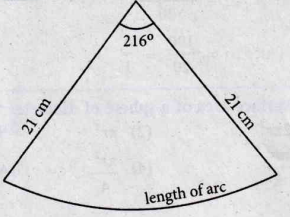
Length of arc of a sector = \(\frac{\theta}{360^{\circ}} \times 2 \pi r_{1}\)
\(=\frac{216^{\circ}}{360^{\circ}} \times 2 \pi \times 21 \)
\(=\frac{3}{5}(2 \pi)(21)=\frac{126 \pi}{5} \mathrm{~cm}\)
Since, sector is made into a cone by bringing the bounding radii together.
\(\left.\begin{array}{l}\text { Circumference of base } \\ \text { of the cone }\end{array}\right\}=\left\{\begin{array}{l}\text { length of are } \\ \text { of a sector }\end{array}\right.\)
\(\therefore 2 \pi r=\frac{126 \pi}{5}\)
radius of base of a cone, \(r=\frac{63}{5} \mathrm{~cm}\)
and radius of sector = slant height of cone
21 = l
Height of cone, h \(=\sqrt{l^{2}-r^{2}}=\sqrt{(21)^{2}-\left(\frac{63}{5}\right)^{2}} \)
\(=\sqrt{441-158.76} \)
\(=\sqrt{282.24}=16.8 \mathrm{~cm}\)
Volume of cone \(=\frac{1}{3} \pi r^{2} h cu. units \)
\(=\frac{1}{3} \times \frac{22}{7} \times 12.6 \times 12.6 \times 16.8 \)
\(=\frac{58677.696}{21}\)
= 2794.176 = 2794.18 cm3
2.
Volume of a cone = 1005 \(\frac{5}{7}\) cu.cm
\(\text { i.e., } \frac{1}{3} \pi r^{2} h=1005 \frac{5}{7}\)
area of base = area of circle
\(
=201 \frac{1}{7} \text { sq. units }
\)
\(i.e
\ \pi r^{2}=201 \frac{1}{7} \Rightarrow r^{2}=64
\)
Substituting in (1), r = 8 cm
\(\frac{1}{3}\left(201 \frac{1}{7}\right) \mathrm{h}=1005 \frac{5}{7}
\)
\(\frac{1}{3}\left(\frac{1408}{7}\right) \mathrm{h}=\frac{7040}{7}
\)
\(h=\frac{7040}{7} \times \frac{7}{1408} \times 3=15 \mathrm{~cm}\)
Slant height of cone \(l =\sqrt{h^{2}+r^{2}}
\)
\(=\sqrt{15^{2}+8^{2}}=\sqrt{225+64}
\)
\(=\sqrt{289}=17 \mathrm{~cm}
\)
3.
External diameter of hollow hemisphere
= 2R = 14 cm
External radius R = 7 cm
Given volume = \(\frac{436 \pi}{3} \mathrm{~cm}^{3}\)
\(\frac{2}{3} \pi\left(R^{3}-r^{3}\right) =\frac{436 \pi}{3}
\)
\(R^{3}-r^{3} =218
\)
(7)3 - r3 = 218
r3 = 343 - 218 = 125 = 5 cm
Thickness = R - r = 7 - 5 = 2 cm
4.
Slant height l = 4 m
Perimeter of larger circle = 2nR = 18 cm
\(R=\frac{9}{\pi}=\frac{63}{22} \mathrm{~m}\)
Perimeter of smaller circle = \(2 \pi r\) = 16 m
\(r=\frac{8}{\pi}=\frac{56}{22} \mathrm{~m}\)
C.S.A of Frustum of cone = \(\pi l(\mathrm{R}+r) \text { sq. units }\)
\(=\frac{22}{7} \times 4 \times\left(\frac{63}{22}+\frac{56}{22}\right) \)
\(=\frac{4}{7}(119)=68 \mathrm{~m}^{2} \)
Cost of painting per sq. m = Rs. 100
Cost of painting for 68 sq. m = 68 x 100
= Rs.6800
5.
Hollow metallic cylinder
External radius R = 4.3 cm
Internal radius r = 1.1 cm
Length = height = h = 4 cm
Volume \(=\pi\left(\mathrm{R}^{2}-\mathrm{r}^{2}\right) \mathrm{h} \text { cu. units }
\)
\(=\pi\left((4.3)^{2}-(1.1)^{2}\right)(4)
\)
\(=\pi(18.49-1.21) 4
\)
\(=69.12 \pi \mathrm{cm} 3
\)
Solid cylinder
height h = 12 cm
radius r = ?
volume \(=\pi r^{2} h\ sq. units
\)
\(=\pi r^{2}(12)
\)
Given, Hollow cylinder is melted to form solid cylinder
Volume of cylinder = Volume of hollow cylinder
\(\pi r^{2}(12) =69.12 \pi
\)
\(r^{2} =\frac{69.12}{12}=5.76
\)
r = 2.4 cm
Diameter of cylinder = 2r = 4.8 cm
6.
Coin is in the form of a cylinder
Diameter of the coin = 1.5 cm
Radius of the coin = \(\frac{1.5}{2}\)
Thickness = height = 2 mm = \(\frac{2}{10}=0.2 \mathrm{~cm}\)
Volume of coin (cylinder) = \(\pi r^{2} h\)
\(=\pi\left(\frac{1.5}{2}\right)^{2}(0.2)
\)
\(=0.1125 \pi \mathrm{cm}^{3}
\)
Diameter of cylinder = 4.5 cm
radius = \(\frac{4.5}{2}=2.25 \mathrm{~cm}\)
height = 10 cm
volume = \(\pi r^{2} h\ sq. units
\)
= \(\pi(2.25)^{2}(10)
\)
= \(50.625 \pi
\)
No.of coins \(=\frac{\text { Volume of cylinder }}{\text { Volume of Coin }}
\)
\(=\frac{50.625 \pi}{0.1125 \pi}=450 \text { coins. }
\)
7.
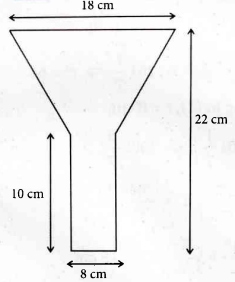
Area of tin sheet required
= C.S.A of cylinder + C.S.A of frustum
Cylinder:
Radius = 4 cm
Height = 10 cm
C.S.A \(=2 \pi r h\ sq. units \)
\(=2 \times \frac{22}{7} \times 4 \times 10=\frac{1760}{7}\ sq. units\)
Frustum of a cone
r1 = radius of top = 9 cm
r2 = radius of bottom = 4 cm
Height = 22 - 10 = 12 cm
Slant height \(l =\sqrt{h^{2}+\left(r_{1}-r_{2}\right)^{2}} \)
\(=\sqrt{12^{2}+(9-4)^{2}} \)
\(=\sqrt{144+25}=\sqrt{169}=13 \mathrm{~cm} \)
C.S.A \(=\pi\left(r_{1}+r_{2}\right) l \text { sq, units } \)
\(=\frac{22}{7}(9+4)(13) \)
\(=\frac{3718}{7} \text { sq. units } \)
Area of tin sheet \(=\frac{1760}{7}+\frac{3718}{7}\)
\(=\frac{5478}{7}=782.57 \mathrm{~cm}^{2}\)
8.
Let the radius of hemispherical bowl = r
Volume of hemispherical bowl
\(=\frac{2}{3} \pi r^{3} \text { cu. units }\)
Let the height of cylindrical vessel = h
Given \(r=h+h \frac{50}{100} \Rightarrow \mathrm{r}=\mathrm{h}\left(1+\frac{50}{100}\right)
\)
\(\mathrm{h}= \frac{2}{3} r
\)
Now, Volume of cylindrical vessel
\(=\pi r^{2}\left(\frac{2 r}{3}\right)=\frac{2}{3} \pi r^{3}\)
Hence, Volume of juice in the cylindrical vessel
\(=\frac{\frac{2}{3} \pi r^{3}}{\frac{2}{3} \pi r^{3}} \times 100 \%=100 \%\)
9.
Solid sphere
radius = 6 cm
Volume \(=\frac{4}{3} \pi r^{3} \text { cu. units }
\)
\(=\frac{4}{3} \pi(6)^{3}
\)
\(=\frac{4}{3} \pi(216)=288 \pi \mathrm{cm}^{3}
\)
Hollow cylinder
Internal radius = 'r'
External radius = 'R' = 5 cm
Height h = 32 cm
Volume of Hollow Cylinder
\(=\pi h\left(\mathrm{R}^{2}-r^{2}\right)\ cu. units
\)
\(=\pi(32)\left(25-r^{2}\right) \mathrm{cm}^{3}
\)
Given that solid sphere is melted to form a hollow cylinder.
Volume of Hollow Cylinder = Volume of Sphere
\(32 \pi\left(25-r^{2}\right) =288 \pi
\)
\(25-r^{2} =\frac{288}{32}=9
\)
r2 = 25 - 9 = 16
Internal radius r = 4 cm
Thickness = External radius - Internal radius
= R - r = 5 - 4 = 1 cm.
10.
Hollow Hemisphere
Internal diameter = 6 cm
Internal radius 'r' = 3 cm
External diameter = 10 cm
External radius 'R' = 5 cm
\(\left.\begin{array}{l} \text { Volume of hemisphere (or) } \\ \text {Volume of material used } \end{array}\right\}=\frac{2}{3} \pi\left(\mathrm{R}^{3}-\mathrm{r}^{3}\right) \text { cu. units }\)
\(=\frac{2}{3} \pi\left(5^{3}-3^{3}\right) \)
\(=\frac{2}{3} \pi(125-27)=\frac{196 \pi}{3} \mathrm{~cm}^{3} \)
Cylinder
Diameter = 14 cm
radius = 7 cm
height = h
Volume of cylinder \(=\pi r^{2} h\ cu. units \)
\(=\pi(7)^{2} h \)
\(=49 \pi h \mathrm{~cm}^{3} \)
Given that hollow hemisphere is melted and cast into a solid cylinder
Volume of cylinder = volume of hollow hemisphere
\(49 \pi h =\frac{196 \pi}{3} \)
\(h =\frac{196}{3 \times 49}=\frac{4}{3}=1.33 \)
Height of the cylinder = 1.33 cm.
11.
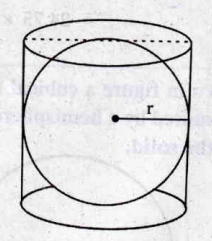
(i) Surface area of a sphere Radius of sphere = r
Surface area = 4r2 sq. units
(ii) Curved surface area of cylinder
Radius of cylinder = r
Height of cylinder = r + r = 2r
Curved surface area \(=2 \pi r h\ sq. units \)
\(=2 \pi r(2 \mathrm{r}) \)
\(=4 \pi r^{2} \text { sq. units } \)
(iii) Ratio of the areas \(=\frac{\text { Surface area of sphere }}{\text { CSA of cylinder }} \)
\(=\frac{4 \pi r^{2}}{4 \pi r^{2}}=\frac{1}{1} \)
Ratio = 1 : 1.
12.
Edge of cube = 7 cm
surface area of a cube = 6a2 sq. units
= 6(7)2
= 294 cm2
radius of hemisphere = \(\frac{7}{2} \mathrm{~cm}\)
[Only C.S.A is considered as the hemisphere surmounted]
C.S.A of hemisphere \(=2 \pi r^{2} \text { sq. units } \)
\(=2 \times \frac{22}{7} \times \frac{7}{2} \times \frac{7}{2} \)
= 77 Cm2
Surface area of = T.S.A of cube + C.S.A the solid of hemisphere area of circular region (bottom of hemisphere)
\(=294+77-\left(\frac{22}{7} \times \frac{7}{2} \times \frac{7}{2}\right)\)
= 371 - 38.5
= 332.5 cm2
13.
Radius of hemisphere = 6 cm
Volume of hemisphere \(=\frac{2}{3} \pi r^{3} \text { cu. units }\)
\(=\frac{2}{3} \pi(6)^{3}
\)
\(=\frac{2}{3} \pi(216)
\)
\(=144 \pi \mathrm{cm}^{3}
\)
base of cone = 6 cm
Height of the cone = 12 cm
Volume of the cone \(=\frac{1}{3} \pi r^{2} h \text { cu. units }
\)
\(=\frac{1}{3} \pi(6)^{2}(12)
\)
= 144 cm3
volume of the solid = Volume of cone + Volume of hemisphere
\(=144 \pi+144 \pi=288 \pi\)
Volume of water displaced
= Volume of the solid placed in the cylinder
\(=288 \pi=288 \times \frac{22}{7}\)
= 905.14 cm3
14.
Let r be the radius of the hemisphere.
Given that, diameter of the hemisphere = side of the cube = l
Radius of the hemisphere = \(\frac{l}{2}\)
TSA of the remaining solid = Surface area of the cubical part + C.S.A. of the hemispherical part − Area of the base of the hemispherical part
= 6 x (Edge)2 + 2\(\pi\)r2−\(\pi\)r2
= 6 x (Edge)2 + \(\pi\)r2
\(=6{ \times (l) }^{ 2 }+\pi { \left( \frac { l }{ 2 } \right) }^{ 2 }=\frac { 1 }{ 4 } (24+\pi ){ l }^{ 2 }\)
Total surface area of the remaining solid \(=\frac { 1 }{ 4 } (24+\pi ){ l }^{ 2 }\)sq. units
15.
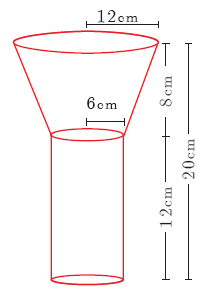
Let R, r be the top and bottom radii of the frustum.
Let h1, h2 be the heights of the frustum and cylinder respectively.
Given that, R = 12 cm, r = 6 cm, h2 = 12 cm
Now, h1 = 20 – 12 = 8 cm
Here, Slant height of the frustum l = \(\sqrt { \left( R-r \right) ^{ 2 }+{ h }_{ 1 }^{ 2 } } units\)
\(=\sqrt { 36+64 } \)
l = 10 cm
Outer surface area = \(2\pi r{ h }_{ 2 }+\pi (R+r)\quad l\quad sq.units\)
\(=\pi [2r{ h }_{ 2 }+(R+r)l]\)
\(=\pi [(2\times 6\times 12)+(18\times 10)]\)
\(=\pi [144+180]\)
\(=\frac { 22 }{ 7 } \times 324=1018.28\)
Therefore, outer surface area of the funnel is 1018.28 cm2.

10th Standard Syllabus & Materials
10th Standard
TN 10th English Prose - 2 - The Night the Ghost Got in Important Questions And Answers Study Material - QB365 Set A
NEW10th Standard
TN 10th English Supplementary - 1 - The Tempest Important Questions And Answers Study Material - QB365 Set A
NEW10th Standard
TN 10th English Poem - 1 - Life Important Questions And Answers Study Material - QB365 Set A
NEW10th Standard
TN 10th English Prose - 1 - His First Flight Important Questions And Answers Study Material - QB365 Set A



Tamilnadu Stateboard 10th Standard Subjects
Tamilnadu Stateboard Standards





