
 100% FREE ACCESS
10th Standard Syllabus & Materials
10th Standard
TN 10th English Prose - 4 - The Attic Important Questions And Answers Study Material - QB365 Set A
NEW10th Standard
TN 10th English Supplementary - 3 - The Story of Mulan Important Questions And Answers Study Material - QB365 Set A
NEW10th Standard
TN 10th English Poem - 3 - I am Every Woman Important Questions And Answers Study Material - QB365 Set A
NEW10th Standard
TN 10th English Prose - 3 - Empowered Women Navigating The World Important Questions And Answers Study Material - QB365 Set A
NEW10th Standard
TN 10th English Supplementary - 2 - Zigzag Important Questions And Answers Study Material - QB365 Set A
NEW10th Standard
TN 10th English Poem - 2 - The Grumble Family Important Questions And Answers Study Material - QB365 Set A

Published on: 31/10/2022
QB365 provides a detailed and simple solution for every Possible Creative Questions in Class 10 Maths Subject -Mensuration , English Medium. It will help Students to get more practice questions, Students can Practice these question papers in addition to score best marks.
Download Tamil Nadu 10th Standard Maths question papers, model tests, one-mark questions, important questions, and public exam papers in PDF format. Free study materials and answer keys for TN State Board students.
Questions + Answers key
Take MCQ Maths Test1.
A right triangle with sides 3 cm and, 4 cm is revolved around its hypotenuse. Find the volume of the double cone thus formed.
2.
A vessel in the form of an invested cone. its height is 8 cm and the radius is 5 cm. It is filled with water up to the brim When lead shots each of which is a sphere of radius 0.5 cm are dropped into the vessel, one fourth of the water flows out. Find the number of lead shots dropped into the vessel.
3.
A hemispherical bowl of internal diameter 36 cm contains a liquid. This liquid is to be filled into cylindrical bottles of radius 3 cm and height 6 cm. How many such bottles are required to empty the bowl?
4.
Find the volume of a solid in the form of a right circular cylinder with hemispherical ends whose total length is 2.7 m and the diameter of each hemispherical end is 0.7 m.
5.
A petrol tank is a cylinder of base diameter 21 cm and length 18 cm fitted with conical ends each of axis length 9 cm. Determine the capacity of the tank
6.
A toy is in the form of a cone on a hemisphere of diameter 7 cm. The total height of the toy is 14.5 cm. Find the volume and the total surface area of the toy
7.
The height of a cone is 30 cm. A small cone is cut off at the top by a plane parallel to the base. If its volume is \(\frac{1}{27}\) of the volume of the given cone, at what height above the base is the section made?
8.
A hemispherical tank is made up of an iron sheet 1 cm thick. If the inner radius is 1 m, then find the volume of the iron used to make the tank.
9.
A cone of height 24 cm has a curved surface area 550 cm2. Find its volume
10.
A solid cylinder has total surface area of 462 sq. cm. Its curved surface area is One-third its total surface area. Find the volume of cylinder
11.
The diameter of a sphere is decreased by 25% By what percent does its curved surface area decrease?
12.
There are two cones. The curved surface area of one is twice that of the other. The slant height of the later is twice that of the former. Find the ratio of their radii.
13.
A factory manufactures 1,20,000 pencils daily The pencils are cylindric in shape, each of length 25 cm and circumference 1.5 cm. Determine the cost of colouring the curved surface of the pencils manufactured in one day at Rs 0.05 per cm2.
1.
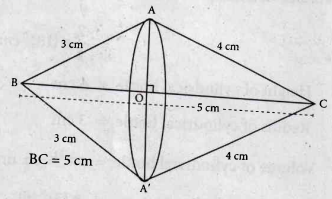
Let \(\Delta\)ABC be the right triangle, right angled at A whose sides are AB and AC measure 3 cm and 4 cm respectively
The length of the side BC (hypotenuse)
\(B C =\sqrt{3^{2}+4^{2}} \)
\(=\sqrt{25} \)
\(=5 \mathrm{~cm} \)
By revolving, \(\Delta\)ABC around its hypotenuse BC, the double Cone is formed
This solid consists two cones namely BAA' and, CA A'
AO or A'O is the common radius.
Height of the cone CAA' is co and slant height is 4 cm.
Height of the Cone BAA' is BO and slant height is 3 cm.
Now \(\Delta\)AOB is similar to \(\Delta\)CAB
Corresponding sides are proportional
\(\text { i.e. }, \frac{A O}{A C}=\frac{A B}{B C}=\frac{B O}{A B} \)
\(\Rightarrow \frac{A O}{4}=\frac{3}{5} \Rightarrow A O=\frac{12}{5} \mathrm{~cm} \)
\(\text { Similarly, } \frac{\mathrm{BO}}{3}=\frac{3}{5} \Rightarrow \mathrm{BO}=\frac{9}{5} \mathrm{~cm}\)
\(\mathrm{CO}=\mathrm{BC}-\mathrm{BO}\)
\(\therefore \text { Volume of double Cone }\)
\(v=\frac{12}{5}, h_{1}=B O= \frac{9}{5}, h_{2}=C O=\frac{16}{5} \)
\(=\left(\frac{1}{3} \pi r^{2} \times B O\right)+\left(\frac{1}{3} \pi r^{2} \times C O\right) \)
\(=\frac{1}{3} \pi r^{2}(B O+C O) \)
\(=\frac{22}{7 \times 3}\left(\frac{12}{5}\right)^{2} \cdot\left(\frac{9}{5}+\frac{16}{5}\right) \)
\(=\frac{22}{7 \times 3} \times \frac{12}{5} \times \frac{12}{5} \times 5 \)
\(=30.17 \mathrm{~cm}^{3}\)
2.
radius of cone r = 5 cm, height h = 8 cm
\(\text { volume of cone }=\frac{1}{3} \pi r^{2} h \text { cubic units }\)
\(=\frac{1}{3} \pi(5)^{2}(8)=\frac{200 \pi}{3} \mathrm{~cm}^{3}\)
Given that the cone is filled to the brim. when read shots are dropped, one fourth of the water flown out. The volume of water flown out
\(=\frac{1}{4} \times \frac{200 \pi}{3}=\frac{50 \pi}{3} \mathrm{~cm}^{3}\)
\(\text { Volume of lead shot }=\frac{4}{3} \pi r^{3}=\frac{4}{3} \pi\left(\frac{1}{2}\right)^{3}\)
\(=\frac{\pi}{6} \mathrm{~cm}^{3}\)
\(\therefore \text { Number of lead shots dropped into the vessel }\)
\(=\frac{50 \pi / 3}{\pi / 6}=100\)
3.
\(\text { Radius of hemispherical bowl }=\frac{36}{2}=18 \mathrm{~cm}\)
\(\text { Volume of hemispherical bowl }=\frac{2}{3} \pi r^{3} \text { cubic units }\)
\(=\frac{2}{3} \pi(18)^{3} \mathrm{~cm}^{3}\)
Height of cylindrical bottle = 6 cm
Radius of cylindrical bottle = 3 cm
\(\text { Volume of cylindrical bottle }=\pi r^{2} h \text { cu. units }\)
\(=\pi(3)^{2}(6)\)
\(\therefore \text { Number of bottles required }=\) \(\frac{Volume \ of \ hemispherical\ bowl }{Volume\ of\ a\ bottle}\)
\(\therefore \text { Number of bottles required }=\frac{\frac{2}{3} \pi(18)^{3}}{\pi(3)^{2}(6)}=72\)
4.
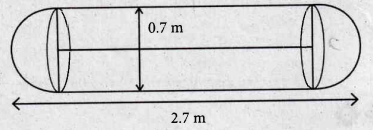
radius of hemispherical ends
\(=\frac{1}{2} \times 0.7 \)
\(=\frac{0.7}{2} m=\frac{7}{20} m \)
Total length of Solid = 2.7 m
Volume of two hemispheres
\(=2\left(\frac{2}{3} \pi r^{3}\right) \mathrm{cu} \text {. units } \)
\(=\frac{4}{3} \times \frac{22}{7} \times\left(\frac{7}{20}\right)^{3} \)
\(=0.1797 \mathrm{~m}^{3} \)
\(\text { Volume of cylinder }=\pi r^{2} h\)
\(=\frac{22}{7} \times\left(\frac{7}{20}\right)^{2} \times 2 \)
\(=0.77 \mathrm{~m}^{3} \)
\(\therefore \text { Volume of solid }=0.1797+0.77\)
\(=0.95 \mathrm{~m}^{3}(\text { app })\)
5.
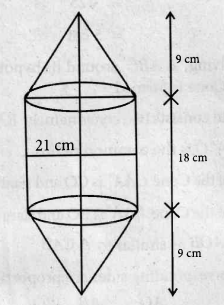
Volume of Cylindrical Portion
\(=\pi r^{2} h \)
\(=\frac{22}{7} \times\left(\frac{21}{2}\right)^{2} \times 18 \)
\(=6237 \mathrm{~cm}^{3} \)
Volume of two Conical ends
\(=2\left(\frac{1}{3} \pi r^{2} h\right) \)
\(=\frac{2}{3} \times \frac{22}{7} \times\left(\frac{21}{2}\right)^{2} \times 9 \mathrm{~cm}^{3} \)
\(=\frac{174636}{84} \)
\(=2079 \mathrm{~cm}^{3} \)
capacity of the tank = Volume of Cylinder + Volume of 2 Cones
= 6237 + 2079
= 8316 cm3
6.
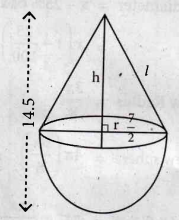
\(\text { Radius of hemisphere ' } r \text { ' }=\frac{7}{2}=3.5 \mathrm{~cm}\)
\(\text { Radius of base of cone }=3.5 \mathrm{~cm}\)
\(\text { Total height of toy }=14.5 \mathrm{~cm}\)
\(\text { Height of conical part }=14.5-3.5=11 \mathrm{~cm}\)
\(\text { Slant height of cone } l=\sqrt{h^{2}+r^{2}}\)
\(=\sqrt{11^{2}+3.5^{2}} \)
\(=\sqrt{121+12.25} \)
\(=\sqrt{133.25}=11.54 \mathrm{~cm} \)
Volume of toy = Volume of cone + Volume of hemisphere
\(=\frac{1}{3} \pi r^{2} h+\frac{2}{3} \pi r^{3} \)
\(=\frac{\pi r^{2}}{3}(h+2 r) \)
\(=\frac{22}{3 \times 7} \times 12.25 \times 18 \)
\(=231 \mathrm{~cm}^{3} \)
Total surface area of toy = C.S.A of cone + C.S.A of hemisphere
\(=\pi r l+2 \pi r^{2}=\pi \mathrm{r}(l+2 \mathrm{r}) \)
\(=\frac{22}{7} \times 3.5(11.54+2 \times 3.5) \)
\(=22 \times 0.5 \times 18.54=203.94 \mathrm{~cm}^{2} \)
7.
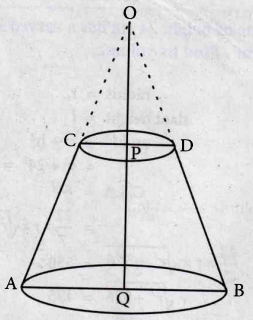
Volume of the original cone OAB
\(=\frac{1}{3} \pi R^{2} H \)
\(=\frac{1}{3} \pi\left(\mathrm{R}^{2}\right)(30)=10 \pi R^{2} \mathrm{~cm}^{3} \)
Volume of small cone OCD
\(=\frac{1}{3} \pi r^{2} h \text { cubic units. }\)
Given Volume of cone OCD
\(=\frac{1}{27}(\text { Volume of cone OAB) }\)
\(\frac{1}{3} \pi r^{2} h =\frac{1}{27}\left(10 \pi R^{2}\right) \)
\(h =\frac{10 \pi R^{2}}{27}\left(\frac{3}{\pi r^{2}}\right) \)
\(=\frac{10}{9}\left(\frac{R}{r}\right)^{2} \)
From similar triangles OQB and OPD
\(\text { We get } \frac{Q B}{P D}=\frac{O Q}{O P}=\frac{30}{h}\)
\(\Rightarrow \frac{R}{r}=\frac{30}{h}\)
\(\text { Substituting (2) in (1), }\)
\(h=\frac{10}{9}\left(\frac{30}{h}\right)^{2}\)
\(\mathrm{h}^{3}=1000\)
h = 10 cm
Hence, at (30 - 10) = 20 cm above the base, the section is made
8.
Internal radius = 'r' m = 1 m
External radius = 'R' m = 1 + 0.01 = 1.01 m.
volume of iron used = External volume -Internal volume
\(=\frac{2}{3} \pi\left(R^{3}-r^{3}\right) \text { cubic units } \)
\(=\frac{2}{3} \pi\left((1.01)^{3}-1^{3}\right) \)
\(=\frac{2}{3} \times \frac{22}{7} \times 0.030301 \)
\(=0.06348 \mathrm{~m}^{3}(\mathrm{app}) \)
9.
radius = r,
slant height = I
\(\text { and } l^{2}=\mathrm{r}^{2}+\mathrm{h}^{2}\)
\(=r^{2}+24^{2}=r^{2}+576\)
\(\text { C.S.A }=\pi r l\)
\(=\frac{22}{7} \times r \times \sqrt{r^{2}+576} \mathrm{~cm}^{2}\)
\(\frac{22}{7} \times r \times \sqrt{r^{2}+576} =550 \)
\(r \sqrt{r^{2}+576} =175
\)
\(\text { Squaring both sides }\)
\(r^{2}\left(r^{2}+576\right) =(175)^{2} \)
\(\Rightarrow r^{4}+576 r^{2}-(175)^{2} =0
\)
\(\Rightarrow \left(r^{2}-49\right)\left(r^{2}+625\right) =0 \)
\(r^{2}+625 \neq 0, \ \therefore r^{2}-49 =0 \)
\(r^{2} =49 \)
\(r =7 \mathrm{~cm} .
\)
\(\therefore \text { Volume } =\frac{1}{3} \pi r^{2} h \text { cubic units. } \)
\(=\frac{1}{3} \times \frac{22}{7} \times 7 \times 7 \times 24 \)
\(=1232 \mathrm{~cm}^{3}
\)
10.
\(\text { radius }=\mathrm{r} \text {, height }=\mathrm{h}\)
\(\text { T.S.A }=2 \pi r(h+r) \text { sq. units }\)
\(\text { Given, } 2 \pi r(h+r)=462\)
\(r(h+r)=\frac{462 \times 7}{2 \times 22}=\frac{147}{2}\)
\(\text { C.S.A }=2 \pi r h \text { sq. units }\)
\(\text { Given, } 2 \pi r h=\frac{1}{3}(2 \pi r(h+r))\)
\(\Rightarrow \mathrm{h}=\frac{h+r}{3} \Rightarrow \mathrm{r}=2 \mathrm{~h}\)
\(\text { Substituting (2) in (1) }\)
\(2 h(h+2 h) =\frac{147}{2} \)
\(6 h^{2} =\frac{147}{2} \)
\(h^{2} =\frac{49}{4} \Rightarrow h=\frac{7}{2} \)
\(\therefore \mathrm{r} =2 \mathrm{~h}=2\left(\frac{7}{2}\right)=7 \mathrm{~cm} \)
\(\therefore \text { Volume } =\pi r^{2} h=\frac{22}{7} \times(7)^{2}\left(\frac{7}{2}\right) \)
\(=539 \mathrm{~cm}^{3} . \)
11.
Let the diameter be 'x' units
\(\text { radius }=\frac{x}{2} \text { units }\)
\(\therefore \text { C.S.A of sphere }=4 \pi r^{2} \text { sq. units. }\)
\(=4 \pi\left(\frac{x}{2}\right)^{2} \)
\(=4 \pi\left(\frac{x^{2}}{4}\right)=\pi x^{2} \)
Given that diameter is decreased by 25%.
New diameter = x - 25 % of x
\(=x\left(1-\frac{25}{100}\right)=\frac{3}{4} x\)
\(\text { New Radius }=\frac{3 x}{8}\)
\(\text { C.S.A of new sphere }=4 \pi\left(\frac{3 x}{8}\right)^{2}=\frac{9 \pi x^{2}}{16}\)
\(\text { Decrease in C.S.A }=\pi x^{2}-\frac{9 \pi x^{2}}{16}=\frac{7 \pi x^{2}}{16}\)
\(\text { Hence, percentage in decrease }\)
\(= \frac{7 \pi x^{2}}{16} \times 100 \% \)
\(= 43.75 \% \)
12.
Let r1, be the radius and I1, be the slant height of first cone and r2, be the radius and l2 be the slant height of the second cone.
\(\text { C.S.A of I cone } =\pi r_{1} l_{1} \)
\(\text { C.S.A of II cone } =\pi r_{2} l_{2} \)
\(\text { Given } \pi r_{1} l_{1} =2 \pi r_{2} l_{2} \)
\(\Rightarrow r_{1} l_{1} =2 r_{2} l_{2} \)
\(\text { and } r_{1} l_{1} =2 r_{2}\left(2 l_{1}\right) \)
\(r_{1} l_{1} =4 r_{2} l_{1} \)
\(r_{1} =4 r_{2} \)
\(\frac{r_{1}}{r_{2}} =\frac{4}{1}
\)
\(\text { Hence, the ratio of their radii is } 4: 1 \text {. }\)
13.
Let the radius of the base be 'r' cm.
\(\text { Circumference } =2 \pi r \)
\(2 \pi r =1.5 \mathrm{~cm} \)
\(r =\frac{1.5}{2 \pi}=\frac{10.5}{44} \mathrm{~cm} \)
\(\text { Curved surface area of pencil }\)
\(=2 \pi r h \)
\(=2 \times \frac{22}{7} \times \frac{10.5}{44} \times 25 \)
\(\text { Cost of colouring }100 \mathrm{~cm}^{2}=\text { र. } 0.05\)
\([\because 1 \text {. sq. } \mathrm{dm}=100 \mathrm{sq} \cdot \mathrm{cm}]\)
\(\text { Cost of colouring }=\frac{0.05}{100} \times 2 \times \frac{22}{7} \times \frac{10.5}{44} \times 25\)
\(=Rs \frac{3}{160}\)
\(\text { Hence, cost of colouring } 1,20,000 \text { pencils }\)
\(=\frac{3}{160} \times 120000=\text { Rs } 2250\)

10th Standard Syllabus & Materials
10th Standard
TN 10th English Prose - 2 - The Night the Ghost Got in Important Questions And Answers Study Material - QB365 Set A
NEW10th Standard
TN 10th English Supplementary - 1 - The Tempest Important Questions And Answers Study Material - QB365 Set A
NEW10th Standard
TN 10th English Poem - 1 - Life Important Questions And Answers Study Material - QB365 Set A
NEW10th Standard
TN 10th English Prose - 1 - His First Flight Important Questions And Answers Study Material - QB365 Set A



Tamilnadu Stateboard 10th Standard Subjects
Tamilnadu Stateboard Standards





