
 100% FREE ACCESS
10th Standard Syllabus & Materials
10th Standard
TN 10th English Prose - 4 - The Attic Important Questions And Answers Study Material - QB365 Set A
NEW10th Standard
TN 10th English Supplementary - 3 - The Story of Mulan Important Questions And Answers Study Material - QB365 Set A
NEW10th Standard
TN 10th English Poem - 3 - I am Every Woman Important Questions And Answers Study Material - QB365 Set A
NEW10th Standard
TN 10th English Prose - 3 - Empowered Women Navigating The World Important Questions And Answers Study Material - QB365 Set A
NEW10th Standard
TN 10th English Supplementary - 2 - Zigzag Important Questions And Answers Study Material - QB365 Set A
NEW10th Standard
TN 10th English Poem - 2 - The Grumble Family Important Questions And Answers Study Material - QB365 Set A

Published on: 09/05/2020
10th Standard Maths English Medium Model Question Paper
Download Tamil Nadu 10th Standard Maths question papers, model tests, one-mark questions, important questions, and public exam papers in PDF format. Free study materials and answer keys for TN State Board students.
Questions + Answers key
Take MCQ Maths Test1.
The difference between the remainders when 6002 and 601 are divided by 6 is ____________
2
1
0
3
2.
3.
4.
If (sin α + cosec α)2 + (cos α + sec α)2 = k + tan2α + cot2α, then the value of k is equal to
9
7
5
3
5.
Kamalam went to play a lucky draw contest. 135 tickets of the lucky draw were sold. If the probability of Kamalam winning is \(\frac{1}{9}\), then the number of tickets bought by Kamalam is
5
10
15
20
6.
a cot \(\theta \) + b cosec\(\theta \) = p and b cot \(\theta \) + a cosec\(\theta \) = q then p2- q2 is equal to
a2 - b2
b2 - a2
a2 + b2
b - a
7.
74k \(\equiv \) ________ (mod 100)
1
2
3
4
8.
When proving that a quadrilateral is a trapezium, it is necessary to show
Two sides are parallel
Two parallel and two non-parallel sides
Opposite sides are parallel
All sides are of equal length
9.
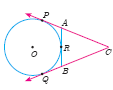
In figure CP and CQ are tangents to a circle with centre at O. ARB is another tangent touching the circle at R. If CP = 11 cm and BC = 7 cm, then the length of BR is
6 cm
5 cm
8 cm
4 cm
10.
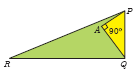
In the given figure, PR = 26 cm, QR = 24 cm, \(\angle PAQ\) = 90o, PA = 6 cm and QA = 8 cm. Find \(\angle\)PQR
80o
85o
75o
90o
11.
A solid sphere of radius x cm is melted and cast into a shape of a solid cone of same radius. The height of the cone is
3x cm
x cm
4x cm
2x cm
12.
Let f and g be two functions given by
f = {(0,1), (2,0), (3,-4), (4,2), (5,7)}
g = {(0,2), (1,0), (2,4), (-4,2), (7,0)} then the range of f o g is
{0,2,3,4,5}
{–4,1,0,2,7}
{1,2,3,4,5}
{0,1,2}
13.
If f: A ⟶ B is a bijective function and if n(B) = 7, then n(A) is equal to
7
49
1
14
14.
A system of three linear equations in three variables is inconsistent if their planes
intersect only at a point
intersect in a line
coincides with each other
do not intersect
15.
If the radii of the circular ends of a conical bucket which is 45 cm high are 28 cm and 7 cm, find the capacity of the bucket. (Use π = \(\frac{22}{7}\))
16.
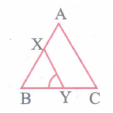
In figure the line segment XY is parallel to side AC of \(\Delta ABC\) and it divides the triangle into two parts of equal areas. Find the ratio \(\cfrac { AX }{ AB } \)
17.
The marks scored by 5 students in a test for 50 marks are 20, 25, 30, 35, 40. Find the S.D for the marks. If the marks are converted for 100 marks, find the S.D. for newly obtained marks.
18.
Prove that the equation x2(a2+b2)+2x(ac+bd)+(c2+ d2) = 0 has no real root if ad≠bc.
19.
Find the LCM and HCF of 6 and 20 by the prime factorisation method.
20.
Show that the points (1, 7), (4, 2), (-1,-1) and (-4,4) are the vertices of a square.
21.
Find the equation of a straight line passing through the mid-point of a line segment joining the points (1, -5), (4, 2) and parallel to: Y axis
22.
Reduce the rational expressions to its lowest form
\(\frac { { x }^{ 2 }-16 }{ { x }^{ 2 }+8x+16 } \)
23.
Find A x B, A x A and B x A
A = B = {p, q}
24.
If the range and the smallest value of a set of data are 36.8 and 13.4 respectively, then find the largest value.
25.
A conical flask is full of water. The flask has base radius r units and height h units, the water poured into a cylindrical flask of base radius xr units. Find the height of water in the cylindrical flask.
26.
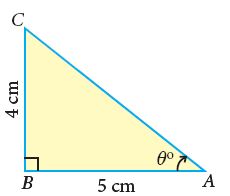
calculate \(\angle \)BAC in the given triangles (tan 38.7° = 0.8011 )
27.
Find the sum of the following
3,7,11....up to 40 terms
28.
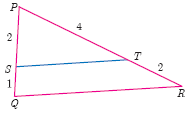
Show that \(\triangle\) PST~\(\triangle\) PQR
29.
The angle of elevation of a tower at a point is 45o, After going 20 meters towards the foot of the tower the angle of elevation of the tower becomes 60o calculate the height of the tower.
30.
In \(AD\bot BC\) prove that AB2 + CD2 = BD2 + AC2.
31.
A spherical ball of iron has been melted and made into small balls. If the radius of each smaller ball is one-fourth of the radius of the original one, how many such balls can be made?
32.
Σx = 99, n = 9, Σ(x - 10)2 = 79, then find,
(i) Σx2
(ii) Σ(x - \(\bar { x } \))2
33.
Which of the following list of numbers form an AP ? If they form an AP, write the next two terms:
1, 1, 1, 2, 2, 2, 3, 3, 3
34.
Find the area of the triangle formed by the points P(-1, 5, 3), Q(6, -2) and R(-3, 4).
35.
A function f: [-7,6) \(\rightarrow\) R is defined as follows.
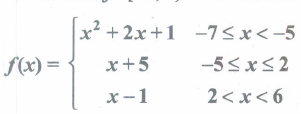
find 2f(-4) + 3f(2)
36.
Use Euclid’s Division Algorithm to find the Highest Common Factor (HCF) of
84, 90 and 120
37.
The time taken by 50 students to complete a 100 meter race are given below. Find its standard deviation.
| Time taken(sec) | 8.5-9.5 | 9.5-10.5 | 10.5-11.5 | 11.5-12.5 | 12.5-13.5 |
| Number of students | 6 | 8 | 17 | 10 | 9 |
38.
From the top of the tower 60 m high the angles of depression of the top and bottom of a vertical lamp post are observed to be 38° and 60° respectively. Find the height of the lamp post (tan38° = 0.7813,\( \sqrt { 3 } \) = 1.732)
39.
The owner of a milk store finds that, he can sell 980 litres of milk each week at Rs.14 / litre and 1220 litres of milk each week at Rs. 16 / litre. Assuming a linear relationship between selling price and demand, how many litres could he sell weekly at Rs. 17 / litre?
40.
Let A = {1, 2} and B = {1, 2, 3, 4}, C = {5, 6} and D = {5, 6, 7, 8}, Verify whether A x C is a subset of B x D?
41.
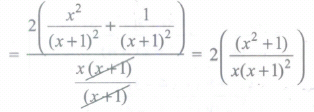
If A = \(\frac { x }{ x+1 } \), B = \(\frac { 1 }{ x+1 } \), prove that \(\frac { { \left( A+B \right) }^{ 2 }+{ \left( A-B \right) }^{ 2 } }{ A\div B } =\frac { 2\left( { x }^{ 2 }+1 \right) }{ x{ \left( x+1 \right) }^{ 2 } } \)
42.
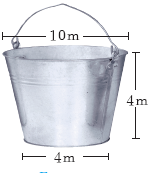
An industrial metallic bucket is in the shape of the frustum of a right circular cone whose top and bottom diameters are 10 m and 4 m and whose height is 4 m. Find the curved and total surface area of the bucket.
43.
Discuss the nature of solutions of the following quadratic equations.
x2 - 8x + 16 = 0
44.
Draw the graph of y = x2 + 3x - 4 and hence use it to solve x2 + 3x - 4 = 0
45.
Draw a tangent to the circle from the point P having radius 3.6 cm, and centre at O. Point P is at a distance 7.2 cm from the centre.
46.
Draw a circle of diameter 6 cm from a point P, which is 8 cm away from its centre. Draw the two tangents PA and PB to the circle and measure their lengths.
1.
(b)
1
2.
(c)
3.
(c)
4.
(b)
7
5.
(c)
15
6.
(b)
b2 - a2
7.
(a)
1
8.
(b)
Two parallel and two non-parallel sides
9.
(d)
4 cm
10.
(d)
90o
11.
(c)
4x cm
12.
(d)
{0,1,2}
13.
(a)
7
14.
(d)
do not intersect
15.
Clearly bucket forms frustum of a cone such that the radii of its circular ends are r1 = 28 cm, r2 = 7 cm, h = 45 cm
Capacity of the bucket = volume of the frustum
\(\Rightarrow \frac { 1 }{ 3 } \times \pi h[{ r }_{ 1 }^{ 2 }+{ r }_{ 2 }^{ 2 }+{ r }_{ 1 }{ r }_{ 2 }]\)
\(\Rightarrow \frac { 1 }{ 3 } \times \frac { 22 }{ 7 } \times 45[{ 28 }^{ 2 }+{ 7 }^{ 2 }+28\times 7)]\)
= 22 x 15 x (28 x 4 + 7 + 28)
\(\Rightarrow 330\times 147{ cm }^{ 2 }\Rightarrow 48510{ cm }^{ 2 }\)
16.
Given XY IIA C
So,
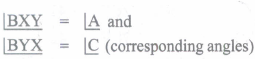
\(\therefore \Delta ABC\sim \Delta XbY\) (AAA similarity criterion)
So, \(\cfrac { ar(ABC) }{ ar(XBY) } =\left( \cfrac { AB }{ XB } \right) ^{ 2 }\) ...(1)
ar(ABC) = 2ar(XBY)
\(\cfrac { ar(ABC) }{ ar(ABC) } =\cfrac { 2 }{ 1 } \) ...(2)
From (1) and (2),
\(\left( \cfrac { AB }{ XB } \right) ^{ 2 }=\cfrac { 2 }{ 1 } i.e.,\cfrac { AB }{ XB } =\cfrac { \sqrt { 2 } }{ 1 } \)
\(\cfrac { XB }{ AB } =\cfrac { 1 }{ \sqrt { 2 } } \)
\(1-\frac{X B}{A B}=1-\frac{1}{\sqrt{2}}\)
\(\cfrac { AB-XB }{ AB } =\cfrac { \sqrt { 2 } -1 }{ \sqrt { 2 } } \)
\(\cfrac { AX }{ AB } =\cfrac { \sqrt { 2 } -1 }{ \sqrt { 2 } } =\cfrac { 2-\sqrt { 2 } }{ 2 } \)
17.
Let assumed mean A = 30
C = 5
| x | d' = \(\frac { x-30 }{ 5 } \) | d'2 |
| 20 | -2 | 4 |
| 25 | -1 | 1 |
| 30 | 0 | 0 |
| 35 | 1 | 1 |
| 40 | 2 | 4 |
| Σd' = 0 | Σd'2 = 10 |
σ =\(\sqrt { \left( \frac { \Sigma d'^{ 2 } }{ n } \right) -\left( \frac { \Sigma d' }{ n } \right) ^{ 2 } } \) x c
=\(\sqrt { \frac { 10 }{ 5 } -0 } \) x 5
=\(\sqrt { 2 } \) x 5
= 5\(\sqrt { 2 } \)
To convert the values for 100, all the values will be multiplied by 2. Therefore the new values are 40, 50, 60, 70, 80.
Let A = 60, C = 10
| x | d' = \(\frac { x-60 }{ 10 } \) | d'2 |
| 40 | -2 | 4 |
| 50 | -1 | 1 |
| 60 | 0 | 0 |
| 70 | 1 | 1 |
| 80 | 2 | 4 |
σ =\(\sqrt { \left( \frac { \Sigma d'^{ 2 } }{ n } \right) -\left( \frac { \Sigma d' }{ n } \right) ^{ 2 } } \) x c
=\(\sqrt { \frac { 10 }{ 5 } -0 } \) x 10
=\(\sqrt { 2 } \) x 10
= 10\(\sqrt { 2 } \)
S.D. also be multiplied by 2. It is also true for the division also.
18.
D= b2-4ac
⇒ 4(ac + bd)2 - 4(a2 + b2)(c2 + d2)
⇒ 4[(ac + bd)2 - (a2 + b2)(c2 + d2)]
⇒ 4(a2c2 + b2d2 + 2acbd - a2c2b2c2 - a2d2 - b2d2]
⇒ 4[2acbd - a2d2 - b2c2]
⇒ 4[a2d2 + b2c2 - 2adbc]
⇒-4[ ad - bc]2
We have ad≠ bc
∴ ad- be of 0
⇒ (ad - bc)2 > 0
⇒ 4(ad - bc)2 < 0 ⇒ D < 0
Hence the given equation has no real roots.
19.
We have 6 = 21 x 31 and
20 = 2 x 2 x 5 = 22 x 51
You can find HCF (6, 20) = 2 and LCM (6, 20) = 2 x 2 x 3 x 5 = 60.
As done in your earlier classes. Note that HCF (6, 20) = 21 = product of the smallest power of each common prime factor in the numbers.
LCM (6, 20) = 22 x 31 x 51 = 60.
= Product of the greatest power of each prime factor, involved in the numbers.
20.
Let A(1, 7), B(4, 2), C(-1, -1) and D(-4, 4) be the given paints. One way at showing that ABCD is a square is to use the property that all its sides should be equal and both its diagonals should be equal.
Now,
AB = \(\sqrt { (1-4)^{ 2 }+(7-4)^{ 2 } } =\sqrt { 9+25 } =\sqrt { 34 } \)
BC = \(\\ \sqrt { (4+1)^{ 2 }+(2+1)^{ 2 } } =\sqrt { 25+9 } =\sqrt { 34 } \)
CD = \(\sqrt { (-1+4)^{ 2 }+(-1-4)^{ 2 } } =\sqrt { 9+25 } =\sqrt { 34 } \)
DA =\(\sqrt { (1+4)^{ 2 }+(7-4)^{ 2 } } =\sqrt { 25+9 } =\sqrt { 34 } \)
AC = \(\sqrt { (1+1)^{ 2 }+(7+1)^{ 2 } } =\sqrt { 4+64 } =\sqrt { 68 } \)
BD = \(\\ \sqrt { (4+4)^{ 2 }+(2-4)^{ 2 } } =\sqrt { 64+4 } =\sqrt { 68 } \)
Since, AB = BC = CD = DA and AC = BD, all the four sides at the quadrilateral ABCD are equal and its diagonals AC and BD are also equal. Therefore, ABCD is a square.
21.
Given points (1, - 5) and (4, 2)
Mid-point of the line joining the points (1, - 5), (4, 2)
\(=\left(\frac{x_{1}+x_{2}}{2}, \frac{y_{1}+y_{2}}{2}\right)=\left(\frac{1+4}{2}, \frac{-5+2}{2}\right)
\)
\(=\left(\frac{5}{2},-\frac{3}{2}\right)
\)
Equation of a straight line passing through
\(\left(\frac{5}{2},-\frac{3}{2}\right)
\) and parallel to Y-axis is x = a
\(\text { i.e., } x=\frac{5}{2} \Rightarrow 2 x-5=0\)
22.
\(\frac { { x }^{ 2 }-16 }{ { x }^{ 2 }+8x+16 } =\frac { \left( x+4 \right) \left( x-4 \right) }{ { \left( x+4 \right) }^{ 2 } } =\frac { x-4 }{ x+4 } \)
23.
A = B = {(p, q)
A x B = {p, q} x {p, q}
= {(p, p), (p, q), (q, p), (q, q)}
A x A = {p, q} x {p, q}
= {(p, p),(p, q),(q, p),(q, q)}
B x A = {p, q} x {p, q}
= {(p, p),(p, q),(q, p),(q, q)}
A x B = A x A = B x A
Since A = B
24.
If the range = 36.8 and
the smallest value =13.4
Range R = L - S
36.8 = L-13.4
= 36.8 + 13.4 = 50.2
The largest value L = 50.2
25.
Radius of conical flask = 'r' units
Height of conical flask = 'h' units
Volume of conical flask = Volume of water
\(=\frac{1}{3} \pi r^{2} h \text { cu. units }\)
Since, water is poured into the cylindrical flask
Volume of cylinder = Volume of water
\(\pi(\mathrm{xr})^{2} H=\frac{1}{3} \pi r^{2} h\)
[xr - radius of cylinder, H - height]
\(\mathrm{X}^{2} \mathrm{r}^{2} \mathrm{H}=\frac{r^{2}}{3} h\)
Height of the water in cylinder flask
\(\mathrm{H}=\frac{h}{3 x^{2}}\)
26.
in the right triangle ABC [see figure. (a)]
tan \(\theta \) =\(\frac { opposite\ side\ }{ adjacent\ side\ } =\frac { 4 }{ 5 } \)
= tan-1(0.8)
\(\theta \) = \(38.7°\)(since tan \(38.7°\) = 0.8011)
\(\angle \)BAC = \(38.7°\)
27.
3, 7, 11, ... upto 40 terms.
We have sum of n terms of an A.P.
Sn = \(\frac{n}{2}\) (2a + (n - 1)d)
Here d = 7 -3 = 11 - 7 = 4
t2- t1 = t3 - t2 and it forms an A.P.
where a = 3,d = 4.
S40 = \(\frac{40}{2}\) (2 X 3 + 39d)
= 20 [6 + (39 x 4)] - 20 [6 + 156]
= 20 [162] = 3240
Sum upto 40 terms = 3240
28.
In \(\triangle\)PST and \(\triangle\)PQR,
\(\frac { PS }{ PQ } =\frac { 2 }{ 2+1 } =\frac { 2 }{ 3 } ,\frac { PT }{ PR } =\frac { 4 }{ 4+2 } =\frac { 2 }{ 3 } \)
Thus, \(\frac { PS }{ PQ } =\frac { PT }{ PR } \) and \(\angle\)P is common
Therefore, by SAS similarity,
\(\triangle\) PST~\(\triangle\)PQR
29.
30.
From \(\Delta ADC\) we have
AC2 = AD2 + CD2 ....(1)
(Pythagoras theorem)
From \(\Delta ADB\) we have
AB2 = AD2 + BD2 ...(2)
(Pythagoras theorem)
Subtracting (1) from (2) we have,
AB2 - AC2 = BD2 - CD2
AB2 + CD2 = BD2 + AC2
31.
No. of balls required \(=\frac { \frac { 4 }{ 3 } \pi { r }^{ 3 } }{ \frac { 4 }{ 3 } \pi \times { \left( \frac { r }{ 4 } \right) }^{ 3 } } \)
\(={ r }^{ 3 }\times \frac { 4 }{ r } \times \frac { 4 }{ r } \times \frac { 4 }{ r } =64\)
32.
Σ(x -10)2 = 79 = Σx2- 20x + 100 = 79
= Σx2- 20Σx + 100 x 9 = 79
= Σx2- 20 x 99 + 900 = 79
Σx2 = 79 + 1980 - 900 = 1159
Σ(x - \(\bar { x } \))2 = Σ(x - 11)2 = Σ(x2 - 22x + 121)
= Σx2 - 22Σx + 121 x 9
= 1159 - 22 x 99 + 1089 = 70
∴ Σx2 = 1159, Σ(x - \(\bar { x } \))2 = 70
33.
1,1,1,2,2,2,3,3,3
t2 - t1 = 1-1 = 0
t3 - t2 = 1-1 = 0
t4 - t3 = 2-1 = 1
Here t2 - t1 ≠ t3 - t2
ஃ It is not an A.P.
34.
The area of the triangle formed by the given points is equal to
= \(\frac { 1 }{ 2 } \) [-1.5 (-2 - 4) + 6 (4 - 3) + (-3) (3 + 2)]
= \(\frac { 1 }{ 2 } \) [9 + 6 - 15] = 0
We can have a triangle at area 0 square units? What does this mean?
If the area of a triangle is 0 square units, then its vertices will be collinear.
35.
2f(-4) + 3f(2)
f(-4) = x + 5 = -4 + 5 = 1
2f(-4) = 2 x 1 = 2
f(2) = x + 5 = 2 + 5 = 7
3f(2) = 3(7) = 21
∴ 2f(-4) + 3f(2) = 2 + 21 = 23
36.
84,90 and 120
First we will find the H.C.F. of 84 and 90.
H.C.F. (90, 84)
Applying Euclid's Division Algorithm until we get remainder zero.
90 = 84 (1) + 6
84 = 6 (14) + 0
Remainder = 0.
H.C.F. (90, 84) = 6
Now finding H.C.F. (120 , 6) we have
120 - 6(20) + 0
Remainder = 0
H.C.F. is 6.
So H.C.F. of 84, 90 and 120 is 6.
37.
Let x1 are the mid values of the given set
Assumed mean A = 11
| Time taken (sec) | xi | fi | di = xi - 11 | d2 | fd | fd2 |
| 8.5 - 9.5 | 9 | 6 | -2 | 4 | -12 | 24 |
| 9.5 - 10.5 | 10 | 8 | -1 | 1 | -8 | 8 |
| 10.5 - 11.5 | 11 | 17 | 0 | 0 | 0 | 0 |
| 11.5 - 12.5 | 12 | 10 | 1 | 1 | 10 | 10 |
| 12.5 - 13.5 | 13 | 9 | 2 | 4 | 18 | 36 |
| \(\Sigma f_{i}\) = N = 50 | \(\Sigma f_{i} d_{i}\) = 8 | \(\Sigma f_{i} d_{i}^{2}\) = 78 |
Standard deviation
\(\sigma =\sqrt{\frac{\Sigma f_{i} d_{i}^{2}}{N}-\left(\frac{\Sigma f_{i} d_{i}}{N}\right)^{2}} \)
\(=\sqrt{\frac{78}{50}-\left(\frac{8}{50}\right)^{2}}\)
\(=\sqrt{\frac{78}{50}-\frac{64}{2500}} \)
\(=\sqrt{\frac{3900-64}{2500}}=\sqrt{\frac{3836}{2500}} \)
\(=\sqrt{1.5344} \simeq 1.238 \simeq 1.24 \)
Standard deviation \( \sigma \simeq 1.24 \)
38.
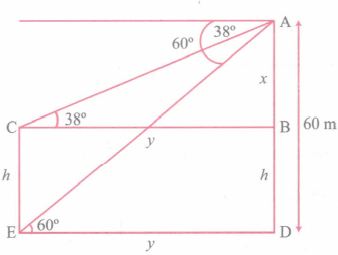
Let AB be the building of height 60 m.
DC be the lamp post.
DC = BE
In the right triangle ADE
\(\tan 38^{\circ}=\frac{A E}{D E}\)
\(0.7813 =\frac{A E}{C B} \)
\(C B =\frac{A E}{0.7813} \)
From the right triangle ACB
\(\tan 60^{\circ} =\frac{A B}{B C} \)
\(\sqrt{3} =\frac{60}{B C} \)
\(B C =\frac{60}{\sqrt{3}}=\frac{60 \times \sqrt{3}}{\sqrt{3} \times \sqrt{3}} \)
\(=\frac{60 \sqrt{3}}{3} C B =20 \sqrt{3} \)
From (1) and (2)
\(\frac{A E}{0.7813}=20 \sqrt{3}\)
AE = 20 x 1.732 x 0.7813
= 34.64 x 0.7813 = 27.064232 = 27.06 m
Now height of the lamp post
= DC = EB = AB - AE = 60 - 22.06 = 32.93 m
Height of the lamp post = 32.93 m
39.
The relationship between selling price and demand is linear. Taking selling price along x- axis and demand along y- axis. We have two points from the data. (14,980) and (16,1220)
Equation of a straight line joining the points (x1, y1) and (x2, y2) is
\(\frac{y-y_{1}}{y_{2}-y_{1}} =\frac{x-x_{1}}{x_{2}-x_{1}} \)
\(\frac{y-980}{1220-980} =\frac{x-14}{16-14} \)
\(\frac{y-980}{240} =\frac{x-14}{2} \)
y - 980 = 120x - 1680
120x - y - 700 = 0
(or) y = 120x - 700
when x = 17, y = 120(17) - 700
= 2040 - 700 = 1340
Hence the owner could sell 1340 litres of milk weekly at Rs. 17/ litre.
40.
A = {1, 2),B = {1, 2, 3, 4}, C = {5, 6},D = {5, 6, 7, 8}
A x C = {1, 2} x {5, 6}
\(\mathrm{A} \times \mathrm{C}=\{(1,5),(1,6),(2,5),(2,6)\}\)
B x D = { 1, 2, 3, 4} x { 5, 6, 7, 8}
\(\begin{array}{r} \mathrm{B} \times \mathrm{D}=\{({1,5}),(1,6),(1,7),(1,8) ({2,5}),(2,6),(2,7),(2,8) (3,5),(3,6),(3,7),(3,8) (4,5),(4,6),(4,7),(4,8)\} \end{array}\)
(A x C) is a subset of (B x D)
41.
A = \(\frac { x }{ x+1 } \), B = \(\frac { 1 }{ x+1 } \)
\(\frac { { \left( A+B \right) }^{ 2 }+{ \left( A-B \right) }^{ 2 } }{ A+B } \)
\(\frac { { A }^{ 2 }+2AB+{ B }^{ 2 }+{ A }^{ 2 }-2AB+{ B }^{ 2 } }{ (A\div B) } \)
\(=\frac { 2{ A }^{ 2 }+{ 2B }^{ 2 } }{ A\div B } =\frac { 2({ A }^{ 2 }+{ B }^{ 2 }) }{ (A\div B) } \)
\(=\frac { 2\left( { \left( \frac { x }{ x+1 } \right) }^{ 2 }+{ \left( \frac { 1 }{ x+1 } \right) }^{ 2 } \right) }{ \frac { x }{ x+1 } \div \frac { 1 }{ x+1 } } \)
42.
Let h, l, R and r be the height, slant height, outer radius and inner radius of the frustum.
Given that, diameter of the top = 10 m; radius of the top R = 5 m.
diameter of the bottom = 4 m; radius of the bottom r = 2 m, height h = 4 m
Now, \(l=\sqrt { { h }^{ 2 }+\left( R-{ r } \right) ^{ 2 } } \)
\(=\sqrt { { 4 }^{ 2 }+(5-2)^{ 2 } } \)
\(l=\sqrt { 16+9 } =\sqrt { 25 } =5m\)
Here, C.S.A. = \(\pi\)(R + r)l sq. units
\(\frac { 22 }{ 7 } (5+2)\times 5={ 110m }^{ 2 }\)
T.S.A. = \(\pi\)(R + r)l + \(\pi\)R2 + \(\pi\)r2 sq. units
\(\frac { 22 }{ 7 } \left[ (5+2)5+25+4 \right] =\frac { 1408 }{ 7 } =201.14\)
Therefore, C.S.A. = 110 m2 and T.S.A. = 201.14 m2
43.
x2 - 8x + 16 = 0
Step 1 Prepare the table of values for the equation y = x2 - 8x + 16
| x | -1 | 0 | 1 | 2 | 3 | 4 | 5 | 6 | 7 | 8 |
| y | 25 | 16 | 9 | 4 | 1 | 0 | 1 | 4 | 9 | 16 |
Step 2: Plot the points for the above ordered pairs (x, y) on the graph using suitable scale.
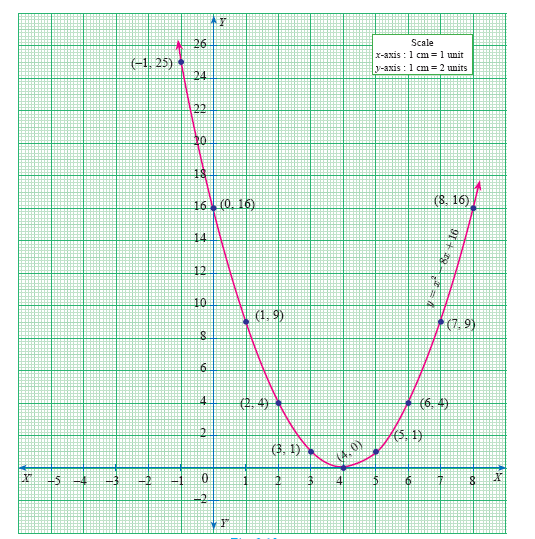
Step 3: Draw the parabola and mark the coordinates of the parabola which intersect with the X axis.
Step 4: The roots of the equation are the x coordinates of the intersecting points of the parabola with the X axis (4,0) which is 4.
Since there is only one point of intersection with X axis, the quadratic equation x2 - 8x + 16 = 0 has real and equal roots.
44.
y=x2+3x-4
| x | -4 | -3 | -2 | -1 | 0 | 1 | 2 | 3 | 4 |
| x2 | 16 | 9 | 4 | 1 | 0 | 1 | 4 | 9 | 16 |
| 3x | -12 | -9 | -6 | -3 | 0 | 3 | 6 | 9 | 12 |
| -4 | -4 | -4 | -4 | -4 | -4 | -4 | -4 | -4 | -4 |
| y=x2+3x-4 | 0 | -4 | -6 | -6 | -4 | 0 | 6 | 14 | 24 |
Draw the parabola using the points (-4, 0), (-3, -4), (-2, -6), (-1, -6), (0, -4), (1, 0), (2, 6), (3, 14), (4,24).
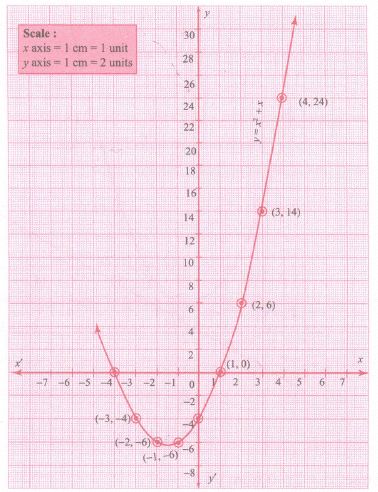
To solve: X2 + 3x - 4 = 0 subtract X2 + 3x - 4 = 0 from y = X2 + 3x - 4
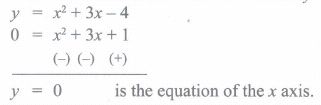
The points of intersection of the parabola with the x axis are the points (-4, 0) and (1, 0), whose x - co-ordinates (-4, 1) is the solution, set for the equation X2 + 3x - 4 = 0.
45.
Given radius r = 3.6 cm
Length of the tangents PA = PB = 6.2cm
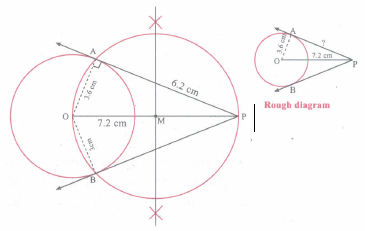
Construction:
Steps
(1) with centre at o, drawn a circle of radius 3.6 cm.
(2) Draw a line OP = 7.2 cm,
(3) Draw a perpendicular bisector of OP, which cuts OP at M.
(4) With M as centre and MO as radius, draw a circle which cuts previous circle at A and B.
(5) Join AP and BP. AP and BP are the required tangents. Thus length of the tangents are PA = PB = 6.2 cm.
46.
Given, diameter (d) = 6 cm, we find radius \((r)=\cfrac { 6 }{ 2 } =3cm\)
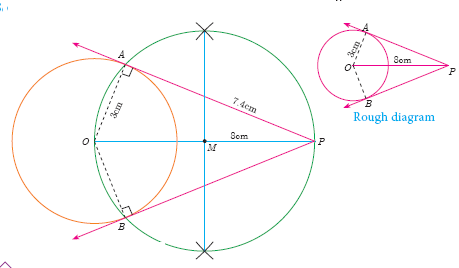
Construction
Step 1: With centre at O, draw a circle of radius 3 cm.
Step 2: Draw a line OP of length 8 cm.
Step 3: Draw a perpendicular bisector of OP, which cuts OP at M.
Step 4: With M as centre and MO as radius, draw a circle which cuts previous circle at A and B.
Step5: Join AP and BP. AP and BP are the required tangents. Thus length of the tangents are PA = PB = 7.4 cm.
Verification : In the right angle triangle OAP,PA2 = OP2 - OA2 = 64 -9 = 55
\(PA=\sqrt { 55= } 7.4\ cm\) (approximately) .

10th Standard Syllabus & Materials
10th Standard
TN 10th English Prose - 2 - The Night the Ghost Got in Important Questions And Answers Study Material - QB365 Set A
NEW10th Standard
TN 10th English Supplementary - 1 - The Tempest Important Questions And Answers Study Material - QB365 Set A
NEW10th Standard
TN 10th English Poem - 1 - Life Important Questions And Answers Study Material - QB365 Set A
NEW10th Standard
TN 10th English Prose - 1 - His First Flight Important Questions And Answers Study Material - QB365 Set A



Tamilnadu Stateboard 10th Standard Subjects
Tamilnadu Stateboard Standards





