
 100% FREE ACCESS
10th Standard Syllabus & Materials
10th Standard
TN 10th English Prose - 4 - The Attic Important Questions And Answers Study Material - QB365 Set A
NEW10th Standard
TN 10th English Supplementary - 3 - The Story of Mulan Important Questions And Answers Study Material - QB365 Set A
NEW10th Standard
TN 10th English Poem - 3 - I am Every Woman Important Questions And Answers Study Material - QB365 Set A
NEW10th Standard
TN 10th English Prose - 3 - Empowered Women Navigating The World Important Questions And Answers Study Material - QB365 Set A
NEW10th Standard
TN 10th English Supplementary - 2 - Zigzag Important Questions And Answers Study Material - QB365 Set A
NEW10th Standard
TN 10th English Poem - 2 - The Grumble Family Important Questions And Answers Study Material - QB365 Set A

Published on: 13/05/2020
10th Standard Maths English Medium Model Question Paper Part - II
Download Tamil Nadu 10th Standard Maths question papers, model tests, one-mark questions, important questions, and public exam papers in PDF format. Free study materials and answer keys for TN State Board students.
Questions + Answers key
Take MCQ Maths Test1.
2.
3.
4.
Variance of first 20 natural numbers is
32.25
44.25
33.25
30
5.
a cot \(\theta \) + b cosec\(\theta \) = p and b cot \(\theta \) + a cosec\(\theta \) = q then p2- q2 is equal to
a2 - b2
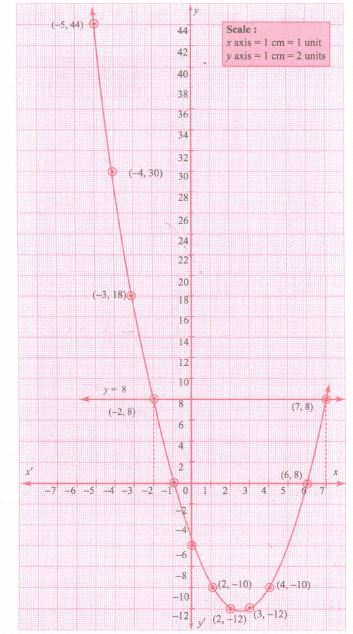
b2 - a2
a2 + b2
b - a
6.
If sin \(\theta \) + cos\(\theta \) = a and sec \(\theta \) + cosec \(\theta \) = b, then the value of b(a2 - 1) is equal to
2a
3a
0
2ab
7.
The value of (13 + 23 + 33 +...+153) - (1 + 2 + 3 +...+ 15)is
14400
14200
14280
14520
8.
If A is a point on the Y axis whose ordinate is 8 and B is a point on the X axis whose abscissae is 5 then the equation of the line AB is
8x + 5y = 40
8x - 5y = 40
x = 8
y = 5
9.
In a \(\triangle\)ABC, AD is the bisector \(\angle\)BAC. If AB = 8 cm, BD = 6 cm and DC = 3 cm. The length of the side AC is
6 cm
4 cm
3 cm
8 cm
10.
If \(\triangle\)ABC is an isosceles triangle with \(\angle\)C = 90o and AC = 5 cm, then AB is
2.5 cm
5 cm
10 cm
\(5\sqrt { 2 } \)cm
11.
A shuttle cock used for playing badminton has the shape of the combination of
a cylinder and a sphere
a hemisphere and a cone
a sphere and a cone
frustum of a cone and a hemisphere
12.
Let f(x) = \(\sqrt { 1+x^{ 2 } } \) then
f(xy) = f(x).f(y)
f(xy) ≥ f(x).f(y)
f(xy) ≤ f(x).f(y)
None of these
13.
If f: A ⟶ B is a bijective function and if n(B) = 7, then n(A) is equal to
7
49
1
14
14.
The number of points of intersection of the quadratic polynomial x2 + 4x + 4 with the X axis is
0
1
0 or 1
2
15.
Find the depth of a cylindrical tank of radius 28 m, if its capacity is equal to that of a rectangular tank of size 28 m x 16 m x 11 m.
16.
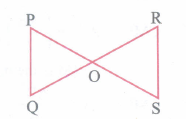
In figure if PQ || RS Prove that \(\Delta POQ\sim \Delta SOQ\)
17.
Find the standard deviation for the following data. 5, 10, 15, 20, 25. And also find the new S.D. if three is added to each value.
18.
Using quadratic formula solve the following equations.
p2x2 + (P2 -q2) X - q2 = 0
19.
Find the LCM and HCF of 6 and 20 by the prime factorisation method.
20.
Show that the points (1, 7), (4, 2), (-1,-1) and (-4,4) are the vertices of a square.
21.
Find
\(\frac { { x }^{ 2 }-16 }{ x+1 } \div \frac { x-4 }{ x+4 } \)
22.
The range of a set of data is 13.67 and the largest value is 70.08. Find the smallest value.
23.
Write the domain of the following real functions
f(x) = \(\frac { 2x+1 }{ x-9 } \)
24.
Find the equation of a line which passes through (5, 7) and makes intercepts on the axes equal in magnitude but opposite in sign.
25.
If the base area of a hemispherical solid is 1386 sq. metres, then find its total surface area?
26.
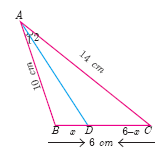
In the Figure, AD is the bisector of \(\angle\)BAC, if A = 10 cm, AC = 14 cm and BC = 6 cm. Find BD and DC.
27.
Find the nth term of the following sequences,
2, 5, 10, 17,....,
28.
prove that \(\sqrt { \frac { 1+cos\theta }{ 1-cos\theta } } \) = cosec \(\theta \) + cot\(\theta \)
29.
Graph the following quadratic equations and state their nature of solutions.
x2 + x + 7 = 0
30.
Draw the graph of y = x2 - 5x - 6 and hence solve x2 - 5x - 14 = 0
31.
Draw a tangent to the circle from the point P having radius 3.6 cm, and centre at O. Point P is at a distance 7.2 cm from the centre.
32.
Construct a \(\triangle\)PQR such that QR = 6.5 cm,\(\angle\)P = 60oand the altitude from P to QR is of length 4.5 cm.
33.
A ladder is placed against a wall such that its foot is at a distance of 2.5 m from the wall and its top reaches a window 6 m above the ground. Find the length of the ladder.
34.
If sin 3A = cos (A - 26°), where 3A is an acute angle, find the value at A.
35.
What is the ratio of the volume of a cylinder, a cone, and a sphere. If each has the same diameter and same height?
36.
C.V. of a data is 69%, S.D. is 15.6, then find its mean.
37.
In a flower bed, there are 23 rose plants in the first row, 21 in the second, 19 is the third, and so on. There are 5 rose plants in the last row. How many rows are there in the flower bed?
38.
If R = {(a, -2), (-5, b), (8, c), (d, -1)} represents the identity function, find the values of a, b, c and
39.
Find the value of k if the points A(2, 3), B(4, k) and (6, -3) are collinear.
40.
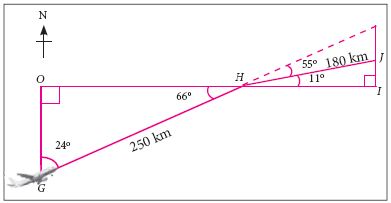
An Aeroplane sets of from G on bearing of 24° towards H, a point 250 km away, at H it changes course and heads towards J deviates further by 55° and a distance of 180 km away.
How far is J to the North of H?
.JPG)
\(\left( \begin{matrix} sin24°=0.4067\quad sin11°=0.1908 \\ cos24°=0.9135\quad cos11°=0.9816 \end{matrix} \right) \)
41.
Simplify
\(\frac { 5{ t }^{ 2 } }{ 4t-8 } \times \frac { 6t-12 }{ 10t } \)
42.
The King, Queen and Jack of the suit spade are removed from a deck of 52 cards. One card is selected from the remaining cards. Find the probability of getting
(i) a diamond
(ii) a queen
(iii) a spade
(iv) a heart card bearing the number 5.
43.
Find the equation of a straight line through the intersection of lines 5x − 6y = 2, 3x + 2y = 10 and perpendicular to the line 4x − 7y + 13 = 0
44.
Find the rational form of the number \(0.\bar { 123 } \)
45.
The internal and external diameter of a hollow hemispherical shell are 6 cm and 10 cm respectively. If it is melted and recast into a solid cylinder of diameter 14 cm, then find the height of the cylinder.
46.
Let A, B, C ⊆ N and a function f : A ⟶ B be defined by f(x) = 2x + 1 and g : B ⟶ C be defined by g(x) = x2. Find the range of f o g and g o f.
1.
(c)
2.
(c)
3.
(d)
4.
(c)
33.25
5.
(b)
b2 - a2
6.
(a)
2a
7.
(c)
14280
8.
(a)
8x + 5y = 40
9.
(b)
4 cm
10.
(d)
\(5\sqrt { 2 } \)cm
11.
(d)
frustum of a cone and a hemisphere
12.
(c)
f(xy) ≤ f(x).f(y)
13.
(a)
7
14.
(b)
1
15.
Volume of the cylindrical tank = Volume of the rectangle tank
πr2h = 28 x 16 x 11 m3

\(h=\frac { 16\times 11 }{ 88 } =2m\)
16.
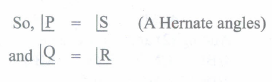
PQ II RS
Also

\(\angle \therefore \Delta POQ\sim \Delta SOR\) (AAA similarity criterion)
17.
| x | d' = \(\frac { x-15 }{ 5 } \) | d'2 |
| 5 | -2 | 4 |
| 10 | -1 | 1 |
| 15 | 0 | 0 |
| 20 | 1 | 1 |
| 25 | 2 | 4 |
| Σd = 0 | Σd'2 = 10 |
\(\bar { x } =\frac { \Sigma x }{ n } =\frac { 75 }{ 5 } \)=15
d'=\(\frac { x-\bar { x } }{ c } =\frac { x-A }{ c } \)
A is assumed mean c is common factor.
Here A= 15, C = 5
σ =\(\sqrt { \left( \frac { \Sigma d'^{ 2 } }{ n } \right) -\left( \frac { \Sigma d' }{ n } \right) ^{ 2 } } \) x c
=\(\sqrt { \frac { 10 }{ 5 } -0 } \) x c
=\(\sqrt { 2 } \) x 5
= 5\(\sqrt { 2 } \)
If 3 is added to each value, we get 8, 13, 18,23, 28 as new values.
| x | d' = \(\frac { x-18 }{ 5 } \) | d'2 |
| 8 | -2 | 4 |
| 13 | -1 | 1 |
| 18 | 0 | 0 |
| 23 | 1 | 1 |
| 28 | 2 | 4 |
| Σd' = 10 | Σd'2 = 10 |
∴ σ =\(\sqrt { \left( \frac { \Sigma d'^{ 2 } }{ n } \right) -\left( \frac { \Sigma d' }{ n } \right) ^{ 2 } } \) x c
=\(\sqrt { \frac { 10 }{ 5 } -0 } \) x 5
=\(\sqrt { 2 } \) x 5
= 5\(\sqrt { 2 } \)
S.D. doesn't change when a number is added or subtracted to the values.
18.
p2x2 + (P2 -Comparing this with ax' + bx + c = 0, we have
a=p2
b=p2-q2
c =-q2
D = b2-4ac
= (P2-q2)-4xp2x-q2
= (P2-q2)2+ 4p2 q2
= (P2+q2)2>0
So, the given equation has real roots given by
\(\alpha =\frac { -b-\sqrt { D } }{ 2a } =\frac { -({ p }^{ 2 }-{ q }^{ 2 })+({ p }^{ 2 }+{ q }^{ 2 }) }{ { 2p }^{ 2 } } \)
\(=\frac { { q }^{ 2 } }{ { p }^{ 2 } } \)
\(\beta =\frac { -b-\sqrt { D } }{ 2a } =\frac { -({ p }^{ 2 }-{ q }^{ 2 })+({ p }^{ 2 }+{ q }^{ 2 }) }{ { 2p }^{ 2 } } \)
=-1
19.
We have 6 = 21 x 31 and
20 = 2 x 2 x 5 = 22 x 51
You can find HCF (6, 20) = 2 and LCM (6, 20) = 2 x 2 x 3 x 5 = 60.
As done in your earlier classes. Note that HCF (6, 20) = 21 = product of the smallest power of each common prime factor in the numbers.
LCM (6, 20) = 22 x 31 x 51 = 60.
= Product of the greatest power of each prime factor, involved in the numbers.
20.
Let A(1, 7), B(4, 2), C(-1, -1) and D(-4, 4) be the given paints. One way at showing that ABCD is a square is to use the property that all its sides should be equal and both its diagonals should be equal.
Now,
AB = \(\sqrt { (1-4)^{ 2 }+(7-4)^{ 2 } } =\sqrt { 9+25 } =\sqrt { 34 } \)
BC = \(\\ \sqrt { (4+1)^{ 2 }+(2+1)^{ 2 } } =\sqrt { 25+9 } =\sqrt { 34 } \)
CD = \(\sqrt { (-1+4)^{ 2 }+(-1-4)^{ 2 } } =\sqrt { 9+25 } =\sqrt { 34 } \)
DA =\(\sqrt { (1+4)^{ 2 }+(7-4)^{ 2 } } =\sqrt { 25+9 } =\sqrt { 34 } \)
AC = \(\sqrt { (1+1)^{ 2 }+(7+1)^{ 2 } } =\sqrt { 4+64 } =\sqrt { 68 } \)
BD = \(\\ \sqrt { (4+4)^{ 2 }+(2-4)^{ 2 } } =\sqrt { 64+4 } =\sqrt { 68 } \)
Since, AB = BC = CD = DA and AC = BD, all the four sides at the quadrilateral ABCD are equal and its diagonals AC and BD are also equal. Therefore, ABCD is a square.
21.
\(\frac { { x }^{ 2 }-16 }{ x+4 } \div \frac { x-4 }{ x+4 } =\frac { \left( x+4 \right) \left( x-4 \right) }{ \left( x+4 \right) } \times \left( \frac { x+4 }{ x-4 } \right) \) = x + 4
22.
Range R = 13.67
Largest value L = 70.08
Range R = L - S
13.67 = 70.08-S
S = 70.08 - 13.67 = 56.41
Therefore, the smallest value is 56.41
23.
f(x) = \(\frac { 2x+1 }{ x-9 } \)
If x - 9 = 0,then
x = 9

The domain is all values of x that make the expression defined.
\(i.e., (-\infty, 9) \cup(9, \infty) \)
\(i.e., (x / x \neq 9) \Rightarrow R-\{9\}\)
24.
Let the x intercept be ‘a’ and y intercept be ‘– a’.
The equation of the line in intercept form is \(\frac { x }{ a } +\frac { y }{ b } =1\)
gives \(\frac { x }{ a } +\frac { y }{ -a } =1\) (Here b = – a)
Therefore, x − y = a ...(1)
Since (1) passes through (5, 7)
Therefore, 5 - 7 = a gives a = − 2
Thus the required equation of the straight line is x − y = − 2 ; or x − y + 2 = 0
25.
Let r be the radius of the hemisphere.
Given that, base area = \(\pi\)r2 = 1386 sq. m
T.S.A. = 3 \(\pi\)r2 sq.m
= 3 x 1386 = 4158
Therefore, T.S.A. of the hemispherical solid is 4158 m2.
26.
Let BD = x cm, then DC = (6 – x)cm
AD is bisector of\(\angle\) A
Therefore by Angle Bisector Theorem
\(\frac { AB }{ AC } =\frac { BD }{ DC } \)
\(\frac { 10 }{ 14 } =\frac { x }{ 6-x } \quad \frac { 5 }{ 7 } =\frac { x }{ 6-x } \)
So, 12x = 30 we get, \(x=\frac { 30 }{ 12 } =2.5\)
Therefore, BD = 2.5 cm, DC = 6−x = 6−2.5 = 3.5 cm
27.
2, 5, 10, 17,....,
= 12 + 1, 22 + 1, 32 + 1, 42 + 1 ...
Here every term is obtained by adding 1 to its square
The general term an = n2 + 1
28.
\(\sqrt { \frac { 1+cos\theta }{ 1-cos\theta } } \)=\(\sqrt { \frac { 1+cos\theta }{ 1-cos\theta } \times \frac { 1+cos\theta }{ 1+cos\theta } } \) [multiply numerator and denominator by the conjugate of 1 - cos\(\theta \)]
=\(\sqrt { \frac { (1+cos\theta { ) }^{ 2 } }{ (1-cos\theta { ) }^{ 2 } } } \) =\(\frac { 1+cos\theta }{ \sqrt { si{ n }^{ 2 }\theta } } \) [since sin2\(\theta \) + cos2\(\theta \) = 1]
=\(\frac { 1+cos\theta }{ sin\theta } =cosec\theta +cot\theta \)
29.
x2 + x + 7 = 0
Let y=x2+x+7
Step 1:
| x | -4 | -3 | -2 | -1 | 0 | 1 | 2 | 3 | 4 |
| x2 | 16 | 9 | 4 | 1 | 0 | 1 | 4 | 9 | 16 |
| 7 | 7 | 7 | 7 | 7 | 7 | 7 | 7 | 7 | 7 |
| y=x2-x+7 | 19 | 13 | 9 | 7 | 7 | 9 | 13 | 19 | 27 |
Step 2:
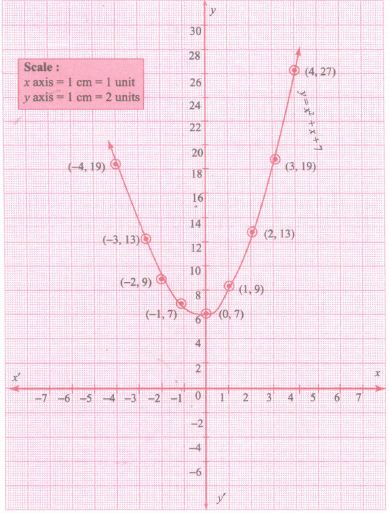
Points to be plotted: (-4, 19), (-3, 13), (-2, 9), (-1, 7), (0, 7), (1, 9), (2, 13), (3, 19), (4, 27)
Step 3:
Draw the parabola and mark the co-ordinates of the parabola which intersect with the x-axis.
Step 4:
The roots of the equation are the points of intersection of the parabola with the x axis. Here the parabola does not intersect the x axis at any point.
So, we conclude that there is no real roots for the given quadratic equation.
30.
| x | -5 | -4 | -3 | -2 | -1 | 0 | 1 | 2 | 3 | 4 |
| x2 | 25 | 16 | 9 | 4 | 1 | 0 | 1 | 4 | 9 | 16 |
| -5x | 25 | 20 | 15 | 10 | 5 | 0 | -5 | -10 | -15 | -20 |
| -6 | -6 | -6 | -6 | -6 | -6 | -6 | -6 | -6 | -6 | -6 |
| y=x2+5x-6 | 44 | 30 | 18 | 8 | 0 | -6 | -10 | -12 | -12 | -10 |
Draw the parabola using the points (-5, 44), (-4, 30), (-3, 18), (-2, 8), (-1, 10), (0, -6), (1, -10), (2, -12), (3, -12), (4, -10)
To solve the equation X2 - 5x - 14 = 0, subtract X2 - 5x - 14 = 0 from y = X2 - 5x - 6.
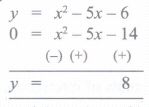 is a straight line parallel to x axis.
The co-ordinates of the points of intersection of the line and the parabola forms the solution set for the
equation X2 - 5x - 14 = 0.
∴ Solution {-2, 7}
31.
Given radius r = 3.6 cm
Length of the tangents PA = PB = 6.2cm
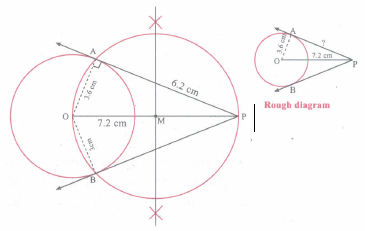
Construction:
Steps
(1) with centre at o, drawn a circle of radius 3.6 cm.
(2) Draw a line OP = 7.2 cm,
(3) Draw a perpendicular bisector of OP, which cuts OP at M.
(4) With M as centre and MO as radius, draw a circle which cuts previous circle at A and B.
(5) Join AP and BP. AP and BP are the required tangents. Thus length of the tangents are PA = PB = 6.2 cm.
32.
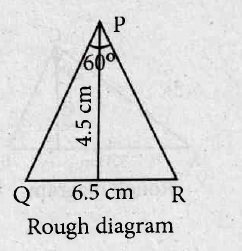
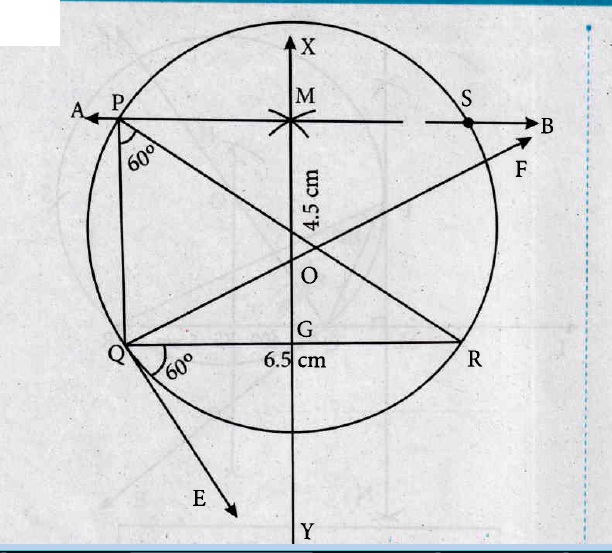
Construction:
Steps (1) Draw QR = 6.5 cm.
Steps (2) Draw \(\angle RQE={ 60 }^{ 0 }\)
Steps (3) Draw \(\angle FQE={ 90 }^{ 0 }\)
Steps (4) Drawn the perpendicular bisector XY to ER which intersects QF at O and ER at G.
Steps (5) With O as center and OQ as radius drawn a circle
Steps (6) XY intersects QR at G. On XY, from G marked an arc at M, such that GM = 4.5 cm
Steps (7) Drawn AB through M which is parallel to QR
Steps (8) AB meets the circle at P and S
Steps (9) Joined QP and RP Then \(\triangle\)PQR is the required triangle.
Steps (10) Here \(\triangle\)SQR is also another required triangle.
33.
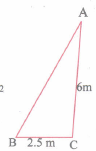
Let AB be the ladder and CA be the wall with . the window at A.
Also, BC = 2.5 m and CA = 6 m
From Pythagoras theorem
AB2 = BC2+ CA2
= (2.5)2 + (6)2
= 42.25
AB = 6.5
Thus, length at the ladder is 6.5 m.
34.
We are given that sin 3A = cos (A - 26°) ...(1)
Since sin 3A = cos(90° - 3A) we can write (1) as
cos (90° - 3A) = cos (A - 26°)
Since 90° - 3A and A - 26° are both acute angles
90° - 3A = A - 26°
which gives A = 29°
35.
Volume of a cylinder \(=\pi { r }^{ 2 }h\)
Volume of a cone \(=\frac { 1 }{ 3 } \pi { r }^{ 2 }h\)
Volume of a sphere \(=\frac { 4 }{ 3 } \pi { r }^{ 3 }\)
Their ratio V1 : V2 : V3
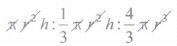
\(h:\frac { h }{ 3 } :\frac { 4r }{ 3 } \)
3h: h: 4r
3h : h : 2(2r) (where 2r = h)
∴ V1 : V2 : V3 = 3: 1 : 2
36.
CV =\(\frac { \sigma }{ \bar { x } } \) x 100 ⇒ \(\bar { x } =\frac { \sigma }{ CV } \) x 100
\(\bar { x } =\frac { 15.6 }{ 6.9 } \) x 100 = 22.6
37.
The number of rose plants in the 1st, 2nd, 3rd, . . . rows are
23,21, 19, ... 5
It forms an A.P.
Let the number of rows in the flower bed be n.
Then a = 23, d = 21 - 23 = -2/a = 5.
As, an = a + (n - 1)d i.e. tn = a + (n - 1)d
We have 5 = 23 + (n - 1)(-2)
i.e. -18 = (n - 1)(-2)
n = 10
ஃ There are 10 rows in the flower bed.
38.
R = {(a, -2), (-5, b), (8, c), (d, -1)} represents the identity function.
a = -2, b = -5, c = 8, d = -1.
39.
Since the given points are collinear, the area a the triangle formed by them must be 0, i.e.,
= \(\frac { 1 }{ 2 } \) [2(k + 3) + 4(-3 - 3) + 6(3 - k)] = 0
= \(\frac { 1 }{ 2 } \) [-4k] = 0
k = 0
Area of ΔABC
= \(\frac { 1 }{ 2 } \)[2(0 + 3) + 4(-3 - 3) + 6(3 - 0)] = 0
40.
In right triangle HIJ,
sin11° =\(\frac { IJ }{ HJ } \)
0.1908 = \(\frac { IJ }{ 180 } \); IJ = 34.34 km
Distance of J to the North of H = 34.34km.
41.
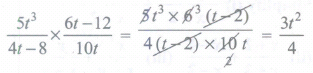
42.
King spade, Queen spade, Jack spade are removed
∴ total number of cards = 52 - 3 = 49.
(i) Probability (diamond)= \(\frac { 13 }{ 49 } \)
(ii) Probability (queen) \(\frac { 4-1 }{ 49 } =\frac { 3 }{ 49 } \)
(iii) Probability (spade) = \(\frac { 13-3 }{ 49 } =\frac { 10 }{ 49 } \)
(iv) Probability (heart bearing number 5) = \(\frac { 13-5 }{ 49 } =\frac { 8 }{ 49 } \)
43.
Given lines are 5x - 6y - 2 and 3x + 2y = 10.
Let us solve the equations to get the point of intersection
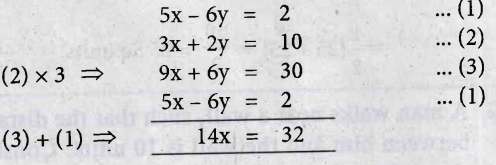
\(x=\frac{32}{14}=\frac{16}{7} \)
Substituting \(x=\frac{16}{7} \text { in }(2) \)
\(3\left(\frac{16}{7}\right)+2 y =10 \)
\(2 y =10-\frac{48}{7}=\frac{22}{7} \)
\(y =\frac{11}{7} \)
The point of intersection is \(\left(\frac{16}{7}, \frac{11}{7}\right)\)
Slope of the line 4x - 7y + 13 = 0 is
\(-\frac{a}{b}=\frac{-4}{-7}=\frac{4}{7}\)
Slope of the perpendicular line is \(-\frac{7}{4}\)
Now, equation of the line passing through \(\left(\frac{16}{7}, \frac{11}{7}\right)\) and having slope \(m=-\frac{7}{4}\) is
\(y-y_{1} =m\left(x-x_{1}\right) \)
\(y-\frac{11}{7} =\frac{-7}{4}\left(x-\frac{16}{7}\right) \)
\(\frac{7 y-11}{7} =\frac{-7 x}{4}+4 \)
28y - 44 = -49x + 112
49x + 28y - 156 = 0
44.
We have \(0.\overline { 123 } \) = 0.123123123....
= 0.123 + 0.000123 + 0.000000123 +....
\(\frac{t_{2}}{t_{1}}=\frac{0.000123}{0.123}=\frac{0.123}{123}=0.001\)
It is a G.P. with a = 0.123 and r = 0.001
Sum of infinity \(=\frac{a}{1-r}
\)
\(=\frac{0.123}{1-0.001}=\frac{0.123}{1-\frac{1}{1000}}
\)
\(=\frac{0.123}{\frac{999}{1000}}=\frac{123}{999}
\)
\(\therefore 0 . \overline{123}=\frac{41}{333}\)
45.
Hollow Hemisphere
Internal diameter = 6 cm
Internal radius 'r' = 3 cm
External diameter = 10 cm
External radius 'R' = 5 cm
\(\left.\begin{array}{l} \text { Volume of hemisphere (or) } \\ \text {Volume of material used } \end{array}\right\}=\frac{2}{3} \pi\left(\mathrm{R}^{3}-\mathrm{r}^{3}\right) \text { cu. units }\)
\(=\frac{2}{3} \pi\left(5^{3}-3^{3}\right) \)
\(=\frac{2}{3} \pi(125-27)=\frac{196 \pi}{3} \mathrm{~cm}^{3} \)
Cylinder
Diameter = 14 cm
radius = 7 cm
height = h
Volume of cylinder \(=\pi r^{2} h\ cu. units \)
\(=\pi(7)^{2} h \)
\(=49 \pi h \mathrm{~cm}^{3} \)
Given that hollow hemisphere is melted and cast into a solid cylinder
Volume of cylinder = volume of hollow hemisphere
\(49 \pi h =\frac{196 \pi}{3} \)
\(h =\frac{196}{3 \times 49}=\frac{4}{3}=1.33 \)
Height of the cylinder = 1.33 cm.
46.
A, B, C ⊆ N
f : A ⟶ B be defined by f(x) = 2x + 1
g : B ⟶ C be defined by g(x) = x2
f o g = f [g (x)] = f(x2) = 2x2 + 1
g o f = g [f (x)] = g(2x - 1) = (2x + 1)2
= 4x2 + 4x + 1
'x can take any real value and can produce any real value. Thus, the domain and range of f o g and g o f is R (Set of real numbers).

10th Standard Syllabus & Materials
10th Standard
TN 10th English Prose - 2 - The Night the Ghost Got in Important Questions And Answers Study Material - QB365 Set A
NEW10th Standard
TN 10th English Supplementary - 1 - The Tempest Important Questions And Answers Study Material - QB365 Set A
NEW10th Standard
TN 10th English Poem - 1 - Life Important Questions And Answers Study Material - QB365 Set A
NEW10th Standard
TN 10th English Prose - 1 - His First Flight Important Questions And Answers Study Material - QB365 Set A



Tamilnadu Stateboard 10th Standard Subjects
Tamilnadu Stateboard Standards





