
 100% FREE ACCESS
10th Standard Syllabus & Materials
10th Standard
TN 10th English Prose - 4 - The Attic Important Questions And Answers Study Material - QB365 Set A
NEW10th Standard
TN 10th English Supplementary - 3 - The Story of Mulan Important Questions And Answers Study Material - QB365 Set A
NEW10th Standard
TN 10th English Poem - 3 - I am Every Woman Important Questions And Answers Study Material - QB365 Set A
NEW10th Standard
TN 10th English Prose - 3 - Empowered Women Navigating The World Important Questions And Answers Study Material - QB365 Set A
NEW10th Standard
TN 10th English Supplementary - 2 - Zigzag Important Questions And Answers Study Material - QB365 Set A
NEW10th Standard
TN 10th English Poem - 2 - The Grumble Family Important Questions And Answers Study Material - QB365 Set A

Published on: 13/05/2020
10th Standard Maths English Medium Model Question Paper Part - IV
Download Tamil Nadu 10th Standard Maths question papers, model tests, one-mark questions, important questions, and public exam papers in PDF format. Free study materials and answer keys for TN State Board students.
Questions + Answers key
Take MCQ Maths Test1.
If x = a sec θ and = b tan θ, then b2x2 - a2y2 is equal to ___________
ab
a2-b2
a2+b2
a2b2
2.
The sum of first n terms of the series a, 3a, 5a...is ____________
na
(2n - 1)a
n2 - a
n2a2
3.
4.
If the mean and coefficient of variation of a data are 4 and 87.5% then the standard deviation is
3.5
3
4.5
2.5
5.
6.
If sin \(\theta \) + cos\(\theta \) = a and sec \(\theta \) + cosec \(\theta \) = b, then the value of b(a2 - 1) is equal to
2a
3a
0
2ab
7.
If the HCF of 65 and 117 is expressible in the form of 65m - 117 , then the value of m is
4
2
1
3
8.
The point of intersection of 3x − y = 4 and x + y = 8 is
(5, 3)
(2, 4)
(3, 5)
(4, 4)
9.
In the adjacent figure \(\angle BAC\) = 90o and AD\(\bot \)BC then
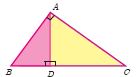
BD.CD = BC2
AB.AC = BC2
BD.CD = AD2
AB.AC = AD2
10.
In a \(\triangle\)ABC, AD is the bisector \(\angle\)BAC. If AB = 8 cm, BD = 6 cm and DC = 3 cm. The length of the side AC is
6 cm
4 cm
3 cm
8 cm
11.
12.
If f(x) = 2x2 and g(x) = \(\frac{1}{3x}\), then f o g is
\(\\ \frac { 3 }{ 2x^{ 2 } } \)
\(\\ \frac { 2 }{ 3x^{ 2 } } \)
\(\\ \frac { 2 }{ 9x^{ 2 } } \)
\(\\ \frac { 1 }{ 6x^{ 2 } } \)
13.
14.
Find the matrix X if 2X + \(\left( \begin{matrix} 1 & 3 \\ 5 & 7 \end{matrix} \right) =\left( \begin{matrix} 5 & 7 \\ 9 & 5 \end{matrix} \right) \)
\(\left(\begin{array}{cc} -2 & -2 \\ 2 & -1 \end{array}\right)\)
\(\left(\begin{array}{cc} 2 & 2 \\ 2 & -1 \end{array}\right)\)
\(\left(\begin{array}{ll} 1 & 2 \\ 2 & 2 \end{array}\right)\)
\(\left(\begin{array}{ll} 2 & 1 \\ 2 & 2 \end{array}\right)\)
15.
BL and CM are medians of a triangle ABC right angled at A.
Prove that 4(BL2 + CM2) = 5BC2.
16.
If sin (A - B) = \(\frac12\), cos (A + B) = \(\frac12\), 0o < A + ≤ 90°, A > B, find A and B.
17.
What is the ratio of the volume of a cylinder, a cone, and a sphere. If each has the same diameter and same height?
18.
Find the co-efficient of variation for the following data: 16, 13, 17,21, 18.
19.
Which of the following list of numbers form an AP? If they form an AP, write the next two terms:
-2, 2, -2, 2, -2
20.
A function f: (1,6) \(\rightarrow\)R is defined as follows:
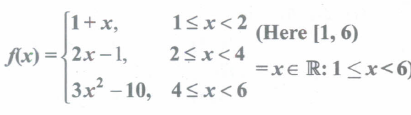
Find the value of f(3),
21.
If the points A(6, 1), B(8, 2), C(9, 4) and D(P, 3) are the vertices of a parallelogram, taken in order. Find the value of P.
22.
Let A = {x \(\in \) W| x < 2}, B = {x \(\in \) N| 1 < x ≤ 4} and C = (3,5). Verify that
(A U B) x C = (A x C) U (B x C)
23.
In a box there are 20 non-defective and some defective bulbs. If the probability that a bulb selected at random from the box found to be defective is \(\frac{3}{8}\) then, find the number of defective bulbs.
24.
A cone of height 24 cm is made up of modeling clay. A child reshapes it in the form of a cylinder of same radius as cone. Find the height of the cylinder.
25.
Find the equation of the median and altitude of Δ ABC through A where the vertices are A(6, 2), B(-5,-1) and C(1, 9)
26.
prove the following identities.
sec6\(\theta \) = tan6\(\theta \) + 3tan2\(\theta \)sec2\(\theta \) + 1
27.
If the radii of the circular ends of a frustum which is 45 cm high are 28 cm and 7 cm, find the volume of the frustum.
28.
Iniya bought 50 kg of fruits consisting of apples and bananas. She paid twice as much per kg for the apple as she did for the banana. If Iniya bought Rs. 1800 worth of apples and Rs. 600 worth bananas, then how many kgs of each fruit did she buy?
29.
Find the least number that is divisible by the first ten natural numbers.
30.
Find the depth of a cylindrical tank of radius 28 m, if its capacity is equal to that of a rectangular tank of size 28 m x 16 m x 11 m.
31.
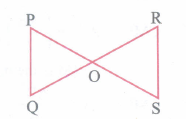
In figure if PQ || RS Prove that \(\Delta POQ\sim \Delta SOQ\)
32.
Find the standard deviation for the following data. 5, 10, 15, 20, 25. And also find the new S.D. if three is added to each value.
33.
Solve the following system of linear equations in three variables.
x + y + z = 6; 2x + 3y + 4z = 20;
3x + 2y + 5z = 22
34.
Prove that \(\sqrt { 3 } \) is irrational
35.
Show that the points (1, 7), (4, 2), (-1,-1) and (-4,4) are the vertices of a square.
36.
Find the range and coefficient of range of the following data.
43.5, 13.6, 18.9, 38.4, 61.4, 29.8
37.
Multiply \(\frac { { x }^{ 4 }{ b }^{ 2 } }{ x-1 } \) by \(\frac { { x }^{ 2 }-1 }{ { a }^{ 4 }{ b }^{ 3 } } \)
38.
The horizontal distance between two buildings is 70 m. The angle of depression of the top of the first building when seen from the top of the second building is 45°. If the height of the second building is 120 m, find the height of the first building.
39.
Find the 19th term of an A.P. -11, -15, -19,....
40.
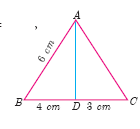
In the figure, AD is the bisector of \(\angle\)A. If BD = 4 cm, DC = 3 cm and AB = 6 cm, find AC.
41.
Represent the function f = {(1,2),(2,2),(3,2),(4,3),(5,4)} through
(i) an arrow diagram
(ii) a table form
(iii) a graph
42.
In each of the following, find the value of ‘a’ for which the given points are collinear. (2, 3), (4, a) and (6, –3)
43.
Discuss the nature of solutions of the following quadratic equations.
x2 + 2x + 5 = 0
44.
Draw the graph of y = x2 + 3x + 2 and use it to solve x2 + 2x + 1 = 0
45.
Draw the two tangents from a point which is 5 cm away from the centre of a circle of diameter 6 cm. Also, measure the lengths of the tangents
46.
Construct a \(\triangle\)PQR such that QR = 6.5 cm,\(\angle\)P = 60oand the altitude from P to QR is of length 4.5 cm.
1.
(d)
a2b2
2.
(c)
n2 - a
3.
(b)
4.
(a)
3.5
5.
(d)
6.
(a)
2a
7.
(b)
2
8.
(c)
(3, 5)
9.
(c)
BD.CD = AD2
10.
(b)
4 cm
11.
(a)
12.
(c)
\(\\ \frac { 2 }{ 9x^{ 2 } } \)
13.
(a)
14.
(b)
\(\left(\begin{array}{cc} 2 & 2 \\ 2 & -1 \end{array}\right)\)
15.
BL and CM are medians at the \(\triangle\)ABC in which
\(A=\angle { 90 }^{ 0 }\)
From \(\triangle\)ABC
BC2 = AB2 + AC2
(Pythagoras theorem)
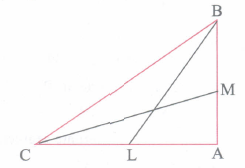
From \(\Delta ABL\)
BL2 = AL2 + AB2
\({ BL }^{ 2 }=\left( \cfrac { { AC }^{ 2 } }{ 2 } \right) +{ AB }^{ 2 }\)
(L is the mid-point at AC)
\({ BL }^{ 2 }=\cfrac { { AC }^{ 2 } }{ 4 } +{ AB }^{ 2 }\)
4BL2 = AC2 + 4AB2
From \(\Delta CMA\)
CM2 = AC2 + AM2
\({ CM }^{ 2 }={ Ac }^{ 2 }+\left( \cfrac { AB }{ 2 } \right) ^{ 2 }\)
(M is the mid-point at AB)
\({ CM }^{ 2 }={ AC }^{ 2 }+\cfrac { { AB }^{ 2 } }{ 4 } \)
4CM2 = 4AC2+ AB2
Adding (2) and (3), we have
4(BL2 + CM2) = 5(AC2 + AB2)
4(BL2 + CM2) = 5BC2
16.
Since, sin(A - B) = \(\frac12\), ∴ A-B = 30° ..... (1)
Also, since cos (A + B) = \(\frac12\)
∴ A + B = 60° ...(2)
Solving (1) and (2)
A - B + A + B = 30o + 60o
2A = 90o
A = 45o
We get,
A = 45° and B = 15°
17.
Volume of a cylinder \(=\pi { r }^{ 2 }h\)
Volume of a cone \(=\frac { 1 }{ 3 } \pi { r }^{ 2 }h\)
Volume of a sphere \(=\frac { 4 }{ 3 } \pi { r }^{ 3 }\)
Their ratio V1 : V2 : V3
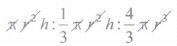
\(h:\frac { h }{ 3 } :\frac { 4r }{ 3 } \)
3h: h: 4r
3h : h : 2(2r) (where 2r = h)
∴ V1 : V2 : V3 = 3: 1 : 2
18.
Mean \(\bar { x } \) = \(\frac { 16+13+17+21+18 }{ 5 } =\frac { 85 }{ 5 } \) = 17
| x | d = x - 17 | d2 |
| 16 | -1 | 1 |
| 13 | -4 | 16 |
| 17 | 0 | 0 |
| 21 | 4 | 16 |
| 18 | 1 | 1 |
| Σd = 0 | Σd2 = 34 |
σ =\(\sqrt { \frac { \Sigma d^{ 2 } }{ n } } =\sqrt { \frac { 34 }{ 5 } } =\sqrt { 638 } \)
σ = 2.61
Co-efficient of variation
CV = \(\frac { \sigma }{ \bar { x } } \) x 100 = \(\frac { 2.61 }{ 17 } \) x 100
= 15.35%
19.
-2, 2, -2, 2, -2
t2 - t1 = 2-(-2) = 4
t3 - t2 = -2 -2 = -4
t4 - t3 = 2 - (-2) = 4
It is not an A.P.
20.
f(3) =. 2x - 1
= 2(3) - 1 = 6 - 1 = 5
21.
We know that diagonals at a parallelogram bisect each other.
So, the coordinates of the mid-point at AC = coordinates of the mid-point at BD.
i.e., \(\left[ \frac { 6+9 }{ 2 } ,\frac { 1+4 }{ 2 } \right] =\left[ \frac { 8+P }{ 2 } ,\frac { 2+3 }{ 2 } \right] \)
\(\left[ \frac { 15 }{ 2 } ,\frac { 5 }{ 2 } \right] =\left[ \frac { 8+P }{ 2 } ,\frac { 5 }{ 2 } \right] \)
\(\frac { 15 }{ 2 } =\frac { 8+P }{ 2 } \)
P = 7
22.
(A U B) x C = (A x C) U (B x C)
A = {0,1} , B = {2,3,4} , C = {3,5}
\(A\cup B\) = {0,1,2,3,4}
\((A\cup B)\times C\) = {0,1,2,3,4} x {3,5}
= {(0,3),(0,5),(1,3),(1,5),(2,3),(2,5),(3,3),(3,5),(4,3),(4,5)} ...(1)
A x C = {0,1} x {3,5}
= {(0,3),(0,5),(1,3),(1,5)}
B x C = {2,3,4} x {3,5}
= {(2,3),(2,5),(3,3),(3,5),(4,3),(4,5)}
\((A\times C)\cup (B\times C)\) = {(0,3),(0,5),(1,3),(1,5),(2,3),(2,5),(3,3),(3,5),(4,3),(4,5)} .....(2)
From (1) and (2), it is clear that
(A U B) x C = (A x C) U (B x C)
Hence verified.
23.
Number of non defective bulbs = 20.
Let x be the number of defective bulbs
Then total number of bulbs n(s) = 20 + x
Let 'A' be the event of getting defective bulbs
\(\mathrm{P}(\mathrm{A})=\frac{x}{20+x}=\frac{3}{8}\)
8x = 3 (20 + x)
8x = 60 + 3x
8x - 3x = 60
5x = 60
\(x=\frac{60}{5}\)
x = 12
Number of defective bulbs = 12
24.
Let h1 and h2 be the heights of a cone and cylinder respectively.
Also, let r be the radius of the cone.
Given that, height of the cone h1 = 24 cm; radius of the cone and cylinder r = 6 cm
Since, Volume of cylinder = Volume of cone
\({ \pi r }^{ 2 }=\frac { 1 }{ 3 } { \pi r }^{ 2 }{ h }_{ 1 }\)
\({ h }_{ 2 }=\frac { 1 }{ 3 } \times { h }_{ 1 }\quad gives\quad { h }_{ 2 }=\frac { 1 }{ 3 } \times 24=8\)
Therefore, height of cylinder is 8 cm
25.
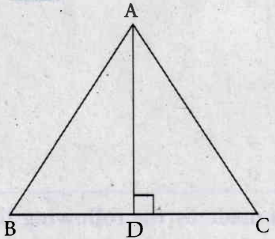
Given vertices are A (6, 2), B (- 5, - 1) and C (1, 9)
Median through A :
Let D be the mid point of BC
Mid point of BC \(=\mathrm{D}\left(\frac{x_{1}+x_{2}}{2}, \frac{y_{1}+y_{2}}{2}\right) \)
\(=\mathrm{D}\left(\frac{-5+1}{2}, \frac{-1+9}{2}\right) \)
= D (-2 , 4)
Now AD is the median.
Equation of AD \(\frac{y-y_{1}}{y_{2}-y_{1}}=\frac{x-x_{1}}{x_{2}-x_{1}}\)
\(\frac{y-2}{4-2}=\frac{x-6}{-2-6} \)
\(\frac{y-2}{2}=\frac{x-6}{-8} \)
- 4y + 8 = x - 6
x + 4y - 14 = 0
Altitude through A
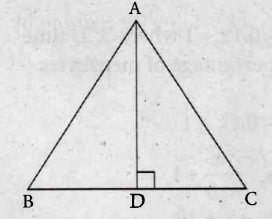
Altitude is passing through 'A' and perpendicular to BC.
Now,
Slope of BC = \(\frac{y_{1}-y_{2}}{x_{1}-x_{2}}=\frac{-1-9}{-5-1}=\frac{-10}{-6}=\frac{5}{3}\)
Slope of Altitude \(=-\frac{3}{5}\)
Equation of the altitude which is passing through A (6,2)and having slope \(-\frac{3}{5}\) is
y - y1 = m(x - x1)
\(y-2=-\frac{3}{5}(x-6)\)
5y- 10 = -3x + 18
3x + 5y - 28 = 0
26.
LHS = sec6\(\theta \)
= (sec2θ)3
= (1 + tan2θ)3
\(
=1^{3}+\left(\tan ^{2} \theta\right)^{3}+3(1)\left(\tan ^{2} \theta\right)\left(1+\tan ^{2} \theta\right)
\)
\({\left[\because(a+b)^{3}=a^{3}+b^{3}+3 a b(a+b)\right]}
\)
\(=1+\tan ^{6} \theta+3 \tan ^{2} \theta\left(\sec ^{2} \theta\right)\)
= tan6θ + 3tan2θ sec2θ + 1
= RHS
27.
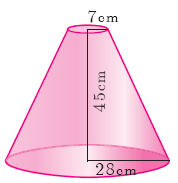
Let h, r and R be the height, top and bottom radii of the frustum.
Given that, h = 45 cm, R = 28 cm, r = 7 cm
Now, Volume \(=\frac { 1 }{ 3 } \pi \left[ { R }^{ 2 }+Rr+{ r }^{ 2 } \right] h\quad cu.units\)
\(=\frac { 1 }{ 3 } \times \frac { 22 }{ 7 } \times \left[ { 28 }^{ 2 }+(28\times 7)+{ 7 }^{ 2 } \right] \times 45\)
\(=\frac { 1 }{ 3 } \times \frac { 22 }{ 7 } \times 1029\times 45=48510\)
Therefore, volume of the frustum is 48510 cm3
28.
Let the weight of applies be a kg.
Let the weight of bananas be b kg.
a+b = 50
ax = Rs. 1800...(1)
by = Rs. 600 ..(2)
x = 2y ....(3)
Use (3) in (1) ⇒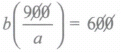
∵ 3b = 2a ....(5)
∵ a + b = 50
\(a+\frac { 2a }{ 3 } =50\Rightarrow \frac { 5a }{ 3 } =50\)
\(\Rightarrow a=50\times \frac { 3 }{ 5 } \)
= 30
∴ b = 20
∴ Iniya bought 30kg of applies and 20 kg of bananas.
29.
The required number is the L.C.M. of first ten natural numbers
i.e., L.C.M. of (1,2,3,4,5,6,7,8,9,10)
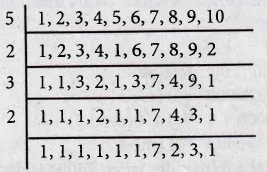
L.C.M. is 5 x 2 x 3 x 2x7 x 2 x 3 = 2520
The least number divisible by first ten natural numbers is 2520.
30.
Volume of the cylindrical tank = Volume of the rectangle tank
πr2h = 28 x 16 x 11 m3

\(h=\frac { 16\times 11 }{ 88 } =2m\)
31.
PQ II RS
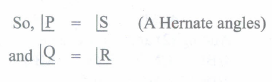
Also

\(\angle \therefore \Delta POQ\sim \Delta SOR\) (AAA similarity criterion)
32.
| x | d' = \(\frac { x-15 }{ 5 } \) | d'2 |
| 5 | -2 | 4 |
| 10 | -1 | 1 |
| 15 | 0 | 0 |
| 20 | 1 | 1 |
| 25 | 2 | 4 |
| Σd = 0 | Σd'2 = 10 |
\(\bar { x } =\frac { \Sigma x }{ n } =\frac { 75 }{ 5 } \)=15
d'=\(\frac { x-\bar { x } }{ c } =\frac { x-A }{ c } \)
A is assumed mean c is common factor.
Here A= 15, C = 5
σ =\(\sqrt { \left( \frac { \Sigma d'^{ 2 } }{ n } \right) -\left( \frac { \Sigma d' }{ n } \right) ^{ 2 } } \) x c
=\(\sqrt { \frac { 10 }{ 5 } -0 } \) x c
=\(\sqrt { 2 } \) x 5
= 5\(\sqrt { 2 } \)
If 3 is added to each value, we get 8, 13, 18,23, 28 as new values.
| x | d' = \(\frac { x-18 }{ 5 } \) | d'2 |
| 8 | -2 | 4 |
| 13 | -1 | 1 |
| 18 | 0 | 0 |
| 23 | 1 | 1 |
| 28 | 2 | 4 |
| Σd' = 10 | Σd'2 = 10 |
∴ σ =\(\sqrt { \left( \frac { \Sigma d'^{ 2 } }{ n } \right) -\left( \frac { \Sigma d' }{ n } \right) ^{ 2 } } \) x c
=\(\sqrt { \frac { 10 }{ 5 } -0 } \) x 5
=\(\sqrt { 2 } \) x 5
= 5\(\sqrt { 2 } \)
S.D. doesn't change when a number is added or subtracted to the values.
33.
x + y + z = 6 ....(1)
2x + 3y + 4z = 20 ...(2)
3x + 2y + 5z = 22 ....(3)
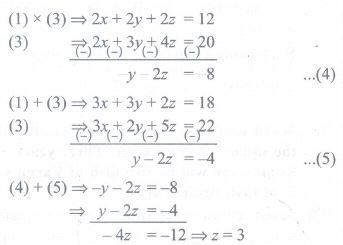
Sub. z = 3 in (5) ⇒ y - 2(3) =-4
y=2
Sub. y = 2, z = 3 in (1), we get
x+2+3=6
x=1
x= 1,y = 2, z = 3
34.
Let us assume the opposite, (1) \(\sqrt { 3 } \) is irrational.
Hence \(\sqrt { 3 } =\frac { p }{ q } \)
Where p and q (q ≠ 0) are co-prime (no common factor other than 1)
Hence, \(\sqrt { 3 } =\frac { p }{ q } \)
\(\sqrt { 3 } \)q = p
Squaring both side
\({ (\sqrt { 3 }q ) }^{ 2 }={ p }^{ 2 }\)
3q2 = p2
\({ q }^{ 2 }=\frac { p }{ 3 } \)
Hence, 3 divides p2 So 3 divides p also .....(1)
Hence we can say
\(\frac{p}{3}\) = c where c is some integer
s, p =p2
Putting p = 3c
3q2 = (3c)2
3q2 = 9c2
q2 = \(\frac13\) x 9c2
q2 = 3c2
\(\frac{9^2}{3}\) = c2
Hence 3 divides q2
So, 3 divides q also ...(2)
By (1) and (2) 3 divides both p and q
By contradiction \(\sqrt { 3 } \) is irrational.
35.
Let A(1, 7), B(4, 2), C(-1, -1) and D(-4, 4) be the given paints. One way at showing that ABCD is a square is to use the property that all its sides should be equal and both its diagonals should be equal.
Now,
AB = \(\sqrt { (1-4)^{ 2 }+(7-4)^{ 2 } } =\sqrt { 9+25 } =\sqrt { 34 } \)
BC = \(\\ \sqrt { (4+1)^{ 2 }+(2+1)^{ 2 } } =\sqrt { 25+9 } =\sqrt { 34 } \)
CD = \(\sqrt { (-1+4)^{ 2 }+(-1-4)^{ 2 } } =\sqrt { 9+25 } =\sqrt { 34 } \)
DA =\(\sqrt { (1+4)^{ 2 }+(7-4)^{ 2 } } =\sqrt { 25+9 } =\sqrt { 34 } \)
AC = \(\sqrt { (1+1)^{ 2 }+(7+1)^{ 2 } } =\sqrt { 4+64 } =\sqrt { 68 } \)
BD = \(\\ \sqrt { (4+4)^{ 2 }+(2-4)^{ 2 } } =\sqrt { 64+4 } =\sqrt { 68 } \)
Since, AB = BC = CD = DA and AC = BD, all the four sides at the quadrilateral ABCD are equal and its diagonals AC and BD are also equal. Therefore, ABCD is a square.
36.
43.5, 13.6, 18.9,38.4,61.4,29.8
Largest value L= 61.4
Smallest value S = 13.6
R = L - S
= 61.4 - 13.6 = 4
Co-efficient of range = \(\frac { L-S }{ L+S } \)
= \(\frac { 47.8 }{ 75 } =0.64\)
Range = 47.8; co-efficient of range = 0.64.
37.
\(\frac { { x }^{ 4 }{ b }^{ 2 } }{ x-1 } \times \frac { { x }^{ 2 }-1 }{ { a }^{ 4 }{ b }^{ 3 } } =\frac { { x }^{ 4 }\times { b }^{ 2 } }{ x-1 } \times \frac { \left( x+1 \right) \left( x-1 \right) }{ { a }^{ 4 }\times { b }^{ 3 } } =\frac { { x }^{ 4 }\left( x+1 \right) }{ { a }^{ 4 }b } \)
38.
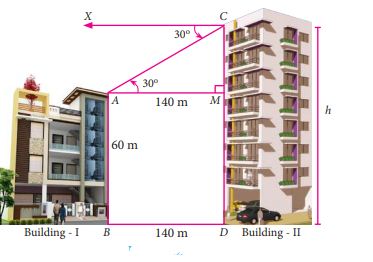
Let AD is the first building.
BC is the second building.
AD = BE = BC - CE
From the right triangle CED
\(\tan 45^{\circ} =\frac{C E}{D E} \)
\(1 =\frac{C E}{A B}=\frac{C E}{70 m} \)
CE = 70 m
BE = BC - EC
= 120 m - 70 m = 50 m
AD = 50 m
Height of the first building is 50 m.
39.
Given the A.P. - 11, - 15, - 19,....
Here First term a = - 11
Common difference d = t2 - t1 = - 15 - ( - 11)
= -15 + 11
d = - 4
nth term of an A.P. is tn = a + (n - 1)d
19th term (t19) = -11 + (19 - 1) (-4)
= -11 + 18 (- 4)
= -11 + (- 72) = -83
19th term of -11,-15, -19,...is - 83.
40.
In \(\triangle\)ABC, AD is the bisector of \(\angle\)A
Therefore by Angle Bisector of \(\angle\)A
\(\frac { AB }{ AC } =\frac { BD }{ DC } \)
\(\frac{4}{3}=\frac{6}{A C}\) gives 4AC = 18. Hence, AC \(=\frac{9}{2}=4.5 \mathrm{~cm}\)
41.
Given function f({1,2), (2,3), (3,2), (4,), (5,4)}
(i) An arrow diagram
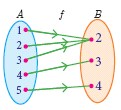
(ii) a table form
| x | 1 | 2 | 3 | 4 | 5 |
| f(x) | 2 | 2 | 2 | 3 | 4 |
(iii) A graph representation
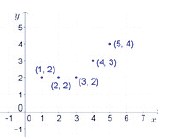
42.
Given points are (2, 3), (4, a) and (6, - 3)
Since the points are colinear, Area of triangle is zero
\(\text { i.e., } \frac{1}{2}\left[x_{1}\left(y_{2}-y_{3}\right)+x_{2}\left(y_{3}-y_{1}\right)+x_{3}\left(y_{1}-y_{2}\right)\right]=0\)
2(a + 3) + 4(- 3 -3) + 6(3 - a) = 0
2a + 6 - 24 + 18 - 6a = 0
-4a + 0 = 0
-4a = 0
a = 0
43.
x2 + 2x + 5 = 0
Let y = x2 + 2x + 5
Step 1 Prepare a table of values for the equation y = x2 + 2x + 5
| x | -3 | -2 | -1 | 0 | 1 | 2 | 3 |
| y | 8 | 5 | 4 | 5 | 8 | 13 | 20 |
Step 2: Plot the above ordered pairs(x, y) on the graph using suitable scale.
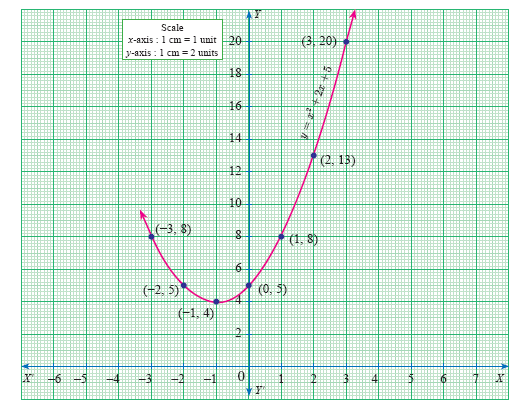
Step 3: Join the points by a free-hand smooth curve this smooth curve is the graph of y = x2 + 2x + 5
Step 4: The solutions of the given quadratic equation are the x coordinates of the intersecting points of the parabola the X axis.
Here the parabola doesn’t intersect or touch the X axis.
So, we conclude that there is no real root for the given quadratic equation.
44.
-1
45.
Diameter = 6 cm
Radius =\(\frac { 6 }{ 2 } =3cm\)
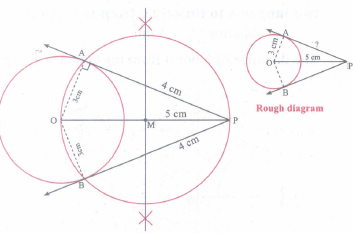
Length of the tangents PA = PB = 4 cm
Construction:
Steps:
(1) With centre O, draw a circle of radius 3cm.
(2) Draw a line OP = 5 cm
(3) Draw a bisector of OP, which cuts OP and M
(4) With M as centre and MO as radius draw a circle which cuts previous circle at A and B
(5) Join AP and BP. AP and BP are the required tangents. Thus length of the tangents are PA = PB = 4 cm.
46.
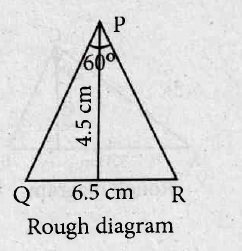
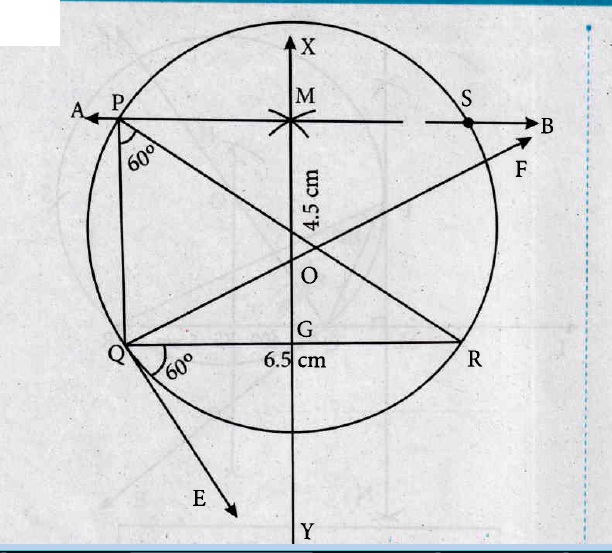
Construction:
Steps (1) Draw QR = 6.5 cm.
Steps (2) Draw \(\angle RQE={ 60 }^{ 0 }\)
Steps (3) Draw \(\angle FQE={ 90 }^{ 0 }\)
Steps (4) Drawn the perpendicular bisector XY to ER which intersects QF at O and ER at G.
Steps (5) With O as center and OQ as radius drawn a circle
Steps (6) XY intersects QR at G. On XY, from G marked an arc at M, such that GM = 4.5 cm
Steps (7) Drawn AB through M which is parallel to QR
Steps (8) AB meets the circle at P and S
Steps (9) Joined QP and RP Then \(\triangle\)PQR is the required triangle.
Steps (10) Here \(\triangle\)SQR is also another required triangle.

10th Standard Syllabus & Materials
10th Standard
TN 10th English Prose - 2 - The Night the Ghost Got in Important Questions And Answers Study Material - QB365 Set A
NEW10th Standard
TN 10th English Supplementary - 1 - The Tempest Important Questions And Answers Study Material - QB365 Set A
NEW10th Standard
TN 10th English Poem - 1 - Life Important Questions And Answers Study Material - QB365 Set A
NEW10th Standard
TN 10th English Prose - 1 - His First Flight Important Questions And Answers Study Material - QB365 Set A



Tamilnadu Stateboard 10th Standard Subjects
Tamilnadu Stateboard Standards





