
 100% FREE ACCESS
10th Standard Syllabus & Materials
10th Standard
TN 10th English Prose - 4 - The Attic Important Questions And Answers Study Material - QB365 Set A
NEW10th Standard
TN 10th English Supplementary - 3 - The Story of Mulan Important Questions And Answers Study Material - QB365 Set A
NEW10th Standard
TN 10th English Poem - 3 - I am Every Woman Important Questions And Answers Study Material - QB365 Set A
NEW10th Standard
TN 10th English Prose - 3 - Empowered Women Navigating The World Important Questions And Answers Study Material - QB365 Set A
NEW10th Standard
TN 10th English Supplementary - 2 - Zigzag Important Questions And Answers Study Material - QB365 Set A
NEW10th Standard
TN 10th English Poem - 2 - The Grumble Family Important Questions And Answers Study Material - QB365 Set A

Published on: 13/05/2020
10th Standard Maths English Medium Model Question Paper Part - V
Download Tamil Nadu 10th Standard Maths question papers, model tests, one-mark questions, important questions, and public exam papers in PDF format. Free study materials and answer keys for TN State Board students.
Questions + Answers key
Take MCQ Maths Test1.
Find the depth of a cylindrical tank of radius 28 m, if its capacity is equal to that of a rectangular tank of size 28 m x 16 m x 11 m.
2.
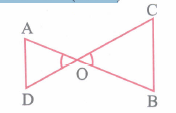
In figure OA· OB = OC·OD
Show that \(\angle A=\angle C\ and\ \angle B=\angle D\)
3.
The marks scored by 5 students in a test for 50 marks are 20, 25, 30, 35, 40. Find the S.D for the marks. If the marks are converted for 100 marks, find the S.D. for newly obtained marks.
4.
Using quadratic formula solve the following equations.
p2x2 + (P2 -q2) X - q2 = 0
5.
Find the LCM and HCF of 6 and 20 by the prime factorisation method.
6.
Show that the points (1, 7), (4, 2), (-1,-1) and (-4,4) are the vertices of a square.
7.
Determine the nature of the roots for the following quadratic equations
x2 - x - 1 = 0
8.
If the mean and coefficient of variation of a data are 15 and 48 respectively, then find the value of standard deviation.
9.
A road is flanked on either side by continuous rows of houses of height \( 4\sqrt { 3 } \)m with no space in between them. A pedestrian is standing on the median of the road facing a row house. The angle of elevation from the pedestrian to the top of the house is 30°. Find the width of the road.
10.
In an A.P. the sum of first n terms is \(\frac { { 5n }^{ 2 } }{ 2 } +\frac { 3n }{ 2 } \). Find the 17th term
11.
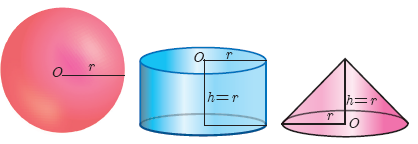
A sphere, a cylinder and a cone are of the same radius, where as cone and cylinder are of same height. Find the ratio of their curved surface areas.
12.
If f(x) = 2x + 3, g(x) = 1 - 2x and h(x) = 3x. Prove that f o(g o h) = (f o g) o h.
13.
Show that the function f: N ⟶ N defined by f(x) = 2x - 1 is one-one-one but not onto.
14.
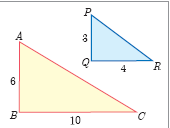
Is \(\triangle\)ABC ~ \(\triangle\)PQR?
15.
In \(\angle ACD={ 90 }^{ 0 }\) and \(CD\bot AB\) Prove that \(\cfrac { { BC }^{ 2 } }{ { AC }^{ 2 } } =\cfrac { BD }{ AD } \)
16.
Express cot 85° + cos 75° in terms of trigonometric ratios of angles between 0° and 45°.
17.
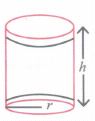
A wooden article was made by scooping out a hemisphere from each end of a cylinder as shown in figure. If the height of the cylinder is 10 cm and its base is of radius 3.5 cm find the total surface area of the article.
18.
C.V. of a data is 69%, S.D. is 15.6, then find its mean.
19.
Which of the following list of numbers form an AP ? If they form an AP, write the next two terms:
1, 1, 1, 2, 2, 2, 3, 3, 3
20.
A function f: (1,6) \(\rightarrow\)R is defined as follows:
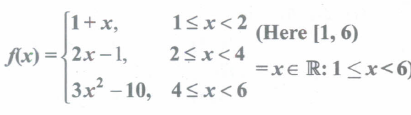
Find the value of f(5),
21.
Find the area of the triangle formed by the points P(-1, 5, 3), Q(6, -2) and R(-3, 4).
22.
If two dice are rolled, then find the probability of getting the product of face value 6 or the difference of face values 5.
23.
To a man standing outside his house, the angles of elevation of the top and bottom of a window are 60° and 45° respectively. If the height of the man is 180 cm and if he is 5 m away from the wall, what is the height of the window?(\( \sqrt { 3 } \) = 1.732)
24.
A right circular cylinder just enclose a sphere of radius r units. Calculate
(i) the surface area of the sphere
(ii) the curved surface area of the cylinder
(iii) the ratio of the areas obtained in (i) and (ii).
25.
A(1, -2) , B(6, -2), C(5, 1) and D(2, 1) be four points Find the slope of the line segment (a) AB (b) CD
26.
Find the GCD of each pair of the following polynomials
12(x4 - x3), 8(x4 - 3x3 + 2x2) whose LCM is 24x3 (x - 1) (x - 2)
27.
Show that the points P(-1, 5), Q(6, -2) , R(-3, 4) are collinear.
28.
Find the greatest number that will divide 445 and 572 leaving remainders 4 and 5 respectively.
29.
How many terms are there in the G.P : 5, 20, 80, 320,..., 20480
5
6
7
9
30.
IF the probability of the non-happening of a event is q, then the probability of happening of that event is
1-q
q
q/2
∝q
31.
32.
If (sin α + cosec α)2 + (cos α + sec α)2 = k + tan2α + cot2α, then the value of k is equal to
9
7
5
3
33.
34.
(1 + tan \(\theta \) + sec\(\theta \)) (1 + cot\(\theta \) - cosec\(\theta \)) is equal to
0
1
2
-1
35.
The value of (13 + 23 + 33 +...+153) - (1 + 2 + 3 +...+ 15)is
14400
14200
14280
14520
36.
A man walks near a wall, such that the distance between him and the wall is 10 units. Consider the wall to be the Y axis. The path travelled by the man is
x = 10
y = 10
x = 0
y = 0
37.
Two poles of heights 6 m and 11 m stand vertically on a plane ground. If the distance between their feet is 12 m, what is the distance between their tops?
13 m
14 m
15 m
12.8 m
38.
If \(\triangle\)ABC is an isosceles triangle with \(\angle\)C = 90o and AC = 5 cm, then AB is
2.5 cm
5 cm
10 cm
\(5\sqrt { 2 } \)cm
39.
The height and radius of the cone of which the frustum is a part are h1 units and r1 units respectively. Height of the frustum is h2 units and radius of the smaller base is r2 units. If h2 : h1 = 1:2 then r2 : r1 is
1:3
1:2
2:1
3:1
40.
Let A = {1, 2, 3, 4} and B = {4, 8, 9, 10}. A function f: A ⟶ B given by f = {(1, 4), (2, 8), (3, 9), (4,10)} is a
Many-one function
Identity function
One-to-one function
Into function
41.
42.
Graph of a linear equation is a ____________
straight line
circle
parabola
hyperbola
43.
Graph the following quadratic equations and state their nature of solutions.
x2 - 9 = 0
44.
Draw the graph of y = x2 + 3x - 4 and hence use it to solve x2 + 3x - 4 = 0
45.
Draw a circle of radius 4.5 cm. Take a point on the circle. Draw the tangent at that point using the alternate segment theorem.
46.
Draw a circle of diameter 6 cm from a point P, which is 8 cm away from its centre. Draw the two tangents PA and PB to the circle and measure their lengths.
1.
Volume of the cylindrical tank = Volume of the rectangle tank
πr2h = 28 x 16 x 11 m3

\(h=\frac { 16\times 11 }{ 88 } =2m\)
2.
OA· OB = OC . OD (Given)
so, \(\cfrac { OA }{ OC } =\cfrac { OD }{ OB } \)
Also we have 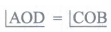
(vertically opposite angles) ...(2)
From (1) and (2)
\(\Delta AOD\sim \Delta COB\)( SAS similarity criterion)
So

(corresponding angles of similar triangles)
3.
Let assumed mean A = 30
C = 5
| x | d' = \(\frac { x-30 }{ 5 } \) | d'2 |
| 20 | -2 | 4 |
| 25 | -1 | 1 |
| 30 | 0 | 0 |
| 35 | 1 | 1 |
| 40 | 2 | 4 |
| Σd' = 0 | Σd'2 = 10 |
σ =\(\sqrt { \left( \frac { \Sigma d'^{ 2 } }{ n } \right) -\left( \frac { \Sigma d' }{ n } \right) ^{ 2 } } \) x c
=\(\sqrt { \frac { 10 }{ 5 } -0 } \) x 5
=\(\sqrt { 2 } \) x 5
= 5\(\sqrt { 2 } \)
To convert the values for 100, all the values will be multiplied by 2. Therefore the new values are 40, 50, 60, 70, 80.
Let A = 60, C = 10
| x | d' = \(\frac { x-60 }{ 10 } \) | d'2 |
| 40 | -2 | 4 |
| 50 | -1 | 1 |
| 60 | 0 | 0 |
| 70 | 1 | 1 |
| 80 | 2 | 4 |
σ =\(\sqrt { \left( \frac { \Sigma d'^{ 2 } }{ n } \right) -\left( \frac { \Sigma d' }{ n } \right) ^{ 2 } } \) x c
=\(\sqrt { \frac { 10 }{ 5 } -0 } \) x 10
=\(\sqrt { 2 } \) x 10
= 10\(\sqrt { 2 } \)
S.D. also be multiplied by 2. It is also true for the division also.
4.
p2x2 + (P2 -Comparing this with ax' + bx + c = 0, we have
a=p2
b=p2-q2
c =-q2
D = b2-4ac
= (P2-q2)-4xp2x-q2
= (P2-q2)2+ 4p2 q2
= (P2+q2)2>0
So, the given equation has real roots given by
\(\alpha =\frac { -b-\sqrt { D } }{ 2a } =\frac { -({ p }^{ 2 }-{ q }^{ 2 })+({ p }^{ 2 }+{ q }^{ 2 }) }{ { 2p }^{ 2 } } \)
\(=\frac { { q }^{ 2 } }{ { p }^{ 2 } } \)
\(\beta =\frac { -b-\sqrt { D } }{ 2a } =\frac { -({ p }^{ 2 }-{ q }^{ 2 })+({ p }^{ 2 }+{ q }^{ 2 }) }{ { 2p }^{ 2 } } \)
=-1
5.
We have 6 = 21 x 31 and
20 = 2 x 2 x 5 = 22 x 51
You can find HCF (6, 20) = 2 and LCM (6, 20) = 2 x 2 x 3 x 5 = 60.
As done in your earlier classes. Note that HCF (6, 20) = 21 = product of the smallest power of each common prime factor in the numbers.
LCM (6, 20) = 22 x 31 x 51 = 60.
= Product of the greatest power of each prime factor, involved in the numbers.
6.
Let A(1, 7), B(4, 2), C(-1, -1) and D(-4, 4) be the given paints. One way at showing that ABCD is a square is to use the property that all its sides should be equal and both its diagonals should be equal.
Now,
AB = \(\sqrt { (1-4)^{ 2 }+(7-4)^{ 2 } } =\sqrt { 9+25 } =\sqrt { 34 } \)
BC = \(\\ \sqrt { (4+1)^{ 2 }+(2+1)^{ 2 } } =\sqrt { 25+9 } =\sqrt { 34 } \)
CD = \(\sqrt { (-1+4)^{ 2 }+(-1-4)^{ 2 } } =\sqrt { 9+25 } =\sqrt { 34 } \)
DA =\(\sqrt { (1+4)^{ 2 }+(7-4)^{ 2 } } =\sqrt { 25+9 } =\sqrt { 34 } \)
AC = \(\sqrt { (1+1)^{ 2 }+(7+1)^{ 2 } } =\sqrt { 4+64 } =\sqrt { 68 } \)
BD = \(\\ \sqrt { (4+4)^{ 2 }+(2-4)^{ 2 } } =\sqrt { 64+4 } =\sqrt { 68 } \)
Since, AB = BC = CD = DA and AC = BD, all the four sides at the quadrilateral ABCD are equal and its diagonals AC and BD are also equal. Therefore, ABCD is a square.
7.
x2-x-1 = 0, Here a = 1, b = -1, c = -1
∆ = b2-4ac = (-1)2-4 x 1 x -1
= 1 + 4
= 5 > 0
∴ The roots are real and unequal
8.
Mean \(\bar x\) = 15
Coefficient of variation (C.V) = 48
Coefficient of variation C.V \(=\frac{\sigma}{x} \times 100 \%\)
\(48 =\frac{\sigma}{15} \times 100 \% \)
\(\frac{48 \times 15}{100} =\sigma \)
\(\sigma=\frac{36}{5}=7.2 \)
Standard deviation \(\sigma=7.2 \)
9.
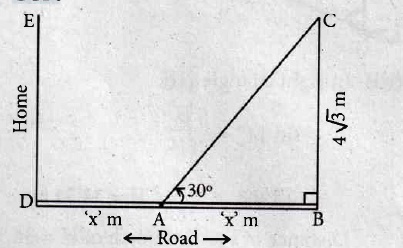
Let AB = x be the distance between foot of the house and the observer at the median of the road.
DB = 2x is the width of the road.
Height of the house BC = \(4 \sqrt{3} m\)
From the right triangle \(\triangle\) ABC
\(
\therefore \tan 30^{\circ} =\frac{B C}{A B}
\)
\(\frac{1}{\sqrt{3}}=\frac{4 \sqrt{3}}{x}
\)
\(x =4 \sqrt{3} \times \sqrt{3}=4 \times 3=12 \mathrm{~m}
\)
\(\text { Width of the road } =2 \times x=2 \times 12=24 \mathrm{~m}\)
Width of the road = 24 m.
10.
The 17th term can be obtained by subtracting the sum of first 16 terms from the sum of first 17 terms
\({ S }_{ 17 }=\frac { 5\times \left( 17 \right) ^{ 2 } }{ 2 } +\frac { 3\times 17 }{ 2 } =\frac { 1445 }{ 2 } +\frac { 51 }{ 2 } =748\)
\({ s }_{ 16 }=\frac { 5\times \left( 16 \right) ^{ 2 } }{ 2 } +\frac { 3\times 16 }{ 2 } =\frac { 1280 }{ 2 } +\frac { 48 }{ 2 } =664\)
Now, t17 = S17 - S16 = 748 - 664 = 84
11.
Required Ratio = C.S.A. of the sphere: C.S.A. of the cylinder : C.S.A. of the cone
\(4\pi { r }^{ 2 }:2\pi rh:\pi rl,\ (l=\sqrt { { r }^{ 2 }+{ h }^{ 2 } } =\sqrt { { 2r }^{ 2 } } =\sqrt { 2r } units)\)
\(=4:2:\sqrt { 2 } =2\sqrt { 2 } :\sqrt { 2 } :1\).
12.
f(x) = 2x + 3, g(x) = 1 - 2x, h(x) = 3x
Now, (f o g)(x) = f(g(x)) = f(1 - 2x) = 2(1 - 2x) + 3 = 5 - 4x
Then, (f o g) o h(x) = (f o g)(3x) = 5 - 4(3x) = 5 - 12x..(1)
(g o h)(x) = g(h(x)) = g(3x) = 1 - 2(3x) = 1 - 6x
So, f o (g o h)(x) = f(1 - 6x) = 2(1 - 6x) + 3 = 5 - 12x...(2)
From (1) and (2), we get (f o g) oh = f o (g o h)
13.
f: N ⟶ N
f(x) = 2x - 1
N = {1,2,3,4,5, ...}
When x = 1, f(1) = 2( 1) - 1 = 1
When x = 2, f(2) = 2(2) - 1 = 3
When x = 3, f(3) = 2(3) - 1 = 5
When x = 4, f(4) = 2(4) - 1 = 7
When x = 5, f(5) = 2(5) - 1 = 9
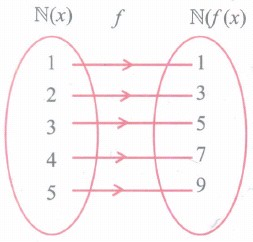
This function maps every element from the domain to element that is twice minus one the original. 2x - 1 is always an odd number when x\(\in\)N.
Clearly, each element from the domain is mapped to different element in the co-domain. So, the function is one-to-one. On the other hand, there are no elements in the domain that would map to even numbers. So, the function is not onto.
Hence f is one one but not onto.
14.
In Is \(\triangle\)ABC ~ \(\triangle\)PQR
\(\frac { PQ }{ AB } =\frac { 3 }{ 6 } =\frac { 1 }{ 2 } ;\frac { QR }{ BC } =\frac { 4 }{ 10 } =\frac { 2 }{ 5 } \)
Since \(\frac { 1 }{ 2 } \neq \frac { 2 }{ 5 } ,\frac { PQ }{ AB } \neq \frac { QR }{ BC } \)
The corresponding sides are not proportional.
Therefore \(\triangle\)ABC is not similar to \(\triangle\)PQR.
15.
\(\Delta ACD\sim \Delta ABC\)
So,
\(\cfrac { AC }{ AB } =\cfrac { AD }{ AC } \)
AC2 = AB ·AD
Similarly \(\Delta BCD\sim \Delta BAC\)
So,
\(\cfrac { BC }{ BA } =\cfrac { BD }{ BC } \)
BC2 = BA·BD
From (1) and (2)
\(\cfrac { { BC }^{ 2 } }{ AC^{ 2 } } =\cfrac { BA.BD }{ AB.AD } =\cfrac { BD }{ AD } \)
16.
cot 85° + cos 75°
= cot(90° - 5°) + cos(90° - 15°)
= tan 5° + sin 15°
17.
Radius of the cylinder be r
Height of the cylinder be h
Total surface area of the article
= CSA of cylinder + CSA of 2 hemispheres
= 2ㅠrh + 2πr2 = 2πr(h + 2r)
\(=2\times \frac { 22 }{ 7 } \times 3.5\times (10+2\times 3.5)\)
= 22 x 17 = 374 cm2
18.
CV =\(\frac { \sigma }{ \bar { x } } \) x 100 ⇒ \(\bar { x } =\frac { \sigma }{ CV } \) x 100
\(\bar { x } =\frac { 15.6 }{ 6.9 } \) x 100 = 22.6
19.
1,1,1,2,2,2,3,3,3
t2 - t1 = 1-1 = 0
t3 - t2 = 1-1 = 0
t4 - t3 = 2-1 = 1
Here t2 - t1 ≠ t3 - t2
ஃ It is not an A.P.
20.
F(5) = 3x2 - 10
= 3(5)2- 10 = 75 - 10 = 65
21.
The area of the triangle formed by the given points is equal to
= \(\frac { 1 }{ 2 } \) [-1.5 (-2 - 4) + 6 (4 - 3) + (-3) (3 + 2)]
= \(\frac { 1 }{ 2 } \) [9 + 6 - 15] = 0
We can have a triangle at area 0 square units? What does this mean?
If the area of a triangle is 0 square units, then its vertices will be collinear.
22.
Product of face values 6: { (1, 6), (2, 3), (6, 1), (3,2)}
Difference of face value 5: {(1, 6), (6, 1)}
P(product 6) = \(\frac { 4 }{ 6\times 6 } =\frac { 4 }{ 36 } =\frac { 1 }{ 9 } \)
p( difference 5) = \(\frac { 2 }{ 2\times 6 } =\frac { 1 }{ 18 } \)
23.
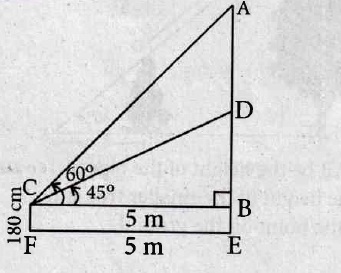
Let CF be the height of the man; AD be the height of the window; BC is the distance between the observer and the house.
From the right triangle \(\triangle\)CBD
\( \tan 45^{\circ} =\frac{D B}{B C} \)
\(1 =\frac{D B}{5} \)
DB = 5m ...(1)
From the right triangle CBA
\( \tan 60^{\circ} =\frac{A B}{C B} \)
\(\sqrt{3} =\frac{A D+D B}{5} \)
\(5 \sqrt{3} =\mathrm{AD}+5 \quad[\because \text { from }(1) D B=5 \mathrm{~m}] \)
\(\mathrm{AD} =5 \sqrt{3}-5=5(\sqrt{3}-1) \)
\(\mathrm{AD} =5(1.732-1) \)
\( {[\text {Given } \sqrt{3}=1.732] }\)
= 5 x 0.732 = 3.660
Height of the window = 3.66 m
24.
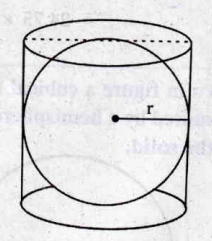
(i) Surface area of a sphere Radius of sphere = r
Surface area = 4r2 sq. units
(ii) Curved surface area of cylinder
Radius of cylinder = r
Height of cylinder = r + r = 2r
Curved surface area \(=2 \pi r h\ sq. units \)
\(=2 \pi r(2 \mathrm{r}) \)
\(=4 \pi r^{2} \text { sq. units } \)
(iii) Ratio of the areas \(=\frac{\text { Surface area of sphere }}{\text { CSA of cylinder }} \)
\(=\frac{4 \pi r^{2}}{4 \pi r^{2}}=\frac{1}{1} \)
Ratio = 1 : 1.
25.
(a) Slope of AB = \(\frac { { y }_{ 2 }-{ y }_{ 1 } }{ { x }_{ 2 }-{ x }_{ 1 } } =\frac { -2+2 }{ 6-1 } =0\)
(b) Slope of CD \(\frac { 1-1 }{ 2-5 } =\frac { 0 }{ -3 } =0\)
26.
Let f (x) = 12 (x4 - x3)
= 12x3 (x - 1)
g(x) = 8(x4- 3x3 + 2x2)
= 8x2 (x2 - 3x + 2)
= 8x2 (x - 1) (x - 2)
Given LCM = 24 x3 (x - 1) (x - 2)
We know f(x) x g (x) = LCM x GCD
\(\therefore \mathrm{GCD} =\frac{f(x) \times \mathrm{g}(\mathrm{x})}{L C M} \)
\(= \frac{12 x^{3}(x-1) \times 8 x^{2}(x-1)(x-2)}{24 x^{3}(x-1)(x-2)} \)
GCD = 4x2 (x - 1)
27.
The points are P(-1, 5, 3), Q(6, -2) , R(-3, 4)
Area of Δ PQR = \(\frac{1}{2}\) { (x1y2 + x2y3 + x3y1) - (x2y1 + x3y2 + x1y3) }
= \(\frac{1}{2}\) { (3 + 24 - 9) - (18 + 6 - 6) }
= \(\frac{1}{2}\) { 18 - 18 } = 0
Therefore, the given points are collinear.
28.
Since the remainders are 4, 5 respectively the required number is the HCF of the number 445 - 4 = 441, 572 - 5 = 567.
567 = 441 x 1 + 126
441 = 126 x 3 + 63
126 = 63 x 2 + 0
Therefore HCF of 441, 567 = 63 and so the required number is 63
29.
(c)
7
30.
(a)
1-q
31.
(b)
32.
(b)
7
33.
(d)
34.
(c)
2
35.
(c)
14280
36.
(a)
x = 10
37.
(a)
13 m
38.
(d)
\(5\sqrt { 2 } \)cm
39.
(b)
1:2
40.
(c)
One-to-one function
41.
(a)
42.
(a)
straight line
43.
x2-9=0
Let y=x2-9
Step 1:
| x | -4 | -3 | -2 | -1 | 0 | 1 | 2 | 3 | 4 |
| x2 | 16 | 9 | 4 | 1 | 0 | 1 | 4 | 9 | 16 |
| -9 | -9 | -9 | -9 | -9 | -9 | -9 | -9 | -9 | -9 |
| y=x2-7 | 7 | 0 | -5 | -8 | -9 | -8 | -5 | 0 | 7 |
Step 2:
The points to be plotted: (-4,7), (-3, 0), (-2, -5), (-1, -8), (0, -9), (1, -8), (2, -5), (3, 0), (4, 7)
(v) Real and equal roots
Step 3:
Draw the parabola and mark the co-ordinates of the parabola which intersect the x-axis.
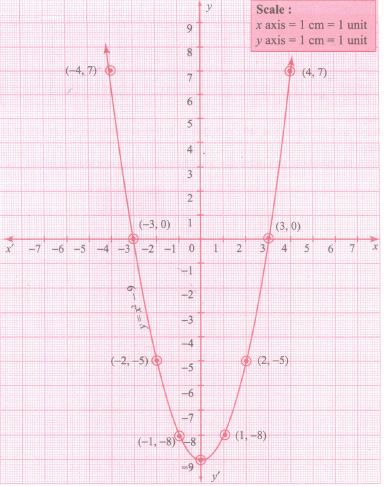
Step 4:
The roots of the equation are the co-ordinates of the intersecting points (-3, 0) and (3, 0) of the parabola with the x-axis which are -3 and 3 respectively.
Step 5:
Since there are two points of intersection with the x axis, the quadratic equation has real and unequal roots.
∴ Solution{-3, 3}
44.
y=x2+3x-4
| x | -4 | -3 | -2 | -1 | 0 | 1 | 2 | 3 | 4 |
| x2 | 16 | 9 | 4 | 1 | 0 | 1 | 4 | 9 | 16 |
| 3x | -12 | -9 | -6 | -3 | 0 | 3 | 6 | 9 | 12 |
| -4 | -4 | -4 | -4 | -4 | -4 | -4 | -4 | -4 | -4 |
| y=x2+3x-4 | 0 | -4 | -6 | -6 | -4 | 0 | 6 | 14 | 24 |
Draw the parabola using the points (-4, 0), (-3, -4), (-2, -6), (-1, -6), (0, -4), (1, 0), (2, 6), (3, 14), (4,24).
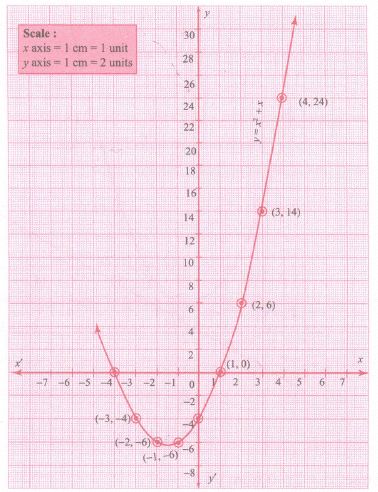
To solve: X2 + 3x - 4 = 0 subtract X2 + 3x - 4 = 0 from y = X2 + 3x - 4
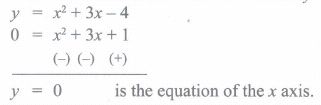
The points of intersection of the parabola with the x axis are the points (-4, 0) and (1, 0), whose x - co-ordinates (-4, 1) is the solution, set for the equation X2 + 3x - 4 = 0.
45.
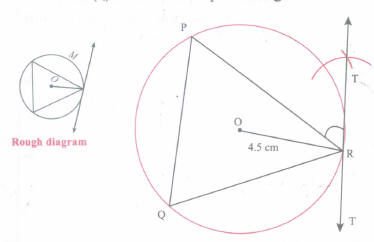
Construction:
(1) With O as the centre, draw a circle of radius 4.5 cm.
(2) Taken a point L on the circle through L drawn as chord LM
(3) Taken a point M distinct from L and N on the circle so that L, M, N are anti-clock wise direction. Joined LN and NM.
(4) Through 'L' drawn a tangent TT' such that \(\angle T L M=\angle M N L\)
(5) TT' is the required tangent.
46.
Given, diameter (d) = 6 cm, we find radius \((r)=\cfrac { 6 }{ 2 } =3cm\)
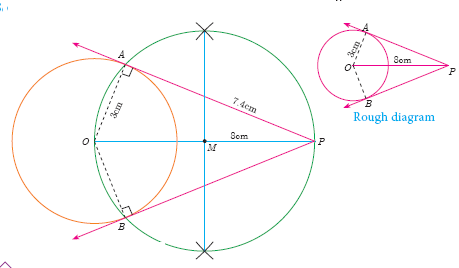
Construction
Step 1: With centre at O, draw a circle of radius 3 cm.
Step 2: Draw a line OP of length 8 cm.
Step 3: Draw a perpendicular bisector of OP, which cuts OP at M.
Step 4: With M as centre and MO as radius, draw a circle which cuts previous circle at A and B.
Step5: Join AP and BP. AP and BP are the required tangents. Thus length of the tangents are PA = PB = 7.4 cm.
Verification : In the right angle triangle OAP,PA2 = OP2 - OA2 = 64 -9 = 55
\(PA=\sqrt { 55= } 7.4\ cm\) (approximately) .

10th Standard Syllabus & Materials
10th Standard
TN 10th English Prose - 2 - The Night the Ghost Got in Important Questions And Answers Study Material - QB365 Set A
NEW10th Standard
TN 10th English Supplementary - 1 - The Tempest Important Questions And Answers Study Material - QB365 Set A
NEW10th Standard
TN 10th English Poem - 1 - Life Important Questions And Answers Study Material - QB365 Set A
NEW10th Standard
TN 10th English Prose - 1 - His First Flight Important Questions And Answers Study Material - QB365 Set A



Tamilnadu Stateboard 10th Standard Subjects
Tamilnadu Stateboard Standards





